Disclosure: airfryerkitchensupply.com is reader-supported. When you buy through links on our site, we may earn an affiliate commission at no extra cost to you.
Where to buy
A vertical propane smoker is one of the few barbecue purchases where the fuel itself is the feature: a standard backyard propane tank, a burner at the bottom of a tall cabinet, and racks stacked above a water pan. Every pick below that carries a link was confirmed against Amazon listing for this site, so the link lands on the actual cabinet and not on a cover, a replacement rack or a bottle of sauce wearing the same brand name.
- Masterbuilt 40-inch ThermoTemp Propane Smoker MB20051316 (Best Overall) — check price on Amazon
- Dyna-Glo DGY784BDP 36-inch Vertical LP Gas Smoker (Best for Whole Brisket) — check price on Amazon
- Masterbuilt MPS 230S Propane Smoker 30-inch (Best for Beginners) — check price on Amazon
- Masterbuilt GS30D Propane 2-Door Smoker (Best Two-Door Design) — check price on Amazon
- Pit Boss 3-Series Propane Gas Vertical Smoker (Best Modern Cabinet) — check price on Amazon
- PIQUEBAR Propane Smoker with Cover, 3 Racks (Best Budget) — check price on Amazon
If you are shopping for the best vertical propane smokers, you are really shopping for control without babysitting. A vertical propane smoker stacks the food in a tall cabinet above a gas burner, a wood chip tray and a water pan, so heat and smoke rise through the racks the way they do in a much more expensive cooker, while a valve — not a pile of charcoal — decides how hot the cabinet runs. That combination is why propane cabinets keep winning over beginners and busy cooks: you light it, set it, and spend the afternoon doing something other than feeding a fire.
The honest state of this market matters before any pick list. The vertical propane category has shrunk. Several famous nameplates have been discontinued, some listings that look like smokers are actually just covers or spare grates, and a handful of no-name cabinets have flooded in with thin steel and optimistic descriptions. The six picks below are the cabinets that survive a simple test: a real, verifiable product, a burner and layout that suit the tall-cabinet format, and a size that matches a recognisable job — family ribs, whole packer briskets, jerky batches, or a small patio footprint.
Read the badges as jobs, not rankings. The best cabinet for a brisket is not the best cabinet for a first summer of ribs, and the cheapest way into propane smoking is not the cabinet you will still be happy with in three years.
In this guide
Quick Picks
Six cabinets, six different jobs. Start here if you want the short answer, then read the full reviews for the trade-offs that decide between them.
- Masterbuilt 40-inch ThermoTemp Propane Smoker MB20051316 — Best Overall. The big Masterbuilt cabinet with a thermostat-style control brief: set a temperature and let the burner cycle to hold it, across the largest cooking area in this roundup. — Check on Amazon
- Dyna-Glo DGY784BDP 36-inch Vertical LP Gas Smoker — Best for Whole Brisket. A long-running 36-inch cabinet whose rack layout suits full-length briskets and ribs laid flat, with a burner setup owners have understood for years. — Check on Amazon
- Masterbuilt MPS 230S Propane Smoker 30-inch — Best for Beginners. The classic 30-inch starter cabinet: simple valve control, a manageable footprint and enough room to learn on ribs, chickens and pork shoulders. — Check on Amazon
- Masterbuilt GS30D Propane 2-Door Smoker — Best Two-Door Design. A two-door 30-inch cabinet: the lower door services chips and water without opening the cooking chamber and dumping your heat and smoke. — Check on Amazon
- Pit Boss 3-Series Propane Gas Vertical Smoker — Best Modern Cabinet. The newest-generation cabinet here: four racks, the largest stated cooking area of the group and a modern controller brief from a brand built on pellet grills. — Check on Amazon
- PIQUEBAR Propane Smoker with Cover, 3 Racks — Best Budget. The budget-tier way in: a simple three-rack vertical propane cabinet that ships with a cover, for buyers testing whether propane smoking suits them. — Check on Amazon
How These Picks Were Chosen
These picks were chosen from the vertical propane cabinets that could be verified as real, current products: the listing title had to describe the cabinet itself, in the right size class, from the brand named. Listings that turned out to be covers, grates or chip trays were rejected even when the search result wore the right brand name — that trap caught at least one famous brisket cabinet during research for this guide, and it is written up honestly in the brisket companion piece rather than linked here.
Beyond verification, four criteria did the sorting. First, burner and temperature control: a propane cabinet lives or dies on how steadily it holds low smoking temperatures on a windy day. Second, cabinet integrity: door seals, latch quality and steel weight decide how much heat and smoke leak away. Third, layout honesty: rack count means little if the racks are too narrow for the food the cabinet claims to cook. Fourth, running practicality: how the chip tray loads, whether the water pan is reachable, and how the cabinet behaves across a six-to-ten-hour cook. Price was never printed and never used as a proxy for quality; tiers are described in words, because listing prices move and a stale number helps nobody.
The 6 Best Vertical Propane Smokers

Masterbuilt 40-inch ThermoTemp Propane Smoker MB20051316 — Best Overall
The ThermoTemp is the pick for the cook who wants propane’s convenience to feel as hands-off as an electric smoker without giving up real wood smoke. Its defining idea is thermostatic control: instead of a bare valve you nudge by feel, the burner is governed to hold the temperature you set, which flattens the learning curve on long cooks and takes the worst of the wind-and-weather swings out of the equation. The 40-inch cabinet is the roomiest in this guide, with space arranged for full racks and large cuts rather than for impressive-sounding rack counts.
In practice this is the cabinet for brisket-and-ribs weekends, holiday turkeys and anyone cooking for a crowd a few times a year. The trade is size and appetite: a bigger cabinet burns more propane to heat empty air on a two-rack Tuesday, and it needs a proper home on the patio rather than a corner. If most of your cooks are big, that trade is obviously worth it. If most are small, the 30-inch Masterbuilt below is the smarter buy.
Strengths
- Thermostatic temperature control removes most burner babysitting on long cooks
- Largest cooking area in this roundup, sized for full packer briskets and party batches
- Tall cabinet layout keeps big cuts away from direct burner heat
Trade-offs
- Oversized for small weeknight cooks and burns fuel heating empty space
- Needs a dedicated, level patio spot and a cover to live outdoors
- Heavier and less portable than the 30-inch class
| Detail | What to know |
|---|---|
| Cooking area | 960 square inches (per Amazon listing title) |
| Control | Analog temperature control with thermostatic burner (per Amazon listing title) |
| Format | 40-inch vertical propane cabinet |
Check on Amazon — check the current price on Amazon before you decide, because bundle contents and included accessories change between listings.
Best for: crowd cooks and brisket weekends who want set-and-hold temperatures / Not suited for: small households cooking two racks at a time
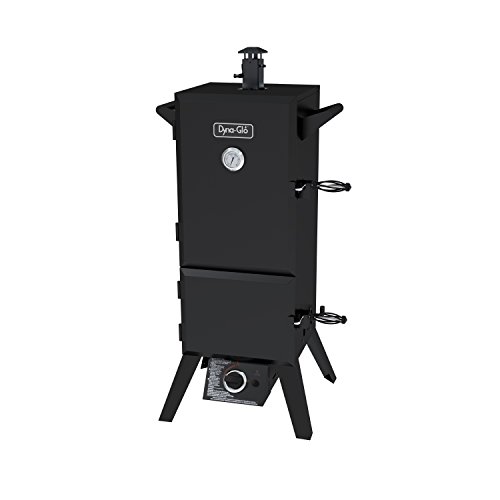
Dyna-Glo DGY784BDP 36-inch Vertical LP Gas Smoker — Best for Whole Brisket
The Dyna-Glo 36-inch is the veteran of this list: a straightforward vertical LP cabinet that has been sold for years, which matters more than novelty in a category full of short-lived listings. Its racks are the story for brisket cooks — the cabinet is laid out so a full packer can lie flat without the fold-over-the-can trick that smaller cabinets force on you, and the vertical stack lets you run a brisket low in the cabinet with ribs or a pork shoulder above it.
It is a more manual smoker than the ThermoTemp. You are the thermostat, which experienced cooks often prefer and beginners should walk into knowingly: expect a learning period of valve adjustments, door thermometer scepticism and one sacrificial cook before a brisket. In exchange you get a simple, repairable machine with no electronics to fail, at a mid-range tier position. For a buyer whose first question is ‘will a whole brisket fit properly?’, this is the most direct answer in the guide.
Strengths
- Rack layout fits a whole packer brisket flat, without folding or trimming to squeeze
- Simple manual burner with nothing electronic to fail mid-cook
- Long production run means parts, covers and owner knowledge are easy to find
Trade-offs
- Manual control demands attention on windy days and overnight cooks
- Door thermometer should be treated as a rough guide, not a measurement
- Seals benefit from the usual owner tweaks before serious low-and-slow work
| Detail | What to know |
|---|---|
| Format | 36-inch vertical LP gas smoker (per Amazon listing title) |
| Finish | Black powder coat (per Amazon listing title) |
Check on Amazon — check the current price on Amazon before you decide, because bundle contents and included accessories change between listings.
Best for: brisket-first buyers who prefer simple manual control / Not suited for: cooks who want thermostatic set-and-forget running

Masterbuilt MPS 230S Propane Smoker 30-inch — Best for Beginners
The MPS 230S is where a generation of propane smokers started, and it remains the easiest recommendation for a first cabinet. Thirty inches is the friendly size class: big enough for whole chickens, several racks of ribs cut or curved, and a pork shoulder with room to spare, small enough that heating it does not feel wasteful and storing it does not require a garage negotiation. The control scheme is a simple burner valve, which teaches a beginner how a propane cabinet actually behaves — a genuinely useful education.
Its limits are the limits of its class. A full packer brisket is a squeeze that demands trimming or folding, the cabinet is light enough that wind moves its temperature around, and long cooks will have you checking the chip tray and water pan on a schedule. None of that disqualifies it as a starter; all of it explains why keen cooks eventually graduate to the 36- or 40-inch cabinets above. Buy it to learn, and it will teach you exactly which bigger cabinet you actually need.
Strengths
- Friendly 30-inch size that suits most family cooks without wasting fuel
- Simple controls make it an ideal first propane smoker to learn on
- Compact footprint fits smaller patios and stores easily
Trade-offs
- Full packer briskets need trimming or folding to fit
- Light cabinet feels wind and weather more than the bigger models
- Chip tray and water pan need regular attention on long cooks
| Detail | What to know |
|---|---|
| Format | 30-inch propane smoker (per Amazon listing title) |
Check on Amazon — check the current price on Amazon before you decide, because bundle contents and included accessories change between listings.
Best for: first-time propane smokers cooking ribs, chicken and shoulders / Not suited for: whole-brisket specialists or crowd cooking

Masterbuilt GS30D Propane 2-Door Smoker — Best Two-Door Design
The GS30D answers the most practical complaint about vertical cabinets: every time you open the main door to add chips or water, the cook you spent an hour building escapes. Its two-door layout separates the firebox chores from the food chamber, so mid-cook servicing costs you far less heat and smoke. For jerky, fish and other cooks where you check and tend often, that is not a gimmick — it is the difference between a stable cabinet and a yo-yo.
The design’s cost is complexity in a small cabinet: two doors mean two seals to keep honest, and the 30-inch chamber inherits the same brisket squeeze as the MPS 230S. Treat it as the tending-friendly alternative in the starter class. If your cooking style is ‘set it at breakfast, slice it at dinner’, the single-door models serve you as well; if you are a fiddler, a jerky maker or a fish smoker, the GS30D’s layout was drawn for you.
Strengths
- Separate lower door for chips and water preserves chamber heat and smoke
- Well suited to jerky, fish and other frequently tended cooks
- Same manageable 30-inch footprint as the starter class
Trade-offs
- Two doors mean two seals to maintain
- Chamber still too small for an untrimmed packer brisket laid flat
- Fewer current listings than the single-door Masterbuilt models
| Detail | What to know |
|---|---|
| Format | Propane 2-door smoker (per Amazon listing title) |
Check on Amazon — check the current price on Amazon before you decide, because bundle contents and included accessories change between listings.
Best for: jerky, fish and hands-on cooks who tend the firebox often / Not suited for: set-and-forget brisket cooks wanting maximum chamber size

Pit Boss 3-Series Propane Gas Vertical Smoker — Best Modern Cabinet
Pit Boss came to vertical propane from pellet grills, and the 3-Series shows it: this is the most current-feeling cabinet in the guide, with four racks, a stated cooking area that leads the class and a controller-led approach to burner management. For buyers who already own a Pit Boss pellet grill and like the brand’s way of doing things, it is the natural second cooker — propane’s instant heat and real chip smoke alongside the pellet rig’s set-and-forget personality.
As the newest design here it carries the usual early-adopter homework: check exactly which controller features the current listing includes, and expect the owner community to be smaller than Masterbuilt’s decade-deep forums. The cabinet itself makes a strong case on layout — four genuine racks in a propane cabinet is party capacity, and the wood chip tray arrangement suits cooks who reload smoke often. If you value current design over long track record, this is your pick.
Strengths
- Four racks and class-leading stated cooking area for batch cooking
- Modern controller approach from a major grill brand
- Strong layout for cooks who reload wood chips frequently
Trade-offs
- Newer design with a smaller long-term owner track record
- Feature set varies by listing revision — verify what the current unit includes
- Party-sized cabinet is more than small households need
| Detail | What to know |
|---|---|
| Cooking area | 983 sq in, 4 racks (per Amazon listing title) |
| Control | HVR controller with wood chip tray (per Amazon listing title) |
Check on Amazon — check the current price on Amazon before you decide, because bundle contents and included accessories change between listings.
Best for: batch cooks and Pit Boss owners adding a propane cabinet / Not suited for: buyers who want a decade of owner history behind the model

PIQUEBAR Propane Smoker with Cover, 3 Racks — Best Budget
Every category needs an honest budget door, and this three-rack cabinet is it. The proposition is simple: a vertical propane cabinet with removable racks and a cover in the box, at the budget tier of this market, for the buyer who is not yet sure propane smoking is their hobby. Ribs, chicken pieces, sausages, peppers and cheese all cook perfectly well in a simple cabinet, and a season on this machine will teach you more about what you want next than any review can.
Honesty about the tier matters. Budget cabinets use lighter steel, simpler seals and plainer hardware than the Masterbuilt and Dyna-Glo models above; temperature will wander more in wind, and longevity is measured in seasons of regular use rather than in decades. That is an acceptable trade at the price of admission — as long as you walk in expecting a starter instrument, not a lifetime one. If you already know you will smoke monthly for years, skip this tier and start at the MPS 230S or above.
Strengths
- Lowest-cost route into vertical propane smoking
- Cover included in the box for outdoor storage
- Three removable racks cover everyday family smoking jobs
Trade-offs
- Lighter build and simpler seals than the established brands
- Temperature stability suffers more in wind and cold
- A starter instrument, not a buy-it-for-life cabinet
| Detail | What to know |
|---|---|
| Format | Vertical propane smoker, 3 removable racks, cover included (per Amazon listing title) |
Check on Amazon — check the current price on Amazon before you decide, because bundle contents and included accessories change between listings.
Best for: curious beginners testing propane smoking on a budget / Not suited for: frequent cooks who need stability and longevity
Comparison Table
| Pick | Badge | Key spec | Best for |
|---|---|---|---|
| Masterbuilt 40-inch ThermoTemp Propane Smoker MB20051316 | Best Overall | 960 sq in, thermostatic control | crowd cooks and brisket weekends who want set-and-hold temperatures |
| Dyna-Glo DGY784BDP 36-inch Vertical LP Gas Smoker | Best for Whole Brisket | 36-inch cabinet, brisket-friendly racks | brisket-first buyers who prefer simple manual control |
| Masterbuilt MPS 230S Propane Smoker 30-inch | Best for Beginners | 30-inch starter cabinet | first-time propane smokers cooking ribs, chicken and shoulders |
| Masterbuilt GS30D Propane 2-Door Smoker | Best Two-Door Design | Two-door 30-inch cabinet | jerky, fish and hands-on cooks who tend the firebox often |
| Pit Boss 3-Series Propane Gas Vertical Smoker | Best Modern Cabinet | 983 sq in, 4 racks, HVR controller | batch cooks and Pit Boss owners adding a propane cabinet |
| PIQUEBAR Propane Smoker with Cover, 3 Racks | Best Budget | 3 racks, cover included, budget tier | curious beginners testing propane smoking on a budget |
How to Choose a Vertical Propane Smoker
Start with the food, not the cabinet. Write down the three cooks you will actually do most — for most households that is ribs, whole chicken and pork shoulder — and the one celebration cook you dream about, which is usually a whole brisket. The everyday cooks decide your minimum size; the celebration cook decides whether you need the 36- or 40-inch class. Cabinets are honest about fitting food only in one direction: rack width. A rack of spare ribs and a packer brisket both care about the longest straight line inside the cabinet, so compare rack dimensions, not the headline cooking area, which can be inflated by counting small racks you will rarely use.
Next, decide how much of a thermostat you want to be. Manual-valve cabinets like the Dyna-Glo and the MPS 230S reward attention and punish neglect; thermostatic and controller-led cabinets like the ThermoTemp and the Pit Boss flatten the curve at the cost of more parts. Neither is better in the abstract. A cook who enjoys tending will be bored by automation and suspicious of it; a cook with kids, guests and a lawn to mow will bless a cabinet that holds temperature alone. Be honest about which cook you are on a Saturday with people coming at six.
Then inspect the unglamorous parts. Door latches that pull the door tight, a chip tray you can service without wearing welding gloves, a water pan that slides rather than tips, and legs or wheels that suit your patio surface will decide your happiness more often than burner specifications. Finally, plan the whole purchase: a cover, a reliable dual-probe thermometer, a spare tank and a regulator-and-hose check belong in the same budget conversation as the cabinet itself.
Propane Cabinet Sizes, Explained in Food
The 30-inch class is the family size. It swallows whole chickens, shoulders and cut racks of ribs, heats quickly and sips propane. Its ceiling is the untrimmed packer brisket and the true party batch, where you will find yourself playing rack Tetris. The 36-inch class is the enthusiast size: briskets lie flat, ribs run uncut, and a brisket-plus-shoulder combination cook becomes routine rather than heroic. The 40-inch class is the crowd size, built for holidays, team lunches and anyone who smokes for freezing and gifting; its cost is fuel appetite on small cooks and a permanent patio address.
Rack count deserves scepticism in every class. Four shallow racks can hold less usable food than three deep ones, because smoking needs air gaps: food packed edge to edge steams its neighbours and blocks the smoke path the vertical design exists to create. When you compare cabinets, imagine your actual largest cook loaded with an inch of breathing room around each piece. The cabinet that fits that picture is your size, whatever the marketing area figure says.
Burners, Wind and the Truth About Low Temperatures
A propane cabinet’s party trick — instant, adjustable heat — is also its weakness at smoking temperatures. The burner must run low and steady for hours, and wind stripping heat from a light cabinet will have a manual valve chasing its tail. Three defences matter. Cabinet mass and seal quality slow the swings. Placement is free performance: a corner sheltered from the prevailing wind, out of direct weather, transforms stability more than any accessory. And a water pan filled and maintained is not just moisture — it is thermal ballast that damps the spikes when the burner cycles or the door opens.
Ignore the dial thermometer in the door as anything but a rough mood indicator; door metal and rack level can disagree by a margin that matters to brisket. A dual-probe thermometer — one probe at rack level, one in the food — is the single upgrade that improves every cook in this guide, and it costs less than one ruined packer. Judge every cabinet in this roundup by how it performs with that thermometer watching, not by the number printed on its lid.
How to Set Up and Run a Vertical Propane Smoker for the First Time
Assemble the cabinet on the surface it will live on, check it sits level, and wash the racks and water pan before any food goes near them. Connect the regulator to a full propane tank, open the tank valve slowly, and leak-check every connection with soapy water: growing bubbles mean stop, tighten or replace, and never cook on a connection you have not checked. Season the cabinet before its first real cook — a light wipe of cooking oil on the interior, then a medium-heat run with wood chips for a couple of hours burns off manufacturing residue and lays down the first protective smoke film.
For a cook, the rhythm is: fill the water pan, load the chip tray without packing it tight, preheat the cabinet to your target with the door closed, and only then load food, working quickly. Bring the cabinet back to temperature and resist opening the door for the first hour; vertical cabinets forgive a lot, but every peek costs heat and smoke. Service chips and water on a schedule rather than on curiosity — through the lower door if your cabinet has one. When the cook ends, close the tank valve first, let the burner consume the line, then close the cabinet controls, and clean the water pan the same day: it is the one chore that is genuinely unpleasant tomorrow.
Store the cabinet covered, the tank valve closed, and the hose and regulator protected from weather and insects. Once a season, inspect the burner ports for rust and blockage and clear them gently; a lazy, yellow, lifting flame is the cabinet asking for that attention before your next brisket does.
Common Buying Mistakes
Buying by headline cooking area. Area figures count every rack at full density, which is not how smoke moves. Rack width and usable depth decide what fits; check those against a brisket and a full rack of ribs.
Trusting the door thermometer with a brisket. A packer is too expensive to cook by a dial in a hot door. A rack-level probe is not an accessory in this category; it is part of the smoker.
Opening the door to admire the food. Vertical cabinets hold a fragile column of heat and smoke. Every admiring peek resets the clock. Cook by probe and by schedule, not by looking.
Packing the chip tray tight or soaking chips into soup. Smouldering needs air. A loosely filled tray of dry chips gives cleaner smoke than a compressed, soaked brick that steams and sputters.
Running out of propane at hour seven. The classic vertical-cabinet heartbreak. Weigh or gauge the tank before long cooks and keep a spare for anything overnight.
Leaving the water pan to become a science project. A neglected pan breeds smells that season the next cook in the worst way. Empty, wash and dry it the day you cook.
Final Recommendation
For most buyers, the Masterbuilt ThermoTemp is the recommendation: thermostatic control and the biggest cabinet make it the easiest propane smoker to live with across the widest range of cooks. Brisket-first buyers who prefer mechanical simplicity should take the Dyna-Glo 36-inch and its flat-fitting racks. Beginners start happily at the MPS 230S, frequent tenders should look at the two-door GS30D, batch cooks at the Pit Boss 3-Series, and the genuinely undecided can test the hobby on the budget PIQUEBAR cabinet without regret.
Whichever cabinet you choose, spend the thermometer money, shelter it from wind, and give it one practice cook before it matters. A vertical propane smoker rewards exactly that modest amount of respect with years of unhurried barbecue.
Keep exploring the cluster: Best Vertical Smokers Best Charcoal Vertical Smokers Best Vertical Electric Smokers Best Built Vertical Propane Smokers Best Vertical Smokers Whole Brisket
Wood Choice in a Propane Cabinet: Chips, Chunks and Smoke Quality
Propane provides the heat, but wood provides the identity, and in a vertical cabinet the wood works under specific conditions: a chip tray sitting over a burner, smouldering rather than flaming, inside a tall column of rising air. That environment rewards dry chips in a loose layer — enough surface to smoulder steadily, enough air to keep the smoke thin and pale rather than thick and white. Thick white smoke is the beginner’s trophy and the experienced cook’s warning: it carries the bitter, acrid compounds that make meat taste like an ashtray’s opinion. What you want is the near-invisible blue-tinged smoke of clean smouldering, and the patience to let the cabinet reach it before food goes on.
Species choice is seasoning by other means. Hickory is the assertive classic for pork and brisket, mesquite is stronger still and best used in short exposures or blends, oak is the steady middle that suits almost everything, and the fruitwoods — apple, cherry, pecan’s gentler cousins — flatter poultry, fish and cheese, where a heavy smoke bullies delicate flesh. In a propane cabinet, where smoke generation is steadier and less intense than a charcoal fire’s, cooks often reach one step bolder in species than they would over coals, and blend: oak for the long base note, hickory for the first hour’s statement, fruitwood when the food is fragile.
Timing matters as much as species. Meat takes smoke most readily while it is cold and its surface is moist, which is the first hours of the cook; after the bark sets and the surface dries, additional smoke contributes progressively less flavour and progressively more risk of bitterness. The practical rhythm for a cabinet cook is therefore front-loaded: full, clean smoke early, a service of the chip tray once or twice as it exhausts, and indifference to smoke in the final third, when the cook is about temperature and tenderness. Cooks who chase smoke to the last minute produce the harsh edge that gives propane smoking an undeserved reputation; cooks who front-load it produce barbecue that charcoal loyalists praise before they ask what cooked it.
Propane Cabinet Maintenance: The Seasonal Hour That Saves the Smoker
A vertical propane smoker asks for little, but what it asks for is specific. The burner’s ports — the row of small holes where gas meets air — clog with rust, grease aerosol and the occasional insect’s housing project, and a clogged port announces itself as a lazy yellow flame, uneven cabinet temperatures and a burner that pops when lit. The seasonal fix is gentle: burner removed, ports cleared with a soft brush or the correct-sized wire, the venturi tube checked for obstructions, and everything reassembled with the patience of someone who does not want to do it twice. Never enlarge a port; a burner is a calibrated instrument wearing overalls.
The cabinet itself wants cleaning in layers. Racks and the water pan are kitchen cleaning — hot water, degreaser, a brush, the day of the cook rather than the week after. The interior walls want restraint: the dark, seasoned film on a smoker’s walls is not dirt, it is the accumulated patina that stabilises temperatures and contributes to the house flavour, and it should be scraped of flakes and grease pools but never scoured back to bright metal. The grease that matters is the liquid kind, pooled in the bottom and around the burner, because that is a fire risk and a rancid-flavour factory; wipe it out after fatty cooks while the cabinet is still warm enough to make the job easy.
The gas path wants an annual audit: hose inspected for cracks and stiffness, regulator connections leak-tested with soapy water, the tank valve exercised, and the whole assembly stored with the hose protected from weather and rodents, both of which eat rubber with conviction. Do this hour once a season and a propane cabinet will outlast several grills. Skip it for years and the cabinet will choose its own moment to teach the lesson — historically, that moment is the morning of a brisket, with guests already invited.
Vertical Propane vs Electric vs Charcoal Cabinets: Choosing Your Fuel Honestly
The vertical cabinet is a shape; the fuel is a personality, and buyers serve themselves best by choosing the personality they will still enjoy in year three. Propane’s personality is immediacy: instant light, fast recovery after the door opens, strong heat authority in cold weather, and real wood smoke from a chip tray — balanced against tank management, wind sensitivity in light cabinets and a burner to maintain. For cooks who smoke in winter, cook large cuts and value responsive control, propane is the working choice, which is why this guide exists.
Electric cabinets trade that authority for serenity: the steadiest temperatures in the category, the simplest operation, and smoke that is gentler and less complex, from chips smouldering on an element rather than over a flame. They suit fish, cheese, jerky and the set-and-forget cook beautifully, and they struggle where propane strides — raw heat in deep cold, and the deepest smoke ring theatre. Charcoal cabinets and drums offer the fullest traditional flavour and the fullest workload: fire building, ash, temperature by vent craft, and results that purists defend at length, earned honestly every time.
The mature answer most experienced cooks arrive at is that fuel choice is a calendar choice. The cook with Saturdays, patience and a purist streak belongs to charcoal. The cook with a family schedule, a winter smoking habit and a brisket ambition belongs to propane — with a probe thermometer, a sheltered corner and a spare tank. The cook whose smoking is mostly delicate, frequent and unattended belongs to electric. None of these cooks is wrong, and each will produce barbecue the others respect, because in the end the cabinet matters less than the cook’s honesty about the life the cabinet must fit.
Temperature Mapping: Learning Your Cabinet’s Hot Spots
No two cabinets cook identically, even off the same production line, and the cooks who get consistent results are the ones who have mapped theirs. The mapping exercise is simple and costs one cheap cook: run the cabinet at your usual smoking temperature with probes at several rack positions — or with plain white bread slices laid across each rack, toasted by the cabinet’s own heat into a visible map of its hot and cool zones. The bread test is old, unglamorous and revelatory: the dark slices mark where briskets will cook faster and ribs will crisp sooner, and the pale corners mark where the chicken should not spend its final hour.
With the map known, loading becomes strategy. Delicate foods live in the cool zones, robust cuts take the hot spots, and a single mid-cook rotation — planned, quick, done once — evens out what placement could not. Write the map down and tape it inside the cabinet door or the cover; a smoker’s personality, documented, stops being a variable and becomes a feature. This is also why borrowing another owner’s exact settings so often disappoints: their cabinet’s map is not yours, and the valve mark that holds their temperature in their sheltered yard will wander in your windy one. Learn your own cabinet and the recipes of others become useful again, translated through knowledge instead of copied through hope.
Cooking for a Crowd in a Vertical Cabinet: Sequencing the Day
A vertical cabinet’s party trick is verticality itself — different foods at different heights, entering and leaving on different schedules, all sharing one column of heat and smoke. Sequencing is what turns that trick into a menu. Long cooks anchor the day: the brisket or shoulder goes on first, low in the cabinet where the heat is steadiest, and everything else is scheduled backwards from its rest. Ribs join with hours to spare, chicken later and higher where it can crisp, and the quick citizens — sausages, peppers, corn, a pan of beans catching drips beneath the meat — fill the final hour’s gaps like guests arriving exactly when the party needs them.
The disciplines that make it work are temperature honesty and door economy. A loaded cabinet cooks slower than an empty one and recovers slower from every opening, so the crowd cook plans door events the way a pilot plans altitude changes: rarely, purposefully, with everything staged before the door moves. Sauces warm in the cabinet’s top corner instead of stealing a burner, finished foods rest in a low oven indoors rather than camping in the smoker, and the cook — this is the part nobody believes the first time — sits down with the guests, because a sequenced vertical cook, unlike a grill session, is designed to finish in waves that serve themselves.
Accessories That Earn Their Place Beside a Propane Cabinet
A cover is the first accessory and the only one that is not optional for an outdoor cabinet: sun, rain and pollen age a smoker faster than cooking does, and a fitted cover, put on a cool and dry cabinet, is the difference between a five-year finish and a fifteen-year one. The second is the dual-probe thermometer this guide has mentioned in every section, because it converts the cabinet from an appliance you guess with into an instrument you cook with. The third is a spare propane tank with a gauge, which converts the category’s classic midnight emergency into a two-minute swap.
Beyond the essentials, buy in the order your cooking complains. A rib rack earns its shelf if ribs crowd your Sundays; a hanging kit earns its hooks if you fall for the drum technique’s logic inside a cabinet; an extra water pan liner earns its keep on the first fatty cook you clean up after. What not to buy is the gadget layer — the smoke tubes and novelty injectors that promise transformation. A vertical propane cabinet, sheltered, probed and understood, is already the transformation. Accessories should serve the cook you have, not advertise the cook you are avoiding becoming.
Frequently Asked Questions
Are vertical propane smokers good for beginners?
Yes — they are arguably the friendliest entry into real wood-smoke barbecue. Ignition is instant, temperature responds immediately to the valve, and there is no charcoal to manage. The learning curve is about wind, door discipline and trusting a probe thermometer rather than the door dial.
Can a vertical propane smoker cook a whole brisket?
The 36- and 40-inch cabinets in this guide can, laid flat. Most 30-inch cabinets require trimming or folding a packer, which works but compromises the cook. If brisket is your main event, buy the size class around it.
How long does a propane tank last in a cabinet smoker?
It depends on cabinet size, weather and target temperature, but a standard backyard tank covers multiple long cooks. The safe habit is to check the tank before any cook over six hours and keep a spare on hand for overnight sessions.
Do I still get real smoke flavour from a propane smoker?
Yes. The propane burner provides heat while a chip tray smoulders real wood above it, so the smoke is genuine wood smoke. Flavour depth rivals charcoal for most foods, though purists will always argue the last few percent.
Why does my cabinet temperature swing so much?
Usually wind, a light cabinet, an empty water pan or frequent door opening — often all four. Shelter the cabinet, keep the pan filled, open the door on a schedule, and measure at rack level before blaming the burner.
Is a two-door propane smoker worth it?
If you tend chips and water often — jerky, fish, long brisket cooks — yes: servicing the firebox without opening the food chamber preserves heat and smoke. For set-and-forget cooks the benefit is smaller.

