Disclosure: airfryerkitchensupply.com is reader-supported. When you buy through links on our site, we may earn an affiliate commission at no extra cost to you.
Where to buy
Whole brisket is the strictest test you can give a vertical smoker, so this where-to-buy box is deliberately strict too: every linked cabinet below was confirmed against its Amazon listing as the actual smoker. One famous brisket cabinet appears in this guide without a link, because the listed only its covers and grates — it is reviewed honestly as prose, with the buying route explained, rather than linked to an accessory by mistake.
- Masterbuilt 40-inch ThermoTemp Propane Smoker MB20051316 (Best Overall for Brisket) — check price on Amazon
- Dyna-Glo DGY784BDP 36-inch Vertical LP Gas Smoker (Best Manual Cabinet for Brisket) — check price on Amazon
- Pit Barrel Cooker Premier Series 18.5-inch Drum Smoker (Best Hanging Technique) — check price on Amazon
- Pit Boss 3-Series Propane Gas Vertical Smoker (Best Batch Cabinet) — check price on Amazon
- Masterbuilt MPS 230S Propane Smoker 30-inch (Best Budget Route — With a Technique) — check price on Amazon
Searching for the best vertical smokers whole brisket cooks can actually use starts with an uncomfortable measurement. A whole packer brisket — point and flat together, untrimmed — is a long, awkward, expensive piece of beef, commonly longer than the racks inside cabinets that advertise themselves as brisket-ready. In a vertical smoker the question is never the headline cooking area. It is whether that brisket lies flat, on one rack, with air moving around it, for twelve or more hours, without being folded over a can, draped, cut in half or trimmed into a different, lesser cook.
This guide is built around that single test, applied without mercy. Cabinets that pass it cleanly lead the list. Cabinets that pass it with a technique — hanging, or a separated point and flat on different racks — are labelled with exactly that technique, so you know what you are signing up for before the beef is in the fridge. One beloved cabinet, the Camp Chef Smoke Vault 24, is included as a pick without a link: it passes the brisket test on merit, but current verified listings for the unit itself could not be confirmed, only its accessories, and this site does not link accessories dressed as smokers.
If brisket is an occasional guest in your cooking, several cabinets here will serve. If brisket is the point of the purchase, read the rack-width discussion in the buying guide before the reviews — it will save you money and one very long, disappointing night.
In this guide
Quick Picks
Ranked by one question — how honestly does this cabinet cook an untrimmed packer? — with the technique each one demands stated up front.
- Masterbuilt 40-inch ThermoTemp Propane Smoker MB20051316 — Best Overall for Brisket. The largest verified cabinet here, with thermostatic control for the overnight hours — the easiest route to a flat-laid packer and a night’s sleep. — Check on Amazon
- Dyna-Glo DGY784BDP 36-inch Vertical LP Gas Smoker — Best Manual Cabinet for Brisket. The 36-inch manual cabinet whose racks take a whole brisket flat — for cooks who would rather run the burner themselves than trust a thermostat. — Check on Amazon
- Camp Chef Smoke Vault 24 — Best Brisket Layout — no link. The 24-inch-wide vault whose rack width is famous among brisket cooks — included on merit, without a link, because only its accessories could be verified at research time. — sold through used and specialist channels; see the buying notes in its review below
- Pit Barrel Cooker Premier Series 18.5-inch Drum Smoker — Best Hanging Technique. Not a cabinet at all — a charcoal drum that cooks whole brisket by hanging it, the legitimate alternative technique, with famously forgiving results. — Check on Amazon
- Pit Boss 3-Series Propane Gas Vertical Smoker — Best Batch Cabinet. Four racks and the biggest stated area here — the brisket-plus-everything cabinet, when the packer shares the cook with ribs, beans and a crowd. — Check on Amazon
- Masterbuilt MPS 230S Propane Smoker 30-inch — Best Budget Route — With a Technique. The honest budget answer: separate the point and flat onto two racks, or trim with intent — a real brisket technique, labelled as one, in the cheapest verified cabinet here. — Check on Amazon
How These Picks Were Chosen
Selection began with the brisket test itself: could the cabinet take a whole packer flat, or offer a legitimate, repeatable alternative technique? Cabinets that only fit a brisket after heavy trimming or halving were excluded, however good they are at ribs. Verification followed the site rule: linked picks match a Amazon listing for the cabinet itself. The Smoke Vault 24 exception is documented rather than hidden — the model is too important to brisket cooks to omit, and too unverifiable, at research time, to link.
Secondary criteria were brisket-specific. Low-temperature stability across ten-plus hours matters more than maximum temperature. Water pan capacity decides how often you break the cabinet’s seal overnight. Chip or fuel servicing that avoids opening the food chamber is worth real money at 3 a.m. And rack construction matters: a brisket’s weight, rendered fat and long cook will find a flimsy rack’s flex by hour eight. General versatility counted, but only after the brisket verdict was settled.
The 6 Best Vertical Smokers for Whole Brisket

Masterbuilt 40-inch ThermoTemp Propane Smoker MB20051316 — Best Overall for Brisket
For a brisket cook, the ThermoTemp’s two virtues compound. The 40-inch cabinet gives a packer genuine flat room with clearance, so bark forms evenly instead of steaming where the meat touches a wall or folds over itself. And the thermostatic burner control holds the cabinet through the night watches, when a manual valve’s slow drift is the difference between waking to a brisket in the stall and waking to a cabinet that wandered cold at 4 a.m.
It is propane, which brisket traditionalists debate and brisket realists appreciate at hour eleven: no ash, no refuelling fire, a chip tray to service and a water pan to check. The cabinet’s size is its cost — heating it for two racks of ribs is wasteful, and it claims permanent patio territory. But this guide is about whole brisket, and for whole brisket this is the most complete verified answer: space, stability and sleep.
Strengths
- Room for a packer to lie flat with airflow on all sides
- Thermostatic control steadies the long overnight middle of the cook
- Large water and chip capacity suit ten-plus-hour sessions
Trade-offs
- Big cabinet is inefficient for small everyday cooks
- Propane flavour profile will not satisfy charcoal purists
- Needs a permanent, sheltered patio position
| Detail | What to know |
|---|---|
| Cooking area | 960 square inches (per Amazon listing title) |
| Control | Thermostatic analog temperature control (per Amazon listing title) |
Check on Amazon — check the current price on Amazon before you decide, because bundle contents and included accessories change between listings.
Best for: brisket cooks who want flat-laid packers and overnight stability / Not suited for: small households or charcoal-only traditionalists
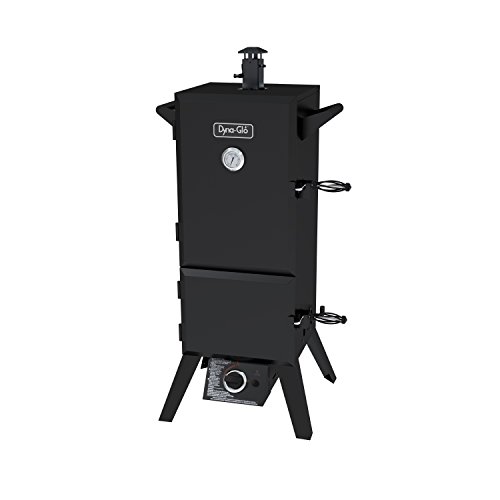
Dyna-Glo DGY784BDP 36-inch Vertical LP Gas Smoker — Best Manual Cabinet for Brisket
The Dyna-Glo earns its place the old way: geometry. Its 36-inch cabinet is laid out so a whole packer lies flat, uncut and unfolded, which is the entire ballgame for bark, rendering and even cooking. Around that geometry sits a deliberately simple machine — a manual propane burner, a chip tray, a water pan — that an experienced cook can run by feel and fix with basic tools, season after season.
The honesty paragraph: you are the control system. On a still night that is a pleasure; on a windy one it is a rota of checks, and your first brisket in this cabinet should be a practice brisket, cooked when nothing depends on it. Owners who learn its valve marks and shelter it well produce brisket that embarrasses far more expensive rigs. If your temperament is hands-on and your priority is the flat fit, this is the brisket cabinet to buy.
Strengths
- Whole packer fits flat — the core brisket requirement, met cleanly
- Simple manual burner, easy to understand and maintain
- Long-running model with deep owner knowledge available
Trade-offs
- Manual control means overnight checks, especially in wind
- Door thermometer is indicative only — a probe setup is essential
- Seals and latches benefit from owner attention before serious cooks
| Detail | What to know |
|---|---|
| Format | 36-inch vertical LP gas smoker (per Amazon listing title) |
Check on Amazon — check the current price on Amazon before you decide, because bundle contents and included accessories change between listings.
Best for: hands-on brisket cooks who value flat fit and simplicity / Not suited for: cooks who need thermostatic overnight running
Camp Chef Smoke Vault 24 — Best Brisket Layout — no link
Ask vertical-smoker owners which cabinet they bought for brisket and the Smoke Vault 24 comes up with unusual consistency, for one reason: width where it counts. The 24-inch vault format gives a packer flat room that narrower 30-inch-class cabinets cannot, and its heavy body and straightforward burner have made it a brisket-workhorse recommendation for years. On the brisket test that governs this guide, it passes on geometry alone.
Why is there no buy link? Because verification for this guide found the Vault’s ecosystem — covers, replacement grates, accessories — but could not confirm a current listing for the smoker itself through the API this site uses. Rather than send you to a cover wearing a smoker’s search result, the pick stands unlinked: if you buy one, buy it through Camp Chef’s own channels or a reputable outdoor retailer, confirm the model number on the box is the 24-inch vault, and treat any marketplace listing priced like an accessory as exactly that. The cabinet deserves its reputation; the listing landscape around it deserves your suspicion.
Strengths
- 24-inch vault width takes a whole packer flat with room to spare
- Heavy, simple construction with a long brisket track record
- Straightforward burner and layout that owners understand deeply
Trade-offs
- No verified unit listing found at research time — buy through official channels carefully
- Manual control, like all classic propane vaults
- Weight and size make it a permanent-fixture purchase
This pick is written unlinked: there is no verified new-retail listing to link, so judge it on the used-market and dealer guidance in this guide rather than on a buy button.
Best for: brisket specialists willing to buy through official retail channels / Not suited for: buyers who want a one-click verified listing today

Pit Barrel Cooker Premier Series 18.5-inch Drum Smoker — Best Hanging Technique
The Pit Barrel breaks this guide’s format on purpose, because it answers the brisket question with a different technique: hang the packer. In the drum, a whole brisket hangs vertically from hooks in a column of charcoal heat, cooking evenly in its own basting juices, in notably less time than a flat cabinet cook, with a devoted following insisting the result is not a compromise but a preference. For a buyer whose patio or budget will not stretch to a wide cabinet, hanging is the honest route to whole brisket — no folding, no halving, no apology.
The trade-offs are technique-shaped. You must learn the hang: hooks set securely in the thick end, attention at the moment the brisket softens late in the cook, and a plan for the wrap stage on the grate. It is charcoal, with charcoal’s lighting and ash, and the drum’s set-and-mostly-forget character still asks respect on windy days. Judge it as what it is — the best alternative answer to the brisket question, not a cabinet substitute.
Strengths
- Cooks a whole packer by hanging — no trimming, folding or halving
- Faster brisket cooks than flat cabinet smoking, with excellent bark
- Simple, durable drum with a huge owner community
Trade-offs
- Hanging is a technique to learn, with a late-cook softening risk to manage
- Charcoal fuel means lighting, ash and less precise control than propane
- Not a cabinet — limited for delicate foods that need flat racks
| Detail | What to know |
|---|---|
| Format | 18.5-inch drum smoker, porcelain coated steel (per Amazon listing title) |
Check on Amazon — check the current price on Amazon before you decide, because bundle contents and included accessories change between listings.
Best for: brisket cooks open to the hanging technique and charcoal / Not suited for: buyers committed to flat-laid cabinet cooking

Pit Boss 3-Series Propane Gas Vertical Smoker — Best Batch Cabinet
Many real brisket days are not brisket-only days. The packer goes on at dawn and, by afternoon, the cabinet is expected to hold ribs, burnt-end pans, beans and whatever the guests brought. The Pit Boss 3-Series is built for that day: four racks and the largest stated cooking area in this guide let the brisket keep its flat rack while the rest of the menu stacks above and below, all under a modern controller-led burner.
For a brisket alone, narrower questions apply: confirm the packer’s fit on the rack you intend — the cabinet’s area is generous, and full packers are exactly its design case — and accept a newer model’s thinner long-term record. As a system for feeding a crowd around a whole brisket, though, nothing else here organises the day as well. Buy it for the party, and the brisket comes along properly.
Strengths
- Four racks run a brisket plus the full party menu at once
- Largest stated cooking area in this guide
- Modern controller approach suits long, busy cook days
Trade-offs
- Newer model with less long-term owner history
- Party capacity is wasted on solo brisket cooks
- Feature details vary by listing revision — verify before buying
| Detail | What to know |
|---|---|
| Cooking area | 983 sq in, 4 racks (per Amazon listing title) |
Check on Amazon — check the current price on Amazon before you decide, because bundle contents and included accessories change between listings.
Best for: crowd cooks built around a whole brisket / Not suited for: minimalists cooking brisket alone

Masterbuilt MPS 230S Propane Smoker 30-inch — Best Budget Route — With a Technique
This pick comes with its warning printed on the label. The MPS 230S does not take an untrimmed packer flat, and this guide will not pretend otherwise. What it does offer is the cheapest verified route to genuinely good whole-brisket cooking, via the technique competition cooks use deliberately: separate the point from the flat before cooking, run them on different racks, and pull each at its own perfect moment. Many cooks who start this way for space reasons keep doing it for quality reasons — the fatty point and lean flat honestly finish at different times.
If separating feels like defeat, the alternative in this cabinet is an aggressive trim, which sacrifices exactly the mass that protects a flat through hour twelve. So the verdict is precise: buy the MPS 230S for brisket only if the separation technique appeals to you as cooking, not as compromise. As a general starter cabinet it is excellent; as a flat-packer cabinet it is the wrong tool, and the Dyna-Glo above is the right one.
Strengths
- Lowest-cost verified cabinet that cooks a whole brisket well via separation
- Point/flat separation lets each muscle finish at its own moment
- Excellent general starter cabinet beyond brisket
Trade-offs
- Cannot fit an untrimmed packer flat — the headline limitation
- Separation changes the classic whole-packer presentation
- Small cabinet feels wind on overnight cooks
| Detail | What to know |
|---|---|
| Format | 30-inch propane smoker (per Amazon listing title) |
Check on Amazon — check the current price on Amazon before you decide, because bundle contents and included accessories change between listings.
Best for: budget buyers who embrace point/flat separation / Not suited for: anyone who wants an untrimmed packer laid flat
Comparison Table
| Pick | Badge | Key spec | Best for |
|---|---|---|---|
| Masterbuilt 40-inch ThermoTemp Propane Smoker MB20051316 | Best Overall for Brisket | 960 sq in, thermostatic propane | brisket cooks who want flat-laid packers and overnight stability |
| Dyna-Glo DGY784BDP 36-inch Vertical LP Gas Smoker | Best Manual Cabinet for Brisket | 36-inch manual propane cabinet | hands-on brisket cooks who value flat fit and simplicity |
| Camp Chef Smoke Vault 24 | Best Brisket Layout — no link | 24-inch wide vault (manufacturer format) | brisket specialists willing to buy through official retail channels |
| Pit Barrel Cooker Premier Series 18.5-inch Drum Smoker | Best Hanging Technique | 18.5-inch charcoal drum, hanging cook | brisket cooks open to the hanging technique and charcoal |
| Pit Boss 3-Series Propane Gas Vertical Smoker | Best Batch Cabinet | 983 sq in, 4 racks | crowd cooks built around a whole brisket |
| Masterbuilt MPS 230S Propane Smoker 30-inch | Best Budget Route — With a Technique | 30-inch cabinet, separation technique | budget buyers who embrace point/flat separation |
How to Choose a Vertical Smoker for Whole Brisket: Measure the Meat, Not the Marketing
A packer brisket’s length is the only dimension that matters first. Measure the briskets you actually buy — most households land in a consistent size band from their usual shop — and compare that number to the rack’s longest usable straight line, remembering that cabinet walls curve, door frames intrude and a brisket needs an inch of air at each end. If the seller cannot tell you rack dimensions, that silence is your answer. Headline cooking area is a party metric; brisket is a geometry problem.
Second, choose your technique before your smoker. Flat-laid is the classic: bark on every surface, fat rendering downward, the slice presentation everyone photographs. It demands width. Hanging trades the flat presentation for drum efficiency and a devoted following. Separation trades the whole-packer theatre for precision — each muscle cooked to its own finish. None is cheating; all three appear in this guide labelled honestly. The only wrong answer is the cabinet that forces a technique you did not choose, discovered at midnight with the meat already trimmed wrong.
Third, audit the overnight hours. A brisket cook is won between hour six and hour twelve, usually while you sleep. Water pan capacity, fuel servicing without opening the food chamber, temperature stability in night wind, and a probe thermometer with an alarm you trust are brisket features in a way that extra racks are not. Spend on those before you spend on size you will use twice a year.
The Brisket Cook in a Vertical Cabinet, Hour by Hour
Trim with restraint: hard fat off, the fat cap shaped to a smooth, thin layer, the thin edges of the flat squared so they do not burn into jerky. Season simply and early enough for the salt to work. Load the brisket fat-side toward the heat source’s character — in most vertical cabinets that means considering the burner below and the cabinet’s hot spots you learned in practice cooks — and place a rack-level probe where the meat sits, not where the door dial guesses.
Hours one to four build bark in clean smoke; resist opening the cabinet entirely. The stall, when the brisket sweats its temperature to a standstill, is weather, not failure: wrap if you wrap, in paper for bark or foil for speed, knowing each choice’s cost. After the wrap, the cook is about feel — a probe sliding into the flat with the resistance of warm butter matters more than any number. Rest is an ingredient, not an intermission: a long, held rest, wrapped and insulated, finishes rendering and redistributes the juices that decide whether slices bend and glisten or crumble dry.
Vertical cabinets add one signature move: rotation. Hot spots in a tall cabinet are real, and a single mid-cook rotation of the brisket — done quickly, once — evens the cook without the door-opening habit that ruins stability. Learn your cabinet’s map with a cheap cook before the expensive one depends on it.
How to Set Up a Vertical Smoker for an Overnight Brisket
The day before: buy the brisket with a bend test — a packer that drapes limply over your hand promises a tender flat — trim it, season it, and refrigerate it uncovered so the surface dries toward better bark. Check your fuel as if the cook depended on it, because it does: a fresh propane tank or a full charcoal supply, a spare plan, chips or chunks staged, water pan clean. Set the cabinet in its sheltered position and do a short test burn if it has sat idle; discovering a clogged burner port at midnight is a self-inflicted wound.
Evening: fill the water pan, load the fuel and smoke wood, preheat to a stable target with the door closed, and verify stability for a full half hour before the meat goes on — a cabinet that will not settle empty will not settle loaded. Load the brisket quickly, probes placed, door closed, alarms set on your thermometer for cabinet low and high limits, not just food temperature. Then go to bed like someone who prepared: one planned check in the deep night hours to service water and fuel, done through the service door where fitted, in minutes, without admiring the meat.
Morning is patience. Judge doneness by probe tenderness in the flat, rest the brisket wrapped and held warm for at least an hour and preferably longer, and slice against the grain — remembering the grain turns in the point, so separate and slice the two muscles on their own terms. Write down what the cabinet did overnight. That notebook page is worth more than the next accessory you were about to buy.
Common Buying Mistakes
Trusting ‘fits a brisket’ marketing. Fits can mean folded, halved or trimmed to a shadow. Demand rack dimensions and compare them to your measured packer.
Trimming away the insurance. The fat and mass you remove cannot protect the flat at hour eleven. Trim for shape and hard fat, not for neatness points.
Cooking to a number instead of tenderness. Two packers finish differently. The probe-tender test in the flat is the finish line; the thermometer reading is a rumour about it.
Slicing after ten minutes because people are hungry. An unrested brisket pours its juice onto the board. The rest is where slices become supple; defend it.
Opening the cabinet all night. Every check costs the stability the cook is built on. Probes, alarms and one planned service visit beat six anxious peeks.
Buying the party cabinet for a brisket habit. If brisket is the mission, rack width and overnight stability outrank total area every time.
Final Recommendation
For the complete brisket answer — flat fit plus overnight control — the Masterbuilt ThermoTemp leads this guide. The Dyna-Glo 36-inch is the manual-control alternative with the same flat-fit virtue. The Smoke Vault 24 remains a brisket favourite worth hunting through official channels, the Pit Barrel offers the hanging technique with real conviction, the Pit Boss 3-Series runs the brisket-party day, and the MPS 230S cooks a fine brisket for cooks who embrace separating point and flat.
Choose the technique you believe in, measure your brisket before you measure cabinets, and give any new smoker one practice packer before a celebration depends on it.
Keep exploring the cluster: Best Vertical Smokers Best Vertical Propane Smokers Best Charcoal Vertical Smokers Best Built Vertical Smokers Best Vertical Smokers For Jerky
Trimming a Packer for a Vertical Cabinet: Shape, Airflow and Sacrifice
A packer brisket arrives shaped like the cow’s schedule, not your smoker’s, and trimming is where the cook negotiates between the two. The goals in a vertical cabinet are specific. First, aerodynamics: a brisket with squared edges and a smooth profile cooks evenly in rising heat, while thin flaps and dangling corners overcook into jerky shards that steal moisture from the slices they were attached to. Trim the flat’s thin edges back to honest thickness, round the corners, and accept the small sacrifice of trim — which is not waste, since it grinds beautifully into burgers and sausage — as the price of an even cook.
Second, the fat cap: shaped, not removed. A smooth, thin, even layer — roughly a quarter-inch by the usual guidance — renders, bastes and protects; the hard, waxy deckle fat between the muscles does none of those things well and should be reduced so heat and seasoning reach the meat and the finished slices separate cleanly. In a vertical cabinet, where heat rises past the brisket for hours, that even cap matters more than in an offset, because there is no side of the meat that the cabinet forgets.
Third, the fit check, done cold and early: lay the trimmed packer on the rack it will cook on, outside the smoker, and confirm the clearance you planned actually exists — an inch of air at each end, no contact with walls, no fold hiding anywhere. If it fails the cold test it will fail worse hot, swollen and at midnight. This is the moment to choose the separation technique or the bigger cabinet, while the choice is still free. Cooks who trim by these three goals — shape, cap, fit — find that the smoker’s part of the bargain becomes almost boring, which is the highest compliment a brisket cook can pay a piece of equipment.
The Stall, the Wrap and the Rest: Brisket’s Three Acts in a Cabinet
Every brisket cook performs the same three-act play, and vertical cabinets stage it with particular clarity. Act one is bark: the hours of clean smoke and rising heat in which the surface dries, the seasoning sets into a crust and the fat begins its long render. The cabinet’s job in act one is stability and absence — no door opening, no fiddling, smoke front-loaded as the meat accepts it most readily while cool and moist. Cooks who rush act one by peeking are reviewing a play they keep interrupting.
Act two is the stall, when evaporative cooling pins the brisket’s temperature in place for hours that feel personal. The stall is physics, not failure, and the wrap decision is the cook’s one real intervention: butcher paper preserves bark while easing the stall, foil accelerates through it at bark’s expense, and no wrap at all produces the deepest bark and the longest night. In a vertical cabinet — where opening the door costs the whole column of heat — the wrap should be one decisive operation, prepared in advance, executed in minutes, rehearsed by the practice cook this guide keeps insisting on.
Act three is the rest, the most under-rehearsed act in home brisket. Off the heat, wrapped and held warm, the brisket’s juices redistribute, its rendered fat sets into succulence rather than puddles, and its texture relaxes into the slice that bends without breaking. An hour is the minimum courtesy; longer holds, properly warm, routinely produce the best slices of the day — which is why experienced cabinet cooks schedule the brisket to finish early and rest long, rather than carving breathlessly at serving time. The play is won in act three by cooks who planned it in act zero.
Slicing and Serving: Where Good Cabinet Brisket Is Won or Lost
A brisket can survive a mediocre smoker and die on a cutting board, so the final discipline deserves the same respect as the first. Rest completed, the packer separates into its two muscles along the fat seam — a natural division that asks only for a knife’s encouragement — because the point and the flat are different foods wearing one name. The flat slices against its grain into even pencil-thick pieces; find the grain before the first cut, mark it with a shallow notch if you must, and remember that a beautiful brisket sliced with the grain eats like rope, however it cooked.
The point’s grain runs differently — often near-perpendicular to the flat’s — which is why it is separated before slicing, and why it so often becomes burnt ends instead: cubed, sauced lightly if at all, and returned briefly to heat until the edges caramelise into the candy that starts arguments at the table. Serving order matters too: slice to order, in small batches, because a sliced brisket dries by the minute in open air, while the unsliced remainder, wrapped and warm, waits patiently. The board should hold only what the next two minutes will eat.
Sauce is a condiment, not a rescue, and a cabinet brisket cooked by this guide needs neither rescue nor apology — a warm, thin sauce on the side for those who want it, and the cook’s confidence to serve the flat naked. Keep the slices’ own juices, caught at carving, spooned back over the board. That liquid is the cook’s final ingredient, and it was twelve hours in the making.
Choosing the Brisket Itself: Grades, Bend and Marbling
The smoker gets the credit and the blame, but the brisket is chosen at the shop, and the choosing is a skill with tells. Grade is the first tell: higher grades carry more intramuscular fat, and intramuscular fat is the brisket’s internal insurance through a twelve-hour cook — it renders slowly, bastes from within and forgives the small temperature sins every cabinet commits overnight. A lean, low-grade packer can be cooked well, but it cannot be cooked carelessly, and for a cook’s first year of briskets the higher grade is not extravagance; it is tuition reduction.
The bend test is the second tell: a packer lifted from one end should drape with a limp, promising flexibility, while a stiff, board-like flat predicts a tough slice no smoker can fully redeem. Thickness at the flat’s thin end is the third — a flat that tapers to nothing will sacrifice its end to the heat whatever you do, while an even flat cooks as one piece. Buy the brisket your cabinet fits and your grade budget flatters, freeze nothing you can cook fresh, and remember that the best brisket decision is usually made standing at the meat counter, not standing at the smoker at midnight.
Fuel and Smoke Wood for the Long Brisket Cook
A brisket’s first hours decide its bark and its smoke character, and the fuel plan should be written before the meat is trimmed. In propane cabinets the wood choice carries the whole smoke responsibility: oak for the steady base that never bullies, hickory for the classic brisket statement in the early hours, a measured hand with mesquite for cooks who like its edge and know its bitterness when overused. Chunks smoulder longer and steadier than chips where the tray accepts them; chips, refreshed once, suit the front-loaded smoke strategy this guide recommends — heavy, clean smoke while the meat is cold and receptive, then heat alone for the long finish.
In charcoal drums and cabinets, the fuel is also the fire’s architecture: a bed arranged for a slow, even burn, wood placed to ignite in sequence rather than all at once, and a reserve staged so the one planned overnight service takes minutes. Whatever the fuel, the rule that outranks every preference is cleanliness — smoke from a fire that is burning properly, thin and pale blue, sweetens meat; smoke from a fire that is smouldering dirty, thick and white, embitters it. Brisket is twelve hours of exposure to whatever your fire is doing. Make the fire boring, and the brisket will be interesting.
Troubleshooting Brisket: Dry Flat, Tough Slices, Bitter Bark
The dry flat is the commonest brisket grief, and its causes line up in a familiar order: the brisket was lean or thin at the flat’s end, the cook ran hot in the final hours, the wrap came late or never, or — most often and least admitted — the rest was short and the slicing was early, pouring the flat’s juice onto the board in front of witnesses. The fixes are correspondingly plain: buy grade and thickness, hold the cabinet steady rather than heroic, wrap on bark and tenderness rather than on the clock, and defend the rest like it is an ingredient, because it is one.
Tough slices that bend like leather rather than draping are usually an undercooking story wearing a dry story’s clothes: collagen that has not finished converting, judged by a thermometer number instead of by the probe’s tender slide. The remedy is patience and the probe test in the flat’s thickest part. Bitter bark, by contrast, is a smoke story — dirty fire, oversmoking into the late hours, or a cabinet whose grease history seasoned the cook — and its remedy lives in the fire discipline section above. Every failed brisket is a syllabus. Cooks who write down which of the three griefs they met, and what the cabinet did overnight, rarely meet the same one twice.
Altitude, Weather and the Brisket Cook’s Calendar
Brisket does not care about your schedule, and the environment keeps voting on the cook whether you consult it or not. Cold weather lengthens everything in a light cabinet and drinks propane or charcoal at a rate summer cooks never meet; wind is worse, stripping heat from one side of the cabinet and turning the overnight hours into a negotiation. The calendar discipline is to plan the brisket around the forecast the way sailors plan around weather — shelter positioned, fuel doubled, start time moved earlier so the rest, not the cook, absorbs the surprises.
Altitude quietly rewrites the physics for mountain cooks: water boils lower, moisture leaves the meat faster, and the stall behaves differently, which is why recipes written at sea level read like fiction at elevation. The cabinet cook’s answer is not a formula but a posture — probe tenderness over numbers, moisture defended with the water pan and the wrap, and times treated as rumours. Every environment has brisket masters; they are simply the cooks who stopped arguing with their conditions first.
The final calendar truth is social: brisket is ready when it is ready, and the wise cook schedules the meal around the meat’s earliest plausible finish plus a long rest, never around a promised hour. Guests forgive a brisket that arrives rested and magnificent at seven instead of six. They remember, in the other direction, the brisket that was carved early because the invitation said six. Cook the meat’s calendar, and let the invitation learn humility.
Leftovers and Second Acts: Brisket Beyond the First Slicing
A whole packer is a lot of beef, and the second acts are part of its value. Sliced flat reheats best gently, in its own juices, sealed against the drying air; the point, cubed, becomes burnt ends on day one and the filling for sandwiches, chilli and hash for the rest of the week. Brisket fat, rendered and kept, is a cooking medium with opinions — potatoes fried in it acquire a following. None of this is thrift theatre; it is the traditional economics of a cut that was always bought to feed people more than once.
Freezing respects the same rules as resting: cool it, portion it in meal-sized amounts, seal it against air with its juices included, and label it with the cook’s date and the cabinet’s notes. A frozen brisket portion, reheated gently months later, routinely outperforms a fresh brisket cooked carelessly — a fact that should encourage every cabinet owner to cook the full packer without fear of the surplus. The surplus is the point.
And there is a quieter second act: the notebook. Each packer teaches the cabinet’s behaviour under real load — where the hot spots moved the cook, how the overnight hours drifted, what the wrap timing did to the bark. Written down, those lessons compound into the cook’s real equipment, more valuable than any accessory. The brisket is eaten in a weekend. The knowledge is eaten from for years.
Brisket on a Budget: Where the Money Actually Matters
Brisket economics tempt cooks to save in the wrong places. The cabinet can be modest — this guide’s budget pick cooks a legitimate brisket with the separation technique — because the cabinet’s job is steadiness, and steadiness can be bought at several prices. The meat cannot be modest in the same way: grade and thickness at the flat decide the cook’s ceiling before the fire is lit, and the difference between a forgiving packer and a punishing one is the cheapest insurance in the entire process when measured against twelve hours of fuel, wood and sleep.
The thermometer is the third place money matters out of proportion: a dual-probe unit with alarms costs less than a single ruined packer and pays its debt the first night it wakes you for a drifting cabinet instead of a dead one. Fuel, by contrast, is where money barely matters — propane and charcoal are commodities, and the cook who overspends there is buying branding, not heat.
Spend, then, in this order: the meat, the measurement, the cabinet, and the rest is garnish. A budget brisket programme built on that order produces results that embarrass expensive rigs run on hope — which is, in the end, the whole argument of this guide in miniature.
Frequently Asked Questions
What size vertical smoker do I need for a whole brisket?
One whose longest rack line exceeds your typical packer’s length with an inch to spare at each end. In practice that points most buyers to 36- and 40-inch-class cabinets, wide vaults, or a drum using the hanging technique.
Can I cook a brisket in a 30-inch vertical smoker?
Yes, with a technique: separate the point and flat onto different racks, which many cooks prefer anyway, or trim aggressively. What a 30-inch cabinet generally cannot do is take an untrimmed packer laid flat.
Is hanging a brisket as good as laying it flat?
It is different, not lesser. Hanging in a drum cooks faster, bastes the meat in its own juices and produces excellent bark, with a late-cook handling step to learn. Flat cooking gives the classic presentation and simpler management.
How do I keep a vertical smoker steady overnight?
Shelter it from wind, fill the water pan, service fuel without opening the food chamber, and run a dual-probe thermometer with high and low cabinet alarms. Thermostatic propane models reduce the workload further.
Should brisket go fat-side up or down in a vertical smoker?
Toward the dominant heat character of your cabinet, which in most verticals means considering the burner below. Learn your cabinet’s hot spots with a practice cook and rotate the brisket once mid-cook.
Why is the Camp Chef Smoke Vault 24 not linked?
Because verification found its covers and grates, but no confirmable listing for the smoker itself. Rather than link an accessory, the guide reviews it unlinked and directs buyers to official retail channels.

