A large offset smoker is a joy to cook on and a chore to clean. The cooking chamber is wide, the grates are long, and the firebox end runs hotter and dirtier than the stack end, so grease and carbon build up across a broad surface that a short brush simply cannot reach. The best grill brush for large offset smokers solves that reach problem first: a long handle keeps your hands away from a hot grate, a wide head covers more steel with every stroke, and a scraper takes off the baked-on residue that bristles alone leave behind.
This guide compares six grill brushes suited to wide offset smoker grates. Every pick below was checked against the live product listing for its handle length, head design and stated grate compatibility, and every link goes to the exact product described. Use the comparison table to narrow the field fast, then read the full section for any brush you are considering. If you are choosing between wire bristles and bristle-free designs, the short version is this: wire bristles clean faster on heavy carbon, while bristle-free designs remove the risk of a loose wire ending up in food. Both styles appear below, so you can pick the trade-off that fits your household.
In this guide
Quick picks: best grill brush for large offset smokers
| # | Product | Where to buy |
|---|---|---|
| 1 | GRILLART grill brush 18-inch handle | Check on Amazon |
| 2 | Weetiee bristle-free grill brush 18-inch | Check on Amazon |
| 3 | TNTOR bristle-free grill brush 18-inch handle | Check on Amazon |
| 4 | Scrub Daddy BBQ Daddy grill brush | Check on Amazon |
| 5 | TNTOR adjustable handle grill brush | Check on Amazon |
| 6 | Oklahoma Joes Blacksmith Combo grill brush | Check on Amazon |
How the picks were chosen
Every brush in this roundup had to clear four checks before it earned a place. First, reach: the handle had to be long enough to clean the far side of a wide offset smoker grate without leaning over hot steel, which in practice means a handle around 18 inches or an adjustable handle that extends to that length. Second, head width: the cleaning head had to cover a useful span of grate with each pass, because a narrow head turns a ten-minute job into a thirty-minute one. Third, a scraper: each pick had to include a scraper blade or a scraping edge for the carbon that bristles cannot shift. Fourth, grate safety: the brush had to be listed as suitable for the grate types found on offset smokers, including steel, cast iron and porcelain-coated grates.
Handle strength mattered as much as length. A long handle that flexes or snaps under pressure is worse than a short one, so the picks favor stainless steel, reinforced construction and ergonomic grips. Bristle safety was weighed openly: wire brushes clean aggressively but shed bristles as they wear, so any wire brush below comes with the reminder to inspect it and wipe the grate with a damp cloth after brushing. Bristle-free brushes trade a little cleaning speed for the peace of mind of no loose wires. We have not tested these brushes in a side-by-side cleaning session; the comparisons below rest on the listed handle length, head design, materials and stated features.
Best grill brush for large offset smokers at a glance
| Brush | Handle | Head type | Best match |
|---|---|---|---|
| GRILLART 18-inch | 18 inch | Triple wire bristle + scraper | Heavy carbon, fast cleaning |
| Weetiee bristle-free 18-inch | 18 inch | Bristle-free helix + wide scraper | Safety-first cleaning |
| TNTOR bristle-free 18-inch | 18 inch, detachable | Bristle-free spiral + scraper | All grate types |
| Scrub Daddy BBQ Daddy | Angled, squeeze trigger | Steam FlexTexture + scraper | Steam cleaning, hot grates |
| TNTOR adjustable 18-inch | Adjustable to 18 inch | Wire bristle + scraper | Storage and reach |
| Oklahoma Joe's Blacksmith Combo | Full-tang, ergonomic | Nylon + steel wool heads | Offset smoker owners |
The picks in detail

Top pick
1. GRILLART Grill Brush, 18-inch Extra-Strong Handle
Verified specs: 18-inch grill brush with triple wire bristle scrubbers and a stainless steel scraper; rust-resistant stainless steel construction; listed for gas, charcoal and smoker grates in steel and cast iron.
Strengths:
- Triple bristle rows carry three times the bristles of a standard brush, so each pass covers more grate.
- 18-inch handle keeps hands clear of the heat on a wide offset smoker grate.
- Built-in scraper tackles the baked-on residue that bristles alone cannot shift.
Trade-offs:
- Wire bristles wear over time and can shed, so the grate needs a damp-cloth wipe after brushing.
- Aggressive wire bristles call for care on porcelain-coated grates.
- Single fixed length means no adjustment for tighter storage or shorter grills.
This is the brush for cooks who clean a dirty smoker often and want the job done fast. The triple bristle head clears a wide path across long offset grates, the scraper handles the stubborn patches near the firebox, and the 18-inch handle reaches the far side without leaning over hot steel. It fits the weekly smoker who values cleaning speed above all else.
Best for: heavy carbon buildup and fast cleaning on wide steel and cast iron grates.
Not suited for: households worried about loose wire bristles, or delicate porcelain-coated grates.
Check price on Amazon: GRILLART grill brush 18-inch handle

2. Weetiee Grill Brush and Bristle Free Outdoor BBQ Scraper
Verified specs: 18-inch bristle-free grill brush with a stainless steel helix coil head and a wide scraper; no wire bristles; listed for gas, charcoal, smoker, porcelain and infrared grates.
Strengths:
- No wire bristles at all, so there is nothing to shed into food.
- Wide scraper covers more grate per pass and clears stubborn residue quickly.
- Flexible helix coil reaches the sides of grates as well as the front, useful on wide offset chambers.
Trade-offs:
- Bristle-free heads generally clean heavy carbon more slowly than wire bristles.
- Helix coil needs correct technique and regular replacement to keep working well.
- Some parts of the handle require assembly on arrival, per the listing notes.
The Weetiee brush is the safety-first pick for families. With no wire bristles anywhere in the design, the worry about a stray wire in food disappears entirely, and the wide scraper still makes short work of the greasy patches that build up near the firebox. It suits cooks who clean the smoker after every session and prefer steady, safe cleaning over maximum aggression.
Best for: families and safety-first cooks who want zero wire bristles on wide grates.
Not suited for: cooks facing months of baked-on carbon who want the fastest possible wire cleaning.
Check price on Amazon: Weetiee bristle-free grill brush 18-inch

3. TNTOR Grill Brush with Scraper, Bristle Free, 18-inch Handle
Verified specs: 18-inch detachable-handle grill brush with a three-layer stainless steel spiral bristle-free head and a sharp scraper; listed for grill, smoker, gas and charcoal cookers; rust-resistant materials.
Strengths:
- Bristle-free spiral head removes the loose-wire risk while still scrubbing in a full circle.
- Detachable 18-inch handle gives full reach on wide grates and easy storage afterwards.
- Sharp scraper handles the crusty buildup that collects at the hot end of an offset smoker.
Trade-offs:
- Bristle-free cleaning is slower than wire on the heaviest baked-on carbon.
- Detachable handle is one more joint to keep tight and check over time.
- Spiral head needs a firm hand on round-bar grates to reach between the bars.
TNTOR bristle-free brush is the versatile middle ground: safe like the other bristle-free picks, but with a detachable handle that stores easily in a crowded garage. The 18-inch reach covers the full width of most offset smoker grates, and the three-layer spiral head cleans from several angles at once. It fits cooks who want one brush for the smoker, the gas grill and the charcoal grill alike.
Best for: all-round cleaning across smoker, gas and charcoal grates with no loose wires.
Not suited for: cooks who want maximum wire-bristle aggression on heavy carbon.
Check price on Amazon: TNTOR bristle-free grill brush 18-inch handle
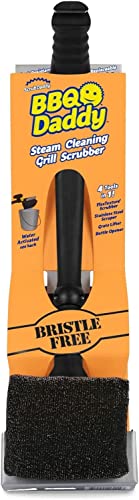
4. Scrub Daddy BBQ Daddy Grill Brush
Verified specs: Bristle-free grill brush with a FlexTexture steam-cleaning head, a steel grill scraper and a scrub brush; ergonomic handle with a leverage knob and angled squeeze trigger; built-in retractable grate hook and bottle opener.
Strengths:
- Steam cleaning: the head softens with heat and steam to reach into grates as you scrub.
- Bristle-free ArmorTec mesh means no loose wires anywhere near food.
- Built-in scraper, grate hook and bottle opener combine several tools into one handle.
Trade-offs:
- Handle is shorter than the 18-inch brushes, so reach across the widest grates needs more leaning.
- Steam method works best on a hot grate, so it suits cleaning right after cooking.
- Replacement heads are a separate purchase when the FlexTexture head wears out.
BBQ Daddy is the clever pick for cooks who clean the smoker while it is still hot. Dip the head in cold water, scrub the hot grate, and the steam does much of the work, softening the head so it reaches between the bars. The leverage knob and squeeze trigger give good control on a long grate, and the built-in grate hook is genuinely useful when you need to lift a hot grate out of the way.
Best for: steam cleaning hot grates right after cooking, and cooks who like multi-tool handles.
Not suited for: the very widest offset chambers where an 18-inch handle is needed for reach.
Check price on Amazon: Scrub Daddy BBQ Daddy grill brush

5. TNTOR Grill Brush with Scraper, 18-inch Adjustable Handle
Verified specs: Grill brush with an adjustable handle extending to 18 inches and contracting to 12.5 inches for storage; three layers of stainless steel bristles plus a sharp scraper; listed for charcoal, smoker, porcelain and other grill types.
Strengths:
- Adjustable handle reaches 18 inches for wide grates and shortens for storage.
- Three-layer wire bristles clean aggressively from several angles at once.
- Sharp scraper clears the stubborn residue that builds near the firebox.
Trade-offs:
- Wire bristles wear and can shed, so wipe the grate with a damp cloth after brushing.
- Adjustable handle adds a moving joint that needs an occasional check for tightness.
- Wire bristles call for care on porcelain-coated grates.
This TNTOR brush is the practical pick for a crowded garage. It extends to a full 18 inches when the offset smoker needs cleaning, then shortens to 12.5 inches to hang on a hook or fit in a storage bin. The wire head cleans fast on steel and cast iron, and the scraper handles the worst patches. It fits cooks who own several grills and want one brush that adapts to each of them.
Best for: cooks who need full reach plus compact storage, and fast wire cleaning on steel grates.
Not suited for: households avoiding wire bristles, or delicate porcelain-coated grates.
Check price on Amazon: TNTOR adjustable handle grill brush

6. Oklahoma Joe's Blacksmith Combo Grill Brush
Verified specs: Combo grill brush with replaceable nylon and steel wool heads, a stainless steel scraper blade and a riveted full-tang ergonomic handle; laboratory tested to 15,000 cycles with no breakage or fallout; includes a hanging notch.
Strengths:
- Two heads in one tool: nylon for cool grates, steel wool for hot grates.
- Replaceable heads mean the handle lasts and only the worn head gets swapped.
- Full-tang riveted handle is built for stability across years of use.
Trade-offs:
- No handle length is stated on the listing, so very wide grates may still need a longer brush.
- Steel wool head is aggressive and calls for care on coated grates.
- Combo design costs more than a single-head brush.
Oklahoma Joe’s is a smoker brand first, and this brush shows it. The two-head system matches how offset smoker owners actually clean: steel wool on the hot grate right after cooking, nylon on the cool grate during a deep clean. The full-tang handle feels solid in the hand, and replaceable heads keep the tool in service for years. It fits cooks who already run an Oklahoma Joe’s smoker and want a brush made for that world.
Best for: offset smoker owners who want a durable two-head brush from a smoker brand.
Not suited for: the very widest chambers where a stated 18-inch handle is needed.
Check price on Amazon: Oklahoma Joes Blacksmith Combo grill brush
Buying guide: how to pick a grill brush for a large offset smoker
Start with handle length. An offset smoker cooking chamber can be a meter or more across, and the grate runs the full width, so a short brush forces you to lean over hot steel or to clean in awkward sections. A handle around 18 inches reaches the far side of most home offset smokers while keeping your hands clear of the heat. Adjustable handles give the same reach with easier storage, and detachable handles pack down further. Whatever the design, the handle should feel stiff in the hand: flex in a long handle means lost pressure at the head, and lost pressure means more strokes for the same result.
Next, choose the head. Wire bristle heads clean the fastest on heavy carbon, because stiff steel wires cut into baked-on grease. They are the right choice when the smoker has not been cleaned for weeks and the grate is crusted. Bristle-free heads use a steel coil, spiral or mesh instead of wires, and they clean a little more slowly but remove the risk of a loose wire ending up in food. Steam heads use a heat-softening core that reaches into the grate as you scrub a hot surface. There is no single right answer: households with children or anyone nervous about wire bristles should go bristle-free, while cooks who clean a heavily used smoker every week may prefer wire.
Look for a scraper. Bristles, wire or not, glide over the worst carbon; a scraper blade lifts it. On an offset smoker the worst buildup sits near the firebox end, where heat and dripping fat combine, and a wide scraper clears that zone far faster than any brush head. Check that the scraper is steel rather than plastic, because plastic softens on a hot grate. A replaceable head is worth paying for: the handle is the expensive part of the tool, and a brush with swap-in heads stays in service for years while a fixed-head brush goes in the bin when the bristles wear.
Match the brush to your grates. Steel and cast iron grates take any brush. Porcelain-coated grates need a gentler touch: bristle-free heads, nylon heads and steam heads are safer choices, while stiff wire bristles can chip the coating if pressed hard. Round-bar grates need a head that reaches between the bars; a coil or spiral head does this well, as does a steam head that softens into the gaps. Flat expanded-metal grates are more forgiving and take any head shape.
Wire bristles vs bristle-free: which is safer
Wire bristle brushes have cleaned grills for decades, and they work. The safety concern is real but manageable: as a wire brush wears, individual wires can break off, and a wire that stays on the grate can end up in food. The risk is low but the consequence is unpleasant, which is why bristle-free designs have grown popular. If you use a wire brush, inspect it before every use, replace it when the bristles look bent, loose or sparse, and always wipe the grate with a damp cloth after brushing to catch anything the brush left behind.
Bristle-free brushes remove the wire risk entirely. A steel coil, spiral or mesh head cannot shed a wire because it has none. The trade-off is cleaning speed on the heaviest carbon: a bristle-free head needs more passes on a badly neglected grate. For most home cooks who clean after every session, the difference is small, and the peace of mind is worth it. Steam heads add another advantage: the heat and moisture loosen grease as you scrub, so the head does less brute work. Whichever style you choose, the rule is the same: clean the grate while it is warm, not cold, and replace the head when it stops cutting through grease.
How to clean a large offset smoker grate
Clean the grate while it is still warm, right after cooking. Heat loosens grease and carbon, so a warm grate cleans in minutes while a cold one fights you for half an hour. Scrape first: run the scraper blade along each bar to lift the thickest buildup, working from the firebox end toward the stack end so debris falls clear of the clean section. Then brush: push the head along the bars with firm, even strokes, covering the full width in overlapping passes. For a bristle-free or steam head, dip the head in cold water first; the steam helps lift grease off the steel.
After brushing, wipe the grate with a damp cloth to catch loose debris and any bristle fragments, then let the grate cool. For a deep clean, remove the grates and wash them with hot water and a mild degreaser, then dry them fully before putting them back; a wet grate left in a steel chamber rusts quickly. Oil cast iron grates lightly after a deep clean to protect the seasoning. Empty the ash from the firebox and the cooking chamber regularly, because ash holds moisture and speeds up rust on the steel.
Common mistakes with grill brushes
The most common mistake is brushing a cold grate. Cold grease is hard and sticky, and a cold brush skates over it without cutting in. Clean while the grate is warm and the job takes a fraction of the time. The second mistake is pressing too hard. Pressure bends wire bristles and flattens coil heads, and bent bristles clean worse, not better; let the head do the work with steady, even strokes. The third mistake is keeping a worn brush. A brush with sparse, bent or loose bristles cleans poorly and sheds more, so replace the head or the brush when it stops cutting through grease in a few passes.
The fourth mistake is ignoring the scraper. Brushing alone leaves the worst carbon in place, and that carbon builds up into a crust that eventually flakes into food. Scrape first, then brush, every time. The fifth mistake is storing a wet brush in a closed space. A damp brush rusts and grows mold; hang it by its loop in a dry spot so air reaches the head. The sixth mistake is using the wrong head on coated grates: stiff wire on porcelain coating chips the surface, and a chipped coating rusts fast. Match the head to the grate and the brush will last years.
Grill brush head types compared
Five head designs cover nearly every grill brush on the market, and each one suits a different cleaning style. Wire bristle heads are the classic: rows of stiff steel wires that cut into carbon fast. They are the best choice for a badly neglected grate and the worst choice for anyone worried about loose wires. Triple-row wire heads cover more grate per pass, which matters on a wide offset smoker, but they still shed as they wear, so they demand inspection and a damp-cloth wipe after every use.
Coil and spiral heads replace wires with a continuous steel coil. The coil scrubs from several angles at once and reaches the sides of grate bars as well as the tops, which is useful on round-bar grates. Coil heads last longer than wire heads because there are no individual bristles to break off, and they clean nearly as fast on moderate buildup. Mesh heads use a woven steel or fabric mesh, sometimes wrapped around a sponge core; they are gentle on coated grates and good at wiping grease, but they struggle with thick carbon unless paired with a scraper.
Steam heads use a heat-softening core that firms in cold water and softens on a hot grate, letting steam lift grease as you scrub. They work best on a hot grate right after cooking and are nearly useless on a cold one, so they suit cooks who clean immediately. Nylon heads are the gentlest of all: safe on cool grates and coated surfaces, but they melt on hot steel, so they belong only in a cool-grate routine. Steel wool heads sit at the other end of the scale: aggressive on hot grates, fast on carbon, but hard on coatings and best kept to steel and cast iron.
| Head type | Cleaning speed | Wire risk | Best on |
|---|---|---|---|
| Wire bristle | Fast | Yes, sheds with wear | Heavy carbon, steel grates |
| Coil / spiral | Medium-fast | No | All grate types, round bars |
| Mesh | Medium | No | Grease, coated grates |
| Steam core | Medium-fast on hot grates | No | Hot grates after cooking |
| Nylon | Slow | No | Cool grates, coated surfaces |
| Steel wool | Fast | No | Hot steel and cast iron |
The practical lesson is to match the head to the job rather than to the brand. A cook who cleans after every session can use any head type and will barely notice the difference. A cook who cleans once a month needs wire or steel wool for the first pass, then a gentler head for maintenance. Keeping two heads, or a combo brush with swappable heads, covers both situations without buying two full tools.
Handle materials and grip
A long handle is only useful if it stays rigid under pressure. Stainless steel handles are the strongest choice: they do not bend, rot or melt, and they survive years of heat and weather. Reinforced plastic handles are lighter and cooler to hold, but they flex under hard pressure and can crack if dropped on concrete. Wood handles feel good in the hand and stay cool, but they absorb grease and moisture over time and can split if left out in the rain. Full-tang construction, where the metal of the head runs through the whole handle, is the strongest design of all, and it is the one to look for in a brush you expect to keep for years.
Grip matters on a long brush because leverage works against you: the longer the handle, the more force your wrist needs to press the head flat. An ergonomic grip with a slight curve, a non-slip surface or a hanging loop gives better control and less fatigue across a wide grate. Angled necks help too: a head that sits at a slight angle to the handle keeps the cleaning surface flat on the grate without forcing your wrist into an awkward bend. When you pick up a brush, check the balance: the head should feel heavy enough to press itself onto the grate, and the handle should feel light enough to steer with one hand.
How to store and maintain your grill brush
Hang the brush by its loop in a dry spot, head down, so water drains away from the handle. A brush left flat on a damp shelf rusts at the head and grows mold on pads and nylon. After each use, rinse the head under hot water, shake off the excess and let it air-dry before hanging. Bristle-free pads and steam heads can be washed with warm soapy water; wire heads need only a rinse and a shake, because soap residue on steel can flavor the next cook.
Inspect the brush before every use. Look for bent, loose or missing bristles on a wire head, and retire the brush at the first sign of shedding. Check coil and mesh heads for fraying or flattening, and check adjustable and detachable handles for tightness. Replace heads on schedule rather than waiting for them to fail: a fresh head cleans in half the time of a worn one, and the cost of a replacement head is small against the cost of a ruined cook. Keep a spare head on the shelf if your brush takes replacements, so a worn head never forces you to clean with a tool past its best.
Can one brush clean both the smoker and the gas grill? Yes, and most brushes in this guide are listed for gas, charcoal and smoker grates alike. Clean the smoker grate first, then the gas grill, so the dirtiest job does not contaminate the cleaner one. If the gas grill has porcelain-coated grates, use a bristle-free or nylon head on that grill and keep the wire head for the smoker.
How often should I clean my offset smoker grates? Brush the grates after every cook while they are still warm, and do a deep clean with removal and washing every few weeks in heavy use. A quick brush after each session takes minutes and stops carbon from building into a crust, while a neglected grate needs a scraper, a soak and far more effort.
Final recommendation
For most owners of large offset smokers, the best grill brush is an 18-inch bristle-free brush with a wide scraper: the Weetiee helix brush for safety-first households, or the TNTOR detachable brush for cooks who want one tool across several grills. Cooks who clean heavy carbon every week and accept the wire-bristle routine will get the fastest results from the GRILLART triple-bristle brush or the adjustable TNTOR wire brush. The Scrub Daddy BBQ Daddy is the pick for cleaning a hot grate right after cooking, and the Oklahoma Joe's Blacksmith Combo is the durable two-head tool for cooks who already live in the offset smoker world. Whichever brush you choose, clean the grate while it is warm, scrape before you brush, and replace the head when it stops cutting.
Frequently asked questions
What size grill brush do I need for a large offset smoker? A handle around 18 inches reaches across the wide grates of most home offset smokers while keeping your hands away from the heat. Shorter handles force you to lean over hot steel, and adjustable handles give the same reach with easier storage.
Are bristle-free grill brushes better than wire brushes? Bristle-free brushes are safer, because they cannot shed a wire into food. Wire brushes clean heavy carbon a little faster. For most home cooks who clean after every session, a bristle-free brush is the better all-round choice; for heavily neglected grates, wire has the edge on speed.
How do I clean a grill brush? Rinse the head under hot water after use, shake off the excess and hang the brush to dry. Bristle-free pads and steam heads can usually be washed with warm soapy water. Never store a wet brush in a closed container, because trapped moisture rusts steel heads and grows mold on pads.
When should I replace my grill brush? Replace a wire brush when bristles look bent, sparse or loose, and replace a bristle-free head when it stops cutting through grease in a few passes. As a rule, inspect the brush before every use and retire it at the first sign of shedding or wear.
Can I use a grill brush on porcelain-coated grates? Yes, but choose a gentle head: bristle-free coil, nylon or steam heads are the safest choices for porcelain coating. Stiff wire bristles can chip the coating if pressed hard, and a chipped coating rusts quickly.
Should I brush the grate hot or cold? Warm, right after cooking. Heat loosens grease and carbon, so a warm grate cleans in minutes while a cold one takes far longer. Scrape first, then brush, and wipe the grate with a damp cloth afterwards.
Related reading on this site: for the cooker itself, see our guides to offset smokers for backyard barbecue and thermometers for offset smokers, and for another cleaning tool, see our grill brush for Weber porcelain enamel grills.


