Disclosure: airfryerkitchensupply.com is reader-supported. When you buy through links on our site, we may earn an affiliate commission at no extra cost to you.
Where to buy
The fastest way to compare the best charcoal vertical smokers shortlisted below is Amazon, where every linked pick on this page was verified against the manufacturer listing before this guide was published. Prices move with seasons and promotions, so we do not print fixed prices here — use the links to check the current price on Amazon for the exact model, size and configuration you want.
- Weber Smokey Mountain Cooker 22-Inch — check price on Amazon
- Cuisinart 18-Inch Vertical Charcoal Smoker (COS-118) — check price on Amazon
- Weber Smokey Mountain Cooker 14-Inch — check price on Amazon
- Dyna-Glo Wide Body Vertical Offset Charcoal Smoker (DGO1890BDC-D) — check price on Amazon
- Pit Barrel Cooker Premier Series 18.5-Inch Drum Smoker — check price on Amazon
- VEVOR 18.5-Inch Barrel Charcoal BBQ Smoker — check price on Amazon
Vertical smokers ship in sections and are sometimes listed by diameter, sometimes by shelf count, occasionally by a cooking-area figure that counts every level. The verified titles here state the format plainly; use them to confirm you are looking at the complete cooker, not a replacement section or accessory.
The best charcoal vertical smokers all exploit the same elegant fact: heat rises. Stack the fire at the bottom, the food in shelves above it, and a lid on top, and you get the most capacity per square foot of patio, the most even use of a single fire, and — in the water-smoker branch of the family — the gentlest, most forgiving cooking in charcoal. Vertical is not one format but a family: bullets with water pans, drums that hang meat, and cabinets fed by offset fireboxes. This guide covers the whole family and tells you which branch fits your cooking.
The family’s shared virtues explain its dominance of home smoking. A vertical cooker heats a column, so every level cooks in the same rising stream; one modest fire serves several shelves; and the footprint stays small enough for balconies, townhouse gardens and crowded patios where a horizontal offset simply cannot live. Its shared vice is the mirror image: height. Shelves at different levels cook at slightly different rates, access means lifting sections or opening tall doors, and a tall cooker in a high wind is a sail with a fire in it.
Our six picks span the family’s full range and price spread, because vertical shoppers are not one budget: the benchmark 22-inch bullet as overall pick, the budget Cuisinart for learners, the compact Weber 14 for small spaces, Dyna-Glo’s wide-body vertical offset for batch volume, the Pit Barrel drum for hanging, and VEVOR’s barrel as the value route into hang-and-grate cooking. Read the format notes as carefully as the product notes — in vertical smoking, choosing your branch matters more than choosing your brand.
In this guide
Quick Picks
If you only read one section, make it this one. These are the six best charcoal vertical smokers we would point a friend toward, each with a clear job. Every badge used here is repeated at the top of that pick’s full review further down, so the shortlist and the deep dives always agree.
- Weber Smokey Mountain Cooker 22-Inch — Best Overall: the 22-inch Smokey Mountain — two full-size grates in a sealed, porcelain-enameled column: the vertical format at its most complete. — check price on Amazon
- Cuisinart 18-Inch Vertical Charcoal Smoker (COS-118) — Best Budget: the 18-inch COS-118 vertical with water bowl, dual vents and integrated thermometer — the family’s proven layout at a learner’s price. — check price on Amazon
- Weber Smokey Mountain Cooker 14-Inch — Best Compact: the 14-inch Smokey Mountain — the benchmark bullet shrunk for balconies, couples and camping, with no change in method or build. — check price on Amazon
- Dyna-Glo Wide Body Vertical Offset Charcoal Smoker (DGO1890BDC-D) — Best Vertical Offset: Dyna-Glo’s wide-body cabinet — stacked shelves fed by a side firebox: batch capacity in a chair-sized footprint. — check price on Amazon
- Pit Barrel Cooker Premier Series 18.5-Inch Drum Smoker — Best for Hanging Meat: the Pit Barrel 18.5-inch drum — vertical cooking by hook: ribs and chickens suspended over the coals in rising heat. — check price on Amazon
- VEVOR 18.5-Inch Barrel Charcoal BBQ Smoker — Best Value Drum: VEVOR’s 18.5-inch barrel with two grates, a hanging rod and six hooks — both vertical methods, hanging and stacked, at a value price. — check price on Amazon
How These Picks Were Chosen
Every linked pick in this guide was verified against its live listing — brand, model, diameter or stated format matching the manufacturer’s own title — before writing. Vertical smokers attract more misleading listings than any other charcoal category (accessory sections sold as cookers, areas summed across every shelf and rack), so the verification pass specifically confirmed that each ASIN resolves to a complete cooker of the format reviewed.
Selection covered the vertical family’s three branches deliberately: water-pan bullets (Weber 22, Weber 14, Cuisinart), hanging drums (Pit Barrel, VEVOR) and the offset-fed cabinet (Dyna-Glo). Within each branch we picked the model we would defend as its best representative at its price, scoring sealing and temperature behaviour first, honest per-level capacity second, and parts support third. A branch with only weak representatives would have been represented honestly as weak; in the event, each branch has a pick we can recommend without crossing our fingers.
We also weighted the family’s defining metric — capacity per square foot of patio — throughout, because it is the reason most buyers go vertical. Headline areas were distrusted on principle and translated into food: briskets flat, racks whole, birds hung. Where a maker’s number counts every shelf and warming rack, the review says what the main levels actually hold.
The 6 Best Charcoal Vertical Smokers

1. Weber Smokey Mountain Cooker 22-Inch — Best Overall
If ‘vertical smoker’ means one cooker to most people, it is this one at its best size. The 22-inch Smokey Mountain stacks two genuinely large grates over its water pan in a porcelain-enameled column that seals tightly enough for its dampers to run the fire with real authority. Full packer briskets lie flat, party loads stack across levels, and the whole production stands on a footprint smaller than a patio chair’s.
Strengths
- Two full-size levels — vertical capacity without the small-grate compromises of budget stacks
- Water pan buffering plus sealed construction gives the steadiest manual smoking here
- Porcelain enamel and the deepest parts ecosystem in vertical smoking
Trade-offs
- Mid-cook access to the lower level means lifting the upper section — plan your load order
- Tall column in strong wind needs shelter; it is a chimney by design
- More cooker than small households need — the 18-inch sibling exists for a reason
Key specs (from the verified listing)
- Size: 22-inch bullet (water) smoker
- Cooking grates: dual cooking grates
- Construction: porcelain-enameled kettle
- Air control: temperature control dampers
The 22’s argument is that it removes the vertical format’s usual asterisk. Budget verticals stack small grates and call it capacity; the Weber stacks two grates that each take real food — a brisket above, butts below, or ribs across both — while the water pan keeps the column’s temperature honest through the stall and the night. It is the vertical cooker against which the family’s value picks are measured, and most of them are measured kindly only because they cost less.
Ownership is the familiar Weber story: enamel that forgives, parts that exist, a community that has documented every cook you will attempt. The format’s inherent chores remain — load the long cooks low, because the top section comes off to reach them; shelter it from wind; seal the door if yours weeps smoke. None of that dents the conclusion: for a household that cooks at volume and wants it vertical, this is the default, and the burden of proof sits on every alternative.
Best for: households cooking at volume who want the vertical benchmark at full size / Not suited for: small households and balcony cooks, for whom the 14-inch or Cuisinart below is the honest fit
Check on Amazon — check the current price on Amazon before you decide, and confirm the size and configuration on the listing match what you measured at home.

2. Cuisinart 18-Inch Vertical Charcoal Smoker (COS-118) — Best Budget
The Cuisinart is the vertical family’s value gateway: an 18-inch stacked bullet with the layout that defines the format — charcoal ring, water bowl, two chrome-plated grates, dual vents — at a price that lets a beginner learn vertical smoking properly instead of approximately. Everything the format teaches (vent discipline, water management, level awareness) is present and correct; only the materials are budget-grade.
Strengths
- True vertical water-smoker layout — nothing about the method is compromised
- Water bowl and dual vents give beginners the forgiving setup the format promises
- Integrated thermometer and included grates: a complete starter with nothing missing
Trade-offs
- Thin steel — the column loses heat in wind and cold more than the Weber
- Chrome grates and budget hardware are maintenance items, not lifetime parts
- Section fit benefits from gasket tape to reach its best stability
Key specs (from the verified listing)
- Size: 18-inch vertical charcoal smoker
- Water bowl: included
- Vents: dual vents
- Grates: chrome-plated
- Thermometer: integrated lid thermometer
Vertical smoking’s skills are format skills, and the COS-118 teaches all of them at the lowest tuition in this guide. Its water bowl steadies the column exactly as the Weber’s does; its dual vents speak the same control language; its levels stack the same way. A cook who learns on this and upgrades later loses nothing — every habit transfers — which cannot be said of the misshapen budget cookers that imitate the format without its layout.
The compromises are materials and weather. Keep it covered, keep the ash out, add gasket tape to the section joints, and site it out of the wind, and it will smoke happily for seasons. Ask it to perform in a January gale and it will show you the difference enamel and mass make. For learners, small families and second-cooker buyers, that is the right trade at this price, made with open eyes.
Best for: beginners and value buyers who want the true vertical method at a starter price / Not suited for: cold-climate, all-winter cooks who need the Weber’s enamel and mass
Check on Amazon — check the current price on Amazon before you decide, and confirm the size and configuration on the listing match what you measured at home.
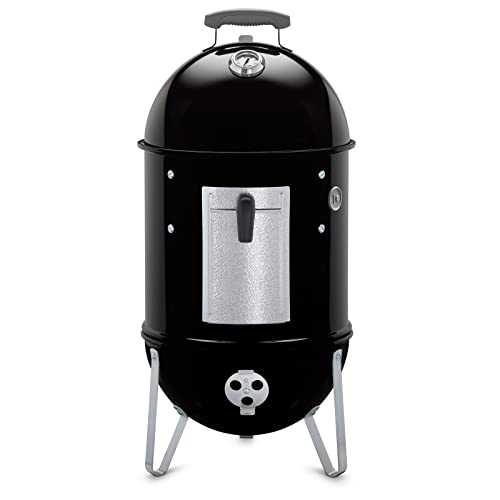
3. Weber Smokey Mountain Cooker 14-Inch — Best Compact
The 14-inch Smokey Mountain answers the vertical family’s small-space question with quality instead of compromise: the same porcelain-enameled column, dual grates, water pan and dampers as its big siblings, at a diameter that fits a balcony corner, a camper’s storage bay or a couple’s patio. It is the compact pick for buyers who refuse to learn on a lesser cooker just because their space is small.
Strengths
- Full Weber build and method at the smallest footprint in this guide
- Dual grates still stack a real cook — a butt above, ribs or a chicken below
- Light and portable enough for camping and tailgating in a way its siblings are not
Trade-offs
- 14 inches is a hard ceiling: brisket means a trimmed flat, ribs get cut or coiled
- Small charcoal ring means shorter maximum burns — very long cooks want a top-up
- Per-cook capacity suits two to four people, not gatherings
Key specs (from the verified listing)
- Size: 14-inch bullet (water) smoker
- Cooking grates: dual cooking grates
- Construction: porcelain-enameled kettle
- Air control: temperature control dampers
Small verticals are usually where quality goes to die, which is what makes the 14 interesting: Weber simply scaled the cooker, not the standard. The column seals, the dampers work, the enamel shrugs off weather, and the water pan buffers exactly as it should. A couple’s pork butt, a spatchcocked chicken, a rack of ribs cut in half — the realistic menu of small-household smoking fits, cooked with the same calm as the big models deliver.
Its discipline is capacity honesty. This is not a party cooker wearing a small hat; it is a small cooker, excellent within its brief. Buyers who host should size up to the 18 or 22 without regret. Buyers whose smoking is intimate — weeknight chickens, weekend butts for two, a portable for the campsite — will find the 14 the most satisfying small smoker in the vertical family, and the only one that needs no excuses.
Best for: couples, balcony cooks and campers who want benchmark quality at a small footprint / Not suited for: hosts and brisket-first cooks who need full-size grates
Check on Amazon — check the current price on Amazon before you decide, and confirm the size and configuration on the listing match what you measured at home.

4. Dyna-Glo Wide Body Vertical Offset Charcoal Smoker (DGO1890BDC-D) — Best Vertical Offset
The vertical offset is the family’s production branch: a tall cabinet of shelves with the fire in a box at its side, so one fire feeds level after level of food. Dyna-Glo’s Wide Body is the branch’s best-known consumer form, with shelves wide enough for briskets and pans rather than the narrow racks of budget cabinets. Meal-preppers, big families and event cooks get chamber volume that would take two bullets, standing in the corner of the patio.
Strengths
- Shelf after shelf of capacity — the most food per square foot in this guide
- Side firebox lets you tend the fire without opening the cabinet and dumping the column’s heat
- Wide shelves take full briskets and hotel pans, not just small cuts
Trade-offs
- Cabinet doors leak until gasketed — plan the mod into the purchase
- Shelves cook at different rates; rotation is part of the vertical-offset method
- Big thin-steel surface area loses heat in wind and cold
Key specs (from the verified listing)
- Design: wide body vertical offset charcoal smoker
- Model: DGO1890BDC-D
Cooking in a vertical offset is managing a column with a fire at its base: the lowest shelves run hottest, the door is a leak until sealed, and the reward for learning your cabinet’s personality is volume — twenty pounds of pork at once, ribs in levels, a freezer filled in a weekend. The Wide Body earns its place because its shelves are honestly sized; too many budget cabinets stack postcard grates and advertise the sum.
Set the expectation correctly and it delivers: this is a production tool at a consumer price, with a consumer cabinet’s sealing and steel. Gasket the door, learn the shelves over two cooks with cheap cuts, shelter it from wind, and it will out-produce everything else in this guide. For one-butt Sundays it is more cooker than the job wants — the bullets above exist for those — but for the batch cook, nothing vertical beats it at this level.
Best for: batch cooks, meal-preppers and event feeders who need stacked volume / Not suited for: small, occasional cooks who would rather have a bullet’s simplicity
Check on Amazon — check the current price on Amazon before you decide, and confirm the size and configuration on the listing match what you measured at home.

5. Pit Barrel Cooker Premier Series 18.5-Inch Drum Smoker — Best for Hanging Meat
Hanging is vertical smoking’s purest form — no grates at all, just meat suspended in the column over the fire — and the Pit Barrel is its defining cooker. Ribs hang end-to-end and cook evenly without flipping; chickens hang and baste in the rising heat; the drippings hit the coals and return as the flavour drum owners swear by. If the vertical idea appeals to you as a method rather than a shape, this is its fullest expression.
Strengths
- Hanging capacity surprises everyone: multiple racks and birds in an 18.5-inch drum
- No grate management — no flipping, no rotating, no grate marks
- Porcelain-coated drum with the simplest fire routine in the family
Trade-offs
- Temperature is the drum’s decision more than yours — a philosophy to accept, not fight
- Grate cooks (the included grate) share space with the hanging system less efficiently
- Brisket and other wide, flat cuts are the drum’s weakest case
Key specs (from the verified listing)
- Size: 18.5-inch drum smoker
- Construction: porcelain coated steel
- Style: drum (UDS) cooker, hang-and-grate cooking
The Pit Barrel earns its vertical-guide slot because hanging solves the family’s oldest problem — uneven levels — by abolishing levels. Every inch of a hung rack of ribs rides in the same rising heat; there is no hot shelf and cool shelf, no rotation schedule, no lower grate to reach by lifting sections. For ribs and poultry specifically, it is arguably the most elegant cooker in this entire charcoal series, and its cooks finish faster than any water smoker’s.
The trade is control and generality. The drum cruises where it cruises; wide flat cuts want a grate’s support; and a cook who loves dialling temperatures will feel managed by the cooker rather than managing it. Within its repertoire — ribs, chickens, sausages, turkey, even hanging vegetables — nothing here touches it. If that repertoire is your menu, the Pit Barrel is not the fifth pick in this guide; it is the first.
Best for: ribs and poultry specialists who want the hanging method in its original form / Not suited for: brisket traditionalists and precision-temperature cooks
Check on Amazon — check the current price on Amazon before you decide, and confirm the size and configuration on the listing match what you measured at home.

6. VEVOR 18.5-Inch Barrel Charcoal BBQ Smoker — Best Value Drum
The VEVOR barrel is the vertical family’s bargain all-rounder: an 18.5-inch coated-steel drum that ships ready for both of the family’s cooking methods — two grates for stacked cooks, plus a hanging rod and six hooks for drum-style hanging — with a built-in thermometer to learn by. For the buyer who wants to try vertical cooking in both its forms without committing premium money to either, it is the obvious experiment.
Strengths
- Hanging rod and six hooks included — true drum method out of the box
- Two grates cover stacked, bullet-style cooks in the same body
- The most vertical capability per dollar in this guide
Trade-offs
- Coated rather than porcelain finish — cover and dry storage are mandatory, not optional
- Basic intake control; expect a learning curve to find its cruising range
- No water pan — its stacked mode cooks drier and faster than a bullet’s
Key specs (from the verified listing)
- Size: 18.5-inch barrel smoker
- Construction: coated steel
- Grates: 2 grilling grates
- Hanging: 1 hanging rod, 6 hooks
- Thermometer: built-in
Value picks earn their place by removing excuses, and the VEVOR removes the format excuse: a new vertical cook can hang ribs on Saturday and stack a butt over the second grate on Sunday, learning which method suits their food before spending seriously on either. The hardware is honest budget steel — the thermometer is a guide, not an instrument, and the coating wants care — but the geometry is right, and geometry is what cooks food.
Treat it as the family’s apprenticeship. Run it covered, empty its ash religiously (coated drums forgive nothing about damp ash), and let it teach you the vertical column’s habits: how heat stratifies, how little charcoal a stack really needs, how hanging changes a rib. Graduates of that apprenticeship buy their next vertical with knowledge; that is worth more than the price difference to a premium drum bought blind.
Best for: new vertical cooks who want to learn both hanging and stacked methods on one value cooker / Not suited for: buyers wanting a decade-long premium drum — that is the Pit Barrel above
Check on Amazon — check the current price on Amazon before you decide, and confirm the size and configuration on the listing match what you measured at home.
Comparison Table
| Pick | Badge | Key spec | Best for |
|---|---|---|---|
| Weber Smokey Mountain Cooker 22-Inch | Best Overall | Size: 22-inch bullet (water) smoker | households cooking at volume who want the vertical benchmark at full size |
| Cuisinart 18-Inch Vertical Charcoal Smoker (COS-118) | Best Budget | Size: 18-inch vertical charcoal smoker | beginners and value buyers who want the true vertical method at a starter price |
| Weber Smokey Mountain Cooker 14-Inch | Best Compact | Size: 14-inch bullet (water) smoker | couples, balcony cooks and campers who want benchmark quality at a small footprint |
| Dyna-Glo Wide Body Vertical Offset Charcoal Smoker (DGO1890BDC-D) | Best Vertical Offset | Design: wide body vertical offset charcoal smoker | batch cooks, meal-preppers and event feeders who need stacked volume |
| Pit Barrel Cooker Premier Series 18.5-Inch Drum Smoker | Best for Hanging Meat | Size: 18.5-inch drum smoker | ribs and poultry specialists who want the hanging method in its original form |
| VEVOR 18.5-Inch Barrel Charcoal BBQ Smoker | Best Value Drum | Size: 18.5-inch barrel smoker | new vertical cooks who want to learn both hanging and stacked methods on one value cooker |
Compare the verticals by level, not by total: what fits on one grate or shelf, and how many true levels there are, predicts your cooks. The Best for column names each branch’s home ground.
How to Choose a Charcoal Vertical Smoker
Choose your branch first. If you want the gentlest learning curve and the classic low-and-slow result, you want a water-pan bullet — the water steadies the column and forgives your early vent work. If you want speed, simplicity and the hanging method’s distinctive flavour, you want a drum. If you want production volume — many shelves, one fire — you want the vertical offset cabinet, accepting its sealing and rotation chores as the price of the volume. Brand debates inside a branch are small; branch mistakes are large and last for years.
Then size by level, not by total. Ask what fits on a single grate: a brisket lying flat needs roughly a 22-inch level or a wide cabinet shelf; a butt and a rack of ribs share an 18-inch level comfortably; a couple’s cook fits a 14-inch level with room to breathe. Count your true levels — the ones at cooking height over the water pan or fire — and ignore warming racks and lid shelves in the maths. That simple discipline prevents nearly every vertical capacity disappointment.
Do vertical smokers cook evenly?
Mostly, with one honest caveat: a column stratifies. The level nearest the fire runs hottest, and in cabinets the door side can lag. Water pans narrow the gap considerably in bullets; drums abolish it by hanging; cabinets ask you to rotate shelves once or twice on long cooks. None of this is a defect — it is the family’s physics, and each branch has its standard answer. What you should not believe is any listing that promises perfectly even heat across five shelves from one small fire.
Vertical or horizontal: which should you buy?
Vertical wins on footprint, fuel efficiency and capacity per dollar; horizontal offsets win on brisket geometry, live-fire flavour and the theatre of the craft. If your patio is small, your cooks are stacked (butts, ribs, birds) and your fuel budget matters, go vertical. If your signature dish is a whole brisket cooked over a live wood fire and you have the space and Saturdays, the offset guides are your home. Most households, honestly assessed, are vertical households.
What Are the Downsides of Vertical Smokers?
Access is the first: reaching a bullet’s lower grate means lifting the upper section — hot, heavy and dripping — so load order matters and mid-cook rearrangement is a planned event, not an impulse. Cabinets solve access with a door and pay for it in leaks. Drums solve it by hanging and pay in generality. There is no free lunch in the column; there are only lunches priced differently, and the reviews above price each one.
Weather is the second. A tall, relatively light cooker is a sail, and a thin-walled column sheds heat to wind faster than a low, heavy horizontal. Site a vertical out of the wind, weight or secure it as the maker allows, and expect winter cooks to burn more fuel than summer ones — or choose the family’s heavier members (the Weber bullets) whose enamel and fit blunt the effect. None of this stops verticals dominating home smoking; it just rewards owners who site them thoughtfully.
Water Pan or No Water Pan? The Vertical Family’s Oldest Debate
The water pan is the bullet branch’s defining part, and its function is widely misunderstood. It is not primarily a moisturiser — meat does not absorb meaningful water from the air — it is a heat sink: a mass of water that cannot exceed boiling point, sitting between the fire and the food, absorbing spikes and releasing heat through dips. That is why bullets are forgiving. The pan flattens the temperature curve that a beginner’s vent work would otherwise draw as a mountain range, and it catches drippings before they can flare on the coals.
The drum branch’s answer is that drippings on coals are not a problem to catch but a flavour to harvest — and that a well-designed drum’s convection is steady enough without the buffer. Both camps are right about their own cooking. The practical guidance: if your cooks are long, lean and precision-leaning (brisket, butts, overnight), the pan’s buffering earns its place. If your cooks are ribs, birds and sub-six-hour sessions where pace and punch matter, the drum’s directness will please you more. Many long-time vertical owners end up with one of each, which tells you the debate’s real answer: it was never either/or.
What should you put in the water pan?
Hot water, to start — cold water drags the cooker’s climb. Some owners use sand (covered in foil) for an even steadier heat sink that never needs topping up, accepting a slightly different bark in exchange. Beer, wine and aromatics in the pan are beloved rituals with, at best, marginal effect on the meat; spend the money on the meat itself. What matters is that the pan is in place and filled as designed — an empty pan in a bullet removes the buffer the whole cooker was tuned around.
Stacking, Hanging and Shelf Rotation: Working a Vertical Cooker Well
Vertical technique is mostly load architecture. Put the longest, most forgiving cuts lowest, nearest the fire’s steady work; put quick and delicate items highest, where they can be reached without dismantling the stack. In a bullet, that means butts below and ribs or chicken above; in a cabinet, butts on the low shelves and pans of beans — the batch cook’s secret weapon — wherever they fit; in a drum, the architecture is done by hook placement, spacing pieces so air moves between them.
Rotation, where your branch needs it, should be a single planned event: halfway through the cook, one opening, shelves swapped top-to-bottom with gloves on and a table ready. Owners who rotate constantly are usually compensating for a cooker running too hot or a load packed too tight for air to move. Fix the cause — a steadier fire, an inch of space between pieces — and the column will do the even cooking it was designed for, with you watching from a chair instead of a step-stool.
Vertical Smokers for Small Spaces: Balconies, Townhouses and Rules
The vertical family’s small footprint makes it the default answer for restricted spaces, but small-space smoking has rules of its own that this guide should state plainly. Many apartment and condo buildings restrict or ban charcoal on balconies — check your lease and local fire code before you buy, not after, because no smoker in this guide is worth a lease violation. Where charcoal is allowed, the compact picks (the Weber 14, the Cuisinart, the VEVOR drum) keep both the cooker and its working space inside a balcony’s corner, and their enclosed columns contain sparks and drips far better than an open grill.
Neighbours are the second consideration. A vertical’s chimney concentrates smoke into a rising plume, which is kinder than a horizontal’s drifting cloud — site the cooker so the plume rises clear of the windows above, give a courtesy word before long cooks, and favour clean-burning technique (thin smoke, settled fires) over smouldering ones. The cooks who smoke happily in dense housing for years are the ones whose neighbours associate the smell with an occasional offered rib, not with a grievance.
Finally, storage: the sectioned bullets break down for cupboard and shed storage, the drums stand in a corner under a cover, and the cabinet — the family’s one genuinely furniture-sized member — should be bought only where it can live permanently. Measure the lift, the doorway and the winter corner before ordering, and the small-space promise of the vertical family will survive contact with your actual home.
A Brief History of Why Vertical Won
The vertical smoker’s dominance is not an accident of marketing. The bullet design proved, decades ago, that a water-buffered column could give a home cook competition-adjacent results from a cooker that fit in a cupboard — and it did so at the exact moment suburban patios were shrinking and interest in real barbecue was growing. Drums followed the same logic from the folk direction: a barrel, a basket and hooks, refined by competition teams into a method fast and forgiving enough for weeknights. Cabinets scaled the column for production. Each branch kept the family’s founding bargain intact — one fire, rising heat, many levels, small footprint — which is why, format war after format war, vertical remains where most home smoking actually happens.
One Sentence of Advice per Branch
If you remember nothing else from this guide: bullets forgive, drums excite and cabinets produce — and the vertical family is large enough that your perfect cooker is in it, provided you choose the branch before the brand and the level size before the total.
How to Set Up a Vertical Smoker for an Even Cook
This setup sequence is written for the water-pan bullets, with the drum and cabinet variations noted — because in the vertical family, setup is where even cooking is decided.
- Site the cooker out of the wind on a level, non-flammable surface, and check the column stands plumb — a leaning stack cooks and drains unevenly.
- Build the fire in the base: a full charcoal ring for a bullet (minion method, wood chunks buried), a standardised basket load for a drum, or a coal bed in the cabinet’s firebox.
- Fill the water pan with hot water (bullets), set the levels in place, and light a modest amount of charcoal — a third to half a chimney — spread over the unlit fuel.
- Assemble the full column with the lid on and vents open, let it climb, and throttle back as it nears your target; give a vertical a full 30 minutes to settle, because the whole column must come to temperature, not just the base.
- Load by architecture: longest cooks lowest, delicate items highest, an inch of air between pieces, cold meat straight from the fridge.
- Cook with the lid or door closed, judging by probe at the level that matters; rotate shelves once, deliberately, only if your branch and load call for it.
- Rest everything properly, then clean top-down while warm: grates brushed, water pan emptied, ash out once cool — a clean column is an even column next time.
Two cooks in, you will know your column’s personality — which level runs hot, where the door weeps, how the wind moves it. Write it down. Vertical smokers reward that knowledge more than any other family, because the column is a system and systems have habits.
Common Buying Mistakes
Counting every shelf in the capacity maths. Warming racks and lid shelves are not cooking levels. Count the true levels over the fire or water pan, at real grate size, or your first party load will not fit.
Loading the levels in the wrong order. The item that finishes last belongs lowest. Loading delicate food low and butts high guarantees a mid-cook excavation through hot sections to rescue it.
Leaving the water pan empty or dry. An empty pan removes the buffer your bullet was designed around and invites flare-ups. Top it up on long cooks; a dry pan at hour six is a temperature spike with a lid on.
Siting the column in the wind. A tall cooker in a gale loses heat and can even be a safety concern. A fence corner or windbreak transforms a vertical’s winter manners more than any accessory.
Opening sections to ‘check’ constantly. Every lift dumps the column’s accumulated heat and resets the cook’s clock. Probe through the vent or a grommet, trust the process, and open with a purpose.
Final Recommendation
The vertical verdict: the Smokey Mountain 22 is the family’s complete expression and our overall pick; the Cuisinart is its honest budget gateway; the Weber 14 is compact quality without compromise; the Dyna-Glo Wide Body is the batch producer; the Pit Barrel is the hanging method’s champion; and the VEVOR is the value apprenticeship in both methods. Choose your branch first and your size second, and any of these will cook well for you.
For the premium end of this family, continue to Best Charcoal Vertical Smokers Over 500.00; for the water-pan branch in depth, see Best Charcoal Water Smokers; and for the price-tier views of the same family, compare Best Charcoal Smokers Under $400 and Best Charcoal Smokers Under $500 Dollars.
- Weber Smokey Mountain Cooker 22-Inch — check price on Amazon
- Cuisinart 18-Inch Vertical Charcoal Smoker (COS-118) — check price on Amazon
- Weber Smokey Mountain Cooker 14-Inch — check price on Amazon
Best Charcoal Smokers Under $300
Related guides
Frequently Asked Questions
Are vertical smokers better than offset smokers?
Better at footprint, fuel efficiency and stacked capacity; not better at wide brisket geometry or live-fire flavour. Most home cooks are better served vertical — it is why bullets dominate the hobby — but ‘better’ is a match between the cooker and your menu, patio and patience, not a property of the steel.
Why do vertical smokers have water pans?
As heat sinks, not humidifiers. The pan sits between fire and food, cannot exceed boiling point, and flattens temperature swings — which is why bullet smokers forgive beginners. Drum verticals skip the pan deliberately, trading that buffer for dripping-on-coals flavour and pace.
How much food fits in a vertical smoker?
By level: an 18-inch grate takes a pork butt plus a rack of ribs, or two butts with planning; a 22-inch grate takes a full brisket flat. Multiply by true levels — two for bullets, several for cabinets — and leave an inch between pieces for air. Hanging drums break the maths entirely: a small drum of hung ribs feeds six to eight.
Do vertical smokers work in winter?
Yes, with expectations set. The column loses heat to wind and cold — the enamelled Webers least, thin cabinets most. Site out of the wind, budget extra charcoal, and keep cooks a touch shorter in deep cold, and every pick here will smoke through winter. Insulated kamados handle cold best of all, but they are a different family.
Can a vertical smoker also grill?
Drums do it natively — raise the coals or use the grate over the basket. Bullets can grill in their base in a pinch, but it is a workaround, not a strength. Cabinets do not grill. If grilling matters weekly, pair a vertical with a kettle, or choose a drum as your vertical.
What is the easiest vertical smoker to learn on?
A water-pan bullet — the Cuisinart for budget, the Weber 18 or 22 for keeps. The pan forgives, the vents teach cleanly, and every skill transfers to the rest of the family. Drums are a close second for ribs-and-chicken cooks who prefer their simpler ritual.


