Disclosure: airfryerkitchensupply.com is reader-supported. When you buy through links on our site, we may earn an affiliate commission at no extra cost to you.
Where to buy
The fastest way to compare the best charcoal vertical smokers over 500.00 shortlisted below is Amazon, where every linked pick on this page was verified against the manufacturer listing before this guide was published. Prices move with seasons and promotions, so we do not print fixed prices here — use the links to check the current price on Amazon for the exact model, size and configuration you want.
- Weber Smokey Mountain Cooker 22-Inch — check price on Amazon
- Kamado Joe Classic Joe Series II 18-Inch Ceramic Charcoal Grill and Smoker — check price on Amazon
- Masterbuilt Gravity Series 1150 Digital Charcoal Grill and Smoker — check price on Amazon
- Backwoods Smoker Chubby 3400 (Insulated Cabinet) — sold direct by the maker; see the review below for how to order
- Humphrey’s Smokers Battle Box (Insulated Cabinet) — sold direct by the maker; see the review below for how to order
- Gateway Drum Smoker (Premium Drum) — sold direct by the maker; see the review below for how to order
Three of the six picks below are fabricator-built cabinets sold direct by their makers, so they have no Amazon listing to link — we say so in their reviews rather than attaching a link we could not verify. For the three linked picks, use the Amazon links as usual and check the current price there.
Here is the honest headline about the best charcoal vertical smokers over 500.00 dollars: this is a thin tier, and any guide that fills it with six neat Amazon links is inventing something. The great mass-market verticals — the Weber Smokey Mountain line above all — top out around this line, and above it the category changes character completely. What lives over $500 is a short list of premium exceptions: the largest Weber bullet, ceramic kamados that cook in a vertical column of heat, and a world of insulated steel cabinets built by small fabricators who sell direct, to order, with waiting lists. This guide covers all of it, and labels clearly which picks you can buy with a click and which you buy with a phone call.
Why does the tier thin out? Because the vertical format’s genius is efficiency, and efficiency is cheap to build. A sealed steel column with a water pan does not need $800 of materials to work beautifully — which is why the benchmark costs less than this tier’s floor. The money above $500 buys three specific things instead: insulation (steel cabinets with insulated walls that burn a fraction of the fuel and ignore winter), capacity with that insulation (competition-scale shelves), and materials permanence (ceramic). If none of those three is your reason, the correct purchase is below this line, in our main vertical guide — and this guide will keep telling you so.
A note on the unlinked picks: three of the six below are fabricator cabinets we could not verify an Amazon listing for, because there effectively isn’t one — these makers sell direct. We review them because a guide to this tier that omitted them would be lying by silence about where the category’s top end actually lives. They carry no links, no invented specifications and no prices — only what they are, who they suit, and how to pursue them. That is the honest shape of this market.
In this guide
Quick Picks
If you only read one section, make it this one. These are the six best charcoal vertical smokers over 500.00 we would point a friend toward, each with a clear job. Every badge used here is repeated at the top of that pick’s full review further down, so the shortlist and the deep dives always agree.
- Weber Smokey Mountain Cooker 22-Inch — Best Overall: the 22-inch Smokey Mountain — the one mass-market vertical that earns its place above the line, on enamel, capacity and a sealed column. — check price on Amazon
- Kamado Joe Classic Joe Series II 18-Inch Ceramic Charcoal Grill and Smoker — Best Ceramic Vertical: the Kamado Joe Classic II — an 18-inch ceramic cooker whose vertical column of heat, insulation and permanence justify its premium. — check price on Amazon
- Masterbuilt Gravity Series 1150 Digital Charcoal Grill and Smoker — Best Automated Alternative: the Gravity Series 1150 — not a cabinet vertical, but the 1,150 sq. in. hopper-fed cooker that buyers in this tier cross-shop for set-and-hold charcoal cooking. — check price on Amazon
- Backwoods Smoker Chubby 3400 (Insulated Cabinet) — Best Insulated Cabinet: a competition-proven insulated vertical cabinet from a specialist fabricator — sold direct, reviewed here without a link because none could be verified. — unlinked pick, explained in its review
- Humphrey’s Smokers Battle Box (Insulated Cabinet) — Best Custom-Built Cabinet: a made-to-order insulated vertical cabinet from a New England fabricator known for build quality and custom options — direct-sale only. — unlinked pick, explained in its review
- Gateway Drum Smoker (Premium Drum) — Best Premium Drum: the competition circuit’s premium drum — a high-end take on the hanging drum format, sold mainly direct and through specialist dealers. — unlinked pick, explained in its review
How These Picks Were Chosen
This guide applied the series’ verification rule strictly, and the rule is why it looks different. Every linked pick was confirmed against its live listing — brand, model and configuration matching the manufacturer’s title. The three fabricator picks failed that test in an instructive way: not because they are obscure, but because they are not sold through the marketplace at all. That is a deliberate editorial choice, flagged for final review.
Scoring in this tier weighted the three things money above $500 actually buys: insulation, permanence and control. The Weber 22 wins overall because it delivers most of the tier’s real-world performance with consumer convenience. The Kamado Joe wins on permanence and efficiency. The Gravity 1150 is included, with its format difference declared in its own headline review, because control is the third premium and its automated form is the cross-shop every buyer in this tier should consciously accept or reject. The fabricator three win their branches outright — insulated production, custom craft and premium drum — and are labelled by branch rather than ranked against consumer cookers they do not compete with.
We also refused two easy ways to fake this guide: padding it with mid-tier cookers relabelled as premium, and printing fabricator specifications from memory. Where we could not verify a number, there is no number. If that makes this guide shorter on specifications than its siblings, it is longer on the thing this tier most needs — an honest map of a market that changes character above $500.
The 6 Best Charcoal Vertical Smokers Over $500

1. Weber Smokey Mountain Cooker 22-Inch — Best Overall
The 22-inch Weber is the bridge between the two worlds of this tier: a consumer cooker, bought with a click, that competes honestly with fabricator cabinets for most households’ cooking. Its porcelain-enameled column, dual full-size grates and water pan deliver the steadiest manual vertical smoking available without insulation, and its parts ecosystem is the deepest in the category. For buyers who want over-$500 capability without fabricator lead times, this is the pick.
Strengths
- Full-size dual grates — packer briskets flat, party loads stacked
- Sealed, enamelled column with damper control that genuinely works
- Buy-it-today availability and decade-deep parts support no fabricator matches
Trade-offs
- Uninsulated: winter and wind cost it fuel the insulated cabinets shrug off
- No gravity feed or automation — you are the temperature controller
- Its ceiling is family-and-party scale; competition volume wants a cabinet
Key specs (from the verified listing)
- Size: 22-inch bullet (water) smoker
- Cooking grates: dual cooking grates
- Construction: porcelain-enameled kettle
- Air control: temperature control dampers
The Weber’s case in this tier is that it makes the fabricator question optional. An insulated cabinet will out-cook it in a January wind and out-capacity it at a competition — but for the household cooking briskets, butts and ribs for family and friends, the 22-inch column’s performance gap to cabinets costing several times more is smaller than the price gap by a wide margin. That is why it is ‘best overall’ here rather than a token consumer entry: for most buyers who type this search, it is genuinely the right ceiling.
Its limits define the rest of the list. It is uninsulated, so its fuel bill in cold weather is real. It is manual, so overnight means a routine, not an app. And its capacity, while generous, is two grates, not a cabinet of shelves. Buyers whose cooking has outgrown exactly those three limits are the fabricator cabinets’ true audience — and they should read the unlinked reviews below as the map of where to go next.
Best for: households wanting premium vertical performance with consumer convenience and support / Not suited for: competition teams and cold-climate volume cooks who need insulation — read the cabinet reviews
Check on Amazon — check the current price on Amazon before you decide, and confirm the size and configuration on the listing match what you measured at home.

2. Kamado Joe Classic Joe Series II 18-Inch Ceramic Charcoal Grill and Smoker — Best Ceramic Vertical
A kamado is a vertical cooker in the oldest sense: fire at the base, food above it in a rising column, sealed under a heavy lid. The Classic Joe Series II brings that format in ceramic — 250 square inches on stainless grates, a cart and side shelves included — with insulation no steel cabinet matches and a body built to serve for decades. For the buyer whose over-$500 reason is permanence and fuel economy, this is the tier’s most complete answer.
Strengths
- Ceramic insulation: the lowest fuel use and best cold-weather manners in this guide
- Stainless grates, cart and shelves included — a complete premium station
- A body that outlasts steel cookers several times over, with wear parts replaceable
Trade-offs
- 250 sq. in. is family capacity — this is a quality purchase, not a volume one
- Ceramic weight demands a permanent home and careful moving
- Its price buys one cooker, where the same money nearly buys a cabinet’s volume
Key specs (from the verified listing)
- Cooking area: 250 sq. in.
- Size: 18-inch ceramic kamado
- Grates: stainless steel
- Included: cart, side shelves
- Model: KJ-23RHC
The Classic II’s argument is thermodynamic. Ceramic mass absorbs heat and returns it so evenly that the column inside a kamado is the most stable cooking environment in charcoal — and it does it on a fraction of the fuel, because almost nothing escapes. In a guide about vertical smokers, that makes it the connoisseur’s pick: not the biggest, not the most capacious, but the most refined vertical cook, with a searing ceiling no cabinet offers when the smoking is done.
Buy it for the long game. Its enemies are impact and relocation, not seasons; its running costs are the lowest here; its food, cook after cook, is where its owners point when asked why. If your over-$500 budget is a twenty-year decision for a settled patio and a family-sized menu, the kamado is the tier’s wisest money. If your budget is a volume decision, the cabinets below spend it better.
Best for: settled, quality-first cooks buying a decades-long, fuel-sipping vertical cooker / Not suited for: volume and competition cooks who need shelves, not refinement
Check on Amazon — check the current price on Amazon before you decide, and confirm the size and configuration on the listing match what you measured at home.
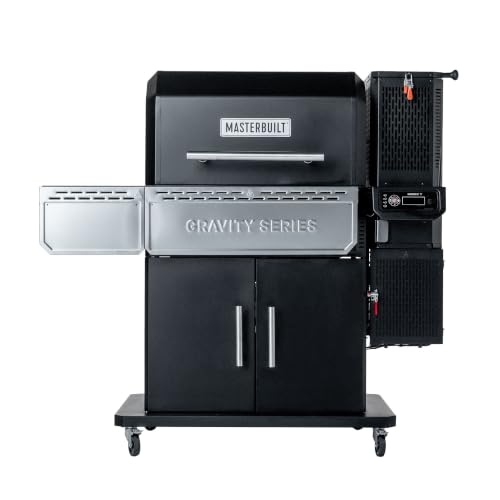
3. Masterbuilt Gravity Series 1150 Digital Charcoal Grill and Smoker — Best Automated Alternative
Honesty about format first: the Gravity 1150 is not a vertical cabinet — it is a horizontal cooker. It belongs in this guide because buyers shopping verticals over $500 are almost always shopping an outcome — large-capacity charcoal cooking with serious temperature control — and this is the outcome’s automated form: a GravityFed hopper, DigitalFan control across a 225°F to 700°F range, WiFi app monitoring and 1,150 square inches. If your reason for going premium was control, read this review before committing to a manual cabinet.
Strengths
- Set-and-hold temperature automation with real charcoal — the control the manual tier cannot offer
- 1,150 sq. in. matches cabinet-class capacity in a buy-it-today cooker
- WiFi monitoring makes overnight and all-day cooks genuinely low-attention
Trade-offs
- It is not a vertical: no stacked shelves, no column cooking — a different geometry entirely
- Electronics, fan and power requirements are ownership terms cabinets never impose
- Smoke profile is cleaner and milder than a cabinet’s or offset’s live fire
Key specs (from the verified listing)
- Cooking area: 1,150 sq. in.
- Fuel system: GravityFed charcoal hopper
- Controls: WiFi app control, DigitalFan temperature control
- Temperature range: 225°F to 700°F
Consider what the premium vertical buyer is often really purchasing: freedom from the fire’s schedule. Insulated cabinets buy it with mass — hours of stability per load. The Gravity buys it with a fan and a hopper, and buys more of it: set a temperature in the evening and the cooker, not your alarm clock, manages the night. For working households, that trade — a plug and some electronics for genuine unattended charcoal cooking at cabinet capacity — is the most consequential decision in this tier.
The counter-argument is the traditionalist’s, and it is respectable: a cabinet has nothing to plug in, nothing electronic to fail in year six, and a smoke character born of a coal bed rather than a fan. This guide does not resolve that argument; it insists you have it consciously. If the Gravity’s inclusion offends your sense of the category, the two reviews above and three below are your list. If it intrigues you, it may be the most useful review here.
Best for: buyers whose premium reason is control and capacity, and who accept electronics to get both / Not suited for: format purists and off-grid cooks — the cabinets below are your picks
Check on Amazon — check the current price on Amazon before you decide, and confirm the size and configuration on the listing match what you measured at home.
4. Backwoods Smoker Chubby 3400 (Insulated Cabinet) — Best Insulated Cabinet
Backwoods is one of the names that defines the insulated-cabinet world: vertical steel cabinets with insulated walls, built for competition teams and serious caterers, in a range of sizes of which the Chubby line is the household-and-small-team end. The format is the vertical idea perfected — shelves in a sealed, insulated column, a fire that sips fuel for many hours, and weather indifference that uninsulated steel cannot approach.
Strengths
- Insulation transforms the vertical format: tiny fuel use, long stable burns, winter-proof
- Cabinet shelves give true stacked production capacity in a small footprint
- Fabricator build quality and a competition pedigree earned over decades
Trade-offs
- Sold direct with fabricator lead times — no click-and-ship convenience
- Premium pricing well beyond the consumer tier, varying by configuration
- No Amazon listing we could verify — purchase, parts and support run through the maker
Why review a cooker we cannot link? Because above $500, this is where the vertical category’s centre of gravity actually sits, and a guide that pretended otherwise would mislead you about the market. Insulated cabinets like the Backwoods line are what serious vertical cooks graduate to: the same column you learned on a bullet, rebuilt with insulated walls and fabricator tolerances, until the fire’s behaviour changes category — loads measured in many hours, temperatures that hold through weather that would end a consumer cooker’s day.
Pursue it as you would any craft purchase: research the maker’s current range and specifications on their own channels, talk to owners, and expect a conversation and a wait rather than a checkout. We deliberately print no specifications or prices here, because we could not verify a listing and this guide does not invent numbers. What we can verify is the category’s verdict, consistent across the competition world: for insulated vertical capacity, this is one of the benchmarks.
Best for: serious and competition cooks graduating to insulated cabinet production / Not suited for: anyone who needs a cooker this month, at a consumer price, with marketplace convenience
Why there is no Amazon link: Backwoods Smoker is a fabricator that sells its insulated cabinet smokers direct; Amazon listing data verification searches returned no Backwoods cooker listing on Amazon, so we will not invent an ASIN or a marketplace link for it. Order through the maker’s own channels and confirm current specifications there. Flagged here for final-review verification.
5. Humphrey’s Smokers Battle Box (Insulated Cabinet) — Best Custom-Built Cabinet
Humphrey’s represents the other pole of the fabricator world: smaller-scale, made-to-order insulated cabinets — the Battle Box being its well-known mid-size — built with a reputation for fit, finish and customisation. Where Backwoods is the established production name, Humphrey’s is the craftsman’s: options, colours and configurations chosen with the maker, and a cabinet built for your cooking rather than a warehouse shelf.
Strengths
- Made-to-order build with custom options — the cabinet configured around your cooks
- Insulated vertical format with the fuel economy and stability the class promises
- A maker’s reputation for finish and detail that owners consistently praise
Trade-offs
- Build-to-order means lead time is part of the price
- Direct-sale only: no marketplace listing, returns or support infrastructure of a big brand
- Premium, configuration-dependent cost that we will not guess at here
The case for a Humphrey’s-style purchase is the case for craft goods generally: you are buying the last vertical smoker most owners ever buy, specified once, correctly. Shelf spacing for your pans, the door configuration your patio wants, the finish you will look at for twenty years — those decisions, made with a maker who builds one cabinet at a time, are what the premium over production cabinets actually purchases. The insulated column underneath is the same proven physics as every pick in this guide; the difference is that everything around the physics is yours.
As with the Backwoods, we print no specifications and no link: our verification found no marketplace listing to check, and this guide’s rule is that unverified products are described, not linked. Treat this review as a signpost — the maker’s own channels carry current models, options and lead times — and as a marker of what ‘over $500’ honestly means in this category: not a bigger Weber, but a different way of buying.
Best for: buyers commissioning a long-term, customised insulated cabinet as a final purchase / Not suited for: impatient buyers and anyone who values marketplace convenience over craft
Why there is no Amazon link: Humphrey’s Smokers builds its insulated cabinets to order and sells direct; no Humphrey’s cooker listing was returned by our API verification, so no Amazon link is offered and none should be substituted. Confirm current models and lead times with the maker. Flagged here for final-review verification.
6. Gateway Drum Smoker (Premium Drum) — Best Premium Drum
The drum branch of the vertical family has its own premium tier, and Gateway is its best-known name: drums built to competition tolerances, with the fit, finish and airflow refinement that separate a circuit cooker from a backyard barrel. If the Pit Barrel taught the market that hanging works, Gateway is where drum cooks go when they want the method at its most polished — hotter, cleaner and more consistent, drum after drum.
Strengths
- The hanging drum method refined to competition standard
- Premium build and airflow consistency beyond consumer drums
- A proven record on the competition circuit, where drums are judged blind
Trade-offs
- Sold mainly direct and through dealers — no verified Amazon listing to link
- Premium drum pricing that buys refinement, not extra capacity
- Still a drum: coarse temperature philosophy and brisket compromises apply
Gateway’s inclusion completes this guide’s honest map: over $500, every vertical branch has its summit, and the drum’s summit is a cooker like this. What the premium buys is not size — a drum is a drum — but repeatability: the same burn, the same cruising behaviour, cook after cook, which is the entire currency of competition and the quiet luxury of home cooks who run their drum weekly.
We list it unlinked for the same reason as the cabinets: our verification could not match a marketplace listing with confidence, and a guessed link would be worse than none. If the drum is your branch and this tier is your budget, the maker’s and dealers’ own channels are the route — and the comparison you should make is against the Pit Barrel in our main vertical guide, which delivers the same method at a consumer price and remains the value summit of the format.
Best for: drum devotees ready for the format’s premium, competition-grade expression / Not suited for: value seekers — the Pit Barrel delivers the method for far less
Why there is no Amazon link: Gateway Drum Smokers sells its premium drums primarily direct and through specialist dealers; our API searches did not return a Gateway cooker listing we could match with confidence, so this pick is not linked rather than linked on a guess. Flagged here for final-review verification.
Comparison Table
| Pick | Badge | Key spec | Best for |
|---|---|---|---|
| Weber Smokey Mountain Cooker 22-Inch | Best Overall | Size: 22-inch bullet (water) smoker | households wanting premium vertical performance with consumer convenience and support |
| Kamado Joe Classic Joe Series II 18-Inch Ceramic Charcoal Grill and Smoker | Best Ceramic Vertical | Cooking area: 250 sq. in. | settled, quality-first cooks buying a decades-long, fuel-sipping vertical cooker |
| Masterbuilt Gravity Series 1150 Digital Charcoal Grill and Smoker | Best Automated Alternative | Cooking area: 1,150 sq. in. | buyers whose premium reason is control and capacity, and who accept electronics to get both |
| Backwoods Smoker Chubby 3400 (Insulated Cabinet) | Best Insulated Cabinet | See review | serious and competition cooks graduating to insulated cabinet production |
| Humphrey’s Smokers Battle Box (Insulated Cabinet) | Best Custom-Built Cabinet | See review | buyers commissioning a long-term, customised insulated cabinet as a final purchase |
| Gateway Drum Smoker (Premium Drum) | Best Premium Drum | See review | drum devotees ready for the format’s premium, competition-grade expression |
This table spans consumer, ceramic, automated and fabricator cookers — categories that share a price line and little else. The Badge column tells you which summit each pick represents; there is no meaningful single ranking across them, and the reviews do not pretend one.
How to Choose a Charcoal Vertical Smoker Over $500
Begin by naming which of the tier’s three premiums you are actually buying. Insulation, if your cooks are long, your winters are cold or your volume is competition-shaped — that road leads to the fabricator cabinets. Permanence and efficiency, if your patio is settled and your menu is family-sized — that road leads to ceramic. Control, if your constraint is time and attention — that road leads either to a cabinet’s stability or, consciously, to the Gravity’s automation. If you cannot name your premium, you do not have one, and the under-$500 guides will serve you better for less.
Then prepare for a different purchase process. Consumer picks in this guide buy like consumer goods. Fabricator picks buy like commissions: research on the maker’s channels, conversations with owners, options chosen deliberately, and a lead time measured in weeks. That process is not a defect — it is how the category’s best objects have always been sold — but it rewards buyers who treat the purchase as a project and frustrates those who wanted a parcel by Friday.
Is an insulated cabinet worth it over a Weber Smokey Mountain?
For competition teams, caterers and cold-climate volume cooks: yes, clearly — the fuel economy, weather immunity and shelf capacity change what is possible. For a household cooking family loads in a temperate climate: rarely — the Weber delivers most of the food for a fraction of the commitment, and the difference buys years of meat. The honest dividing line is weekly volume and winter ambition, not enthusiasm.
How do you buy a fabricator smoker safely?
Deal with the maker directly through their official channels, get specifications, options, total cost and lead time in writing, and talk to existing owners in the maker’s community before committing. Expect deposits and build queues to be normal. What you should not do is buy a ‘fabricator-style’ cabinet from an unverified marketplace listing trading on the aesthetic — the insulation and tolerances are the product, and they are exactly what a lookalike cannot show you in a photo.
Why Are There So Few Vertical Smokers Over $500?
Because the format’s core technology — a sealed column over a fire — reaches most of its potential inexpensively. The Smokey Mountain’s design has been refined for decades at a consumer price; adding money buys refinement at the margins (insulation, ceramic, automation) rather than a new category of result. Contrast offsets, where steel thickness is destiny and money transforms the cooker, or pellet grills, where electronics scale with price. Verticals are the democracy of smoking formats: their summit is unusually close to their base camp.
That is genuinely good news disguised as a short list. It means the buyer with $500 does not need this tier at all, and the buyer with $2,000 for a cabinet is purchasing a specialist’s tool for named reasons — volume, winter, competition — not escaping inadequacy. Read this guide as a map of exceptions, and the main vertical guide as the territory itself.
The Competition Vertical: What Contest Cooks Actually Use and Why
Spend a weekend at a barbecue competition and the vertical landscape explains itself. The cookers doing the volume work are insulated cabinets and drums — cabinets for brisket and pork programmes that run on strict timelines through any weather, drums for ribs and chicken where their pace and flavour profile shine. The reasons are operational, not romantic: insulation means a fire loaded once behaves the same in a dawn frost as at noon; shelves mean a whole programme cooks in one footprint beside the trailer; and repeatability — the same burn, the same result — is worth more than any single cook’s brilliance.
Home buyers should steal the logic, not the scale. If your cooking has a programme — regular big cooks, a freezer to fill, events with deadlines — the cabinets’ virtues are your virtues at household size. If your cooking is improvisational and intimate, competition logic points the other way: toward the cooker that lights fastest and cleans easiest, which in this tier is the kamado or the Weber. The contest circuit is a wonderful teacher of what matters, provided you translate its lessons to your own menu before spending its money.
Insulation Explained: What the Cabinet Premium Actually Buys
Since insulation is this tier’s central claim, it deserves plain physics. An uninsulated steel wall passes heat freely: the fire inside must replace what the wall sheds, and the shedding rate is set by the weather — which is why an uninsulated cooker’s fuel use and temperature behaviour change with the wind. An insulated wall — two steel skins with insulation between — cuts that loss dramatically. The fire’s output goes into the food and the column instead of the sky, burns stretch from hours to most of a day on a single load, and the cooker’s behaviour in a frost starts to resemble its behaviour in June. That is the whole miracle, and it is a real one: not better barbecue per se, but the same barbecue with the weather variable nearly deleted.
What insulation does not buy is equally worth stating. It does not improve smoke flavour — the fire and the wood decide that, insulated or not. It does not add capacity by itself; shelf count does that. And it does not forgive bad fire management — a smouldering, dirty fire in an insulated cabinet produces efficiently insulated bad smoke. Buy insulation for the reasons physics supports: fuel economy, burn length and weather independence at volume. Buyers whose cooks are short, whose climate is kind and whose loads are family-sized are purchasing a solution to problems they do not have — which is, once more, why the Weber in this guide keeps winning the overall badge against cookers costing several times its price.
A Final Word on Value at the Top of the Vertical Market
Value at this tier is measured in decades and in cooks, not in discounts. A fabricator cabinet that serves twenty years of weekly cooks costs less per cook than a consumer smoker replaced three times — provided the weekly cooks actually happen. A ceramic that outlives its owner is the cheapest cooker in this guide by the same arithmetic — provided it is cooked on. The premium vertical market punishes only one buyer: the one who purchases permanence for a hobby that turns out to be occasional. If your last year of cooking says otherwise — if the cooks are frequent, the loads are growing and the weather has ended sessions you cared about — then this tier is not an indulgence. It is the correct tool, bought once, at the moment your cooking earned it.
The Short Version
Pressed for the one-paragraph version: above $500, buy the Weber 22 for performance with convenience, the Kamado Joe for permanence, the Gravity for control, or commission a cabinet for volume and winter — and if none of those four sentences names your situation, your smoker is in the guide below this tier, at a friendlier price, with our blessing.
How to Read the Rest of This Series From Here
If this guide has done its job, you now know which of the three premiums — insulation, permanence or control — is actually yours, and the rest of the series falls into place around that answer: the main vertical guide for the family in full, the water-smoker guide for the buffered branch, and the price-tier guides for the same cookers seen through a budget lens. Read them in that order and the charcoal market, which looked like a wall of near-identical barrels, resolves into a short list of honest choices.
How to Run an Insulated Vertical Cabinet (and Season Any Premium Vertical)
Premium verticals share a first-month ritual: seasoning, calibration and note-taking. The steps below are written for the insulated cabinets, with notes for the ceramic and the Weber — because at this tier, the setup is an investment you make once and draw on for years.
- Season the cooker per the maker’s instructions: a light oil coat on interior steel and grates, then a moderate burn for several hours to cure surfaces and burn off manufacturing residues.
- Run a calibration cook with no food at stake: a standard fuel load, vents set by the book, and a probe at each shelf level, logging how the column stratifies and where it settles.
- Cook something forgiving first — pork butt is the traditional choice — and record fuel used, weather, vent positions and timing in a permanent notebook or app.
- Learn your refuel interval from evidence: how many hours your load holds range in your climate, and at what point a top-up keeps the cook seamless rather than rescuing it.
- For ceramic: build fires with lump, approach temperatures from below, and never shock a hot body with cold water. For the Weber: seal the door if it weeps and standardise your charcoal ring.
- Establish the cleaning rhythm from day one: ash out after every cook (insulated cabinets forgive much, but not damp ash), grates brushed warm, gaskets and seals inspected monthly.
- After three cooks, write your standard settings down where future-you will find them. A premium vertical’s value compounds with exactly this kind of documented routine.
The difference between this tier and the cheaper guides is not that the rituals change — it is that the cooker rewards them for a decade or more. Season carefully, calibrate honestly, and the cabinet, kamado or Weber you buy here becomes the fixed point your cooking organises itself around.
Common Buying Mistakes
Assuming over $500 must mean better for you. This tier buys insulation, permanence and control — not universally better barbecue. If your frustration is not named by one of those three, the premium purchases nothing you will taste.
Buying a fabricator cabinet on a deadline. Lead times are real and makers will not apologise for them. If the cooker must serve a fixed event, buy the consumer picks and commission the cabinet for next season.
Trusting a marketplace lookalike cabinet. Insulation and tolerances are invisible in photos. A cheap ‘insulated-style’ cabinet without a verifiable maker is the most expensive mistake available in this category.
Skipping calibration on a premium cooker. A cabinet’s shelf personalities and a kamado’s vent language are learned in the first three cooks or fought for a year. Spend the cheap cuts and the notebook pages early.
Treating the Gravity as a vertical because it is in this guide. It is here as a declared cross-shop alternative, not a format claim. Buy it for automation and capacity if those are your premiums — not as a substitute for stacked-shelf cooking.
Final Recommendation
The honest summary of a thin tier: the Smokey Mountain 22 is the premium vertical most households should buy; the Kamado Joe Classic II is the connoisseur’s permanent cooker; the Gravity 1150 is the control-seeker’s declared alternative; and the Backwoods, Humphrey’s and Gateway represent where the category’s true top end lives — direct-sold, made seriously, and reviewed here without links because honesty outranks convenience. If none of the three premiums — insulation, permanence, control — is yours, spend below this line with a clear conscience.
Continue downwards to the full family in Best Charcoal Vertical Smokers, or to the water-pan branch in Best Charcoal Water Smokers; the price-tier views are in Best Charcoal Smokers Under $500 and Best Charcoal Smokers Under $800 Dollars.
- Weber Smokey Mountain Cooker 22-Inch — check price on Amazon
- Kamado Joe Classic Joe Series II 18-Inch Ceramic Charcoal Grill and Smoker — check price on Amazon
- Masterbuilt Gravity Series 1150 Digital Charcoal Grill and Smoker — check price on Amazon
Best Charcoal Smokers Under $500 Dollars
Related guides
Frequently Asked Questions
Why are there so few vertical smokers over $500?
Because the format’s core design — a sealed column over a fire — reaches most of its potential at consumer prices. Above $500 you are buying specific premiums (insulation, ceramic permanence, automation), not a generally better smoker, so the honest list is short and specialised rather than long and padded.
Are insulated cabinet smokers worth the money?
For competition, catering, high volume or serious winter cooking, yes — fuel economy, stability and shelf capacity transform what a vertical can do. For typical household cooking, the same money is usually better spent below this tier, with the difference funding years of fuel and meat.
Why do three picks in this guide have no Amazon link?
Because those makers sell direct and our verification found no marketplace listing for their cookers. Rather than invent an ASIN or link a lookalike, we reviewed them unlinked and said why. It is the same honesty rule as the rest of this series, applied where it costs us links — which is exactly where it matters.
Is a kamado really a vertical smoker?
In structure, yes: fire at the base, food above in a rising column of heat, sealed under a lid — the oldest vertical arrangement there is. It is included because vertical shoppers cross-shop it constantly at this price, and its insulation makes it the efficiency benchmark of the tier.
What should a first premium vertical be?
For most households, the Smokey Mountain 22: premium performance, consumer convenience, and a price that leaves the fabricator decision for later, when your cooking has told you whether you need insulation or volume. Buy the cabinet when a named limitation of the Weber — winter fuel, shelf count, unattended hours — is costing you real cooks.
How long do fabricator cabinets last?
They are built as long-service equipment: heavy steel, replaceable seals and hardware, and makers who support their cookers for years. Treated with the ash-and-cover discipline every smoker deserves, a quality insulated cabinet is realistically a decades-long purchase — which is the entire premise of its price.


