Disclosure: airfryerkitchensupply.com is reader-supported. When you buy through links on our site, we may earn an affiliate commission at no extra cost to you.
Where to buy
For best digital mixers for live outdoor sound, start here: Outdoor mixers face sun, dust, distance and weather — buy current production models with cases and support, as every linked pick here is. Every linked pick below was verified against Amazon’s catalog before this guide was written, so the product you land on is the product described. Linked picks say “check price on Amazon” because live pricing changes too often to print honestly. Picks marked as unlinked are real products sold mainly outside Amazon; they are described in full, with no purchase link, rather than replaced with a weaker substitute.
Behringer X AIR XR18 (Best Overall): Check on Amazon — check the current price on Amazon.
Allen & Heath Qu-16C (Best Rackmount Upgrade): Check on Amazon — check the current price on Amazon.
Allen & Heath CQ-18T (Best for Small Stages): Check on Amazon — check the current price on Amazon.
Yamaha TF1 (Best Fader Surface): Check on Amazon — check the current price on Amazon.
Zoom LiveTrak L-12 (Best for Recording Every Session): Check on Amazon — check the current price on Amazon.
Soundcraft Ui12 (Best Budget): Check on Amazon — check the current price on Amazon.
Introduction: what actually matters here
The best digital mixers for live outdoor sound are chosen by the failures they prevent: a screen you cannot read in sunlight, a tablet connection that drops across a field, a mix position a hundred metres from the stage, and wind that turns every open microphone into a noise source. The six mixers below — stage boxes and compact consoles verified through Amazon’s catalog — were picked for outdoor duty specifically, not merely reused from an indoor list.
Outdoors removes the room and adds the elements. There are no walls to help the PA, so system headroom and clean gain matter more; there is also no ceiling to bounce feedback around, which forgives some sins while punishing others. Digital mixers help disproportionately outside: recall for repeat festival slots, remote control that frees the engineer from a distant tent, and processing — high-pass filtering above all — that tames wind and handling noise at the source.
One truth before the picks: no mixer weatherproofs itself. Every recommendation below assumes a case, a canopy or tent for the operating position, and cable discipline. The mixers differ in how gracefully they work under those conditions — sunlight readability, network robustness, and how much console you must expose to the weather at all.
In this guide
Quick Picks
Behringer X AIR XR18 — Best Overall: The outdoor default: the mixer lives under the stage canopy while the engineer mixes from anywhere the audience is. — Check on Amazon
Allen & Heath Qu-16C — Best Rackmount Upgrade: The festival-console pick: a real surface for changeovers, readable at a glance, expandable for bigger outdoor bills. — Check on Amazon
Allen & Heath CQ-18T — Best for Small Stages: Touchscreen speed with feedback assistance — strong for community outdoor events run by small crews. — Check on Amazon
Yamaha TF1 — Best Fader Surface: Motorised faders you can see in sunlight and Yamaha reliability for outdoor seasons that run all summer. — Check on Amazon
Zoom LiveTrak L-12 — Best for Recording Every Session: The outdoor band’s recorder: run the show and capture it, with monitor mixes for the whole line-up. — Check on Amazon
Soundcraft Ui12 — Best Budget: The small outdoor event box: park ceremonies, sports days and garden parties with browser control and minimal exposure. — Check on Amazon
How These Picks Were Chosen
Picks were ranked for outdoor realities: stage-box designs that keep the expensive electronics under the stage canopy scored highest, followed by consoles with readable screens and motorised faders that show their state in bright light. Each model was matched by brand and model against its Amazon listing title before linking.
Network planning is treated as part of the product outdoors. A tablet mixer is only as good as its link across an open field, so the guidance assumes a quality external router with line-of-sight placement — the mixers’ built-in Wi-Fi is a rehearsal convenience, not a festival plan, and the reviews say so where it matters.
Channel and bus counts follow the live-band logic of full line-up plus spares, with an extra outdoor consideration: ambient and audience microphones for recordings and streams are common outside, and they consume inputs that indoor counts forget.
The 6 Best Options: Best digital mixers for live outdoor sound in detail
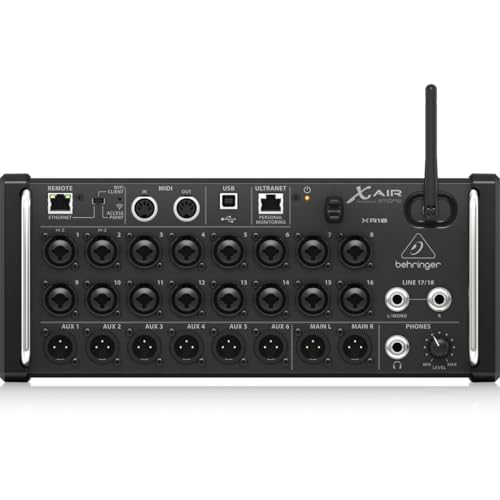
Behringer X AIR XR18 — Best Overall
Outdoors, the stage-box pattern stops being a convenience and becomes weather strategy. The XR18 sits in a rack under cover at the stage, short microphone cables stay dry and tidy, and the engineer walks the field with a tablet — checking the mix at the food stalls and the back fence, where outdoor sound actually succeeds or fails.
Strengths
- Stage-box form keeps electronics under cover; only a tablet faces the weather
- Walking-the-field mixing finds dead spots no fixed tent position reveals
- Multi-track recording captures the set for the band regardless of conditions
Trade-offs
- Demands a serious external router and line-of-sight discipline outdoors
- Tablet screen needs a shade hood in direct sun
- Rain on the operator is still rain on the operator — dress the human too
Key specs (verified): 18 channels, 12 buses, 16 programmable Midas preamps, built-in Wi-Fi, multi-channel USB audio interface (per Amazon title)
Its outdoor party trick is the soundcheck: record the rehearsal multi-track, then play it back and walk the entire audience area alone, tuning coverage and delay fills without the band waiting in the heat. Outdoor engineers who adopt virtual soundcheck stop guessing how the back of the field sounds — they have stood there, listening, before gates opened.
The XR18’s outdoor network plan deserves specifics: mount the router high on a speaker stand or pole at the stage, keep the mix position within honest line of sight, and rehearse the walk — tablet in hand, full audience area — at soundcheck, noting dead spots before the crowd fills them with signal-absorbing bodies. Bands and engineers who map the field early mix the whole show from data; those who discover the dead zone during the headline set mix the encore from hope.
Best for: Festivals, fairs and outdoor stages with roaming engineers / Not suited for: Fixed outdoor installations wanting a permanent console in a booth
Check on Amazon — check the current price on Amazon before you buy, and confirm the exact configuration in the listing title matches the model reviewed here.

Allen & Heath Qu-16C — Best Rackmount Upgrade
Multi-band outdoor days are changeover contests, and the Qu-16C’s show-and-scene system is built for them: each band’s file recalled in seconds, a surface a visiting engineer can read instantly in daylight, and stage-box expansion when the headline production outgrows the base inputs.
Strengths
- Scene-per-band workflow survives the tightest festival turnarounds
- Physical surface reads clearly in bright conditions — no squinting at glass
- Expansion path covers growth from local fair to regional festival
Trade-offs
- The console itself needs a proper tent and weather discipline
- Heavier logistics than a stage box — crew and cases required
- Depth is wasted on a single-band picnic concert
Key specs (verified): Rack-mountable compact digital mixer, Chrome Edition (per Amazon title)
Outdoor engineers judge consoles by the worst ten minutes of the day: a storm delay, a swapped running order, a guest vocalist. The Qu’s file discipline and legible surface are designed for exactly those minutes, which is why it anchors professional outdoor bills rather than merely appearing at them.
Festival Qu-16C crews should build a changeover kit around the console: printed input lists per band, a labelling routine that survives excitement, and show files collected from bands in advance wherever possible. The console’s recall speed is only realised when the paperwork around it moves at the same pace — a truth every festival stage manager learns once, expensively, in front of an audience.
Best for: Festival and multi-band outdoor production with an engineer / Not suited for: Solo operators running a single band in a park
Check on Amazon — check the current price on Amazon before you buy, and confirm the exact configuration in the listing title matches the model reviewed here.

Allen & Heath CQ-18T — Best for Small Stages
Town fairs, school sports days and outdoor worship share a profile: a small crew, a mixed programme of speech and music, and no time for ceremony. The CQ-18T’s guided setup, feedback suppression for roving speech microphones, and compact footprint suit that profile — the whole rig can live under one gazebo with the operator.
Strengths
- Feedback assistance helps roving speech mics — the outdoor community-event staple
- Compact footprint fits a single-gazebo FOH
- Bluetooth playback covers ceremony music and announcements beds
Trade-offs
- Touchscreen glare management needed in direct sun — position and shade it
- Input count suits community scale, not festival scale
- Newer platform for hire-fleet familiarity
Key specs (verified): Digital mixer with 7-inch touchscreen, Wi-Fi and Bluetooth connectivity (per Amazon title)
Speech outdoors is harder than music: wind, distance and reflective nothing conspire against intelligibility. The CQ’s processing priorities — clear vocal channels, fast setup, forgiving automation — match the actual programme of most outdoor community events, where the mayor’s microphone matters more than the drum submix.
The CQ-18T’s community-event strength compounds with a simple accessory: a shade hood or a repositioned gazebo wall that keeps direct sun off the screen during the programme’s peak. Outdoor touchscreen work is a lighting problem with a lighting solution, and crews who solve it in setup enjoy the interface’s speed all day; crews who fight glare hourly conclude, unfairly, that touchscreens fail outdoors.
Best for: Community events, outdoor worship and school productions / Not suited for: Large festival main stages
Check on Amazon — check the current price on Amazon before you buy, and confirm the exact configuration in the listing title matches the model reviewed here.

Yamaha TF1 — Best Fader Surface
For a summer season of outdoor dates with a regular position — a bandstand, a resort stage, a weekly market — the TF1 offers a console whose state is visible physically: faders show the scene, labels read in daylight, and presets speed the weekly repetition of a known programme in a known space.
Strengths
- Motorised faders display the mix without relying on screen brightness
- Preset workflow suits repeating outdoor programmes
- Yamaha build and support suit season-long installations
Trade-offs
- Console format needs weather cover and a stable position
- Less suited to roaming, mix-from-the-crowd working
- Preset crutch risk if operators stop walking the audience area
Key specs (verified): 16 channels, motorised faders, touchscreen with Touch & Turn workflow (per Amazon title class)
Season work rewards boring excellence: the same rig, the same programme, improving weekly. The TF1’s recall-plus-faders combination lets a venue refine an outdoor mix across a season instead of restarting each Saturday, and its reliability record matches equipment that cannot have a bad day in August.
Season-long TF1 installations benefit from a weather log alongside the show file: temperature, wind and any rain events noted against each date. Patterns emerge — the evening the wind turns off the water, the bank-holiday crowd that absorbs the top end — and the season’s later mixes improve on evidence. Outdoor sound is local knowledge accumulated; the TF1’s recall makes that knowledge executable, and the log makes it real.
Best for: Bandstands, resorts and repeating outdoor programmes / Not suited for: One-off field festivals with roaming engineers
Check on Amazon — check the current price on Amazon before you buy, and confirm the exact configuration in the listing title matches the model reviewed here.

Zoom LiveTrak L-12 — Best for Recording Every Session
Bands playing outdoor circuits — weddings in gardens, festival fringes, brewery yards — get double duty from the LiveTrak: it mixes the show with independent monitor mixes and records the multi-track to SD under the same canopy, no laptop exposed to sun or spilled drinks.
Strengths
- SD recording removes the laptop from the weather equation
- Multiple monitor mixes serve full bands on outdoor stages
- Scenes per venue type speed repeat outdoor bookings
Trade-offs
- 12 channels require planning for larger outdoor line-ups
- Console needs the same canopy discipline as any surface
- Small faders in bright light demand a deliberate operating position
Key specs (verified): 12 channels, records to SD card while mixing, USB audio interface (per listing class)
Outdoor recordings are disproportionately valuable — festival footage books next year’s festivals — and the LiveTrak’s always-available recording means the set that went brilliantly is the set that got captured. For a band building an outdoor circuit, that archive is a business asset, not a souvenir.
LiveTrak outdoor bands should protect the recording habit against the elements literally: spare SD cards in a sealed pouch, a shaded home for the desk, and a load-out routine that backs the card up before the social hour. Festival footage lost to a damp card or a forgotten copy is the one unforced error this pick’s owners report — the desk did its job in the sun; the filing must do its job in the tent.
Best for: Outdoor-circuit bands recording every show / Not suited for: Production companies running large festival stages
Check on Amazon — check the current price on Amazon before you buy, and confirm the exact configuration in the listing title matches the model reviewed here.

Soundcraft Ui12 — Best Budget
For small outdoor programmes — a ceremony PA, a sports-day announcer plus music, a garden-party band — the Ui12 keeps the hardware footprint tiny and covered: one small box near the speakers, control from a phone under any shade, scenes for the running order, and nothing expensive sitting in the sun.
Strengths
- Minimal hardware exposure — the box lives covered by the speakers
- Any phone controls it; no console tent required for small events
- Scenes follow a ceremony running order reliably
Trade-offs
- Limited inputs and buses cap programme ambition
- Control depends on the network you set up — do it at home first
- No recording path for events that need an archive
Key specs (verified): 12 inputs, remote-controlled via browser on any device, built-in Wi-Fi access point (per Amazon title class)
Small outdoor events fail through fuss, not fidelity: too much rig, too many cables, too much to go wrong in public. The Ui12’s restraint is its qualification — a complete, recallable PA brain that one person can carry, cover and operate while also running the event.
Small-event Ui12 operators should rehearse the one failure that matters: loss of control connection mid-ceremony. The audio continues — the box does not stop because a phone slept — but the operator who has practised reconnecting calmly, and who sets conservative levels for unattended stretches, runs ceremonies without the visible panic that guests remember longer than the vows.
Best for: Ceremonies, sports days and small outdoor gatherings / Not suited for: Festival stages or full outdoor band production
Check on Amazon — check the current price on Amazon before you buy, and confirm the exact configuration in the listing title matches the model reviewed here.
Comparison Table
| Pick | Badge | Key spec | Best for |
|---|---|---|---|
| Behringer X AIR XR18 — Check on Amazon | Best Overall | 18ch / 16 Midas preamps / Wi-Fi | Festivals, fairs and outdoor stages with roaming engineers |
| Allen & Heath Qu-16C — Check on Amazon | Best Rackmount Upgrade | Rackmount / 16ch class | Festival and multi-band outdoor production with an engineer |
| Allen & Heath CQ-18T — Check on Amazon | Best for Small Stages | Touchscreen / Wi-Fi / Bluetooth | Community events, outdoor worship and school productions |
| Yamaha TF1 — Check on Amazon | Best Fader Surface | 16ch / motorised faders | Bandstands, resorts and repeating outdoor programmes |
| Zoom LiveTrak L-12 — Check on Amazon | Best for Recording Every Session | 12ch / SD multitrack recording | Outdoor-circuit bands recording every show |
| Soundcraft Ui12 — Check on Amazon | Best Budget | 12 inputs / browser control | Ceremonies, sports days and small outdoor gatherings |
How Do You Plan Delay Fills and Coverage for Larger Outdoor Areas?
Coverage planning starts with honesty about distance: beyond a certain depth, a single pair of main speakers cannot deliver both level and clarity, and delay fills — secondary speakers timed to the mains — stop being a luxury. The mixer requirement is outputs and delay processing, which the leading picks here provide; the skill is placement and level, fills audible as clarity at the back rather than as a second, competing source.
Tune fills by walking: familiar music, the full area, adjustments in small steps, and a trusted second pair of ears at the mix position while you walk the extremes. Store the result in the venue scene — outdoor sites repeat (festivals, sports grounds, market squares), and last year’s tuned coverage is next year’s head start, adjusted for this year’s layout rather than rebuilt from silence.
Resist solving depth with volume. A main system pushed to reach the back punishes the front rows, fatigues the audience and still smears consonants at distance. The professional outdoor sound that impresses crowds is rarely the loudest; it is the one where the back row hears words — and words are a coverage product, not a power product.
What Does an Outdoor Weather Plan for Audio Actually Include?
A weather plan names thresholds in advance: the wind speed that grounds tall speaker stands, the lightning rule that stops the show and who calls it, the rain covers staged before they are needed, and the load-out order that protects electronics first when a storm ends the day early. Decided calmly in the office, these rules protect people before equipment — the only correct priority — and protect equipment better than improvisation ever does.
Covers and cases are the plan’s hardware: canopies that shed sideways rain, not just vertical; cable paths that avoid gathering water; connectors off the ground on every run; and silica-dry storage after any damp event. Outdoor audio gear rarely dies dramatically — it corrodes, intermittently, over a season of small neglects, and the plan exists to interrupt that story.
Finally, the plan includes the audience’s experience of weather decisions: announcements ready, programme flexibility agreed with organisers, and a mixer scene for the ‘acoustic, under-cover’ contingency where one exists. Shows are remembered for how their worst ten minutes were handled; the weather plan is written for exactly those minutes.
How Should Outdoor Crews Handle Power, Grounding and Safety Breaks?
Outdoor power distribution belongs to qualified hands and local rules: this guide’s position is deliberately conservative — use distribution designed for the environment, keep connections covered and elevated, and take local professional advice for anything beyond the smallest systems. A mixer guide that improvised electrical instruction would be failing its readers; the professional habit is knowing which questions are yours and which belong to an electrician.
Breaks in the programme are part of the safety system: heat, sun and physical load degrade crew judgement across a long outdoor day, and the soundcheck-at-noon, show-at-nine schedule hides a fatigue curve. Rotate the walking checks, shade the operator position, and treat water and rest as rig items. The mix at hour ten is made by the crew care taken at hour four.
Document incidents and near-misses in the show log alongside the audio notes. Outdoor production improves the way aviation does — by writing down what nearly went wrong while it is fresh, and changing one procedure before the next date. The log that began as mix notes becomes, over a season, the crew’s real qualification.
Which Outdoor Scenario Fits Which Mixer? A Decision Walk-Through
Scenario one: a community calendar — fairs, sports days, outdoor worship, school productions — run by a small crew under one gazebo. The CQ-18T’s guided speed and feedback help, or the Ui12 for the smallest programmes, fit the reality that the operator also unlocks the hall and makes the tea. Prioritise shade for the screen, a printed running order taped to the case, and scenes named by event segment rather than by band.
Scenario two: a working band on the outdoor circuit — gardens, brewery yards, festival fringes — recording its progress. The XR18’s covered stage box and roaming control is the circuit standard for a reason, with the LiveTrak as the choice when guaranteed recording outranks roaming. Either way, the router rides high, the field gets walked at soundcheck, and the show file carries the venue’s name into next year’s diary.
Scenario three: a festival or multi-band day with changeovers timed in minutes. The Qu-16C’s scene-per-band discipline, fed by input lists collected in advance, is the professional pattern; the TF1 serves the single-stage, single-programme version of the day with fader-visible calm. Crew the changeovers like pit stops — roles named, cables staged, paperwork printed — and the console’s speed becomes the day’s speed.
Scenario four: a season-long outdoor position — bandstand, resort, weekly market — where the same programme improves across a summer. The TF1’s recall-plus-faders, kept in a weather-planned installation with a season log, compounds small weekly gains into a noticeably better August than June. Season work rewards the boring virtues — documentation, maintenance, the same rig set the same way — more than any single feature this guide can name.
Your Pre-Purchase Checklist: Seven Questions Before the Season Starts
One: have you walked your largest audience area and counted the outputs coverage truly needs — mains, fills, monitoring, recording and stream feeds — against the candidate mixer’s real output count? Two: what is the control plan at maximum distance, with the crowd in place — which router, mounted where, tested on which rehearsal walk? Both questions are answered outdoors, in the venue, or they are not answered at all.
Three: where does the electronics’ weather come from — which canopy, which cases, which cable ramps — and is that protection budgeted as part of this purchase rather than as a later apology? Four: how readable and operable is the control surface at your showtime sun angle, tested, not assumed? A five-minute test with the actual device at the actual hour settles arguments that specifications cannot.
Five: what are your show’s weather thresholds — wind, lightning, rain — who calls them, and does the running order have a covered contingency the mixer can recall instantly? Six: is the power plan professionally sound for your scale, with local advice taken where the system outgrows the smallest class? This guide’s conservatism here is deliberate and should be copied.
Seven: what gets logged after every date — coverage notes, weather, incidents, the mix changes that worked — and whose job is the log? Outdoor sound is a local-knowledge business accumulated across seasons, and the crews that write it down own an asset their competitors rent afresh each summer. The mixer you choose will execute that knowledge; the checklist ensures the knowledge exists.
After the First Month of Outdoor Dates: Lessons the Field Teaches
The field’s first month writes its lessons in specifics: the venue where the router’s honest range ended ten metres short, the afternoon the sun found the screen at exactly showtime, the car park surface that turned every cable run into a trip hazard with a soundtrack. Written into the show log the same evening, these are next month’s setup improvements; remembered vaguely in the van, they are next month’s repeat performances, at the same venues, in front of the same organisers.
Review the recordings and the coverage notes together — the back-of-field judgement you made at soundcheck, tested against what the recording and the audience’s behaviour said during the show. Outdoor engineers calibrate themselves this way, venue by venue, until their first walk of a new field carries the accumulated evidence of every previous one. That calibration, not any console feature, is the professional product an outdoor crew is really selling.
Then do the maintenance the month earned: connectors inspected, cases dried and aired, covers washed of the season’s first dust, the weather kit replenished before it is needed at a run. Outdoor equipment ages in public, one small neglect at a time — the crews whose rigs look and behave identically in August and May are not luckier; they are simply the ones whose debriefs end in actions with owners.
A Note on Hiring, Sharing and Second-Hand Outdoor Rigs
Outdoor production has always shared equipment — festivals pool backline, towns share PA across the summer’s events, bands borrow the desk that lives in the village hall. Digital mixers suit sharing unusually well when their owners use show files properly: your configuration travels on a stick, the borrowed desk becomes yours for the day, and the owner’s settings return untouched at load-out. The discipline is reciprocal and learnable in one event: save before you change, name what you save, restore what you found.
Hiring deserves its arithmetic done honestly for occasional outdoor users: a summer of three events may cost less hired, with an engineer attached, than owned, cased, stored and insured. The crossover arrives quietly — usually the season the diary fills — and the mixers in this guide are priced and sized for the owning side of that line. Rent first if your calendar is young; the hire company’s desk will also teach you, at their maintenance expense, which shape of mixer your events actually need.
Second-hand outdoor purchases carry one extra inspection: the weather history. Ask where the desk has worked, open the case and look for the tide marks of damp load-outs, test every connector for the intermittence corrosion leaves behind. Outdoor gear ages by its wettest night, not its average one — and a desk that has been dried, serviced and honestly described by its previous crew is worth more than a younger unit with a mysterious past and a very clean listing photograph.
One More Thing: The Audience Remembers the Words
Outdoor audiences forgive many things — a late start, a brave set list, weather that tested everyone’s commitment — but they remember, with unusual precision, whether they could hear the words. Speeches, lyrics, announcements, vows: the spoken and sung content is the event, and everything in this guide — coverage, filtering, walking the field, protecting the electronics — exists to deliver syllables intact across open air to the person standing furthest away, who paid the same attention as the front row.
Judge your purchase, finally, by that listener. The mixer that frees you to stand where they stand, hear what they hear and fix it before the gates open is the right one, whatever its channel count. Buy it, walk with it, log what the field teaches you — and let the back row’s experience, season after season, be the review that matters.
A Final Word on Craft
Outdoor sound is a craft practised in public, in weather, against clocks — and its practitioners are made, not born, one logged event at a time. The mixer you choose from this guide is your instrument in that apprenticeship: forgiving where the day is hard, exact where your growing skill can use exactness, and reliable in the specific, unglamorous ways that let attention flow to the audience instead of the equipment. Buy it, then go and stand in fields with it, season after season, notebook in hand. The craft will do the rest — it always has, for everyone willing to walk the whole audience area and listen.
One Practical Promise to Make Your Crew
Promise this: every outdoor date ends with ten protected minutes — log written, recordings safe, kit dried or flagged for drying, one improvement named for next time — before the social part of load-out begins. Ten minutes, defended like a soundcheck, is where outdoor seasons are won: the corroded connector caught in June instead of failing in August, the coverage note that makes next year’s festival feel like a home game. Crews keep promises like this in their bodies, not their documents — start with the next date, and let the habit compound, event after event, season after season, without exception or apology.
How to Choose a Mixer for Outdoor Sound: Coverage, Control and Weather?
Outdoor sound is coverage first. With no room to reinforce the PA, the audience area is covered by loudspeaker placement and delay fills, and the mixer’s job expands: enough outputs for mains plus delays, recall to reproduce a tuned setup at repeat venues, and an engineer free to walk the area — the strongest argument for stage-box control outdoors. Judge candidate mixers by outputs and control freedom before channel glamour.
Control distance is the second test. A tablet link that works across a living room may fail across a field with a crowd absorbing signal. Plan an external router, elevated and line-of-sight, on a dedicated network — and prefer mixers whose control ecosystem is proven at distance, as the leading picks here are. Wired control backup for the main position is professional paranoia worth copying.
Weather discipline is the third test, and it is about your system, not the badge: cases that close, canopies that shed water sideways, cable ramps that keep connectors out of puddles, and a power plan with proper distribution and protection. The mixer that survives outdoors is the one whose owner planned the boring parts.
How Do You Fight Wind Noise and Feedback Outdoors?
Wind is a microphone problem before it is a mixer problem: fit proper foam or furry windshields to every outdoor microphone, position mics out of direct gusts where the programme allows, and then let the mixer help — high-pass filters on vocal and speech channels remove the low-frequency rumble wind generates, and gentle gating on spoken channels cleans the gaps. Every pick here provides per-channel high-pass filtering; use it more aggressively outdoors than you ever would indoors.
Feedback outdoors behaves differently: fewer reflections mean ringing starts later but PA-to-audience distances are longer, tempting operators to push gain. Resist with placement — speakers forward of microphones, aimed at the audience and away from the stage — and with the feedback-assistance tools on picks like the CQ-18T as a safety net rather than a strategy.
Finally, soundcheck at show volume in show conditions where permitted: a system rung out quietly at noon behaves differently at full level in evening air. Recallable scenes let you store the honest, full-volume result rather than the polite midday approximation.
What Power and Cabling Rules Keep Outdoor Shows Safe?
Outdoor power is a safety discipline, not a shopping list: use distribution designed for the environment, keep connections elevated and covered, protect circuits appropriately, and route cables so neither vehicles nor crowds can damage them. When in doubt, a qualified local electrician’s advice outranks any guide — including this one.
Signal cabling follows the same conservatism: balanced lines for distance, cable ramps at crossings, spare runs for the lines that would end the show if cut, and connectors inspected after every wet load-out. Digital mixers reduce cable bulk dramatically — one network or digital snake line can replace a heavy analogue multicore — which is itself an outdoor safety and logistics win worth factoring into the purchase.
How to Set Up an Outdoor Mix That Survives the Whole Audience Area?
Outdoor setup is a walking discipline. The mix position is a starting point, not a verdict — build the routine below into every outdoor date.
- Site the stage box or console under cover first, run power safely, and establish the control network with the router elevated and line-of-sight to the mix area.
- Line-check every input, apply generous high-pass filtering to vocal and speech channels, and fit windshields before judging any microphone’s sound.
- Set mains and any delay fills by walking the audience area with familiar music, adjusting coverage and delay levels at the extremes — back, sides and front rows.
- Use recorded rehearsal playback (virtual soundcheck) to refine the mix across the whole area without exhausting the band in the heat.
- Ring out speech microphones at show level in their real positions, store the result as the show scene, and note sun position — the screen that was readable at soundcheck may not be at showtime.
- During the show, walk the area at least twice; outdoor conditions, crowd size and air temperature all move the mix after gates open.
After the event, dry everything before cases close, inspect connectors, and log what the extremes of the audience area actually sounded like. Outdoor mixing improves venue by venue, notebook by notebook.
Common Buying Mistakes
Trusting built-in Wi-Fi across a field. Crowds absorb signal and distances grow. An elevated external router on a dedicated network is the professional baseline.
Mixing only from the tent. The mix position is the one place the audience is not. Walk the area at soundcheck and during the show, or accept that you mixed for yourself.
Skipping windshields and high-pass filters. Wind rumble eats headroom and clarity. Foam, fur and filters are the cheapest outdoor upgrade that exists.
Exposing the console to ‘a dry forecast’. Weather changes and sprinklers exist. Cover the electronics as if rain were scheduled, every time.
Forgetting delay fills for deep audience areas. A louder main PA is not coverage. Outputs for fills are a mixer requirement for larger outdoor crowds — count them before buying.
Final Recommendation
For most outdoor work the XR18’s covered stage box plus roaming control is the pattern to beat, with the Qu-16C serving engineered festival bills, the CQ-18T community programmes, the TF1 season-long positions, the LiveTrak recording bands, and the Ui12 small ceremonies. All assume the unglamorous companions: a real router, real cover and real cable discipline.
Buy the control freedom to walk your audience, filter the wind at the channel, and keep the electronics dry — outdoor sound rewards those three decisions every single show.
Shortlist again, for convenience: Behringer X AIR XR18 — Check on Amazon; Allen & Heath Qu-16C — Check on Amazon; Allen & Heath CQ-18T — Check on Amazon.
Related reading on this site: Best Digital Mixers For Live Bands; Best Digital Mixers For Church; Best 40 Channel Digital Mixers For Live Outdoor Sound; Best Digital Mixers For Home Studio; Best Audio Mixers Digital For Live.
Frequently Asked Questions
Can a tablet-controlled mixer really work across a field?
Yes, with a proper external router — elevated, line-of-sight and on a dedicated network. Built-in mixer Wi-Fi is a rehearsal convenience; distance plus a crowd’s worth of bodies absorbing signal is a different problem, and the router is its answer.
How do I read a screen in direct sunlight?
Shade the operating position, favour consoles whose motorised faders show state physically, and set brightness before the show. Plan the sun’s position at showtime, not at soundcheck — they are rarely the same angle.
What stops wind ruining vocal microphones outdoors?
Windshields on every microphone, placement out of direct gusts, and generous per-channel high-pass filtering at the mixer. Foam and fur are not accessories outdoors; they are the first stage of the sound system.
Do outdoor shows need delay fills?
Deep audience areas do. A louder main system is not coverage — it is a louder front and a distant, smeared back. Choose a mixer with enough outputs for mains plus fills, and tune by walking the whole area.
How do I protect the mixer from weather?
Assume rain regardless of forecast: cases that close, canopies that shed water sideways, connectors elevated out of puddle reach, and everything dried before cases close at load-out. The mixer is never the place to test optimism.
Is feedback worse outdoors?
Different rather than worse: fewer reflections delay ringing, but longer distances tempt operators to push gain. Speaker placement forward of microphones and honest gain structure matter more than any processor; feedback-assistance tools are a net, not a strategy.


