Disclosure: airfryerkitchensupply.com is reader-supported. When you buy through links on our site, we may earn an affiliate commission at no extra cost to you.
Where to buy
For best digital mixers for live bands, start here: Live band mixers earn their keep at load-in, not in a showroom — every pick below is a current production model with cases, apps and user communities behind it. Every linked pick below was verified against Amazon’s catalog before this guide was written, so the product you land on is the product described. Linked picks say “check price on Amazon” because live pricing changes too often to print honestly. Picks marked as unlinked are real products sold mainly outside Amazon; they are described in full, with no purchase link, rather than replaced with a weaker substitute.
Behringer X AIR XR18 (Best Overall): Check on Amazon — check the current price on Amazon.
Allen & Heath Qu-16C (Best Rackmount Upgrade): Check on Amazon — check the current price on Amazon.
Yamaha TF1 (Best Fader Surface): Check on Amazon — check the current price on Amazon.
Allen & Heath CQ-18T (Best for Small Stages): Check on Amazon — check the current price on Amazon.
Zoom LiveTrak L-12 (Best for Recording Every Session): Check on Amazon — check the current price on Amazon.
Soundcraft Ui12 (Best Budget): Check on Amazon — check the current price on Amazon.
Introduction: what actually matters here
The best digital mixers for live bands are judged at three moments: the twenty-minute changeover, the first song when the room fills and the mix changes, and the last song when the recording becomes the band’s next booking tool. The six mixers below — stage boxes and compact consoles, all verified through Amazon’s catalog — were chosen for those moments: fast recall, enough monitor mixes, multi-track capture, and reliability when the network, the weather and the drummer are all unpredictable.
Digital changed live band economics. One mixer now replaces the console, the effects rack, the graphic EQs and the crossover of the analogue era, stores a scene per venue, and lets the engineer mix from the room on a tablet while the box sits on stage where the cables are short. Bands that once needed a hire company now own a rig that fits in a car.
The dividing line in this list is who mixes. Bands with a dedicated engineer can exploit a stage box fully; self-mixing bands need simplicity, forgiving automation and monitor control each musician can run from a phone. Both camps are served below, and each review says which camp it belongs to.
In this guide
Quick Picks
Behringer X AIR XR18 — Best Overall: The working band standard: 16 preamps on stage, tablet mixing in the room, personal monitor control and a multi-track recording of every gig. — Check on Amazon
Allen & Heath Qu-16C — Best Rackmount Upgrade: The engineer’s console for bands with a front-of-house position — deeper processing, confident build, room to grow via stage boxes. — Check on Amazon
Yamaha TF1 — Best Fader Surface: Yamaha dependability with presets that rescue short soundchecks — the function-band and wedding-band favourite. — Check on Amazon
Allen & Heath CQ-18T — Best for Small Stages: A compact console a band member can run from side-stage — touchscreen speed plus automatic feedback help for difficult rooms. — Check on Amazon
Zoom LiveTrak L-12 — Best for Recording Every Session: A mixer-recorder for bands whose live rig doubles as their demo studio — every rehearsal and gig captured in multi-track. — Check on Amazon
Soundcraft Ui12 — Best Budget: The pub-band starter: browser control, tiny box, enough mixer for a four-piece in a small room. — Check on Amazon
How These Picks Were Chosen
Picks were ranked on monitor-mix count and preamp count first — the two resources bands actually run out of — then on recording, app maturity and road-worthiness. Each model was matched by brand and model against its Amazon listing title before linking, and channel counts below describe usable band inputs rather than headline marketing numbers.
Stage-box mixers (XR18, CQ-18T, Ui12) put inputs on stage and control in the room; consoles (TF1, Qu-16C) put a surface at front-of-house for engineers who mix with their hands. Working bands increasingly carry a stage box as the main rig and it is reflected in the ordering — but a residency band with a house engineer will read the list in reverse, correctly.
Expansion honesty matters: several picks accept stage-box or card expansion, others are fixed. A band planning to add horns, extra vocals or a second guitarist within a year should buy the headroom now; replacing a mixer mid-growth costs more than the price step did.
The 6 Best Options: Best digital mixers for live bands in detail
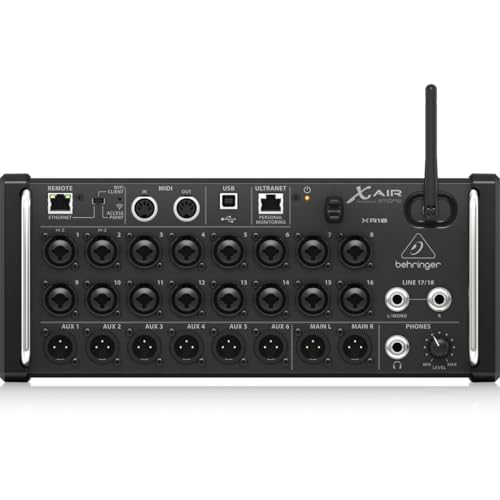
Behringer X AIR XR18 — Best Overall
More club and function bands run an XR18 than any other digital mixer, for reasons that compound: the box lives on stage in a rack, cables stay short, the engineer (or the singer between songs) mixes from the audience, each musician adjusts their own in-ears from a phone, and the USB feed records every input for tomorrow’s promo video.
Strengths
- 16 Midas-designed preamps cover a full band with spares
- Personal monitor mixing by phone frees the engineer for the room mix
- Multi-track USB recording turns every gig into content and evidence
Trade-offs
- An external router is effectively mandatory in busy venues
- No faders — a hands-on engineer must commit to the tablet
- Six aux buses get shared creatively once in-ears multiply
Key specs (verified): 18 channels, 12 buses, 16 programmable Midas preamps, built-in Wi-Fi, multi-channel USB audio interface (per Amazon title)
Its network of knowledge is a feature in itself: any dep engineer, hire tech or YouTube tutorial assumes this ecosystem, so help is always one search away. For a band buying its first serious rig, that shared knowledge is worth channels — problems get solved at soundcheck instead of becoming legends.
Dep-proofing is the XR18’s final argument: bands change engineers, engineers change bands, and a rig the incoming engineer already knows removes a rehearsal’s worth of friction from the first gig together. Keep the show file documented — input list, monitor assignments, one paragraph of ‘how we run it’ — in the case, and the ecosystem advantage compounds: your rig becomes the one deps request by name because its previous night is always legible.
Best for: Gigging bands with in-ears and a tablet-mixing engineer or self-mixing singer / Not suited for: Residency bands with a house console position and fader engineer
Check on Amazon — check the current price on Amazon before you buy, and confirm the exact configuration in the listing title matches the model reviewed here.

Allen & Heath Qu-16C — Best Rackmount Upgrade
Where a band plays rooms with a real mix position — theatres, larger clubs, festivals — the Qu-16C gives an engineer a surface worth standing behind: refined channel processing, a scene system that handles support slots and headline sets in one show file, and stage-box expansion as the production grows.
Strengths
- Processing quality rewards a skilled engineer’s ears
- Scene/show structure suits multi-band bills and festival changeovers
- Expansion path protects the purchase as the band grows
Trade-offs
- Needs a defined FOH position and longer cable or digital snake planning
- Heavier, more deliberate rig than a stage box in a rack
- Depth is wasted on a band that will only ever recall one scene
Key specs (verified): Rack-mountable compact digital mixer, Chrome Edition (per Amazon title)
Festival changeovers are its audition piece: recall the show, line-check against a labelled input list, and the band is ready while analogue rigs are still being re-patched. Engineers who work across many bands ask for this class of console by name, which tells a band manager everything about hiring flexibility.
The Qu-16C’s expansion path should be planned, not merely possessed: know which stage box extends it, what the full system costs, and at what band size you will buy it. Bands that plan the step buy the base console with confidence; bands that discover expansion prices mid-growth feel ambushed by a purchase they actually chose well. Its rackmount form also invites a proper wheeled rack with power distribution — budget the furniture, because consoles live or die by their housing.
Best for: Bands with a regular engineer and real FOH positions / Not suited for: Self-mixing pub bands needing the simplest possible rig
Check on Amazon — check the current price on Amazon before you buy, and confirm the exact configuration in the listing title matches the model reviewed here.

Yamaha TF1 — Best Fader Surface
Function bands live on tight turnarounds: first dance learned that week, three sets, requests. The TF1’s one-knob processing and source presets get a competent mix fast, its motorised faders show volunteers and dep engineers exactly where things stand, and Yamaha’s reliability record suits equipment that earns money weekly.
Strengths
- Preset-led workflow shortens soundchecks dramatically
- Motorised faders make scene changes visible and confidence-building
- Built for weekly professional use, with support to match
Trade-offs
- FOH format — less suited to mixing from stage while performing
- Presets can become a crutch if the engineer stops listening
- Larger footprint in the car than stage-box rigs
Key specs (verified): 16 channels, motorised faders, touchscreen with Touch & Turn workflow (per Amazon title class)
Wedding and function work rewards the TF1’s temperament: nothing exotic, everything where a dep engineer expects it, and a mix that is 90 percent right from presets before the first full song. Bands are businesses; this is the businesslike pick.
Function bands should exploit the TF1’s presets as a starting grid, then save the band’s own versions: your singer’s voice, your sax player’s dynamics and your drummer’s kit are not the factory’s assumptions. A month of saving band-specific presets converts a generic fast desk into your fast desk — and the dep engineer who sits at it still recognises the layout instantly, which is the whole point of choosing a mainstream surface.
Best for: Function, wedding and residency bands with a soundcheck clock / Not suited for: Self-mixing bands performing and mixing simultaneously
Check on Amazon — check the current price on Amazon before you buy, and confirm the exact configuration in the listing title matches the model reviewed here.

Allen & Heath CQ-18T — Best for Small Stages
The CQ-18T fits the band that mixes itself from the stage edge: a touchscreen that reads at a glance, quick setup tools, feedback suppression for the pub corner where the vocal mic lives dangerously close to the PA, and recording for the inevitable ‘record the gig’ request.
Strengths
- Touchscreen glanceability suits a performing band member mixing between songs
- Automatic feedback assistance tames small, reflective rooms
- Compact enough for side-stage or a small booth position
Trade-offs
- Input count requires discipline with larger line-ups
- Touchscreen in direct sunlight or stage glare needs shading thought
- Newer ecosystem — fewer dep engineers know it yet
Key specs (verified): Digital mixer with 7-inch touchscreen, Wi-Fi and Bluetooth connectivity (per Amazon title)
Self-mixing is an honesty test: the mixer must be operable by someone holding a guitar. The CQ’s interface passes that test better than any pick here, and its feedback tools address the exact failure — a ringing vocal mic in a hard room — that ruins more small gigs than every other cause combined.
The CQ-18T asks one discipline of self-mixing bands: appoint the operator per set and protect them. A touchscreen this approachable invites every member to adjust everything, which is how monitor mixes dissolve mid-show. One pair of hands per set, requests spoken aloud, changes logged mentally against the saved scene — small governance that keeps a democratic mixer from becoming an argument with a PA attached.
Best for: Self-mixing bands and small line-ups in difficult rooms / Not suited for: Bands with a dedicated engineer wanting maximum buses
Check on Amazon — check the current price on Amazon before you buy, and confirm the exact configuration in the listing title matches the model reviewed here.

Zoom LiveTrak L-12 — Best for Recording Every Session
The LiveTrak L-12 earns its place in a live list by serving the week, not just the weekend: the same desk that runs the gig’s monitor mixes records rehearsals and shows to SD, so the band’s live rig is also its content factory. Five independent monitor mixes keep a full band’s headphones and wedges honest.
Strengths
- Multiple independent monitor mixes for the whole band
- SD multi-track recording of gigs and rehearsals without a laptop
- Scene recall per venue shortens repeat-booking setups
Trade-offs
- 12 channels demand economical drum miking for bigger kits
- Small-format faders suit a set-and-check engineer more than a ride-everything mixer
- Less app-ecosystem depth than the Behringer line
Key specs (verified): 12 channels, records to SD card while mixing, USB audio interface (per listing class)
Bands building an audience live on captured moments — the LiveTrak makes capturing them the default rather than a project. A band that records every gig improves faster, books better and argues less about what actually happened on stage.
LiveTrak bands should build a content routine around the recording habit: one song per gig reviewed on the drive home, one clip per week posted, one full show per month archived properly. The desk supplies the raw material automatically; the routine is what converts it into bookings. Bands that skip the routine own a recorder; bands that keep it own a media department that fits in the mixer case.
Best for: Bands recording every performance for content and improvement / Not suited for: Large line-ups needing maximum channel count
Check on Amazon — check the current price on Amazon before you buy, and confirm the exact configuration in the listing title matches the model reviewed here.

Soundcraft Ui12 — Best Budget
A four-piece in pubs needs vocals, a couple of DIs, simple monitors and nothing that takes longer to set up than the drum kit. The Ui12 is that mixer: a small stage box, any phone as the console, saved scenes per venue, and a price that leaves budget for the PA itself — which, at this level, matters more.
Strengths
- Browser control — the band’s existing phones are the console
- Venue scenes turn repeat bookings into ten-minute setups
- Compact and cheap enough to carry a spare philosophy
Trade-offs
- 12 inputs and limited buses are a hard ceiling for growth
- No multi-track recording story for content-minded bands
- Network setup must be done properly once, at home, not at the gig
Key specs (verified): 12 inputs, remote-controlled via browser on any device, built-in Wi-Fi access point (per Amazon title class)
Judge it as a system decision: at pub level, money moved from mixer to loudspeakers improves the gig more. The Ui12 covers the mixing duties of a small band completely, and its scenes quietly teach the band the digital habits they will carry to a bigger rig later.
The Ui12’s spare philosophy deserves repeating as strategy: at its level, some bands carry a second unit as a hot spare, pre-loaded with the same scenes, for less than the price step to a larger mixer. For pub and function work where the show cannot pause, redundancy beats capacity — a philosophy the bigger picks cannot match at their prices, and a legitimate reason to choose small on purpose.
Best for: Four-pieces and trios in pubs and small venues / Not suited for: Bands with in-ears for everyone plus a recording habit
Check on Amazon — check the current price on Amazon before you buy, and confirm the exact configuration in the listing title matches the model reviewed here.
Comparison Table
| Pick | Badge | Key spec | Best for |
|---|---|---|---|
| Behringer X AIR XR18 — Check on Amazon | Best Overall | 18ch / 16 Midas preamps / Wi-Fi | Gigging bands with in-ears and a tablet-mixing engineer or self-mixing singer |
| Allen & Heath Qu-16C — Check on Amazon | Best Rackmount Upgrade | Rackmount / 16ch class | Bands with a regular engineer and real FOH positions |
| Yamaha TF1 — Check on Amazon | Best Fader Surface | 16ch / motorised faders | Function, wedding and residency bands with a soundcheck clock |
| Allen & Heath CQ-18T — Check on Amazon | Best for Small Stages | Touchscreen / Wi-Fi / Bluetooth | Self-mixing bands and small line-ups in difficult rooms |
| Zoom LiveTrak L-12 — Check on Amazon | Best for Recording Every Session | 12ch / SD multitrack recording | Bands recording every performance for content and improvement |
| Soundcraft Ui12 — Check on Amazon | Best Budget | 12 inputs / browser control | Four-pieces and trios in pubs and small venues |
How Do Bands Handle In-Ear Monitoring Without Losing the Room?
In-ears fail socially before they fail technically: a band sealed into perfect private mixes can play a bloodless show, because the room’s energy is part of the performance. The fixes are musical, not technological — an ambient microphone in the mix so the audience exists in your ears, one ear out for acoustic gigs where safe, and monitor levels set at soundcheck and defended against mid-show creep, when adrenaline quietly asks for more of everything.
Technically, give the system a rehearsal of its own. First in-ear experiences belong in the rehearsal room, at practice volume, with time to adjust fits and balances — not at a wedding’s first dance. The mixers in this guide feed in-ears well; the band’s patience in adopting them is the variable that decides whether they last past the second gig.
Protect hearing as a band policy: agree a sensible ceiling, use the mixer’s recall to return to it nightly, and treat ringing ears as a rig fault, not a war story. A band is a long project; the mixer’s memory can protect the members’ hearing only if the band lets it.
What Does a Band’s Load-In Checklist Actually Need?
A checklist that lives in the mixer case and reflects the real rig: stage box position, power order, router placement, input list against the stage plan, monitor assignments, recording armed, spare cables located. Laminated, one page, ticked by one named person. Bands resist checklists as un-rock-and-roll right up to the gig where the router password is in a departed member’s messages.
Load-in order protects the checklist: power and PA first, mixer and network second, instruments into a working system third, soundcheck last and shortest. A band that can hear itself line-check within minutes of arrival spends its venue time on music instead of troubleshooting — the audience never sees this discipline, and hears nothing else.
Load-out is the checklist’s second half: recording stopped and backed up, show file saved with the venue name, cables coiled by their owners, mixer cased before the social hour begins. Gear survives tours on load-out discipline; the bands that treat it as part of the show keep their rigs — and their deposits — intact.
How Should a Band Choose Between Hiring and Owning a Rig?
Own the rig when the band plays often enough that hire costs cross the purchase within a season or two, when the same venues recur (scenes compound in value), and when at least one member will genuinely own the system’s care. Hire when dates are rare, productions vary wildly, or no member wants the responsibility — an unloved owned rig sounds worse than a hired one with its engineer.
The hybrid most working bands choose: own the mixer core — the picks in this guide, cased with router and cables — and hire PA scale per venue. The mixer carries the band’s sound, scenes and recordings from room to room, while loudspeaker muscle flexes with the booking. It is the economics behind the stage-box era, and the reason these mixers, rather than full PA systems, anchor this guide.
Whichever route you choose, decide who carries knowledge, not just cases: the member who knows the show file, the network and the input list is as load-bearing as any hardware. Write that knowledge down, share it with a deputy, and the band’s sound survives holidays, illnesses and the occasional drummer-related emergency.
Which Band Scenario Fits Which Mixer? A Decision Walk-Through
Scenario one: a pub and club covers band, four or five pieces, self-mixing or with a partner on sound. The XR18 rig — stage box, dedicated router, personal monitor mixes — is the proven answer, with the Ui12 as the budget entry that teaches the same habits. Your first season’s work is not buying more; it is building the venue scenes, the input list and the load-in checklist until the rig runs itself and the band’s energy goes back into the performance.
Scenario two: a function and wedding band with a dep engineer pool and a reputation priced per booking. The TF1’s mainstream surface and preset speed protect you when a dep sits at the desk with twenty minutes’ acquaintance, and the Qu-16C steps in when your regular engineer’s ambitions outgrow it. Either way, document the show file as if a stranger must run it tomorrow — because at a wedding in August, one will.
Scenario three: an original band building an audience, where content is the growth strategy. The LiveTrak L-12 turns every rehearsal and gig into reviewable, postable material without a laptop’s fragility, and its monitor mixes keep a full band honest on small stages. Pair it with the content routine — a clip a week, a review on the drive home — and the mixer stops being equipment and becomes the band’s media department.
Scenario four: a band graduating to theatres, festivals and support slots with house production. The Qu-16C’s show-file discipline and expansion path speak the language those productions expect, and its surface keeps your engineer employable across the circuit. Buy it when the diary asks for it; bands that buy production-grade desks before the bookings exist own impressive storage problems, while bands that time the step own a career tool.
Your Pre-Purchase Checklist: Seven Questions Before the Band Pays
One: have you counted monitor mixes before channels — one per in-ear user or wedge position — and does the candidate desk cover that count at your fullest line-up? Two: who mixes, by name, at your hardest gig of the year, and is the desk shaped for that person’s hands and habits rather than for the band’s collective self-image? Both answers belong on paper in the band meeting, not in the group chat after the box arrives.
Three: what is the network plan — dedicated router, mounting position, password custody, a spare tablet — and has it been rehearsed at a practice, not merely purchased? Four: how does the rig record, and who owns the routine that turns recordings into reviews and clips? A recording feature without an owner is a specification; with an owner, it is the band’s development programme.
Five: what case, cables, DI boxes and spares complete the rig, and does the full basket — not the mixer alone — fit the band’s actual budget and vehicle? Six: are show files backed up somewhere that is not the mixer, with an input list printed in the case, so a dep engineer or a replacement unit can reconstruct your night in twenty minutes?
Seven: what is the growth trigger — the band size, diary scale or production level at which you will expand or step up — and does today’s desk expand toward it or get replaced by it? Bands that name the trigger buy once with confidence. The picks in this guide each carry their trigger in their reviews; the checklist’s job is to make the band say its own out loud before money moves.
After the First Month of Gigs: The Debrief That Matters
Four gigs in, hold the debrief with evidence open: the recordings, the show files, the load-in times nobody estimated honestly beforehand. The mixer will have kept its promises or exposed its mismatches in specific, nameable ways — a monitor mix short here, a changeover scramble there — and specific problems have specific, usually cheap, fixes. Vague dissatisfaction, by contrast, is how bands talk themselves into replacing the wrong component at the wrong price.
Month one is when the rig’s paperwork earns its keep or gets written: the input list corrected against reality, the scene names standardised, the router password moved from a departed phone into the case where it belongs. Bands describe this as admin because it is; it is also the difference between a rig that survives its first dep engineer and one that becomes a story other bands tell as a warning.
Decide, at the debrief, the one improvement the next month buys — a case upgrade, a spare stage box cable, a dedicated recording routine, an in-ear rehearsal — and assign it an owner and a date. Bands improve the way their mixes do: one deliberate change at a time, verified at the next gig, saved into the show file of their habits.
A Note on Second-Hand Rigs, Hire Fleets and Borrowed Desks
Working bands buy used constantly, and digital mixers are good used purchases when their wear points are understood: faders and encoders on consoles, fans and power supplies in stage boxes, and the network hardware nobody photographs in the listing. Test under show conditions — full input list, full monitor load, a recording running — because a desk that behaves at living-room level and drops a bus at show level has told you the truth exactly once, at the wrong time, unless you asked it earlier in private.
Hire-fleet retirements are the connoisseur’s source: maintained on a schedule, cased properly, sold with known hours and honest descriptions. A retired fleet XR18 or console with its case and a service history is frequently a better purchase than a younger, privately abused unit — provenance is a specification, and fleet paperwork is provenance you can read. Ask what it was replaced by and why; fleets answer such questions without drama, which is itself information.
Borrowed desks — the dep’s own rig, the venue’s house system — deserve the band’s standard courtesies performed technically: your show file loaded from your backup, your changes saved under your name, the house configuration restored and the engineer thanked with specifics. Bands are remembered by the production community in exact proportion to how they treat other people’s equipment, and that memory books gigs long after the set list is forgotten.
One More Thing: The Band Is the System
Every mixer in this guide will, on a good night, disappear — and what remains is the band, the room and the audience’s memory of both. That disappearance is the actual product: not channels, not buses, but the absence of the audience ever thinking about sound at all. Buy toward that absence. The desk whose operation your band has rehearsed into invisibility, whose failures you have planned for, whose recordings you actually review, will outperform a theoretically superior desk operated as a stranger, every night of the season.
Rehearse the sound the way you rehearse the songs — briefly, regularly, with the log open — and let the mixer’s memory accumulate your band’s collective good judgement. A year of that discipline is worth more than any single purchase this guide could recommend, and it is available, starting at the next rehearsal, at no cost whatsoever beyond the band’s agreement that the sound is part of the music.
A Final Word on the Long Game
Bands measure equipment in seasons, not in unboxings. The mixer that matters is the one still earning its place in the van at year three — its scenes a diary of every room the band has conquered, its case scarred in the honourable places, its operator’s knowledge shared by at least two members so the sound survives any single absence. Choose, from this guide’s picks, the desk you can imagine at that third year: maintained without resentment, expanded without drama, and so familiar that the band’s attention is entirely where it belongs — on the stage, in the songs, in the room that came to hear them.
One Practical Promise to Make Yourselves
Promise this as a band: the soundcheck sequence, the checklist and the recording habit get one full season before anyone proposes replacing a single component. A season of evidence will identify the true weak link — it is rarely the item anyone blamed in week two — and the money saved by not guessing becomes the case, the spares, the in-ear rehearsal or the engineer for the biggest date of the year. Discipline is the cheapest upgrade in live sound, and the only one that improves every component you already own, simultaneously, starting tonight.
How to Choose a Live Band Mixer: Monitors, Inputs and Who Mixes?
Start with monitor mixes, because bands feel monitors and audiences feel mains — and a band that cannot hear itself plays worse no matter how good the room mix is. Count one mix per distinct need: each in-ear user ideally, or shared mixes for wedges by stage position. Then count inputs at full line-up plus a spare vocal and a spare DI, because guests, deps and broken channels are live-music constants.
Then answer the human question: who mixes? A dedicated engineer unlocks stage boxes and deeper consoles; a performing band member needs glanceable simplicity and feedback automation; a venue’s house engineer needs a console they already know — which is an argument for the mainstream picks above that no specification captures. Buy for your actual operator, not an imaginary one.
Recording deserves a budget line in the decision: a multi-track of every gig is marketing, quality control and dispute resolution in one. If content matters to the band’s plan, recording capability should outrank a marginal channel or two.
What Does a Band Need Beyond the Mixer for a Complete Rig?
The mixer is the brain; the rig is the body. Budget for a protective case or rack (mixers die in car boots, not on stages), a dedicated Wi-Fi router for control, labelled cables and a digital or analogue snake that fits your stage layout, DI boxes for keys and acoustic guitars, and a spare of every cable type that can end a gig. None of it is glamorous; all of it is the difference between a rig and a pile of equipment.
In-ear monitoring, if adopted, needs its own line: earphones for the band, enough aux buses to feed them, and rehearsal time to learn them. Bands that rush in-ears at a gig without rehearsal usually retreat to wedges and blame the technology; the mixers above can feed either world, but the band must choose deliberately and rehearse the choice.
How Loud Is Too Loud? Protecting Hearing and the Room Mix
A live mixer cannot fix a stage that is too loud: guitar amplifiers and acoustic drums set a floor the vocal mix must climb over, and the climb ends in feedback and audience fatigue. Use the mixer’s tools honestly — high-pass filters on everything that is not bass or kick, gentle compression rather than gain wars — and solve volume at the source with amp placement, shields or modelling rigs where the band accepts them.
Hearing protection is a professional topic, not a lecture: musicians mixing their own in-ears should set a sensible ceiling at soundcheck and resist mid-gig creep. The best mixers above make monitor levels recallable — use scenes to return to sane levels every night instead of re-rolling the dice.
How to Run a Band Soundcheck That Actually Finishes on Time?
A finished soundcheck is a managed sequence, not a jam with interruptions. Run it in this order and protect the order socially as well as technically.
- Recall the venue scene, confirm the input list against the stage as it actually stands, and line-check every channel quietly before anyone plays a note.
- Set gains instrument by instrument, loudest realistic playing, drums first, then bass, guitars, keys and vocals last so the reference levels exist before voices arrive.
- Build monitor mixes one musician at a time — only that musician requests, only that mix changes — then lock personal-mix phones if the system allows it.
- Ring out vocal microphones gently in the actual positions singers will occupy, moving as they will move.
- Run one full song at show energy, mix from the room’s centre and its worst corner, and save the scene with the venue and date in the name.
- Record the first song of the show if the mixer allows it; review at the interval, adjust once, and stop chasing the mix.
If a soundcheck runs long, the cause is almost always conversation, not technology. Appoint one voice to run the sequence — engineer or bandleader — and let everyone else answer questions rather than ask them.
Common Buying Mistakes
Counting headline channels instead of usable inputs. Stereo playback channels do not mic a drum kit. Count microphone preamps and line inputs you can use simultaneously.
Starving the monitor mixes. Bands buy mains processing and forget ears. If the band cannot hear, the show fails from the stage outward.
Venue Wi-Fi for mixer control. A stage box on a shared, busy network is a dropout waiting for the first chorus. Carry a dedicated router.
No scene discipline. Overwriting the one good scene at every gig destroys digital’s main advantage. Save per venue, date the names, back up the show file.
Skipping the recording. The gig you did not record is the one everyone argues about. Multi-track capture costs a memory card; use it.
Final Recommendation
Most gigging bands should buy the XR18 and a good router: it is the ecosystem, the monitor story and the recording habit in one rack. Bands with a real engineer and FOH position step up to the Qu-16C or the dependable TF1; self-mixing bands should take the CQ-18T’s glanceable touchscreen; the LiveTrak serves bands recording everything; the Ui12 starts pub bands honestly.
Whichever desk you choose, build venue scenes, protect monitor mixes and record the show — those three habits are worth more than the badge on the box.
Shortlist again, for convenience: Behringer X AIR XR18 — Check on Amazon; Allen & Heath Qu-16C — Check on Amazon; Yamaha TF1 — Check on Amazon.
Related reading on this site: Best Digital Mixers For Church; Best Digital Mixers For Home Studio; Best Digital Mixers For Live Outdoor Sound; Best Digital Dj Mixers Under $1000; Best Audio Mixers Digital For Live.
Frequently Asked Questions
How many monitor mixes does a band need?
One per distinct need: ideally each in-ear user, or wedge mixes by stage position. Count monitors before channels — a band that cannot hear itself plays worse regardless of the front-of-house mix, and buses are the resource bands run out of first.
Can the band mix itself from stage?
Yes, with the right shape of mixer: a glanceable touchscreen like the CQ-18T or phone-based personal monitor mixing on a stage box. What self-mixing cannot survive is a deep, menu-led console — choose simplicity if a performer is also the engineer.
Is it worth recording every gig?
A multi-track recording is marketing material, quality control and dispute resolution in one file, for the cost of a memory card or a USB connection. Bands that review their shows improve measurably faster than bands that rely on memory and opinion.
Do we need an external router for a stage-box mixer?
In real venues, treat it as mandatory. House Wi-Fi is busy and unreliable; a dedicated router, elevated with line of sight to the mix position, is the cheapest reliability upgrade in live sound.
When should a band step up to a console like the Qu-16C?
When a regular engineer mixes from a real front-of-house position, when multi-band bills demand fast show-file changeovers, or when the band’s input and monitor needs outgrow a stage box. Buy the step when the work asks for it, not before.
How do we protect the mixer on the road?
A proper case or rack, labelled cables, backed-up show files, and a spare of every gig-ending cable. Mixers rarely die on stage; they die in car boots and damp lockups. Storage and transport discipline is a sound-quality decision.


