Disclosure: airfryerkitchensupply.com is reader-supported. When you buy through links on our site, we may earn an affiliate commission at no extra cost to you.
Where to buy these vacuums
Every vacuum in this guide to the best canister vacuums with HEPA filter is sold on Amazon, and every product link points to a listing we confirmed through Amazon’s own catalog data before writing — including checking that the listing itself states HEPA filtration, because that phrase is this guide’s entire premise. We do not print fixed prices; use the “Check on Amazon” link under any pick to see the current price. A note on method that matters here: we repeat each manufacturer’s HEPA wording exactly as its listing states it — “HEPA,” “HEPA Filter,” “Double HEPA Filter” — and we do not upgrade any of them to “true HEPA” or “certified HEPA,” because the listings do not say that, and the difference is a real one the buying guide explains.
- Kenmore 81214 200 Series Bagged Canister Vacuum with HEPA — Check on Amazon
- Kenmore 81414 400 Series Bagged Canister Vacuum with HEPA — Check on Amazon
- Miele Guard L1 Allergy Bagged Canister Vacuum with HEPA Filter — Check on Amazon
- Aspiron Canister Vacuum Cleaner, Bagless, Double HEPA Filter — Check on Amazon
- Atrix Lil Red Canister Vacuum with HEPA Filter — Check on Amazon
- Eureka WhirlWind NEN186BL Bagless Canister Vacuum, HEPA — Check on Amazon
Introduction: why the canister-plus-HEPA combination is its own distinct category
The best canister vacuums with HEPA filter solve a problem uprights and stick vacuums mostly dodge: whole-house cleaning — stairs, curtains, upholstery, under furniture, ceiling corners — with filtration fine enough that the dust you collect does not leave through the exhaust while you work. It is a category bought by people who have thought about where dust goes, which is why this guide treats its claims with unusual care. The canister format puts the motor and the dirt in a body that rolls behind you while a light wand does the reaching, and a sealed HEPA-stage filtration path means the air path ends in a filter rated for fine particles rather than in a mesh screen and optimism. This guide is deliberately strict about admission. Every pick’s listing, as confirmed through Amazon’s catalog data, states HEPA filtration in its own words; canister vacuums we like whose listings do not state HEPA — including a popular Bissell hard-floor canister and Miele’s Cat & Dog Guard models, which use a different filter designation — were excluded, because a guide titled “with HEPA filter” that recommends vacuums on assumed filtration has failed before the first review. What remains is a six-vacuum field with real range: two Kenmore bagged workhorses, Miele’s allergy flagship, two bagless options at different tiers, and a compact portable for small spaces and stairs — enough range, in other words, for nearly every household that shops this category seriously.
In this guide
Quick Picks at a Glance
- Best Overall — Kenmore 81214 200 Series: bagged HEPA filtration, a 2-motor system, and 3 cleaning tools in a lightweight pet-friendly canister. Check on Amazon
- Best for Pet Homes — Kenmore 81414 400 Series: HEPA, an extended telescoping wand, retractable cord, and 4 cleaning tools, built pet-friendly. Check on Amazon
- Best Premium — Miele Guard L1 Allergy: the allergy-designated Guard model whose listing states a HEPA filter outright, in Miele’s bagged system. Check on Amazon
- Best Bagless — Aspiron Canister Vacuum: a washable 4QT dust cup and a stated Double HEPA Filter, with 5 tools for hard floors. Check on Amazon
- Best Compact — Atrix Lil Red: a portable canister with a 2-quart HEPA filter and variable speed motor, made for stairs, cars, and small homes. Check on Amazon
- Best Budget Bagless — Eureka WhirlWind NEN186BL: HEPA stated in the listing, auto cord rewind, and a 2-in-1 design for hard floors, carpets, and pet hair. Check on Amazon
How These Picks Were Chosen and Verified
One gate came before all others, and it was absolute: the listing had to state HEPA, in its own words, in the catalog data returned for that exact model — not in a sibling model’s title, not in a category description, and not by inference from the brand’s reputation, however strong that reputation might be. We searched canister vacuums through Amazon’s catalog data on the airfry site, read the returned listings literally, and admitted only complete vacuums whose own titles claim HEPA filtration. That discipline excluded three kinds of near-misses, named here so you can check our work: replacement HEPA filters and HEPA dust bags sold alone (parts, not vacuums — several appeared in the same searches), canister vacuums whose listings name a different filter system instead of HEPA, and uprights or sticks outside the canister brief. Within the gate, we balanced the ownership models — bagged versus bagless, full-size versus compact, mainstream versus premium — because HEPA shoppers divide by those loyalties more than by suction claims. Manufacturer suction and wattage figures are quoted only where the listing states them and are labeled as manufacturer figures; filtration wording is quoted exactly, never upgraded. Only confirmed listings received product links.
The 6 Best Canister Vacuums with HEPA Filter, Reviewed

1. Kenmore 81214 200 Series Bagged Canister Vacuum with HEPA — Best Overall
The 200 Series is the mainstream answer done right, and its verified listing states the package in full: a pet-friendly, lightweight bagged canister vacuum with HEPA, a 2-motor system, and 3 cleaning tools, in orange. The bagged architecture is the filtration story here — in a bagged HEPA canister, the bag itself is the first and largest filter stage, capturing the bulk of debris before the air reaches the HEPA exhaust stage, which is why bagged HEPA systems hold their filtration performance gracefully between bag changes and empty without a dust cloud. The 2-motor system (separate suction and brushroll motors, the classic Kenmore canister formula) gives the power head its own drive for carpet work, and “lightweight” in a full-size canister is a real quality-of-life feature on stairs and between floors. This is the vacuum for the household that wants HEPA canister cleaning as an appliance, not a hobby.
Strengths
- Bagged HEPA system: the bag does the heavy filtering, changes are hygienic, and filtration stays consistent.
- 2-motor system with a powered head for carpets plus 3 cleaning tools for above-floor work.
- Lightweight, pet-friendly positioning from the longest-running name in this category.
Trade-offs
- Bags are a running cost and a keeping-stock chore; HEPA systems want the correct bag type, not generics of unknown fit.
- The listing states “HEPA” without the word “filter” after it — we report the wording as stated and do not embellish it.
- Full-size canisters store larger than sticks; plan the closet space.
| Mini spec — as stated in the verified listing | |
|---|---|
| Type | Bagged canister, lightweight, pet friendly |
| Filtration (as stated) | HEPA |
| Motors | 2-motor system |
| Tools | 3 cleaning tools |
| Color verified | Orange |
If your household cleans whole floors weekly, has carpets and hard floors in mixture, and wants filtration that does not depend on your filter-washing discipline, this is the default buy — the canister the category is measured against at a mainstream tier. It is also the easiest recommendation in this guide to live with: bags in the closet, tools on the wand, and a machine whose entire maintenance plan fits on an index card taped inside the closet door.
Best for: mixed-floor family homes wanting bagged HEPA consistency. / Not suited for: anyone unwilling to buy replacement bags, or tiny storage spaces.
Check the current price on Amazon
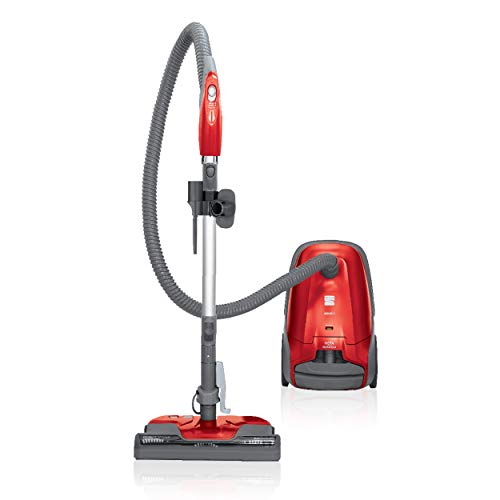
2. Kenmore 81414 400 Series Bagged Canister Vacuum with HEPA — Best for Pet Homes
The 400 Series is the 200’s bigger sibling, and the verified listing’s additions are precisely the pet-home ones: a pet-friendly lightweight bagged canister with an extended telescoping wand, HEPA, a retractable cord, and 4 cleaning tools, in red. The telescoping wand is the above-floor weapon — ceiling corners, curtain tops, stair edges, the fur drifts behind doors — and the fourth tool plus pet-friendly positioning acknowledge what pet homes know: the hair is not on the floor plan, it is everywhere, at every height. The retractable cord sounds minor until you have wound a canister cord by hand for the hundredth time. Filtration repeats the family formula — bagged first stage, HEPA as stated — which suits pet homes doubly, because dander is exactly the fine-particle load HEPA stages exist for, and because a bag contains a month of hair without a dust-bin emptying ritual over the trash can.
Strengths
- Extended telescoping wand and 4 tools: the above-floor reach pet hair demands.
- Bagged HEPA contains hair and dander hygienically — no dust-cup cloud over the bin.
- Retractable cord and lightweight body make a whole-house clean less of an event.
Trade-offs
- Same bagged running costs as the 200 Series, at a step up in tier.
- Pet-friendly describes the tools and positioning; determined hair on deep carpet still rewards a second pass.
- As with its sibling, the listing’s HEPA wording is reported exactly as stated.
| Mini spec — as stated in the verified listing | |
|---|---|
| Type | Bagged canister, lightweight, pet friendly |
| Filtration (as stated) | HEPA |
| Wand | Extended telescoping wand |
| Cord | Retractable |
| Tools | 4 cleaning tools |
| Color verified | Red |
Choose between the two Kenmores by your ceilings and your animals: floor-focused homes take the 200, homes where hair climbs the curtains take the 400. Either way, the bagged HEPA core is the same sound bet, and the step between them is one of the easiest upgrade decisions in this category to get right.
Best for: pet homes with above-floor cleaning and mixed surfaces. / Not suited for: bagless loyalists or minimal-storage homes.
Check the current price on Amazon

3. Miele Guard L1 Allergy Bagged Canister Vacuum with HEPA Filter — Best Premium
Miele sells several Guard canisters, and this guide’s discipline matters most here: the Guard L1 Cat & Dog models in the same catalog data do not state a HEPA filter in their listings, so they are not in this guide — the Guard L1 Allergy is, because its verified listing says exactly what this category requires: a bagged canister vacuum with HEPA filter, in the Allergy model designation. That designation is the point of the purchase. Miele’s bagged system pairs its dustbags with serious exhaust filtration, and the Allergy variant is the one Miele itself positions for buyers whose first specification is the air leaving the machine. Around that core sits the usual Miele proposition — build quality, quiet manners, and a parts-and-service ecosystem measured in decades — at a premium tier this guide will not pretend is small. Buy it as the filtration-first, keep-it-for-years appliance it is.
Strengths
- The listing states “HEPA Filter” outright, in the Allergy-designated model — the clearest filtration claim in this guide.
- Miele’s bagged ecosystem: bags and filters are standardized, available, and engineered as a system.
- Premium build and service network suit a buy-it-for-a-decade plan.
Trade-offs
- Premium tier, unambiguously — several times the budget picks’ territory.
- Bagged running costs at Miele’s own price level for bags and filters.
- Other Guard variants (Cat & Dog, Parquet) optimize different jobs; this one optimizes filtration, so choose the variant by your actual priority.
| Mini spec — as stated in the verified listing | |
|---|---|
| Type | Bagged canister vacuum |
| Filtration (as stated) | HEPA Filter |
| Model | Guard L1 Allergy |
| Brand | Miele |
For the household where air quality is the brief — the allergy-aware home that has already sealed the bedroom and washed the curtains — this is the canister that treats exhaust air as the product. The premium is real, and so is what it buys. Buyers in this segment should also note the discipline this guide applied on their behalf: the Miele badge here was earned by a listing that states its filtration, in a line where not every sibling model does.
Best for: filtration-first and allergy-conscious homes buying for the long term. / Not suited for: budget shoppers or bagless loyalists.
Check the current price on Amazon

4. Aspiron Canister Vacuum Cleaner, Bagless, Double HEPA Filter — Best Bagless
Bagless HEPA canisters live or die by their filter discipline, and the Aspiron’s verified listing states its hand openly: a bagless canister vacuum cleaner with a manufacturer-stated 40Kpa suction figure and 1600W motor, a 4QT washable dust cup, a Double HEPA Filter, a retractable cord, a lightweight build, and 5 tools for hard floors. The washable cup is the economic argument — no bags, ever — and the double HEPA staging is the filtration argument, with two filter stages between the dirt and the room. The honest bagless caveats apply and this guide will not hide them: a dust cup empties with more dust contact than a bag, and washable filters only filter as claimed when they are actually washed and fully dried on schedule. (The listing title is truncated in the catalog data at its final word; we quote only the complete, verifiable portion and invent nothing past it.)
Strengths
- Stated Double HEPA Filter — the strongest filtration wording among the bagless picks.
- Washable 4QT dust cup ends bag costs; the cup is generously sized for whole-house sessions.
- 5 tools for hard floors and a retractable cord round out a complete package at a mid tier.
Trade-offs
- Bagless emptying means dust contact; allergy-first households should weigh the Miele or the bagged Kenmores.
- Filtration depends on your washing discipline — a neglected washable filter is a claim on paper only.
- Manufacturer suction figures (40Kpa as stated) are not standardized across brands; compare within, not across, listings.
| Mini spec — as stated in the verified listing | |
|---|---|
| Type | Bagless canister, lightweight |
| Filtration (as stated) | Double HEPA Filter |
| Dust cup | 4QT, washable |
| Motor (as stated) | 1600W; 40Kpa manufacturer figure |
| Tools | 5 tools for hard floors |
If your floors are mostly hard, your bag-buying patience is zero, and your filter-washing discipline is real, this is the bagless HEPA canister to buy. It trades the bagged picks’ set-and-forget filtration for running-cost freedom, fairly and squarely, and its stated double filtration gives that trade a stronger foundation than most bagless machines offer.
Best for: hard-floor homes and bagless loyalists with good maintenance habits. / Not suited for: allergy-first households that should empty dirt through a sealed bag.
Check the current price on Amazon

5. Atrix Lil Red Canister Vacuum with HEPA Filter — Best Compact
Not every home needs a full-size canister, and the Lil Red is the compact end of the HEPA idea: the verified listing describes the AHSC-1 Atrix Lil Red as a portable canister vacuum with a 2-quart HEPA filter and a variable speed motor. Variable speed is the connoisseur’s feature in a small canister — full power for hard floors and entry mats, dialed down for curtains, upholstery, and the delicate jobs where a big vacuum’s fixed blast is a liability — and portability makes this the stairs-and-car-and-closet vacuum that full-size owners buy as a second machine. The 2-quart capacity in the listing refers to its HEPA filter canister format; either way, this is a small-volume machine for small-volume jobs, and it should be bought as one: apartments, stairs, workshops, vehicles, and quick messes, not whole-house deep cleans of a five-bedroom home.
Strengths
- Portable format with HEPA filtration — the only pick that treats stairs and cars as home turf.
- Variable speed motor adapts suction to delicate above-floor work.
- Compact storage footprint suits apartments and second-vacuum roles.
Trade-offs
- Small capacity means frequent emptying on big jobs; it complements a full-size vacuum more than it replaces one.
- Compact canisters trade the powered-head carpet performance of the Kenmores for portability.
- Atrix is a specialist brand — check filter availability for your region before committing.
| Mini spec — as stated in the verified listing | |
|---|---|
| Type | Portable canister vacuum |
| Filtration (as stated) | 2 Quart HEPA Filter |
| Motor | Variable speed motor |
| Model | AHSC-1 Lil Red |
Buy it for the jobs the big canister makes you postpone — the stairs, the car interior, the craft room, the workshop bench — and it will be the vacuum you actually reach for most weeks, which is its own kind of best. Small machines earn their keep by being present, and presence is a filtration strategy too.
Best for: apartments, stairs, cars, and as a second vacuum. / Not suited for: whole-house deep cleaning of large homes.
Check the current price on Amazon

6. Eureka WhirlWind NEN186BL Bagless Canister Vacuum, HEPA — Best Budget Bagless
Eureka’s WhirlWind line is the budget face of bagless canisters, and the NEN186BL is the variant whose verified listing states HEPA — a distinction worth pausing on, because several sibling WhirlWind models in the same catalog results do not state HEPA in their titles, and this guide admits only the one that does. As listed: a lightweight bagless canister at a manufacturer-stated 1000W, with a stated noise figure of ≤82 dBA, HEPA, auto cord rewind, and a 2-in-1 design for hard floors, carpets, and pet hair. That is a complete budget brief — the rewind alone is a feature budget canisters often skip — at the lowest tier in this guide. The expectations contract is the usual budget one: plastics and fit-and-finish are a class below the Kenmores, and the filtration claim lives or dies by the same filter maintenance as any bagless machine.
Strengths
- HEPA stated in the listing at the guide’s lowest tier — the budget door into this category.
- Auto cord rewind and a 2-in-1 hard-floor/carpet design cover daily life completely.
- Lightweight bagless format with a stated ≤82 dBA noise figure for apartment awareness.
Trade-offs
- Budget build class: expect lighter plastics and a shorter accessory list than the Kenmores.
- Bagless maintenance discipline applies in full — wash and dry filters on schedule or the HEPA claim fades.
- Check sibling model numbers carefully when shopping; only the NEN186BL was verified with HEPA in its listing here.
| Mini spec — as stated in the verified listing | |
|---|---|
| Type | Bagless canister, lightweight |
| Filtration (as stated) | HEPA |
| Motor (as stated) | 1000W; ≤82 dBA noise figure |
| Cord | Auto cord rewind |
| Model | NEN186BL WhirlWind |
For a first HEPA canister, a rental, a dorm, or a second-floor machine, this is the sensible spend. Maintain its filters like the category depends on it — because in a bagless machine, it does, entirely and without exception.
Best for: budget buyers, rentals, and smaller homes. / Not suited for: heavy daily whole-house use or buyers wanting premium build.
Check the current price on Amazon
Comparison Table of the Six Vacuums
| Pick | Badge | Key spec | Best for |
|---|---|---|---|
| Kenmore 81214 200 Series | Best Overall | Bagged, HEPA stated, 2-motor | Mixed-floor family homes |
| Kenmore 81414 400 Series | Best for Pet Homes | Bagged, HEPA, telescoping wand | Pet hair at every height |
| Miele Guard L1 Allergy | Best Premium | Bagged, “HEPA Filter” stated | Filtration-first homes |
| Aspiron Bagless Canister | Best Bagless | Double HEPA Filter, 4QT cup | Hard floors, no bag costs |
| Atrix Lil Red | Best Compact | Portable, variable speed | Stairs, cars, apartments |
| Eureka NEN186BL | Best Budget Bagless | HEPA stated, auto rewind | First HEPA canister |
Key Takeaways on HEPA Canisters
- Admission to this guide required the listing itself to state HEPA — several liked canisters and all filter-only parts were excluded on that rule.
- HEPA wording is quoted exactly as listed (“HEPA,” “HEPA Filter,” “Double HEPA Filter”) and never upgraded to “true” or “certified.”
- Bagged systems filter most consistently and empty most hygienically; bagless systems trade that for zero bag costs and a maintenance obligation.
- The canister format’s real advantage is reach — wands, stairs, upholstery, ceilings — with the filtration riding along.
- Filtration is a system: bags, filters, seals, and your maintenance rhythm matter as much as the HEPA label itself.
- Ownership cost is bags and discipline versus filters and attention — run your household’s arithmetic before choosing the architecture.
- Most underperformance is maintenance, not machinery: bag level, filter state, hose blockages, and wound brushrolls explain nearly every complaint.
How to Choose a Canister Vacuum with HEPA Filter
Decide bagged versus bagless first, because it decides your next five years. Bagged HEPA canisters (both Kenmores, the Miele) filter through the bag first, hold performance steadily, and empty by removing a sealed bag — the hygienic choice, at a running cost. Bagless canisters (Aspiron, Eureka) cost nothing to feed and demand filter washing in exchange; their HEPA stages only perform while you maintain them. Allergy-first households should weight bagged heavily. Then read the HEPA claim like a lawyer. The words in the listing are the claim: “HEPA filter” is a component claim, “HEPA” alone is a system claim, and neither is automatically “true HEPA” — a specific performance designation no pick here was verified stating, so none is described that way. Sealed-system construction matters alongside the filter itself; a great filter in a leaky body filters the air that bothers to pass through it. Then match the machine to the house: carpets want a powered head and a 2-motor system; hard floors want tools and gentle wheels; stairs and apartments want the compact pick; pet homes want the wand reach and the bag capacity for hair. Finally, price the consumables — bags and filters over three years — into the purchase, because the cheapest HEPA canister to buy is not always the cheapest to own.
How to Use and Maintain a HEPA Canister Vacuum
Technique first: let the wand do the work it was designed for. Move the floor head slowly — suction needs dwell time, and the classic fast sawing motion cleans the middle of the rug and leaves the edges — overlap your passes, and work from the far corner toward the door so the canister body and cord trail behind you instead of through the cleaned path. Use the tools as a system: crevice tool for edges and under radiators, upholstery tool for sofas and curtains (with suction reduced where the machine allows), dusting brush for shelves and blinds — above-floor cleaning is the canister’s home advantage, and skipping it wastes the format entirely. Maintenance is filtration care, and it is not optional: change bags when they are two-thirds full, not when suction dies, because an overfilled bag strangles airflow, stresses every seal downstream, and quietly converts a sealed system into a leaky one. Replace or wash filters exactly on the manufacturer’s schedule — washable filters must dry completely, a full day, before returning to service — and check the bag seat and filter seals for dust trails, which are the visible signature of a leak. Wipe the exhaust area, keep the cord’s rewind path clean, and store the machine with the wand parked, not kinked. A HEPA canister maintained this way delivers its listing’s filtration claim for years; neglected, it becomes a dust redistribution system with a famous filter inside it.
HEPA, “HEPA-Type,” and Sealed Systems: A Plain-Language Glossary
The vocabulary around filtration is engineered to confuse, so here is the plain version. HEPA is a filter performance class — high-efficiency particulate air — and in strict usage it describes filters tested to capture the overwhelming majority of particles at the most penetrating size. “True HEPA” is marketing’s way of claiming the strict standard was actually met; “HEPA-type,” “HEPA-style,” and “HEPA media” describe filters built in HEPA’s image without the tested rating, and they are not the same claim — which is why this guide quotes each listing’s exact words and upgrades none of them. Sealed system describes the machine around the filter: if the air path leaks before the filter, the filter’s rating describes only the air that reached it. Bagged filtration uses the bag as a first stage, which is why bagged HEPA machines hold up so well in real homes. None of this makes the non-HEPA picks in the wider market bad vacuums — several excellent canisters use other excellent filter systems — but a shopper whose brief is HEPA deserves a guide that treats the word as a verifiable claim rather than a vibe, and that is the standard applied to every pick above.
Canister vs. Upright vs. Stick: For the HEPA Shopper
Format choice precedes model choice, and HEPA shoppers have specific reasons to land where they land. Uprights concentrate weight and machinery in one body: excellent on open carpet, clumsy on stairs, limited above the floor without hose gymnastics, and their HEPA stages vary from sealed systems to a filter in a leaky path. Sticks win on convenience and lose on capacity and sustained suction; their filtration is typically a small washable stage, and few are built as sealed HEPA systems — they are maintenance tools, not deep-clean filtration appliances. Canisters separate the engine from the work: the body rolls, the wand reaches — under beds, up curtains, across stairs — and the format has the physical room for real filter stages and, in bagged models, a bag that does most of the filtering before the HEPA stage is even consulted. That is why the allergy-aware and pet-heavy households over-index on canisters, and why this category persists in a stick-dominated market. The canister’s costs are storage footprint and a two-piece handling style some people simply dislike. If that is you, buy the best sealed upright you can and accept the above-floor compromise with open eyes; if reach and filtration are the brief, you are in the right guide.
The True Cost of Owning a HEPA Canister
Sticker prices in this guide span from the Eureka’s budget tier to the Miele’s premium, but the three-year cost of ownership narrows that spread in instructive ways. Bagged machines consume bags on a rhythm set by your floors and animals — pet homes change most often — plus periodic exhaust filters; price your model’s correct bags before buying, because proprietary bags at premium prices are a real, if manageable, annuity. Bagless machines consume attention instead: filter washes on schedule, replacement filters when washing stops restoring them, and the occasional dust-cup seal. Their cash cost is lower; their discipline cost is the price, and households honest about their habits choose accordingly. Premium machines like the Miele charge more for everything and return it in longevity and parts availability — a ten-year machine at a premium can undercut two budget machines on cost per year while filtering better throughout. Run your own arithmetic with your own bag rhythm; the right answer differs by household, which is why this guide stocks all three ownership models instead of crowning the spreadsheet.
A Room-by-Room Playbook for HEPA Canister Cleaning
Bedrooms are the filtration priority — you breathe there for eight hours — so vacuum them with the full system: floor head slow, mattress and upholstery tool across the bed base and headboard, curtain tops with reduced suction where available. Living rooms reward the wand: sofa cushions off, crevice tool along the seams where dander and crumbs settle, under furniture rather than around it. Stairs are the canister’s showcase — body at the base or carried mid-flight, wand doing the climbing — and the compact Atrix’s home turf. Kitchens and entries are grit zones: hard-floor tool, slower passes, and attention to the mat wells where outdoor dust concentrates. Curtains, shelves, and ceiling corners are where canister ownership justifies itself monthly — the dust that settles high becomes the dust that circulates, and only a hose-and-wand machine reaches it without a ladder-and-duster production. Work top-down through the house, finish with the floors, and empty or check the bag at the end: the playbook and the maintenance rhythm are the same habit seen from two sides.
What About Robot and Cordless “HEPA” Claims?
Shoppers cross-shopping this category will meet HEPA language in two neighboring markets, and a sentence of calibration helps. Robot vacuums frequently carry small HEPA-style filters and the word appears in their listings; their filtration stages are necessarily compact, their dirt capacity is small, and their cleaning model — frequent, shallow, autonomous — is a complement to a canister, not a substitute for one, in a filtration-first home. Cordless sticks make similar claims with similar physics. Neither is dismissed here; both are simply answering a different brief (maintenance cleaning, convenience) from this guide’s (deep, whole-house, filtration-led cleaning). Households often end up owning one of each, and the sensible order is the canister first — it is the machine that sets the home’s clean baseline — with the robot or stick added later as the between-days keeper. What we would not do is let a robot’s filter wording satisfy a HEPA brief it was never sized to carry.
Troubleshooting: When a HEPA Canister Underperforms
Most “weak vacuum” complaints in this category are maintenance confessions, and the diagnosis order matters. Problem: suction has faded over weeks. Check the bag first (two-thirds full is done), then the filters (a bagless filter overdue for washing, or a washable filter put back damp), then the hose for a blockage — a sock in the hose is the classic — then the floor head’s brushroll for wound hair. Problem: the exhaust smells dusty. That is filtration bypass or exhaustion: inspect the bag seat and filter seals for dust trails, confirm the correct bag type is fitted, and replace the exhaust filter if it is past schedule. Problem: the machine is loud or hot. A straining motor is usually an airflow problem wearing a disguise — work the same checklist before assuming the motor is dying. Problem: fine dust reappears on furniture quickly. Technique before hardware: slow the passes, add the above-floor tools to the routine, and check that curtains and high shelves are in the rotation, because resettled dust usually fell from above, not through the filter. Run this checklist quarterly and a HEPA canister’s tenth year resembles its first — which is, in the end, the entire argument for the format.
Storing and Living With a Canister
The format’s one domestic friction is storage, and it is solvable in a sentence per household type. Closets take a canister best with the wand parked vertically in its clip and the hose looped once, not kinked — a kinked hose is a future crack. Under-stair cupboards and utility rooms suit the full-size picks; the compact Atrix was designed for the shelf or the car trunk and asks nothing. Keep bags and filters stored with the machine, not in a different room’s junk drawer, because a filter you cannot find at change time is a filter that stays in service past its schedule. Households with curious toddlers should store the machine with the cord fully retracted — two of our picks rewind automatically, which is a safety feature wearing a convenience costume. And give the machine a parking spot it can reach without moving furniture: a vacuum that requires a furniture rearrangement to deploy gets deployed half as often, and filtration only works on the days the vacuum runs.
Common Buying Mistakes
- Buying the filter instead of the vacuum. Search results mix replacement HEPA filters and bags into vacuum listings’ territory; a replacement filter, however cheap, is not a canister vacuum, however good the deal looks at first glance.
- Assuming a sibling model shares the claim. Within both the Miele Guard and Eureka WhirlWind lines, only specific variants state HEPA in their listings. Buy the exact model whose listing makes the claim.
- Upgrading the wording in your head. “HEPA” in a title is not automatically “true HEPA.” Read what is stated; want more, buy a model that states more.
- Neglecting bagless filter washing. A bagless HEPA machine with a clogged, damp filter is a HEPA machine in name only.
- Overfilling bags. Two-thirds full is the change point; a packed bag strangles suction and stresses seals, quietly defeating the filtration you paid for.
- Judging by wattage or suction figures across brands. Those numbers are manufacturer-stated and not standardized; filtration wording, tools, and format fit are the honest comparisons.
Final Recommendation
There is no wrong architecture among the six — only a wrong match between architecture and household. Bagged machines forgive forgetful owners; bagless machines forgive tight budgets; the premium machine forgives nothing and delivers everything; the compact forgives small homes their square footage. Choose by the forgiveness you actually need, verify the exact model’s HEPA wording at the listing before you pay, and the machine will do the rest for years.
Most households should buy the Kenmore 81214 200 Series — bagged HEPA consistency, a 2-motor system, and a mainstream tier. Pet homes step up to the 81414 400 Series for its wand and tools; filtration-first homes go to the Miele Guard L1 Allergy and do not look back. Bagless loyalists choose the Aspiron for hard floors or the Eureka NEN186BL on a budget, and small-space owners add the Atrix Lil Red for stairs and cars. For adjacent canister angles, see our guides to Best Canister Vacuums For Pet Hair, Best Canister Vacuums For Tiled Floors, Best Economical Canister Vacuums, and Best Bissell Canister Vacuums.
Frequently Asked Questions
Direct answers on filtration claims, maintenance, and formats — the questions that decide whether a HEPA canister delivers what its title promises.
What does HEPA mean in a canister vacuum?
HEPA — high-efficiency particulate air — is a class of fine filtration for the vacuum’s exhaust path, capturing fine particles like dust and dander instead of blowing them back into the room. The exact claim varies by listing, which is why this guide quotes each model’s wording precisely and never upgrades “HEPA” to “true HEPA” on a manufacturer’s behalf.
Are bagged or bagless canisters better for HEPA filtration?
Bagged systems are more consistent and hygienic: the bag is a large first filter stage and empties sealed. Bagless systems can filter excellently — the Aspiron here states a Double HEPA Filter — but only while their washable filters are washed and fully dried on schedule. Allergy-first households generally belong in the bagged camp.
How often should HEPA filters and bags be changed?
Change bags at about two-thirds full, before suction drops. Filters follow the manufacturer’s schedule for your model — and washable filters must dry completely, typically a full day, before going back in. Dust trails around the bag seat or filter housing mean a seal needs attention, not just a new filter.
Is a canister better than an upright for allergies?
For whole-house cleaning, the canister format has real advantages: a long hose and wand for above-floor dust (curtains, shelves, upholstery) without dragging a heavy body, and — in the bagged HEPA models here — sealed, hygienic dirt disposal. The format does not replace filtration quality, but it delivers it to more of the house.
Why were some popular canisters excluded from this guide?
Because their listings do not state HEPA. A well-known Bissell hard-floor canister and Miele’s Cat & Dog Guard models use other filter designations in their listings, and replacement HEPA filters sold alone are parts, not vacuums. A guide with “HEPA” in its title has to be strict, or the title means nothing.
Do I need a HEPA vacuum if nobody has allergies?
Need is too strong a word, but the benefit is real for any household: fine dust and dander are ordinary indoor pollutants, pet homes generate them in quantity, and a HEPA-stage canister simply returns cleaner air than it took in. Households without a specific sensitivity can weigh the bagged-versus-bagless and tier choices on convenience and cost; the filtration comes along either way in this guide.
How loud are these canisters?
Only one pick states a noise figure — the Eureka, at ≤82 dBA as listed — and we report figures only where listings state them. As a class, canisters concentrate their noise in the rolling body rather than at your hand, and Miele’s premium models are known for quiet manners; for exact numbers on any model, the product page and its documentation are the honest source.
Can a compact canister really have HEPA filtration?
Yes — the Atrix Lil Red’s listing states a 2-quart HEPA filter in a portable body with a variable speed motor. Capacity and whole-house stamina are what compact machines trade away, not filtration; they suit stairs, cars, apartments, and second-vacuum duty rather than large-home deep cleans.


