Disclosure: airfryerkitchensupply.com is reader-supported. When you buy through links on our site, we may earn an affiliate commission at no extra cost to you.
Where to buy
Economical, in a canister vacuum, should mean cheap to buy and cheap to keep — bags, filters and years of service included in the arithmetic. Every linked pick below was confirmed as a current Amazon listing through Amazon data before earning a link, and the shortlist favours simple, proven designs whose running costs are as modest as their purchase tier. The six below cover bagged and bagless, featherweight and step-up, pet homes and plain ones. Start with the first pick unless your floors say otherwise.
- Eureka 3670M Canister Cleaner (Mighty Mite family) — Check the current price on Amazon
- Bissell Zing Bagless Canister 2156A — Check the current price on Amazon
- Kenmore 81214 200 Series Bagged Canister — Check the current price on Amazon
- Eureka WhirlWind Bagless Canister NEN110A — Check the current price on Amazon
- Dirt Devil Bagless Canister with Cord Rewind — Check the current price on Amazon
- Eureka 3670H Bagged Canister — Check the current price on Amazon
The best economical canister vacuums share a philosophy: a simple motor, a hose, a wand and a floor head, built by the million and priced like it. Canisters suit this brief better than any other vacuum format, because the format separates the heavy parts — motor and dust container, which trail behind on wheels — from the part you push, so a light wand and head do the cleaning while the engineering stays basic and durable. There is very little in a good budget canister to go expensively wrong.
Economical also has a second meaning that matters more over five years: cost per year of ownership. A vacuum that is cheap to buy but eats proprietary filters, or dies when a belt snaps inside a sealed power head, is not economical at all. The picks below were chosen on total arithmetic — purchase tier, bag and filter costs, the availability of those consumables, and a design simple enough that a blocked hose is a two-minute fix rather than a repair bill.
Set expectations honestly at the start. At this tier you are buying suction, simplicity and longevity, not cordless freedom, robot mapping or whisper-quiet refinement. For hard floors, rugs, stairs, upholstery and the car, a good budget canister is not a compromise purchase; for many homes it is simply the correct tool, and the expensive formats are the ones that would have been the extravagance.
Read the picks with your own floors in mind and the shortlist sorts itself quickly: hard floors point one way, pets another, filtration a third — and the right answer is the one whose maintenance rhythm sounds like your household on an ordinary week, not its best one.
In this guide
Quick Picks
- Eureka 3670M Canister Cleaner (Mighty Mite family) — Best Overall Value. The budget canister benchmark: featherweight, bagged, powerful for its size, and supplied with bags to get you started. — Check price on Amazon
- Bissell Zing Bagless Canister 2156A — Best Bagless Budget. The bagless twin of the budget idea: a cyclonic dirt cup, washable filters and a retractable cord, with zero bag costs forever. — Check price on Amazon
- Kenmore 81214 200 Series Bagged Canister — Best Step-Up Economical. The economical ceiling: HEPA filtration, a two-motor system and proper tools, at the top of what ‘budget canister’ can honestly mean. — Check price on Amazon
- Eureka WhirlWind Bagless Canister NEN110A — Best for Hard Floors. A hard-floor specialist in bagless form: light, simple, with a floor head that glides over wood and tile and a cup that empties in seconds. — Check price on Amazon
- Dirt Devil Bagless Canister with Cord Rewind — Best Compact with Cord Rewind. Dirt Devil’s take on the formula: bagless, cord rewind, versatile tools — the tidy-away canister for smaller homes. — Check price on Amazon
- Eureka 3670H Bagged Canister — Best for Pet Owners on a Budget. The pet-household version of the Mighty Mite idea: bagged capture that seals hair and dander away, plus the blower for the garage and porch. — Check price on Amazon
How These Picks Were Chosen
Picks had to clear four bars. First, genuine canister design with a floor head suited to hard floors and low rugs, since that is the workload this budget serves. Second, consumable sanity: bags or filters that are standard, stocked by multiple sellers, and priced like commodities — the Eureka and Kenmore bag ecosystems are the benchmark here. Third, weight and handling appropriate to the format’s promise: a budget canister that is heavy to trail has missed its own point. Fourth, a track record — every model here is a long-running design or a current evolution of one, because unproven novelty is a risk a value purchase should not carry.
Both bagged and bagless designs are represented, deliberately. Bagged canisters at this tier usually win on hygiene, suction consistency and motor life; bagless ones win on never buying bags. The reviews state which household each logic suits, because the economical choice depends on whether your home produces a little dust weekly or a lot of pet hair daily.
Noise and cord length were recorded rather than ranked: at this tier every machine is honestly audible, and cord lengths vary enough that a household with sparse sockets should check the figure against its largest room. An extension lead kept with the vacuum is a legitimate, economical accessory — far cheaper than buying a different machine for the sake of two metres.
The 6 Best Economical Canister Vacuums

Eureka 3670M Canister Cleaner (Mighty Mite family) — Best Overall Value
The 3670 series — the Mighty Mite line — is the vacuum that defines this category, and the 3670M is its current standard-bearer. It is light enough to carry up stairs in one hand while the hose trails, strong enough for hard floors and low-pile rugs, and simple enough that there is almost nothing to break. For flats, smaller houses and anyone whose cleaning is mostly hard floors with rugs, it is the answer that has been right for years.
Strengths
- Genuinely lightweight — stairs and car cleaning stop being a production
- Bagged hygiene: dust leaves the house sealed in the bag
- Blower port clears leaves, dust and workshop debris as a bonus
Trade-offs
- Not built for deep-pile carpet — no powered brushroll
- Basic filtration compared with sealed HEPA models
- Short cord by modern standards; plan your sockets
Key specs: Bagged design, lightweight canister body, floor and rug nozzle, blower port, starter bags included.
Suction is the surprise for newcomers: a small bagged canister with a clean bag pulls hard, and it keeps pulling because the bag is the filter — as it fills, you replace the whole filtration surface in ten seconds. That is the hidden economy of the design. Owners who change bags on schedule describe a vacuum that feels new for years; owners who run bags to bursting describe a weak vacuum, and both are describing the same machine at different maintenance levels.
Treat it as the default recommendation of this guide. If your floors are hard with rugs, your home is small to medium, and your budget has better places to go than a vacuum cleaner, the 3670M is where the search ends.
Best for: flats, small-to-medium homes, hard floors and rugs, stairs and cars / Not suited for: deep-pile carpet households or anyone needing a powered brushroll
Check the current price on Amazon
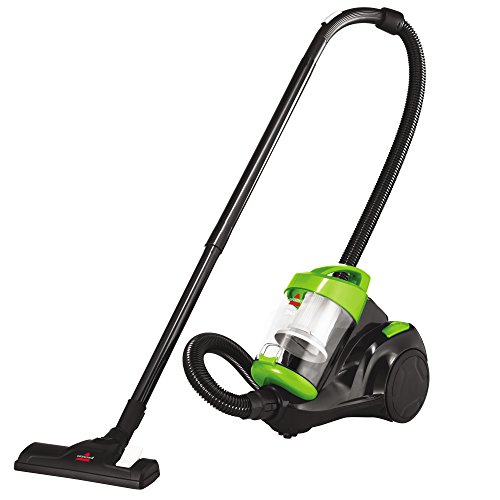
Bissell Zing Bagless Canister 2156A — Best Bagless Budget
The Zing bagless answers the one objection to the Mighty Mite philosophy: the bags. Its cyclonic cup separates dust without a bag to buy, the filters wash rather than replace on a schedule, and the retractable cord — a small luxury at this tier — makes putting it away a one-button act. For a household that vacuums often and lightly, it is the running-cost champion of this list.
Strengths
- No bags to buy, ever — the lowest running costs here
- Retractable cord is a genuine quality-of-life feature at this price tier
- Compact and light, with a carry handle for stairs
Trade-offs
- Emptying the cup is dustier than swapping a sealed bag
- Filters need washing and full drying to keep suction honest
- Cyclonic cups lose their edge with fine dust if filters are neglected
Key specs: Bagless cyclonic dirt cup, automatic cord rewind, washable filter system, multi-surface floor head.
Bagless economics reward the diligent. Wash the filters on the maker’s rhythm, empty the cup before the fill line rather than after, and the Zing holds its suction and costs nothing but electricity. Neglect either chore and performance fades in a way bagged owners never experience, because their maintenance is built into the consumable. Neither system is superior; they suit different temperaments, and this guide refuses to pretend otherwise.
Choose the Zing if you vacuum frequently, dislike buying consumables on principle, and will actually wash a filter. It is the budget canister for high-frequency, light-soil homes — exactly the homes where bag costs would otherwise accumulate fastest.
Best for: frequent light cleaning, bag-free households, compact homes / Not suited for: dust-sensitive households that prefer sealed-bag emptying
Check the current price on Amazon

Kenmore 81214 200 Series Bagged Canister — Best Step-Up Economical
The Kenmore 200 Series is what economical looks like when it grows up slightly: still a straightforward bagged canister, but with sealed HEPA filtration for finer dust control, a two-motor system that separates suction from the floor head’s work, and a tool set that covers upholstery, crevices and dusting without improvisation. For a mixed-floor family home that wants one vacuum to do everything respectably, this is the value peak.
Strengths
- HEPA filtration contains fine dust far better than basic budget filters
- Two-motor design and proper tools cover the whole house
- Bagged system keeps emptying clean and suction consistent
Trade-offs
- Costs more than the basic picks — it is the step-up, not the floor
- Heavier to trail than the featherweight models
- Bags are a Kenmore-format consumable to keep stocked
Key specs: Bagged design with HEPA filtration, two-motor system, three cleaning tools, telescoping wand.
The filtration is the real upgrade. In homes with heavy dust loads — pets, workshops tracked indoors, renovation aftermath — a sealed HEPA bagged system visibly changes how much dust resettles after cleaning, because what the vacuum collects stays collected. That, plus tools that fit their jobs, is what the extra money over the basic tier actually buys, and for a main family vacuum it is money with a daily return.
Buy it as the one-vacuum household’s economical answer. It undercuts the premium canister world by a wide margin while giving up remarkably little that a normal home will ever notice.
Best for: one-vacuum family homes with mixed floors and dust concerns / Not suited for: buyers wanting the absolute cheapest or lightest canister
Check the current price on Amazon

Eureka WhirlWind Bagless Canister NEN110A — Best for Hard Floors
Hard floors are the budget canister’s home turf, and the WhirlWind is tuned for them: light to trail from room to room, a head that does not scatter debris ahead of itself on wood and tile, and bagless emptying for the gritty, sandy loads hard floors produce. Homes with mostly hard flooring and a rug or two will find it covers the whole brief without a bag budget.
Strengths
- Excellent hard-floor manners at a budget tier
- Bagless cup suits gritty, frequent emptying
- Light enough for daily quick cleans rather than weekly events
Trade-offs
- Low-pile rugs only — deep carpet is beyond its brief
- Bagless filter washing is part of the ownership deal
- Basic tool set compared with the Kenmore
Key specs: Bagless dirt cup, lightweight canister body, multi-surface floor nozzle, washable filtration.
The hard-floor case deserves respect because it is most modern homes. A vacuum that makes a five-minute kitchen-and-hall sweep effortless gets used daily, and daily light cleaning beats weekly heroics for how a home actually feels. The WhirlWind’s lightness and simplicity are therefore features, not economies — they are the difference between a vacuum that lives in a cupboard and one that lives within reach.
Pair it with a washable-filter rhythm and it will hold its performance for years. If your home is wood, tile and low rugs wall to wall, this may be the most-used appliance you buy this year.
Best for: hard-floor homes, daily sweepers, flats and kitchens / Not suited for: carpet-dominant homes needing brushroll power
Check the current price on Amazon

Dirt Devil Bagless Canister with Cord Rewind — Best Compact with Cord Rewind
The Dirt Devil entry covers the same ground as the Zing with its own emphases: cord rewind for tidy storage, a versatile tool selection for a small home’s varied little jobs, and bagless running costs of zero. In a flat or a small house where the vacuum lives in a hall cupboard and comes out often, those storage and tool details are the daily experience of the machine.
Strengths
- Cord rewind keeps a small-home cupboard tidy
- Tool set covers upholstery, edges and dusting without extras
- Bagless running costs stay at zero
Trade-offs
- Like all bagless models, filters want regular washing
- Not the choice for deep carpet or heavy pet loads
- Compact cup means frequent emptying in larger homes
Key specs: Bagless dirt cup, automatic cord rewind, multi-surface tools, lightweight body.
Small-home vacuums are judged on friction: how fast the machine goes from cupboard to cleaning and back. Cord rewind, a light body and tools that live on board all shave that friction, and shaved friction is used cleaning time. The Dirt Devil understands its brief — frequent, varied, small-space cleaning — and serves it without pretending to be a whole-house deep cleaner.
Choose it against the Zing on the details you will touch daily: the tools, the storage, the feel of the wand in hand. At this tier those tactile details are the real specification, and either machine will reward the household that maintains its filters.
Best for: small homes and flats wanting tidy storage and zero bag costs / Not suited for: large or carpet-heavy homes
Check the current price on Amazon

Eureka 3670H Bagged Canister — Best for Pet Owners on a Budget
Pet hair changes the economical calculation, because the cheapest system to run is worthless if it cannot handle the load your home actually produces. The 3670H applies the Mighty Mite formula to pet homes: strong suction for hair on hard floors and low rugs, and — critically — bagged capture, so a week’s collected hair and dander leaves the house sealed rather than shaken out of a cup over the bin.
Strengths
- Bagged emptying seals pet hair and dander away hygienically
- Strong suction on the hard floors where pet hair gathers
- Blower clears the porch, garage and car footwells
Trade-offs
- Pet homes fill bags faster — budget for the consumable honestly
- No powered brushroll for deep carpet hair
- Basic filtration beside the Kenmore’s HEPA system
Key specs: Bagged design, lightweight body, floor nozzle for hard floors and low carpet, blower port, starter bags.
The bag-versus-cup argument is at its sharpest with pets. A cup emptied daily of hair is a dusty chore performed at face height; a bag changed monthly is not. For many pet households that difference alone justifies the bag cost, and the 3670 family’s bags are among the cheapest, most available consumables in the entire vacuum market — the economy that makes the system sustainable.
If your pet lives on hard floors and low rugs, this is the budget answer with the fewest regrets. If your home is deep carpet wall to wall, no budget canister is the right tool, and this guide says so in the buying section rather than selling you the wrong machine.
Best for: pet owners with hard floors and low rugs on a budget / Not suited for: deep-carpet homes or anyone expecting brushroll performance
Check the current price on Amazon
Comparison Table
| Pick | Badge | Key spec | Best for |
|---|---|---|---|
| Eureka 3670M Canister Cleaner (Mighty Mite family) | Best Overall Value | Bagged canister, lightweight body, blower function | flats, small-to-medium homes, hard floors and rugs, stairs and cars |
| Bissell Zing Bagless Canister 2156A | Best Bagless Budget | Bagless cyclonic, retractable cord, washable filters | frequent light cleaning, bag-free households, compact homes |
| Kenmore 81214 200 Series Bagged Canister | Best Step-Up Economical | Bagged, HEPA filtration, 2-motor system, 3 tools | one-vacuum family homes with mixed floors and dust concerns |
| Eureka WhirlWind Bagless Canister NEN110A | Best for Hard Floors | Bagless, lightweight, hard-floor friendly head | hard-floor homes, daily sweepers, flats and kitchens |
| Dirt Devil Bagless Canister with Cord Rewind | Best Compact with Cord Rewind | Bagless, cord rewind, versatile tool set | small homes and flats wanting tidy storage and zero bag costs |
| Eureka 3670H Bagged Canister | Best for Pet Owners on a Budget | Bagged, pet-floor focus, blower function | pet owners with hard floors and low rugs on a budget |
How to Choose the Best Economical Canister Vacuums Without Buying Twice
Do the five-year maths, not the ticket maths
Add the machine, five years of bags or filters at your household’s realistic rate, and one allowance for a belt or a hose, and compare totals. The cheapest ticket in this category regularly finishes third on that table, beaten by a slightly pricier machine with commodity bags. Every pick here was chosen because its consumables are standard parts sold by many sellers — the single strongest predictor of a vacuum staying economical.
Bagged versus bagless is a temperament test
Bagged systems bundle maintenance into the consumable: suction stays consistent, emptying is sealed and clean, and the motor breathes through a fresh filter surface each change. Bagless systems make maintenance a chore you perform: washing filters, emptying cups carefully, keeping seals clean. Both work. Choose the one whose maintenance you will actually do, because the economical vacuum is the one still performing in year four.
Know the format’s honest limits
Budget canisters without powered brushrolls are hard-floor and low-rug machines. On deep-pile carpet they will surface-clean politely and leave the deep grit behind, and no amount of wishing changes the physics. If your home is mostly deep carpet, the economical answer is a different format bought once — and recognising that before purchase is the most economical decision in this entire guide.
Why Canisters Win the Value Argument
The canister layout puts weight on wheels and lightness in the hand, which is why a budget canister can clean stairs, upholstery and car interiors that defeat heavier formats at three times the price. The motor sits in a simple, cool-running body with few moving parts beyond itself; the hose and wand are passive tubes that either work or obviously do not. Simplicity is not a lack of features at this tier — it is the feature that keeps the machine out of the repair shop.
Canisters also age gracefully. A bagged canister with a strong motor feels adequate for a decade, because suction does not go out of fashion. The households that report the lowest cost per year of vacuuming in this category are, almost without exception, running simple canisters they maintain on rhythm — which is the entire thesis of this guide in one sentence.
Noise, Weight and Storage: The Daily-Living Specs
Budget canisters are not quiet, and this guide will not pretend otherwise: a simple motor in a light body makes an honest working noise. What the format offers instead is brevity — the cleaning itself is fast, the machine trails rather than being pushed, and it stores in a cupboard footprint smaller than any upright. Weigh those daily-living facts as heavily as suction. A vacuum that stores badly gets used reluctantly, and reluctance is the most expensive specification of all.
Weight deserves the same realism. The featherweights here can be carried in one hand with the hose in the other, which is why they dominate stairs and flats; the step-up Kenmore trades some of that lightness for filtration and tools. Neither is wrong — but know which household you are before choosing which trade to make.
Bags, Filters and the Consumable Trap
The vacuum industry’s oldest business model is a cheap machine married to expensive, proprietary consumables. Defend yourself with one question before any purchase: are the bags or filters a standard pattern sold by several makers? The Eureka MM-pattern bags and Kenmore’s canister bags pass that test so completely that third-party options compete their prices down to commodity level. A model whose filter is one brand, one seller and one volatile price is not an economical vacuum whatever its ticket says.
Stock discipline completes the defence. Keep two bags or one clean spare filter set in the cupboard, reorder when you fit the last one, and the machine never spends a month wheezing on an overfull bag while a delivery wanders. Most ‘my vacuum lost suction’ stories are consumable stories, and they are all preventable for the price of a coffee.
Stairs, Cars and Upholstery: Where the Budget Canister Shines
Put the canister body on a stair tread, take the wand up the flight, and you have cleaned the hardest surface in the house with a machine that cost less than a night out. The same lightness transforms car cleaning — the body sits on the driveway, the nozzle reaches footwells and boot corners, and the blower-equipped Eurekas clear the loose grit first. Upholstery and curtains, which need suction without a heavy machine balanced on the sofa, are the same story.
These are the jobs that justify a canister even in homes that own another vacuum. Many households run a budget canister as the stairs-car-upstairs specialist beside a main machine, and on cost per year that two-machine system still undercuts a single premium all-rounder — while doing several jobs better.
Keeping a Budget Canister Strong for a Decade
Three habits decide whether an economical canister is a ten-year servant or a two-year disappointment. Change bags at two-thirds full, because suction falls as the bag’s pores load, long before it looks full. Wash or replace filters on the maker’s schedule, and let washable filters dry fully — a damp filter is a mould farm and a suction brake. Clear hose blockages the moment suction drops, with a broom handle and patience, rather than running the motor against a blockage until it overheats.
None of this is skilled work, and all of it is cheaper than any repair. The budget canister’s bargain is explicit: a low price in exchange for a little rhythm. Households that keep the rhythm get a decade; the machine was always capable of it.
Canister Versus Upright Versus Stick: The Honest Format Comparison
The upright’s kingdom is carpet: a powered brushroll in a self-propelled body remains the fastest way to deep-clean wall-to-wall pile, and households with that flooring should not let a canister’s price talk them out of the right tool. The stick’s kingdom is the quick daily pass — light, cordless, always ready — paid for with small bins, battery lifespans and prices that make this entire guide look like a rounding error. The canister’s kingdom is everything else: hard floors, stairs, upholstery, curtains, cars, and homes that value a machine that can be maintained with a screwdriver and a consumable.
Cost per year rearranges the podium completely. The canister’s consumables are commodities, its failure points are visible and cheap, and its motor has no battery to fade or electronics to obsolesce. A household that keeps a budget canister for a decade — a normal outcome with rhythm — has spent less on vacuuming than a stick owner spends on a single battery replacement cycle. Formats are not rivals so much as answers to different questions; this guide’s question is economy, and on economy the canister is not close.
What ‘Pet Friendly’ Means at This Tier — and What It Does Not
Pet-friendly on a budget canister means three specific things: suction strong enough to lift hair from hard floors and low rugs, a capture system that disposes of it hygienically, and a floor head that does not felt hair into a mat around its wheels. It does not mean a motorised pet tool, tangle-free brushroll engineering or sealed allergen systems — those live at higher tiers, and pretending otherwise sets buyers up to blame a good machine for a missing feature it never claimed.
Within those honest limits, technique closes most of the gap. Vacuum pet zones little and often rather than weekly and heroically; use the crevice tool where hair drifts and collects — skirting, stair corners, the lee of furniture; and keep the consumable fresh, because hair loads bags and cups faster than any other household soil. Pet households that adopt that rhythm routinely report that the budget canister outperforms the expensive machine it replaced, because it is used daily instead of ceremonially.
The Second-Hand and Spare-Parts Advantage
An underappreciated virtue of long-running budget designs is their ecosystem. Bags, filters, hoses, wands and floor heads for the Eureka and Kenmore families are stocked everywhere, fit across years of production, and cost commodity money. A cracked wand or a perished hose on a decade-old machine is a small order, not a funeral — which is precisely why so many of these canisters reach ages that sealed, proprietary designs never see.
That ecosystem also makes the used market rational in this category and few others. A second-hand 3670 with a fresh bag and a clear hose is most of a new machine’s performance for pocket money, because there is so little hidden to be wrong with it. Buyers with a garage, a rental property or a workshop to equip exploit this routinely, and it is one more way the economical canister stays economical long after the first purchase.
Reading Suction Claims Without Being Fooled
Suction specifications at the budget tier are a swamp of incomparable numbers — air watts, amps, pascals — measured by each maker in the way that flatters it most. The honest tests are physical and free: a clean-consumable canister that lifts the rug’s edge on a slow pass, holds a sheet of paper to its hose end without trembling, and pulls grit from a skirting crevice at arm’s length has all the suction a hard-floor home can use. The models in this guide pass those tests in ordinary homes, which is worth more than any laboratory figure printed on a carton.
Remember also that suction is a system state, not a fixed property: the same machine measures heroically with a fresh bag and feebly with a loaded one. When a review or a neighbour reports a weak budget canister, the first question is never the model — it is the consumable. That is why this guide returns so often to rhythm: at this tier, the owner is half the specification.
Apartments, Rentals and Landlord Logic
There is a reason the budget canister is the unofficial vacuum of rental housing on several continents: it is cheap to replace, hard to kill, gentle on the hard floors landlords care about, and its consumables can be left as a welcome packet that sets the tenancy’s cleaning standard. Tenants benefit in mirror image — a machine light enough for stairs, kind to deposit-relevant floors, and simple enough that no cleaning argument ever starts with the equipment.
If you are furnishing a rental, buy two of the benchmark rather than one of the flagship: one in service, one in reserve, both running on the same commodity bags. That is the arithmetic of every professional landlord, and it is available to any household willing to value outcomes over objects.
How to Get the Most From an Economical Canister Vacuum
A budget canister rewards technique more than any premium format, because its simplicity puts the results in your hands. Work through these habits and the machine will perform a class above its ticket.
- Start every session with the consumable check: bag below two-thirds, cup below the line, filters clean and dry. Thirty seconds here is the whole maintenance philosophy.
- Clean in the format’s strength order: hard floors first with the floor head, then rugs with slower, overlapping passes that give suction time to work.
- Use the crevice tool along skirting and sofa edges before the main pass — edges are where canister suction is at its most decisive.
- Do stairs top-down with the body parked a few treads below you, so the hose works downhill and the machine is never balanced above your head.
- Empty or change the consumable immediately after a heavy session — pet hair and renovation dust compact in storage and age the filters.
- Store with the cord rewound and the hose looped loosely; tight kinks stored for months become the hose’s permanent memory.
- Once a season, check the floor head’s wheels and brush strip for wound hair and grit, and clear the hose with a broom handle if suction ever feels shy.
Followed consistently, these habits make the economical canister what it promises to be: the lowest cost per clean floor in the vacuum world. The machine is simple; the system around it is what you are really buying into, and it is a good system.
Finally, teach the household the two-minute version: consumable check, edges first, slow passes on rugs, empty after heavy work. A budget canister shared by people who all know its rhythm stays at full strength without anyone owning the chore — and a machine everyone can use is a machine that gets used, which is the last and largest economy of all.
Common Buying Mistakes
Buying on ticket price and ignoring consumables
A cheap machine with scarce, pricey filters is a subscription you did not read. Check that bags or filters are standard patterns with multiple sellers before the machine goes in the basket.
Running bags to bursting or cups past the line
Suction dies quietly as consumables overload, and motors strain against the blockage. Two-thirds full is the change point for bags; the marked line is the limit for cups. The performance you paid for lives on the right side of those marks.
Expecting brushroll results on deep carpet
A suction-only floor head cannot agitate deep pile. Using a budget canister as a deep-carpet machine disappoints the owner and misjudges the tool; match the format to the floors you actually own.
Never washing bagless filters
Bagless does not mean maintenance-free; it means the maintenance is yours. A clogged, unwashed filter is the number one cause of bagless suction loss, and it is entirely self-inflicted.
Storing the vacuum with a full cup or bag
Collected dust compacts, smells and ages seals in storage. Empty after heavy sessions and the machine starts every clean at full strength — and the cupboard smells of nothing at all.
Judging a canister by its first clean on a filthy floor
Any vacuum’s hardest day is the inherited mess. Judge a budget canister on its third and fourth cleans, once the home is at maintenance level — that steady state is the life you are buying, and it is where simple suction and good technique quietly shine.
Final Recommendation
Start with the Eureka 3670M if your home is hard floors, rugs and stairs — it is the category’s benchmark for a reason. Choose the Bissell Zing or the Dirt Devil if bags offend you and filter-washing does not. Step up to the Kenmore 200 Series if one vacuum must serve a whole family home with filtration to match, and take the 3670H if a pet writes your cleaning schedule.
Whichever you choose, keep its consumables stocked and its rhythm kept. Economical is not a price; it is a five-year outcome, and every pick here can deliver it. That settlement — bought once, maintained lightly, and forgotten about between cleans — is what economical was always supposed to mean.
Buy the machine, stock its bags or spare filters the same day, and the question of vacuuming is settled for years at a cost most households spend on a single month of streaming.
- Eureka 3670M Canister Cleaner (Mighty Mite family) (Best Overall Value) — Check the current price on Amazon
- Bissell Zing Bagless Canister 2156A (Best Bagless Budget) — Check the current price on Amazon
- Kenmore 81214 200 Series Bagged Canister (Best Step-Up Economical) — Check the current price on Amazon
- Eureka WhirlWind Bagless Canister NEN110A (Best for Hard Floors) — Check the current price on Amazon
- Dirt Devil Bagless Canister with Cord Rewind (Best Compact with Cord Rewind) — Check the current price on Amazon
- Eureka 3670H Bagged Canister (Best for Pet Owners on a Budget) — Check the current price on Amazon
Related reading on this site: Best Vacuums For Hardwood Floors, Best Vacuums For Pet Hair, Best Lightweight Vacuums, Best Bagged Vacuums, Best Vacuums For Stairs, Best Budget Vacuums
Frequently Asked Questions
Are cheap canister vacuums actually durable?
The simple ones are — a basic motor, a hose and a floor head give very little to fail, and designs like the Eureka 3670 family have served for years in homes that maintain them. Durability at this tier is mostly maintenance: bags changed on time, filters kept clean, blockages cleared early.
Bagged or bagless — which is cheaper over five years?
Bagless, on consumables alone, if you wash its filters faithfully. Bagged, if you count the performance consistency and the motors that live longer breathing through fresh bag surfaces. The honest answer is that the cheapest system is the one whose maintenance you will actually perform.
Can an economical canister handle pet hair?
On hard floors and low rugs, yes — strong suction plus bagged capture, as in the 3670H pick, handles pet homes well. On deep carpet, pet hair needs a powered brushroll, and no budget canister in this guide pretends otherwise.
Why do canister vacuums suit stairs so well?
The weight sits on the tread while only the light wand and head travel, so you are never lifting the motor. That separation of weight from work is the format’s founding idea, and stairs are where it pays off most visibly.
How often should I change the bag in a budget canister?
At roughly two-thirds full, which for most homes is every month or two, and sooner in pet or renovation households. Suction falls as the bag loads, so the change point is about performance, not capacity.
Is a budget canister loud?
Generally livelier than premium insulated models — another honest trade of the tier. It is the sound of a simple, powerful motor in a light body. For most households it is a few minutes of honest noise per room; if silence is a priority, that is a reason to step up a tier, stated plainly.
Can I use a budget canister vacuum as my only vacuum?
Yes, if your floors match its brief — hard floors, low rugs, stairs and upholstery are a complete household workload that these machines cover well. The household that cannot is the deep-carpet one, where a brushroll format is the right primary machine and a budget canister becomes the excellent second vacuum for everything else.
What should I check first when a budget canister loses suction?
The consumable, then the hose, then the filters — in that order, because that is the order of probability. A loaded bag or cup causes most cases; a sock in the hose causes most of the rest; a clogged filter explains the remainder. All three are free to check and cheap to fix, which is the format’s enduring charm.
Are replacement bags for these models easy to find?
Yes — that was a selection rule for this guide. The Eureka and Kenmore bag patterns are among the most widely stocked vacuum consumables anywhere, with genuine and quality third-party options competing on price. If a model’s bags ever look scarce or expensive, that model has stopped being economical, whatever its ticket says.

