Disclosure: airfryerkitchensupply.com is reader-supported. When you buy through links on our site, we may earn an affiliate commission at no extra cost to you.
Where to buy
Pet hair is a floorhead problem as much as a suction problem, so every vacuum below pairs a canister body with a brush or turbo head designed to pull hair out of carpet — and each was verified as a current listing. If you are comparing the best canister vacuums for pet hair, start with the pet-specific models at the top: their floorheads and filtration are built for exactly your mess.
- Kenmore 600 Series Pet Friendly Bagged Canister Vacuum 81615 — check price on Amazon
- Kenmore 600 Series Bagged Canister Vacuum with Hair Eliminator Brushroll — check price on Amazon
- Miele Classic C1 Cat & Dog Bagged Canister Vacuum — check price on Amazon
- Miele Guard L1 Cat & Dog Bagged Canister Vacuum — check price on Amazon
- Miele Complete C3 Calima Bagged Canister Vacuum — check price on Amazon
- Eureka Bagged Canister Vacuum 3670H — check price on Amazon
The best canister vacuums for pet hair earn the title in the floorhead, not the motor. Any strong canister can suck up hair lying on hardwood; the test that separates pet models is carpet, where hair weaves itself into the pile and has to be combed out by a powered or turbine-driven brush while suction carries it away. Add the second pet reality — dander and odor riding along with the hair — and the specification that matters becomes a system: the right head, sealed HEPA-grade filtration, and a bag or bin that empties without puffing the evidence back into your face.
Canisters suit pet homes for structural reasons. The weight rides on the floor instead of your arm, the hose reaches under sofas and up stairs where pet hair migrates, and the floorhead swaps in seconds — a parquet brush for the hardwood where hair tumbleweeds gather, a powered brush for the carpet where it hides. Uprights can do this work; canisters do it with less fatigue over a whole house.
The six picks below are all real, listing-verified listings, and they span the honest range of the category: two Kenmore 600 Series models built explicitly for pets, two Miele Cat & Dog machines from the premium end, a turbo-brush Miele for mixed floors, and a lightweight Eureka that has been the budget pet-canister answer for years. Bagged versus bagless, powered versus turbine heads, and filtration are compared plainly, because pet owners live with the consequences daily.
Key Takeaways
- The floorhead decides pet performance: motorized brush for carpet, turbine for low-medium pile, suction for hard floors.
- Sealed HEPA filtration plus sealed bags handles the dander and odor half of the pet problem.
- Bagged designs dominate this list because pet-hair emptying is where bagless systems fail their owners.
- Vacuum slower than feels natural, and the pet’s favorite spot twice as often as the rest of the home.
In this guide
Quick Picks
Kenmore 600 Series Pet Friendly Bagged Canister Vacuum 81615 — Best Overall. The complete pet system at a sane tier: a motorized Pet PowerMate floorhead, a second motor for suction, HEPA filtration, and a retractable cord — built for pet homes from the first sketch.
Check the current price on Amazon
Kenmore 600 Series Bagged Canister Vacuum with Hair Eliminator Brushroll — Best for Shedding Breeds. The 600 Series turned up for maximum shedders: a Hair Eliminator brushroll that resists the wrap-around tangle, Pet PowerMate drive, HEPA filtration, and a stair-grip body for the staircase hair farm.
Check the current price on Amazon
Miele Classic C1 Cat & Dog Bagged Canister Vacuum — Best Premium Pet Canister. Miele’s pet answer in the Classic line: a Cat & Dog canister built for deep carpet cleaning, with the brand’s sealed bag system and the build quality that makes Mieles decade-long appliances.
Check the current price on Amazon
Miele Guard L1 Cat & Dog Bagged Canister Vacuum — Best New-Generation Miele for Pets. Miele’s newer Guard generation in Cat & Dog trim, aimed at hard floors and low-to-medium carpet — the modern Miele for the way pet homes are actually floored now.
Check the current price on Amazon
Miele Complete C3 Calima Bagged Canister Vacuum — Best for Mixed Floors & Allergies Focus. The C3 Calima pairs Miele’s flagship canister body with a turbine-driven brush that spins up on carpet — a sealed, quiet, premium system for pet homes with low-to-medium pile.
Check the current price on Amazon
Eureka Bagged Canister Vacuum 3670H — Best Budget & Lightweight. The veteran budget answer: a featherweight bagged canister, sold for hardwood, carpet, pet, and car duty, with a blower function — the second vacuum or small-apartment pet machine that punches far above its tier.
Check the current price on Amazon
How These Picks Were Chosen
We filtered for pet capability as a system. A qualifying vacuum needed a floorhead that agitates carpet — a motorized power nozzle or a turbine brush — because suction alone leaves woven-in hair behind. Sealed filtration with HEPA-grade media was the second requirement, since hair without dander control solves only the visible half of the problem. Each candidate was verified against its exact listing, model number included, before any link was placed.
Bagged designs dominate this list deliberately. For pet households, a sealed bag that lifts out and seals shut is the cleanest emptying experience available, and modern high-capacity bags compress weeks of hair into a dense, odor-contained package. The one budget classic earns its place on value and weight, with its trade-offs stated.
We also weighed the daily-life details pet owners actually curse: cord length and retraction, whether the wand reaches a full staircase, how the machine behaves on the transition from carpet to hard floor where hair collects at the edge, and whether replacement bags and filters are easy to find years from now.
The 6 Best Canister Vacuums for Pet Hair
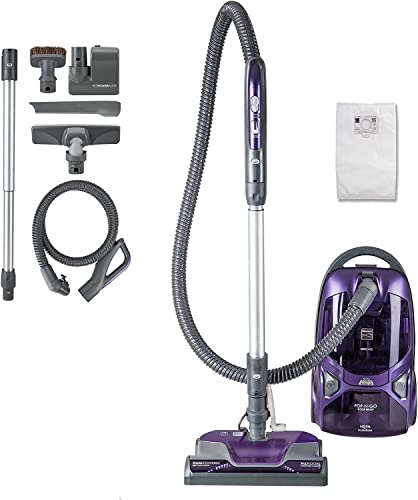
Kenmore 600 Series Pet Friendly Bagged Canister Vacuum 81615 — Best Overall
Kenmore’s 600 Series 81615 is the pet canister most households should buy. Its Pet PowerMate is a motorized brush head — the brush has its own motor, so it keeps combing carpet at full aggression regardless of suction load — and the 2-motor design means suction and brushing never compete. HEPA filtration handles the dander half of the problem, and the bagged body keeps emptying clean.
Strengths
- Motorized Pet PowerMate head combs hair out of carpet rather than skimming it
- 2-motor system keeps brush and suction independent
- HEPA filtration plus sealed bags address dander and odor, not just visible hair
Trade-offs
- Bagged running costs continue for the life of the machine
- Heavier than the lightweight picks when carried between floors
- Kenmore support now runs through its current brand channels rather than the old Sears counters
| Floorhead | Pet PowerMate, motorized |
| Motors | 2-motor system |
| Filtration | HEPA filter |
| Cord | Retractable |
The powered head is the whole argument. Turbine brushes slow exactly when carpet gets thick and hair gets deep — the moment you need them most. A motorized brush does not care; it combs at full speed through the rug by the door where the dog actually sleeps, which is where pet vacuums are truly graded. Owners upgrading from a suction-only canister consistently describe the first pass over a pet rug as the moment they understood what their old vacuum had been leaving behind.
The retractable cord and the canister’s balance make it a whole-house machine rather than a spot cleaner: unplug once per floor, work rooms in sequence, and let the cord reel do the tidying. For multi-pet homes cleaning several times a week, that rhythm is the difference between a chore done and a chore deferred.
Best for: multi-pet homes with real carpet, and anyone upgrading from suction-only cleaning / Not suited for: buyers who refuse ongoing bag costs on principle

Kenmore 600 Series Bagged Canister Vacuum with Hair Eliminator Brushroll — Best for Shedding Breeds
Some dogs shed a garnish; others shed a second dog, weekly, forever. This 600 Series variant is for the second kind. Its Hair Eliminator brushroll is designed to resist the classic failure of powered heads — hair wrapping the brush into a felted rope that you must cut free with scissors — while keeping the Pet PowerMate drive, 2-motor layout, and HEPA filtration of the line. The stair grip design acknowledges where canisters and pet hair both end up: the staircase.
Strengths
- Hair Eliminator brushroll reduces the cut-the-tangle maintenance ritual
- Same proven 600 Series pet platform: powered head, 2 motors, HEPA
- Stair grip design suits the split-level reality of pet homes
Trade-offs
- The brushroll helps enormously but very long human hair will still wrap eventually
- Bagged consumables, as with the line
- Feature-rich head is heavier at the end of the wand than a simple parquet brush
| Brushroll | Hair Eliminator design |
| Floorhead | Pet PowerMate |
| Filtration | HEPA filter |
| Design | Stair grip body |
Brushroll tangling is the hidden tax on pet vacuuming: ten minutes of cleaning, five minutes of scissor surgery over a trash can. A brushroll engineered to shed hair into the suction path instead of hoarding it returns those minutes every single week, which over a vacuum’s life is the largest quality-of-life number in this entire comparison — larger than any suction figure.
Choose between the two Kenmores by your dominant frustration. If your old vacuum simply left hair behind, the standard 81615 solves it. If your old vacuum collected the hair and then made you cut it off the brush, this is your machine.
Best for: homes with heavy-shedding breeds and long hair / Not suited for: mostly-hardwood homes that rarely need a powered head

Miele Classic C1 Cat & Dog Bagged Canister Vacuum — Best Premium Pet Canister
The Classic C1 Cat & Dog is the premium route into pet canisters: Miele engineering, a model tuned specifically for pet hair in carpet, and the ownership experience the brand is famous for — quiet power, dense sealed bags, and parts availability measured in decades. For a home that vacuums pet hair several times a week, the machine’s longevity math beats buying a budget unit three times.
Strengths
- Purpose-built Cat & Dog model from the category’s premium brand
- Deep carpet cleaning focus with pet hair as the design brief
- Miele bags and filters are available everywhere, for years
Trade-offs
- Premium tier pricing, and Miele consumables are premium too
- Bagged only — no bagless Miele option exists to switch to
- The Classic line’s cord and hose reach are good rather than class-leading
| Model | Classic C1 Cat & Dog |
| Format | Bagged canister |
| Focus | Deep carpet cleaning (per listing) |
| Brand | Miele |
Miele’s case has always been total cost over time, and pet homes stress-test that case hardest because they run their vacuums like appliances, not ornaments. A machine built to be serviced, with bags and filters stocked everywhere and a body that shrugs off weekly use for a decade, is the rational luxury. The Cat & Dog tuning — carpet aggression plus odor-conscious filtration options in the Miele ecosystem — means the premium buys pet performance, not just a badge.
It is also the quietest route through a pet home’s cleaning routine. In houses with noise-sensitive animals — which is to say, most cats — a calmer machine makes the weekly vacuum less of a household event.
Best for: pet owners who keep appliances for a decade and vacuum constantly / Not suited for: budget-first buyers and bagless loyalists

Miele Guard L1 Cat & Dog Bagged Canister Vacuum — Best New-Generation Miele for Pets
The Guard L1 Cat & Dog reflects a flooring shift: most pet homes now run mostly hard floors with area rugs and low-pile carpet, not wall-to-wall plush. Miele’s newer Guard platform in Cat & Dog configuration is tuned for exactly that mix — strong on hard surfaces where hair gathers visibly, capable on the low-to-medium carpet where it hides. If your home’s carpet is the exception rather than the rule, this is the correctly aimed Miele.
Strengths
- Cat & Dog tuning on Miele’s current Guard platform
- Hard-floor strength matches modern pet-home flooring
- Same sealed-bag cleanliness as the rest of the Miele line
Trade-offs
- Low-to-medium carpet focus means deep plush is not its home turf — that is the C1 Cat & Dog’s job
- Newer platform, so the long-term track record is still being written
- Premium pricing and consumables, as with all Miele
| Model | Guard L1 Cat & Dog |
| Surfaces | Hard floors and low-medium carpet (per listing) |
| Format | Bagged canister |
| Brand | Miele |
Matching the vacuum to the floor mix is the most common pet-buying error this guide can prevent. A maximum-aggression carpet machine in a hard-floor home is wasted money and can scatter debris; a hard-floor specialist on deep carpet leaves hair woven in place. The Guard L1 Cat & Dog exists for the majority floor plan, and its honesty about low-to-medium carpet is a feature, not a limitation.
As the current platform, it is also the Miele to buy for the longest supported future — bags, filters, and parts will follow the Guard line for years.
Best for: pet homes with mostly hard floors and low-pile rugs / Not suited for: homes with deep plush carpet throughout

Miele Complete C3 Calima Bagged Canister Vacuum — Best for Mixed Floors & Allergies Focus
The Complete C3 is Miele’s flagship canister platform, and the Calima configuration drives its carpet brush by turbine — suction spins the brush — which suits low-to-medium pile and hard floors in one head-swapping system. For pet homes whose carpet is moderate and whose owners want the C3’s sealed body, quiet running, and long reach, the Calima is the connoisseur’s configuration.
Strengths
- Flagship C3 sealed body and quiet operation
- Turbobrush handles low-medium carpet pet hair without a second motor to maintain
- Excellent hard-floor manners, where most pet hair visibly collects
Trade-offs
- Turbine brushes lose aggression on thick, hair-loaded carpet versus motorized heads
- Flagship pricing
- Curry yellow is a personality choice not everyone will sign for
| Model | Complete C3 Calima |
| Floorhead | Turbobrush (turbine-driven) |
| Surfaces | Low-medium pile carpet and hard floors |
| Format | Bagged canister |
The turbine-versus-motor question deserves its honest answer: on low and medium pile, a good turbobrush pulls pet hair nearly as well as a powered head, with less weight at the wand and nothing electrical in the head to fail. On deep plush loaded with shepherd fur, the motorized Kenmores and the C1 Cat & Dog pull ahead. The Calima buyer is choosing refinement and sealed-system quality for the floors they actually have.
The C3 body is the long-game purchase: the filtration path, the bag dock, the cord reel, and the wand all feel engineered a class above, and in a house that vacuums constantly, that tactile quality is experienced thousands of times.
Best for: premium buyers with low-to-medium pile and hard floors / Not suited for: deep-plush carpet homes needing maximum brush aggression

Eureka Bagged Canister Vacuum 3670H — Best Budget & Lightweight
The Eureka 3670H has been the budget canister recommendation for so long because its formula is right: genuinely lightweight, bagged (so pet hair empties cleanly), strong suction for its size, and a listing that names pet duty among its jobs. It is not a powered-head machine, and this guide will not pretend otherwise — but for hard floors, low rugs, stairs, and cars, it does pet work that embarrasses pricier machines.
Strengths
- Featherweight body is effortless on stairs and between floors
- Bagged emptying keeps pet hair contained and clean
- Blower function blows hair out of garage corners and car crevices before vacuuming
Trade-offs
- Suction-only floorhead cannot match powered brushes on real carpet
- Budget build: plastics and fittings are functional, not premium
- Smaller bags fill faster in heavy-shedding homes
| Model | 3670H |
| Format | Lightweight bagged canister |
| Extras | Blower function |
| Listed for | Hardwood, carpet, pet, car (per listing) |
Every category needs the pick that respects a budget without lying about it. The 3670H’s honest role: hard floors and low pile, apartments and second floors, the car after the dog’s beach day, and the staircase where a heavy flagship is a wrestling match. In those arenas its light weight is not a compromise — it is the winning specification.
Many pet households end up owning this alongside a flagship: the big machine for the weekly deep clean, the Eureka for the daily two-minute hair patrol. That two-machine pattern, at this price, is rational rather than extravagant.
Best for: apartments, stairs, cars, and as a lightweight second vacuum / Not suited for: homes whose main challenge is hair in deep carpet
Comparison Table
The divides that matter: motorized brush heads (Kenmore) versus turbine (Calima) versus suction-only (Eureka), and carpet-first tuning (C1 Cat & Dog) versus hard-floor-first (Guard L1). Match the head to your deepest carpet and the body to your floors.
| Pick | Badge | Key spec | Best for |
|---|---|---|---|
| Kenmore 600 Series Pet Friendly Bagged Canister Vacuum 81615 | Best Overall | Pet PowerMate powered head, HEPA, 2-motor system | multi-pet homes with real carpet, and anyone upgrading from suction-only cleaning |
| Kenmore 600 Series Bagged Canister Vacuum with Hair Eliminator Brushroll | Best for Shedding Breeds | Hair Eliminator brushroll, Pet PowerMate, stair grip | homes with heavy-shedding breeds and long hair |
| Miele Classic C1 Cat & Dog Bagged Canister Vacuum | Best Premium Pet Canister | Cat & Dog model, electrobrush-class carpet cleaning | pet owners who keep appliances for a decade and vacuum constantly |
| Miele Guard L1 Cat & Dog Bagged Canister Vacuum | Best New-Generation Miele for Pets | Guard L1 Cat & Dog, hard floors and low-medium carpet | pet homes with mostly hard floors and low-pile rugs |
| Miele Complete C3 Calima Bagged Canister Vacuum | Best for Mixed Floors & Allergies Focus | Turbobrush floorhead, low-medium carpet and hard floors | premium buyers with low-to-medium pile and hard floors |
| Eureka Bagged Canister Vacuum 3670H | Best Budget & Lightweight | Lightweight bagged canister, pet-listed, blower function | apartments, stairs, cars, and as a lightweight second vacuum |
How to Choose a Canister Vacuum for Pet Hair
The floorhead decides everything
Rank your home by its hardest surface: the deepest carpet your pets actually lie on. Deep or plush carpet demands a motorized brush head, which combs hair out under its own power. Low-to-medium pile can be served by a turbine brush. Hard floors and low rugs need only suction and a good parquet head — and there, a heavy powered head is wasted weight. Most pet-vacuum disappointment is a floorhead mismatch: an excellent vacuum aimed at the wrong floor.
Filtration is the invisible half of pet cleaning
Hair is the visible problem; dander and odor are the persistent ones. Look for sealed systems — where the air path is gasketed so dust cannot bypass the filter — with HEPA-grade media, and prefer bagged designs for pet duty: a sealed bag change is the only emptying method that does not return a puff of the finest particles to the room you just cleaned. Bagless bins are economical, but emptying a bin of compressed pet hair is an outdoor chore in any honest household.
Reach and rhythm matter more than peak suction
Pet hair lives under sofas, along baseboards, on stairs, and in the car. A canister’s hose reach, a wand that extends, attachments that live on the machine, and a cord long enough to finish a floor without replugging decide whether the weekly clean is a flowing routine or a series of interruptions. Suction figures beyond a competent threshold change little; a vacuum you enjoy using gets used, and frequency beats intensity in pet homes.
Bagged vs. Bagless for Pet Owners, Settled Plainly
Bagless marketing promises freedom from consumables, and for pet-free homes that promise mostly holds. Pet hair changes the arithmetic: bins fill with hair that mats and must be pulled out by hand, filters wash and clog on a schedule, and the emptying puff is precisely the dander you vacuumed to remove. A modern sealed bag, by contrast, compacts weeks of hair, drops out without contact, and keeps the machine’s filtration performing at specification for its whole service interval. That is why five of the six picks here are bagged — not nostalgia, but the lived experience of emptying both kinds over a shedding season.
Anatomy of a Pet-Hair Clean: Where the Hair Actually Lives
Pet hair distributes itself by physics, not malice. The visible fraction — tumbleweeds on hard floors, drifts along baseboards — is the easy part, and any competent suction removes it. The consequential fraction is woven: hair worked into carpet pile by paws and body weight, aligned with the fibers, effectively upholstered into the rug. That fraction is why the brush head matters more than any suction number, and why a vacuum can leave a carpet looking clean while a hand rubbed across it raises a grey film. Test any vacuum’s real performance with that hand test, in the pet’s favorite spot, and you will know more than a spec sheet can tell you.
The third fraction is airborne and settled dander — the fine material that rides air currents and lands on shelves, bedding, and lungs. This is the filtration argument in physical form: a vacuum that exhausts fine particles while collecting coarse ones is redistributing the problem at a smaller scale. Sealed systems with HEPA-grade media exist to close that loop, and for households where pet dander is the complaint behind the complaint, the sealed bagged designs in this list are not a preference but the point.
Knowing the three fractions explains the routine in the how-to section: tools first for the settled fraction on furniture, slow brush passes for the woven fraction, edges and corners for the drifted fraction, and a sealed machine over all of it so the fine fraction stays captured. A pet clean is a system, and the vacuum is its engine — which is why this guide grades vacuums as systems rather than as motors.
Stairs, Cars, and the Territories Between Cleans
Ask pet owners where the hair wins and they name the same two territories: the staircase and the car. Stairs defeat heavy machines by geometry — an upright is a hazard, a heavy canister a wrestling match — and they collect hair at the tread edges where feet and paws compress it daily. This is why the Kenmore’s stair-grip design and the Eureka’s featherweight body appear in this guide without apology: they are specifications aimed at the territory, not marketing garnish. A vacuum that does stairs willingly gets the stairs done; one that does not, does not, and the hair compounds weekly.
The car is the second front: hair woven into upholstery and floor mats, in a space no full-size vacuum fits. The canister format is the natural car tool — body on the ground, hose and tools in the cabin — and the Eureka’s blower function earns a specific mention here, because blowing hair and grit out of crevices and mat pile before vacuuming is the professional detailer’s sequence, available in a budget machine. Pet households that add a monthly car session to the routine stop experiencing the car as a separate, hopeless ecosystem.
Between the deep cleans, the honest secret of hair-free homes is the two-minute patrol: the pet’s bed, the sofa’s seat, the rug by the door, done with whatever machine is lightest to hand. It is unglamorous, and it is the entire difference between homes where hair is managed and homes where it is periodically battled. Choose at least one vacuum you do not dread lifting, and the patrol happens.
Bags, Filters, and the Maintenance Calendar That Keeps Suction Honest
Every vacuum in this guide loses performance on a schedule set by its consumables, and pet homes run that schedule faster than any other. Bags fill with hair that does not compact like dust — a shedding home can fill a bag in weeks that a pet-free home would take months to fill — and a bag past its fill line strangles airflow no matter what the motor promises. The discipline is simple: check the bag monthly by hand, not by the calendar or the indicator alone, and keep spares in the house, because a vacuum waiting a week for bags is a week of compounding hair.
Filters follow the same logic. Pre-motor filters protect the motor and clog quietly; exhaust and HEPA filters protect the room and clog more quietly still. Rinse or replace them on the maker’s schedule, sooner in heavy-shedding homes, and write the dates on a card kept with the spare bags. The brushroll is the third consumable nobody lists: check it for wrapped hair after heavy sessions, because a felted brushroll silently converts a powered head into a suction-only one — the exact failure this guide warned against at purchase.
None of this is burdensome; it is fifteen minutes a month, and it is the difference between a vacuum that performs at year three like it did on day one and one that “just isn’t as good anymore.” Pet homes do not kill vacuums. Neglected consumables do, on an entirely predictable schedule that a small calendar prevents.
Setting Up a Two-Machine Pet Household (and When One Is Enough)
Many pet homes eventually discover the pattern this guide has hinted at: a flagship for the weekly deep clean and a lightweight for the daily patrol. The logic is behavioral, not mechanical. The deep clean needs the powered head, the sealed system, and the reach — the Kenmore or a Miele, working slowly through every room. The patrol needs only to be effortless: the Eureka’s featherweight body, out of the closet and back in four minutes, covering the pet’s bed, the door rug, and the sofa before hair migrates. Each machine makes the other’s job easier, and the total cost of the pair is often less than one ultra-premium flagship asked to do both jobs resentfully.
One machine is enough when the home is small, the floors are mostly hard, or the pets are light shedders — in those cases a single mid-tier canister, used often, beats a fleet used rarely. The honest test is your own friction: if the weekly clean happens reliably with one machine, you own enough vacuum. If it slips because the machine is heavy, stored badly, or dreaded, the second lightweight machine is not an indulgence but the fix for the actual problem.
Storage decides more of this than specifications do. A canister that lives assembled in a hall closet gets used; one that lives boxed in a basement gets scheduled. Give the patrol machine the best storage spot in the home — the flagship can tolerate the worse one, because its sessions are planned. Arrange the house so the easy thing is the right thing, and the hair stays managed almost by itself.
Whichever pattern you choose, the measure of success is the same quiet one: guests stop producing hair on their socks, dark clothes survive a sit on the sofa, and the weekly clean feels like maintenance rather than archaeology. That is what the machines in this guide are for, in whatever combination your home honestly needs.
Reading Your Home’s Hair Map Before You Buy
Before ordering any vacuum in this guide, spend one cleaning session reading your home’s hair map — the specific geography of where hair accumulates in your rooms, because that map, honestly read, picks the vacuum for you. Note where the drifts form (behind doors, along the baseboards of the pet’s favorite room), where the woven fraction lives (which rug, which carpet, the pet bed’s surroundings), and where the awkward territories are (the staircase, the car, the upholstered chair nobody sits in because it is the cat’s). Every home’s map is different, and every pick in this guide is the champion of a particular map.
A map dominated by woven carpet hair demands the powered heads — the Kenmores, the C1 Cat & Dog. A map of hard-floor drifts and low rugs belongs to the Guard L1 or the Calima. A map whose frontiers are stairs and upholstery and a car in the driveway argues for the Eureka’s lightness somewhere in the arsenal, whatever else you buy. Shopping from the map prevents the category’s classic error: buying the most powerful vacuum for a home whose problem was never power.
Re-read the map after a month with your new machine. It will have changed — the drifts smaller, the woven fraction thinner, the frontiers pushed back — and what remains is your home’s true maintenance geography, the two-minute patrol route that keeps it that way. The vacuum was the purchase; the map is the system. Pet owners who learn theirs stop fighting hair and start merely collecting it, which is the whole ambition of this guide.
A Final Word on Floors: Protecting What You Are Cleaning
A pet vacuum’s last job is to do no harm to the floors it serves, and canisters have two advantages here worth naming. Their floorheads are purpose-swapped — a parquet head with soft bristles or felt for hard floors, rather than a spinning brush dragged across wood — and their bodies trail behind on their own wheels instead of being pushed into baseboards and furniture legs at body height. The damage uprights and wrong heads do to floor finishes is slow and cumulative, and it is entirely avoidable with the head discipline this guide has recommended: brush for carpet, parquet for hard floors, and never the twain confused.
Wheels and hoses deserve the same thirty seconds of attention: a canister’s wheels pick up grit, and a gritty wheel dragged across a soft finish is a scratch with a motor behind it. Wipe the wheels when you check the brushroll — it is the same maintenance moment — and your floors will age at the rate of the home, not the rate of the cleaning. The best pet clean is the one nobody can trace afterward: no hair, no dander, and no evidence the machine was ever there.
How to Vacuum a Pet Home So the Hair Stays Gone
Technique multiplies any of these machines. This is the routine that experienced pet households converge on, in the order that makes physical sense.
- Start high and dry: use the hose and crevice tool on sofa cushions, pet beds, and the tops of baseboards first, so anything you dislodge falls to a floor you have not vacuumed yet.
- Vacuum carpet slowly, in overlapping passes, and change direction for the final pass. Brush heads need dwell time to comb; a fast single pass skims the surface hair and leaves the woven fraction behind.
- Do hard floors with the parquet head or suction setting, working toward the room’s center — hair migrates to edges and corners, so finish along baseboards with the crevice tool where tumbleweeds collect.
- Vacuum the pet’s favorite spot twice as often as the rest of the home, even if it is a two-minute midweek pass with a lightweight machine. Hair controlled at the source never becomes a whole-house problem.
- Empty or check the bag before it is packed solid, and wipe the floorhead’s brush after heavy sessions. A brush wrapped in hair and a bag at capacity quietly halve any vacuum’s performance.
Follow the rhythm for a month and the house crosses a threshold: hair stops accumulating faster than you remove it, and the weekly clean becomes maintenance instead of recovery. That threshold, not any single session, is what pet owners are actually buying.
Common Buying Mistakes
Buying suction numbers instead of a floorhead
A mighty motor behind a suction-only head still leaves carpet hair woven in place. The brush is the tool; suction is its assistant.
Choosing bagless to save on bags
Pet hair makes bin-emptying a hands-in chore and clogs washable filters relentlessly. Sealed bags are the pet-owner technology, whatever the shelf talker says.
Vacuuming fast
Brush heads comb at their own pace. Doubling your pass speed roughly halves your hair removal on carpet — slow down and let the machine work.
Ignoring the stairs and car
Hair’s favorite territories are the ones the big vacuum is awkward in. A lightweight canister or a stair-friendly design closes the gap where hair otherwise breeds undisturbed.
Letting the brushroll felt up
A wrapped brushroll stops combing and starts skating. Check it after heavy sessions; the Hair Eliminator design reduces this chore, it does not repeal physics for very long hair.
Final Recommendation
Most pet homes should buy the Kenmore 81615: powered pet head, independent motors, HEPA filtration, sane tier. Homes with extreme shedding and long hair should step to its Hair Eliminator sibling. Miele buyers choose by floor: the Classic C1 Cat & Dog for carpet-first homes, the Guard L1 Cat & Dog for hard-floor-first homes, and the C3 Calima for refined mixed-floor cleaning. The Eureka 3670H remains the lightweight budget champion and the best second vacuum in the category.
Whichever you choose, vacuum slower than feels natural and more often than feels necessary for the first month. The machine and the routine together are the product.
Start your shortlist here: Kenmore 600 Series Pet Friendly Bagged Canister Vacuum 81615 · Kenmore 600 Series Bagged Canister Vacuum with Hair Eliminator Brushroll · Miele Classic C1 Cat & Dog Bagged Canister Vacuum
Keep exploring the same cluster: Best Vacuums For Pet Hair Best Bagged Canister Vacuums Best Vacuums For Hardwood Floors And Pet Hair Best Cordless Vacuums For Pet Hair Best Robot Vacuums For Pet Hair
Related guides
Frequently Asked Questions
Why a canister instead of an upright for pet hair?
Canisters put the weight on the floor, reach under furniture and up stairs with a hose, and swap floorheads in seconds — a powered brush for carpet, a parquet head for hard floors. For whole-house pet cleaning, that flexibility usually beats an upright’s all-in-one bulk.
Do I really need a motorized brush head?
If your pets lie on carpet deeper than low pile, yes — suction alone cannot comb woven hair out of the pile. On hard floors and low rugs, a turbine or suction head is sufficient and lighter.
Are bagged vacuums better for pet owners?
For most, yes: sealed bags compact weeks of hair, empty without a dander puff, and keep filtration at spec. Bagless saves bag costs but makes emptying a hands-on, outdoor chore in a shedding home.
How often should I vacuum with shedding pets?
The pet’s favorite areas benefit from a quick pass every two to three days, with a full-house clean weekly. Frequency at the source beats intensity later — hair removed early never migrates.
What filtration should pet owners look for?
A sealed system with HEPA-grade media, so the dander fraction is captured rather than blown through. The bag or bin is part of that system: sealed bags preserve the benefit at emptying time.
Can one vacuum do carpet and hard floors well?
Yes, with the right heads: a powered or turbine brush for carpet and a parquet-style head for hard floors. The canisters here are built around exactly that swap, which is the format’s core advantage in mixed-floor pet homes.
How do I get pet hair out of car upholstery with a canister vacuum?
Blow first if your machine has a blower function, to lift hair from crevices and mat pile, then vacuum with the upholstery tool in slow, overlapping passes, finishing with the crevice tool along seams and seat edges where hair packs tightest.
How often will I change bags in a heavy-shedding home?
More often than the box suggests — check monthly by hand during shedding season. Hair fills bags faster than household dust, and a bag changed on time preserves the suction you paid for. Keeping spares at home is part of the system.
Can a canister vacuum handle a full flight of carpeted stairs?
Yes — that is a canister strength. The body sits on a tread (the Kenmore here is designed with a stair grip), and the hose and wand work the steps above and below. Lightweight models like the Eureka make the job easier still.

