Disclosure: airfryerkitchensupply.com is reader-supported. When you buy through links on our site, we may earn an affiliate commission at no extra cost to you.
The best affordable meat smokers prove that the price of the cooker has remarkably little to do with the quality of the meat that comes out of it. Brisket, pork butt, ribs, and chicken respond to stable temperature, clean smoke, and time — and every one of those inputs is available in the entry tier if you choose a design that spends its budget on the chamber and the fire instead of on screens and apps. What the affordable tier cannot forgive is a bad design: thin steel, leaky doors, and fires you cannot control.
This guide is organized around meat specifically. That means capacity is judged by packer briskets and full racks, temperature ranges by the 225–275°F band where meat smoking lives, and features by whether they help meat — water pans, rack spacing, drip management — rather than whether they look good in a listing photo. A grill that happens to smoke is not the same thing as a meat smoker, and the six below are the real article in their respective styles.
Each pick was verified against its current Amazon listing before inclusion, and each represents a different honest route to the same plate: charcoal, electric, pellet, offset, and gas. Pick your route by the routine you will keep, not by the flavor debate — every style here has produced competition-worthy meat in the right hands.
Where to buy
All six smokers are sold on Amazon, most via their manufacturers’ stores, with seasonal availability at outdoor retailers. Use the links below and check price on Amazon before ordering.
- Weber Smokey Mountain 22 — Check the current price on Amazon
- Masterbuilt 30-inch Digital Electric — Check the current price on Amazon
- Char-Griller Smokin’ Pro — Check the current price on Amazon
- EAST OAK 30-inch Electric — Check the current price on Amazon
- Pit Boss 500 FB2 — Check the current price on Amazon
- Dyna-Glo 36-inch Propane — Check the current price on Amazon
In this guide
Quick Picks
Six routes to smoked meat on an entry budget — the big charcoal bullet, the set-and-forget electric, the offset-style Char-Griller, the windowed EAST OAK, a pellet option, and a gas cabinet.
- Weber Smokey Mountain Cooker 22-inch — Best Overall: The big bullet: two large grates, a water pan the size of a washtub, and charcoal stability that turns briskets and butts into a weekend routine instead of a project. — Check on Amazon
- Masterbuilt 30-inch Digital Electric Smoker MB20071117 — Best Set-and-Forget: Digital temperature holding, a side chip loader, and 710 square inches of racks — the easiest route to pulled pork and ribs that exists at this tier. — Check on Amazon
- Char-Griller Smokin’ Pro Charcoal Grill and Offset Smoker — Best Offset-Style Value: A grill-and-offset combo with a side firebox, dual damper control, and 1,130 square inches total — the cheapest honest taste of offset meat smoking. — Check on Amazon
- EAST OAK 30-inch Electric Smoker — Best with Viewing Window: A 725 sq in electric cabinet with a clear viewing window, a built-in meat probe, and a side chip loader designed for long uninterrupted smoking. — Check on Amazon
- Pit Boss 500 FB2 Series Pellet Grill & Smoker — Best Pellet for Meat: 518 square inches of pellet cooking with an LCD controller, a meat probe, and a flame broiler that sears the steaks your smoker days alternate with. — Check on Amazon
- Dyna-Glo DGY784BDP 36-inch Propane Smoker — Best Gas Cabinet: A tall 36-inch propane cabinet: instant ignition, strong heat for poultry, and rack after rack of vertical space for ribs and butts — no outlet, no charcoal. — Check on Amazon
How These Picks Were Chosen
Candidates were restricted to current-production smokers in the entry tier of each fuel family, then verified one by one against live Amazon listings. Anything that was really a grill with a smoking gimmick — no enclosed chamber, no low-temperature control — was excluded, because meat smoking is a sustained low-heat discipline, not a lid and a prayer.
We scored on meat-specific criteria: whether a whole packer brisket fits, how steadily the cooker holds the 225–275°F band, rack spacing for tall cuts like pork butts, and drip and moisture management. Flavor character was judged by fuel type rather than ranked absolutely — charcoal, pellet, gas, and electric smoke are different dialects, and the right one is the one your household enjoys eating every month, not once a year.
The 6 Best Affordable Meat Smokers

Weber Smokey Mountain Cooker 22-inch — Best Overall
The 22-inch Smokey Mountain is the affordable meat smoker against which others are measured, because it solves the two problems that ruin cheap smoked meat: temperature swings and capacity. The enormous water pan buffers the charcoal fire for hours, the two cooking grates swallow whole packer briskets and multiple pork butts, and the porcelain-enameled bowl and lid shrug off seasons of outdoor life. Set the vents once the fire settles and the cooker cruises in the smoking band with an almost unfair steadiness.
Strengths
- Two big grates fit whole packer briskets and multiple butts
- Water pan stability makes long meat cooks remarkably steady
- Porcelain-enameled build and full parts support for years of service
Trade-offs
- Charcoal fuel and ash are part of every cook
- Vent craft takes a few cooks to learn properly
- Large footprint and weight for a ‘portable’ class of smoker
| 2 | 2 |
| C | h |
Meat cooked on a bullet develops the deep mahogany bark and clean charcoal-kissed flavor that electric cabinets cannot imitate, and the technique transfers everywhere: master vent control here and you can run any charcoal cooker ever made. The costs are charcoal, a chimney starter, and the willingness to learn a fire across two or three cooks. For meat-first buyers who want one affordable smoker to grow with for a decade, this is the purchase — everything else on this page is a specialist alternative to it.
Ownership of the big bullet settles into a satisfying pattern: a full charcoal ring and a lit chimney on Saturday morning, vents set by mid-morning, and a cooker that minds itself until the meat says otherwise. The 22’s appetite is its one extravagance — it burns more charcoal than the 18 simply because the chamber is bigger — but it repays the fuel the first time a whole brisket and two butts ride together for a family event. Parts support deserves repeating: a decade from now, the grate, door, or gasket you need will still be a standard order, and that continuity is a form of build quality no specification sheet captures. This is the affordable smoker least likely to be replaced, because there is nothing above it that most cooks actually need.
Best for: meat-focused cooks who want capacity, flavor, and a decade of service on an entry budget / Not suited for: anyone unwilling to manage a charcoal fire at all

Masterbuilt 30-inch Digital Electric Smoker MB20071117 — Best Set-and-Forget
Some meat smokers ask you to become a fire keeper; the Masterbuilt 30-inch digital asks you to become a person who eats smoked meat on weeknights. The digital controller holds the set temperature for the whole cook, the side loader lets you refresh wood chips without opening the cabinet, and the rack layout — 710 square inches across chrome racks — handles two butts, a rib load, or a brisket with the point separated. For brisket specifically, the steady low heat and the cabinet’s natural humidity are genuinely kind to the flat.
Strengths
- Digital control holds smoking temperature for the entire cook
- Side chip loader preserves heat and humidity when adding wood
- 710 sq in of racks covers family meat cooks with room to spare
Trade-offs
- Lighter smoke flavor than charcoal or offset cooking
- Brisket must often be separated or trimmed to fit the cabinet width
- Requires a sheltered outdoor outlet
| 7 | 1 |
| E | l |
| S | i |
The honest limitation is smoke intensity: electric heat with chips gives a lighter smoke profile than charcoal, which many eaters actually prefer on poultry, fish, and ribs, and which reads as ‘clean’ rather than ‘weak’ on pulled pork. Run the chip loader on a rhythm for the first hours of a long cook, when meat takes smoke most readily, and the results are thoroughly convincing. If your life has no room for fire management, this is the affordable meat smoker that respects that fact instead of punishing it.
The pattern of ownership here is frequency: this is the smoker that gets used on a Wednesday for salmon and on a Saturday for butts, because the effort threshold is so low that smoking stops being an event and becomes a cooking method. The chip loader’s rhythm — a fresh load every hour or so during the early cook — becomes second nature, and the cabinet’s humidity retention is kind to lean meats that charcoal cookers can dry. Keep the interior wiped, the sensor clean, and the unit covered, and the digital Masterbuilt simply accumulates successful cooks. In a guide about meat, that reliability is a flavor argument: the best smoker is the one whose results you can predict, and prediction is this machine’s native language.
Best for: busy cooks who want brisket and pulled pork without tending a fire / Not suited for: smoke-ring traditionalists who judge a cook by bark color alone

Char-Griller Smokin’ Pro Charcoal Grill and Offset Smoker — Best Offset-Style Value
The Smokin’ Pro is how thousands of cooks first meet offset smoking: a horizontal barrel with a side firebox, so meat cooks in clean convection smoke rather than over the coals. The headline 1,130 square inches includes the firebox and warming rack, but the main chamber alone is honestly sized for a brisket or a serious rib cook, and dual damper control gives you both ends of the fire to work with — intake for burn rate, chimney for draw and smoke quality.
Strengths
- True offset firebox delivers genuine wood-smoke meat flavor
- Dual dampers give real control over burn and draw
- Doubles as a full-size charcoal grill between smokes
Trade-offs
- Headline capacity includes firebox and warming rack, not just smoking space
- Needs sealing tweaks at assembly to hold temperature evenly
- Fire checks every 45 minutes or so are part of the style
| 1 | , |
| D | u |
This class of cooker rewards the traditional offset habits: small, hot fires; fuel added in modest amounts; and a gasket-and-sealing session during assembly to tame the door leaks that affordable offsets are known for. Do that hour of work and the Smokin’ Pro produces meat with the unmistakable offset signature — deep smoke, rendered fat, bark with structure. It also grills in the main chamber when smoking season ends, which quietly makes it the hardest-working dollar on this page for a small yard.
Living with the Smokin’ Pro is a tinkering relationship, and the right owner finds that delightful: seal the doors at assembly, learn the firebox’s preferred split size, add a tuning plate or a water pan if your cooks demand it, and the cooker steadily becomes yours in a way sealed appliances never do. Its grill identity matters more over time than expected — the main chamber grills weeknight dinners all summer, so the cooker earns its patio space weekly rather than monthly. Rust vigilance at the firebox is the standing chore, as with all affordable offsets: ash out promptly, paint touched up yearly. For the hands-on cook, this is the most characterful dollar in the guide.
Best for: aspiring offset cooks who want real fire flavor and a grill in the same footprint / Not suited for: set-and-forget buyers, or anyone who hates assembly-day tinkering

EAST OAK 30-inch Electric Smoker — Best with Viewing Window
The EAST OAK 30-inch answers the electric smoker’s oldest temptation — opening the door to look — with a clear viewing window, so you can watch bark set and fat render without dumping the cabinet’s heat. The built-in meat probe is the second thoughtful touch: instead of a separate gadget, doneness monitoring is part of the cooker, which matters on meat, where the difference between sliceable and pullable is a few degrees held patiently.
Strengths
- Viewing window lets you monitor meat without losing heat
- Built-in meat probe simplifies doneness decisions
- 725 sq in suits bigger batches than most entry cabinets
Trade-offs
- Window needs regular wiping to stay clear
- Newer brand, so long-term parts depth is thinner than Masterbuilt’s
- Electric smoke profile remains the mild style of the category
| 7 | 2 |
| B | u |
With 725 square inches the cabinet is sized a notch above the entry standard, enough for bigger batches — the listing’s own framing — and the side chip loader is designed to stretch the interval between wood additions, keeping long cooks genuinely uninterrupted. As with all electrics, smoke flavor is the gentle kind, and the window will film over with smoke residue unless you wipe it while warm after cooks. For meat cooks who like to watch progress and trust a probe more than a clock, it is a well-aimed machine.
The EAST OAK’s ownership pleasures are small and daily: watching bark darken through the window with a coffee in hand, glancing at the built-in probe’s reading instead of opening the door, loading chips from the side without the heat whoosh that resets a cook’s momentum. Its bigger batch capacity suits the cook who smokes in quantity and freezes portions — a style of meat cooking, meal-prep smoking, that electric cabinets serve better than any other type because their running cost is trivial. Wipe the window warm, keep the probe’s cable tidy, and the machine stays presentable and precise. It is the thoughtful person’s cabinet, designed by people who clearly watched beginners struggle with the category’s old frustrations.
Best for: visual cooks who want to see the meat and probe it without opening the door / Not suited for: buyers who prioritize a long-established parts network above features

Pit Boss 500 FB2 Series Pellet Grill & Smoker — Best Pellet for Meat
The 500 FB2 is the meat smoker for households that refuse to choose between smoking and grilling: the pellet system holds low temperatures for ribs and butts with controller steadiness, and the flame broiler plate slides open to sear directly over the fire pot when the menu turns to steaks and chops. The 518 square inches fit a brisket or a family rib cook, the included meat probe takes the guesswork out of the stall, and the 180–500°F range covers everything from smoke-roasted chicken to a proper pizza-hot finish.
Strengths
- Flame broiler adds real searing to a smoker’s repertoire
- LCD controller and meat probe simplify long meat cooks
- Wide 180–500°F range covers smoke-to-sear cooking
Trade-offs
- 5 lb hopper is small for overnight cooks — refills required
- Pellet flavor is lighter than charcoal or offset smoke
- 518 sq in is family-sized, not crowd-sized
| 5 | 1 |
| 1 | 8 |
| 5 |
Know the hopper: at 5 lb it is the smallest here, sized for day cooks rather than unattended overnight briskets — plan a refill before bed or choose shorter cooks. Pellet smoke on meat is clean and sweet, lighter than offset smoke, and pairs especially well with pork and poultry. As an affordable single appliance that smokes meat credibly and grills without apology, the FB2 earns its place; just respect its hopper the way charcoal cooks respect their fuel pile.
The FB2’s ownership story is the two-appliance household collapsing into one: the smoker that handles Saturday’s ribs sears Tuesday’s steaks through the flame broiler, and the patio gets simpler. Its controller behavior is the mature budget standard — steady at smoking temperatures, responsive when you open the broiler for a finish — and the meat probe closes the loop for cooks who like data. The hopper discipline becomes automatic: a glance before any cook longer than four hours, a refill as routine as checking charcoal. Vacuum the fire pot on schedule and the FB2 is a low-drama machine whose only real demand is that you respect its size — it is a family cooker, and within that brief it is complete.
Best for: households wanting one affordable machine that smokes meat and still sears steaks / Not suited for: overnight brisket cooks who refuse to check a hopper
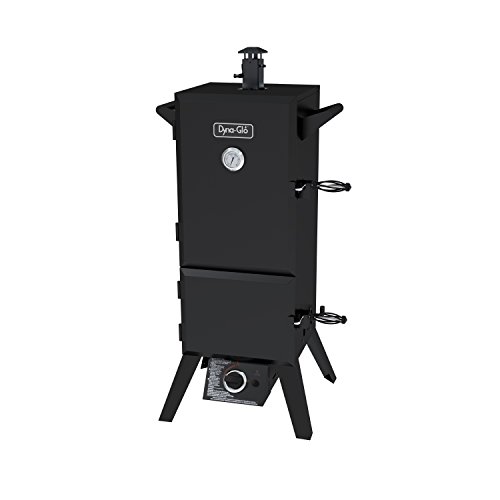
Dyna-Glo DGY784BDP 36-inch Propane Smoker — Best Gas Cabinet
Propane cabinets are the meat smoker for people whose yards lack outlets and whose patience lacks charcoal-lighting time, and the Dyna-Glo 36-inch is the format’s affordable standard-bearer. The tall vertical cabinet stacks racks for ribs hung or laid in quantity, the burner lights instantly and recovers heat quickly after loading, and gas heat runs hotter and drier than electric — a genuine advantage for poultry skin and for cooks who finish ribs with a firmer bite.
Strengths
- Instant start, fast recovery, and no electrical outlet required
- Tall cabinet format excels at ribs and batch cooking
- Gas heat crisps poultry skin better than electric cabinets
Trade-offs
- Dial control rather than digital temperature holding
- Smoke depth depends on early chip-box management
- A spare propane tank is effectively mandatory for long cooks
| 3 | 6 |
Wood smoke comes from the chip box over the burner, so the first hour’s chip management decides the smoke depth on a long cook; load it full at the start, when meat absorbs smoke most readily. Temperature is managed by the burner dial and the cabinet’s vents rather than a digital thermostat, which makes the first two cooks a calibration exercise — mark your dial settings in a notebook and the cooker becomes predictably yours. Keep a spare tank on hand and this is among the lowest-hassle ways to smoke meat ever sold.
Propane ownership runs on a tank gauge and a habit: check the level before long cooks, keep the spare full, and the DGY784 never surprises you. The tall cabinet’s racks make it a natural for the vertical menu — ribs in quantity, hanging sausages, stacked chickens — and its hotter, drier heat gives poultry the skin that electric cabinets struggle to produce. The chip box rewards a full load at the start and restraint thereafter; by the third cook, owners have their smoke routine written in the notebook every gas cook should keep. For meat volume per dollar and per square foot of patio, this remains one of the strongest quiet values in the affordable market.
Best for: meat cooks without an outdoor outlet who want instant, portable gas heat / Not suited for: anyone who wants a thermostat to hold temperature untouched for ten hours
Comparison Table
| Pick | Badge | Key spec | Best for |
|---|---|---|---|
| Weber Smokey Mountain Cooker 22-inch | Best Overall | 22-inch charcoal bullet, two grates, water pan | meat-focused cooks who want capacity, flavor, and a decade of service on an entry budget |
| Masterbuilt 30-inch Digital Electric Smoker MB20071117 | Best Set-and-Forget | 710 sq in digital electric cabinet | busy cooks who want brisket and pulled pork without tending a fire |
| Char-Griller Smokin’ Pro Charcoal Grill and Offset Smoker | Best Offset-Style Value | Offset firebox combo, 1,130 sq in total | aspiring offset cooks who want real fire flavor and a grill in the same footprint |
| EAST OAK 30-inch Electric Smoker | Best with Viewing Window | 725 sq in electric, window + built-in probe | visual cooks who want to see the meat and probe it without opening the door |
| Pit Boss 500 FB2 Series Pellet Grill & Smoker | Best Pellet for Meat | 518 sq in pellet with flame broiler | households wanting one affordable machine that smokes meat and still sears steaks |
| Dyna-Glo DGY784BDP 36-inch Propane Smoker | Best Gas Cabinet | 36-inch propane vertical cabinet | meat cooks without an outdoor outlet who want instant, portable gas heat |
The Meat Itself: Matching Cuts to Cookers
Not every smoker flatters every cut, and matching them is where affordable equipment punches above its price. Brisket wants length and stability: bullets and offsets fit the whole packer and hold the band for fourteen hours, while cabinets ask for a trim or a separation of point and flat — a small surgery that many cooks prefer anyway, since the two muscles finish at different times. Pork butt wants humidity and patience and forgives everything; it is the universal donor cut that makes every cooker in this guide look competent. Ribs want width and gentle, even heat, and they expose hot spots ruthlessly — a cooker that cooks ribs evenly edge to edge is an honest cooker.
Poultry inverts the usual priorities: it wants heat more than time, and drier air for skin, which is why gas cabinets and pellet grills at their upper range produce the best birds, while water-pan bullets produce the most forgiving ones. Fish and cheese live at the opposite pole — low temperatures, delicate smoke, no flare risk — the home ground of electric cabinets and automatic-feed systems. The practical conclusion is not that you need three smokers; it is that your primary cut should choose your primary cooker. A household that cooks brisket monthly and chicken weekly should buy for the brisket and adapt the chicken; the reverse order produces a drawer full of regrets.
There is also the matter of batch logic. Smokers run most efficiently full — the fuel for one butt is nearly the fuel for three — so the affordable strategy is to cook in batches and freeze with intent: pulled pork, sliced brisket, and rib portions all reheat beautifully, and a vacuum sealer turns one Saturday cook into a month of weeknight barbecue. This is why capacity appears so often in these reviews: not for the annual party, but because batch cooking is how affordable smokers pay for themselves, one frozen portion at a time.
How to Choose an Affordable Smoker for Meat
Meat is forgiving of cheap cookers and unforgiving of unstable ones. These four checks separate an affordable meat smoker that will serve you for years from one that will frustrate you by the third brisket.
M
e
M
e
C
h
M
e
Where the Money Goes in an Affordable Meat Smoker
In the affordable tier, price differences buy four things, in this order of importance: steel and sealing (stability and lifespan), controller quality (in electric and pellet models), honest capacity, and support depth. Notice what is not on the list: maximum temperature, app features, and styling. A buyer comparing two models should ask which of the four real things the extra money buys; if the answer is none of them — if it buys a bigger number on the box or a touchscreen — the cheaper model is the better purchase. The six picks here were each chosen because their price lands on the real four.
The second wallet is consumables, and meat smokers differ sharply. Charcoal cooking spends fuel every cook; pellet cooking spends a steadier, predictable amount; propane and electric are the cheapest hours in barbecue. Wood is its own budget line: chunks for charcoal, chips for cabinets, bisquettes for the Bradley-style systems in the wider market, pellets as both fuel and flavor. None of these costs is large, but they compound across a season, and the cook who smokes weekly should weigh them as seriously as the sticker — over three years, fuel can exceed the price difference between the cheapest and the best pick in this guide.
How to Smoke Your First Pork Butt on an Affordable Smoker
A pork butt is the perfect first meat cook: inexpensive, forgiving, and nearly impossible to ruin on any of the six cookers above. The process below translates across fuel types — only the fire management differs.
- T r
- B r
- F a
- A r
- B e
- R e
Write down the timeline of your first butt — when it went on, when it stalled, when it finished. On your cooker, with your fuel, that single page of notes is worth more than any chart printed in a cookbook.
Cleaning and Storing a Meat Smoker Between Cooks
Meat smoking is a greasy business conducted outdoors; the cleanup routine below is calibrated to that reality — thorough where it matters for flavor and safety, quick where it does not.
Racks and grates, while warm
Brush or scrape racks as the cooker cools from a cook, when residue is soft, and wash them properly every few cooks. Seasoned steel racks need only a wipe and a light oil coat; chrome racks benefit from a soak. Clean racks are not vanity — old residue smokes bitterly into fresh meat.
The grease path, monthly
Follow the fat: drip pan, grease channel, cabinet floor, fire pot surround. Scrape and empty the whole path monthly in season. This is flavor hygiene and fire prevention in one chore, and it is the maintenance item most often skipped by owners of every cooker type.
The chamber walls, seasonally
A meat smoker’s interior should carry a thin, hard seasoning — not a thick, flaking grease coat. Wipe walls down when buildup starts to flake, and never use oven cleaner inside a smoker you eat from. If the interior smells rancid when cold, a hot empty burn followed by a wipe resets it.
Storage between seasons
Deep-clean, dry thoroughly, oil the grates lightly, empty all fuel systems, and cover. Charcoal and pellets go to sealed dry bins; propane tanks stay upright and outdoors; electrics get unplugged with cords coiled dry. A smoker stored clean wakes up ready; a smoker stored dirty wakes up as a project.
Matching the Cooker to the Meat Program
Brisket every month
Your cooker must fit whole packers, hold the band for fourteen hours, and do it without heroics. The Smokey Mountain 22 is the affordable answer — capacity and stability in one — with the Char-Griller offset as the flavor-first alternative for cooks who enjoy the fire. Electric and cabinet owners can absolutely cook brisket, but they will trim or separate, and they should choose that trade knowingly rather than discover it with a brisket in hand and guests at six.
Ribs and butts for the freezer
Batch cooking is a capacity-and-running-cost equation, and the tall cabinets win it: the Dyna-Glo propane and the big electric class cook the most meat per fuel dollar, and their racks stage beautifully for production-line loading. The pellet FB2 serves smaller batches with better weeknight versatility. If your style is cook-big-on-Saturday, eat-all-month, buy vertical space and cheap fuel hours — that combination, not any single feature, is the batch cooker’s spec sheet.
Poultry, fish, and the delicate menu
Heat control at the gentle end and clean smoke matter more than capacity. Electric cabinets are the natural instruments — the EAST OAK’s probe and window were practically designed for salmon and chicken — and pellet cookers at low settings run a close second. Charcoal can do this menu beautifully but asks for a smaller, carefully managed fire. If half your smoking is fish, cheese, and poultry, weight your choice toward the cookers that idle sweetly at low temperatures.
The mixed-grill household
Your smoker must also be your grill, because the patio holds one cooker. The Pit Boss FB2’s flame broiler was built for exactly this double life, and the Char-Griller’s grill chamber answers it in charcoal. Pure cabinets and bullets smoke better than they grill; households that grill four nights a week should be honest about the ratio and buy the hybrid, accepting a small compromise on each side for a cooker that is right every night.
Pre-Purchase Checklist: Meat Smokers
Verify these eight things and the smoker you buy will still be the right one after the first brisket.
- Your signature cut fits: Brisket length, butt height, rib width — check your actual menu against the chamber, not the advertised area.
- The band is the spec: Judge temperature claims by the 225–275°F range and by owner reports of stability there, not by maximum heat.
- Rack spacing suits tall cuts: Butts and chickens need vertical room between racks. Crowded racks cook unevenly and tear bark on removal.
- Moisture management exists: A water pan, a humidity-friendly cabinet, or a clear spritz-and-wrap plan. Dry chambers make dry meat.
- Drip system is removable: You will clean rendered fat constantly. If the grease path is awkward, you will skip it — and pay later.
- Fuel cost per cook is known: Estimate your monthly cooks and price the charcoal, pellets, gas, or power honestly before choosing.
- A probe plan is in place: Grate-level and in-meat temperature knowledge is not optional for meat. Budget the thermometer with the cooker.
- Support and parts are real: Racks, elements, igniters, and gaskets listed by the maker. Meat smokers are long-term tools; buy accordingly.
Common Buying Mistakes
B
i
E
v
T
w
S
l
R
e
The Long View: Becoming a Meat Cook
Every experienced meat cook can name the purchase that changed them, and it is rarely the expensive one — it is the first cooker that held a temperature honestly while they learned what brisket, pork, and ribs actually do across twelve hours of heat. The affordable smokers in this guide are those cookers, in six different dialects of fire. What they teach cannot be bought at a higher tier, because it is not a feature: it is the accumulated judgment of stalls survived, bark judged by eye, and tenderness recognized by the probe’s slide. A premium cooker bought later will make that judgment easier to apply; it cannot substitute for having earned it.
There is a financial long view too, and it favors the cook who starts affordable and cooks often. Money not spent on flagship steel becomes money spent on meat — more briskets, more experiments, more of the practice that actually builds skill — and on the freezer stock that turns smoking from an event into a household system. Five years of that arithmetic produces a cook with a deep repertoire and a paid-for smoker, which is a better position than a novice with a depreciating showpiece. Buy the cooker, spend on the meat, and let time do the compounding.
Troubleshooting: Smoked Meat Problems and Fixes
Problem: the brisket came out dry and crumbly
Crumbly-dry brisket is usually overcooked past tenderness or sliced without rest — but check the instrument first: a cooker running 25 degrees hotter than its dial claims will march a brisket past perfect while the schedule still looks right. Verify grate temperature with a probe, cook to probe tenderness rather than the clock, and rest the wrapped brisket a full hour. The next one, at a verified temperature, will tell you which variable it was.
Problem: ribs are tough and pull clean off the bone reluctantly
Tough ribs are undercooked ribs, almost every time — the collagen has not finished converting. The bend test is the verdict: pick the rack up with tongs and look for the bark cracking and the meat bending deeply. Give them time in thirty-minute increments rather than raising the heat, which tightens what time would relax. Wrapping for the middle portion of the cook is the reliable accelerator if the schedule demands it.
Problem: pulled pork tastes flat despite good smoke
Flat pulled pork is a seasoning and finishing problem, not a smoking problem. Salt the rub adequately before the cook, and — the step most beginners skip — season the pulled meat after pulling, with its own defatted juices and a finishing rub or a vinegar-based sauce in the Carolina style. Meat that tasted perfect at the bark tastes diluted once the unsalted interior is mixed in; finishing seasoning restores the balance.
Problem: chicken skin is rubbery
Rubber skin is a temperature story: poultry smoked low the whole way renders fat slowly and never crisps. The fixes are to finish hot — raise the cooker or move the bird to a hot grill for the final minutes — to dry the skin uncovered in the refrigerator overnight before cooking, and to favor the hotter, drier cookers (gas, pellet at range) for poultry-forward menus. Spatchcocking also helps by flattening the bird into even, faster cooking.
Problem: everything tastes like an ashtray
That is dirty smoke plus old grease, in some proportion. Clean the chamber’s grease path first — it is free and it is the most common cause — then examine the fire: smoldering fuel, oversoaked chips, or a starved pellet burn. Run the cooker empty and hot for thirty minutes after cleaning and smell the exhaust; it should smell like a clean campfire, not a fireplace the morning after. Fix the fire’s air before you blame the wood.
Meat smoking rewards a seasonal pantry as much as a good cooker: spring’s lighter menus — chicken, fish, ribs — suit the year’s first cooks while you relearn your smoker’s manners; summer is for volume and for the batch cooks that stock the freezer; autumn’s cool, stable air is brisket weather, the long cooks running sweetly in the cold; and winter asks for the forgiving cuts, butts and hams, that tolerate a cook who checks less often from a warm kitchen. Cook with the calendar and every season has a signature dish your affordable smoker was effectively designed for.
Final Recommendation
For the single best affordable meat smoker, take the 22-inch Smokey Mountain: it fits the big cuts, holds its temperature like a cooker costing far more, and flavors meat the traditional way. If your life runs on schedules rather than charcoal, the Masterbuilt digital electric or the EAST OAK windowed cabinet will put smoked meat on your table far more often — and frequency is its own kind of quality.
Offset dreamers should start with the Smokin’ Pro and a roll of gasket tape, pellet households with the Pit Boss FB2 and a respect for its small hopper, and outlet-free yards with the Dyna-Glo propane cabinet and a spare tank. Every route here ends at the same place: tender meat, honest smoke, and money left over for the meat itself — which was always the right place for the budget to go.
And if you are standing where every meat cook once stood — first smoker, real budget, high hopes — take the forgiving path: a pork butt on any of these six cookers this weekend will teach you more than another month of comparison shopping. The meat is patient. Start cooking, keep notes, and let the second purchase, if there ever is one, be made by the experienced cook you are about to become.
Keep exploring the cluster: Best Affordable Smokers Best Affordable Backyard Smokers Best Affordable Pellet Smokers Best Affordable Outdoor Smokers Best 3 In1 Smokers
Related guides
Frequently Asked Questions
A
P
l
W
r
U
s
Y
e
T
h
How do I keep smoked meat moist on a budget smoker?
Start with the right cut — well-marbled meat is moisture insurance no technique can replace. Then manage the basics: hold the temperature band steady, use a water pan where the design provides one, wrap at the stall if you like, and rest the meat properly before cutting. Dryness usually traces to a cooker running hotter than its dial claims, so verify temperature at the grate before blaming the recipe.
Is a smoke ring important for flavor?
No — the ring is a chemical souvenir of combustion gases meeting meat myoglobin early in the cook, and it carries no flavor of its own. Charcoal and pellet cookers produce it readily; electric cabinets rarely do, yet their meat can taste excellent. Judge smoked meat by tenderness, moisture, and clean smoke flavor, and let the ring be the decoration it is.
How much wood should I use for a pork butt?
Less than instinct suggests. On charcoal, a few fist-sized chunks buried in the fuel; in a cabinet, a loaded chip tray refreshed during the first hours; on pellets, the fuel is the wood. Meat absorbs smoke mainly while it is cold and moist at the start, so front-load your wood and let the fire run clean afterward — oversmoked meat is the most common beginner error and the hardest to eat.
D
o
Y
e


