Disclosure: airfryerkitchensupply.com is reader-supported. When you buy through links on our site, we may earn an affiliate commission at no extra cost to you.
Where to buy
The best 3 in1 smokers are machines that grill, smoke and run a second fuel or a side burner in one footprint — and the honest differences between the picks are which three jobs each one actually combines. Start with the Texas Trio if you want the fullest combination in a single footprint, and confirm the firebox and burner configuration on the listing before ordering, because combo models are revised often.
- Char-Griller Texas Trio 3-Burner Gas & Charcoal Grill and Smoker 3070 — check price on Amazon; choose the listing sold or shipped by Amazon or the brand’s own store, and confirm the exact model name before you order.
- Oklahoma Joe’s Canyon Combo Gas and Charcoal Smoker and Grill — check price on Amazon; choose the listing sold or shipped by Amazon or the brand’s own store, and confirm the exact model name before you order.
- Oklahoma Joe’s Longhorn Combo Offset Smoker and Grill — check price on Amazon; choose the listing sold or shipped by Amazon or the brand’s own store, and confirm the exact model name before you order.
- Char-Griller Smokin’ Pro Charcoal Grill and Offset Smoker — check price on Amazon; choose the listing sold or shipped by Amazon or the brand’s own store, and confirm the exact model name before you order.
- Royal Gourmet CC1830W Charcoal Grill with Offset Smoker — check price on Amazon; choose the listing sold or shipped by Amazon or the brand’s own store, and confirm the exact model name before you order.
- Realcook Charcoal Grill with Offset Smoker, 800 Sq In — check price on Amazon; choose the listing sold or shipped by Amazon or the brand’s own store, and confirm the exact model name before you order.
The best 3 in1 smokers exist because most backyards have room for one cooker and most cooks want three: a grill for weeknights, a smoker for weekends, and a second fuel or burner for everything in between. The combination market answers with machines that merge those jobs into a single footprint — gas and charcoal side by side, an offset firebox hanging off a barrel grill, a side burner waiting for a pan of beans. This guide ranks the six combinations that do the merging most honestly, and it is blunt about the truth of the category: a combo is a compromise by design, and the right one is the compromise shaped like your cooking.
Read the picks by their combinations, not their badges. One pick here is a true three-fuel-class machine — gas grill, charcoal grill and smoker with a side burner in a single unit. Others pair a charcoal grill with an offset smoker, which is two cooking methods plus the indirect versatility the firebox brings. All six were verified against their makers’ listings, with cooking areas quoted from those listings, because combo grills attract more creative arithmetic than any other category in barbecue.
Who should buy one at all? The household with one patio slot and varied ambitions — that reader is genuinely well served here. The reader with space and a deepening obsession should know the exit story too: most combo owners who catch the smoking bug eventually add a dedicated smoker, and keep the combo happily as their grill. This guide is written to make the first purchase a good one either way.
In this guide
Quick Picks
Six verified combinations — one true gas-charcoal-smoker flagship, two dual-fuel combos from a smoking specialist, and three charcoal grill-plus-offset-smoker barrels at descending sizes and prices of admission.
- Best True 3-in-1: Char-Griller Texas Trio 3-Burner Gas & Charcoal Grill and Smoker 3070 — the fullest combination sold in one footprint — gas grill, charcoal grill, offset smoker and a side burner, over a verified 1,390 sq in.
- Best Dual-Fuel Combo: Oklahoma Joe’s Canyon Combo Gas and Charcoal Smoker and Grill — a smoking specialist’s dual-fuel answer — 3-burner propane on one side, charcoal smoking on the other, 1,031 sq in between them.
- Best for Offset Character: Oklahoma Joe’s Longhorn Combo Offset Smoker and Grill — the combo with the deepest smoking roots — a full offset smoker sharing a frame with a grill, across 1,060 sq in.
- Best Mid-Size Combo: Char-Griller Smokin’ Pro Charcoal Grill and Offset Smoker — the long-running barrel-and-firebox formula at full size — 1,130 sq in, dual damper control and a warming rack.
- Best Value Combo: Royal Gourmet CC1830W Charcoal Grill with Offset Smoker — the value version of the formula — 783 sq in, adjustable fire grates and a wooden work table, sized for real backyards and real budgets.
- Best Compact Party Combo: Realcook Charcoal Grill with Offset Smoker, 800 Sq In — an 800 sq in barrel combo pitched squarely at gatherings — grill space for the party, a firebox for the cook who arrives early.
How These Picks Were Chosen
Every pick was verified on 2026-11-20, and cooking areas, burner counts and firebox configurations in the spec boxes come from the manufacturers’ own listings. Where a model’s ‘3-in-1’ claim rests on interpretation — grill, smoker, and the indirect cooking the offset box enables — the review says so rather than repeating the claim as fact.
The criteria were combination-specific. First, the quality of each job separately: a combo that grills badly and smokes badly is not versatile, it is just disappointing twice. Second, the seams between jobs — firebox fit, damper control, and whether the smoker side can hold a low temperature without the grill side leaking the heat away. Third, fuel logic: dual-fuel machines earn their footprint only if both fuels are genuinely convenient, not one main act and one apology. Fourth, size honesty: total cooking area quoted by makers often sums every rack and box, so the guide weights the main chamber most.
We also weighed the ownership arc. Combo grills have more parts, more seams and more paint in the line of fire than dedicated cookers, so build weight, grate material and the availability of covers and spares counted. A cheap combo that rusts at its seams in two seasons is the most expensive grill in this guide; the picks are ordered with that arithmetic in mind.
The 6 Best 3 in 1 Smokers

Char-Griller Texas Trio 3-Burner Gas & Charcoal Grill and Smoker 3070 — Best True 3-in-1
The Texas Trio is the only pick here that answers the keyword literally and completely: its listing verifies a 3-burner gas grill and a charcoal grill sharing one body, a side firebox that turns the charcoal side into an offset smoker, and a side burner besides — 1,390 square inches in total. Gas for Tuesday, charcoal for Saturday, smoke for the brisket, and a burner for the sauce and beans while everything else cooks. If one machine must do everything, this is the machine the category built.
Strengths
- The most complete combination verified in this guide
- Side firebox gives true offset smoking, not a workaround
- Side burner handles sauces, beans and breakfast duty
Trade-offs
- A lot of machine: footprint, assembly and upkeep all scale up
- Each individual job is good rather than class-leading
- More seams and paint in the fire line than any dedicated cooker
| Combination | Gas grill + charcoal grill + offset smoker + side burner |
| Cooking area | 1,390 sq in total (from listing) |
| Ignition | Push-button (gas side) |
Judge the Trio as a system and it wins; judge any single chamber against a dedicated rival and it places second — which is exactly the deal this category offers, stated plainly. The gas side is a perfectly serviceable weeknight grill. The charcoal side grills with real fire flavour and, with the firebox lit and the dampers set, smokes with genuine offset character: heat and smoke drawn across the chamber by the stack, the way the method is supposed to work. The side burner, which sounds like a brochure extra, becomes the most-used feature by month two — sauces, side dishes, coffee on a morning cook.
Ownership is where the Trio asks its price. Three cooking systems mean three sets of grates to season and clean, a firebox that wants its ash emptied and its paint touched up, and a cover that is not optional if the machine lives outdoors. Budget the assembly afternoon honestly, keep it covered, and oil the charcoal-side grates after cooks, and the machine repays the care with a decade of genuine versatility. Neglect it, and the seams between its three jobs are where the rust will start. That is the combo bargain in one paragraph.
Best for: one-cooker households that genuinely cook all three ways / Not suited for: specialists who want any single job done at the highest level
Oklahoma Joe’s Canyon Combo Gas and Charcoal Smoker and Grill — Best Dual-Fuel Combo
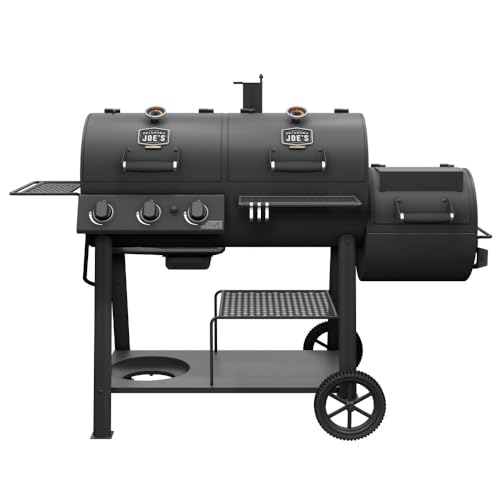
Oklahoma Joe’s built its name on smokers, and the Canyon Combo shows it: a dual-fuel machine pairing a 3-burner propane gas grill with a charcoal smoker-grill across 1,031 square inches. Where the Texas Trio adds a side burner, the Canyon concentrates on the two fuels themselves, from a maker whose damper and firebox instincts were formed in the offset world. For the reader whose split is ‘gas when I’m busy, charcoal and smoke when I’m not’, this is the focused version of the idea.
Strengths
- Smoker-side design from a dedicated smoking brand
- Dual fuel without extra gimmicks diluting the brief
- 1,031 sq in is a serious family-plus capacity
Trade-offs
- No side burner for pan work
- Charcoal side still asks offset skills for best smoking results
- Large, heavy single footprint
| Combination | Propane gas grill + charcoal smoker/grill |
| Cooking area | 1,031 sq in (from listing) |
| Gas side | 3 burners |
The Canyon’s smoking side benefits from the brand’s offset heritage in the details that decide cooks: damper control that actually meters the fire, a chamber that draws properly, and grates placed where the heat path makes sense. It will not out-smoke the same maker’s dedicated offsets — the combo chamber shares its life with a grill — but it smokes with more authority than the generic barrel combos below it in this guide, and for many households that authority is the difference between smoking as a novelty and smoking as a habit.
The dual-fuel rhythm this machine enables is the real product. Weeknight chicken on gas with zero setup; a Saturday shoulder on charcoal with the afternoon built around it; both sides running at a party, gas holding finished food warm while the charcoal side finishes the main event. Owners who cook that rhythm get full value. Owners who discover they only ever light one side should take the hint at replacement time and buy that side’s dedicated machine — the combo will have done its job as the experiment that told them.
Best for: dual-fuel households that lean toward smoking / Not suited for: anyone who needs a side burner in the same unit

Oklahoma Joe’s Longhorn Combo Offset Smoker and Grill — Best for Offset Character
The Longhorn Combo is the choice for readers whose heart is in the smoker and whose head needs a grill in the same purchase. Its listing describes an offset charcoal smoker and grill combination with 1,060 square inches, and the emphasis in the design follows the name order: the offset side is a real smoker in the maker’s tradition, not a firebox accessory, while the grill side covers the direct-heat work. Of all the picks here, this is the one a dedicated-smoker owner would recognise as kin.
Strengths
- Offset side with genuine smoking pedigree
- 1,060 sq in across the combination
- Charcoal throughout: one fuel, deep flavour
Trade-offs
- No gas side: every cook starts with a fire to build
- Offset smoking skill curve applies in full
- Combo seams still trail a dedicated offset on sealing
| Combination | Offset charcoal smoker + charcoal grill |
| Cooking area | 1,060 sq in (from listing) |
| Fuel | Charcoal |
Offset character is a flavour claim before it is a design claim: a fire burning in its own box, its smoke and heat drawn across the meat and out the stack, lays down a bark and a depth that direct configurations imitate without matching. The Longhorn’s firebox and chamber proportions come from a line of dedicated offsets, so the draw works as it should once the fire is managed — and fire management is the honest price. This is the pick for the reader who wants to learn real offset cooking without buying a second machine to grill on, and who accepts that ‘learning’ involves a few cooks that teach more than they feed.
Practical ownership notes: season the whole unit thoroughly before the first cook, keep the fire small and clean rather than large and smouldering, and expect the firebox paint to age first — it lives closest to the fire and a high-heat touch-up is routine maintenance on every offset ever made, dedicated or combo. Kept covered and ash-free between cooks, the Longhorn’s heavier build gives it the longest plausible life of the charcoal combos in this guide.
Best for: aspiring offset cooks who also need a grill in the purchase / Not suited for: anyone who wants push-button weeknight cooking

Char-Griller Smokin’ Pro Charcoal Grill and Offset Smoker — Best Mid-Size Combo
The Smokin’ Pro is the classic American combo formula executed at generous scale: a charcoal barrel grill with a side fire box for offset smoking, dual damper control, a chrome-plated warming rack and 1,130 square inches in total. It has sold for years because the formula works — grill directly over charcoal in the main barrel, or light the firebox and smoke indirectly through it — and because its size swallows party loads that embarrass smaller barrels.
Strengths
- Proven grill-plus-offset formula with real capacity
- Dual damper control for fire management on both modes
- Warming rack adds genuine holding space at parties
Trade-offs
- Chrome-plated grates ask more care than porcelain or cast iron
- Thin-steel barrel loses heat in wind and cold
- Assembly and seasoning are an afternoon, not an hour
| Combination | Charcoal grill + offset smoker (side fire box) |
| Cooking area | 1,130 sq in total (from listing) |
| Controls | Dual damper control |
The Smokin’ Pro teaches the central combo skill better than any pick here: damper literacy. Grill mode wants air and a hot bed; smoke mode wants a small fire, a drawn chamber and patience. The dual dampers give you both levers, and the cooks who learn them get a machine that genuinely does two jobs. The cooks who leave everything wide open get a grill that sometimes tastes of smoke. That is not a defect in the machine — it is the honest nature of charcoal combinations, and this one’s long production run means every mistake you might make has a forum thread and a fix attached to it.
Heat loss is the barrel’s known weakness: single-wall steel sheds warmth to wind, so smoking in cold weather means more fuel and more attention than the same cook in a heavier cooker. A sheltered pitch, a welding-blanket trick in deep winter, and realistic expectations handle it. Within its climate and its price class, the Smokin’ Pro remains what it has been for years — the default recommendation when someone wants one charcoal machine that grills all week and smokes all weekend.
Best for: charcoal households wanting the classic two-mode barrel at full size / Not suited for: cold-climate smokers who cook through winter outdoors

Royal Gourmet CC1830W Charcoal Grill with Offset Smoker — Best Value Combo
Royal Gourmet’s CC1830W shrinks the combo formula to a friendlier scale and price of admission: a 783-square-inch barrel charcoal grill with an offset smoker, a wooden front table, hooks for tools and adjustable fire grates. The adjustable grates are the detail to notice — raising and lowering the charcoal bed is the fastest heat control a charcoal grill can offer, and it is a feature many pricier barrels omit. For a first combo, the specification is smarter than its tier suggests.
Strengths
- Adjustable fire grates give quick, physical heat control
- Wooden front table is genuinely useful working space
- Accessible size and cost of entry to the combo format
Trade-offs
- 783 sq in caps party loads sooner than the big barrels
- Value-tier steel and fittings need cover discipline
- Offset side is compact: briskets are a squeeze
| Combination | Charcoal grill + offset smoker |
| Cooking area | 783 sq in (from listing) |
| Features | Adjustable fire grates, wooden table, hooks |
This pick understands its reader. The first combo is usually bought to find out whether smoking is a hobby or a passing mood, and the CC1830W answers that question at the lowest reasonable cost in money and patio space — while including the one feature, adjustable grates, that makes daily grilling noticeably better. Its smoker side handles ribs, chickens and small shoulders happily; whole packer briskets are where its scale shows. Most first-time smokers cook those smaller loads for their entire first year anyway, which makes the limitation more theoretical than real.
Ownership at this tier is a care equation: the steel is thinner, the fittings simpler, and the machine’s lifespan is decided by whether it lives covered and ash-free. Ash left in a firebox after a cook holds moisture against the steel, and that single habit accounts for most early combo deaths at every price. Empty it, cover it, and the Royal Gourmet will teach you smoking and grilling for seasons; its replacement, when you outgrow it, will be bought with knowledge this machine gave you cheaply.
Best for: first-time combo buyers and modest patios / Not suited for: large briskets or large parties as a routine

Realcook Charcoal Grill with Offset Smoker, 800 Sq In — Best Compact Party Combo
The Realcook closes the guide as the gathering-sized alternative: an 800-square-inch charcoal barrel grill with an offset smoker, positioned by its maker for backyard parties and weekend barbecues. Its case is simple — party grilling is mostly direct-heat volume, and 800 square inches of it covers burgers and chicken for a crowd, while the offset box lets the host smoke ribs or a shoulder ahead of the rush and hold court as the person who actually cooked.
Strengths
- 800 sq in of party-scale grilling in a compact footprint
- Offset box adds a real smoking option for the host
- Straightforward barrel design, nothing to overthink
Trade-offs
- Lesser-known brand with a thinner support trail
- Party-first design: smoking finesse is secondary
- Barrel steel needs the usual cover and ash discipline
| Combination | Charcoal grill + offset smoker |
| Cooking area | 800 sq in (from listing) |
| Positioning | Backyard parties and gatherings |
Party cooking has its own logic that this design respects: throughput first. Burgers, sausages and chicken pieces move across a wide grate in waves, and the cook’s bottleneck is grate area and charcoal access, both of which a simple barrel provides without fuss. The offset smoker plays the supporting role it plays at most real gatherings — one special item, smoked properly through the afternoon, that makes the event feel cooked rather than catered. Judged on that brief rather than on brisket championships, the Realcook is honestly specified.
If your gatherings grow a smoking habit — the shoulder becomes two, the ribs become the main event — this machine will show its ceiling the way all party-first combos do, in chamber size and temperature finesse. That is a good problem, and it arrives with a full season of successful parties behind it. Until then, keep the firebox seasoned, the ash emptied and the cover on, and let it do the job it was bought for.
Best for: hosts whose priority is party grilling with a smoking option / Not suited for: smoking-led cooks — the Oklahoma Joe’s picks suit you better
Comparison Table
| Pick | Badge | Key spec | Best for |
|---|---|---|---|
| Char-Griller Texas Trio 3-Burner Gas & Charcoal Grill and Smoker 3070 | Best True 3-in-1 | Gas + charcoal + smoker + side burner, 1,390 sq in | one-cooker households that genuinely cook all three ways |
| Oklahoma Joe’s Canyon Combo Gas and Charcoal Smoker and Grill | Best Dual-Fuel Combo | Dual fuel, 3-burner gas + charcoal smoker, 1,031 sq in | dual-fuel households that lean toward smoking |
| Oklahoma Joe’s Longhorn Combo Offset Smoker and Grill | Best for Offset Character | Offset smoker + grill combo, 1,060 sq in | aspiring offset cooks who also need a grill in the purchase |
| Char-Griller Smokin’ Pro Charcoal Grill and Offset Smoker | Best Mid-Size Combo | Charcoal grill + side firebox, 1,130 sq in | charcoal households wanting the classic two-mode barrel at full size |
| Royal Gourmet CC1830W Charcoal Grill with Offset Smoker | Best Value Combo | 783 sq in, wooden front table, adjustable fire grates | first-time combo buyers and modest patios |
| Realcook Charcoal Grill with Offset Smoker, 800 Sq In | Best Compact Party Combo | 800 sq in barrel combo | hosts whose priority is party grilling with a smoking option |
Total areas in this table sum every chamber and rack the maker counts, which is the category’s habit; compare the main chambers when you shortlist. The real dividing lines are fuel (gas convenience versus charcoal character) and emphasis (the Oklahoma Joe’s picks lean smoker, the barrels lean grill, the Texas Trio refuses to lean at all).
How to Choose the Best 3 in1 Smokers (Grill, Smoker and Combo)
Start by naming your three jobs honestly. For most households they are: fast weeknight grilling, low-and-slow smoking, and one variable — a second fuel, a side burner, or searing power. Then check each candidate’s combination against that list in order, and be suspicious of any machine whose third job is one you will never use. A side burner you never light is patio furniture; a gas side you use four nights a week is the best money in the purchase.
Next, weigh emphasis. Every combo has a first language: the Oklahoma Joe’s machines speak smoker, the barrels speak grill, the Texas Trio is genuinely bilingual at the cost of size and upkeep. Buy the machine whose first language is your most frequent cook, because that is the chamber you will judge it by weekly. The second job needs to be competent; the first needs to be good.
Finally, price the ownership, not the box. Combos carry more seams, more painted steel near fire and more grates to maintain than dedicated cookers. A cover is mandatory, firebox paint touch-ups are routine, and ash discipline decides lifespan. The cheapest combo, neglected, is a two-season machine; a mid-priced combo, covered and emptied, is a decade. Choose the tier you will actually maintain.
Getting Real Smoke Out of a Combo: Firebox Craft
The combo smoker’s reputation for weak smoke is usually a fire problem, not a design problem. The firebox wants a small, hot, clean-burning fire — splits or chunks burning with visible flame — rather than a large smouldering pile. Clean fire makes clean smoke; smouldering makes the bitter, acrid coating that gives offset cooking a bad name among people who have only tasted it done badly. Feed the fire little and often, and let the chamber temperature ride the fire’s rhythm instead of chasing the dial with the dampers every five minutes.
Preheat the chamber and cook to the draw. A combo’s smoke path runs from firebox, across the meat, out the stack — keep the stack fully open, manage temperature at the firebox intake, and resist opening the chamber to admire the bark. Every opening resets the draw and the temperature together. Cooks who learn those two habits — small clean fires, stack open — routinely produce combo-smoked food that guests refuse to believe came from a combination machine.
Fuel Strategy for Combo Owners: Two Fuel Types, One Pantry
Owning a dual-fuel combo quietly makes you the manager of two fuel supply chains, and the owners who thrive treat that as a system rather than an afterthought. Charcoal wants dry storage, a rotation habit — oldest bags first — and a quality floor: dense, large-piece fuel for smoking, everyday briquettes for grilling. Gas wants a spare tank, always, because the tank that empties during a party does so in front of an audience. Keep both inventories boringly stocked and the combo’s promise — any cook, any night — is real. Let either lapse and the machine is a single-fuel cooker with extra weight.
Smoke wood is the third inventory, and the combo format is its natural home: chunks for the firebox, chips for quick grill-side smoke, in two or three varieties matched to your meats. The discipline that matters is dryness and moderation — wood stored dry, added in amounts that burn clean. Combo owners have a unique advantage here: the gas side can hold a steady base temperature while the charcoal side contributes smoke, a hybrid technique that rescues many a windy day and produces food guests describe as suspiciously good for a backyard.
Budget the three inventories as one line and the combo’s running costs stop surprising you. In practice, charcoal dominates the spend for smoking-led households and propane for grilling-led ones — another small diagnostic of which cook you actually are, delivered by your own receipts.
How to Smoke on a 3 in 1 Combo, Step by Step
Written for the charcoal combos; the gas-side machines follow the same arc with the burner doing the fire work.
- Season the whole machine first. One hot, empty burn with oiled grates across every chamber burns off residues and teaches you how each side breathes before food is at stake.
- Build the fire in the firebox, not the chamber. A modest bed of charcoal with wood chunks or a small split, lit and allowed to burn clean — thin smoke, visible flame — before you close anything down.
- Preheat the cooking chamber. Let it settle at smoking temperature with the stack open and the intake damper doing the control. Judge stability over twenty minutes, not two.
- Load the meat cold and close the chamber. Cold meat takes smoke well. From here, the chamber door is opened for reasons, not curiosity.
- Feed little and often. Add small fuel before the temperature sags, not after; a combo firebox rewards anticipation and punishes rescue missions.
- Rest off the heat, clean while warm. Rest the meat properly, then empty the firebox ash once cool and wipe the grates. Ash left sitting is the combo killer — this five minutes decides the machine’s lifespan.
Gas-side adaptation: on the Texas Trio and Canyon, the same discipline applies to the burner side — preheat fully, cook with the lid down, and let the firebox side carry the smoke. Running both sides at once, gas holding sides warm while charcoal smokes the main, is the combo party trick worth mastering.
Common Buying Mistakes
Buying the combination you wish you cooked. Three jobs you never do are worth less than two you do weekly. Audit your last month of cooking before you audit any feature list.
Smouldering a huge fire for smoke. Thick white smoke is unburned fuel, and it tastes like it. Small, clean, flaming fires make the sweet smoke this category is capable of.
Leaving ash in the firebox. Ash plus moisture plus steel equals rust, on a schedule measured in months. Emptying the box after every cook is the cheapest longevity in barbecue.
Cooking with the stack closed down. Choking the exhaust traps stale smoke and kills the draw. Control temperature at the intake and fire size; leave the stack open.
Skipping the cover to save money. On a combo, with its seams and painted firebox, the cover is not an accessory — it is half the lifespan. Buy it with the machine.
The Honest Future of a Combo Purchase
Most combo owners follow one of two arcs, and knowing yours in advance sharpens the choice. In the first, the combo is the destination: one machine, three jobs, a decade of varied cooking, replaced eventually by its newer equivalent. Readers on this arc should buy up a tier — the Texas Trio or an Oklahoma Joe’s — because the machine will be asked to do everything for years, and build quality is the whole ballgame.
In the second arc, the combo is the discovery phase: a season or two of cooking reveals that one job — usually smoking — is the passion, and a dedicated machine joins the patio while the combo continues as the grill. Readers on this arc can buy lighter, like the Royal Gourmet, without regret: the combo’s job is to teach cheaply, and its second life as a grill is honourable. The only bad purchase is the expensive combo bought by a discovery-phase cook, or the flimsy one bought by a destination cook. This guide is organised so you can tell which you are before the box arrives.
Getting the Most From the Grill Side You Almost Ignored
Combo buyers shop for the smoker and live with the grill, so a short rehabilitation of the grill side is in order. On the charcoal barrels, the grill side’s virtues are direct heat and simplicity: a two-zone fire — coals banked to one side — turns the whole barrel into a system, searing over the coals and finishing in the indirect zone, with the lid and dampers doing oven work that a kettle would envy. Adjustable grates, where fitted, make that system fast; where they are not, coal placement is the control, and it is enough.
On the gas sides, the rehabilitation is about heat discipline: preheat fully, cook with the lid down, and use the coolest burner zone as the holding area that ends the era of finished food going cold while the last batch cooks. The side burner, where fitted, completes the system with sauces and sides at the cooker rather than in the kitchen — the difference between a cook who visits the party and a cook who hosts it from behind a serving line of their own making.
None of this requires new equipment. It requires noticing that the machine you bought for its third job is, on most days of the year, a grill — and that the household that grills well on its combo smokes better on it too, because fire is fire and the hands learn everywhere.
Safety and Siting for Combination Cookers
A combo concentrates more fire in one place than any single cooker in the backyard, and its siting deserves a deliberate decision rather than a habitual corner. Give it level, non-combustible ground, clearance from structures and overhangs on every side — the firebox side especially, which radiates where visitors do not expect heat — and a position out of the main traffic path of children and guests. The gas side adds its own rules: connections checked with soapy water each season, the tank valve closed between cooks, and the hose inspected for the cracking that sunlight eventually writes into rubber.
Fire discipline is the second half. A grease-loaded grill side and an ash-loaded firebox are the two halves of every combo incident report ever written, and both are prevented by the cleaning rhythm the main guide prescribes: ash out after cooks, grates and drip paths degreased on schedule, and never a firebox emptied into anything combustible while the ash is still warm. Combo owners cook with two fuels and three methods; the ones who cook that way for a decade treat these paragraphs as part of the purchase price, paid in minutes rather than money.
A Word on Covers, Paint and the Firebox’s Hard Life
Every combo in this guide will show its first age in the same place: the firebox paint. This is not a defect to discover but a schedule to expect — the firebox lives at temperatures that ordinary paint surrenders to, and a seasonal wire-brush and high-heat touch-up is the routine maintenance of every offset configuration ever sold, dedicated or combo. Owners who build that ten-minute ritual into their spring find the rest of the machine aging gracefully around it. Owners who read the first paint bubble as betrayal tend to neglect the cabinet at exactly the moment it asked for the least help.
The cover is the firebox’s partner in longevity. A combo’s seams — and a combo is mostly seams — channel water into every joint when the machine stands uncovered, and the rust that follows starts inside those joints where no one sees it until it matters. A breathable, fitted cover, put on when the machine is cool and dry, is the difference between a combo that ages in appearance and one that ages in structure. Buy it with the machine, use it without exception, and the third job your combo does will be lasting — which no badge on any box in this category can promise without your help.
Final Recommendation
Buy the Texas Trio if one machine must genuinely do everything — it is the fullest verified combination in the category, side burner and all. Choose the Canyon Combo for the dual-fuel rhythm with a smoker’s pedigree, or the Longhorn Combo if offset character is the point of the purchase and gas convenience is not.
Take the Smokin’ Pro for the classic barrel formula at full size, the Royal Gourmet for the smartest value entry with adjustable grates, and the Realcook if party throughput leads your cooking. Whichever you choose: cover it, empty the ash, and burn small clean fires, and a compromise machine will cook like a conviction.
- Char-Griller Texas Trio 3-Burner Gas & Charcoal Grill and Smoker 3070 — one-cooker households that genuinely cook all three ways
- Oklahoma Joe’s Canyon Combo Gas and Charcoal Smoker and Grill — dual-fuel households that lean toward smoking
- Oklahoma Joe’s Longhorn Combo Offset Smoker and Grill — aspiring offset cooks who also need a grill in the purchase
Keep exploring this cluster: Best 100 Pounds Sausage Smokers Best 2 Door Gas Smokers Best 16 Hour Smokers Best 3 Inch Thermometer For Offset Smokers Best 30 Inch Electric Smokers
Frequently Asked Questions
What does 3-in-1 actually mean on a smoker grill?
It varies by model, which is why this guide checks each listing. At its fullest it means three cooking methods in one unit — gas grilling, charcoal grilling and offset smoking, as on the Texas Trio. On barrel combos it means grilling, smoking and the indirect cooking the firebox enables. Always name the three jobs before buying the claim.
Can a combo smoker match a dedicated smoker?
It can come close on flavour when the fire is run cleanly, and it will trail on sealing, temperature stability and capacity. For most households the gap is smaller than the convenience gained. For a reader who smokes weekly and seriously, a dedicated smoker eventually earns its place beside the combo.
Gas or charcoal side — which will I use more?
Gas wins weeknights on convenience; charcoal wins weekends on flavour. The honest audit is your last month of cooking. Dual-fuel combos exist precisely because most households split — and discover their true ratio only by owning both.
Why does my combo produce harsh, bitter smoke?
Almost always a smouldering fire: too much fuel, too little air. Burn a smaller, hotter fire with visible flame, keep the stack open, and add fuel little and often. Clean fire is the entire secret.
How long should a combo grill last?
With a cover, emptied ash and occasional firebox paint touch-ups, a mid-tier combo should serve for many seasons. Neglected — ash sitting, no cover — the same machine can rust at its seams within a couple of years. The lifespan is a habit, not a specification.
Is a combo a good first smoker?
It is the classic first smoker, and a sensible one: it teaches offset fundamentals while still grilling dinner if a smoke goes sideways. Choose a value pick to learn on, or a destination pick if you are confident the habit will stick.


