Disclosure: airfryerkitchensupply.com is reader-supported. When you buy through links on our site, we may earn an affiliate commission at no extra cost to you.
Where to buy
The best 2 door gas smokers are a shrinking niche, so this guide is honest about what the current market actually offers: one verified current two-door model, the classic two-door design sold through dealer channels, and the strongest current vertical propane cabinets for readers whose real priority is the two-door benefit — tending the fire without disturbing the food. Confirm the door layout on the listing photos before ordering any model here, because manufacturers revise cabinet designs between seasons.
- Masterbuilt GS30D Propane 2-Door Smoker — check price on Amazon; choose the listing sold or shipped by Amazon or the brand’s own store, and confirm the exact model name before you order.
- Smoke Hollow Pro Series 44-Inch Two-Door Propane Smoker — sold direct by the maker rather than through Amazon; treat it as a premium option and order from the maker’s own store or an authorised dealer.
- Dyna-Glo DGY784BDP 36-Inch Vertical LP Gas Smoker — check price on Amazon; choose the listing sold or shipped by Amazon or the brand’s own store, and confirm the exact model name before you order.
- Pit Boss 3-Series Propane Gas Vertical Smoker with HVR Controller — check price on Amazon; choose the listing sold or shipped by Amazon or the brand’s own store, and confirm the exact model name before you order.
- Masterbuilt MPS 230S Propane Smoker, 30-Inch — check price on Amazon; choose the listing sold or shipped by Amazon or the brand’s own store, and confirm the exact model name before you order.
- PIQUEBAR Propane Smoker with Cover, 3 Racks — check price on Amazon; choose the listing sold or shipped by Amazon or the brand’s own store, and confirm the exact model name before you order.
The best 2 door gas smokers solve one specific, annoying problem: on a single-door vertical propane smoker, every wood-chip refill and water-pan check opens the whole cabinet, dumping the heat and smoke you spent an hour building. A two-door design separates the fire from the food — a lower door for the burner, chip tray and water pan, an upper door for the racks — so the cooking chamber stays sealed while you work below. It is a simple idea, and this guide exists because finding it in the current market takes more honesty than most roundups admit.
Here is that honesty up front: true two-door propane smokers are a niche within a niche, and several classic models now sell mainly through dealers and seasonal stock rather than permanent listings. This guide therefore does two jobs. It covers the genuine two-door machines — including one verified current model whose own listing names it a 2-door smoker — and it includes the best current vertical propane cabinets, clearly labelled, for readers who decide the underlying benefit matters more than the exact door count.
What does not change between the two groups is the buying logic: vertical propane is the easiest live-fire smoking there is, with instant heat, no ash and no cord. Whether your cabinet has one door or two, the picks below were chosen for temperature manners, rack room and build that survives seasons outdoors — and every linked model was verified against its maker’s listing before it earned a place.
In this guide
Quick Picks
Six vertical propane picks built around the two-door idea — the verified two-door model first, the classic design next, then the strongest current cabinets for readers weighing the benefit against availability.
- Best True Two-Door Pick: Masterbuilt GS30D Propane 2-Door Smoker — the genuine article — a propane smoker whose own listing names it a 2-door model, from the biggest name in vertical smoking.
- Best Large Two-Door Design: Smoke Hollow Pro Series 44-Inch Two-Door Propane Smoker — the big classic of the format — a 44-inch-class two-door cabinet that defined what this category means at home scale.
- Best Large Vertical Alternative: Dyna-Glo DGY784BDP 36-Inch Vertical LP Gas Smoker — a long-running 36-inch vertical propane cabinet — the established alternative for readers who want size and availability today.
- Best Temperature Manners: Pit Boss 3-Series Propane Gas Vertical Smoker with HVR Controller — 983 square inches on four racks with a verified 100–300°F range — the best-documented temperature manners in this guide.
- Best Compact Propane Cabinet: Masterbuilt MPS 230S Propane Smoker, 30-Inch — the compact end of the Masterbuilt propane line — the right size for couples and small families learning vertical smoking.
- Best Budget Vertical: PIQUEBAR Propane Smoker with Cover, 3 Racks — the budget route into vertical propane — three removable racks, heavy-duty positioning and a cover in the box.
How These Picks Were Chosen
Every linked pick in this guide was verified on 2026-11-20, and the specifications in the boxes — cooking area, rack counts, temperature ranges — are quoted from the manufacturers’ own listings. One pick is written unlinked: a classic two-door design whose current sales channel is dealer stock rather than a stable marketplace listing, and the guide says so at the pick rather than inventing a link.
The criteria started with the door question and widened from there. Door architecture: does the design genuinely separate fire-tending from the cooking chamber? Temperature manners: propane burners are powerful and cheap cabinets can run hot and uneven, so control range and burner design mattered. Rack room: vertical smokers earn their footprint through stacked racks, so verified cooking area counted heavily. And build: thin, leaky cabinets lose the heat that the two-door design exists to protect, so door seals and cabinet construction were judged as one system.
A note on method for this category: because manufacturers revise these cabinets frequently, the guide describes each pick by the features its current listing verifies, and advises a listing-photo check for door layout at purchase time. That is not hedging — it is how this specific market behaves, and a guide that pretends otherwise would send some readers a different cabinet than the one reviewed.
The 6 Best 2 Door Gas Smokers

Masterbuilt GS30D Propane 2-Door Smoker — Best True Two-Door Pick
The GS30D is the pick this search is actually about. Its listing names it plainly — a propane 2-door smoker from Masterbuilt — and the design delivers the layout the category promises: the fire, chips and water live behind the lower door, the food behind the upper, and the two only meet when you decide they should. For a reader who arrived with a clear picture of the machine they want, this is the shortest path from this page to that machine.
Strengths
- True two-door layout verified in its own listing
- Fire-tending never opens the cooking chamber
- Masterbuilt parts and knowledge ecosystem behind it
Trade-offs
- An older design: no digital control or connectivity
- Availability fluctuates with seasonal stock
- Propane manners still need a learning curve at low settings
| Design | 2-door vertical propane (from listing) |
| Brand | Masterbuilt |
The two-door benefit compounds over a long cook in a way a single demonstration never shows. A six-hour smoke might involve four chip refills and two water checks; on a single-door cabinet that is six full heat dumps, each followed by a recovery overshoot as the burner works to rebuild temperature. On the GS30D those six interventions happen below a sealed cooking chamber, and the food experiences one continuous smoke instead of six interrupted ones. Ribs forgive the difference. Delicate fish, cheese-adjacent smokes and sausage — the loads that punish temperature swings — do not, and they are where this design earns its premium.
Ownership is old-school in the good sense: a burner, a regulator, a chip tray and a water pan, with nothing electronic to fail in year three. The skills it asks for are propane skills — learning where the low, stable setting sits on your unit, keeping the burner ports clean, storing the cabinet so the doors stay true. Masterbuilt’s scale means covers, trays and advice are easy to find. If the two-door layout is your requirement rather than your preference, buy this one and stop reading; the rest of the guide is for readers still deciding how much the layout is worth to them.
Best for: buyers who specifically want the two-door layout, verified / Not suited for: anyone who wants digital control or app monitoring
Smoke Hollow Pro Series 44-Inch Two-Door Propane Smoker — Best Large Two-Door Design
The Smoke Hollow Pro Series 44-inch is the machine many readers picture when they type this search: a tall two-door propane cabinet with the fire below and a genuinely large cooking chamber above. It is written unlinked in this guide because its sales channel is dealer and seasonal stock rather than a stable listing we could verify — and that status is itself useful information about where this category has gone. If you find one in stock at a dealer, it remains the format’s benchmark for size.
Strengths
- The two-door layout at full 44-inch-class scale
- Huge chamber suits whole ribs, briskets and batch smoking
- A long production history and a deep owner community
Trade-offs
- Sold through dealers/seasonal stock — expect a hunt, not a click
- Large cabinets magnify propane consumption and heat-up time
- No verified listing means specs must be confirmed with the seller
Scale is this design’s argument and its warning. A 44-inch-class chamber takes full racks of ribs lying flat and briskets without trimming gymnastics, and the two-door layout keeps that big, expensive-to-heat air mass sealed while you tend the fire — the larger the cabinet, the more each avoided door opening is worth. But the same scale means longer heat-up, more propane across a long cook, and a cabinet that dominates a small patio. Buyers with the space and the batch sizes get the format at its best; buyers without them get a monument.
Because this pick is bought through dealers, buy it like a dealer purchase: confirm the exact model’s door layout, rack count and burner specification with the seller, inspect door fit before you commit, and ask about parts support while you are standing there. The design is proven; the transaction is the variable. Readers who want the two-door experience without the hunt should look hard at the GS30D above, which trades some size for a verified, orderable listing.
Best for: large-batch smokers with dealer access and patio space / Not suited for: anyone who needs a guaranteed in-stock online order today
Available direct from the maker — check the current price on the maker’s own store.
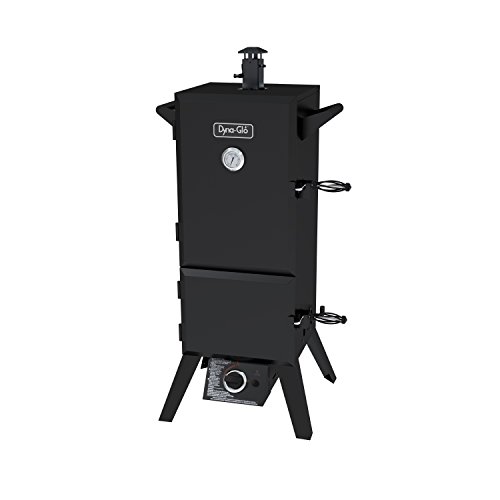
Dyna-Glo DGY784BDP 36-Inch Vertical LP Gas Smoker — Best Large Vertical Alternative
The Dyna-Glo 36-inch vertical LP smoker is the pragmatic pick: a black powder-coat cabinet from a maker with a long line in vertical propane, in a size class that fits serious loads without the 44-inch footprint. It is included honestly as the strongest established alternative in this guide — a current, verified, orderable machine for readers who weigh the two-door benefit against actually owning a smoker this season, and decide in favour of cooking.
Strengths
- 36-inch class chamber handles family-plus loads
- Long-running model line with known ownership patterns
- Verified current listing — no dealer hunt required
Trade-offs
- Not the two-door layout this search names
- Powder-coat finish needs cover discipline outdoors
- Vertical propane learning curve applies as usual
| Format | 36-inch vertical LP gas (from listing) |
| Finish | Black powder coat |
Judge this pick on what vertical propane does well. The format stacks a lot of cooking into a small footprint, heats fast, and holds a steady low temperature once you learn your burner’s low setting — and a 36-inch cabinet is the size where that format stops feeling like a compromise for family cooking. Ribs fit, a brisket fits, and a batch of wings for a party fits. What you give up against the true two-door picks is the sealed chamber during chip refills; what you gain is a machine you can actually buy, with years of owner knowledge attached to the exact model.
Heat management on this class of cabinet rewards two habits. First, use the water pan as the thermal battery it is: filled, it visibly steadies the temperature swings that propane’s on-off character can cause. Second, learn to refill chips quickly and partially — a smaller handful more often disturbs the chamber less than a full tray swap. Neither habit is difficult, and both close much of the practical gap between this cabinet and the two-door designs for most real cooks.
Best for: buyers who want a large vertical propane smoker they can order now / Not suited for: two-door purists — see the GS30D above

Pit Boss 3-Series Propane Gas Vertical Smoker with HVR Controller — Best Temperature Manners
The Pit Boss 3-Series earns its place on documentation. Its listing verifies 983 square inches across four racks and a temperature range starting at a genuinely low figure and topping out where smoking ends — the exact band vertical propane should work in, stated by the maker rather than guessed by a reviewer. The HVR controller and wood chip tray complete a package aimed at the cook who cares about low, steady heat more than any other single trait.
Strengths
- Verified 100–300°F range starts low enough for delicate smoking
- 983 sq in on four racks is the largest verified area here
- Purpose-built chip tray simplifies smoke management
Trade-offs
- Single-chamber access: chip service opens the cabinet
- Newer series with a shorter ownership history
- Four racks of food is a lot of door-open time when loading
| Cooking space | 983 sq in, 4 racks (from listing) |
| Temperature range | 100°F to 300°F |
| Features | HVR controller, wood chip tray |
That low starting temperature deserves emphasis, because it is where cheap propane smokers fail. Many vertical gas cabinets idle far hotter than their dials suggest, which cooks fish and sausage instead of smoking them. A maker willing to print a low floor in the listing is making a claim about burner control that the whole design has to honour. For the reader whose smoking leans delicate — fish, cheese-adjacent work, sausage, jerky — this verified range is the single most relevant number in the guide, and it is why this pick outranks larger names for that reader.
The four-rack layout rewards batch thinking. Load by finishing time — the food that needs longest at the bottom near the heat, quick items up top — and the cabinet becomes a small production line rather than a box you hover over. Keep a simple log for the first few cooks: load, setpoint, weather, result. Propane cabinets are consistent machines once you know yours, and the log is how you get to know it in three cooks instead of ten.
Best for: delicate smoking and batch cooks who prize a verified low range / Not suited for: readers for whom two doors are a hard requirement

Masterbuilt MPS 230S Propane Smoker, 30-Inch — Best Compact Propane Cabinet
The MPS 230S is the 30-inch entry in Masterbuilt’s propane line, and it is the pick for readers whose loads are honest: a couple of racks of ribs, a chicken or two, a small shoulder. Compact vertical cabinets heat faster, use less propane and store in a corner, and for a household of two to four those virtues beat chamber volume every single week. It is also the gentlest way into this category — a current, verified model from the maker whose name defines it.
Strengths
- Compact 30-inch footprint suits small patios and storage
- Fast heat-up and modest propane use
- Masterbuilt ecosystem: covers, parts and advice everywhere
Trade-offs
- Full briskets and rib racks need trimming or hanging tricks
- Single-door access like most of the current market
- Small water pan needs checking on long cooks
| Format | 30-inch vertical propane (from listing) |
| Brand | Masterbuilt |
Small cabinets have a temperature virtue nobody advertises: less air. A 30-inch chamber reaches temperature quickly and recovers from a door opening in a fraction of the time a 44-inch cabinet needs, which quietly compensates for the single-door layout on shorter cooks. Where the big cabinets win on capacity, this one wins on weeknight realism — it is the smoker that actually gets used on a Tuesday, and a smoker used weekly teaches its owner faster than a monument used monthly.
Buy it with the right companions: a cover, because compact cabinets live outdoors too, and a second rack strategy for the days a party load arrives — rib racks and hooks extract surprising capacity from a small chamber. If your household grows into bigger loads, this model also holds its role as the second smoker: the fish-and-sausage unit beside a future larger cabinet. Few purchases in this category age as gracefully as a well-kept compact propane smoker.
Best for: couples, small families and first-time vertical smokers / Not suited for: large batch cooking or full-pack brisket ambitions

PIQUEBAR Propane Smoker with Cover, 3 Racks — Best Budget Vertical
The PIQUEBAR is the value pick: a vertical propane smoker with three removable smoking racks, sold with a cover, positioned by its maker as a heavy-duty outdoor unit. It exists in this guide because the two-door classics and big-name cabinets all ask real money, and a reader testing whether vertical propane smoking suits their life should be able to start without funding the whole category. The cover in the box matters — budget cabinets live or die by weather protection.
Strengths
- Cover included protects the investment from day one
- Three removable racks cover the core vertical-smoking jobs
- Accessible entry point to the whole format
Trade-offs
- Lesser-known brand: thinner manual and support trail
- Budget construction will not seal like the premium cabinets
- Three racks cap batch size quickly
| Racks | 3, removable (from listing) |
| Included | Cover |
| Format | Vertical propane |
Spend your expectations correctly and this class of smoker delivers. The cooking is genuinely good — propane heat and wood smoke do not check the badge on the door — while the compromises live in sealing, hardware feel and the finesse of low-temperature control. A strip of high-heat gasket tape, a sheltered spot and a water pan kept full close most of the real-world gap to pricier cabinets, and the money saved buys a lot of ribs to practice on. As a first vertical smoker, that trade is not just acceptable; it is often the smartest money in the guide.
The ownership discipline for a budget cabinet is weather discipline. Use the cover every time, oil the grates after cooks, and store the chip tray dry; budget steel rewards care and punishes neglect faster than premium cabinets do. Do that and the PIQUEBAR is a two-to-three-season teacher that will tell you exactly which features your second smoker needs — which is the most valuable thing a first smoker can do.
Best for: first-time buyers testing vertical propane on a budget / Not suited for: anyone wanting a decade-long, buy-it-for-life cabinet
Comparison Table
| Pick | Badge | Key spec | Best for |
|---|---|---|---|
| Masterbuilt GS30D Propane 2-Door Smoker | Best True Two-Door Pick | Verified 2-door propane design | buyers who specifically want the two-door layout, verified |
| Smoke Hollow Pro Series 44-Inch Two-Door Propane Smoker | Best Large Two-Door Design | 44-inch class two-door cabinet (maker design) | large-batch smokers with dealer access and patio space |
| Dyna-Glo DGY784BDP 36-Inch Vertical LP Gas Smoker | Best Large Vertical Alternative | 36-inch vertical LP cabinet | buyers who want a large vertical propane smoker they can order now |
| Pit Boss 3-Series Propane Gas Vertical Smoker with HVR Controller | Best Temperature Manners | 983 sq in, 4 racks, 100–300°F range | delicate smoking and batch cooks who prize a verified low range |
| Masterbuilt MPS 230S Propane Smoker, 30-Inch | Best Compact Propane Cabinet | 30-inch propane cabinet | couples, small families and first-time vertical smokers |
| PIQUEBAR Propane Smoker with Cover, 3 Racks | Best Budget Vertical | 3 removable racks, cover included | first-time buyers testing vertical propane on a budget |
Read the Key spec column as the guide’s honesty in miniature: two picks are genuine two-door designs (one verified and orderable, one a dealer-channel classic), and the rest are the strongest current vertical propane cabinets, included because availability is a feature too. If two doors are your hard requirement, the table’s first two rows are your shortlist.
How to Choose a 2 Door Gas Smoker — and When to Choose Something Else
Decide first whether two doors are a requirement or a preference. The layout’s value scales with cook length and food delicacy: long smokes with frequent chip service, and delicate loads like fish and sausage, gain the most from a sealed chamber. Short, forgiving cooks — wings, ribs on a Saturday afternoon — gain little, because you open the cabinet twice and the food never notices. Requirement buyers should go straight to the GS30D or hunt the Smoke Hollow; preference buyers can honestly widen the field to the whole vertical propane market, which is what this guide does.
Then judge the cabinet as a sealed system. The two-door design exists to protect heat and smoke, and a leaky cabinet wastes that protection at every seam. Look for doors that close flat, latches that pull the door in rather than merely holding it shut, and a chip tray you can service quickly. On any model, plan the gasket-tape fix into your first month: it is cheap, reversible and transforms the manners of mid-priced cabinets.
Finally, size by your real load. Vertical smokers quote impressive areas by stacking racks, but the binding constraint is usually the largest single item — a brisket or a full rib rack. Measure that item, compare it with the rack dimensions in the listing, and let it choose between the 30, 36 and 44-inch classes rather than letting a headline area choose for you.
Propane Smoking Temperatures: Getting Low and Staying There
Propane’s challenge is the opposite of charcoal’s: not building heat, but restraining it. A powerful burner in a small steel box wants to run hot, and the craft of gas smoking is the craft of the low setting — finding the point where your burner holds a gentle temperature without flaring or dying. Every cabinet has that point at a slightly different dial position, and learning yours, in your weather, is the first cook’s real assignment. The verified low range on the Pit Boss pick shows what good burner control looks like when a maker designs for it.
The water pan is your co-pilot. Filled, it absorbs spikes and releases heat in dips, visibly calming the trace of a long cook; empty or dry, the same cabinet hunts. Keep it filled, check it when you service chips, and on two-door models enjoy the fact that both jobs happen below the food. Temperature manners in this category are not a specification you buy once — they are a system of burner, pan and habits that you operate.
Living With Propane: Tanks, Regulators and Cold Mornings
Propane ownership has its own small curriculum, and the two-door question sits inside it rather than above it. Tank management first: a standard barbecue tank carries many long smokes, but the gauge lies by omission — it reads pressure, and pressure stays cheerful until the tank is nearly done. Weigh the tank before a big cook, or keep a filled spare; the middle of a six-hour smoke is the wrong classroom for this lesson. Regulators and hoses age in sunlight and weather, so the seasonal soapy-water leak check in the how-to is not boilerplate — it is the inspection that keeps a decade-old cabinet safe.
Cold mornings are propane’s character test. The burner lights as willingly as ever, but a cold cabinet and cold meat pull the early temperature around, and cheap cabinets overshoot as the burner compensates. The water pan, filled warm on cold days, is the stabiliser; the low setting learned in summer sits slightly differently in January; and the cook who logs two winter smokes knows their cabinet better than a year of forum reading could teach. None of this is difficult — it is simply the texture of the fuel, and it is shared by every pick in this guide regardless of door count.
Storage decides the cabinet’s second five years. Covered, with the tank valve closed and the chip tray dry, a vertical propane smoker asks almost nothing between cooks. Uncovered, its doors, hinges and burner ports collect the weather that eventually becomes the review someone else reads. The two-door design protects the food during the cook; the cover protects the cabinet during the other six days of the week, and of the two protections, the cover is used more.
How to Set Up and Run a Vertical Propane Smoker
The routine below suits every pick in this guide; the two-door advantage appears at step five.
- Season the cabinet first. A short empty burn with a light coat of cooking oil on the interior burns off manufacturing residue and lays down the first protective seasoning. Do it before food ever enters the cabinet.
- Set the water pan and chip tray. Fill the water pan most of the way, and load the chip tray with dry wood chips — a modest handful, not a mound. More chips make more ash and bitter smoke, not more flavour.
- Light and stabilise. Ignite the burner, set it low, and give the cabinet a full twenty minutes to settle at smoking temperature with the doors closed before judging the dial. Propane cabinets overshoot when rushed.
- Load quickly, bottom to top. Longest-cooking food lowest, fastest at the top, with space between pieces for smoke to move. Close the door and leave it closed.
- Service the fire, not the food. On two-door models, work through the lower door: chips and water only. On single-door cabinets, make the same service one quick, planned opening — chips in, water topped, door shut, in under a minute.
- Rest and clean while it is warm. Rest smoked food properly, then empty ash and wipe the cabinet once it cools enough to handle. Propane leaves no ash bed, so the whole clean-up is minutes — one of the format’s quiet luxuries.
Safety note that outranks every tip here: propane smokers are outdoor appliances. Run them in open air, away from structures, check hose connections with soapy water at the start of each season, and never improvise around a burner that will not light cleanly.
Common Buying Mistakes
Assuming two-door models are everywhere. They are a niche. Readers who start shopping with a single model name and no fallback waste weeks; decide your requirement-versus-preference line before you shop, as the guide section above lays out.
Cranking the burner to speed heat-up. Propane overshoot is real: a cabinet blasted to temperature then loaded will spend the first hour oscillating. Low and patient from the start is faster to stable.
Soaking chips into a swamp. Sodden chips steam, cool the tray and delay smoke. Dry chips in sensible amounts smoke sooner and cleaner; the water pan is where the water belongs.
Skipping the water pan. It is a temperature stabiliser, not a garnish. Dry pans are behind a large share of the temperature complaints pinned on perfectly good cabinets.
Judging by the door thermometer alone. Cabinet dial gauges are approximate and measure one spot. A probe at rack level tells you the temperature your food experiences, which is the only one that matters.
One Door or Two: What the Numbers Actually Feel Like
The difference between the layouts is best understood as a recovery problem. A vertical propane cabinet holds a modest volume of hot air; opening a full-height door exchanges most of it for patio air in seconds. The burner then rebuilds the temperature, typically overshooting slightly as the cold food mass and hot burner negotiate. Once is nothing. Across a long cook with repeated chip service, the food experiences a sawtooth of cooling and overshoot instead of a steady smoke — and delicate proteins record every tooth of that saw in their texture.
Two doors flatten the sawtooth by keeping the exchange below the food. The lower compartment is small, its air is cheap to reheat, and the cooking chamber above barely notices the service happening beneath it. That is the whole engineering story, and it explains both the format’s loyal following and its niche status: for cooks who rarely open the cabinet, the benefit is small, and most buyers rationally choose availability and price. For cooks who service chips hourly over long, delicate smokes, the benefit is the difference between managing a fire and merely feeding one.
Accessories That Earn Their Place Beside a Vertical Gas Smoker
Three accessories earn their money beside every pick in this guide, and a fourth earns it beside most. First, a dual-probe thermometer: one probe for the cabinet at rack level, one for the meat, converting the door dial from an authority into a cross-check. Second, a fitted cover, for the reasons the section above gives. Third, a spare chip supply in variety — a fruitwood for fish and poultry, a stronger wood for beef and pork — because vertical propane makes changing smoke character as easy as changing a handful of chips, and owners who stock variety use it.
The fourth is a rib rack or a set of hanging hooks, sized to your cabinet. Vertical smokers quote their capacity in stacked square inches, but ribs and links cook best with air around them, and the rack that stands ribs on edge or the hooks that hang links from the top convert the cabinet’s height into honest capacity. Between them, these four purchases — none glamorous, all cheap beside the cabinet — close most of the gap between a budget vertical and a premium one, which is worth remembering when the accessory page loads after checkout.
Two Doors in Practice: Three Cooks That Show the Difference
Cook one: a full load of ribs across an afternoon, with chips serviced three times. On the two-door cabinet the ribs experience one continuous smoke; the cook works below them, unseen by the food. On a single-door cabinet the same service is three weather events. The ribs forgive both — but the bark sets cleaner and the temperature log reads flatter on the two-door, and across a season of Saturdays the difference becomes the cook’s reputation. This is the two-door case at its most ordinary, and ordinary is where most cooking lives.
Cook two: fish, the delicate test. A low, gentle smoke, a cabinet that must not spike, and a product that records every degree of carelessness. Here the two-door advantage sharpens: the water check and the chip top-up happen without the chamber ever opening, and the fish finishes with the silkiness that only an undisturbed smoke gives. It is no accident that the classic two-door models built their following among fish and sausage smokers first.
Cook three: the winter sausage run, where the cabinet is opened by the cold as much as by the cook. Every avoided opening is heat the burner does not have to replace, propane the tank does not spend, and a temperature curve that stays where the casings need it. Add the three cooks together and the pattern is the guide’s thesis in miniature: the two-door design is worth most to cooks whose food is delicate, whose smokes are long, and whose climate is unkind — and worth least to the Saturday wing cook, who should buy availability and enjoy lunch.
The Resale and Secondhand Angle on Two-Door Models
Because the two-door format is a niche with a loyal following, its secondhand market behaves differently from the general smoker market — and both buyers and sellers benefit from knowing it. Sellers of genuine two-door models, particularly the classic large cabinets, often find a motivated audience: the format’s scarcity means the right buyer has usually been looking for a while. Buyers, in turn, should inspect a used two-door cabinet with the format’s specific weaknesses in mind. Hinges and latches on both doors take twice the cycles of a single-door cabinet, and door fit is the whole product — check that both doors close flat and stay closed against a gentle pull, with the cabinet cold.
The burner and regulator deserve the same hands-on check: light the cabinet if the seller allows it, watch the flame’s colour and evenness, and turn the control through its range to feel for the low setting’s stability. A two-door cabinet that seals well and burns evenly is worth real money secondhand, because its new equivalent is genuinely hard to source — the scarcity this guide opened with cuts in the used buyer’s favour only when the individual cabinet is sound. Inspect like a fabricator, buy like a neighbour, and the niche’s small market becomes an advantage rather than an obstacle.
One more used-market habit is worth the ink: ask the seller to walk you through their last cook on the cabinet — what they smoked, how the temperature behaved, and what they would fix first if they were keeping it. Owners of sound cabinets answer that question with stories, complete with times, weather and the load that taught them the burner’s low setting. Owners of tired cabinets answer it with adjectives. The story is the inspection that no amount of hinge-wiggling can replace, and in a niche where the community is small and talkative, it is usually available simply for the asking. Take the story, check it against the steel standing in front of you, and let the two together — the narrative and the evidence — set the price you are willing to pay.
Final Recommendation
If two doors are the requirement, the Masterbuilt GS30D is the verified, orderable answer, and the Smoke Hollow Pro Series 44-inch is the larger classic worth a dealer hunt. Both deliver the sealed-chamber cooking this search promises.
If the two-door benefit is a preference rather than a rule, the Pit Boss 3-Series brings the best-documented low temperature range in the guide, the Dyna-Glo 36-inch is the established large alternative, the MPS 230S is the compact Masterbuilt for smaller households, and the PIQUEBAR opens the format to budget buyers. Choose by your load and your delicacy, not by door count alone.
- Masterbuilt GS30D Propane 2-Door Smoker — buyers who specifically want the two-door layout, verified
- Dyna-Glo DGY784BDP 36-Inch Vertical LP Gas Smoker — buyers who want a large vertical propane smoker they can order now
- Pit Boss 3-Series Propane Gas Vertical Smoker with HVR Controller — delicate smoking and batch cooks who prize a verified low range
Keep exploring this cluster: Best 100 Pounds Sausage Smokers Best 16 Hour Smokers Best 3 In1 Smokers Best 30 Inch Electric Smokers Best 48 Trailer Smokers
Related guides
Frequently Asked Questions
What is the point of a two-door gas smoker?
Separation of fire and food. The lower door lets you refill wood chips and water and check the burner without opening the cooking chamber, so long smokes keep their heat and smoke instead of dumping both at every refill.
Are two-door propane smokers being discontinued?
The format has become a niche: several classic models now sell through dealers and seasonal stock rather than permanent listings. Current verified models exist — the GS30D in this guide is one — but shoppers should expect a smaller field than single-door verticals offer.
Is propane good for low-and-slow smoking?
Yes, with a cabinet whose burner controls well at low settings. Propane heats instantly and cleanly; the craft is restraint. A filled water pan and a learned low setting give steady smoking temperatures, and one pick here verifies a range starting at a genuinely low figure.
How long does a propane tank last when smoking?
Far longer than most new owners expect — smoking temperatures sip gas compared with grilling. A standard tank covers many long cooks; keep a spare for events, and weigh or gauge the tank before a big day rather than guessing.
Can I convert a gas smoker to natural gas?
Only with a maker-approved kit for that exact model, fitted properly. Improvised conversions are a safety hazard and a warranty problem. If natural gas is your plan, choose a model the maker sells or approves for it from the start.
Do vertical propane smokers need electricity?
No — that is one of their charms. The burner, regulator and your thermometer are the whole system, which makes these cabinets dependable in gardens, campsites and power cuts alike.


