Disclosure: airfryerkitchensupply.com is reader-supported. When you buy through links on our site, we may earn an affiliate commission at no extra cost to you.
Where to buy
The search for the best 100 pounds sausage smokers starts with an honest picture: sausage at the 100-pound scale is a commercial conversation, and the starting point is that Amazon’s marketplace carries the cabinets below — real, current machines — while the very largest smokehouses are sold direct by fabricators. Start with the two commercial electric cabinets if you truly process in bulk, and confirm rack counts and interior dimensions on the listing before ordering, because hanging sausage needs vertical clearance more than it needs rack area.
- HAKKA Commercial Electric Smoker DSH-S50B — check price on Amazon; choose the listing sold or shipped by Amazon or the brand’s own store, and confirm the exact model name before you order.
- CLIVIA Electric Smoker, 4-Rack Digital Commercial — check price on Amazon; choose the listing sold or shipped by Amazon or the brand’s own store, and confirm the exact model name before you order.
- IntXanth Electric BBQ Meat Smoker, Commercial Vertical — check price on Amazon; choose the listing sold or shipped by Amazon or the brand’s own store, and confirm the exact model name before you order.
- Smokehouse Big Chief Electric Smoker — check price on Amazon; choose the listing sold or shipped by Amazon or the brand’s own store, and confirm the exact model name before you order.
- Smokehouse Little Chief Front Load Smoker — check price on Amazon; choose the listing sold or shipped by Amazon or the brand’s own store, and confirm the exact model name before you order.
- Masterbuilt 40-inch Digital Electric Smoker MB20072918 — check price on Amazon; choose the listing sold or shipped by Amazon or the brand’s own store, and confirm the exact model name before you order.
If you are shopping for the best 100 pounds sausage smokers, the first thing to know is that the number in the search is doing quiet damage to most buying decisions. Almost no consumer smoker is honestly rated for a full 100 pounds of sausage in a single load, and the one famous home unit in this guide is verified at half that figure. What actually exists at this scale is a split market: commercial electric cabinets with many racks and low, steady temperature ranges on one side, and traditional low-temperature home smokers that were practically designed around sausage, jerky and fish on the other. This guide covers both, and it tells you plainly which loads each machine can really handle.
Sausage is also the least forgiving product you can put in a smoker. Links need to hang or lie without touching, the cabinet needs to start cool and climb slowly so the fat inside the casing never renders out, and the smoke has to stay gentle for hours. A big brisket smoker run hot will ruin sausage; a modest cabinet that holds a low, even temperature will make superb sausage. So the rankings below weight temperature control and hanging room ahead of raw size, and every capacity claim is either taken from the manufacturer’s own listing or described in plain qualitative terms.
Who is this guide for? Hunters processing a season’s harvest, small farms and market vendors making fresh and smoked sausage in batches, and serious home charcuterie makers who have outgrown a kettle grill. If you make ten pounds of links twice a year, the smaller picks here will serve you better than the commercial cabinets — and the guide says so at each pick rather than pushing you up the range.
In this guide
Quick Picks
Six machines that can genuinely work at sausage scale — three commercial cabinets for bulk batches, two traditional low-temperature smokers built for links and jerky, and one large consumer cabinet for mixed loads.
- Best Overall Commercial Cabinet: HAKKA Commercial Electric Smoker DSH-S50B — the bulk-batch anchor of this guide — an 8-rack vertical smoke oven whose own listing names sausage first among its jobs.
- Best Digital Control for Sausage: CLIVIA Electric Smoker, 4-Rack Digital Commercial — a stainless commercial cabinet whose verified temperature range starts low enough for proper sausage work.
- Best Side-Loader for Long Smokes: IntXanth Electric BBQ Meat Smoker, Commercial Vertical — a five-rack commercial vertical with a side chip loader, so smoke can be topped up without opening the door on a bulk load.
- Best Proven Home Workhorse: Smokehouse Big Chief Electric Smoker — the classic low-temperature home smoker, verified in its own listing at a 50 lb capacity and sized for sausage, jerky and fish.
- Best for Cold-Smoked and Delicate Sausage: Smokehouse Little Chief Front Load Smoker — the smaller Chief, built for the cool end of smoking — the right tool for delicate links, cheese and fish alongside sausage.
- Best for Mixed Loads: Masterbuilt 40-inch Digital Electric Smoker MB20072918 — the big consumer cabinet: 970 square inches and a side loader, for days when sausage shares the smoker with ribs and shoulders.
How These Picks Were Chosen
Every pick below was verified as a real, current product on 2026-11-20, and the model names, rack counts and temperature ranges quoted in the spec boxes come from the manufacturers’ own listings. Where a listing does not state a load rating, this guide does not invent one: the pick is described by its rack layout and cabinet style, and the text says what that means for sausage in practice.
The criteria were sausage-specific. First, low-end temperature control: sausage starts cool and finishes at modest heat, so a cabinet that cannot run low and steady is disqualified no matter how big it is. Second, hanging and rack geometry — vertical room for links on sticks or hooks, and enough racks for ring sausage and snack sticks laid flat. Third, smoke delivery that can stay light for hours rather than blasting for forty minutes. Fourth, cleaning: sausage fat and cure residue punish cabinets that cannot be wiped down or fitted with drip management.
One deliberate honesty note: we did not force a ‘100 lb rated’ claim onto any pick. The Big Chief’s 50-pound capacity is stated in its own listing title. The commercial cabinets are described as multi-rack bulk machines because that is what their listings support. If a seller anywhere promises you a home smoker rated for 100 pounds of sausage at a casual price, treat the claim the way this guide treats all unverified numbers — as marketing, not specification.
The 6 Best 100 Pounds Sausage Smokers

HAKKA Commercial Electric Smoker DSH-S50B — Best Overall Commercial Cabinet
The HAKKA DSH-S50B is aimed squarely at the reader this search describes: someone processing sausage in quantities that make home smokers feel like toys. Its listing describes a vertical commercial smoke oven with eight racks, built for pastrami, sausage, bacon and whole birds, and that rack count is the real story — eight levels means ring sausage, snack sticks and salami can be spread in a single layer with air between them instead of stacked and steamed.
Strengths
- Eight racks give genuine single-layer capacity for rings and sticks
- Vertical smoke-oven format suits hanging and racked sausage equally
- Commercial brief: the listing names sausage, bacon and pastrami as core jobs
Trade-offs
- Cabinet footprint and weight are commercial, not patio-friendly
- No consumer-style app or probe ecosystem around it
- Overkill — and slower to heat — for small weekend batches
| Format | Vertical electric smoke oven |
| Racks | 8 |
| Listing-named uses | Sausage, bacon, pastrami, smoked chicken and pork |
For sausage specifically, the HAKKA’s value is discipline at scale. A bulk load of links fails when the cabinet has hot corners and cold shelves, because some links render their fat while others never take colour. A tall, narrow commercial oven with many closely spaced racks is the format the sausage industry settled on for a reason: heat and smoke rise evenly through the stack, and the operator’s job becomes rotation and patience rather than fire management. Load the middle racks first, leave gaps at the edges, and this cabinet rewards you with batch after batch of consistent links.
Ownership is commercial in character too. Expect a machine you hose-adjacent wipe down rather than detail, with racks that go in a big sink or a wash tub, and a learning curve around how its element cycles at the low settings sausage wants. Budget time for a seasoning run and a cheap test batch of breakfast links before you commit a full harvest of venison to it. Buyers who treat it as a small smokehouse — which is what it is — tend to be happy; buyers who expect a plug-and-play patio appliance tend to be surprised by its size and simplicity.
Best for: hunters, farms and vendors processing sausage in true bulk batches / Not suited for: apartment balconies or anyone making a few pounds at a time

CLIVIA Electric Smoker, 4-Rack Digital Commercial — Best Digital Control for Sausage
The CLIVIA’s headline is its verified temperature range, which begins at a genuinely low setting and tops out at a modest ceiling — exactly the band sausage lives in. The listing describes a four-rack digital commercial smoker in a stainless steel cabinet, with a timer up to twelve hours and automatic shutoff, aimed at jerky, sausage, fish and turkey. For charcuterie, that combination of low-end control and a timer is worth more than extra racks.
Strengths
- Verified low starting temperature suits the slow ramp sausage needs
- Digital control with timer and auto shutoff for unattended finishing
- Stainless cabinet wipes down well after fatty loads
Trade-offs
- Four racks is mid-scale, not true smokehouse volume
- Modest top temperature limits hot-smoking versatility
- Commercial styling with a smaller support footprint than big consumer brands
| Temperature range | 86–248°F (from listing) |
| Timer | 0–12 hours with auto shutoff |
| Cabinet | Stainless steel, 4 racks |
Sausage making is a ramp, not a setpoint: links go in cool to dry the casings, climb in stages so the fat stays emulsified, and finish at a moderate temperature until they are cooked through. A digital cabinet that can start low and step up on a timer automates the fussiest part of that curve. The CLIVIA is the pick for the maker who has ruined one batch with a temperature spike and does not intend to ruin another — set the stages, let the cabinet climb, and spend your attention on grinding, seasoning and stuffing instead.
The stainless cabinet matters more than it looks. Sausage work involves cure salts, vinegar-based casings soaks nearby, and a lot of rendered fat; painted consumer cabinets show that history quickly, while stainless wipes clean and does not hold odours between batches. The trade-off for the control is scale: four racks will handle a serious home batch or a small vendor run, but a full hunting-season processing day will have you running it in relays. Plan your grind size around the cabinet, not the other way around.
Best for: charcuterie makers who value a controlled low-temperature ramp over raw volume / Not suited for: anyone needing the largest possible single load
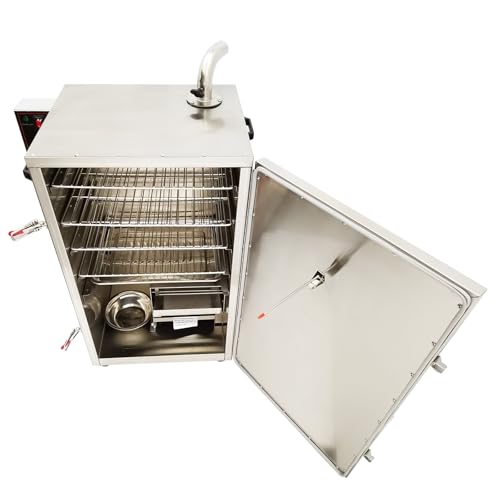
IntXanth Electric BBQ Meat Smoker, Commercial Vertical — Best Side-Loader for Long Smokes
The IntXanth is a commercial vertical electric smoke oven with five detachable racks and a side wood chip loader, and its listing uses the words ‘sausage smoke oven’ outright. The side loader is the detail that earns its place: on a long, low sausage smoke, opening the main door to add chips dumps the cabinet’s carefully built temperature and humidity. Feeding smoke from the side keeps the environment stable, which is precisely what a six-hour link smoke needs.
Strengths
- Side wood chip loader tops up smoke without a door opening
- Five detachable racks configure for hanging or flat loads
- Listing temperature band suits low-and-slow sausage work
Trade-offs
- Lesser-known brand with a thinner manual and support trail
- Detachable racks need a wash routine to stay pleasant
- 110V commercial format assumes a dedicated spot and outlet
| Racks | 5, detachable |
| Smoke feed | Side wood chip loader |
| Format | Vertical electric, 110V (from listing) |
Think of the IntXanth as the production-minded middle option. It gives up one rack level to the HAKKA in exchange for the side loader, and for sausage that trade is often correct: the limiting factor on a long smoke is rarely the last few pounds of capacity, it is the temperature crash every time the door opens. Snack sticks and summer sausage, which smoke for many hours at low temperatures, benefit most. Fresh links that finish faster benefit less, which is why this pick ranks below the HAKKA overall but ahead of it for one specific style of work.
Set expectations on finish and documentation. Commercial import cabinets like this one are built to a price and a function, and the function here is sound: a tall box, an element, a controller and a smoke feed that does not disturb the load. What you do not get is the hand-holding of a big consumer brand. Do a dry run, map the cabinet’s hot spots with a cheap test load of links, and write your own rotation schedule on a card you keep with the machine. That half hour of calibration is the difference between this cabinet frustrating you and quietly becoming your processing-day workhorse.
Best for: long, low smokes like snack sticks and summer sausage in bulk / Not suited for: buyers who want a big-brand manual and app experience

Smokehouse Big Chief Electric Smoker — Best Proven Home Workhorse
The Big Chief is the honest centre of this guide. Its own listing states a 50-pound capacity — half the search’s number, and the largest figure any home smoker in this roundup can actually document. Smokehouse Products has sold this simple electric box for decades to people who smoke fish, jerky and sausage, and its low, steady heat is the reason: it runs in exactly the gentle band where sausage casings dry, take smoke and set without sweating their fat out.
Strengths
- Documented 50 lb capacity — the real home-scale benchmark
- Low, steady heat profile that suits sausage and jerky perfectly
- Dead-simple design with decades of production behind it
Trade-offs
- No digital control: temperature is fixed by the element and the weather
- Not a hot smoker — brisket and ribs are outside its brief
- Half the keyword capacity: plan two runs for a true 100 lb day
| Capacity | 50 lb (stated in listing title) |
| Format | Electric, front-loading cabinet |
| Best-known uses | Fish, jerky, cheese and sausage (brand positioning) |
There is a reason the Big Chief keeps appearing in sausage conversations while fancier machines rotate out. Sausage does not need a smoker that can do everything; it needs one that cannot easily do the wrong thing. The Big Chief’s element holds a modest temperature and simply stays there, hour after hour, which makes it forgiving for beginners and consistent for production. Two runs in a Big Chief will process your 100 pounds with less drama than one overloaded run in a cabinet that was never rated for the load — and the links will show it, with plump casings instead of shrivelled ones.
Its limits are the flip side of its simplicity. Wind and cold weather pull its temperature around because there is no controller compensating, so most owners smoke in a sheltered spot and some build a simple windbreak or insulating wrap for winter batches. The racks are sized for fish and jerky as much as sausage, so long links do best hung from the top or coiled as rings. None of this is hidden cost; it is the known character of a machine that has been doing one job well for a very long time. If your sausage volume is ‘a deer or two a year, plus jerky’, this is the sensible buy.
Best for: home processors who want proven, gentle heat and a documented capacity / Not suited for: anyone needing precise digital staging or hot-smoking range

Smokehouse Little Chief Front Load Smoker — Best for Cold-Smoked and Delicate Sausage
The Little Chief is the Big Chief’s smaller sibling, described in its own listing as a low-to-mid temperature smoker for fish, jerky, cheese and sausage. It earns a place in a guide about big sausage loads for one reason: not every sausage job is a bulk job. Cold-smoked styles, delicate fresh links you intend to finish in a pan, and the test batches you run when developing a recipe all want the gentlest smoke you can make, and that is this machine’s home territory.
Strengths
- Cool-running character suits cold-smoked and delicate sausage
- Front-load layout is easy to load with rings and sticks
- Same simple, repairable design philosophy as the Big Chief
Trade-offs
- Small capacity — a supporting player, not a bulk machine
- Fixed heat output, weather-sensitive like its sibling
- Front-load door gives less hanging height than tall cabinets
| Format | Electric front-load cabinet |
| Temperature character | Low to mid (from listing) |
| Listing-named uses | Fish, jerky, cheese, sausage |
Recipe development is where the Little Chief quietly pays for itself. When you are tuning a new bratwurst seasoning or testing how a venison mix behaves with more fat, you do not want to commit twenty pounds to an untested idea. A small, cool-running smoker lets you smoke a two-pound test coil exactly the way the big batch will be smoked, taste the result, adjust, and only then scale up. Paired with any of the larger cabinets above, it completes a two-machine setup that mirrors how small commercial sausage makers actually work: a test and finishing unit beside the production unit.
Used alone, it suits the maker whose sausage life is modest and varied — some links, some jerky, a side of salmon, a wheel of cheese in the cool months. The front-load design makes it the easiest of the Chiefs to load and unload, and its small footprint stores on a shelf, which matters in a garage that also holds the grinder, stuffer and tubs. Just do not buy it as your only machine if bulk processing days are genuinely on your calendar; that is the Big Chief’s job, and the price of learning the difference is a very long processing day.
Best for: test batches, cold-smoked styles and small varied smoking / Not suited for: bulk processing days on its own

Masterbuilt 40-inch Digital Electric Smoker MB20072918 — Best for Mixed Loads
Not every reader type this query processes sausage and only sausage. The Masterbuilt 40-inch is the large consumer option: a digital electric cabinet with 970 square inches of cooking area, chrome racks and a side wood chip loader. On a mixed processing day — links on the upper racks, a shoulder below, jerky drying in between — its size and digital control make it the most flexible machine in this guide, even though it is not a dedicated sausage oven.
Strengths
- 970 sq in is the largest verified cooking area in this guide
- Digital control plus side loader suits long mixed loads
- Huge accessory and knowledge ecosystem around the model line
Trade-offs
- Consumer temperature floor is higher than sausage specialists prefer
- Rack spacing favours roasts over hanging long links
- Bigger cabinet to clean after every fatty session
| Cooking area | 970 sq in (from listing) |
| Format | 40-inch digital electric vertical |
| Smoke feed | Side wood chip loader |
The Masterbuilt’s sausage technique is adaptation. Its controller will not idle as low as the charcuterie cabinets like to start, so experienced owners dry casings with the door cracked during the first stage, then close up and ramp as normal. Links do better hung from the top rack positions or coiled, because the rack spacing was drawn around pork butts, not salami. None of this stops it making very good sausage — it asks for a slightly more attentive cook, and in exchange it covers every other smoking job your household will ever ask of it, which for most families is the real brief.
Ownership is the easiest in this guide: parts, covers, replacement racks and advice are everywhere because the model line sells in volume. The side loader deserves its reputation — topping up chips without opening the door is worth real temperature stability on a long smoke. Grease management is the chore to stay ahead of; a cabinet this size processing fatty sausage needs its drip system cleaned before residue builds into off flavours. If your sausage is one part of a bigger barbecue life rather than the whole of it, this is the pick that respects that.
Best for: households whose sausage days are part of a wider smoking habit / Not suited for: purists who want a dedicated low-temperature sausage oven
Comparison Table
| Pick | Badge | Key spec | Best for |
|---|---|---|---|
| HAKKA Commercial Electric Smoker DSH-S50B | Best Overall Commercial Cabinet | 8-rack vertical commercial smoke oven | hunters, farms and vendors processing sausage in true bulk batches |
| CLIVIA Electric Smoker, 4-Rack Digital Commercial | Best Digital Control for Sausage | Digital 86–248°F range, timer, stainless cabinet | charcuterie makers who value a controlled low-temperature ramp over raw volume |
| IntXanth Electric BBQ Meat Smoker, Commercial Vertical | Best Side-Loader for Long Smokes | 5 detachable racks, side wood chip loader | long, low smokes like snack sticks and summer sausage in bulk |
| Smokehouse Big Chief Electric Smoker | Best Proven Home Workhorse | 50 lb capacity stated in its own listing | home processors who want proven, gentle heat and a documented capacity |
| Smokehouse Little Chief Front Load Smoker | Best for Cold-Smoked and Delicate Sausage | Low-to-mid temperature, front-load design | test batches, cold-smoked styles and small varied smoking |
| Masterbuilt 40-inch Digital Electric Smoker MB20072918 | Best for Mixed Loads | 970 sq in across a 40-inch cabinet, side chip loader | households whose sausage days are part of a wider smoking habit |
Read the table with the honesty note from the top of this guide in mind: only one pick carries a manufacturer-stated load capacity, and it is 50 pounds. The commercial cabinets earn their place through rack count and cabinet format, which is how bulk sausage capacity actually works in practice — single layers with air gaps, not a headline weight.
How to Choose a Smoker for 100 Pounds of Sausage
Start by translating the headline number into loads. One hundred pounds of sausage is roughly two full runs in the largest home cabinet in this guide, or one long day of relays in a commercial multi-rack oven. Decide which rhythm suits your life: a processing day built around two calm, well-managed loads, or a single cabinet stuffed to its limits with uneven results. Experienced makers choose the two-load rhythm every time, because sausage quality is decided by airflow around each link, and airflow is the first thing an overloaded cabinet loses.
Next, shop the temperature range before the dimensions. Sausage begins cool — casings need to dry and set before real heat arrives — and finishes at a moderate temperature. A cabinet whose range starts genuinely low, or whose fixed heat output sits in the gentle band like the Smokehouse machines, will make better sausage than a larger cabinet that idles hot. Digital staging is the premium version of the same virtue: it lets the cabinet climb the ramp for you while you work on the next batch of stuffing.
Finally, measure hanging room, not just rack area. Long links, summer sausage chubs and salami want vertical clearance; rings and sticks want rack count. A tall cabinet with removable racks covers both, because you can pull racks out to make hanging space. Check the listing’s rack count and cabinet height against the longest product you actually make, and be honest about it — the time to discover your summer sausage does not fit is not processing day.
Budget Tiers for Bulk Sausage Smoking
Money in this category sorts into three honest tiers. The budget tier is the traditional home cabinet: simple element, no controller, decades-proven, and priced like the appliance it is. The mid tier is the large consumer digital cabinet, which buys you flexibility across all smoking, not just sausage. The premium tier is the commercial smoke oven, which buys rack count, stainless construction and low-end control — capacity and discipline rather than features. None of the tiers is a mistake; the mistake is buying the tier that does not match your batch rhythm.
Leave room in the budget for the rest of the sausage system. A cabinet is only one station: the grinder, the stuffer, casings, cure and a scale all compete for the same money, and a mid-tier cabinet plus a good vertical stuffer will out-produce a premium cabinet fed by a frustrating stuffer every single processing day. Spend on the bottleneck, which for most makers is stuffing speed, not smoking space.
Casings, Cure and the Details That Decide a Batch
Equipment gets the attention, but sausage is decided by consumables. Casings first: natural hog casings give the snap and the traditional bite for fresh links, collagen suits high-volume consistency and snack sticks, and fibrous casings are the summer sausage standard. Whichever you run, soak and rinse them properly, keep them cold, and load the stuffer horn without tearing — a casing failure mid-batch costs more time than any smoker decision in this guide. The smoker’s job begins only when the stuffing was done well.
Cure is the second decision, and it is a safety system before it is a flavour. Cured styles that smoke low for long hours spend extended time in the temperature band where care matters most, and the correct cure for the recipe — used at the correct rate, weighed rather than eyeballed — is non-negotiable practice for low-and-slow sausage. Fresh sausage that will be cooked through and eaten promptly is a different case. Know which case each of your recipes is, follow tested formulations for cured work, and never improvise cure quantities from a forum comment.
Finally, fat and temperature discipline in the grind decide texture before the smoker is lit. Keep everything — meat, fat, grinder parts, bowls — genuinely cold through grinding and mixing, mix until the protein extraction gives you a tacky, bound mass, and rest the stuffed links before smoking as the main guide describes. A batch handled cold and bound properly will survive a mediocre smoke; a warm, smeared batch cannot be rescued by the finest cabinet in this guide. The smoker is the last ten percent of sausage making, and the best equipment decision is the one that leaves you energy for the first ninety.
How to Smoke a Bulk Batch of Sausage, Step by Step
This is the workflow the picks above are built around — a staged, low-and-slow smoke that scales from ten pounds to a full processing day.
- Chill the links first. Sausage goes into the smoker cold and surface-dry; if the casings are wet, smoke will streak and the finish will look tired. An hour uncovered in the fridge, or a short rest in front of a fan, sets the pellicle that smoke sticks to.
- Load with air gaps. Hang links from sticks or hooks where the cabinet allows, or lay rings and sticks in a single layer with space between them. Any two links that touch will finish pale at the contact point.
- Start cool and dry. Run the first stage at the lowest setting your cabinet manages, door cracked if needed, until the casings feel dry and tacky to the touch. This stage is about surface, not cooking.
- Add smoke gently. Feed chips or pellets in small amounts. Sausage wants a thin, steady smoke for hours, not a dense blast; if you cannot see through the smoke, it is too much.
- Ramp in stages. Raise the temperature gradually through the middle of the cook so the fat inside the casings stays emulsified. Sudden jumps are what cause fat-out and shrivelled links.
- Finish to temperature, then bloom. Cook links through, move them to a rack at room temperature to bloom and deepen in colour, and only then refrigerate. Rushing them into the cold dulls both flavour and appearance.
Scale note: on a true 100-pound day, run this workflow as two staggered loads. Start the second grind and stuff while the first load smokes, and the cabinet — whichever pick you chose — becomes the steady centre of the day instead of its bottleneck.
Common Buying Mistakes
Overloading the cabinet. The single most common failure at this scale. Links packed tight steam instead of smoking, finish unevenly, and leave you blaming the machine for a loading decision. Air gaps are capacity you can taste.
Starting hot. Heat before the casings dry gives you streaked colour and rendered fat. The cool first stage feels like wasted time and is actually where good sausage is decided.
Believing headline capacities. A number in a product name is not a load rating. Trust the manufacturer-stated capacity in the listing, and treat everything else as rack geometry you have to judge yourself.
Smoking straight from the stuffer. Wet, warm links take smoke badly and cook unevenly. The chill-and-dry rest is a step, not a suggestion.
Judging doneness by colour. Smoke colour arrives long before the interior is cooked. Work to internal temperature with a probe, and let colour be the last thing you check, not the first.
Sausage Styles and the Smokers That Suit Them
Fresh smoked links — bratwurst, Italian, kielbasa — are the volume kings of processing day, and they are the most forgiving: a moderate staged smoke in any pick in this guide will serve them. They want rack room more than hanging height, and they reward the big consumer cabinet and the commercial ovens equally. If fresh links are ninety percent of your production, buy rack area and digital staging and do not overthink the rest.
Cured and dried styles — summer sausage, snack sticks, salami-style products — are where the specialists pull ahead. These smoke low for many hours, sometimes across more than one session, and they punish temperature spikes and door openings. The side-loader cabinets and the cool-running Smokehouse machines exist for this work. If cured sausage is your real goal, weight the low end of the temperature range above everything else in the table.
The practical conclusion most makers reach is a two-machine answer: a bulk cabinet for production and a small cool smoker for development and delicate work. This guide is organised so you can build that pair from it — one pick from the top of the list, one from the Smokehouse pair — and cover every sausage style a home or small-farm operation realistically makes.
A Processing-Day Workflow for Two Full Loads
Here is the 100-pound day as experienced makers actually run it, built around the two-load rhythm this guide recommends. The day before: grind and season the full batch, mix to bind, and refrigerate — seasoned meat stuffs better and tastes better for the rest. Morning: stuff the first half into casings while the smoker preheats, load it, and start the staged smoke. While load one smokes, stuff the second half and hold it cold and covered. The rhythm is deliberate: the stuffer and the smoker are never both waiting.
As load one finishes, links bloom on racks while the cabinet — still warm, still seasoned with the day’s smoke — takes load two with no restart penalty. Bloom, package and refrigerate load one during load two’s early stages, when the smoker needs the least attention. By the time load two finishes, load one is already put away, and the day ends with cleaning rather than a second mountain of work. Total elapsed time is a working day; total stress is a fraction of the single-overload approach, and the sausage — every link of it — got air, stages and attention.
Write your version of this workflow down after your first big day, with your cabinet’s actual timings in the margins. The second 100-pound day runs on that card, and it will feel half as long as the first. That, more than any single product in this guide, is what buying the right smoker is for.
Cleaning and Storing a Sausage Smoker Between Batches
Sausage cabinets work in a residue of fat, cure and smoke that turns rancid faster than brisket grease does, and the cleaning rhythm is part of the product quality. While the cabinet is still warm after a batch, wipe the walls and door seal, empty and wash the drip system, and take the racks to a tub of hot, soapy water — sausage fat releases easily warm and sets like glue cold. Commercial cabinets earn their keep here: flat stainless interiors and removable racks are a cleaning specification as much as a cooking one, and the Smokehouse boxes, for all their simplicity, hose-and-wipe clean in minutes.
Storage between batches is the second half of the ritual. A cabinet stored clean and dry, with its door cracked so the interior breathes, starts the next batch neutral; a cabinet stored closed and dirty starts it with last month’s flavours baked into the first hour. If your batches are seasonal — hunting season, the autumn preserving run — add a pre-season seasoning burn to the calendar, and inspect cords, elements and seals before the meat is ground rather than after. The makers who process at this scale for decades are not doing anything exotic. They are doing these two paragraphs, every time.
Final Recommendation
For true bulk work, the HAKKA DSH-S50B is the anchor pick: eight racks, a commercial brief and a listing that names sausage as its core job. If your batches are smaller but your standards are not, the CLIVIA’s verified low temperature range and timer make it the control freak’s choice, while the IntXanth’s side loader is the smart buy for long cured smokes.
For home processors, the Big Chief remains the benchmark this whole category is measured against — a documented 50-pound capacity and heat that suits sausage by design. Buy the Little Chief beside it when test batches and cold-smoked styles enter your life, and choose the Masterbuilt 40-inch when sausage is one chapter of a bigger barbecue story rather than the whole book.
- HAKKA Commercial Electric Smoker DSH-S50B — hunters, farms and vendors processing sausage in true bulk batches
- CLIVIA Electric Smoker, 4-Rack Digital Commercial — charcuterie makers who value a controlled low-temperature ramp over raw volume
- IntXanth Electric BBQ Meat Smoker, Commercial Vertical — long, low smokes like snack sticks and summer sausage in bulk
Keep exploring this cluster: Best 16 Hour Smokers Best 2 Door Gas Smokers Best 3 In1 Smokers Best 30 Inch Electric Smokers Best 40 Inch Electric Smokers
Related guides
- Best Choice Products Smokers
- Best Airfilter For Smokers
- Best Airleaner For Smokers
- Best Whiskey Smokers
Frequently Asked Questions
Is there really a home smoker rated for 100 pounds of sausage?
Not that we could verify. The largest manufacturer-stated home capacity in this guide is 50 pounds, from the Big Chief’s own listing. Reaching 100 pounds in a day is realistic — as two managed loads, or in a commercial multi-rack cabinet — but a home smoker honestly rated at 100 pounds in one load was not something the current market offered when this guide was verified.
Why does sausage need lower temperatures than brisket?
Because of the fat inside the casing. Sausage is an emulsion held together by protein and kept juicy by fat; push the heat too fast and the fat renders out, leaving dry, shrivelled links. Brisket wants its fat rendered. Sausage wants its fat preserved, which is why the smoke is staged from cool to moderate.
Should sausage hang or lie on racks?
Both work, and the choice follows the product. Long links and chubs hang best, which needs vertical clearance. Rings and sticks lie flat, which needs rack count. A tall cabinet with removable racks covers both styles, which is why the commercial picks in this guide are built that way.
How long does a bulk sausage smoke take?
Plan on several hours for fresh links and much longer for cured styles like snack sticks and summer sausage, which smoke low across extended sessions. The exact clock matters less than the stages: dry the casings, smoke gently, ramp slowly, finish to internal temperature.
Can I smoke sausage in a regular pellet grill?
You can, and many people do, but it is the hardest common tool for the job: most pellet grills idle hotter than sausage likes to start, and their horizontal layout wastes space on hanging product. If sausage becomes a serious habit, a vertical cabinet — even a simple one — will repay the change quickly.
What else do I need besides the smoker for 100-pound days?
A grinder and stuffer sized to the batch, casings, cure if your recipes call for it, tubs for staging, and a reliable probe thermometer. The smoker is one station in a line; the day runs at the speed of the slowest station, which is usually stuffing.


