Disclosure: As an Amazon Associate, airfryerkitchensupply.com earns from qualifying purchases. Links on this page are affiliate links; they cost you nothing extra. Prices and availability change often, so check the current Amazon listing before you buy.
Ask whether a porch swing is worth it and most answers talk about charm. Run the numbers over ten years instead. A swing is not a single purchase; it is a small ownership programme that keeps invoicing you in cushions, finish, chain and attention long after the bench itself is paid for. It earns that money back only on the days somebody actually sits in it. So this guide does two honest sums side by side: what a decade of owning one really costs, set against a pair of rocking chairs, a glider and a hammock, and how often a normal household will truly use it once the novelty month has passed.
Work through both sums before you look at any model. If you will sit out most evenings from April to October, the ten-year total divides into hundreds of cheap, pleasant hours and the swing wins easily. If your porch is a corridor you cross carrying shopping, the same total divides into a handful of expensive sits, and no discount rescues it. Everything that follows is priced against that break-even line.
Key Takeaways
- Count ten years, not checkout day: cushions, refinishing and hardware belong in the total.
- Cost per sit, not purchase tier, decides whether a swing beats rockers, a glider or a hammock.
- Low-upkeep materials cost more at the start and less in weekends across the decade.
- Real frequency is the multiplier: daily use forgives almost any tier, rare use forgives none.
- Write your expected sits per week down before buying, then judge every model against it.
In this guide
Safety First: The Rules That Come Before Comfort
Hang a porch swing only from structural ceiling joists. In ownership terms this is also an economic rule, because a swing fixed into roof decking, decorative boards or drywall will eventually fail, and a failure costs a bench, a porch floor and possibly an injury all at once. The bolts belong in or through the solid timber that carries the roof. Every departure, every child bouncing down and every third guest adds dynamic load far beyond the quiet weight of the empty seat. Cannot find the joists with confidence? Paying a carpenter for an hour is the cheapest insurance in this entire purchase.
Use hardware and chain rated above the loaded weight. Loaded means the bench, the heaviest combination of people who will ever share it, and the extra force generated once it is moving. Eye bolts, hooks, connectors and chain each need a rating above that combined figure, with margin left over. This is the one line in the ten-year budget where saving money is false economy: rated components cost a little more once, while undersized hardware wears faster, gets replaced sooner and carries a risk no discount offsets. Reject anything delivered bent, pitted or rough, before it ever carries weight.
Leave real swing clearance in front and behind. Clearance is free at the planning stage and expensive afterwards, in scuffed paint, dented planters and bruised shins that quietly teach a household to avoid its own porch. Measure the whole travelling arc, not the seat at rest, and keep walls, rails, posts and the main walking route outside it. Children will test the furthest reach of that arc within the first week. If the porch cannot spare the space, spend the money on a single swing chair or a stand placed somewhere roomier rather than forcing a bench into a gap it will pay for daily.
Inspect chains and eyelets for wear each season. Treat this as scheduled maintenance, like servicing a boiler, because that is what keeps a ten-year lifespan from becoming a four-year one. Run a hand and an eye over every link, hook and bolt at the start of the season and once more mid-season on a busy porch. Stretched links, rust, cracked timber around a fixing or an eyelet beginning to oval are all early warnings while replacement is still cheap. A single new link bought in spring costs almost nothing; a whole hanging system ignored until it fails costs considerably more.
Respect stands and small fingers. A stand avoids installation cost but introduces its own condition: A-frames tip when rocked hard, so the frame needs level, firm ground and adults who set a calm pattern from the first day. Then there are pinch points, the narrow gaps where chain meets frame and where the seat passes the armrests, which attract exactly the small fingers least able to judge them. Teaching children where hands go is not an extra feature of ownership; it is part of the running cost, paid in attention, and households unwilling to pay it should choose a static seat instead.
What You Actually Get — Is a Porch Swing Worth It in Daily Terms
Over ten years, what you are really buying is a second living room you already own the walls of. Without any seat, a porch produces almost no hours: it is crossed, swept and decorated, but rarely inhabited. Add a swing and that same square footage starts returning evenings, morning coffees and long conversations at no extra rent. Divide a decade of ownership cost by those returned hours and the swing often works out cheaper, hour for hour, than almost any other furniture in the house — provided, always, that the hours genuinely happen.
The motion itself has economic value too, because it is what keeps the seat in use after year one. A static bench is sat on; a swinging bench is lingered in. People stay for the second cup, children who arrived restless settle into the rhythm, and a ten-minute break stretches into the best half hour of the day. That lingering is the difference between a seat used three times a week and one used twice a month — and frequency, over ten years, turns a premium bench into a bargain or a cheap bench into clutter.
The third return is longevity of a repairable kind. Unlike upholstered furniture that dies when its foam or fabric does, a swing is an assembly of replaceable parts: a chain section here, a slat there, a fresh coat of finish every few seasons. Nothing about it needs to be thrown away whole. That repairability is why the ten-year sum, rather than the first-year sum, flatters a well-chosen swing — the bench keeps earning while cheaper, disposable alternatives are bought for the second or third time.
The Real Costs Beyond Money
Build the honest ledger. Year one brings the bench, hanging hardware and, for most households, cushions and a cover. Around years three to five, exposed wood wants sanding and refinishing, sun-thinned fabric wants replacing, and a chain section may want renewing. A second cushion set often arrives before the decade ends. None of it is dramatic, which is why it gets forgotten in the showroom calculation — yet together it adds a substantial share to the original outlay. Then add the non-cash charges: porch space surrendered daily, one installation weekend, brief inspections a few times a year, and the teaching that keeps a moving seat safe.
Who It Pays Off For
The porch household
Some households already live facing the street: coffee migrates outside, neighbours get waved to by name, chairs are forever being dragged to the front. For them the arithmetic is not speculative at all. The swing simply replaces improvised seating with a better seat inside a habit that already exists, so the cost per sit falls from the very first month. This is the lowest-risk purchase in the whole guide, because the usage forecast is not a hope — it is last summer, observed.
The family in the thick of it
A household with children and grandparents nearby gets a second kind of return: one seat that every generation uses for a different reason. It is a debriefing bench after school, a settling place before bed and a perch an older visitor can enjoy without climbing out of a low chair, provided the safety rules are taught and kept. Shared across that many people, the ten-year cost is divided by far more sits than a single buyer ever generates, which is why family porches so often justify the sturdier, premium end of the range.
The reader, the thinker, the early riser
A solo user with a protected quiet hour should do the sum in the opposite direction: fewer people, but near-daily frequency. Three hundred short sits a year makes even a mid-tier swing chair inexpensive per use, and the routine it anchors — reading before the house wakes, thinking through the day with a coffee — has a value no spreadsheet captures but every owner recognises. For this buyer, spending on back comfort beats spending on width they will never share.
Who Should Skip It
Skip the swing if the joists cannot be confirmed and a stand holds no appeal, because a bench you cannot hang safely has a ten-year value of exactly zero. Skip it if giving it a proper arc means surrendering the only walking line across the porch; a seat the household resents and squeezes past will be used less each year while its maintenance bill stays the same. Skip it if nobody will honestly do the seasonal checks or bring cushions in, because neglected ownership converts a durable good into a deteriorating one. And skip it, without guilt, if your household’s life happens at the back of the house. Money follows life, and a glider on the patio you actually use beats a swing on the porch you only photograph.
Strengths and Trade-Offs of Owning One
Strengths
- Turns space you already own into hundreds of low-cost hours across a decade.
- Every wear part can be renewed singly, so the bench rarely needs replacing whole.
- One seat serves toddlers, teenagers and grandparents in the same evening.
Trade-Offs
- The purchase price is only the opening instalment of a ten-year cost.
- It rents porch space permanently and demands inspection as a standing habit.
- Low real usage makes even the cheapest model expensive per sit.
Alternatives to Consider
Price the rivals over the same decade before deciding. Two rocking chairs ask nothing of the ceiling, can be bought one at a time, moved for conversation or company, and replaced individually — for a porch without confirmed structure they are often the cheapest honest route to motion. A glider gives smooth, contained travel with no arc to clear and no hanging hardware, though its mechanism becomes its own maintenance item. A hammock has the lowest entry cost and the deepest relax for one person, but its fabric and rope are consumables bought again within the decade, and it offers little to a second sitter. A stand-mounted swing keeps the full bench where hanging is impossible, at the price of the stand, level ground and respect for its tipping limit. The swing wins when shared, daily, long-term sitting is the real pattern; the alternatives win when the pattern is solo, occasional or structurally awkward.
Models Worth a Closer Look
Judge each model below the same way: not by its tier label, but by what it will ask from you between now and year ten, and how many of your forecast sits it will actually serve.
Amish Casual Heavy Duty Roll Back Porch Swing
Best for: roll-back comfort. Tier: premium.
Start the ten-year sum for this one with comfort, because the roll-back backrest is what you are paying the premium for. A curved back that meets the spine properly does not just feel nicer for five minutes; it is the reason a sit lasts forty minutes instead of ten, and longer sits are the raw material of a low cost per hour. The Amish Casual build follows a traditional pattern — generous slats, a frame that feels planted rather than delicate, and hardware intended to be inspected and kept for the life of the bench. That makes it a porch-anchor purchase: right for a covered porch where this will be the principal seat, used by two people most days, and wrong for a narrow frontage, a tenancy where fixings are forbidden, or anyone who expects to lift the seat down alone whenever the mood changes. Put a modest annual allowance beside it for finish care on the ledger and the picture stays honest: higher outlay at the start, repaid in seasons of long, frequent use rather than in any single impressive feature.
Confirm the details on the current listing before committing. Not suited for: porches that cannot give it a clear, safe arc, or buyers unwilling to follow the hanging and inspection rules in this guide.

Jack Post Traditional Porch Swing
Best for: classic slatted value. Tier: entry.
Think of the Jack Post as the low-entry-cost experiment that still behaves like a proper swing. Its slatted bench is the familiar shape most people picture, proportions are conventional, and nothing in the design is exotic enough to make replacement chain or hardware a puzzle later — an underrated saving across ten years, because standard parts are the parts you can actually find. For a first porch, that combination lets a household discover its real sitting frequency on a modest outlay before deciding whether a handcrafted bench is justified. The limits sit at the other end of the decade: do not expect sculpted ergonomics or heirloom joinery at this tier, and do not expect a traditional finish to look after itself outdoors. Hung from confirmed joists with rated hardware and checked each season, it delivers the essential return — a sociable, gently moving seat — at the gentlest starting figure in this line-up.
Look over the current listing before you order. Not suited for: porches that cannot give it a clear, safe arc, or buyers unwilling to follow the hanging and inspection rules in this guide.
Porchgate Amish Heavy Duty Porch Swing
Best for: sturdy Amish-style build. Tier: premium.
Porchgate makes its case on cost per year rather than cost per purchase. The bench presents as squared, substantial and built for a porch that never really rests — children climbing up, grandparents settling in, two adults and a dog negotiating the remaining space. A heavier build asks more of the installation, and its weight makes taking it down for storage a chore nobody will volunteer for, so count it as furniture that lives hung, in place, season after season. That permanence is exactly where its economics work: owners who measure value in uninterrupted service, and who are content to maintain rather than move their furniture, spread the premium across a very long working life. On a small porch, though, the same solidity crowds the walking line, and a bench that obstructs daily life will be sat in less, which quietly ruins its own arithmetic. As ever, the bench is half the system; the joists, eye bolts and chain above it determine whether the other half ever gets to prove itself.
Verify the current listing before buying. Not suited for: porches that cannot give it a clear, safe arc, or buyers unwilling to follow the hanging and inspection rules in this guide.

Best Choice Products Hanging Porch Swing
Best for: accessible hanging bench. Tier: entry.
Best Choice Products is the test-the-water option, and judged as a test it is economically rational. The outlay is accessible, the two-person bench is simple and friendly in design, and the proposition is to get a household swinging this season instead of debating timber for a year. Many owners need exactly that: one real summer of evidence about how often the porch gets used, bought cheaply. Where the honesty has to come in is exposure and expectation. This is not the densest hardwood nor a piece to hand down, and on an uncovered porch its owners will pay in checks, covers and earlier replacement what they saved at the start. Under a roof, used regularly and inspected like any other pick here, it still returns the core asset — the slow arc, the conversation, the evening air — and if it teaches the household that a premium bench is warranted later, it has earned its place in the ten-year story twice over.
Review the current listing before you buy. Not suited for: porches that cannot give it a clear, safe arc, or buyers unwilling to follow the hanging and inspection rules in this guide.
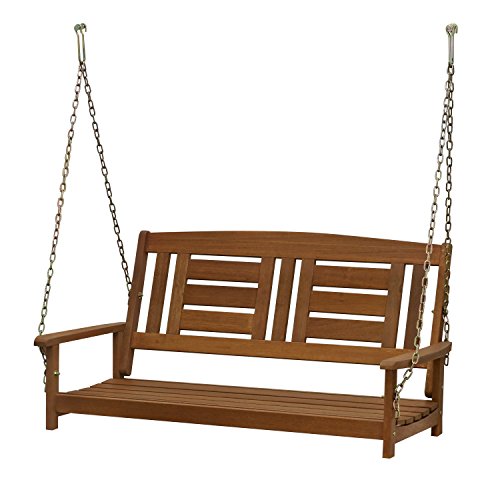
Furinno Tioman Hardwood Swing Chair
Best for: single-seat hardwood swing chair. Tier: mid.
The Tioman changes the unit economics by changing the unit. One seat instead of a bench means a smaller purchase, a smaller arc to clear and a seat that fits corners, balconies and narrow porches where a full bench would either not fit or would consume the whole space and be resented for it. In return it serves a different pattern of use: a reading corner, a morning-coffee post, a quiet second seat beside a bench rather than the social centre of the porch. The hardwood gives it a warm, planted feel among plants and a side table. Do the frequency sum for one person, not a family — a daily solo sitter will extract excellent value, while a household hoping to sit together will find the chair permanently insufficient no matter how well it is made. Stretching out is not on offer, and the sit is closer and more upright than a bench gives. Every hanging rule still applies in full, because a smaller seat hung badly fails in exactly the same way as a large one.
Check the current listing details before ordering. Not suited for: porches that cannot give it a clear, safe arc, or buyers unwilling to follow the hanging and inspection rules in this guide.

POLYWOOD Chippendale Porch Swing
Best for: recycled-lumber low upkeep. Tier: premium.
POLYWOOD is where the ten-year ledger most visibly flips. The Chippendale costs premium money on day one and then largely stops asking: recycled plastic lumber needs no sanding-and-sealing cycle, shrugs at rain that would start a timber owner planning a weekend, and carries its colour through the material instead of wearing it as a surface coat. Price that honestly against a wooden bench plus several refinishing rounds, plus the value of the weekends themselves, and the gap narrows far more than the two starting figures suggest. It is the natural candidate for exposed porches, coastal air, second homes that stand empty for weeks and owners who know their maintenance intentions are better than their maintenance record. The compromises are real but non-financial: no wood grain, scent or ageing character, and a formal patterned back that looks tailored on the right house front and slightly dressed-up on a very rustic one. On the tightest starting budget it remains out of reach, whatever the decade says.
Confirm the current listing before you buy. Not suited for: porches that cannot give it a clear, safe arc, or buyers unwilling to follow the hanging and inspection rules in this guide.
Value, Weighed Slowly
Materials, honestly explained
Every material is a different payment schedule wearing a different finish. Solid wood charges modestly at purchase and then bills you in care: a surface that can be sanded back, repaired and refinished for many years, in exchange for attention wherever sun and rain reach it. Recycled plastic lumber charges heavily once and then goes quiet, asking for a wash rather than a workshop and forgiving owners whose good intentions slip. Painted or powder-coated metal sits between the two, bringing slimmer, stronger frames, often carrying wood or sling seats whose own schedules still apply. So do not ask which material is best in the abstract. Ask which payment schedule matches the owner you have actually been for the last five years, because a forgiving material still looking decent in year five is worth more than a finer one that peeled, unrescued, in year two.
Style that belongs to the house
Style has a ten-year cost too, though it never appears on an invoice: a swing that clashes with its house gets photographed around, apologised for and eventually replaced early, which is the most expensive outcome of all. A bench is the most visible furniture a home owns, the first thing the street reads and the backdrop of every photograph taken on the steps. Traditional slats blend almost anywhere, a formal patterned back suits a tailored frontage, and clean contemporary lines sit naturally on newer builds. Colour either echoes the door and trim into a look of intention or makes a deliberate, joyful contrast — both work, restlessness does not. Cross the street, view your own house as a visitor does, and pick the design you will still be pleased to see in year ten, because longevity of liking is a genuine saving.
Children, grandparents and everyone between
Sharing a bench across generations spreads its cost across far more sits, but only if every generation trusts it. That trust is built from unglamorous specifications: honest load ratings, calm geometry, a seat height that lets older feet rest flat, armrests that genuinely help someone stand, and an arc gentle enough never to feel like a fairground ride. Children add the other half of the bargain — supervision, clear rules about standing and rocking, and pinch points remembered at every inspection. Get those things right and the swing becomes shared infrastructure, used daily by somebody. Get them wrong and a tippy, low or frantic-feeling seat slides into decoration, the worst cost-per-sit outcome available at any tier.
Value over years, not weekends
Spread the money across the decade and the ranking of these benches rearranges itself. A premium swing, handcrafted or recycled-lumber, that serves continuously with modest care can undercut a cheap swing bought, weathered and replaced twice — while a simple traditional bench under a deep covered porch can embarrass both calculations by simply refusing to wear out. The trap runs in the other direction as well: premium money spent on features nobody uses, or on a fine finish an exposed porch will destroy, is not quality but waste with better marketing. The discipline is matching — tier to exposure, material to maintenance habits, size to real sitting patterns — after which the purchase tends to justify itself quietly, one ordinary evening at a time.
How to Get the Most Value If You Buy
Protect the return on the money from the first fortnight. Site the swing where shade, breeze and view already are, because a seat in the good spot gets used twice as often as a seat near the easiest fixing, and frequency is the whole investment. Buy cushions in the same season rather than someday, since comfort compounds into habit. Set the house rules on day one, and put inspection dates into the family calendar so maintenance happens by system rather than memory. Then use the seat deliberately for two weeks — coffee there, calls there, the end-of-day review there — until sitting outside becomes the default. A swing that becomes a fixture in month one is almost never a regret in year ten.
The Decision Checklist
- Have you added cushions, cover, hardware and refinishing to the purchase figure?
- Can the joists be confirmed, or is a stand position genuinely available?
- Does the porch give a clear arc and keep its walking line?
- How many sits per week, honestly, in the months you will use it?
- Is someone willing to inspect chains and eyelets each season?
- Does the material’s payment schedule match the owner’s real habits?
Score it in money and frequency together. A ten-year total you can state, paired with a weekly sit count you believe, that still looks reasonable per hour of use: buy the best-fitting model you can justify. A total that only works if the porch gets used far more than it ever has: step down to a chair, a stand or a pair of rockers and re-run the sum. A total that fails even on optimistic use: walk away without regret and spend the money where your household’s hours actually happen. The arithmetic is short because, stripped of catalogue photographs, the decision genuinely is.
Worth It for Whom? A Porch Swing Break-Even Test Based on Your Actual Routine
Here is the break-even test in its plainest form. Write down the full ten-year figure — bench, hardware, cushions, a cover, one refinishing or cushion replacement cycle, and a small allowance for chain and connectors. Then write down, without optimism, how many times the seat will be used in a typical month of its season, and multiply that across the years you realistically expect to keep it. Divide the first number by the second. That cost per sit is the only figure worth arguing about, and it should be compared against the same calculation for two rocking chairs, a glider or a hammock before any model is chosen. Structure comes before all of it: confirm the joists and fixings first, because a swing that cannot be hung safely has no break-even point at all.
Most disappointed owners did not buy a bad bench; they forecast a fantasy household. They pictured nightly conversations and got a porch used at weekends, pictured summers outdoors and forgot the months the seat hangs empty, pictured diligent upkeep and delivered none. So forecast from evidence. Look at where the household actually sat last summer, count the evenings anyone stayed outside after dinner, and notice whether reaching the porch means moving bikes, bins or stored furniture out of the way first — every obstacle between the kitchen and the seat quietly taxes its usage for a decade. Written numbers, however unflattering, separate a sound purchase from an expensive hope faster than any feature comparison.
- Forecast monthly sits from last season’s behaviour, not from intentions.
- Put a review date one month after hanging to test the forecast against reality.
- Decide in advance the minimum weekly use that justifies keeping the swing.
- Enter storage, cleaning, cushions and replacement parts into the ten-year total.
- Name what a rocker, glider or hammock would leave undone for your household.
Before buying, audit what you already own. A pair of serviceable rocking chairs already delivering the evening sit changes the swing from a necessity into an upgrade, and upgrades must justify themselves on comfort and shared seating, not on motion alone. Audit the extras, too: a swing advertised without the cover, cushion set or hanging kit you will inevitably add is priced lower than it will ever cost, and discovering that after delivery sours an otherwise good purchase. Then check the human fit photographs hide — seat depth, back angle and arc clearance — because a bench that suits nobody’s legs is abandoned within a fortnight. The recurring chores between uses, from damp cushions to storm covers, are part of the specification too.
Notice how swings actually die, because it is rarely dramatic. Chains and ropes wear link by link, fixings work fractionally loose, cushions left damp outside mildew and thin — a slow decline that consistent ten-minute checks interrupt cheaply and neglect turns into replacement. Give the purchase a checkpoint instead of a verdict: after a month, ask whether the swing does its job without being thought about, because furniture that disappears into daily life is furniture whose cost per sit falls every week.
Allow the first fortnight some grace: a household is unlearning indoor habits as much as learning porch ones, and early awkwardness is not evidence of a bad buy unless a basic fit check has failed. Where a swing asks for something between uses, let the routine supply it automatically — cushions stored where they are sat on, inspection tied to a date already in the calendar. For a daily seat, spend on durability and fit in that order, because the purchase happens once and the using, if the forecast was honest, happens several thousand times.
Frequently Asked Questions
Is a porch swing worth it for a small house?
On cost per hour, often more worth it than for a large one, because a small house has the most to gain from a room it does not have to build. A swing converts porch footage into seating, reading space and visiting space simultaneously, so the same ten-year outlay returns hours a bigger house might get from a spare room. The constraint is geometry, not budget: the porch must fit the arc and keep its walking line, which on the smallest frontages argues for a single swing chair with a far smaller footprint and a far smaller total to recover.
Does a porch swing add value to a home?
Separate the two kinds of value, because only one of them can be banked on. Lived value arrives immediately and is collected daily: a furnished, cared-for porch makes a house feel enjoyed, and that shows whenever the home is approached, photographed or offered for sale. This guide makes no promise about resale figures, which belong to markets and locations rather than to furniture. The dependable claim is the owner’s arithmetic — households that use the seat as forecast routinely reckon it settled well inside its first seasons, with the remaining years running at little more than maintenance cost.
Is a premium porch swing worth it over a basic one?
Only where the decade rewards it: daily use, hard exposure or a genuine low-upkeep requirement. There, the premium buys solidity, a back shaped for long sits and freedom from the refinishing cycle, and those savings in money and weekends accumulate year after year. On a covered porch with gentle, occasional use, the same evenings are available from a traditional value bench, and the premium buys a label the household never cashes in. Ask what the extra money purchases in your specific ten years — years of service, ease, weather tolerance — and pay it only for the items on that list you will actually collect.
What if we end up not using it?
Then the financial damage is containable and the information is valuable. A swing is a simple, durable good with a ready second life: it can move to a stand in the garden, go to family, or be sold on while it still has most of its lifespan left, recovering part of the outlay. An unused swing also diagnoses something worth knowing — the seat was in the wrong spot, the wrong size, or the household’s life simply happens elsewhere in the house. Reduce the risk before it arises by staging the decision: forecast from last season, start with a chair if the doubt is genuine, and site the bench where life already gathers.
Is a porch swing worth it for renters?
Run the tenancy through the same sum and the stand-mounted version often passes it. A stand asks nothing of a landlord’s joists, incurs no installation cost to abandon, and moves house when you do, so its ten-year cost travels with its owner instead of being left screwed into someone else’s ceiling. Hanging from structure is a different proposition for a renter: it needs permission, confirmed joists and a tenancy long enough for the sits to repay a fixed installation. For a tenancy measured in years, with a patio or garden for the stand, the daily-use arithmetic works out the same as it does for any owner.
How long until a porch swing pays for itself?
In hours, which is the currency that matters here, the line is crossed sooner than most buyers expect — if the forecast was honest. A household taking morning coffee, afternoon calls and evening talk outside accumulates sits by the hundred in a single warm season, and by the end of a second summer the cost per sit has usually fallen below what the same hours would cost in almost any other leisure spending. Keep the swing hung true, inspected and comfortable, and the seasons after break-even are close to free: a cushion refresh and a few minutes of attention against hundreds more hours of use.
Related Guides and Next Steps
Price the neighbouring decisions with the same ten-year lens using the companion guides in this cluster and the most relevant live guides on the site. Rockers, rugs, chairs and installation each carry their own ownership costs, and the pieces below let you compare them before the money is committed.
the detailed porch swing review
porch swing reviews and what owners learn
porch swing pros and cons, both sides
how to install a porch swing safely
best outdoor swing chairs for smaller spaces
indoor outdoor rugs under a swing
More to Consider: Care through the seasons
Budget care as a rhythm of small payments rather than a single rescue bill. Spring is the audit: wash off winter, work along chains and eyelets, tighten what the cold loosened and judge the finish around every bolt while intervention is still cheap. Summer asks only for wipes before pollen and spills set, and for cushions brought in ahead of storms — the habit that most extends their life. Autumn is when trapped leaves hold damp against a seat and quietly start the damage winter gets blamed for, and when a wood finish gets its honest verdict: a coat now, or a diarised job for spring. Winter rewards a cover or storage for exposed swings and, for covered ones, a habit of stilling the seat in high winds. Totalled across a year it is perhaps an hour, but it is the hour that separates a ten-year bench from a four-year disappointment.
Counted over the decade, that rhythm is simply the cheaper line in the ledger: ten springs of brief inspections cost an afternoon in total, while one neglected hanging system can approach the price of a second swing.
More to Consider: Reading, talking and the social physics of a swing
Social physics is what fills the usage column of the ledger. Two people side by side, facing outward, moving gently, talk in a way two people in facing armchairs do not: conversations run longer, silences stop needing filling, and teenagers who would decline a formal chat drift onto a moving bench and stay. Readers colonise the corner with the best light, coffee drinkers take the early shift, and without anyone organising it the seat develops a timetable of rituals. Those rituals are the forecast made real, so choose for them deliberately. Talk as the main purpose argues for width and a calm, unhurried arc; reading argues for back support and somewhere to set a drink; reviewing the day after dark argues for cushions, a throw and comfort that holds up in cooler air.
That is also why a swing can out-earn two separate chairs: the bench makes sitting together the activity itself, and shared activities get repeated — the operative word in every cost-per-sit calculation here.
More to Consider: Children, grandparents and everyone between
Revisit the generations question with a calculator in hand. A bench used by a grandparent each morning, children each afternoon and parents each evening may log three times the sits of a single-user seat, which means its cost per use can undercut a cheaper chair bought for one person. That multiplication only happens, though, when the specifications serve everyone at once: ratings with genuine margin, a seat height that lets older feet stay flat, armrests that bear weight on the way up, and motion calm enough that nobody feels they are riding something. Children contribute the supervision cost — rules about standing, rocking and fingers near pinch points — and it has to be paid consistently, in attention, for as long as small children use the porch.
Where one generation finds the seat awkward, the multiplication collapses into single-user furniture at a multi-user price, so buy stability and familiar proportions, and let the company provide the excitement.
More to Consider: Value over years, not weekends
Weekend thinking asks what a swing costs; decade thinking asks what it costs per year of service, and the two questions crown different winners. A handcrafted or recycled-lumber bench still working in year ten, having asked for little along the way, is inexpensive furniture by any honest measure. A bargain bench replaced in year four and again in year eight is expensive furniture that merely arrived in smaller instalments. Even the middle case flatters patience: a plain traditional swing, kept under a roof and refinished when it asked, routinely outlasts the expectations its price created. The discipline is simply to compare like with like — total spent across the same ten years, including every refresh and replacement, against total hours sat.
Apply that discipline and the premium question answers itself: pay up where money buys extra years or removes recurring work, and refuse it where it buys only features the real routine never touches.
More to Consider: When a stand makes sense
A stand rewrites the cost sheet rather than cancelling it. It deletes the carpenter, the joist hunt and any question of permission — a decisive saving for renters and for porches whose structure cannot be confirmed — and it adds the price of the frame itself, a footprint of level, firm ground and an assembly job that must be done exactly as its maker directs. It also relocates the asset: the best sitting spot may be a lawn or patio rather than the porch at all, and a stand lets the swing follow the household’s life instead of the building’s beams. Respect the standing condition that A-frames tip under hard rocking, carry over every rule about ratings, clearance and inspection unchanged, and a stand is not a compromise at all. It is the correct engineering for that household, bought once and movable for the whole decade.
Portability has cash value too: a hung swing’s installation is left behind at a move, while a stand and bench travel, and their cost per sit keeps falling in the next garden.
More to Consider: Materials, honestly explained
Return to materials with the full decade in view, because this is where the largest hidden costs hide. Wood offers warmth, weight and a surface that can be sanded, patched and refinished almost indefinitely — a genuine asset — but each refinishing round is a weekend and a small bill, and exposed porches demand them more often. Recycled plastic lumber surrenders the natural character and charges more at the outset, then asks for washing and little else, which over ten exposed years can make it the cheaper material outright. Metal frames, painted or powder-coated, bring slim strength and are often paired with seats whose own material sets the real maintenance schedule. None wins universally; each wins for a particular owner in a particular exposure.
So the deciding question is autobiographical: if a spring afternoon with a brush is a pleasure you reliably take, wood repays you; if the swing will be lucky to be washed, buy the material that forgives that truth.
More to Consider: Comfort is a back, a seat and an arc
Comfort decides the length of a sit, and the length of a sit decides the economics, so judge a bench twice: once at ten seconds and once at forty minutes. The ten-second verdict belongs to the seat — its depth, the spacing of its slats and whether its front edge presses behind the knees. The forty-minute verdict belongs to the back, where a gentle roll or curve keeps supporting long after a tall flat board has started an argument with your spine, and to armrests at a natural height that let shoulders actually drop. The third element is invisible in photographs: the arc. Hung to travel in a long, shallow glide, a swing feels calm enough to read in; hung short and steep, the same bench feels busy and can leave tea-drinkers faintly seasick.
Measure every design against the longest sit you honestly take — a chapter, a long conversation, a toddler asleep against your side. A bench that wins the forty-minute test gets used more, and that is the whole financial case in miniature.
More to Consider: Chains, ropes and hangers
The hanging system is a consumable budget line, not a fit-and-forget fitting, and treating it that way saves money. Chain earns its dominance honestly: it adjusts link by link, shows its condition openly and can be renewed in sections, so a worn stretch costs a section rather than a system. Rope looks softer and suits coastal or rustic porches, but it is a wear item on a shorter clock, needing closer inspection and outright replacement at the first fraying or rot — price that cycle in before choosing it for its looks. Geometry matters as much as material: fixings set slightly wider than the bench, runs hanging clean and untwisted, both sides level so the seat neither creeps nor lists.
A crooked swing is not character; it is uneven wear manufactured daily. Correcting lengths or fixing positions is a small job that pays for itself in hardware life — in the first week, not the third season.
More to Consider: Weather, sun and the covered porch question
Exposure is the silent multiplier on every figure in this guide. Under a roof, finishes last years longer, cushions stay serviceable, hardware corrodes slowly and even modest materials post long lifespans — a covered porch is effectively a discount on the entire ten-year ledger. Out on an open deck or a stand in the yard, ultraviolet greys and cracks finishes, rain hunts down end grain, and wind swings an empty bench into posts often enough to add its own wear. None of that forbids a swing; it reprices one. Exposed sites should weight the choice toward weather-tolerant materials, budget a cover for the worst months and adopt the storm habit of stilling or securing the seat before serious weather arrives.
Make that adjustment at the buying stage and the decade stays predictable. Ignore it, and the porch presents the difference later — refinishing brought forward, cushions replaced early — the same bill, paid in a worse mood.