Disclosure: As an Amazon Associate, airfryerkitchensupply.com earns from qualifying purchases. Links on this page are affiliate links; they cost you nothing extra. Prices and availability change often, so check the current Amazon listing before you buy.
Weather should choose your swing before style does. Salt drifting off the water, midday sun hammering a south-facing porch, rain that never lets timber dry out, a winter of freeze and thaw — each climate attacks a different weakness, and a bench that flourishes in one place can split, rust or fade early in another. So this guide pairs every material with the conditions it will actually endure: cedar, teak, cypress and treated pine among the woods, coated metal, and recycled plastic lumber with HDPE.
Read it in order and the shortlist builds itself. First the structure that keeps people safe, then the families of swing, then six models judged against salt, sun, rain and frost as much as against looks. What you are really buying is a pairing — a material matched to a climate, plus a care routine you will keep.
Key Takeaways
- Climate comes first: salt, sun, rain and freeze each punish a different material weakness.
- No confirmed joists and no level stand position means no swing, whatever the timber.
- Long-sit comfort is decided by back shape and by how calmly the seat glides.
- Choose the care routine your weather imposes and your diary can honestly sustain.
- Ratings on chains and hangers, and clear space for the arc, are buying criteria.
In this guide
Safety First: The Rules That Come Before Comfort
A swing hangs from joists, never from the ceiling you can see. Decking, decorative boards and drywall are only a skin over the structure; fixings belong in, or through, the solid joist timber carrying the roof. Loads move — people settle, push off, squeeze together — and each motion tugs harder than still weight would. Weather compounds the risk: timber around a bolt that stays damp all rainy season, or that swells and shrinks through freezing winters, grips less surely than dry, stable wood. Cannot find and confirm the joists? Stop, and pay a carpenter for certainty, because a failed swing comes down with its passengers.
Rate every link for more than the fullest load it will ever carry. Count the bench, the heaviest combination of sitters, and the extra force of motion itself, then demand that eye bolts, hooks, connectors and chain each exceed that figure with room left over. Geography belongs in this calculation. Salt air corrodes ordinary plated steel at a pace inland owners never see, and in a wet region a rust-thinned link is a structural failure waiting, not a blemish. Buy matched, properly rated components, question corrosion resistance hard if you live near the sea, and reject anything delivered bent or rough.
Judge space by the travelling arc, never by the seat at rest. The bench sweeps forward and back, so walls, rails, posts, planters and the walking route across the porch must all stand clear of the whole journey, including the exuberant version children will discover in week one. Airflow is part of clearance in a wet climate: a swing jammed against a wall keeps its back face damp and shaded, mildew follows, while a seat with air circulating dries between storms. If the porch cannot offer room to move and room to breathe, shrink the bench, pick a swing chair, or move to a stand on open ground.
Give chains and eyelets a hands-on audit every season. Work link by link with fingers and eyes, at the season’s start and again midway on a busy porch. Stretched or twisted links, rust pushing through a coating, timber cracked or softened near a bolt, an eyelet worn towards oval — each is a retirement notice. Your climate writes the timetable: salt corrodes monthly, fierce sun eats the finish that shields wood, rain hunts exposed end grain, and water frozen inside a hairline crack widens it over one winter. Swap the worn part before the next sit; optimism is not a load rating.
Treat stands as structures and pinch points as hazards. An A-frame stand overturns under hard rocking, so plant it on level, firm ground and establish early, through the adults’ example, that violent rocking is misuse. Then map where small fingers get caught: the chain-to-frame junction, the sliver where seat passes armrest, any closing gap on a moving part. Curious hands go exactly there. Teach children where hands belong, supervise close play around a moving seat, and add those gaps to the same seasonal round that checks chains, bolts and the material surrounding them.
What a Porch Swing Does and the Main Types — Porch Swing Buying Guide Foundations
The traditional bench swing
The default image: slats, chains, room for two or more, at home on nearly any house front. No family spans a wider spread of tiers, from plain value builds to handcrafted work, and none suits sociable, outward-facing sitting better. The type itself is climate-neutral; its destiny outdoors is written by whatever the slats are made from and how that material is finished. Start here if company is the picture in your head, then let your rainfall, sun hours and winter lows cut the material list down.
The roll-back and comfort-shaped swing
These benches curve the back — often the seat too — to meet the body, surrendering a little formal crispness for support that lasts an afternoon. Readers, talkers and nappers are the audience; this is the upgrade when the swing becomes the porch’s main seat. The Amish Casual roll-back below is the clearest example in this guide. One climate question follows the design around: shaped backs mean shaped joinery, so in wet country ask how those joints and curves shed water instead of holding it.
The recycled-lumber swing
Recycled plastic lumber keeps the classic silhouette and deletes most of the care calendar. Rot has nothing to eat, insects lose interest, and rain becomes weather rather than threat — hence the family’s strength on exposed porches, in coastal air, at second homes standing empty, and with owners honest about skipping maintenance. The POLYWOOD Chippendale below shows its formal face; plainer slatted versions share the same material logic. Budget for the premium tier, and expect a feel that is proudly its own rather than an imitation of timber.
The swing chair
A lone suspended seat for corners, narrow porches and private rituals — part chair, part swing. The Furinno Tioman flies its flag in the models below. Smallness waives nothing: joists, rated hardware and a clear arc are all still owed, merely within a smaller footprint, and a chair coexists happily with a bench on a bigger porch, giving one household a social seat and a retreat. It is also the cheapest education in local weathering available — one hardwood chair on your own porch reports exactly what your sun and rain do.
The stand-mounted swing
When the building cannot be trusted or cannot be drilled, a frame does the carrying. Gardens, patios and rented homes are its territory; level ground is its demand; and its standing warning, repeated throughout this guide, is that A-frame stands tip if rocked hard. This is not the lesser option — it is the correct engineering where hanging fails, chosen with identical care over ratings and clearance. Put the frame itself through the climate test too: coatings near salt water, feet that will not sink or rot in a sodden winter lawn.
Models Worth a Closer Look
Six models, six different answers to the same weather — a working shortlist across the families and tiers.
Amish Casual Heavy Duty Roll Back Porch Swing
Best for: roll-back comfort. Tier: premium.
The curve is the whole argument. Where a flat board holds your back at attention, this roll-back profile cradles shoulders and spine in one shallow sweep, and the payoff arrives around minute forty, when lesser benches start negotiations and this one stays silent. Everything else about the build is traditional and unhurried: broad slats, a frame with real heft in the hand, hardware intended to be checked and tightened across years rather than swapped out every second season. Buy it for a porch you intend to keep, ideally a covered one where it can reign as the main seat — a roof overhead doubles as weather defence, keeping driving rain and noon sun off the joinery. Narrow porches will find it greedy, renters who cannot anchor into structure should pass, and nobody should expect to haul it around alone on impulse. Ownership includes the finish: a seasonal inspection, a gentle wash, and wood care paced to your climate — brisk under hard sun or constant rain, relaxed in gentle, sheltered country.
Check the current listing before you buy, and picture this bench beneath your own roof line first. Not suited for: porches that cannot give it a clear, safe arc, or buyers unwilling to follow the hanging and inspection rules in this guide.

Jack Post Traditional Porch Swing
Best for: classic slatted value. Tier: entry.
Here is the porch swing of collective memory: plain slats, honest proportions, nothing exotic anywhere in the concept. Familiarity is a genuine feature — the shape suits almost any facade, and chains and fittings for so conventional a design are understood everywhere and replaced easily. As a first swing it excels, letting a household learn its own habits — how often the seat fills, where the evening light lands, which way the rain blows in — before money follows knowledge into a premium piece. Do not ask it for heirloom joinery or a back sculpted to the spine, and do not ask any traditional finish to survive neglect: the care chapters below land very differently on a sheltered porch in mild country than on an open deck under fierce sun. Hung from real joists on rated hardware, checked each season, it simply delivers the sociable, gently moving seat it promises.
Check the current listing before you buy, weighing its finish against your own sun and rainfall. Not suited for: porches that cannot give it a clear, safe arc, or buyers unwilling to follow the hanging and inspection rules in this guide.
Porchgate Amish Heavy Duty Porch Swing
Best for: sturdy Amish-style build. Tier: premium.
Porchgate sells substance. The bench arrives squared, solid and plainly built for the daily traffic of a family porch — children scrambling up, grandparents settling in, no days off — rather than for occasional admiration. That mass is the appeal and, in weather, a quiet virtue: a heavy seat shrugs at gusts that set lighter benches restless, and feels planted when the wind gets up. Value here is counted in years of service, by owners comfortable with permanence. The same weight sets the limits. A deep, hefty bench can swallow the walking line of a small porch, and nobody will cheerfully unhook it ahead of every storm; it lives where it hangs, maintained in place. In wet or freezing country that makes placement a climate decision — choose cover, drainage and moving air, not just a pretty view. And the bench remains half a system: joists, eye bolts and chain above it carry the same responsibility as the timber you can touch.
Check the current listing before you buy, confirming your porch can house its bulk year-round. Not suited for: porches that cannot give it a clear, safe arc, or buyers unwilling to follow the hanging and inspection rules in this guide.

Best Choice Products Hanging Porch Swing
Best for: accessible hanging bench. Tier: entry.
This is the low-commitment way to find out whether porch sitting suits your household at all. The design is plain and friendly, the bench plainly seats two, and the entire proposition favours getting a swing hung and enjoyed over debating timber species for a month. Smaller budgets, first porches, gifts, and families happy to learn now and upgrade later are its natural buyers. Honesty about exposure is the price of admission: an accessible build rewards a covered porch, cushions rescued ahead of storms, and regular attention to hardware, because salt air and persistent damp test lighter fittings earlier than heavier ones. Hunters after dense hardwood, refined finishes or an heirloom should shop further up the tiers. None of which touches the core pleasure — hung level, safely and clear of walls, this still gives you the slow arc and the evening conversation that convert sceptics.
Check the current listing before you buy, ideally with a sheltered spot already chosen for it. Not suited for: porches that cannot give it a clear, safe arc, or buyers unwilling to follow the hanging and inspection rules in this guide.
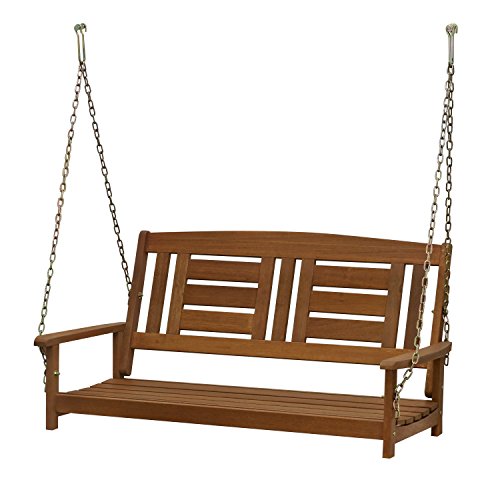
Furinno Tioman Hardwood Swing Chair
Best for: single-seat hardwood swing chair. Tier: mid.
The Tioman changes the geometry of the whole shortlist: one hardwood seat instead of a bench, and with it a different social contract. This is a personal perch — a reading nook, a first-coffee observatory — not the porch’s gathering point, and its compact footprint unlocks corners, balconies and narrow porches where no bench could swing safely. Hardwood gives it a warm, garden-room presence among plants and a side table. It also makes climate management easy: a single piece is quick to oil, quick to inspect, and feasible to shift under deeper cover when a brutal season threatens, in a way a full bench never is. Solo sitters, tight spaces and bench owners wanting a quieter second seat are its people. Families wanting to sit together, anyone hoping to stretch out, and sitters who dislike a chair’s closer, upright posture should look elsewhere. Smallness earns no safety discounts — structure, ratings, clearance and seasonal checks apply in full.
Check the current listing before you buy; think of it as a hardwood test piece for your climate. Not suited for: porches that cannot give it a clear, safe arc, or buyers unwilling to follow the hanging and inspection rules in this guide.

POLYWOOD Chippendale Porch Swing
Best for: recycled-lumber low upkeep. Tier: premium.
POLYWOOD’s reputation rests on recycled plastic lumber, and the Chippendale dresses that material in a formal bench with a distinctive patterned back. The selling point is really a climate argument. There is no sanding-and-sealing ritual to fall behind on; rain that would creep into timber joints and end grain simply runs off; colour lives throughout the material instead of sitting on it as a film for ultraviolet light to peel. Salt air — the enemy of finishes and fittings alike — leaves the lumber itself unmoved. Exposed porches, coastal homes, second properties standing empty between visits, and owners certain that annual wood care will never happen: this is their candidate, for busy households that prefer washing to refinishing. The honest debits are character and cost. Lovers of wood’s feel, scent and slow ageing will not find them here, and quality recycled lumber prices at the premium tier. The Chippendale pattern also speaks loudly, so audition it against your facade — tailored on the right house, while a rustic front may prefer a plainer slatted sibling.
Check the current listing before you buy, especially if salt, storms or an empty house are your reality. Not suited for: porches that cannot give it a clear, safe arc, or buyers unwilling to follow the hanging and inspection rules in this guide.
How Much Room Do You Actually Have?
Two measurements matter: the porch’s, and the household’s. The bench claims width; the arc claims open air ahead and behind; meanwhile people must still cross, open the door wide and lug shopping past. Chalk exposes the truth — outline the footprint, outline the arc at full enthusiasm, then walk the route carrying something awkward and watch where the lines collide. Weather adds its own margins. Rainy porches owe a seat breathing room so it can dry; sun-blasted porches owe it shade at the hours that matter; snow-belt porches must keep it out of the roof’s shedding line and away from drip-and-refreeze spots. When the chalk argues, obey it: downsize, switch to a chair, or stand the swing where space is generous. Daily use follows fit, and resentment follows crowding, whatever the bench cost.
Which Material Fits Your Habits?
Walk the material shelf with your forecast in hand. Western red cedar defends itself with natural oils against rot and insects, stays light for its bulk, and silvers gracefully if left unfinished — kind to damp, shaded porches, though soft enough to record every knock. Teak is the aristocrat: dense, oily, almost contemptuous of rain and sun, needing little beyond washing, while strong light slowly greys it unless oiled. Cypress earned its reputation in wet country, carrying preservative oils of its own through humidity that defeats lesser woods. Pressure-treated pine is the democrat — preservative forced deep into cheap softwood buys genuine rot resistance, paid for in weight, in movement while it seasons, and in patience before it accepts a finish. Metal offers slim strength wholly dependent on its coat: powder coating intact is weatherproof in practice, one chip in salt air is rust’s open gate. Recycled lumber and HDPE sign the simplest contract of all — no rot, no sealing, wash occasionally — at premium prices, with a heavier seat that warms up in direct sun. Now run the honest test: your hardest week of weather, your real diary. Whose needs still sound reasonable?
What Makes a Swing Comfortable for Hours?
Four things, in order: the back, the seat, the glide, the textiles. A curve meeting the lower spine lets an hour evaporate; a seat deep enough to carry the thigh without biting behind the knee keeps legs at peace; hangers tuned to a long, shallow path keep motion soporific rather than busy; cushions and pillows convert adequacy into invitation. Armrests quietly matter — to older sitters, and to anyone standing up holding a sleeping child. Climate edits every item on the list. Under fierce sun, a seat that stays touchable and fabrics that dry fast after a shower count as much as any curve; in damp, cool regions, cushions light enough to carry in nightly are the ones still sweet in October. Interrogate listings with these tests and back the design that answers them, not the one staging the prettiest photograph.
How Will It Hang, and From What?
Settle hanging before models, because hanging can veto models. Find the joists, note their direction, plan fixings into structure, specify chain and hardware rated above the loaded weight, then trace the arc those anchor points create and audit everything it must miss. A finished ceiling costs one small investigation — locating timber behind boards — which in older, damper homes doubles as a health check on wood you are about to trust with people. If structure, permission or geometry says no, pivot early to a stand and invest the saved effort in level ground and placement. The companion installation guide in this cluster carries the full method once buying is finished.
How to Prioritise by Use Case
Let your harshest weather rank the criteria, then dress the ranking for your household. Coastal porch: corrosion leads — recycled lumber, or an oily wood like teak or cedar, over hardware specified for salt, because the air attacks daily. Sun porch: ultraviolet tolerance leads — colour-through HDPE, teak content to silver, or timber whose finish you will truly renew. Rain porch: drainage and drying lead — cypress or treated pine, slats that shed water, air on all sides. Freeze porch: movement-tolerant joinery leads, plus a cover or storage plan from day one. Then the familiar overlays: width and ratings where family traffic is heavy, back shape and a still arc for the reader’s porch, stand and portability for rentals and gardens. Each combination lands on a different model above — proof the shortlist holds real choices rather than one bench in six costumes.
Buying With the Seasons in Mind
Care through the seasons
Your climate’s calendar, not a generic chart, should conduct care. Spring opens with washing away winter’s grime, the chain-and-eyelet inspection, a tightening round, and scrutiny of the material around every bolt — freeze-thaw leaves its signatures there. Summer is light duty with two exceptions: cushions run indoors ahead of storms everywhere, and under brutal sun, finishes are quietly cooking, so exposed faces earn a mid-season look. Autumn is drainage season — rake out the leaves packing damp against the seat, and decide finishes while time remains: coat now, or diarise spring properly. Winter splits by map. Snow country: cover or store exposed swings, and still them against wind. The coast: rinse with fresh water so the season’s salt does not sit and work. Mild, covered porches: stilling, and dry storage for textiles, mostly suffices. It reads like a programme and lives like ten minutes, a few mornings a year, alongside sweeping the steps.
Reading, talking and the social physics of a swing
Posture explains the magic. Side by side, facing outward, rocked in a shared gentle rhythm, people converse differently — longer, with silences that stop feeling like failures. Teenagers who refuse a seated chat will colonise a moving bench and open up sideways. Readers annex the bright corner, coffee drinkers the dawn shift, and the seat becomes a roster of small ceremonies. Weather writes much of that roster: the sunny corner is treasure in a cool spring and a furnace at summer noon; deep roof shade is the prize in hot country; in rainy country the reliably dry seat hosts the evening debrief. So buy for your ceremonies. Talk wants width and a calm arc; reading wants back support and somewhere for a glass; the nightly review wants cushions, a throw, and shelter from whichever weather owns your evenings.
Value over years, not weekends
Cost a swing like a door or a kettle — divided by years of daily service, not judged at the checkout. Climate keeps the ledger. The identical bench lives two different lifespans in two different skies: premium teak or recycled lumber shrugging off your salt or your deluges for a very long time can be the thrifty buy, while a bargain timber cooked by relentless sun or rotted in a wet corner becomes expensive through repetition. Reverse the lens and a plain traditional bench under a deep roof in gentle country can outlive every prediction, making weatherproofing premiums pure waste. Match tier to exposure first and habits second, and the purchase keeps feeling right at every sitting — the only verdict that survives.
When a stand makes sense
Joist-hanging is the classic, but the stand wins wherever the ceiling cannot be confirmed, the lease forbids drilling, or the garden simply beats the porch as a place to sit. The questions relocate rather than vanish: level, firm ground; assembly exactly as the maker specifies; and universal respect for the fact that A-frame stands tip if rocked hard. Weather moves in too. Feet on a lawn through a sodden season must not sink, rust or rot; a metal frame by the sea is only as good as its coating; freeze country rewards a hard, drained standing surface before frost heave tilts the frame. In exchange the swing gains a self-contained, daybed-like presence that flatters lawns and patios. Renters and garden sitters are not settling — they are engineering correctly for their ground and their sky, provided ratings, clearance and inspection travel with the choice.
First Setup and Care Essentials
Setup obeys the safety section’s sequence: prove the structure, fit rated fixings, hang the seat level, test the arc empty, then — and only then — sit. Afterwards, care runs on your climate’s rhythm rather than a universal one. Spring brings the wash and the chain-and-eyelet inspection; tightening follows whatever has worked loose; finishes are judged against the sun and rain they actually survived; salt gets rinsed where the sea supplies it; cushions are stored dry, not merely indoors; and the swing is stilled before serious storms and hard freezes. No skill is required anywhere in that list. Consistency is the whole trick, and the first season builds it — so write the checks into the diary the day the swing goes up.
Mistakes to Avoid
Most expensive errors in this guide wear weather camouflage: a timber chosen for its looks by someone who never asked what local rain, salt or sun does to it; a care routine nobody will perform; a seat measured at rest while its arc goes unmeasured; fixings sunk into surface boards; savings taken on rated hardware in air that corrodes for a living; a flagship bench bought for a porch crying out for a chair. The cheap errors are quieter — no cushion budget, a blocked walking line, a swing parked under a roof drip or sprinkler arc so one end never dries, and children expected to respect geometry nobody taught them. Dodge the list in roughly that order and the seat tends to become the household favourite at suspicious speed.
Before You Buy: A Porch Swing Fit, Space and Routine Checklist
Ordering takes an afternoon; ownership takes years, at your porch, under your sky, through the first storm, heatwave and frost, long after the packaging is forgotten. Reason backwards from that life. Fix the exposure, the space and the sitters in your mind before weighing any feature that gleamed on a product page, and start with structure and fixings before the seat itself is even chosen. Fail that check and stop — every other virtue a swing owns is borrowed from a foundation your house has declined to lend. Visitors supply the second test: whatever needs explaining, warning or apologising for when a guest sits down is confessing its everyday misfit.
Cannot yet name your dominant weather, your drying conditions and the care routine you will truly keep? Then the honest move is an hour of clarifying before an hour of comparing listings. List everything the first week of ownership requires and confirm, item by item, what arrives in the box and what must be sourced separately. Disappointment with outdoor seats follows a slow, predictable script — chains wearing, fixings loosening, cushions mildewing, finishes surrendering first exactly where sun or salt strikes hardest — and predictable scripts can be rewritten before purchase. Tape before shortlist, always: written measurements end arguments that photographs start, above all around clearances that only exist once the swing is moving.
- Measure the real space — full arc, walking line, and breathing room for the seat to dry.
- Run the fit checks against your own porch and weather, never against a showroom.
- Name the climate threat that leads — salt, sun, rain or freeze — and the routine it demands.
- Write down three jobs the swing must do and the one compromise you accept.
- Confirm what the current listing includes and what you must supply yourself.
When problems appear, sequence beats panic: free, simple causes first, in a technician’s order, and the swing itself suspected only after they are cleared. Score candidates on the listing page against identical points in identical order, so photography cannot outvote measurement — and cannot outvote the material your climate will punish, either. This guide has ranked the criteria; the checklist’s contribution is sequence. Exposure and fit first, routine second, shortlist third, appearance last. And audit your own home for duplicated function, because the seat you already own that half-does this job changes what the new one genuinely needs to be.
Everything brought home leaves a footprint beyond its dimensions — noise, mess, moisture, effort, clutter — and weather writes an outdoor seat’s footprint in particular: cushions dripping through the hallway, finishes chalking, a frame printing rust onto the boards. Weigh it as seriously as the tape work. Oversizing stays the quietest error in buying, since unused capacity must still be stored, cleaned, moved and circumvented daily, in every season. The easiest possessions ask nothing between uses; if a swing asks something, arrange for the season itself to prompt it rather than relying on memory. Finally, decide whether the placement is permanent or provisional and buy to match — a swing for one fixed, sheltered home and a swing meant to move between rentals are different designs sharing a name.
Frequently Asked Questions
What size porch swing should I buy for my climate and porch?
Let the clear arc and the real company decide, then adjust for exposure. Two-person benches fit most family porches; longer benches want wide porches and sociable households; chairs serve narrow porches and solo sitters. Chalk footprint and arc, walk the route past carrying something bulky, and let the porch vote — while remembering that a seat also needs air around it to dry after rain, and, in snow country, shelter from roof-shed slides. A smaller swing moving freely, walking line intact, will be loved longer than a grand bench everyone squeezes past.
Which material survives salt air, hard sun, heavy rain or freezing winters best?
Different champions for different skies — that is the honest answer. Salt air: recycled lumber and HDPE withdraw the seat from the fight entirely, teak and cedar lead the woods, and the real contest becomes corrosion-proof hardware. Hard sun: teak silvers gracefully, colour-through HDPE refuses the faded-patch problem, and softer woods survive only behind finishes renewed before ultraviolet light strips them. Heavy rain: cypress and pressure-treated pine bring preservative defences, cedar brings its oils, and every timber gains from draining slats and circulating air. Freezing winters: sound joinery, a rigorous autumn inspection, and a cover or storage where possible, since water frozen inside a crack is a wedge. Buy against your dominant threat, not a universal league table.
Can I hang a swing if my porch ceiling is finished?
Generally yes — if the joists behind the finish can be located and the fixings can reach them. A stud finder, minor test work or a carpenter’s visit answers it, and in older or damper houses the peek behind the boards doubles as a health check for staining or softness in hidden timber. The forbidden move is anchoring into the finishing boards, decking or drywall themselves. Joists unreachable or unconfirmable? Take the stand and do not gamble, because the cargo is people, in motion, for years.
How much should I expect to spend?
Think in tiers, not a figure: accessible traditional benches open the range, solid mid-tier builds occupy the middle, handcrafted and recycled-lumber models close it at the premium end. Listings move, so this guide prints no fixed numbers — check the current listing for anything shortlisted. Judge value across years of service in your weather specifically: a material that halves your maintenance and doubles the seat’s life in salt air or hard rain may be your economical tier even at a premium. And count hangers, cushions and any stand in the true total from the start.
Do I need cushions in the budget?
Budget for them if your sittings outlast a quick coffee. Owners call cushions the step from seat to destination, and the specification is climatic: fabrics that dry fast where rain is frequent, fade resistance where sun is fierce, storage with airflow rather than sealed plastic where humidity reigns. A sound bench stays comfortable bare, so cushions may follow a month later if money needs staging — provided the decision is made in advance, not discovered during the first long evening on bare slats.
When is a stand better than hanging?
When structure cannot be confirmed, when a tenancy forbids fixings, or when the garden or patio plainly beats the porch as a sitting place. The stand asks for level, firm ground, exact assembly and respect for its tipping limit under hard rocking — plus a weather plan of its own: feet that will not sink into wet soil, a coating trustworthy near the coast, a hard drained surface where freeze and thaw tilt frames standing on earth. Chosen on those grounds it is correct engineering rather than fallback, with every rule on ratings, clearance and inspection still in force.
Related Guides and Next Steps
Planning continues in this cluster’s companion guides and the site’s most relevant live guides. A swing is one decision among the several that shape a porch; the pieces below cover the neighbouring seats, surfaces and soft furnishings that finish it.
our in-depth porch swing review
porch swing reviews and owner patterns
porch swing pros and cons before you decide
is a porch swing worth it for your household
how to install a porch swing once you have bought it
patio table and chairs for the other end of the porch
indoor outdoor rugs under a swing
patio furniture pillows for extra comfort
More to Consider: Cushions, pillows and staying out longer
Bare slats are honest; cushions are what stretch a twenty-minute sit into an evening. A seat cushion takes the edge off the boards, a back cushion or outdoor pillows brace the lower spine, and a throw turns the bench into the porch’s after-dinner magnet. Specify textiles by weather, exactly as you specified the bench: fabrics that shed water and dry fast in rainy regions, fade resistance under violent sun, foam aired rather than sealed away in humid ones — trapped damp is the musty smell that ruins good foam. Keep the layer conceptually separate from the furniture. The bench should please unadorned; textiles are the replaceable skin that changes with seasons, colours and wear.
Small layers, honestly chosen for local weather, are what make a good bench feel inevitable by the second summer.
More to Consider: Sizing the swing to the porch
Fit is a property of the moving swing, not the parked one. Protect the walking line first — crossing, door, shopping runs, all without the sideways shuffle — then grant the arc its liveliest clearance front and back, exactly as the safety section demands. Add your climate’s margins: air space so timber dries after rain, distance from the roof’s drip line, shelter from sprinkler spray, a berth outside the roof-snow slide path. Most family porches land on a two-person bench; longer benches become true social seats and occasional nap spots; the single chair rescues corners and narrow porches from bench domination. Chalk it, walk it, believe it: the slightly smaller swing that moves freely outloves the grand one everyone edges past.
Space, air and motion together decide fit — the tape measure alone only ever tells a third of the story.
More to Consider: Style that belongs to the house
No furniture is more public: first thing the street reads, backdrop to every photograph taken on the steps. Slatted traditionals blend almost anywhere, formal patterned backs flatter tailored facades, clean contemporary lines suit new builds. Material speaks style as loudly as shape — cedar and cypress warm and regional, teak composed and coastal, honestly silvered wood sometimes suiting an old house better than any fresh finish, colour-through recycled lumber holding a painted look with no film for the sun to peel. Colour itself works quietly: echo the door or trim and the swing looks inevitable; contrast boldly and it can sing or jar. Skip the designer. Cross the street, view your house as a visitor does, and pick the swing that looks grown there — and that your weather will allow to keep looking that way in year ten.
Belonging is durability’s twin: the right look, in a material your climate cannot spoil, stays right for decades.
More to Consider: Care through the seasons
Rhythm, not regime — and your sky conducts. Spring: wash off winter, inspect chains and eyelets, tighten fixings, examine the material around every bolt. Summer: wipe before pollen and spills set, run cushions in ahead of storms, and glance at finishes that hard sun is consuming. Autumn: evict the leaves banking damp against the seat, and call the finish question while time remains — coat now or commit to spring. Winter: covers or storage and stilling for exposed swings in snow country, a fresh-water rinse against accumulated salt on the coast, and mostly stilling plus dry textiles under a mild covered porch. On paper, a list; in life, ten minutes a few times a year, riding along with sweeping the steps.
Timed to your seasons, those few minutes are the entire difference between a swing ageing gracefully and one merely ageing.
More to Consider: Reading, talking and the social physics of a swing
The posture does it. Side by side, outward-facing, gently rocked in unison, people talk longer and let silences sit comfortably; teenagers who would never book a chat drift in and stay. Readers take the lit corner, coffee drinkers the early shift, and a timetable of rituals assembles itself. Climate holds the pen: sun corner, deep shade or reliably dry seat — whichever your weather makes precious becomes the contested chair. Buy for the rituals you actually want. Talk asks for width and a calm arc; reading asks for back support and a perch for a drink; the nightly debrief asks for cushions, a throw and comfort after dark. The furniture is simple; the life arranged around it is the true specification.
Choose for the ceremonies your weather permits, and the seat stays occupied in every season it offers.
More to Consider: Children, grandparents and everyone between
One seat, every generation — which is why honest load ratings and calm geometry outrank novelty. Children bring the supervision question, rules about standing and rocking, and the pinch points the safety section maps; they also argue for materials that forgive scuffs and spills without a lecture. Grandparents bring ergonomics: a seat height that lets feet rest flat, armrests that genuinely assist standing, an arc that never feels like a fairground ride. Serve both ends and the swing gets used daily; miss, and a tippy, low or frantic seat quietly retires into decoration. Stability, familiar proportions and generously rated hardware are the safe defaults — excitement should arrive with the company, not the motion.
A seat trusted at both ends of life, in all weathers, earns its place on the porch permanently.
More to Consider: Value over years, not weekends
Do the division properly: total cost spread over years of daily service. Climate is the accountant — a premium handcrafted or recycled-lumber bench tolerating your particular sky for a very long time, on modest care, can undercut a cheap swing bought three times over, while a plain traditional under a deep roof in gentle country can embarrass every lifespan prediction made for it. The mirror error exists too: weatherproofing bought for weather that never comes, features bought for people who never sit. Tier matched to exposure and habits is what makes a purchase feel right at every single sitting, and that feeling, compounded, is the only review that counts.
Count the winters and summers survived gracefully; the first weekend’s excitement is the least informative number available.
More to Consider: When a stand makes sense
Three situations crown the stand: no confirmable structure overhead, a lease that forbids fixings, or a garden that simply out-sits the porch. The questions move rather than disappear — level firm ground, assembly exactly as directed, and household-wide respect for the tipping limit of an A-frame under hard rocking. The frame then faces the same climate tribunal as any seat: coating integrity near the sea, feet that refuse to sink, rust or rot through a wet season, a hard drained standing place where frost heaves soil. What it returns is presence — self-contained, almost daybed-like, at home on lawns and patios — and freedom from the ceiling altogether. That is correct engineering for its situation, not a consolation prize, provided ratings, clearance and inspection come along in full.
Freed from the ceiling, the swing still answers to ground, weather, load and clearance — and on those terms it can be the best seat you own.
More to Consider: Materials, honestly explained
Strip the marketing and a material is a maintenance personality wearing your weather. Cedar: self-defending oils, light weight, graceful silvering — soft enough to keep every dent as a souvenir. Teak: density and oils that shrug at rain and sun alike, premium-priced, greying unless you intervene. Cypress: the wet-country veteran, preservative by nature, trusted where humidity never leaves. Treated pine: affordability with preservative driven deep, paid for in weight, seasonal movement and patience before finishing. Metal: slim strength entirely mortgaged to its coating — intact, effectively weatherproof; chipped in salt air, an open door. Recycled lumber and HDPE: the forgetful owner’s contract — no rot, no sealing, a wash now and then, at a premium and with a character all their own. None wins universally. Enjoy wielding a brush each spring and wood will repay you in most climates; know the swing will be lucky to see a sponge and choose forgiveness instead, because the seat still looking cared-for in year five beats the finer one that peeled in year two.
Species names impress in listings; honesty about climate and habits is what still impresses on the porch in five years.
More to Consider: Comfort is a back, a seat and an arc
Two verdicts arrive at different times. Ten seconds in, the seat is on trial: depth, slat spacing, the front edge’s behaviour behind your knees. Forty minutes in, the back takes the stand — a gentle roll outlasts a tall flat board every time, with armrests at natural height letting shoulders finally drop. The arc testifies throughout: a long shallow glide reads as calm, a short steep one as fuss, enough to leave readers faintly seasick. Weather cross-examines everything — a dark seat baking at July noon fails instantly whatever its curves promise, and slow-drying cushions fail October just as surely. So judge against your longest realistic sit: book in hand, conversation running, toddler asleep on your arm. The showroom perch is evidence of nothing.
Comfort is local, like durability: the right back, seat and arc, in a material your sky cannot ruin, on the porch you actually own.