Disclosure: As an Amazon Associate, airfryerkitchensupply.com earns from qualifying purchases. Links on this page are affiliate links; they cost you nothing extra. Prices and availability change often, so check the current Amazon listing before you buy.
Day one started with a stopwatch, a tape measure and a porch that suddenly felt smaller than it looked in photographs. It is a test diary: how long the hanging actually took, what the first week of real sitting revealed, which seats stayed kind after forty minutes, where the creaks showed up, and how each bench behaved once two people, two mugs and one restless child were all aboard at the same time.
A porch swing earns its place if your household will genuinely live on the porch, if the seat can be hung from proper structure overhead, and if somebody is willing to spend a few unglamorous minutes each season checking the hardware. It fails, quickly and sometimes noisily, when it is treated as decoration — screwed into thin ceiling boards, squeezed into a gap with no room to travel, and then forgotten until something groans, scrapes or gives way.
Key Takeaways
- Our timed sits kept proving the same point: the curve of the back, not the seat board, decides whether hour two feels as good as minute two.
- Pick a material by the maintenance diary you will actually keep, not by the finish you admire on delivery day.
- No comfort test matters until the joists, the rated fixings and the swing arc have all passed their checks.
- In our week of use, wood repaid attention, recycled lumber shrugged off neglect, and value benches were happiest under a roof.
- A short hands-on inspection of chain and eyelets each season was the difference between a swing we trusted and one we watched.
In this guide
Safety First: The Rules That Come Before Comfort
Hang a porch swing only from structural ceiling joists. That was minute zero of our install, before any bench came out of its packaging. We crawled, tapped, measured and confirmed where the real roof-carrying timber ran, because decorative ceiling boards, roof decking and drywall are only skins over the structure — none of them was built to hold a moving seat with people on it. If you cannot find the joists and prove they are solid, stop the clock and call a carpenter.
Use hardware and chain rated above the loaded weight. In the diary we wrote the loaded figure down before choosing a single fitting: the bench itself, plus the heaviest combination of people who would ever sit together, plus the extra force that motion adds on top. Then every component — eye bolts, hooks, connectors, chain — had to be rated above that total, with margin. This is the wrong place to save money.
Leave real swing clearance in front and behind. We chalked the arc on the porch boards, and the chalk told a story the tape measure alone had missed. Test the extremes, not the middle, because children will find the extremes within the first afternoon. If the porch cannot give up that space, our week suggests a smaller bench, a single swing chair or a stand placed somewhere better — never a full-size seat wedged in to bruise shins and scrape paintwork.
Inspect chains and eyelets for wear each season. Our inspection routine, worked out link by link during the test week, is tactile as much as visual. Run every chain link through your fingers. Look for links that have stretched or twisted, for rust blooming at contact points, for timber cracking around a fixing, for an eyelet that has begun to pull oval. Do it when the season opens and again midway through a busy summer.
Respect stands and small fingers. When we tried a stand-mounted setup on uneven ground, the lesson arrived fast: an A-frame that is rocked hard can tip, so a stand belongs on level ground, with vigorous rocking treated as misuse from the first day and adults setting that tone before children test it. The other hands-on check is for pinch points. We watched small fingers explore exactly the gaps we would have predicted — where chain meets frame, where the seat passes the armrests, where moving parts close.
What a Porch Swing Is and Where It Fits — Porch Swing Review Basics
Strip the idea back and a porch swing is a bench that is allowed to move. That one permission changes everything we measured. A fixed bench just has to be sturdy; a swing has to manage motion safely for years, which is why joists, chain ratings and empty space around the seat kept appearing in our notes long after we stopped thinking about style.
By day three of the test week, the swing had quietly taken over the porch. The chairs simply stopped being chosen. We started treating it the way you would treat a sofa purchase rather than a plant stand: sized for the people who will actually share it, positioned for view and shade, and setting the daily timetable — first coffee, afternoon chapter, last conversation before the porch light goes off.
The benches and chairs in this diary fall into families we came to recognise by behaviour as much as by looks. Traditional slatted wooden benches are the familiar default, running from straightforward value models up to handcrafted Amish-style builds. A swing chair shrinks the whole idea down to one person. The six models below were each lived with in turn, and the notes on each one follow the same diary discipline: assembly, first sits, long sits, two-person sits, and the noises they made along the way.
Design, Build and Setup
Our comfort testing always started at the back, because that is where long sits are won or lost. Roll-back and curved backs carried the spine through the second hour; straight backs photographed crisply and were perfectly pleasant for a short perch, especially with a cushion, but they asked the sitter to do more of the postural work. Slats needed to feel smooth, evenly spaced and softened at the edges legs meet, and the front rail had to clear the backs of the knees rather than digging in when feet were tucked back.
Build quality announced itself in places no listing photograph lingers on. We pushed each assembled swing sideways by hand and listened. The good ones moved as a single piece. The less convincing ones creaked, racked slightly or twisted at the joints between seat and back. The full step-by-step hanging method lives in the companion installation guide in this cluster, but the governing order never changed during our installs: confirm the joists, fit rated hardware, hang, then level. Get it wrong and no amount of handsome joinery rescues the result.
Performance in Real Use
Morning coffee and the first hour
The 7 a.m. test became the one we trusted most. A gentle arc suits waking up in a way a rigid chair simply does not, and a bench with a supportive back — with a cushion left ready the night before — turned into a ritual object within three mornings: same end of the seat, same mug, same patch of light moving across the boards. When we compared notes at the end of the week, this unplanned hour, not any gathering we staged, was what everyone said justified the purchase.
Conversation and company
Evenings told a different story. Seating people side by side, all facing out, changes the social physics of a porch in ways we had underestimated. Width, though, had to match real company rather than hoped-for company. A two-person bench handled a couple, or a parent with a child tucked in, beautifully. A longer bench turned the porch into the place neighbours get waved over to.
Reading, resting and the occasional nap
Reading exposed hangers that were set too short. Print needs a calm arc, so we lengthened the effective glide until pages stopped drifting in and out of focus — a long, shallow travel, with back support doing its work and a cushion that stayed where it was put instead of migrating. If napping is anywhere on your list, write it down before you buy, because it changes the size you should be looking at.
Weather and daily life
Then real life got its turn: pollen filming every surface by breakfast, a spilled drink on day four, wet shoes, and one stretch where nobody wiped anything down at all. Cushions needed a home out of the weather. The conclusion we wrote in the diary that week has stayed with us: the best-performing swing in real life is the one whose care routine matches the household’s actual habits, which is why maintenance keeps appearing in this review as a performance measure rather than a footnote.
Strengths and Trade-Offs
Strengths
- Within a week, it turned a pass-through porch into the room the household chose first.
- The market runs from simple value benches to heirloom-grade builds, so most budgets found something in our line-up that fit.
Trade-Offs
- There is no shortcut version: structural hanging and seasonal inspection are part of ownership, every year, without exception.
- The arc needs genuine room, so a small porch may honestly only suit a chair, or a stand somewhere else entirely.
- Wooden versions swap their beauty for a recurring care routine, and owners have to accept that trade before delivery day.
Models Worth a Closer Look
Six models went through the diary in turn, from a value traditional bench to premium recycled lumber and a single-seat chair, and together they map the spread of the market.
Amish Casual Heavy Duty Roll Back Porch Swing
Best for: roll-back comfort. Tier: premium.
Assembly afternoon, first note: this is a substantial piece, and the roll-back shape is not a styling flourish. By minute forty, you notice it by its absence — no shifting, no cushion wedged behind the lower back, no quiet decision to go inside. You simply settle further into a gentle curve that follows the spine, which makes this a swing for long, unhurried occupancy rather than a perch while someone finds their shoes. The Amish Casual approach is traditional throughout: solid-looking slats, a frame that feels substantial the moment you push it sideways, and hardware that invites checking and tightening rather than assuming it will be replaced in a couple of seasons. It belongs on a covered porch where the swing is the main seat, where two people genuinely sit side by side and talk, and where the finish becomes part of a seasonal ritual — inspected, cleaned gently, cared for as honest wood asks to be cared for.
Not suited for: a narrow porch that cannot spare a clear, safe arc, anyone who cannot anchor into structure, anyone after a feather-light seat to move alone on a whim, or a buyer who will not follow the hanging and inspection routine this guide insists on.

Jack Post Traditional Porch Swing
Best for: classic slatted value. Tier: entry.
If the Amish Casual was the diary’s fixture, the Jack Post was its familiar neighbour — the traditional slatted bench most people picture before they have ever shopped for one, and that familiarity turned out to be a practical asset during setup. Nothing about the concept is exotic, the proportions are conventional, the styling sat comfortably against the house front, and the world of chains and hardware around this broad style is easy to understand and easy to source. Where the diary separates it from the premium benches is the long sit and the finish. This is a swing for learning your porch — a first purchase for households that want the experience without committing to a handcrafted piece, and a sensible way to discover your real habits before upgrading.
Take a moment over the current listing before you commit. Not suited for: a porch that cannot offer a clear, safe arc, or an owner unwilling to keep up the hanging checks and seasonal inspection this guide describes.
Porchgate Amish Heavy Duty Porch Swing
Best for: sturdy Amish-style build. Tier: premium.
The Porchgate made its impression before anyone sat on it: squared, solid and clearly built for a porch that gets used hard. Our sideways push test, which had found a little rack in lesser benches, found none worth writing home about here, and that confidence carried through a test week in which the swing rarely got a rest — children climbing up, grandparents settling in for long stretches, the bench treated as furniture rather than ornament. In the two-person comfort test it felt planted in the best sense, though a deep, solid bench like this can crowd the walking line on a small porch, so the chalked-arc check matters even more here. The joists above it, the eye bolts through them and the chain carrying the load matter exactly as much as anything Porchgate built into the seat.
Not suited for: small porches where a deep bench eats the walking line, anyone planning to take the swing down and store it often, a porch without a clear, safe arc, or a buyer unwilling to follow the hanging and inspection rules in this guide.

Best Choice Products Hanging Porch Swing
Best for: accessible hanging bench. Tier: entry.
Some purchases are furniture projects. This one, in our diary, was a weekend. Best Choice Products sits at the accessible, widely available end of the market, and its hanging bench is what people reach for when they want to find out whether porch sitting suits them at all, without first debating timber species. The diary’s cautions are equally clear. Do not expect the densest hardwood or the most refined finish at this tier, and be especially honest about weather exposure, because accessible swings reward a covered porch and regular checks more than most. None of that touched the core pleasure in our evening tests: safely hung and clear of walls and rails, it still produced the slow arc, the longer conversation and the evening air that make people fall for porch swings in the first place.
Not suited for: an exposed spot without a clear, safe arc to swing in, or an owner unwilling to follow the hanging and inspection rules in this guide.
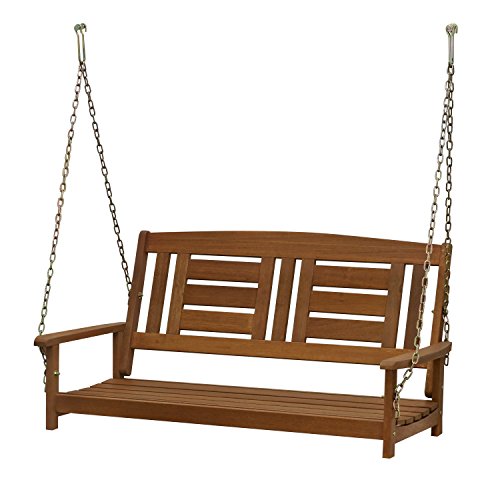
Furinno Tioman Hardwood Swing Chair
Best for: single-seat hardwood swing chair. Tier: mid.
The Tioman changed the diary’s rhythm, because it is not a smaller bench — it is a different social object. A single-seat hardwood swing chair is a personal seat: a reading nook, a quiet first-coffee post, a place one person goes rather than a place the household gathers. In our tests that smaller footprint opened up exactly the spaces the benches had failed — a corner, a balcony edge, a narrow porch where a full bench could never have kept a safe arc. Its clearest limitation appeared the moment a second person arrived with a mug and nowhere to land: this is not a family seat, it will not let anyone stretch out, and its closer, more upright feel will not suit buyers who love the sprawl of a bench.
Not suited for: families who want to sit together, a porch that cannot give even a chair a clear, safe arc, or a buyer unwilling to follow the hanging and inspection rules in this guide.

POLYWOOD Chippendale Porch Swing
Best for: recycled-lumber low upkeep. Tier: premium.
The POLYWOOD entry in the diary is the one with the shortest maintenance log, and that is the point of it. Built from recycled plastic lumber, the Chippendale takes a classic, formal bench shape — the distinctive patterned back is the giveaway — and removes the sanding-and-sealing ritual from ownership. The surface shrugged off weather that had us fussing over timber, and because the colour runs through the material rather than sitting on it as a coat, small knocks did not announce themselves the way they do on a painted finish. The trade-offs are character and cost: purists who want the feel, smell and ageing story of real wood will not find it here, and quality recycled-lumber furniture sits in the premium tier. The formal styling also makes a statement from the street, so picture it against your own house front — tailored on the right porch, possibly too dressed on a very rustic one, where a plainer slatted design may blend better.
Not suited for: a porch that cannot give it a clear, safe arc, or a buyer unwilling to follow the hanging and inspection rules in this guide, however low-upkeep the bench itself may be.
How It Compares
Our porch, by the end of the test period, had hosted every rival in turn, and the comparisons wrote themselves. Against a pair of rocking chairs, the swing won every shared evening: it seats people together and moves them together, which is why couples drift to it, while the rockers won on independence — each sitter sets their own pace, and the chairs rearrange in seconds. Against a hammock, the division was social against solitary: the swing is the upright, come-as-you-are seat, the hammock the full-length retreat for one.
Living With the Choice
Materials, honestly explained
A week of weather taught us more about materials than any specification sheet. Choosing a material is really choosing a maintenance personality, and the diary made the personalities vivid. Solid wood brought warmth and weight, and a surface that can be sanded, repaired and refinished across many years — but it asked for that care in return, especially anywhere sun and rain could reach the seat. Recycled plastic lumber gave up some natural character and in exchange ignored the weather almost entirely: washed, left out, largely forgotten, and none the worse for it in our tests. If a spring afternoon with a brush and a tin of finish sounds like pleasure, wood will repay you for years. If you know the swing will be lucky to get an occasional wash, choose the material that forgives neglect, because a swing that still looks cared for in year five beats a theoretically finer one that peeled in year two.
Comfort is a back, a seat and an arc
Every swing in this diary was judged twice, whether we planned it or not: once in the first ten seconds, and again after forty minutes. The first judgement belongs to the seat — its depth, the spacing of its slats, and whether the front edge presses behind the knees when you settle. The second, more honest judgement belongs to the back. A gentle roll or curve kept supporting us long after a tall, flat board had started asking our posture to do the work, and armrests at a natural height let shoulders drop instead of hovering. Hung for a long, shallow glide, a swing feels calm enough to read on. Hung short and steep, the same bench feels busy, and more than one tea-drinker in our tests reported a faint, unwelcome seasickness.
Cushions, pillows and staying out longer
The cushion test took one evening to settle. A bare slatted bench is honest and handsome, and for twenty minutes it is enough. Then the cushions came out, and twenty minutes became the whole evening. A seat cushion softens the slats, a back cushion or a pair of outdoor pillows gives the lower back somewhere to rest, and a throw turns the swing into the place people migrate to after dinner. Our practical notes: choose outdoor fabrics that shed water and resist fading, bring cushions under cover when rain threatens, and let them dry fully before they go into any box or bench, because trapped damp is what breeds the musty smell that ruins good foam.
Style that belongs to the house
Stand across the street. That was the last test we ran, and in some ways the most useful. A porch swing is unusually visible furniture — the first thing the street sees, and the frame around every photograph taken on the steps — so belonging matters in a way it does not for a chair in a back room. Traditional slatted benches blended with almost everything we pictured them against. Formal patterned backs suited more tailored house fronts. Simple contemporary lines sat best on newer builds. Look at your own house the way a visitor does, let practicality decide the shortlist, and let belonging decide which one will still please you in year ten.
Who Should Buy It and Who Should Skip It
Buy one if your diary would look like ours: confirmed joists overhead or a good level position for a stand, a household that will sit out most days, and someone willing to own the small seasonal inspection habit. Skip it for now — and we mean that as genuine advice from the test week, not a sales caveat — if the structure cannot be confirmed, if the clearance cannot be given, or if the honest truth is that your porch is a passage rather than a place. A fine pair of chairs will serve that house better, and the swing can wait for the next porch.
Setup, Care and Maintenance Essentials
Our install log, compressed: joists first, hardware second, hanging third, levelling last, in that order every time, with the full method set out in the installation companion guide. Care settled into a rhythm during the test period that has not needed revising since — wash the seat, work along the chains and eyelets by hand, tighten what has loosened, judge the finish, and store the cushions dry. Maintenance, we learned, is mostly noticing early. A link beginning to wear, a fixing starting to work in its hole, a finish thinning on the front rail where hands and heels catch it: each one is a small job when noticed and a bigger one when ignored.
Testing a Porch Swing Properly: What to Check in the First Week of Use
The delivery is the easy part, and our diary treats it as day zero rather than as a verdict. A swing proves itself against your beams, your clearance, your view — in the middle of an ordinary evening, in the middle of an unhurried conversation, long after the packaging has gone to recycling. So we judged in a fixed order: routine first, space second, features last. Before the seat itself was even chosen, the supporting structure and fixings had to be settled, because that unglamorous detail quietly decides whether every other specification ever gets the chance to matter. The one-month verdict, written after the routine had tested each swing properly, was the only opinion we trusted enough to act on.
We also refused to judge on a calm day. The diary’s hardest entries are the honest ones: a rushed morning with everyone leaving at once, a crowded evening with more guests than seats, the week everything happened at the same time. That is when a swing earns or loses its place, so a fair test has to be a realistic one — full load, real timing, real users. Anything gentler is a demonstration, and demonstrations are designed to flatter. The failure pattern we planned against rarely arrives suddenly. Chains or ropes wearing, fixings loosening, cushions staying damp outside: in our notes it built slowly, through small ordinary habits nobody noticed in the first few weeks.
- Write down every small friction point the day it happens; memory smooths them away by the weekend.
- Make the keep-or-return decision inside the return window, from those notes, not from a general feeling.
- Score the swing against the three jobs you named before you bought it, and no others.
- Put it through the hardest normal condition your porch offers sometime during the first week.
- After several real uses, go back over fit, finish and every moving part with fresh eyes.
One thing our week kept proving: uncertainty about your own routine cannot be fixed by research about products. Once we settled how, where and how often the swing would actually be used, the shortlist shortened itself. Expect a learning curve, however small, and decide honestly who in the household faces the steepest part of it with this swing, and whether the design helps or hinders them. And read the included-parts list as carefully as the feature list.
When a shortlist forms, run these checks against the exact listings in front of you — for example the Amish Casual Heavy Duty Roll Back Porch Swing and the Jack Post Traditional Porch Swing — reading the current listing details rather than relying on memory. Then turn to the diary questions. Does the seat depth suit how your people actually sit? Does the back angle hold up at minute forty? Does the clearance survive a lively arc? These sound secondary while you are shopping. They became primary the moment each swing joined our routine.
Ask which part will look tired first, and whether that tiredness is cosmetic, cleanable, repairable or terminal, because the answer sets the realistic lifespan more honestly than any promise. The most future-proof question we asked all week was also the simplest: if your routine changed moderately, would this swing adapt, or would it become the wrong tool kept out of guilt? Every household has an unusual week. For yours it may be the narrow porch, where the swing arc and the walking space fight for the same boards — so buy for that week as well as for the ordinary one.
Your own first week is the review that will matter most, so record the annoyances as they happen rather than trusting a general feeling at the end of it. Delegation is the sharpest test of all: a swing that only works in one person’s hands, with one person’s knack for settling it, is a fragile solution for a shared home. Keep a small paper trail as you go — the instructions, the model details from the listing, any quirk written down as it appears instead of reconstructed months later.
Frequently Asked Questions
How long does a porch swing last?
Judging by what wear looked like even in our short test window, the honest answer is: years, if the unglamorous habits hold. Sound hanging, rated hardware and the seasonal inspection rhythm will carry a well-made wooden or recycled-lumber swing through many seasons, and its chains and fixings can be renewed individually as they wear rather than condemning the whole bench. What shortens life fastest is poor structure, corrosion nobody looked at, and finishes left to fail in hard weather. Treat wear parts as replaceable, keep the small care rhythm going, and the bench itself should outlast several sets of cushions and at least one repaint of the porch around it.
Can a porch swing hold two adults and a child?
Our two-up tests always ended at the same page of the diary: the ratings page. Whether that combination is safe depends entirely on the ratings of the specific swing, its hardware and its chain, which is why this guide insists on every component being rated above the loaded weight with room to spare. Add up the swing itself and everyone aboard, allow for the extra force of motion, and stay inside the lowest rating anywhere in the system. If a gathering might exceed that figure, the porch answer is simple — add chairs, not passengers.
Is a swing chair as good as a bench?
After a week of alternating between them, we stopped treating that as a contest. The chair was better for one person, a small porch and a quiet corner; the bench was better for company, for children, and for stretching out on a warm afternoon. They solve different problems, and many porches eventually hold both. Choose by the sit you want most often. Solo reading points to the chair, shared evenings point to the bench, and neither choice counts as a compromise when it matches the household’s real habits.
What is the biggest mistake buyers make?
Hanging from the wrong structure — and we write that having stood under a porch ceiling with a stud finder, understanding exactly how the mistake happens. Screwing into ceiling boards, decking or drywall instead of confirmed structural joists is the error behind most failures, and it is entirely avoidable with patience, a stud finder or a carpenter’s short visit. The second mistake is buying for the photograph instead of the porch: too wide, no clearance, or a material whose care nobody in the house will actually do. Measure first, confirm the structure, and be honest about maintenance.
Do porch swings damage the porch?
Not when they are hung the way our installs were. A correctly hung swing loads the joists the way the structure can bear, and the marks it leaves over time are honest ones: polished chain paths, gentle wear where feet land, and fixing holes that belong to the installation. The damage stories almost always trace back to fixings in surface material, a swing banging walls for lack of clearance, or corrosion ignored until parts failed. Follow the safety rules, and porch and swing age gracefully together — we would expect nothing worse than character.
Should I take the swing down in winter?
Our covered-porch answer, in a mild climate, is that most owners leave the swing hung, still it ahead of storms and store the cushions dry. In harsh winters, or on exposed stands, a cover or indoor storage will extend the life of finishes, rope and textiles. Either way, the ritual that matters is the spring one: do the full inspection when the swing returns to daily use, because that check is what turns storage from a hope into a maintenance system.
Related Guides and Next Steps
Keep planning with the companion guides in this cluster and the most relevant live guides on the site. A swing is one decision among several that shape a porch, and the pieces below cover the neighbouring seats, surfaces and soft furnishings that complete it.
porch swing reviews from other owners’ angles
the full porch swing buying guide
porch swing pros and cons in plain terms
is a porch swing worth it for your house
how to install a porch swing safely
best outdoor swing chairs for smaller spaces
patio table and chairs for the other end of the porch
indoor outdoor rugs under a swing
More to Consider: Chains, ropes and hangers
Day two of the diary was hardware day, and chain won it. Most porch swings hang from chain for reasons that became obvious once we started adjusting levels link by link: chain is honest about its condition, easy to inspect, and easy to replace in sections when one stretch wears before the rest. Rope hangers had their advocates — they look softer, and on coastal or rustic porches they suit the mood — but our inspection notes were blunt about the trade. Rope is a wear item. It has to be checked even more faithfully than chain and replaced at the first sign of fraying or rot, not nursed along. Whatever hanger a swing uses, geometry ruled the result. Fixings set slightly wider than the swing, chains running cleanly without twists, both sides level so the seat neither creeps nor lists. A crooked swing, we decided by day three, is not a charming quirk. It is a diagnosis — of lengths, fixing positions or joist points that need correcting — and it will wear its hardware unevenly until somebody does that small, satisfying job properly.
That was the moment the diary’s larger lesson settled into place. A porch swing is a long-term piece of household furniture, and the choices that look minor in a listing — the material, the shape of the back, the style of hanger, the structure overhead — are precisely the choices you live with every single day. Weigh them once, carefully, at the start, and the swing tends to take care of the rest.
More to Consider: Weather, sun and the covered porch question
The overnight rain in our test week drew the map clearly. A covered porch is the kindest home a swing can have, and it widens every material choice on the shortlist: under a roof, wood finishes last far longer, cushions stay usable instead of living in storage, and hardware corrodes at a pace you can keep up with. Move the same swing onto an open deck or a stand in the yard and the diary entries change tone. Ultraviolet light greys and cracks finishes, rain finds every scrap of end grain, and wind can walk an empty swing into a post hard enough to leave a mark. If your spot is exposed, weight the choice towards weather-tolerant materials, plan a cover for the worst months, and build one simple habit — stilling or securing the swing ahead of serious storms. Exposure does not rule out a swing. It simply changes which swing, and how much care, makes sense.
Standing under that porch roof on the last wet morning, the connection back to the main decision was hard to miss. The small listing choices — material, back shape, hanger style, the structure above it all — are the ones that decide daily life with the thing. Weigh them once and weigh them carefully, and a swing tends to look after the rest itself.
More to Consider: Cushions, pillows and staying out longer
We ran this as a deliberate experiment: one evening bare, the next evening dressed. The bare slatted bench was honest and handsome, and the sit lasted twenty minutes. With cushions, the same bench held everyone until the light went. A seat cushion softens the slats, a back cushion or a pair of outdoor pillows supports the lower back, and a throw turns the swing into the place people migrate to after dinner almost without deciding to. The care notes from that week are practical ones. Choose outdoor fabrics that shed water and resist fading. Store cushions under cover when rain threatens. Let them dry fully before they go into any box or bench, because trapped damp breeds the musty smell that ruins good foam. And treat the textiles as a replaceable comfort layer rather than as part of the swing itself — the bench should still be pleasant unadorned, and the soft layers can change with seasons, colours and wear without replacing the furniture underneath.
It is the same lesson the whole diary keeps circling back to, seen from the soft furnishings this time. A swing is a long-term piece of household furniture, and choices that look small in a listing — material, back shape, hanger style, the structure above it — are the ones you live with daily. Weigh them once, carefully, and the swing tends to take care of the rest.
More to Consider: Sizing the swing to the porch
Chalk taught us this one. The right swing is not the one that fits the tape measure at rest; it is the one that fits the porch with its arc in motion. We started with the walking line, because people still have to cross the porch, reach the door and carry shopping past a moving bench without a sideways shuffle. Then we pictured the arc at its liveliest, with the clearance in front and behind that the safety section of this guide insists on, and chalked both onto the boards. The pattern that emerged held across the whole test: a two-person bench suits most family porches, a longer bench becomes a genuine social seat and an occasional nap spot, and a single swing chair solves the corners and narrow porches a bench would dominate. Measure honestly, chalk the footprint and the arc if it helps — it helped us — and remember that a slightly smaller swing that moves freely will be loved more than a grand one everyone has to squeeze past.
Size, in other words, is not a number on a listing. It is one of those small-looking choices — alongside material, back shape, hanger style and the structure overhead — that you end up living with every day on a long-term piece of household furniture. Weigh them once, carefully, and the swing tends to take care of the rest.
More to Consider: Style that belongs to the house
The across-the-street test closed our style notes, because a porch swing is unusually visible furniture: the first thing the street sees, and the frame for every photograph taken on the steps. Traditional slatted benches blended with almost everything in our comparisons. Formal patterned backs suited more tailored house fronts. Simple contemporary lines belonged on newer builds. Colour did quiet work throughout the week — a swing echoing the door or the trim looked intentional, while a bold contrast was joyful on the right porch and restless on another. None of this needs a designer. Stand where a visitor stands, look at your own house with fresh eyes, and choose the swing that looks as though it grew there. Practicality decides the shortlist; belonging decides which one still pleases you in year ten.
That is really the diary’s closing argument about the main decision in this guide. A porch swing is long-term household furniture, and the choices that look small in a listing — material, back shape, hanger style and the structure above it — are the choices you will live with every day. Weigh them once, carefully, and the swing tends to take care of the rest.
More to Consider: Care through the seasons
By the end of the test period our care routine had shrunk from a project into a rhythm, and the seasons give that rhythm its shape. Spring opens with a wash to clear winter grime, a hands-on inspection of chains and eyelets, fixings tightened, and a judgement call on the timber or lumber around every bolt. Summer is lighter work: a quick wipe before pollen and spills set, and cushions brought in ahead of storms. Autumn means clearing the leaves that trap damp against the seat, and deciding whether a wood finish gets another coat now or a planned job in spring. Winter asks covered-porch swings mainly to be stilled in high winds, while exposed swings earn a cover or indoor storage. Written down it sounds like a list. Lived, it was ten minutes a few times a year, folded into the same mornings as sweeping the steps.
Which is why the diary keeps returning to the same closing thought. A porch swing is a long-term piece of household furniture, and the choices that look small in a listing — material, back shape, hanger style and the structure above it — are the choices you will live with every day. Weigh them once, carefully, and the swing tends to take care of the rest.
More to Consider: Reading, talking and the social physics of a swing
The strangest diary entries were the social ones. A swing changes how people use a porch because it changes how they sit together: side by side, facing out, moving gently, people talk differently. Readers claimed the corner seat and the light. Coffee drinkers claimed the early shift. By the end of the week the swing had become a timetable of small rituals, and nobody had planned any of it. So choose for those rituals. If talk is the point, width and a calm arc matter most. If reading is the point, back support and a place to set a drink matter. If the porch is where the day gets reviewed, comfort after dark, a throw and cushions matter. The furniture is simple; the life around it is the real specification.
And that life, in the end, is the main decision this guide is really about. A porch swing is a long-term piece of household furniture, and the choices that look small in a listing — material, back shape, hanger style and the structure above it — are the choices you will live with every day. Weigh them once, carefully, and the swing tends to take care of the rest.
More to Consider: Children, grandparents and everyone between
The final test group was the whole household at once, and it was the strictest examiner of all. The best porch swings serve everyone simultaneously, which is why honest load ratings and calm geometry mattered more in our diary than any novelty. Children need supervision, clear rules about standing and rocking, and the pinch points kept in mind, exactly as the safety guidance in this article sets out. Older sitters need a seat height that lets feet rest flat, armrests that genuinely help with standing, and an arc gentle enough never to feel like a ride. A swing a grandparent trusts and a child is taught to respect got used daily in our tests. A swing that felt tippy, low or frantic quietly became decoration, and stayed decoration. When in doubt, choose stability, familiar proportions and hardware with generous ratings, and let the excitement come from the company rather than from the motion.
That, written on the diary’s last page, is the point everything connects back to. A porch swing is a long-term piece of household furniture, and the choices that look small in a listing — material, back shape, hanger style and the structure above it — are the choices you will live with every day. Weigh them once, carefully, and the swing tends to take care of the rest.