Disclosure: As an Amazon Associate, airfryerkitchensupply.com earns from qualifying purchases. Links on this page are affiliate links; they cost you nothing extra. Prices and availability change often, so check the current Amazon listing before you buy.
Follow the load, and you will understand this entire installation. Every pound of bench, chain and sitter travels upward through two fixing points and into the timber that frames the porch roof, so hanging a porch swing is really a small structural job with a comfortable seat at the bottom of it. This guide works along that load path from the top down: joists first, then bolts, then chain, then geometry, and only at the end the cushions.
Set aside a calm half day, recruit a second pair of hands for the lift, and give yourself explicit permission to halt the job if the timber overhead turns out to be rotten, undersized or simply not where the ceiling suggested it would be. A fixing seated in sound wood is permanent; one seated in guesswork is a stored failure above people’s heads.
Key Takeaways
- Start at the joists: every bolt lands in or through structural ceiling timber, never in a surface finish.
- The weakest link sets the limit, so each bolt, hook, connector and chain is rated above the full loaded weight.
- Fixing spacing sets the arc, which sets the comfort — measure the geometry before any hole is drilled.
- Prove the installation empty first, then load it in stages, listening at the fixings throughout.
- Inspection is part of the build: put the seasonal hardware check in the calendar from day one.
In this guide
Safety First: The Rules That Come Before Comfort
Nothing carries the swing except the ceiling joists. Decking over the roof, beadboard or tongue-and-groove ceiling finishes, plaster and drywall are skins; they hide the structure, they do not replace it. Each bolt has to bite into, or pass through and bear against, solid joist timber, because the load is not static: people settle, shift, push off with their feet and pile on beside each other, and every movement multiplies what the fixing must hold. When the joists cannot be found and verified, the job stops and a carpenter joins it, since a failure here does not happen on an empty porch.
Rate every single component for more than the worst load it will meet. Add the bench, the heaviest plausible combination of sitters and the dynamic extra that motion contributes, then demand a rating above that sum from each eye bolt, hook, connector and length of chain in turn, because the system is only as strong as its least-rated link. This is the wrong place to save money or improvise with unmarked hardware from a mixed bin. Anything delivered bent, roughly finished or unlabelled goes back before it ever carries weight.
Give the moving seat a genuinely empty corridor. At rest a swing looks modest; travelling, it claims floor space in front of the seat and behind it that must stay free of the wall, the rail, posts, planters and the route people walk to the door. Walk the whole arc while a helper pushes the empty bench through its travel, and assume a child will one day swing it harder than any adult in the test. Where the porch cannot surrender that corridor, the structural answer is a smaller bench, a single swing chair or a stand sited where the arc harms nobody.
Put inspection dates on the calendar the day the swing goes up. Once each spring, and again in midsummer on a porch that sees daily use, run fingers and eyes along each chain link, hook, eyelet and bolt. Hunt for links that have stretched or taken a twist, orange rust breaking through, timber splitting around a bolt hole and eyelets slowly pulling oval under load. A part showing any of those signs comes off before the next sit, not after one more season of hoping it holds.
Treat a stand as a structure too, and guard the pinch points. An A-frame transfers the same loads into the ground instead of the joists, so it belongs on firm, level footing and loses its safety the moment hard rocking turns it into a lever that wants to tip. Separately, watch the small gaps where chain meets frame and where the seat passes the armrests: those closing spaces are precisely where a child’s fingers explore. Teach hands-off points early, supervise close play, and fold the pinch points into every scheduled inspection.
What You Need
The tool kit is unremarkable — a stud finder and tape, a drill with bits matched to pilot holes in structural timber, spanners and sockets, a level, a ladder tall enough that you never work at a stretch, and a helper. The hardware deserves far more care than the tools: purpose-made eye bolts or swing hangers, connectors that close completely and chain, each piece rated and each rating clearing the combined weight of swing, sitters and motion. Useful extras are chalk for drawing the arc on the boards and a second helper for the empty test, while cushions stay boxed until the dust settles. If a rated part cannot be sourced with confidence, postpone the hanging; in a load path, an unknown substitute is not a saving, it is a weak link you chose.
Safety and Before You Start — How to Install a Porch Swing Without Shortcuts
Before a drill comes out, reread the opening safety section with the actual ceiling in front of you. Establish the structure first: where the joists run, their spacing, whether the timber is sound along the fixing lines, and whether each bolt will land near a joist centre rather than grazing an edge. Sweep the floor and the arc for obstacles, agree where each helper stands during the lift, and clear children and pets from the porch until the loaded test is finished. Work only from a stable ladder, never standing on the bench, and remember that porch ceilings can conceal wiring, which is another reason probing is done gently and, whenever doubt remains, by a professional.
The Installation, Step by Step
Step one: find and mark the joists
Sweep the stud finder across the ceiling in slow passes, then verify every reading by approaching from the opposite direction before marking a joist centre in pencil. Because joists run parallel, the direction of those lines decides whether the bench hangs parallel to the house wall or across it. A finished ceiling that returns vague, shifting readings deserves a tiny, deliberate investigation hole in an inconspicuous spot, or a carpenter booked for this step alone. The trap at this stage is accepting a probable line as a proven one; a bolt that misses the joist’s heart loses most of its grip, so spend the extra minutes buying certainty.
Step two: plan the geometry on paper and on the floor
Sketch the installation before touching the porch itself: resting position of the seat, its height above the boards and its distance from the wall, all following the maker’s guidance for the model you bought. Transfer it to the floor in chalk — the full travel, not the resting footprint — walk the route to the door through the marks, and shift anything standing inside the swing’s territory. Ceiling fixing points are normally spaced a touch wider than the bench’s own attachment points, which lets the chains hang cleanly and keeps the seat tracking straight instead of crabbing. Planning around the bench alone is the classic error; structurally and spatially, the arc is the object you are installing.
Step three: drill pilots and set the fixings
Drill each pilot at the marked joist centre, at the diameter the hardware maker specifies — too tight splits timber, too loose steals thread grip — and drive the eye bolt or hanger fully home. Then test it like a sceptic: a hard two-handed pull should produce no rotation, no creak, no sense of a bolt merely threaded into a surface layer. A fixing that spins, grinds or pulls crumbly fibres is reporting that solid joist is not behind that hole, and the only correct response is to abandon the hole and relocate onto verified timber. Never pack, glue or sleeve a failed hole back into service. These two fixings are the entire foundation, and nothing done later can upgrade a bad one.
Step four: prepare the chains and hangers
Prepare both chain runs on the floor, side by side, counting links until the two lengths match exactly. Pass every link through your fingers; this ground-level check is the swing’s first inspection, and flaws obvious in your hands would be invisible overhead. Fit connectors exactly as directed, keep each run free of twists and confirm that every hook closes fully under its own spring or gate. Assembling chain in the air, by feel, above your head is how unequal lengths and hidden twists get built into an installation, whereas chains prepared flat make the lift a simple, controlled connection.
Step five: hang the swing and level it
Lift the bench with your helper, connect one side, then the other, and avoid leaving the full weight hanging from a single fixing any longer than the manoeuvre itself demands, since a one-sided hang loads that bolt at an angle it was never meant to take alone. Once connected, level deliberately: rest the level across the seat, shorten or lengthen a link at a time, and check that both chains are genuinely sharing the load with no slack side and no bar-taut side. Finally judge it visually from the doorway and from the street. A bench that looks true from both viewpoints is the bench every passer-by and every sitter will trust.
Step six: test the arc empty, then loaded gradually
Test in stages, each stage earning the next. Push the unloaded bench through its complete travel and watch clearances fore and aft, the chains at each extreme, any brush against wall, rail or post — and listen at the ceiling for sound from the fixings. Then load progressively: one person still, the same person moving gently, then normal household use, pausing at each step to look and listen again. A sound installation is almost dull under test: quiet bolts, even chains, no contact anywhere. A localised creak, movement at a fixing or a touch inside the arc is diagnostic information, so stop, correct the cause and repeat the test from the top.
Step seven: finish, furnish and set the rules
Cushions, pillows and a throw are the reward, arriving only after the loaded test passes. While the work is fresh, brief the household: sitting only, never standing; a gentle arc, never spinning the bench or winding the chains; stands never rocked toward tipping; small fingers away from the closing gaps at chain and frame. Before the tools go away, enter the first seasonal inspection in the calendar, because an installation without a maintenance date is half finished. Then sit down together — the household’s own acceptance test.
Troubleshooting and Common Mistakes
Read symptoms as messages from the load path. A bench listing to one side usually means unequal chain lengths; if equalising them changes nothing, re-examine the fixing positions. A seat drifting diagonally is being steered by fixings out of line, and will keep wearing one side harder until the geometry is corrected. Squeaks tend to pinpoint a connector or eyelet that needs reseating or replacing, and they reward attention rather than endurance. A bench that reaches the wall was sited by its resting footprint instead of its arc, so move the fixings, restrain the travel or accept a smaller seat. Underneath most faults sits the same original sin, a bolt that never found the joist, and no adjustment downstream can redeem it; the structure has to be put right at the fixing.
After the Installation
Chains, ropes and hangers
Chain remains the default hanger for good structural reasons. It adjusts one link at a time, making levelling precise, it shows its condition honestly — stretch, twist and corrosion are all visible — and a damaged section can be renewed alone. Rope hangers soften the look and suit coastal or rustic porches, but rope hides internal wear, degrades from within and therefore demands closer, more frequent checking and prompt replacement at any sign of fraying or rot. Whichever medium you choose, the geometry is non-negotiable: ceiling points slightly wider than the seat’s attachments, runs hanging straight and untwisted, both sides equal so the bench neither creeps nor lists. A crooked hang is not character; it is uneven loading announcing itself, and it will consume the weaker side’s hardware first.
Weather, sun and the covered porch question
A roof overhead changes the whole ageing equation, which is why a covered porch widens the material shortlist so much. Shade and shelter slow corrosion at the fixings, keep finishes intact for years longer and spare cushions the worst of the weather. An exposed deck or a stand out in the yard writes a harder specification: ultraviolet breaks down finishes and fibres, rain works into end grain and bolt holes, and wind can set an empty bench travelling until it strikes a post. On an open site, favour weather-tolerant materials, plan a cover for the worst months and make stilling or securing the swing part of the storm routine. Exposure is a design input, not a disqualification, provided the hardware ratings and inspection rhythm are stepped up to match it.
When a stand makes sense
When the ceiling cannot be trusted — or cannot be touched, as in a rental — a stand relocates the load path rather than abolishing it. The questions move downward: is the ground firm and level, is the frame assembled exactly to its maker’s sequence, and does everyone accept that an A-frame rocked hard becomes a tipping lever? In exchange, the stand frees the swing from the porch entirely, letting it follow the best sitting spot into the garden and giving lawns and patios a self-contained, almost daybed-like presence. That is not a compromise purchase. It is the correct engineering answer for that site, as long as ratings, clear arc and scheduled inspection travel with it unchanged.
Gear for This Guide
Nothing in the gear list is exotic: purpose-made swing eye bolts or hangers, connectors that close completely, chain you can examine link by link, and a bench matched to the porch through the buying guide in this cluster. Each model below hangs by the method above. What separates them is comfort, material and tier — never a different standard of fixing.
Models Worth a Closer Look
Six benches follow, all installed the same way. Decide by fit, material and the porch you actually have, then hang the winner on rated hardware, into verified joists, by the steps above.
Amish Casual Heavy Duty Roll Back Porch Swing
Best for: roll-back comfort. Tier: premium.
The roll-back backrest defines this bench, because its curve keeps working long after a flat board has made its point. You do not perch against it so much as settle into it, the backrest meeting the spine along a gentle arc, which is why it rewards the long, unhurried sit over the two-minute pause while shoes are tied. The Amish Casual execution is unapologetically traditional: honest slats, a frame with real substance to it and hardware intended to be inspected, tightened and kept in service for years rather than discarded on a short cycle. Read it as a purchase for a porch you intend to keep. It belongs as the principal seat on a covered porch, wide enough for two people to sit and talk properly. It belongs less on a tight porch, in a rental where bolts cannot go into structure, or in the hands of anyone wanting a featherweight seat to move on impulse. Ownership includes the finish: look it over each season, clean it gently and treat routine wood care as part of the pleasure of the piece.
Look over the current listing before ordering. Not suited for: a porch that cannot give this bench a clear, safe arc, or an owner unwilling to anchor it and inspect it as this guide requires.

Jack Post Traditional Porch Swing
Best for: classic slatted value. Tier: entry.
Jack Post represents the familiar, unpretentious end of the market: a traditional slatted bench of the kind most people picture the moment the words porch swing are spoken. Familiarity works in its favour structurally as well as visually. The proportions are conventional, the styling sits comfortably against almost any house front, and because nothing in the concept is exotic, replacement chain and hardware for this style are easy to source and easy to understand. It fits first-time buyers who want the experience without funding a handcrafted piece, and households content to learn their porch habits on a straightforward seat before considering an upgrade. It will not satisfy anyone hunting for heirloom joinery or a sculpted ergonomic back, and a traditional finish is not maintenance-free, so read the care sections before assuming otherwise. Anchored into real joists, on rated hardware, with honest checks each season, it delivers precisely its promise: a simple, sociable seat on a gentle arc.
Verify the details on the current listing before you buy. Not suited for: porches without the clear arc this bench needs, or buyers who plan to skip the hanging and inspection discipline set out above.
Porchgate Amish Heavy Duty Porch Swing
Best for: sturdy Amish-style build. Tier: premium.
Porchgate builds its case on substance. The bench presents as solid, squared and ready for daily family service rather than occasional decoration, and that confidence is the appeal: a substantial seat, a straightforward slatted design and construction aimed squarely at durability. Busy porches are its natural territory, the ones where children climb up, grandparents settle in and the swing rarely rests. Buyers who measure value in years of service, and who accept the weight and permanence of a sturdier piece, will feel well served. A deep, heavy bench is harder to love on a small porch, where it can crowd the walking line, and anyone intending to take the swing down for storage each season should note that substantial benches are happiest left hung and maintained in place. Remember, too, that the bench is only the lower half of the system: the joists overhead, the bolts through them and the chain between carry exactly as much responsibility as the seat itself.
Confirm the specification on the current listing before ordering. Not suited for: a porch whose arc cannot stay clear for a bench of this presence, or owners unwilling to follow the fixing and inspection rules in this guide.

Best Choice Products Hanging Porch Swing
Best for: accessible hanging bench. Tier: entry.
Best Choice Products works the accessible, widely available end of the market, and this hanging bench is the kind of purchase made by people who want to test porch sitting itself before turning it into a furniture project. The design language is simple and friendly, the bench reads unmistakably as a two-person seat, and the whole proposition is about getting a swing up safely and enjoying it rather than debating timber species. Smaller budgets, first porches, gift purchases and households expecting to learn, adjust and perhaps upgrade later are its audience. Buyers wanting the densest hardwood, the most refined finish or a piece to hand down should look higher in the line-up, and owners should be candid about exposure, since accessible swings reward a covered porch and regular attention. None of that touches the core reward: hung level, into structure, with clearance on every side, it still offers the slow arc, the conversation and the evening air that convert people to porch swings.
Check the live listing before making the purchase. Not suited for: porches that cannot keep its arc clear and safe, or buyers who will not follow the hanging and inspection rules this guide lays down.
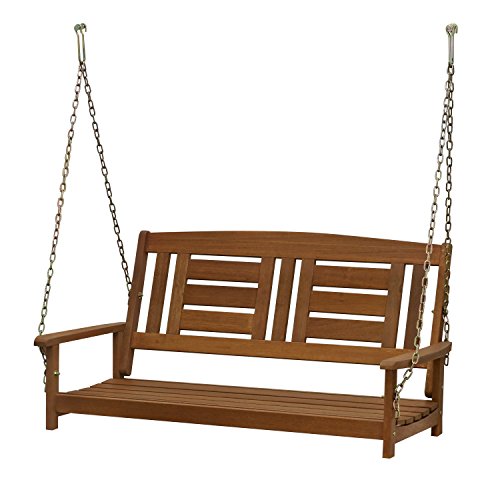
Furinno Tioman Hardwood Swing Chair
Best for: single-seat hardwood swing chair. Tier: mid.
The Furinno Tioman changes the shape of the shortlist: one hardwood seat instead of a bench built for two or three. That single difference reorganises how the seat gets used. A swing chair is personal territory — a reading corner, a quiet first coffee of the day — rather than the social centre of the porch, and its smaller footprint unlocks corners, balconies and narrow porches where a full bench could never travel with safe clearance. The hardwood presentation brings a warm, garden-room character that sits naturally among plants with a small side table alongside. Solo sitters, compact spaces and households adding a quieter second seat beside a bench are its people. Families wanting to sit together, anyone hoping to stretch out, and buyers who dislike the closer, more upright posture of a chair should pass. And smaller does not mean lighter rules: the same structural fixing, rated hardware, clear arc and seasonal inspection apply in full.
Review the current listing before you buy. Not suited for: a spot that cannot give even this single seat a clear, safe arc, or buyers unwilling to observe the hanging and inspection rules in this guide.

POLYWOOD Chippendale Porch Swing
Best for: recycled-lumber low upkeep. Tier: premium.
POLYWOOD built its reputation on recycled plastic lumber, and the Chippendale applies that material to a formal, classic bench whose patterned back makes a deliberate statement. The practical case is upkeep, or rather the lack of it: there is no sanding and sealing ritual, the surface takes rain in its stride far more casually than bare timber, and the colour runs through the material instead of sitting on it as a vulnerable coat. Porches with genuine weather exposure, salt air, second homes that stand empty between visits and owners who know honestly that annual wood care will never happen are all strong candidates. Purists who want the feel, smell and gradual ageing of real wood will not convert, and the tightest budgets should note that quality recycled-lumber furniture occupies the premium tier. Styling matters too: against the right house front the Chippendale looks tailored, while on a deeply rustic porch a plainer slatted bench may settle in more quietly.
See the current listing before deciding. Not suited for: porches unable to provide a clear, safe arc, or buyers unwilling to follow the hanging and inspection rules set out in this guide.
Maintenance and Keeping It Working
Keeping a swing in service is a rhythm, not an event: wash the seat, pass a hand along every chain link, study eyelets and bolts for wear, ovaling and corrosion, nip up anything loose, judge the finish and store cushions dry. Spring is the non-negotiable inspection, with a second pass in midsummer on a busy porch, and worn parts are replaced before they carry another sitter, never after. Still or secure the bench ahead of serious storms. The whole routine takes minutes, and it is precisely what separates installations still quietly perfect in their tenth year from installations that became cautionary stories.
Installation Checks for a Porch Swing: The Hour After Fitting Matters Most
Buying the bench is the simple transaction. The swing proves itself afterwards, overhead, where its bolts meet the joists and its arc meets the real dimensions of the porch, on evenings of sitting out long after the packaging has been recycled. So reason backwards from the structure: settle fixing points, joist spacing and the soundness of the timber before the seat is finalised, because that unglamorous investigation determines whether every other specification ever gets the chance to matter. Nor is an installation finished when it merely looks finished from the doorway. It is finished after it has been loaded, tested, listened to, and checked once more when everything has had a day to settle into place.
One habit does most of the protective work: hands on the hardware, repeatedly, through the season, with cushions covered or brought in when wet weather sets in. Built in from the first week, it prevents most of the deterioration owners later blame on the product. A modest bench whose bolts are checked will outlast a superior bench whose fixings nobody has looked at since installation day, which is why care burden belongs near the top of any comparison. The easiest swings to own ask for almost nothing between uses; where one does ask for something, arrange the routine so it happens automatically instead of depending on somebody remembering. A fitting that only one person knows how to check is a fragile arrangement for a shared home, so spread the knowledge around the household.
- Work the load path in order, from joist to bolt to chain to seat, changing one thing at a time.
- Finish each session with the reset the structure needs: chains straight, fixings checked, cushions dry.
- Meet resistance in a bolt or a link? Stop and diagnose it — force hides exactly the faults that matter.
- Note every creak, mark which fixing it came from, and correct one variable before the next test.
- Lay out tools, rated hardware and chalk marks before the first hole, so nothing is improvised overhead.
First impressions flatter nearly every bench. Trust instead the verdict after a month of real loads: guests settling in together, children testing the arc, fixings carrying weather and weight in rotation. If a visitor can use the swing correctly without a briefing, the geometry is intuitive; if they cannot, expect that same friction in your own routine. Flexibility deserves its premium only when the routine uses it — a bench that folds or converts impresses in a listing and matters only if your porch asks it to. Judge every model against the exact structure it will meet, not a showroom photograph, because a swing can be excellent in isolation and wrong for the joists in front of you.
For something loaded daily, durability and fit deserve the larger share of attention, since the purchase happens once and the loading happens hundreds of times. Some households suit a rotation approach, one seat resting, drying or waiting in reserve while another works, and it can extend useful life for surprisingly little organisation. Anything load-bearing deserves a respectful pause in the decision, and the maker’s own guidance, read before purchase rather than after the first creak, forms part of the specification. Ask the future-proof question plainly: if your routine changed moderately, would this swing, hung from this structure, adapt with it — or would it become the wrong piece of furniture, kept overhead out of guilt while its fixings quietly aged unchecked?
Keep a short written record of any problem: when it started, what changed around that time, and which fixing or link was involved. That note converts a vague worry into a solvable question when you need a part, a repair or a replacement decision. Ask the least enthusiastic person in the house what would irritate them about the installation; the answer usually names the noise, the clearance clash or the maintenance chore the buyer was too optimistic to see. Picture the extremes as well, because a narrow porch, where the arc and the walking route compete for the same boards, punishes choices that only work in average conditions. Then picture the busiest realistic week — guests, children underfoot, weather turning — and ask whether the bolts, arc and seat still work at full load.
Frequently Asked Questions
Can I hang a porch swing from the ceiling boards?
No, and the reason is load. Ceiling boards, roof decking and drywall are finishes; a moving benchload will work fixings out of them gradually until the failure is sudden. Every bolt must land in, or pass through, a confirmed structural joist. On a finished ceiling, find the joists with a finder and verify the readings, or pay a carpenter to establish them. Where joists cannot carry the swing, the correct answer is a stand — never a longer screw in a weaker material.
How high should a porch swing hang?
Set the height by the sitters, following the maker’s guidance: feet resting naturally, entry and exit easy for the oldest person who will use the bench. Judge it during levelling, with real sitters and cushions in place, since cushion thickness changes the effective height. Adjust one link at a time until sitting, swinging and standing all feel unremarkable. In structural work, unremarkable is the compliment you are aiming for.
Do I need two joists or one?
It depends on how the porch was framed and what the hardware maker directs. The two fixing lines may draw on one joist arrangement or on separate joists, and either layout can be sound — what cannot vary is the principle underneath: every fixing centred in solid structural timber, every component in the path rated for the load. Spacing matters: a bolt near a joist edge holds a fraction of what a centred bolt holds. If the framing is unclear, a carpenter’s brief visit at planning stage is the cheapest certainty in the project.
What if my porch has no usable joists?
Choose the stand without apology. On firm, level ground, assembled exactly as directed and never rocked hard, a stand-mounted swing delivers the whole experience while asking nothing of a ceiling that cannot give it. Renters and owners of fragile porch structures take this route routinely and surrender nothing but the drilling. Every other rule still binds in full: ratings, clearance, pinch points and the inspection calendar all transfer unchanged.
How do I stop the swing hitting the wall behind it?
Correct the geometry, not the behaviour. The seat needs empty space behind it as surely as in front, so shift the fixing points, adjust the hang to shorten the travel, or move whatever obstruction can be moved. Retest the complete arc empty after every adjustment, listening at the fixings as you do. A swing that can reach a wall will reach it eventually, generally with a child’s enthusiasm behind it — solve it with a drill and tape at installation, not with a household rule afterwards.
How often should hardware be replaced?
Replace by condition, not by calendar. The triggers are visible: a stretched or twisted link, corrosion eating deep rather than blooming on the surface, an eyelet pulling oval, a bolt that no longer seats firmly. Any one ends a part’s service immediately. Inspected each season, quality rated hardware lasts a long time, and links and bolts can be renewed individually. The calendar guarantees the inspections; the inspections tell you when a part is done.
Related Guides and Next Steps
Continue with the companion guides in this cluster and the most relevant live guides on the site. A swing is one structural decision among several that shape a porch, and the pieces below cover the neighbouring seats, surfaces and soft furnishings that complete it.
start with the porch swing buying guide
the porch swing review of comfort and build
porch swing reviews and owner lessons
porch swing pros and cons before you drill
is a porch swing worth it, decided first
best outdoor swing chairs for smaller spaces
patio table and chairs for the other end of the porch
patio furniture pillows for extra comfort
More to Consider: Reading, talking and the social physics of a swing
A loaded swing quietly reorganises porch life, because people side by side, facing outward and moving gently, talk in a different register: conversations stretch, silences stop being awkward and teenagers who would never agree to a chat drift onto the bench and stay. Readers colonise the corner with the light, coffee drinkers take the early shift, and the seat develops a timetable of small rituals. Choose for those rituals, but remember what underwrites them — a calm arc is only calm because the fixings above it are centred, rated and checked. If talk is the point, width matters; if reading is the point, back support and a drink’s resting place matter; if the porch is where the day gets reviewed, comfort after dark matters.
That social life rests, literally, on the structure carrying it. The decisions that look minor in a listing — joist spacing, bolt placement, chain condition, back shape — are the ones the household lives with daily, and the structural ones fail least forgivingly. Settle them carefully once, verify them under load, and the swing tends to look after the rest of the evening by itself.
More to Consider: Children, grandparents and everyone between
A bench that serves everyone at once is an exercise in honest numbers: a load rating that covers the heaviest realistic combination of sitters, and geometry calm enough that nobody has to think about the motion. Children need supervision, firm rules about standing and hard rocking, and the pinch points at chain and frame kept in mind. Older sitters need a seat height that lets feet rest flat, armrests that help when standing, and an arc that never feels like a fairground ride. A swing a grandparent trusts and a child has been taught to respect gets used daily; one that feels tippy, low or frantic quietly becomes decoration. Where doubt remains, choose stability, familiar proportions and hardware rated well beyond the calculated load, and let the excitement come from the company.
In a mixed-age household the margin is the kindness. Ratings chosen with headroom, bolts centred in sound timber and inspections nobody skips are what let a grandparent relax and a child be a child on the same seat. Get the structure generous and the rules clear, and the bench stops being equipment to worry about and becomes simply where the family sits.
More to Consider: Value over years, not weekends
Judge a swing the way you would judge a roof or a door: by cost spread across years of daily service, not by the figure on delivery day. A premium handcrafted or recycled-lumber bench serving for a very long time, on modest care, can be the economical choice beside a cheap swing replaced repeatedly, while a simple traditional bench under cover can outlast every expectation. The reverse holds too: paying a premium for a porch that cannot shelter the swing, or for features nobody will use, is waste dressed as quality. Include the structure in the arithmetic — sound fixings and rated chain are part of the purchase price of every year that follows. Match tier to porch, exposure and real habits, and the purchase tends to feel right at every sit, which is the only review that ultimately counts.
Spread across a decade, the cheapest component in the whole installation is the good bolt you almost economised on. Money spent on verified timber, rated hardware and a carpenter’s certainty at the planning stage returns itself every season the swing simply works. Value, here, is a structure that never makes you think about it.
More to Consider: When a stand makes sense
A stand deserves a second, fuller consideration, because for many porches it is not the fallback but the answer. It earns its place when the ceiling offers no trustworthy structure, when a tenancy forbids fixings, or when the best seat on the property is out in the garden rather than under the roof at all. The structural questions relocate rather than disappear: the ground must be firm and level so the frame’s feet share the load evenly, the assembly must follow the maker’s sequence exactly, and the household must respect that an A-frame rocked hard is a frame looking for its tipping point. In return the swing gains a self-contained, almost daybed presence for lawns and patios, and freedom from the joist question. That is not second best; it is the engineering that fits the ground, provided ratings, clearance and inspection come across in full.
Think of the stand as a portable joist: it carries the same people, through the same chains, under the same rules. The load does not know whether it ends in a ceiling or in a frame’s feet, and neither should your standards. Rate it, level it, inspect it, and a stand-mounted swing is structurally every bit as respectable as a hung one.
More to Consider: Materials, honestly explained
Choosing a material is choosing how the bench will age under load and weather, and what maintenance personality you bring to it. Solid woods offer warmth, weight and a surface that can be sanded, repaired and refinished across many years, but they ask for that care in return, particularly where sun and rain reach the seat and bolt holes. Recycled plastic lumber surrenders some natural character for indifference to weather: it can be washed, left out and largely forgotten, which suits busy owners. Painted and powder-coated metal frames bring structure and slimmer profiles, often paired with wood or sling seats. None wins universally. The honest question is who you are as an owner: if a spring afternoon with a brush and finish sounds like pleasure, wood will repay you; if the swing will be lucky to receive a wash, choose the material that forgives neglect, because a bench still looking cared for in year five beats a finer one that peeled in year two.
Material choice reaches the fixings, too. Timber that stays sound around a bolt hole keeps the bolt’s grip; finishes that keep water out of end grain and fixing points are structural maintenance, not cosmetics. Pick the material whose care rhythm you will actually keep, and the load path stays as sound in year five as the day the pilot holes were drilled.
More to Consider: Comfort is a back, a seat and an arc
Comfort announces itself twice. In the first ten seconds the seat speaks: its depth, the spacing of its slats and whether the front edge presses behind the knees. After forty minutes the back takes over, and a gentle roll or curve supports a long sit far better than a tall flat board, while armrests at a natural height let shoulders finally drop. The third judge is the arc, and the arc is geometry you installed: hung to glide in a long, shallow path, a swing feels calm, whereas short, steep travel feels busy and can leave readers faintly seasick. Fixing spacing and chain length set that path, making comfort a structural decision made with a tape measure. When comparing models, picture your longest realistic sit — a book, a conversation, a sleeping toddler — and judge every design against it, not a showroom perch.
None of that comfort survives a sloppy hang. A bench level to the link, chains untwisted and equal, fixings pulling straight down their joist centres — those are the conditions under which a good back and a good seat can do their work. Comfort, on a porch swing, is what correct structure feels like from underneath.
More to Consider: Chains, ropes and hangers
Revisit the hangers with a structural eye. Chain earns its dominance by adjusting link by link, displaying its condition openly — stretch, twist and corrosion all show — and allowing a damaged section to be replaced alone. Rope hangers look softer and flatter coastal or rustic porches, but rope is a wear item: inspect it even more faithfully and retire it at the first sign of fraying or rot, since fibres can fail inside where eyes cannot follow. Whatever carries the bench, geometry governs: fixing points slightly wider than the attachments, runs clean and untwisted, both sides level so the seat neither creeps nor lists. A crooked hang is not a charming quirk; it is asymmetric loading, wearing one chain, one eyelet and one bolt faster than the others.
Equalise the hangers and you equalise the load; neglect them and the structure quietly concentrates every sit onto its weakest link. That is why the chain check, fingers on every link, sits inside the seasonal inspection rather than beside it. Hangers are not accessories to the structure. On a porch swing, they are the structure, in its most exposed and hardest-working form.
More to Consider: Weather, sun and the covered porch question
Return, finally, to the covered porch, because shelter is the kindest condition a swing can be given and it widens every material choice. Under a roof, finishes endure far longer, cushions stay usable, and — most importantly here — hardware corrodes slowly, so bolts keep the grip they had on installation day. On an open deck or a stand in the yard the same swing lives harder: ultraviolet cracks finishes, rain finds every end grain and bolt hole, and wind can walk an empty bench into a post hard enough to shock the fixings. If your spot is exposed, favour weather-tolerant materials, plan a cover for the worst months and still or secure the swing ahead of serious storms. Exposure changes which swing, which hardware and how much vigilance make sense; it does not rule out a swing.
Shelter, in other words, is part of the structure. A roof that keeps rain off the fixings extends the service life of every bolt and link beneath it, while an exposed site must buy that same lifespan back with better materials and shorter inspection intervals. Price the porch’s shelter honestly when you choose, and the installation will repay the honesty for years.
More to Consider: Cushions, pillows and staying out longer
A bare slatted bench is honest and handsome, yet cushions stretch twenty minutes into an evening. A seat cushion softens the slats, a back cushion or outdoor pillows support the lower back, and a throw turns the swing into the place people migrate to after dinner. Choose fabrics that shed water and resist fading, store cushions under cover when rain threatens and dry them fully before boxing them away, because trapped damp breeds the musty smell that ruins foam. Keep the structural perspective: cushions add weight, change the effective seat height and belong on the bench only after the loaded test has passed without them. Treat them as a replaceable comfort layer — the bench should still please unadorned, and textiles can change with seasons and wear without touching the furniture, or the fixings, underneath.
End where the load ends: with people, comfortable, staying longer than they planned. Cushions earn that extra hour, but they earn it on top of a structure that was verified before the first soft thing touched the seat. Softness is the last layer of a porch swing, in every sense — the final thing added, and the first thing that should be removed from your mind when the structure underneath needs attention.