Disclosure: As an Amazon Associate, airfryerkitchensupply.com earns from qualifying purchases. Links on this page are affiliate links; they cost you nothing extra. Prices and availability change often, so check the current Amazon listing before you buy.
A porch swing earns its real verdict slowly. Nobody knows in the first week whether the finish will chalk and fade by the third summer, whether a hairline crack will open along a seat slat, whether the chain will stretch just enough to leave the seat sitting lower and slightly uneven, or whether the ten-minute jobs nobody planned for will quietly become a habit. This survey is therefore built as a long-term ownership synthesis: it reads owner experience across many seasons, follows what aged, what loosened, what faded and what held, and asks the question that only time can answer — knowing everything they know now, would these owners choose the same swing again, and what would they do differently the second time around?
Viewed that way, the pattern is reassuring but not sentimental. The swings that owners keep, season after season, are rarely the ones that looked most impressive on delivery day. They are the ones that were hung into solid structure, given room to travel, matched to the weather their porch actually delivers, and maintained in small, regular doses before small problems became repairs. The six models below are examined through that long lens, because a swing is not a purchase you judge once — it is a piece of furniture you re-judge every spring.
Key Takeaways
- After several seasons, satisfaction follows fit, hanging quality and upkeep far more closely than it follows the original price tier.
- Finishes tell the truth first: fading is cosmetic, but peeling, cracking and soft end grain are the warnings owners wish they had acted on earlier.
- Chain stretch, ovalled eyelets and tired hangers — not the bench itself — are what most often end a swing’s service.
- Owners of recycled lumber praise how little the years ask of them; owners of wood praise that almost everything can be sanded, tightened or refinished back to life.
- Nearly every owner who would buy the same swing again describes the same ritual: inspect in spring, touch up early, replace wear parts before they fail.
In this guide
Safety First: The Rules That Come Before Comfort
Hang a porch swing only from structural ceiling joists. Years of loaded, moving weight will find any weakness above the seat, which is why the fixings belong in — or through — the solid joist timber carrying the roof, and never in porch roof decking, decorative ceiling boards, drywall or any thin skin that merely covers the structure. If you cannot find the joists and prove they are sound, bring in a carpenter before anyone sits down; a swing that fails does not fail empty.
Use hardware and chain rated above the loaded weight. Think in terms of the heaviest load the swing will ever carry — the bench itself, every sitter together, and the extra force added by the motion — then rate every eye bolt, hook, connector and length of chain above that figure with margin to spare. This matters more, not less, as the years pass, because metal fatigues, links wear thinner where they rub, and a component that began life exactly at its limit has nothing left to give by its fifth season.
Leave real swing clearance in front and behind. Clearance is a long-term issue as much as a first-day one: porches accumulate planters, storage boxes and extra chairs over the years, and each addition quietly steals from the arc until one day the seat clips a rail or a shin. Keep the full travel of the swing — not just its resting position — clear of walls, posts, rails and the route people walk, and re-check that space whenever the porch layout changes. If the space cannot stay clear, a smaller bench, a swing chair or a stand placed elsewhere will serve the household better than a large swing in a shrinking gap.
Inspect chains and eyelets for wear each season. Make the inspection a dated habit rather than a vague intention: once when the swing comes back into regular use, and again in midsummer on a busy porch. Run your hand along each link, looking for the tell-tales of age — links that have stretched or begun to twist, rust blooming where the finish on the metal has worn, eyelets slowly pulled oval, and timber around a fixing that has cracked or gone soft. Replace a suspect part when you find it, not at the end of one more season.
Respect stands and small fingers. A stand-mounted swing lives outdoors in a different way, and the seasons test it accordingly: check that it still sits level after ground has heaved, settled or softened, and treat hard rocking as misuse, because an A-frame that is rocked beyond its design can tip. The pinch points deserve the same seasonal attention as the chain — the gaps where chain meets frame, where the seat passes the armrests, and anywhere a moving part closes — since small fingers explore exactly those places, and wear can change a gap’s size over time.
What Owners Actually Talk About — Porch Swing Reviews in Themes
Stack several years of owner comments together and the conversation changes character. Early remarks are about delivery, assembly and looks; the later ones — the ones worth synthesising — are about change. Five subjects dominate. First, appearance over time: how far the colour drifted from the day it arrived, whether fading stayed even or went patchy, and whether the surface still looks cared for after ordinary cleaning. Third, the hanging system in middle age — chain that crept longer, hangers that developed a squeak, fixings that needed a spanner. Fourth, the maintenance ledger: what each year actually demanded, in minutes and effort, and whether the owner judged that a fair price. Fifth, the re-choice verdict, where owners say plainly whether they would buy this model again, buy a different material, or buy a different size.
They talk about the spring the finish gave up on the front rail, the storm that tested the cover, the grandchild who now claims the corner seat, and the afternoon spent refinishing that turned out to be oddly satisfying.
The Models, Reviewed as Owners Review Them
The six models gathered here span the families that long ownership treats most differently: a traditional value bench, two Amish-style heavy-duty builds, an accessible hanging bench, a single-seat hardwood chair and a premium recycled-lumber design. Learn how each family ages and you can predict, with fair accuracy, what the fifth-year review of almost any individual model will say.
Models Worth a Closer Look
Each pick below is judged the way its owners judge it after the novelty has worn off: by what the seasons did to it, what upkeep it demanded in return, and whether it would be chosen again.
Amish Casual Heavy Duty Roll Back Porch Swing
Best for: roll-back comfort. Tier: premium.
The roll-back backrest is what owners mention first in year one, and — tellingly — it is still what they mention in year five, because a curve that follows the back does not stop mattering once the finish has dulled a little. You settle rather than perch, and that settled posture is what turns a swing into the seat where an hour disappears. The traditional construction around that backrest shapes the ownership story: solid-looking slats and a substantial frame that owners describe as worth keeping up, with hardware intended to be checked and tightened rather than discarded. The long-term bargain here is honest wood care. Expect the finish to need judging each spring, a gentle clean, and recoating before sun and rain get ahead of it; owners who kept that rhythm report a swing that mellows, while those who skipped two seasons describe the familiar catch-up job of sanding back grey, weathered patches. Chosen again? By owners on covered porches, consistently yes — usually with the footnote that they would start the maintenance rhythm in the first spring, not the third.
Check the current listing before you buy, and picture it after several seasons, not just on delivery day. Not suited for: porches that cannot give it a clear, safe arc, or buyers unwilling to follow the hanging and inspection rules in this guide.

Jack Post Traditional Porch Swing
Best for: classic slatted value. Tier: entry.
The Jack Post represents the traditional slatted bench in its most familiar form, and its long ownership story is the story of the type: conventional proportions, styling that sits comfortably against almost any house front, and nothing exotic anywhere in the design — which, years later, turns out to be a genuine virtue, because chains, hangers and hardware for a standard bench are ordinary, understandable and easy to source when a wear part finally needs replacing. Owners who bought it as a first swing often describe it as the seat on which they learned their porch: how much arc they really had, how much weather their spot truly delivered, and how much maintenance they were honestly willing to do. Its limits are the familiar ones of the tier and the type — do not expect heirloom joinery or a sculpted ergonomic back, and do not expect a traditional finish to look after itself on an exposed porch. Hung from structural joists on rated hardware, it delivers exactly the simple, sociable, gently moving seat it promised on day one — and keeps delivering it for as long as its owner keeps up the small side of the bargain.
Check the current listing before you buy; the seasons will test whatever you choose. Not suited for: porches that cannot give it a clear, safe arc, or buyers unwilling to follow the hanging and inspection rules in this guide.
Porchgate Amish Heavy Duty Porch Swing
Best for: sturdy Amish-style build. Tier: premium.
Porchgate’s heavy-duty, Amish-style proposition reveals its value slowly, in the way substantial furniture usually does: not in a dramatic first impression but in the absence of drama across years of daily use. The bench presents as solid and squared, and owners of busy porches — children climbing up, grandparents settling in, the swing rarely resting — are the ones who speak most warmly about that solidity in later seasons, because a frame that still feels planted after thousands of sits is the whole point of the tier. The ownership costs are the counterparts of the weight. The finish, as with any wooden build, becomes the owner’s recurring appointment: keep it sealed and the bench ages gracefully; neglect it and the front rail and seat edges — the places hands, heels and weather reach first — will show it. Owners measuring value in years of service, who are comfortable with that permanence, are exactly the households this design rewards.
Check the current listing before you buy, and weigh the upkeep rhythm it will ask of you each spring. Not suited for: porches that cannot give it a clear, safe arc, or buyers unwilling to follow the hanging and inspection rules in this guide.

Best Choice Products Hanging Porch Swing
Best for: accessible hanging bench. Tier: entry.
Best Choice Products sits at the accessible end of the market, and the honest long-term question for a swing like this is not whether it matches a handcrafted bench — it is how gracefully it handles the seasons it was actually bought for. For many households the answer is: well enough to have been entirely worth it. The design is simple and friendly, the bench reads clearly as a two-person seat, and the proposition is to get a swing hung and enjoyed rather than to open a long furniture project. That makes exposure honesty the whole game with this pick: it suits smaller budgets, first porches, gifts, and households content to learn, adjust and perhaps upgrade in a few years with real experience behind the decision. It suits buyers wanting the densest hardwood or a piece to hand down far less. Judged on its own terms — seasons of slow arcs, conversation and evening air at an accessible tier — it holds up as a beginning that many owners remember fondly even after they eventually move on.
Check the current listing before you buy. Not suited for: porches that cannot give it a clear, safe arc, or buyers unwilling to follow the hanging and inspection rules in this guide — the rules its long service will depend on.
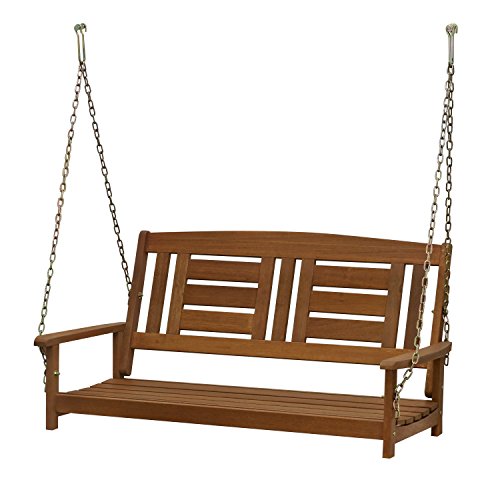
Furinno Tioman Hardwood Swing Chair
Best for: single-seat hardwood swing chair. Tier: mid.
The Tioman is the shape that changes the long-term arithmetic, because a single-seat hardwood swing chair ages as a personal seat rather than as the social centre of the porch. Its owners’ later reviews read differently from bench reviews: less about gatherings, more about a reading corner that survived five summers, a morning-coffee ritual, a quiet spot that stayed claimed by one person. The smaller footprint is what makes that possible on corners, balconies and narrow porches where a bench would never have fitted with a safe arc — and a seat that fits keeps being used, while a seat that crowds gets resented and finally removed. Hardwood brings the warm, garden-room character owners praise, and also the hardwood owner’s standing duties: watch the finish where sun lands, expect the colour to deepen and drift, and treat small surface cracks early before water moves in. It suits solo sitters and anyone adding a second, quieter seat beside a bench; it does not suit families wanting to sit together or anyone hoping to stretch out. The full hanging discipline still applies — structural fixing, rated hardware, clear arc, seasonal inspection — and a single seat’s hardware wears just as surely as a bench’s, only with one person’s habits written into it.
Check the current listing before you buy, thinking in years of sits rather than a single summer. Not suited for: porches that cannot give it a clear, safe arc, or buyers unwilling to follow the hanging and inspection rules in this guide.

POLYWOOD Chippendale Porch Swing
Best for: recycled-lumber low upkeep. Tier: premium.
The Chippendale is the control experiment in this survey: take the classic formal bench, with its distinctive patterned back, and build it from recycled plastic lumber, then watch which long-term complaints simply never appear. There is no finish to peel, because the colour runs through the material rather than sitting on it as a coat; there is no sanding-and-sealing appointment each spring; rain that would set a wooden owner’s teeth on edge is, here, a washing opportunity. Owners on exposed porches, in coastal air and at second homes that sit empty between visits write the calmest multi-season reports in the whole category, and their re-choice verdict is the most one-sided: they would buy it again precisely because the years asked so little. The premium tier is the other standing consideration, best justified by exactly the households who use it hardest or maintain it least.
Check the current listing before you buy. Not suited for: porches that cannot give it a clear, safe arc, or buyers unwilling to follow the hanging and inspection rules in this guide, season after season.
Themes Across the Reviews
Comfort over time
Comfort has a biography. In the first month owners praise how a swing looks from the street; by the second year they are talking about their backs, because the body keeps the longest records. Roll-back and gently curved designs gather the enduring compliments, the ones written by people who read, talk and nap out there, while flat-backed benches gather something equally informative — cushion recommendations, added lumbar pillows, quiet admissions that twenty minutes is the natural limit. If your household’s porch time runs long, weight this theme above almost everything, and judge a bench by the sit you will still be taking in year four.
Build and the hanging weekend
Owners forgive plain styling for a decade; they do not forgive a swing that creaks, twists or arrived with fixings they never quite trusted, because those irritations repeat at every single sit. The heavy-duty Amish-style builds earn their lasting praise here, still feeling settled long after lighter pieces have developed movement at the joints. The hanging weekend, remembered in unusual detail years later, splits owners into two camps: those who confirmed joists and fitted rated hardware, who recall a satisfying project, and those who opened the ceiling and found boards over nothing, who recall the delay while help was found.
Weather and the second summer
If one season makes a finish look good, the second is when it files its evidence. Ultraviolet works on whatever faces the sun, so one armrest fades ahead of the other; rain finds end grain and the bottoms of legs; a covered porch flatters every material and quietly extends every finish’s life, while an exposed one separates the survey into clear camps. Recycled-lumber owners write the least weather prose of all, because so little happens to report. Match the material to your exposure and to the owner you actually are, and your own second-summer account is likely to be a kind one.
Parts, cushions and staying power
Long ownership turns out to be a story told in small parts. A section of chain replaced when stretch became visible. The models that collect grateful late reviews are the ones whose wear parts are ordinary and findable, because a swing that can be refreshed cheaply stays in service, while a swing with one irreplaceable, tired component drifts toward the garage no matter how sound the rest of it is. Before buying, confirm that hangers, chain and cushions for your chosen style are standard, available things — you are really checking whether your future self will be able to keep a promise your present self is making.
Strengths and Trade-Offs
Strengths
- Years of accumulated owner experience make the patterns — fading, stretch, wear points — predictable enough to plan around.
- Every tier contains a swing that can still be serving well after many seasons, provided fit, hanging and upkeep are right.
- Almost everything that wears can be replaced or refinished, so a good swing is maintained rather than discarded.
Trade-Offs
- One owner’s decade reflects one porch’s weather and one household’s habits, so transfer any single story to your own porch with care.
- Premium money buys slower ageing and lighter upkeep, not immunity from seasons, inspections or physics.
- Wood asks for recurring care and recycled lumber asks for acceptance; there is no material that asks for nothing at all.
What the Reviews Teach
Chains, ropes and hangers
Chain is the default hanger for reasons that only become clearer with age: it adjusts link by link when stretch slowly lowers one side, it shows its condition honestly to anyone who runs a hand along it, and a tired section can be replaced without disturbing the rest. Rope tells a shorter story. It looks softer and suits coastal and rustic porches beautifully, but sun and moisture age it from the inside, so it demands closer inspection and earlier replacement at the first fray or softness. Whatever hangs your swing, geometry decides how evenly it ages: fixings set slightly wider than the bench, runs hanging clean and untwisted, both sides level. A seat that lists is not character; it is a progress report on uneven wear, and correcting it early is one of the most satisfying small jobs in porch ownership.
Weather, sun and the covered porch question
Ask owners what changed their swing most and few say use; most say weather, and specifically the combination their porch serves daily. A roof overhead is the single kindest condition a swing can be given — finishes last seasons longer, cushions stay in service, hardware corrodes at a stroll. Without one, the biography accelerates: colour greys and then checks, rain works into every end grain and fixing hole, and wind worries an empty swing against posts until someone stills it. None of this forbids an exposed swing; it reprices the choice. Weather-tolerant materials move up the list, a cover for the worst months stops being optional, securing the seat before storms becomes a household reflex, and the finish inspection moves from annual to whenever you happen to be out there with coffee.
Sizing the swing to the porch
Size mistakes also ripen with time. A bench that merely fitted on day one becomes, by year two, the obstacle everyone edges around with shopping, the seat whose arc the new planter keeps invading, the reason the porch feels smaller than it is. The swings that stay loved are the ones sized for the arc and the walking line together: room to travel at its liveliest, room for people to reach the door without a sideways shuffle, room for the porch’s life to grow around it. A two-person bench remains the natural fit for most family porches; a longer bench earns its footprint where gatherings and naps genuinely happen; a single chair keeps solving the corners nothing else could use.
Children, grandparents and everyone between
Households change around a swing that stays. The toddler who once had to be lifted on becomes the child who must be taught not to stand, twist the chains or test the arc’s extremes, and in time becomes the teenager who drifts out to it with a phone and stays for a conversation nobody scheduled. At the other end, older sitters judge with increasing precision: a seat height that lets feet rest flat and standing stay dignified, armrests that genuinely help, a motion calm enough never to feel like a ride. Honest load ratings and steady geometry are what let one piece of furniture serve all of that, across all of those years. Choose stability and familiar proportions, keep the hardware generously rated, and the swing can remain the household’s common ground while the household itself rearranges around it.
Who Each Pattern Suits
Let the long stories, not the launch descriptions, sort you. If the accounts that move you are the quiet-morning ones still being written after many seasons, put back comfort and a calm, unchanging arc first. If they are the family ones — same bench, bigger children, same arguments about who gets the corner — put width, ratings and hardware you can inspect at a glance first. If they are the low-upkeep ones, where the owner’s whole maintenance diary fits in a sentence, recycled lumber under whatever sky you have will reproduce them most faithfully.
Care Essentials Behind the Good Reviews
Read enough five-season success stories and the same unglamorous routine surfaces in all of them, usually described in a single breath: a wash each spring, a hand travelled slowly along the chain, a spanner offered to every fixing, cushions brought under cover and stored dry, and a finish judged while it still only needs help rather than rescue. The households that let a rhythm form while the swing was new, when enthusiasm did the motivating, are the ones whose later reviews sound contented rather than rueful. Maintenance, in the long record, is not a chore attached to a swing; it is the difference between a swing that ages into the porch and one that ages out of it.
Reading Porch Swing Reviews Critically: Patterns That Matter More Than One Opinion
Start from the calendar, not the catalogue. A porch swing is bought in an afternoon but judged across years — across the fading of its sunny side, the slow stretch of its chains, the springs when its finish did or did not get attention — so the reviews worth trusting are the ones written after all of that has had time to happen, and this section weighs evidence accordingly. Work backwards from the life your swing will actually lead: the exposure of the spot, the weight and habits of the people, the storage you truly have. Settle those first, because they decide which features matter.
Pay attention to time stamps and to what owners say they would repeat. A glowing review written in the first month proves a swing can be delivered and hung; a measured one written in year four, listing a replaced chain section and a refinished rail alongside continued satisfaction, proves something far more valuable — that the ageing was manageable. Try this exercise before shortlisting: write down the three jobs the swing must do for years, the one compromise you can live with indefinitely, and the one flaw — a finish you will not maintain, a size you must squeeze past, a care routine you know you will abandon — that should walk you away. A candidate that survives that list has earned its place.
- Favour reviews written after at least a full year, and prize ones that report what changed, what wore and what was replaced.
- Weight households whose exposure, household size and maintenance honesty resemble your own.
- Watch for version changes in recent comments, since a model’s materials or hardware may not be what earlier owners bought.
- Note every workaround a long-term owner mentions — a cover, a recoating rhythm, a chain swap — and decide whether you would actually adopt it.
- Treat dramatic single stories, good or bad, as anecdotes until the same detail repeats across unrelated owners and seasons.
The most useful question to ask of any review is also the simplest: what does this swing ask of its owner each year, and did this owner enjoy paying it? Add the minutes honestly — the washing, the inspecting, the recoating, the cushion storing, the occasional re-levelling — because that annual total, repeated for a decade, is as much a specification as the bench’s length. Ask which component will look tired first, and whether its tiredness is cosmetic, cleanable, repairable or terminal; the answer quietly sets the realistic lifespan of the whole piece.
Where a swing lives decides how it ages, and how it ages decides how it is used. If your shortlist includes models such as the Amish Casual Heavy Duty Roll Back Porch Swing and the Jack Post Traditional Porch Swing, run each through the same long-term checks in the same order — exposure, structure, arc, upkeep, wear parts — using current listing details rather than an old screenshot or a remembered specification, because the version you buy is the version that will age in your porch’s particular weather.
When two swings still look equal after all that, the missing information is usually not about the products at all; it is about which owner you will turn out to be. Attention is a budget that compounds like interest. A swing needing constant remembering — cushions in, cover on, chain checked, finish watched — spends it every week for years, so count that cost beside the financial one. And for the parts that wear through constant use, a planned spare — a length of chain, a set of eye bolts, cushion covers in reserve — is not extravagance. It is how a decade-long routine survives the day the original finally gives out.
Frequently Asked Questions
Which porch swing do owners keep longest?
The ones that were right for their porch, their structure and their owner’s habits from the start — a combination found at every tier. Handcrafted wood dominates the longest stories because almost everything on it can be repaired or refinished; recycled lumber dominates the lowest-effort stories because so little ever needs doing. Time rewards fit and attention far more faithfully than it rewards spending.
What do owners complain about most?
With a few seasons behind them, owners return to the same three grievances: a finish that was left until it cracked and peeled instead of being recoated while it was merely dull, hanging hardware that wore — stretched links, ovalled eyelets — because nobody built inspection into the year, and a bench bought for its impressive length that spent its life crowding the porch it hung on.
Are expensive porch swings worth it in owner experience?
Ask premium owners in year five and a pattern emerges: what they believe they paid for is not a better first summer but a slower decline — joinery that still feels tight, comfort shaping that still supports, materials that asked little of them across many seasons. The premium buys time and ease under hard, daily use; it does not buy a different view at sunset. Match the tier to your exposure and your honest upkeep appetite, and both groups’ long accounts make sense.
Do owners recommend cushions?
Yes — and the long view adds a refinement: owners recommend cushions and a replacement rhythm for them. Textiles live faster than benches. Covers fade ahead of the frame, foam softens, and a set that transformed the sit in year one may be the tiredest-looking thing on the porch by year four, so experienced owners choose outdoor fabrics, store them dry, and treat covers as renewable rather than permanent. Either way, the durable advice is to choose a seat that is comfortable unadorned, then let replaceable textiles carry the changing seasons of colour and comfort.
What surprises new owners most?
Two things, one delightful and one instructive. The delightful one is permanence of habit: chairs are abandoned, routines migrate outdoors, and the swing becomes the default seat for calls, reading and supervising homework — and stays that way for years. The instructive one is how much of the swing’s character lives above it. The same bench, re-hung level on fresh, correctly rated hardware after its chains had quietly stretched, can feel like a different and better piece of furniture.
How do owners handle swinging into walls or rails?
Experience teaches them to fix the geometry rather than police the children. Across the long accounts the remedies repeat: hangers shortened or repositioned so the arc sits where the porch can hold it, planters and rails moved out of the travel before they collect another scuff, clearance defended whenever new furniture arrives, and occasionally the honest admission that a smaller swing was the right answer all along. The principle underneath every version is the same — the arc is part of the furniture for the whole of its life, and a porch arranged around that fact stays peaceful, unmarked and unbumped decade after decade.
Related Guides and Next Steps
The companion guides in this cluster carry the same long view into the neighbouring decisions — the seats, surfaces and soft furnishings that will age alongside the swing — so keep planning with them and with the most relevant live guides on the site before you settle the porch as a whole.
the single-model deep dive in our porch swing review
the porch swing buying guide for choosing
porch swing pros and cons weighed plainly
is a porch swing worth it, answered directly
how to install a porch swing, step by step
patio table and chairs for the other end of the porch
indoor outdoor rugs under a swing
More to Consider: Weather, sun and the covered porch question
Give a swing five years outdoors and its two sides may stop matching: the armrest the afternoon sun reaches fades a shade ahead of its partner, the rail under the roofline keeps its colour while the exposed edge of the seat goes grey, and hardware on the weather side shows rust blooms a full season before the sheltered side. Those under a roof mostly watch it happen slowly and intervene rarely. Those in the open learn to rotate what can be rotated, cover what can be covered, recoat the sun-struck faces before they check and split, and still the swing before storms rather than after them. Exposure, in other words, does not decide whether a swing lasts — it decides how much of the lasting the owner has to do personally.
Choose the material your sky will test and the care your calendar will honestly hold, and the seasons become a slow patina instead of a countdown.
More to Consider: Cushions, pillows and staying out longer
Cushions live the fastest life of anything on the porch. A set that turns twenty minutes into a whole evening in the first summer will, by the third or fourth, have faded unevenly where the sun lands, softened where the household’s favourite seat presses, and picked up the faint mustiness that comes from one damp storing too many. Owners who fare best treat this as the design rather than a disappointment: outdoor fabrics chosen for shedding water and resisting fade, a dry store they actually use, a full drying before anything goes into a box or bench, and a standing expectation that covers — sometimes the whole set — will be renewed while the bench beneath carries on unchanged.
Hold the bench to the stricter standard, then: it should sit comfortably bare in its tenth year, because the textiles that made it luxurious in its first will have been replaced twice by then.
More to Consider: Sizing the swing to the porch
A tape measure taken on delivery day cannot predict the porch of year three, when a storage bench has arrived, the planters have multiplied and the children need more arc, not less. That is why long-serving swings tend to have been sized with slack: the walking line still works with shopping in both arms, the door still opens without negotiation, and the travel of the seat still clears everything the porch has accumulated since. If you are between two lengths, let the household’s future cast the vote — the smaller swing that still swings freely in five years will have been sat on far more than the larger one that spent those years being edged around.
Chalk both outlines, footprint and arc, before you decide; then imagine the porch as it will be, not as it is, and keep the size that future porch can still welcome.
More to Consider: Style that belongs to the house
Style ages on its own schedule, separate from finish and hardware. A swing is the first furniture the street sees and the backdrop of a decade of photographs on the steps, so the question is not whether it impresses now but whether it will still look like it belongs when the door has been repainted, the trim colour has changed and the planting has matured around it. Traditional slatted benches pass that test almost everywhere, which is part of why they dominate the longest ownership stories. Formal patterned backs keep suiting tailored house fronts year after year. Simple contemporary lines settle into newer builds and stay settled. Stand across the street and choose for the house you will still be looking at in ten years.
Practicality should build the shortlist, but belonging should pick the winner, because finishes can be renewed and chains replaced, while a shape that never suited the house will be forgiven more slowly with every passing year.
More to Consider: Care through the seasons
Spread across a year, swing care resolves into a rhythm so light that long-term owners struggle to call it work. Spring is the audit: wash off winter, travel a hand along every link, test each fixing with a spanner, look hard at the timber or lumber around every bolt, and judge the finish while a recoat is still a small job. Summer asks only for wipes before pollen and spills set, and for cushions to come in ahead of storms rather than dry out after them. Winter, for exposed swings, means a cover or storage and a seat stilled against high winds; for covered porches, little more than the same stilling. Written out it looks like a programme; lived, it is ten minutes folded into the mornings when the steps get swept anyway.
The owners who keep that rhythm rarely meet a big repair, and that is the whole secret the long reviews keep repeating: care given early and seasonally is what makes care stay small.
More to Consider: Reading, talking and the social physics of a swing
The rituals a swing hosts also have a lifespan, and they tend to lengthen rather than fade. Side by side, facing outward, moving gently, people keep talking past the point where a face-to-face seat would have let the conversation close; silences stay comfortable; the teenager who would not sit down for a chat drifts onto the moving bench and stays. Choosing for them means choosing for repetition: width and a calm arc if talk is the point, back support and a place for a drink if reading is, cushions and comfort after dark if the day is reviewed out there.
A swing bought for those rituals tends to be maintained almost without thinking, because a seat woven into daily life gets noticed the moment its chain stretches or its finish dulls — and noticed things get fixed.
More to Consider: Children, grandparents and everyone between
Return to a swing after a decade and the household around it will have rearranged itself: babies become climbers, climbers become loungers, and the grandparents who once did the lifting now choose their seat by how kindly it lets them stand up again. Furniture that serves all of that without modification earns a particular kind of loyalty, and it is built from unglamorous choices — honest load ratings with room to spare, a seat height that keeps feet flat, armrests positioned to take weight, an arc calm enough never to feel like a fairground ride. A swing that the oldest sitter trusts and the youngest is taught to respect gets used daily for years; one that feels tippy or frantic is quietly demoted to decoration, whatever it cost.
So choose for the household’s whole span, not its current snapshot — stability and familiar proportions are the features still earning their keep when every other feature has become background.
More to Consider: Value over years, not weekends
The honest unit for a swing is not its purchase price but its cost per season of real service, and owners who have run the numbers after the fact reach surprisingly convergent answers. A premium handcrafted or recycled-lumber bench, maintained lightly and still sound after many years, often works out as the economical choice beside an inexpensive swing replaced twice in the same span. The losing entries share a shape: money spent against the porch rather than with it — a fine finish bought for an exposed spot that destroyed it, features nobody used ageing expensively in the rain. Value, in the long record, is not a tier. It is the match between tier, exposure and the owner’s real habits, still feeling right on an ordinary evening in the seventh year.
Judge the purchase the way its owner will judge it then: not by the day it arrived, but divided by every season it served, every repair it asked for, and every evening it quietly hosted.
More to Consider: When a stand makes sense
A stand rewrites where a swing can live, and its long-term story is about ground rather than ceiling. For porches without sound joists, for renters who may not fix into a landlord’s structure, and for households whose best seat is honestly in the garden, a frame is not a compromise but the correct engineering. Its ageing checks are its own: ground that heaves, settles or softens across winters must be re-levelled before the frame starts to work against itself; fixings on a frame flexed by weather deserve the same spanner as any ceiling bolt; and the standing rule — an A-frame treated gently, never rocked hard enough to test its tipping point — matters more, not less, as years and confidence accumulate.
Carry the full discipline across — ratings respected, clearance defended, inspection diarised — and a stand-mounted swing’s decade can read exactly as contentedly as a hung one’s.
More to Consider: Materials, honestly explained
Choosing a material is really choosing which version of the future you prefer to manage. Solid wood offers warmth, weight and the great long-term consolation that almost nothing is final: a surface can be sanded out of its scratches, a faded finish stripped and renewed, a small crack treated before it matters. In exchange it asks, every year or two, for the care that makes those rescues possible, and it asks most insistently exactly where sun and rain reach. Recycled plastic lumber declines the whole negotiation — no finish to fail, no recoating appointment, a wash standing in for a maintenance programme — at the cost of the natural character and repairability some owners come to miss.
So answer the question the long reviews all circle back to: if you enjoy a spring afternoon with a brush in hand, wood will keep rewarding you; if the swing will be lucky to get a wash, choose the material that forgives that — a forgiven swing in year five beats a finer, peeling one every time.
More to Consider: Comfort is a back, a seat and an arc
Comfort is judged twice — in the first ten seconds and again after forty minutes — and the two verdicts rely on different evidence, which is why they sometimes disagree in year one and almost always agree by year three. The quick verdict belongs to the seat: its depth, the spacing of its slats, whether its front edge presses behind the knees. The slow verdict belongs to the back and the arc together. A gentle roll or curve keeps supporting a sitter long after a tall, flat board has started negotiations with their spine, armrests at a natural height let shoulders stay down, and a long, shallow glide feels calm while a short, steep one keeps readers and tea-drinkers faintly busy.
When you compare models, therefore, rehearse the longest sit you honestly take — the book, the conversation, the sleeping toddler — and let that sit, repeated across years, be the standard every design has to meet.