Disclosure: As an Amazon Associate, airfryerkitchensupply.com earns from qualifying purchases. Links on this page are affiliate links; they cost you nothing extra. Prices and availability change often, so check the current Amazon listing before you buy.
There is no single verdict on a porch swing, because there is no single porch and no single household living behind it. Behind screens, the same bench becomes a bug-free evening room. Out in the open, it becomes a front-row seat that also takes the rain. In a rented house it raises questions about holes and landlords before it raises questions about comfort, in a house with toddlers it raises questions about fingers and climbing, and for a tall sitter or someone arriving with crutches or a wheelchair, the first question is not style at all — it is whether getting in and out feels steady and dignified. This guide sorts the advantages and drawbacks through that double lens, porch type by household type, so you can find your own combination in the trade-offs instead of borrowing someone else’s.
Read that way, a pattern emerges quickly. The rewards repeat daily: a shared seat, a gentle motion, a reason to linger outside. The costs cluster elsewhere, in preparation and upkeep — sound support overhead, hardware with a proper margin, room for the seat to travel, and brief checks as the seasons turn. A household whose porch and routines can absorb those jobs usually wonders why it waited. A household whose porch cannot should hear that answer early, while a different chair, a stand or a smaller seat can still deliver most of the pleasure without the mismatch.
Key Takeaways
- Screened porches collect the most pros: longer evenings, fewer insects, gentler weather on wood and cushions.
- Open porches collect the most exposure, so material choice matters there more than anywhere else.
- Renters should solve permission and fixings first; a stand often turns a forbidden project into an allowed one.
- With small children, supervision, pinch points and a calm arc decide whether the family pro is real.
- Tall sitters and anyone using mobility aids should judge seat height, armrests and the transfer path before any styling detail.
In this guide
Safety First: The Rules That Come Before Comfort
Only structural joists can carry a hanging swing. Look past the finished ceiling to the timber that actually holds the roof up, and fix into or through that timber. Painted boards, thin decking and plasterboard are merely the ceiling’s clothing; they were never meant to carry people in motion. Every landing, every push with the feet and every extra guest multiplies the load, so guesswork has no place here. When the joists cannot be found or their condition is doubtful — a common problem on older screened porches where the ceiling is fully lined — bring in a carpenter and treat that fee as part of the purchase.
Every component overhead needs a rating above the real, moving load. Add the bench, the heaviest plausible combination of sitters and the extra force created once the seat is travelling, then choose eye bolts, hooks, connectors and chain that clear that figure comfortably. Do not let one bargain link sit inside an otherwise sound system, and do not install anything that turns up bent, pitted or poorly finished. For households with children, who will inevitably test the seat harder than adults promise they will, that margin is not caution for its own sake; it is the design.
Plan the travel of the seat, not just its parked footprint. Measure where the bench sits at rest, then where it reaches at the front and back of a lively swing, and keep walls, screen panels, rails, posts and planters outside that envelope. On a screened porch, remember that a screen flexes and tears long before a wall complains. On any porch, keep the everyday walking route — front door to steps, post box to kitchen, wheelchair turning space included — outside the arc entirely. If the envelope does not fit, shrink the seat or change its form rather than shrinking the clearance.
Walk the hardware by hand at the start of each season. Run fingers along the chain, open and close every connector, look at each eyelet for stretching into an oval, and look at the timber around every fixing for rust staining or hairline cracks. Repeat the check halfway through a heavy summer, especially on an open porch where rain reaches the fittings. Anything worn gets swapped before the next person sits down. Ten unhurried minutes twice a year is the entire price of keeping this particular con theoretical.
Treat stands, edges and small hands as one subject. A freestanding frame belongs on ground that is flat and firm, and hard rocking can tip an A-frame, so the rule for energetic sitters has to be set on day one and repeated without embarrassment. Then look for the closing gaps — chain against frame, seat against armrest, any joint that narrows as the bench moves — because those are precisely the places a toddler investigates. Show children where hands rest, stay close while they learn, and add the pinch points to the same seasonal round as the chain.
The Pros — Porch Swing Pros and Cons, the Credit Side
It turns a passage into a place
On most houses the porch starts as infrastructure: somewhere parcels land and shoes come off. Add a moving seat that faces outward and the space acquires a purpose of its own. The effect is strongest behind screens, where the bench anchors a genuine outdoor room that families drift into after supper, and it still works on a plain open stoop, where ten claimed minutes with a morning drink can become the calmest part of the day. A route gets crossed; a destination gets chosen, and chosen spaces accumulate use week after week in a way corridors never do.
It seats people together, gently
Two or three people sharing one rhythm, shoulders aligned, eyes on the street or garden, talk in a way that face-to-face seating rarely produces. Grandparents and grandchildren settle into it naturally, neighbours pause and join without ceremony, and partners can review a day without the formality of a table between them. The motion itself does quiet work: babies nod off, restless schoolchildren slow down, and adults who fidget through a film find their hands still. No other ordinary porch furniture combines company and calm in quite that proportion.
It serves every age at once
Very few purchases survive contact with every generation in a house, yet a well-chosen swing is claimed by all of them for different reasons. Children see the best seat in the house, teenagers see a semi-private perch for calls, working adults see a decompression chamber, and older relatives see armrests, a view and company without having to ask for any of it. Households that include a wheelchair user or someone unsteady on crutches benefit in a particular way: a stable bench at a predictable height, reached by a clear route, is a seat the whole family can share instead of a special seat set apart. Use spread that widely is also the economic argument — cost per sitting falls fast.
It offers real choice at every tier
Shoppers are not choosing between two near-identical benches. The field runs from plain traditional slatted seats through heavy Amish-style builds and curved roll-back designs to recycled-lumber benches and single swing chairs, with frames available for porches that cannot carry a hanging seat at all. That spread lets a screened-porch owner prioritise comfort, an open-porch owner prioritise weather resistance, and a renter prioritise a stand, all inside the same product family. Wearing parts — chain, cushions, finishes — can be renewed individually, which stretches the useful life of the bench itself.
It ages visibly and repairably
Time shows on a good swing in ways most owners come to like: timber handled to a soft sheen, a finish renewed a shade deeper, lumber washed back to an even tone. More importantly, decline is rarely terminal. A tired chain, a split slat, a faded cushion or a worn eye bolt can each be dealt with in an afternoon using ordinary parts, instead of condemning the whole piece. For second homes and screened porches that sit shut for months, that repairability matters doubly, because the faults found on reopening are usually small, visible and fixable on the spot.
The Cons — the Debit Side, Without Evasion
It demands structure, and structure is non-negotiable
Here the debit side starts with a condition that cannot be negotiated away. If the joists overhead cannot be located, reached or trusted, a hanging bench is simply not available to that porch, however perfect it looks in photographs. Renters meet this con twice over, because even sound joists may be off limits under a lease. The honest exits are two: pay to have the structure properly confirmed, or move the whole idea onto a stand. Anything presented as a clever workaround for fixing into a ceiling skin should end the conversation with that seller or adviser.
It takes space in three dimensions
Count the bench, then count the air it moves through, then count the patience of everyone who still has to cross behind it with shopping, a pushchair or a walking frame. Deep, narrow porches feel this first: the route to the door narrows to a shuffle, the back of the arc threatens the screen or the wall, and a seat bought for relaxation becomes furniture people negotiate with. A single chair recovers many such porches, and some porches are honestly better served by a fixed bench and two chairs. Deciding that on paper, before delivery, is a success rather than a surrender.
It carries a care rhythm, especially in wood
None of the recurring jobs is large — wash the seat, work through the fittings, tighten what has loosened, judge the finish, bring cushions under cover — but together they form a standing appointment that somebody in the house must actually keep. Open porches accelerate everything, because sun and driven rain reach the bench daily; screened porches slow the cycle without cancelling it, since the hanging hardware still ages. Recycled lumber shortens the list considerably. What it never does is excuse skipping inspection, and a household that knows it will skip should weigh this drawback at its full, unsoftened weight.
It concentrates risk in its hardware
A static bench fails by sagging. A swing is carried, every single sitting, by a short chain of parts above and beside the sitters, and that concentration is the real con — not fragility, because correctly specified components are generously strong, but dependence. The margin of safety lives in items that are easy to underbuy at the till and easy to forget afterwards. Tall, heavy households and busy family porches load that chain of parts hardest, which is why ratings and inspections are repeated throughout this guide instead of mentioned once and left behind.
It can be misused, and misuse has physics
A moving seat issues an invitation that children, in particular, accept literally: stand on it, twist the chains until it spins, swing it high enough to test the frame. Add a stand that can tip under violent rocking and gaps that close on exploring fingers, and the purchase plainly includes teaching and supervision alongside timber and chain. None of this disqualifies a swing from a family home — generations have grown up on them — but the rules have to arrive with the furniture, be explained in plain language, and be enforced most carefully in the first enthusiastic month.
What the Trade-Offs Mean for You
Start with the screened porch attached to a house that loves being outside. There the balance is barely a contest: evenings lengthen, insects stay on the other side of the mesh, cushions live longer, and the remaining duties reduce to structure, hardware and a twice-yearly inspection. Move the same bench to an open porch in a wet climate and the argument shifts to materials, where recycled lumber or a well-kept finish stops being a preference and becomes the decision. Put the household in a rental and the argument shifts again, away from the bench entirely and towards permission, reversibility and whether a stand on the lawn answers the same longing.
Now change the household instead of the porch. With toddlers, clearance, pinch points and a deliberately calm arc carry the verdict. With teenagers and grandparents sharing one seat, width and togetherness carry it. For a tall sitter, seat depth and a back that meets the shoulders properly carry it. For someone transferring from a wheelchair or steadying themselves on crutches, the verdict lives in seat height, firm armrests, a swing that can be stilled, and an approach route with nothing to step over or squeeze past. Set against alternatives, the pattern holds: rockers give independence but not togetherness, a fixed bench gives simplicity but not motion, and a hammock gives sprawl but excludes anyone who cannot climb into one. The swing wins its particular job — shared, upright, gentle sitting — and loses honestly outside it.
Trade-Offs in Daily Life
Comfort is a back, a seat and an arc
Comfort reveals itself on two clocks. In the first minute, sitters notice depth: too shallow and a tall person perches, too deep and a shorter person loses the floor and the support of the front edge. Across the next hour, the backrest takes over, and a shaped or gently rolled back keeps shoulders easy long after a straight, tall board has started an argument with them. Armrest height quietly decides whether a grandparent can push up to standing without help, and whether someone with a sore hip can lower themselves with control. Last comes the motion itself. A long, shallow glide reads as restful; a short, steep travel reads as busy and can unsettle readers. Test any design against your longest realistic sitting — a chapter, a long conversation, a child asleep against your side — not against a thirty-second perch in a showroom.
Sizing the swing to the porch
Forget the bench’s dimensions for a moment and draw the porch as it is actually used. Mark the door swing, the route from steps to hallway, the turning circle a wheelchair needs, the space a pushchair parks in, and the screen door’s own arc if there is one. Only then place the seat and its travel inside what remains, with clear air in front and behind as the safety guidance requires. Within that honest space, a two-person bench fits most family porches well, a longer bench earns its width where several generations genuinely sit together, and a single chair rescues corners and narrow screened bays that a bench would swallow. Chalk lines on the boards settle arguments that tape measures start. A modest seat that travels freely will be loved longer than an imposing one that every passer-by has to dodge.
Reading, talking and the social physics of a swing
Side-by-side seating lowers the stakes of conversation. Nobody has to hold eye contact, silences stop feeling like failures, and difficult subjects get talked through more easily while both people watch the street. That is why teenagers who dodge the kitchen table will occupy a swing for an hour, why neighbours confess more on a porch than at a fence, and why the seat develops shifts: a reader at the bright end in the morning, coffee drinkers early, a whole household after dark behind the screens. Choose for the shift you care about most. Talk points to width and a settled arc, reading points to back support and somewhere dry for a drink and a book, and evening use points to cushions, a throw and, on an open porch, a plan for insects that does not involve surrendering at dusk.
How to Buy Smart
Turn each drawback into a question asked before payment. Structure: have the joists been found and trusted, or is a stand the real plan? Permission: if the house is rented, is that plan allowed in writing? Space: has the arc been chalked and the walking route — pushchair, crutches, wheelchair and all — walked at full swing? Material: does it match the exposure of this porch and the upkeep this household honestly performs? Hardware: is every component rated beyond the loaded weight, and is the seasonal check already pencilled in? Then fit the profile to the people: heavy-duty construction where children and guests load the seat daily, shaped backs where long reading sits are the point, recycled lumber where weather or absence rules out refinishing, and a chair where the porch is small. A con with a check beside it stops being a warning and becomes a specification.
Models Worth a Closer Look
Six seats follow, and each one answers the porch-by-household equation differently — read them by the home they suit, not by a league table.
Amish Casual Heavy Duty Roll Back Porch Swing
Best for: roll-back comfort. Tier: premium.
The rolled back is not decoration; it is the whole sitting experience, because the curve meets your spine instead of presenting it with a flat board to lean against. That difference grows with every minute, which is why this design belongs to households whose porch time is measured in chapters and long conversations rather than in quick stops. The construction follows the same long-view logic — substantial slats, a planted frame, fittings intended to be inspected and kept. Picture it on a covered or screened porch as the principal seat, used by two adults most evenings. Tall sitters tend to appreciate the support reaching further up the back, while anyone who struggles to rise should test the seat height and armrests carefully, because a relaxed recline is a pleasure only if getting up stays easy. On a narrow open porch, or in a rental where fixing into joists is forbidden, its strengths cannot be used. Wood care is part of the bargain here, so budget the seasonal wash and finish check as ownership, not as a defect discovered later.
Confirm the details on the live listing before ordering. Not suited for: a porch that cannot spare this bench its full, clear arc, or a household unwilling to keep up the hanging checks described earlier.

Jack Post Traditional Porch Swing
Best for: classic slatted value. Tier: entry.
This is the bench most people sketch when they hear the words porch swing: straight slats, familiar proportions, nothing exotic to explain to a guest. That ordinariness is useful. It settles against almost any house front, the hanging arrangement is the well-understood standard for its class, and a first-time owner can learn their household’s real habits — who sits, when, for how long, in what weather — on a seat that does not demand a premium commitment first. It makes particular sense as the learning purchase for a family, or for a screened porch where the building itself supplies much of the comfort. Set expectations plainly in return: the back is traditional rather than sculpted, so long reading sits will test it sooner than a roll-back design, and a conventional finish on an open porch needs the seasonal attention described in this guide. Fixed correctly into joists, with properly rated fittings and an honest arc, it delivers the essential experience without embellishment — company, motion and evening air.
Check the live listing before you commit. Not suited for: porches short on safe clearance around the seat, or buyers who expect to skip the structural and seasonal rules in this guide.
Porchgate Amish Heavy Duty Porch Swing
Best for: sturdy Amish-style build. Tier: premium.
Where the previous bench trades on familiarity, this one trades on substance. The squared, heavy-duty Amish-style build is aimed at porches with a workload: children clambering up beside grandparents, guests added without a seating reshuffle, a seat that is used hard every day the weather allows. Owners who count value in years rather than seasons are its natural audience, and so are taller, heavier households that want a bench which feels unmoved by a full load. That substance has a geography, though. A deep, solid bench eats walking room on a tight porch, it is no friend to anyone planning to unhang and store it regularly, and its weight makes correct fixing even less of a detail. Treat the bench and the structure above it as one purchase — joists, eye bolts and chain carrying exactly the same importance — and it suits a permanent, busy, owner-occupied porch better than a temporary or rented arrangement.
Review the current listing first. Not suited for: tight porches where its travel would crowd the walking route, or owners who will not maintain rated fixings and regular inspections.

Best Choice Products Hanging Porch Swing
Best for: accessible hanging bench. Tier: entry.
Think of this as the low-friction way to find out whether your household is a porch-swing household at all. The design is straightforward and welcoming, the bench reads instantly as a seat for two, and the proposition is to get it hung safely and start using the porch this season rather than turning the purchase into a research project. That suits first porches, modest budgets, gifts, and renters who have secured permission for proper fixings and want a seat proportionate to a tenancy. Be equally clear about the limits: this tier is not where heirloom timber or the most refined finish lives, and weather is less forgiving of it, so a covered or screened setting and regular checks repay the owner quickly. None of that touches the core of the thing. Hung level, clear of walls, screens and rails, it still produces the slow travel, the shared view and the conversations that convert sceptics.
See the live listing for the current details. Not suited for: a setting without room for its arc, or anyone treating correct hanging and seasonal checking as optional extras.
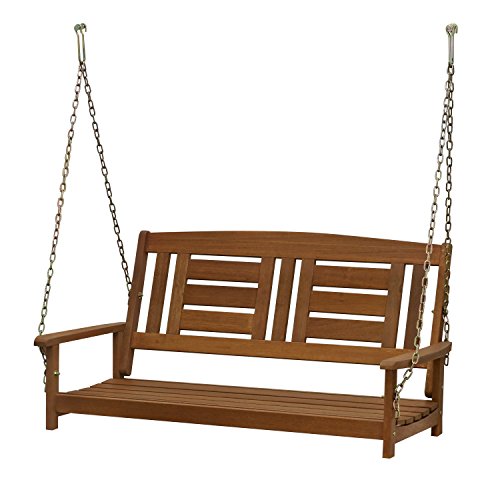
Furinno Tioman Hardwood Swing Chair
Best for: single-seat hardwood swing chair. Tier: mid.
Every other seat here is a bench; this one is a room of its own for one person. That single-seat format changes both the social maths and the floor plan. Socially it is a retreat — a reading corner, a quiet first coffee — rather than a gathering place. In plan, its compact footprint fits bays and corners of screened porches, slim open porches and balconies where a bench plus its arc would consume the walking route. The hardwood gives it a warm, planted feel alongside planting and a small side table. It will disappoint anyone shopping for togetherness, anyone who likes to stretch out, and anyone who expects the lounging depth of a bench from a more upright chair. Mobility deserves a specific thought too: a single chair can be steadied and approached from the side, which some sitters find an easier transfer than a wide moving bench. The full safety regime still applies — structural fixing, rated fittings, clear travel, seasonal checks — because a smaller seat hangs by the same physics.
Verify the specification on the live listing. Not suited for: porches that cannot keep its swing path clear, or households that will not still the seat and inspect its fittings as advised above.

POLYWOOD Chippendale Porch Swing
Best for: recycled-lumber low upkeep. Tier: premium.
The material is the argument here. Recycled plastic lumber in a formal Chippendale-pattern bench removes the sanding-and-sealing cycle from ownership altogether: rain is an inconvenience rather than a threat, the colour runs through the board instead of sitting on its surface, and cleaning replaces refinishing on the seasonal list. That points this seat squarely at open porches with real exposure, coastal air, second homes that stand empty between visits, and busy households — including those managing children, work and mobility needs — who know their spare minutes will not go to a tin of finish. In exchange, buyers give up the feel and gradual character of genuine timber, and they pay premium-tier money for the privilege. The patterned back also has a presence, so hold it up mentally against your own frontage: tailored houses wear it beautifully, while a deliberately rustic porch may sit happier with plain slats. The hanging hardware, note, enjoys none of the material’s indifference to weather and still needs its inspection.
Read the live listing before buying. Not suited for: any porch unable to give it clear travel on all sides, or buyers unwilling to follow the rating and inspection guidance in this article.
Setup and Care That Reduce the Cons
Installation day decides how large the drawbacks ever become. Confirm the joists, fit rated components, hang the seat level, test the travel empty and then loaded, and teach the house rules — hands clear of the closing gaps, no standing, no spinning, no violent rocking of a stand — before the first celebration sit. After that, care settles into a short circuit: wash the seat, work along chain and eyelets, tighten fixings, store cushions dry, and give an exposed swing extra attention after storms. Screened-porch owners will find the circuit shorter, open-porch owners more frequent, and second-home owners should put the inspection first on the reopening list, before the kettle. Households that run this circuit stop describing the cons as features of the swing at all; they become a familiar ten minutes attached to sweeping the steps.
Bottom Line
Judge the exchange in your own combination of porch and people. If the structure is sound or a stand is welcome, if the travel fits without stealing the route to the door, if the material matches the weather and the upkeep on offer, and if the seat’s height, depth and armrests suit the tallest sitter and the least steady one alike, then the daily returns described here are genuinely collectable and the duties are small. If one of those conditions fails outright — a lease that forbids fixing and forbids a stand, a porch too narrow for a safe arc, a transfer that cannot be made secure — believe the failure early. A well-chosen different seat will serve that household better than a swing bought on hope and negotiated with ever after.
The Trade-Offs in Daily Life: Where a Porch Swing Earns Its Place and Where It Does Not
The brochure moment lasts an afternoon; the reality lasts years, and it happens in a specific place — behind a screen door that sticks slightly, under a ceiling whose joists run one way and not the other, in a house where a toddler, a tall teenager and a grandmother on a walking stick all need the same route to the front door. So judge in a strict order — routine first, setting second, product last. Most disappointing purchases reverse that order and fall in love with a bench before interrogating the porch. Begin overhead, with structure and fixings, because every later virtue depends on that answer. If it fails and a stand is not an answer either, stop with a clear conscience. If trouble appears later, bring dated notes rather than impressions; they get useful help far faster.
When several benches all look acceptable, the missing fact is almost never in the listings. It is in your household’s calendar. A seat that delights in May must still make sense during the dark, wet months, during holiday weeks when the porch holds coats and deliveries, and after the household changes shape — a baby arriving, a parent moving in, a knee operation that puts someone on crutches for a season. A drawback met at every crossing outweighs a delight met on occasional fine Sundays, whatever symmetry a list pretends to offer. Photographs flatter dimensions, so write the real ones down: the available width, the depth, the travel at front and back, the turning space, and the path the bench itself must take through doors and screens to reach its place at all.
- For each drawback, note whether a habit, a fitting or a different model genuinely manages it.
- For each advantage, estimate how many days a month your household will actually feel it.
- Test the decision against the busiest, messiest week of your year, not the quietest.
- Ask which compromise each person in the house finds easiest to live with — they may differ.
- Let a daily friction count for more than a rare inconvenience, every time.
Position quietly governs use. A swing reached only by shifting planters, bikes or a parked pushchair will be visited less and less. Then look hard at fit for real bodies: depth against thigh length, armrests against the effort of standing, and a route in and out that a person on crutches can manage without the bench drifting mid-transfer. Check the choice against both rhythms — the weekday dash and the weekend sprawl — rather than averaging them.
Some homes solve competing needs by pairing rather than choosing: a bench for company and a single swing chair in a quiet bay, or a hanging seat on the screened porch and the stand doing duty in the garden through summer. Treat anything load-bearing with the respect its maker’s guidance demands, and read that guidance before money changes hands rather than after the box is open. If a shortlist has formed, take it back to the actual listings — the Amish Casual Heavy Duty Roll Back Porch Swing and the Jack Post Traditional Porch Swing, for instance — and compare the current details there instead of relying on remembered impressions. The bench must fit around fixed facts — screen door, porch light, the step down. It adapts to the house; the house does not adapt to it.
Read the contents list with the same care as the feature list, because many miserable first evenings are simply the discovery that hangers, connectors or an essential fitting were never included. There is no universal winner, only a fit or a misfit with a household’s week. When something does go wrong, work the sequence a technician would: free and simple causes first, the swing itself last. Think at the start about repair and eventual disposal too, because designs differ enormously there.
Where a habit genuinely manages a drawback — seasonal checks, cushions in ahead of wet weather, stilling the seat while an unsteady sitter settles — record it as an effort cost, not a veto. Fit and durability deserve the bulk of your attention, since buying happens once and sitting happens daily. Sometimes the cleverest purchase is the smaller one, leaving an existing chair to cover solitary reading. Validate the decision against rain on an open porch and a tired household crossing in the dark, not against a calm day.
Frequently Asked Questions
What is the biggest disadvantage of a porch swing?
For a hanging bench, the demand for real structure overhead. Without confirmed joists and fittings rated beyond the loaded, moving weight, there is no safe installation, and no finish or bracket changes that. Renters meet the sharpest version, since sound joists may still be forbidden territory. Space runs second — the travel needs clear air ahead and behind — and the recurring inspection duty runs third, as the habit that stops the first two from ever turning into incidents.
Are porch swings safe for children?
They can be, in a house that treats the rules as part of the seat itself. Sound fixing, rated hardware, a clear arc and a calm, unhurried motion form the base; on top of that come supervision, an early ban on standing, climbing and chain-twisting, and deliberate attention to the gaps where the seat and chains move and small fingers wander. Inspect on schedule and enforce the rules most firmly while the swing is still a novelty. Reported trouble overwhelmingly follows poor installation or unchecked misuse, not the idea of a family swing itself.
Do the pros outweigh the cons for most people?
For an owner-occupied house with a usable porch and trustworthy joists, experience says comfortably yes — the sitting becomes daily, while the duties compress into a brief seasonal round, and screened porches tilt the balance further still. The answer reverses where structure is unavailable and a stand is unwanted, where a narrow porch cannot give the seat its travel, where a lease forbids every workable arrangement, or where nobody will perform even the minimum checks. Those are facts about a setting, and this guide treats them as decisive in either direction.
How much maintenance is the honest minimum?
A thorough spring session — wash the seat, examine chain, eyelets and fixings one by one, tighten what needs it — plus a shorter mid-season look on a busy or exposed porch, cushions kept dry, finishes renewed when their material asks, and worn components replaced before they carry another season rather than after. Recycled lumber removes the refinishing from that list; timber on an open porch adds it back. The total is measured in minutes a few times a year, but it is genuinely a rhythm: the only version that fails is skipping it altogether.
Is a porch swing a good idea for a small porch?
Usually only in its smaller forms. A full bench on a tight porch tends to fail on travel and to tax everyone crossing behind it, until each advantage arrives wrapped in friction — worst of all where that crossing is also the route for a pushchair, crutches or a wheelchair. A single swing chair, fixed with exactly the same structural care into a corner with clear air around it, keeps the motion and the ritual at a footprint the porch can afford. Chalk the travel on the boards, walk the route, and let the porch itself cast the deciding vote.
What is the most common regret owners report?
Oversizing comes first: a bench bought for the porch in a photograph rather than the porch with its doors, screens and walking routes measured. Casual hanging comes a close second, cured by joists, rated fittings and patience. A third regret surfaces more slowly — a high-upkeep material matched to a low-upkeep household, often on an open porch, until the finish gives up. Households with an unsteady sitter add a fourth: discovering too late that seat height and armrests were the specifications that mattered. Every one of these regrets is cheaper to have on paper than on the porch.
Related Guides and Next Steps
A swing is only one of the decisions that shape how a porch works, and the right neighbours for it depend on your setting — screened or open, compact or wide, gathering place or quiet retreat. The companion pieces below cover the related seats, surfaces and soft furnishings in this cluster.
what owners report in porch swing reviews
the porch swing buying guide, step by step
is a porch swing worth it, in money and time
how to install a porch swing the safe way
best outdoor swing chairs for smaller spaces
patio table and chairs for the other end of the porch
patio furniture pillows for extra comfort
More to Consider: Sizing the swing to the porch
Begin with movement through the space rather than with the seat. Someone must still reach the door with shopping in both hands, a child must pass without ducking the bench, and a person using a wheelchair or crutches must approach, turn and transfer without the swing drifting into their path. Draw those routes first, add the travel of the seat at its liveliest, and only then see which format the remainder honestly holds: a two-person bench for most family porches, a longer bench where gatherings are the whole point, or a single chair for the narrow screened bay. Chalk is cheaper than returns.
For this porch-by-household way of judging, size is not a catalogue dimension but a daily negotiation — and a slightly smaller seat that never has to be apologised for will quietly outscore a grander one that taxes every crossing.
More to Consider: Style that belongs to the house
Few pieces of furniture are as public as this one. It frames the front door, appears in every photograph taken from the steps, and is the first thing a visitor reads as a statement about the house. Plain slatted benches sit comfortably against most frontages, a formal patterned back suits a tailored house, and cleaner contemporary lines belong with newer builds. Colour works quietly in the background: echo the door or the trim and the seat looks grown rather than placed, while a deliberate contrast can lift one porch and unsettle another. Screened porches add a filter to all of this, softening whatever sits behind the mesh.
Stand on the pavement and look at your own home as a stranger would. Belonging is the quality that survives a decade of looking, long after the practical shortlist that produced it has been forgotten.
More to Consider: Care through the seasons
Think in seasons rather than in chores. Spring means washing away winter, handling every link and eyelet, tightening fixings and checking the material around each bolt. Summer, on an open porch, means wiping spills and pollen before they set and pulling cushions in ahead of storms; behind screens the same jobs arrive more slowly. Autumn asks for leaves to be cleared before they hold damp against the seat, and for an honest call on timber finishes — recoat now or schedule it properly. Winter asks exposed seats for a cover or storage, and windy sites for a way of stilling the bench.
None of this expands beyond a few short sessions a year, and households that attach it to an existing ritual — sweeping the steps, reopening a second home, the first barbecue — find it stops feeling like maintenance at all.
More to Consider: Reading, talking and the social physics of a swing
Shared, outward-facing, gently moving: the arrangement does social work that the sitters rarely notice. Without eye contact to maintain, conversation loosens, pauses stop needing to be filled, and people say things on a swing that they would edit at a table. Households discover shifts without planning them — a reader defending the bright end in the morning, coffee drinkers at dawn, everyone piled in behind the screens after supper. Choose according to the shift you value. Company argues for width and an unhurried arc, reading for back support and a dry perch for a drink, and evening talk for cushions and a throw within reach.
The lesson for the porch-by-household lens is that the specification is not really the bench. It is the ritual the bench will host, in that light, with those people, on that porch.
More to Consider: Children, grandparents and everyone between
A seat shared across generations has to be judged at both ends of life at once. Children need the rules taught early — no standing, no spinning, hands away from the closing gaps — and an adult close enough to enforce them while they are still exciting. Older sitters need almost the opposite qualities emphasised: a height that lets feet rest flat, armrests solid enough to push up from, and a motion gentle enough never to feel like a fairground. Between those poles sit tall adults who need depth, and anyone recovering on crutches who needs the bench stilled and the approach kept clear. Generous load ratings and calm, familiar proportions serve every one of them simultaneously.
When a swing feels steady to a grandparent and is respected by a child, it gets used daily. When it feels low, tippy or frantic to either, it quietly becomes scenery — which is why stability outranks novelty here.
More to Consider: Value over years, not weekends
Spread the cost across the sittings and the arithmetic changes character. A premium handcrafted or recycled-lumber bench that serves for many years with modest attention can undercut a cheap seat replaced repeatedly, while a simple traditional bench under a covered or screened porch can outlast every expectation attached to its tier. The trap runs in the other direction too: premium money spent protecting against weather a screened porch never delivers, or on width a household never fills, is waste wearing the clothes of quality. Renters should run the sums differently again, favouring arrangements they can take with them.
Matched to porch, exposure and real habits, a purchase tends to feel right at every sitting. Mismatched on any of those three, no tier is expensive or cheap enough to rescue it.
More to Consider: When a stand makes sense
A stand is not the consolation prize for a failed hanging plan; in several common situations it is simply the correct engineering. Rented homes where fixing is forbidden, porches whose joists cannot be trusted, and households whose best sitting place is honestly the lawn all belong on its list. The questions move rather than vanish: the ground must be level and firm, the frame assembled exactly as directed, and hard rocking treated as misuse, because an A-frame can tip. In return the seat becomes movable, reversible and take-it-with-you — qualities no bolted installation offers.
Carry the same discipline across with it — ratings respected, travel kept clear, fittings inspected on schedule — and a stand-mounted swing gives up nothing that matters to the people sitting in it.
More to Consider: Materials, honestly explained
Choosing a material is really choosing the owner you are going to be. Timber offers warmth, weight and a surface that can be sanded and refinished for years, and asks for exactly that attention wherever sun and rain can reach it — which, on an open porch, is everywhere. Recycled lumber trades some natural character for near-indifference to weather, suiting busy households, exposed sites and homes left empty for stretches. Metal frames bring slimmer profiles and structure, often carrying timber or sling seats. Behind screens, where weather is filtered, timber’s demands soften considerably and its character argues louder.
Answer honestly rather than aspirationally. If a spring afternoon with a brush sounds like pleasure, timber will repay you for decades; if the seat will be lucky to be washed, choose the material that forgives that, because a swing still looking cared-for in year five beats a finer one that peeled in year two.