Disclosure: As an Amazon Associate, airfryerkitchensupply.com earns from qualifying purchases. Links on this page are affiliate links; they cost you nothing extra. Prices and availability change often, so check the current Amazon listing before you buy.
A meat thermometer buying guide has one job: to turn a wall of similar-looking probes into a short, confident shortlist. This meat thermometer buying guide does it in the order experienced cooks actually decide — first the design that matches your cooking, then the handful of criteria that separate a tool you will use daily from one that will gather dust, then six real models from ThermoWorks, MEATER, Inkbird and Taylor placed honestly into entry, mid and premium tiers. No prices are printed here, because prices move; tiers and the current listing will tell you what you need when you buy.
Key Takeaways
- Decide the design first — instant-read, leave-in wired or truly wireless — because it decides everything else.
- Temperature is the only reliable doneness check; you are buying certainty about the coldest spot in the meat.
- Tip sensing and a fast settle matter more than headline features for everyday cooking.
- Buy probe channels for the cooks you actually do: one for spot checks, two for meat plus chamber, four for mixed loads.
- Plan the unglamorous parts: probe washing between checks, sheathed storage away from children, and a twice-yearly accuracy check.
In this guide
What a Meat Thermometer Does and the Main Types
A meat thermometer measures the internal temperature of food at the spot its probe tip occupies — ideally the thermal centre, the thickest part, which is the last place to cook through and therefore the place that decides both safety and texture. Everything in the category is a variation on how that measurement is taken and delivered.
Instant-Read Thermometers
An instant-read is a spot-check tool: a probe on a handle, pushed into the meat for a few seconds at the moment you want a verdict, then removed. Digital models read at or near the tip, which makes them accurate in thin and thick cuts alike, and the better ones settle quickly enough that checking five spots costs you almost no cooking time. Dial models work the same way but settle more slowly and sense further up the stem. Instant-reads cannot stay in a closed oven or smoker, and they give you a moment, not a movie — which is why they pair so well with a leave-in for long cooks.
Leave-In Wired Probes
A leave-in probe is built to stay in the meat for the whole cook, connected by a heat-resistant cable to a base unit outside the oven or smoker. It watches continuously, and — the feature that changes cooking — it alarms at your target, so a roast announces itself instead of relying on you remembering to check. Many bases take a second probe for the cooking chamber itself, which exposes the gap between what your oven dial claims and what the food is actually experiencing. The cable is the compromise: it must route through a door seal without being pinched, and it must be kept away from direct flame.
Truly Wireless Probes
The newest category puts the whole sensor in a single spike with no cable at all. The probe stays in the meat, senses internal temperature at the tip and ambient temperature at the exposed end, and reports to an app through a repeater in its charging block. The freedom is real — rotisseries, sealed pans and small air fryer baskets all become monitorable — but so are the constraints: one probe watches one piece, the probe needs a minimum depth of meat around it, and the system lives or dies on charge and connection. Most serious kitchens end up owning one tool from two of these three families, because they answer different questions.
One principle sits underneath everything in this article, and it is worth stating plainly: temperature is the only reliable check of doneness. Colour is not. A chicken breast can look white and opaque at the edges while its centre is still underdone, a burger can brown beautifully on the outside long before the middle is safe, and pork can keep a blush of pink at a temperature that standard public food-safety guidance considers fully cooked. Judging by colour, by how clear the juices run, or by how long a recipe says a cut usually takes are all ways of guessing at the one number that actually decides both safety and quality. A thermometer replaces the guess with the number.
Standard public food-safety guidance — the figures published by government food-safety agencies and printed on countless packaging inserts — puts poultry at the top of the scale, ground meats in the middle, and whole cuts of beef, pork, lamb and fish lower, with a short rest for whole cuts before serving. You do not need to memorise a chart to cook well, but you do need to look your target up for the cut in front of you and then measure the coldest spot, because the coldest spot is the one that decides. That habit — target first, probe second, judgement third — is the entire skill this article is about.
Top Picks at a Glance
| Pick | Badge | Design | Tier |
|---|---|---|---|
| ThermoWorks Thermapen ONE | Best Overall | Instant-read | Premium |
| ThermoWorks ThermoPop | Best for Most Kitchens | Instant-read | Mid |
| ThermoWorks Smoke | Best for Smoking | Leave-in, radio | Premium |
| MEATER Plus | Best Cable-Free | Truly wireless | Premium |
| Inkbird IBBQ-4T | Best for Big Cooks | Leave-in, four probes, Wi-Fi | Mid |
| Taylor Classic | Best Budget Backup | Dial | Entry |
Badges describe roles, not ranks: the entry-tier Taylor is the right pick for the job it is badged for, and the premium Thermapen would be a poor buy for someone whose real need is overnight monitoring. Read the criteria sections below before treating any row as your answer.
How Fast Does It Need to Read?
Speed is the instant-read criterion, and it matters for a physical reason: every check happens with a lid up or a door open, heat escaping, and your hand near the heat. A fast digital settles before the moment becomes a negotiation; a slow one teaches you to check less often, which quietly defeats the purpose. Dial models settle slowest and also sense further up the stem, which is why they suit thick roasts better than burgers. If you grill thin cuts often, prioritise a digital model that senses at the very tip — it is the difference between measuring the centre of a fillet and measuring somewhere near it.
Spot-Check or Full-Time Monitoring?
This is the fork in the whole buying guide. Spot-checking — an instant-read used at decision moments — covers the majority of home cooking: weeknight proteins, grilling, frying, air frying. Monitoring — a probe that stays in and alarms at your target — transforms long, unattended cooking: smoking, big roasts, whole birds, and slow cooks in machines like those in our guide to sous vide machines, where the bath holds temperature but a final check still confirms the centre of a thick cut. Many households end up with one of each, bought in that order. Be honest about which cook you are most weeks, and buy for that cook first.
Wired, Radio or Truly Wireless?
Among monitoring systems, the connection shapes the experience. A wired probe to a base beside the cooker is simplest and cheapest but keeps you nearby. A dedicated radio receiver, as on the ThermoWorks Smoke, carries the numbers around the house with no app, no pairing and no account — a deliberate, robust kind of simplicity. Wi-Fi systems such as the Inkbird IBBQ-4T report to your phone from anywhere your network reaches, with graphs and history, at the cost of setup and app dependence. Truly wireless probes like the MEATER Plus remove the cable entirely for rotisseries and small baskets; compare the connected end of the market in wireless meat thermometers if this is your direction. None of these is ‘best’ in the abstract — each trades freedom, simplicity and oversight differently.
How Many Probes, and How Long?
Probe count should follow your largest regular cook, not your largest imaginable one. One probe: a single main piece. Two: the piece plus the chamber, the classic barbecue arrangement that also audits your oven. Four: genuinely mixed loads. Probe length matters too — the probe must reach the centre of the thickest food you cook, with handle to spare, which is why turkey households and brisket households should measure their biggest joint before ordering the shortest, neatest model. Thin, tip-sensing probes leave smaller holes and suit delicate fish and sliced meats; sturdier probes shrug off years of brisket duty.
Display, Alarms and the Details That Decide Daily Use
The features that decide whether a thermometer gets used are embarrassingly practical. A display you can read at arm’s length, backlit for evening grilling, ideally rotating if you check from odd angles. Alarms that are loud enough to hear from the next room and simple enough to set with greasy hands. A body that tolerates splashes and wipes clean. A probe that stores capped or sheathed — probes are sharp, and a bare spike in a drawer is an accident and a child-safety problem waiting to happen. Batteries you already own, or a rechargeable base you will actually remember to charge. Judge models on these details and you will rarely regret a purchase; judge on headline features alone and the drawer of abandoned gadgets grows.
How you handle the probe matters as much as where you put it. A probe that has just been inside raw chicken is, for hygiene purposes, raw chicken: wash it with hot soapy water, or wipe it thoroughly, before it goes into cooked food, into a second piece of meat you are about to serve, or back into its storage sleeve. The same rule applies between checks during one cook — probe the raw side of a half-cooked roast, wash, then probe again — because cross-contamination is how a careful cook undoes careful cooking. Keep a small bowl of hot soapy water or a clean damp cloth by the grill for exactly this job and it becomes a two-second habit rather than a chore.
Placement is the other half of accuracy. Always probe the thickest part of the meat, pushing the tip into the centre of that thickest mass, and keep the tip away from bone, fat seams and gristle. Bone conducts heat differently from muscle and can read hot while the meat beside it lags; a pocket of fat reads its own temperature, not the muscle’s; gristle and cartilage do the same. If a reading looks suspiciously fast or high, it usually means the tip is touching bone or sitting in fat — pull back slightly, angle into fresh muscle, and check again. On irregular pieces, take two readings in two spots and trust the lower one.
Meat Thermometer Buying Guide Priorities: How to Choose by Use Case
The Weeknight Cook
Your cooks are fast and frequent: chicken breasts, chops, burgers, salmon. Prioritise instant-read speed, tip sensing and a display you can read one-handed. ThermoPop or Thermapen ONE, according to tier. Monitoring can wait.
The Smoker
Your cooks are long and lid-sensitive. Prioritise at least two probes, dependable alarms and chamber monitoring: the Smoke for app-free reliability, the IBBQ-4T for four channels and remote checks. New to the cooker itself? Start with electric smokers for beginners.
The Roast and Holiday Cook
Your cooks are occasional but expensive: the big joint, the whole bird. Prioritise probe length, a leave-in alarm so the centrepiece announces itself, and an instant-read for the post-rest confirmation — especially for the birds discussed in turkey air fryers and their oven-roasted cousins.
The Gadget-Tidy Cook
You hate cables and clutter. The MEATER Plus was designed for you — one probe, one wooden block, no wires — provided your cooking is one main piece at a time and rarely thin cuts.
The Picks in Detail

ThermoWorks Thermapen ONE — Best Overall Instant-Read
The Thermapen ONE is the reference point for instant-read thermometers: a folding digital probe that wakes when you open it, reads at the very tip of a slim needle, and folds away into a handle that feels more like a tool than a gadget. The body is chunky enough to grip securely with a damp hand or a thin oven mitt, the display is large and backlit, and the reading settles fast enough that you are not hovering over a hot grill with the lid up and the heat escaping while you wait. That speed is the whole point of the design: a quick check should cost you seconds of cooking, not a meaningful drop in grill or oven temperature.
Best for: Frequent grillers, roasters and air fryer cooks who want one fast, dependable spot-check tool. Not suited for: Anyone who mainly wants hands-off monitoring of long smokes; a leave-in alarm model fits better.
Tier: premium — check price on Amazon.
ThermoWorks ThermoPop — Best Mid-Tier Instant-Read
The ThermoPop takes the same design philosophy as its bigger sibling and trims it to the essentials: a short folding-style probe on a compact body, a display that rotates so you can read it from whichever hand and angle you approach the meat, and simple one-button operation. The rotating display sounds like a small thing until you are checking a chicken thigh from the left side of a crowded oven shelf and realise you no longer have to read numbers upside down. It is light, pocketable, and easy to wipe clean.
Best for: Home cooks who want a trustworthy everyday checker without paying flagship prices. Not suited for: Cooks who want a single tool that also monitors long cooks; pair it with a leave-in instead.
Tier: mid — check price on Amazon.
ThermoWorks Smoke — Best Leave-In for Smoking and Roasting
The Smoke is a leave-in system built around a simple idea: one probe watches the meat, a second watches the air inside your smoker, grill or oven, and a wireless receiver you carry with you reports both, with alarms you set for a target temperature and for a cooking-chamber range. There is no app to pair and no account to create; the base unit and receiver talk to each other over a direct radio link, which is exactly what you want at six in the morning when the brisket goes on and your phone is still on the nightstand.
Best for: Smokers and roast cooks who want alarms without apps, accounts or pairing rituals. Not suited for: Cooks who need to monitor from away from home; a Wi-Fi model is the better fit.
Tier: premium — check price on Amazon.

MEATER Plus — Best Truly Wireless Probe
The MEATER Plus removes the cable entirely. The probe itself is a slim metal spike that stays in the meat from the start of the cook to the end, sensing the internal temperature at its tip and the ambient temperature at its outer end, and it charges in a wooden block that also acts as a signal repeater for the companion app. With no wire to route through a door seal or lid, it is uniquely happy in places cables are awkward: a rotisserie, a small air fryer basket, a covered pan, or a grill you keep opening as little as possible.
Best for: Rotisserie, air fryer and tidy-kitchen cooks who hate cables and cook one main piece at a time. Not suited for: Batch cooks monitoring several meats at once, or anyone cooking mostly thin cuts.
Tier: premium — check price on Amazon.

Inkbird IBBQ-4T — Best Multi-Probe Wi-Fi Value
The Inkbird IBBQ-4T is the multi-probe workhorse of the group: four colour-coded probes on one base unit, Wi-Fi as well as local wireless, and an app that graphs the cook and fires alarms at your targets. Four probes change how you cook a mixed grill — two cuts of different thickness, a chicken and a rack of ribs, meat plus chamber — because each piece gets its own number instead of sharing one hopeful check. The colour coding sounds trivial until you are tracing which cable belongs to which reading in the dark.
Best for: Cooks running several meats at once, and anyone who wants to check a long cook from another room or further. Not suited for: Minimalists who cook one small cut at a time; a simple instant-read is less to manage.
Tier: mid — check price on Amazon.
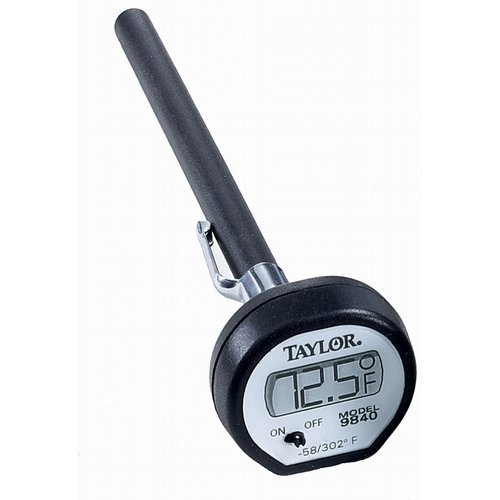
Taylor Classic Instant Read Thermometer — Best Entry-Tier Backup
The Taylor Classic is the old-school answer: an analogue dial thermometer with a stainless stem, a pocket sleeve with a clip, and no battery to die at the wrong moment. You push the stem into the meat, wait for the needle to settle, and read the dial. It has survived in kitchen drawers for decades because it is simple, tough and cheap enough — firmly entry tier — to own as a spare without thinking about it.
Best for: Beginners building the temping habit, and as a no-battery backup for any kitchen. Not suited for: Thin cuts, fast grill work, or anyone who wants an unambiguous digital number.
Tier: entry — check price on Amazon.
First Setup and Care Essentials
Resting is part of measuring, not an afterthought. When meat comes off the heat, its temperature does not freeze: the hot outer layers keep pushing heat inward for a while, a carryover effect that is strongest on large roasts and whole birds, and juices that are still moving will flood out of a cut made too early. As a principle, judge a roast by the temperature it will reach after its rest, not only by the number at the moment you lift it out, and let the rest happen tented and undisturbed. Small cuts rest briefly; big joints rest longer. The thermometer’s job is not finished at the oven door — a final check after resting, in the thickest part, is the reading that counts.
Finally, check the checker. Thermometers drift, get dropped and age, so build the habit of verifying yours periodically at principle level: a glass of iced water, well stirred, should read at freezing point, and boiling water at a rolling boil should read at boiling point for your altitude. If a digital model reads a degree or two off in both tests, cook with that offset in mind or follow the maker’s recalibration steps; if a dial model is off, its adjustment nut exists for exactly this. Two minutes, twice a year, keeps every other reading in this article honest. And because probes are sharp, store them capped or sheathed — sleeve, magnetic case or a cork on the tip — in a drawer where children cannot grab a bare spike, and never loose in a washing-up bowl where a hand goes in blind.
Care is short and unglamorous. Wash the probe shaft after every use — hot soapy water, a thorough wipe, dry before storing — and never immerse a digital body or base unit unless the maker explicitly says it is waterproof; most are splash-resistant at best, and the electronics live in the handle, not the probe. Keep cables away from direct flame, do not let them dangle onto a hot grate, and coil them loosely rather than wrapping them tightly around the base, which fatigues the wire inside. Store probes capped or sheathed, tips protected and out of children’s reach, and keep spare batteries with the thermometer rather than discovering a dead display with a turkey in the oven.
Calibration checks, as described earlier, belong on the same calendar as changing a smoke-alarm battery: iced water and boiling water, twice a year, two minutes. If a probe reads consistently off and cannot be adjusted, retire it from safety-critical duty — a thermometer you cannot trust is worse than none, because it replaces honest uncertainty with false confidence. Treat the tool well and a good digital model will outlast several grills.
Mistakes to Avoid When Buying
Buying the design your neighbour loves instead of the one your cooking needs. Paying premium tier for channels and connectivity you will never switch on. Choosing a dial for a household that cooks mostly thin cuts. Forgetting the second purchase the design implies — spare batteries, a sheath, a home within reach of the stove. And the meta-mistake: treating the thermometer as the finish line, when the technique — thickest part, wash between checks, rest before judging, covered in how to use a meat thermometer — is what makes its numbers mean something. If the whole purchase still feels optional, is a meat thermometer worth it argues the question honestly, and meat thermometer pros and cons lists what ownership gives and what it asks.
Buying for Specific Foods
Poultry: The Non-Negotiable Case
If your household cooks chicken and turkey, the thermometer decision is really a decision about which model, not whether. Whole birds need a probe that reaches the inner thigh’s centre and, ideally, monitoring so the breast is not sacrificed while the thigh catches up; pieces need tip-sensing speed. Households whose year peaks at a holiday bird should weigh probe length and a leave-in alarm heavily — the most expensive poultry mistake of the year happens on exactly the day the whole family is watching.
Steaks and Chops: Precision at the Margin
For steaks, the thermometer’s job is not safety so much as aim: the difference between the doneness you ordered from yourself and the one beside it is a small temperature band, and colour and touch both blur it. A fast tip-sensing instant-read, entered from the side, is the tool; leave-in probes are generally too much apparatus for a cut that cooks in minutes, and dials too slow to catch a moving target on a hot grill.
Fish: The Delicacy Test
Fish exposes weak probes. Fillets are thin, fragile and quick, and they punish a thick, slow sensor that tears the flesh and averages the pan’s heat into the reading. A slim digital instant-read is close to mandatory here; everything else in this guide’s table should be considered a roast-and-grill tool that fish tolerates rather than enjoys.
Ground Meat: Where Guessing Is Worst
Burgers, meatballs, meatloaf and sausages combine the highest guidance temperatures in everyday cooking with the least reliable visual cues — browning happens early and proves nothing. Side-entry instant-read checks on patties, centre checks on meatloaf, and the wash between raw-centre and finished pieces are the routine. A household that cooks ground meat weekly gets more safety per use from its thermometer than any other profile in this guide.
Beyond Meat: Bread, Custard and Leftovers
Budget the tool’s value honestly and the non-meat jobs count: enriched breads judged by crumb temperature, custards pulled before they curdle, leftovers reheated to a safe serving temperature rather than a hopeful one, and poaching water held in its gentle band. A thin, fast digital probe does all of this; it is one more reason the instant-read is the recommended first purchase for nearly every kitchen.
Three Worked Examples
The Tuesday-night parent. Two proteins a night, homework at the table, no patience for systems. The buying guide’s answer: a mid-tier digital instant-read with a rotating or backlit display, stored sheathed by the stove. Monitoring would be jewellery on this profile; speed and hygiene are the whole game.
The new smoker owner. A first brisket is planned and the cooker is already bought. The answer: a two-probe leave-in at minimum — meat plus chamber — with alarms that can be heard from the house. Radio or Wi-Fi is a temperament choice; channels and alarm reliability are not. Add the instant-read at the next purchase for the post-rest confirmation.
The holiday host. Fifty weeks of ordinary cooking, two weeks of birds and joints for a crowd. The answer: probe length and an alarm first — a leave-in that reaches the centre of the biggest bird of the year — with the entry dial kept as the second-opinion backup when twelve people are asking if it is ready yet.
Questions to Ask Before You Pay
Run any candidate model through these five questions and the shortlist usually shortens itself. Does the sensor sit where my food needs it — tip for thin cuts, deep stem for big joints? Can this design stay in my longest cook, or only visit it? How does the reading reach me at the moment of decision — screen in hand, receiver in pocket, phone in another room? What exactly happens at washing-up time, and where does the sharp probe sleep tonight? And what does the tier step above this one actually buy, in behaviour I will feel weekly? A model that answers all five cleanly is rarely the wrong purchase, whatever badge it wears in the table above.
Understanding Range, Resolution and Other Listing Language
Listings speak a dialect worth translating before you buy. Range describes the span a thermometer can measure, which matters at the extremes — a model meant for the smoker should shrug off chamber heat, and one destined for sugar work or deep frying needs headroom at the top — but for meat itself, every serious model covers the territory with room to spare. Resolution is the fineness of the display: whole degrees are genuinely sufficient for cooking decisions, since your targets, rests and carryover all operate at that scale, while finer resolution flatters the spec sheet more than the cook. Response language — ‘instant’, ‘rapid’, ‘fast’ — should be read as a class claim rather than a measurement, and weighed alongside the design: a tip-sensing digital will always out-settle a dial, whatever either box promises. Water-resistance language deserves the same scepticism: probes wash, bodies vary, and the honest phrase to look for describes the body, not the product as a whole. Finally, probe-count language on monitored systems should be checked against what is actually in the box and what the base can run at once; channels you cannot use simultaneously are not channels. A buyer who translates these five phrases can read any listing in the category in under a minute — and will find that the six models in this guide describe themselves, in the main, fairly.
Where to Keep It: The Storage Decision
End the buying process with the least glamorous and most consequential decision: where the thermometer will live. The right answer is within one step of where meat is cooked, sheathed or cased, with its batteries or charger as neighbours. A magnetic case on the fridge door beside the oven, a dedicated slot in the knife strip’s block, a shallow drawer by the hob with the sheath fixed in place — all work. What does not work is the deep utensil drawer across the kitchen, where a sharp probe hides among spatulas, endangers the hand that goes fishing, and — human nature being reliable — gets skipped on the busy nights when it is needed most. Decide the home before the model arrives, buy the sheath or case in the same order if the model lacks one, and the best buying decision in this whole guide will quietly make itself every night thereafter.
A Short Buying Timeline: What to Buy First, Second and Never
Most kitchens should not buy their whole thermometer setup in one order, and this guide closes its advice with the sequence that experience recommends. First: the design that covers your most frequent cooks — for the great majority, a digital instant-read at the tier your frequency justifies. Live with it for a season. Learn your oven’s drift, your grill’s hot corner, your own carryover on the joints you actually cook. Second, only if the gap appears: the complementary design. The gap announces itself honestly — you catch yourself wishing a roast would simply tell you when it is ready, or wishing the smoker did not need patrols, or avoiding the rotisserie because nothing you own can ride it. That wish, felt repeatedly, is the correct trigger for a leave-in, multi-probe or wireless purchase, bought then with the knowledge of exactly which limitation it removes. Never: a second unit that duplicates the first’s job at a lower tier ‘for the other kitchen drawer’, a connected system bought for a cook who has disabled notifications on everything they own, or channels and features purchased for imaginary dinner parties. The timeline sounds austere; in practice it is how households end up, a year later, owning exactly the tools they use weekly and nothing they apologise for — which is the definition of a buying guide that worked.
Final Checklist Before Checkout
Design chosen and matched to your most frequent cooks. Sensor placement suited to your thinnest regular food. Probe length sufficient for your thickest annual one. Display readable in your light, at your angles. Alarm audible in your house, if alarms are the point. Washing understood, sheath included or added, storage home decided. Tier justified by frequency, not by features. If every line is ticked, buy with confidence and put the tool by the stove the day it arrives — the first chicken breast it saves will start repaying the decision before the packaging is recycled.
Buying Second-Hand, Buying for Others, Buying Abroad
Three buying situations deserve a paragraph each before this guide closes. Second-hand: instant-read digitals and dials travel well between owners — verify against iced and boiling water on arrival, wash the probe thoroughly, and the tool is yours with a clear conscience. Monitored systems deserve more caution: probes and cables are the wear items, a missing channel or a frayed cable is the commonest disappointment, and app-based models should be checked for a living app before money changes hands. Buying for others: gift the design the recipient’s cooking needs, not the one yours does; the new cook gets the mid-tier instant-read, the barbecue devotee gets monitoring, and nobody gets a system whose app they will resent — include the sheath, and if the model lacks one, add it, because a gift that arrives storable gets used. Buying while travelling or from overseas listings: check the temperature scale the display uses and whether it switches, confirm the battery type is one you can buy at home, and remember that warranty support follows the market the unit was sold for. None of these situations changes the criteria in this guide; they merely add a verification step to it, which is, appropriately, the most on-brand advice a thermometer guide can give.
The One-Paragraph Version of This Entire Guide
If everything above must collapse into a single breath, it is this: choose the design by your cooking — instant-read for the many quick checks of ordinary weeks, leave-in or wireless for the long cooks that need watching — then buy the highest tier your frequency justifies, with a tip that suits your thinnest food, a probe long enough for your thickest, a display you can read in your light, and a sheath for the sharp end; keep it by the stove, wash it between raw and cooked, verify it against ice and boiling water twice a year, and judge your meat by its thickest part after its rest. Everything else in this guide is commentary on that paragraph.
Accessories: The Short List That Is Actually Worth It
Thermometers attract accessories the way grills attract gadgets, and most of them can be declined with a clear conscience. The exceptions are few and specific. A proper sheath or case, if the model lacks one, is not an accessory but a completion of the product — the sharp probe needs its cover, and the household with children needs it doubly. Spare probes for a monitored system you genuinely use are legitimate insurance, because cables live hard lives near heat and a dead channel on the morning of a big cook is a small tragedy with a known price of prevention. A spare set of the batteries your model eats, bought with the tool and stored with it, converts the commonest failure in the category into a thirty-second errand. A probe wiper or a dedicated small cloth that lives at the grill makes the hygiene habit frictionless, and frictionless habits are the ones that survive February. Beyond those four, the category’s accessory shelf — decorative stands, novelty cases, duplicate tools in festive colours — is decoration. Buy the four, skip the rest, and spend the difference on the meat the thermometer was bought to honour.
When to Replace Rather Than Repair
Buying guides rarely discuss the end of a thermometer’s life, but the decision matters because an inaccurate thermometer is worse than none — it manufactures confidence. Replace, rather than nurse, a digital model whose readings wander between checks of the same ice bath, whose display fades or floods, or whose probe has been bent at the tip and straightened by hope. Replace a leave-in probe whose cable has met flame and shows it, or whose readings disagree with a trusted instant-read in the same piece of meat. A dial that will no longer hold its adjustment after the ice-water check has also finished its service. In each case the test is the same pair of fixed points this guide has recommended throughout — iced water and boiling water, twice a year — because a thermometer that cannot pass its own physicals has no business judging dinner. Retire it without sentimentality, keep the sheath if it fits the successor, and let the replacement inherit the home by the stove that made the original so useful.
A Note for the Cook Who Has Been Burned Before
Some readers arrive at a buying guide carrying the memory of a thermometer that failed them — the dial that lied at Christmas, the gadget whose app died with a phone upgrade, the probe that bent in a drawer and read fiction ever after. That scepticism is earned, and this guide’s answer to it is not enthusiasm but method: the failures named are almost never failures of the category. They are failures of verification, of storage, of a design asked to do another design’s job. The buying discipline in these pages — design first, tier by frequency, ice-and-boiling-water checks twice a year, a sheath and a home by the stove — exists precisely so that the next thermometer is judged by the meat it cooks rather than by the ghost of the last one. Buy by the method, and the category will treat you as well as it treats the cooks who swear by it.
Before You Buy: A Meat Thermometer Fit, Space and Routine Checklist
The purchase is the easy part. A meat thermometer proves itself at the grill, oven or stovetop, wherever food is cooking, in the middle of checking doneness at the thickest part without cutting the food open, long after the packaging has gone. So work backwards from daily life: fix the routine, the space and the people in your mind first, and only then weigh the features that looked persuasive on a product page. Start with that the probe reaches the centre of the thickest piece without touching bone or pan. If that check fails, stop there, since the remaining virtues of any meat thermometer are built on a foundation your home has already rejected. If something does go wrong, your own notes are gold: dates, symptoms and what you already tried will get you a useful answer far faster than a general description of disappointment.
Dead heats between two candidates are broken by weaknesses, not strengths: pick the meat thermometer whose compromises fall on the jobs you do least often. Think about what the meat thermometer has to live alongside. The neighbouring furniture, fittings and appliances in your home are fixed facts, and the newcomer is the one that has to fit in. Every item leaves a footprint on the home beyond its dimensions: noise, mess, heat, moisture, effort or visual clutter. Weigh that footprint for a meat thermometer as seriously as its size. If a shortlist is already forming, run these checks against the exact listings you are comparing, for example the ThermoWorks Thermapen ONE and the ThermoWorks ThermoPop, reading the current listing details rather than relying on memory.
- Name the three jobs it must do well and the one compromise you accept.
- Confirm the first two fit checks against your own home, not a showroom.
- Settle the weekly care routine and the storage or drying spot in advance.
- Verify the included parts in the current listing and note anything extra to source.
- Write down the dimensions of the space and the clearances around it before shortlisting.
For items that suffer from constant use without rest, a planned spare is not extravagance; it is how the routine survives the day the main one is wet, dirty, broken or missing. Give the decision a checkpoint: after a month of real use, ask whether the meat thermometer does its three jobs without being thought about, because invisibility is the sign of a genuinely good match. Weekday and weekend versions of the same routine can want different things from a meat thermometer, so check your choice against both rhythms rather than averaging them into a routine nobody actually lives. When every option looks equally good, the missing information is rarely about the products; it is about your household, and that is the gap to close before spending anything.
Photograph complicated setups before you change them and note settings that worked. With a meat thermometer, your own records become the manual for your particular home. Sometimes the right purchase is smaller than planned because an existing possession covers the heavy or rare jobs, leaving the new meat thermometer to specialise in the frequent ones. Nothing is kept forever. Favour the meat thermometer you could repair, rehome or responsibly retire over the one that becomes an awkward problem the day it stops working. Specification creep is real. Each extra feature on a meat thermometer must be paid for in money, space or maintenance, so make every addition justify itself against your actual routine.
Edge cases matter here: thin cuts and small pieces, where probe placement matters more than the device itself. A meat thermometer chosen with that situation in mind will not need replacing the first time life deviates from the brochure. The first fortnight involves unlearning old habits as much as learning new ones, so allow the meat thermometer that adjustment period before delivering a final verdict, unless a basic fit check has failed. The failure pattern to plan against is readings taken in the wrong spot, giving confidence the food has not earned, and it seldom arrives suddenly; it builds through small, ordinary habits that nobody notices during the first few weeks. Where the meat thermometer involves weight, heat, blades, water or power, and most do in some combination, the safe choice is the one whose correct use is also its easiest use.
If a guest can use the meat thermometer correctly without instruction, the design is intuitive; if they cannot, expect the same friction, softened only by habit, in your own routine. Think about handing the task over: if someone else had to use, clean or reset the meat thermometer from your brief description alone, the design and your setup would pass or fail together. Read the included-parts list as carefully as the feature list. Many disappointing first days with a meat thermometer are simply the discovery that an essential accessory was never in the box. Get the tape measure out before you get the shortlist out. Written measurements settle arguments that photographs start, especially around clearances that only matter when the meat thermometer is actually in use.
Frequently Asked Questions
What is the best type of meat thermometer for a beginner?
A digital instant-read. It covers the widest range of everyday cooking, reads at the tip so it works in thin and thick cuts, gives an unambiguous number with no needle to interpret, and builds the core habit — probe the thickest part, trust the temperature over colour — that every other design builds on. Add monitoring later only if long cooks become part of your routine.
How much should I expect to spend?
Think in tiers rather than figures, because listings move. Entry tier buys a serviceable dial that teaches the habit. Mid tier buys a good digital instant-read or a capable multi-probe system — the sweet spot for most households. Premium tier buys speed, build, displays and reliability that heavy users feel at every cook. Decide your design first; the tier decision then makes itself based on how often you cook meat.
Do I need a thermometer with an app?
Only if the app solves your problem: checking a long cook from another room, graphing a brisket, or receiving an alarm on the phone that is always in your pocket. If your cooks are short or you prefer dedicated tools, a radio-receiver system or a plain instant-read removes setup, pairing and account friction entirely. Connectivity is a workflow choice, not a quality badge.
Can a meat thermometer be used for things besides meat?
Yes, and this quietly doubles its value. The same probe checks bread by its crumb temperature, custards and reheated leftovers for safe serving, frying oil trends, and the water for poaching. Just wash the probe between raw meat duty and anything ready-to-eat, and remember that delicate non-meat uses favour a thin, fast, tip-sensing digital probe.
What temperature should I cook chicken to?
Follow the standard public food-safety guidance for the cut in front of you — poultry carries the highest recommended temperatures in that guidance, ground meats sit in the middle, and whole cuts of beef, pork and fish sit lower with a rest. Look the figure up for the specific food, then measure the thickest part away from bone, and trust the thermometer over the meat’s colour, which can look done well before the centre is safe.
How do I store a meat thermometer safely?
Capped or sheathed, always: the probe is a sharp spike, and a bare one in a drawer endangers fingers and children and dulls or bends the tip that your accuracy depends on. Use the sleeve or case it came with, or a cork on the tip, keep it within reach of where you cook rather than in a deep drawer, and store cables loosely coiled rather than tightly wound around the base.
Related Guides
Keep exploring: meat thermometer review; meat thermometer reviews; Bluetooth meat thermometers for smoking; sous vide cookers for beginners.


