Disclosure: airfryerkitchensupply.com is reader-supported. When you buy through links on our site, we may earn an affiliate commission at no extra cost to you.
Where to buy
Every thermometer in this roundup of the best bluetooth meat thermometers for smoking is sold on Amazon, and the listings matter here because probe counts, connectivity type and included accessories are stated in the verified titles — the three specifications that decide a smoking thermometer. Use the links below to check price on Amazon for each pick. One caution: range figures in listings are the manufacturers’ own open-air ratings, and we flag them as such throughout this guide. A brick house, a steel smoker lid and a phone in a back pocket all tax real-world range, so choose connectivity (Wi-Fi versus Bluetooth-only) before you choose by feet.
- ThermoWorks Signals BBQ Alarm Thermometer (Wi-Fi & Bluetooth) — Best Overall: check price on Amazon
- MEATER Pro Smart Meat Thermometer — Best Truly Wireless: check price on Amazon
- MEATER Pro Duo Wi-Fi & Bluetooth Thermometer, 2-Probe — Best Premium Wireless: check price on Amazon
- INKBIRD IBT-4XS Bluetooth Meat Thermometer, 4 Probes — Best Value Multi-Probe: check price on Amazon
- Govee Bluetooth Meat Thermometer, 6 Probes — Best for Big Cooks: check price on Amazon
- TempPro TempSync Bluetooth Meat Thermometer, 2 Probes — Best Long-Range Value: check price on Amazon
Smoking is the cooking method that most rewards remote temperature monitoring, which is why the search for the best bluetooth meat thermometers for smoking matters more than it does for grilling. A brisket cooks for twelve hours. Nobody should spend those hours lifting a steel lid every thirty minutes — every peek dumps heat, stalls the cook and dries the bark. A good Bluetooth thermometer watches the meat and the pit for you, alarms when the fire fades or the stall breaks, and lets smoking be the relaxed craft it is supposed to be.
The category divides into two architectures, and choosing between them matters more than choosing a brand. Wired-probe base stations (ThermoWorks, Inkbird, Govee, TempPro) run cables from probes to a transmitter: proven, multi-probe, and happy to dedicate one probe to pit temperature. Truly wireless probes (MEATER) put the sensor and transmitter in the probe itself: nothing to snag, nothing to melt, and a phone app that estimates finish times. Both architectures have won devoted followings among smokers, and this guide includes the best of each.
Every model below was matched against Amazon’s catalog data through our verification process before any link was attached. Probe counts, connectivity and sensor details quoted here come from the verified listings; range numbers are the makers’ own ratings, labeled as such, because smoking forums are full of the gap between rated and real-world range — plan for walls and steel to take their cut.
In this guide
Quick Picks
Six thermometers across both architectures, ranked for long smokes rather than quick grills — the short version first.
Best Overall — ThermoWorks Signals BBQ Alarm Thermometer (Wi-Fi & Bluetooth). the pitmaster’s base station: Wi-Fi plus Bluetooth, four-channel monitoring and ThermoWorks’ alarm pedigree — check price on Amazon via the product link.
Best Truly Wireless — MEATER Pro Smart Meat Thermometer. a single wireless probe rated to 1000°F ambient, with guided cooks and finish-time estimates in the app — check price on Amazon via the product link.
Best Premium Wireless — MEATER Pro Duo Wi-Fi & Bluetooth Thermometer, 2-Probe. two wireless probes with Wi-Fi in the bamboo charger — six sensors total, for the two-meat cook who refuses cables — check price on Amazon via the product link.
Best Value Multi-Probe — INKBIRD IBT-4XS Bluetooth Meat Thermometer, 4 Probes. four probes, a rechargeable base with magnetic mount and a maker-rated 150 ft range — the pit-per-dollar champion — check price on Amazon via the product link.
Best for Big Cooks — Govee Bluetooth Meat Thermometer, 6 Probes. six probes and a maker-rated 230 ft range — maximum meat coverage for feast-day smokers — check price on Amazon via the product link.
Best Long-Range Value — TempPro TempSync Bluetooth Meat Thermometer, 2 Probes. two probes and a maker-rated 450 ft Bluetooth range — the longest claim in the guide, at a value tier — check price on Amazon via the product link.
How These Picks Were Chosen
Smoking imposes requirements grilling does not, so we screened for them specifically. Pit-temperature monitoring came first: a smoking thermometer earns its keep as much by watching the fire as the meat, so multi-probe systems with an ambient channel scored highest. Alarm quality second — high/low pit alarms and target-temperature alerts that will actually wake you or reach you indoors. Third, session endurance: an overnight brisket is a 12-to-16-hour commitment, and battery and connection stability across that span separate smoking tools from grilling toys.
We also weighed the two architectures fairly rather than crowning one. Wireless probes win on convenience and lose on pit monitoring (a single probe reads meat and ambient at two points, but cannot watch a second meat). Wired systems win on probes-per-dollar and pit data, and lose on cable management and probe-wire durability at the lid gasket. The badges reflect those honest divisions, and they stay consistent across the Quick Picks, the review headings and the comparison table.
A note on accuracy claims: every maker in this guide claims professional-grade accuracy, and in practice all six are accurate enough for smoking, where a two-degree error changes nothing over twelve hours. What separates them is everything around the number — connectivity, alarms, probes and the app — which is where these reviews spend their words.
The 6 Best Bluetooth Meat Thermometers for Smoking, Reviewed
Each review covers the smoker the unit suits, three strengths, three trade-offs, a spec box limited to verified listing details, a deeper analysis, and a bold verdict. Range figures are maker ratings wherever they appear, and we say so — real-world range through a house is always shorter, and Wi-Fi models exist precisely for the cooks who learn that the hard way.

ThermoWorks Signals BBQ Alarm Thermometer (Wi-Fi & Bluetooth) — Best Overall
ThermoWorks is the name competition barbecue teams reach for when accuracy stops being a preference, and the Signals is its connected flagship: a BBQ alarm thermometer with both Wi-Fi and Bluetooth, built to watch multiple channels — meats and pit — through cooks that run past half a day. The dual connectivity is the headline: Bluetooth for the backyard, Wi-Fi for the whole house and beyond.
It suits the serious smoker — the brisket-and-butts cook who runs overnight sessions and wants pit alarms that reach the bedroom, the office or the school run. If your smoker is a hobby with a budget line, this is the thermometer the budget is for.
Strengths
- Wi-Fi plus Bluetooth: monitoring survives leaving the backyard, which Bluetooth-only units cannot promise
- Multi-channel alarm architecture designed for BBQ — dedicate a channel to pit temperature with high/low alarms
- ThermoWorks’ calibration reputation: the brand professionals use to check their other thermometers
Trade-offs
- Premium tier positioning — it costs what a pitmaster’s instrument costs
- Wired probes mean cable routing at the lid and probe wires as long-term consumables
- The app-and-cloud ecosystem is powerful but more than a casual griller will ever configure
| Specification | Detail |
|---|---|
| Connectivity | Wi-Fi and Bluetooth |
| Type | BBQ alarm thermometer, multi-channel |
| Maker | ThermoWorks |
| Finish | Nautical Blue (other colors in the range) |
The Signals earns Best Overall on the strength of the 3 a.m. test. An overnight brisket’s dangerous hours are when the fire fades at 4 a.m. and the pit slides toward 180°F while the cook sleeps. A Bluetooth-only unit alarms a phone that may be out of range of the backyard; the Signals, on Wi-Fi, alarms through the house network — and its base-station alarms sound at the unit itself, a redundancy that has saved more briskets than any app feature ever written.
Channel discipline is the other professional touch. Serious smokers run one probe in the meat’s thickest point, one at grate level for true pit temperature (the lid thermometer lies, always), and keep channels spare for a second meat. The Signals was designed by people who cook this way, and its alarms — per-channel, high and low — map exactly onto the failure modes of a long cook: fire faded, fire spiked, meat done early, meat stalled long.
Buy it if smoking is a serious craft in your household. The price is real, but so is the brisket it protects, and pitmasters amortize instruments across a decade of cooks.
Best for: serious smokers running overnight and multi-meat cooks who need Wi-Fi reach / Not suited for: casual grillers or anyone who will never dedicate a probe to pit temperature
Check on Amazon — check the current price on Amazon before you buy, because listings, bundles and included accessories change over time.

MEATER Pro Smart Meat Thermometer — Best Truly Wireless
The MEATER Pro is the wireless idea perfected: one probe, no cables anywhere, carrying sensors for both the meat’s internal temperature and the ambient heat at its tip, rated by the maker to withstand 1000°F environments, and paired with an app that runs guided cooks and estimates when the meat will finish. For smoking, that ambient sensor is the quiet star — it reads the air around the meat, which is the pit temperature that actually matters.
It suits the smoker who values simplicity and cooks one hero piece at a time: the Sunday brisket, the pork butt, the prime rib. If your cooks are single-meat and your nemesis is cable clutter, this is the most elegant instrument in the guide.
Strengths
- Truly wireless: no cables to route, melt, snag or replace — the cleanest possible smoker setup
- Dual sensing in one probe: internal meat temperature plus ambient temperature at the meat’s surface
- Maker-rated 1000°F heat resistance and an app with guided cooks and finish-time prediction
Trade-offs
- One probe means one meat: multi-meat cooks need multiple probes (see the Pro Duo below) or a wired system
- Bluetooth range is taxed by the steel smoker itself — the probe transmits from inside a metal box, and distance to the phone varies by setup
- Ambient reading sits at the meat, not at grate level across the pit; it is representative, not a full pit map
| Specification | Detail |
|---|---|
| Type | Truly wireless single probe |
| Connectivity | Bluetooth, long range (maker-rated) |
| Heat rating | Up to 1000°F (maker-rated) |
| Extras | Guided Cook System in app |
Wireless probing changes smoker ergonomics completely. Rotisserie cooks — impossible with cables — become trivial. Wrapping a brisket in butcher paper mid-cook stops being a cable untangling ceremony. The probe goes in at the start, the lid closes, and the app narrates the cook, including the stall, which the finish-time estimator handles with a candor that teaches new smokers patience: watch the estimate stretch during the stall and contract after the wrap, and you learn your pit’s personality in one cook.
The honest limitations are architectural. Bluetooth from inside a steel smoker is a radio working in a metal enclosure; MEATER’s design (and its charger-relay ecosystem in the wider range) mitigates this, and most users cook happily within patio range of their phone. But the smoker who wants alarms in a distant bedroom should buy Wi-Fi — the Signals above or the Pro Duo below — rather than blame Bluetooth physics.
Within its architecture, the Pro is the benchmark: heat rating high enough for any smoker and most grills, app polish the category chases, and a single-probe simplicity that suits how most people actually smoke.
Best for: single-meat smokers who want zero cables and a guided app experience / Not suited for: multi-meat cooks or anyone needing alarms far from the smoker
Check on Amazon — check the current price on Amazon before you buy, because listings, bundles and included accessories change over time.

MEATER Pro Duo Wi-Fi & Bluetooth Thermometer, 2-Probe — Best Premium Wireless
The Pro Duo answers the single-probe objection: two wireless probes, six sensors between them (internal and ambient per probe, per the verified listing), and — critically — Wi-Fi built into the bamboo charger, which acts as the bridge that carries your cook from the smoker to your phone anywhere the home network reaches. It is the wireless architecture with its two classic weaknesses engineered out.
It suits the two-meat smoker: brisket plus butt for a party, or the cook who runs a probe in the flat and one in the point. If you loved the MEATER idea and cook too much meat for one probe, this is your instrument.
Strengths
- Two wireless probes with Wi-Fi bridging — multi-meat monitoring without a single cable
- Six sensors across the pair: internal and ambient data at two points in the pit
- Same 1000°F maker-rated heat resistance and guided-cook app as the Pro
Trade-offs
- Premium tier: two probes and a Wi-Fi charger price accordingly
- The charger must live within range of the smoker and the home Wi-Fi — placement is a small ritual
- Ambient sensing still sits at the meat rather than offering a dedicated grate-level pit probe channel
| Specification | Detail |
|---|---|
| Probes | 2 wireless probes |
| Sensors | 6 total (maker listing) |
| Connectivity | Wi-Fi and Bluetooth |
| Heat rating | Up to 1000°F (maker-rated) |
| Charger | Bamboo, Wi-Fi bridge |
The Duo’s Wi-Fi charger deserves explanation, because it is the cleverest piece of engineering in this guide. The probes speak Bluetooth to the charger beside the smoker; the charger speaks Wi-Fi to the house. That relay solves the steel-box problem (the charger sits outside the smoker, in the clear) and the range problem (Wi-Fi carries the cook indoors) in one object that also happens to charge and store the probes in bamboo.
Two probes change what you can learn. Brisket flat and point cook at different rates; a butt and a brisket in the same pit finish hours apart. With a probe in each, the app tracks both arcs, and the cook stops being a single anxious number and becomes a managed schedule — which pieces rest, which keep cooking, what time the cooler comes out.
It remains a premium purchase, and wired systems still deliver more probes per dollar. But for the smoker committed to the wireless life at party scale, the Duo is the complete version of the idea.
Best for: two-meat and party-scale smokers who want wireless freedom with Wi-Fi reach / Not suited for: budget buyers or single small cooks who need only one probe
Check on Amazon — check the current price on Amazon before you buy, because listings, bundles and included accessories change over time.
INKBIRD IBT-4XS Bluetooth Meat Thermometer, 4 Probes — Best Value Multi-Probe
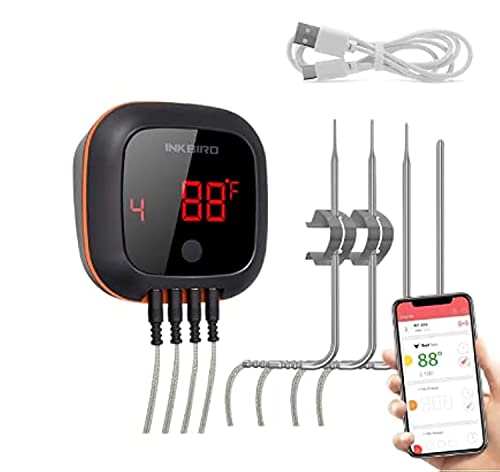
Inkbird built its following among homebrewers and smokers by selling honest specifications at honest prices, and the IBT-4XS is the formula in thermometer form: four probes, a rechargeable base unit with an LED backlit display, a magnetic back for sticking to the smoker’s leg or shelf, and Bluetooth with a maker-rated 150-foot range. Four probes means three meats and a pit channel, or two meats and two pit zones — real smoking configurations, at a value tier.
It suits the value-minded pitmaster and the multi-meat cook: the household whose smoker runs full on weekends and whose budget prefers to be spent on meat. Inkbird’s app handles the alarms and graphs; the hardware handles the heat.
Strengths
- Four probes at a value tier — the best probe-count-per-dollar in this roundup
- Rechargeable base with backlit display and magnetic mount: usable at the smoker without the phone
- Dedicated pit-probe configurations are easy: run one probe on the grate and still cover three meats
Trade-offs
- Bluetooth-only: the maker-rated 150 ft is open-air; through walls and a steel lid, plan on patio-and-nearby-rooms range
- Probe cables are consumables over years of lid closings — budget for eventual replacements
- App polish trails the MEATER and ThermoWorks ecosystems, though the core alarms and graphs are all present
| Specification | Detail |
|---|---|
| Probes | 4 |
| Connectivity | Bluetooth, 150 ft maker-rated |
| Base | Rechargeable, LED backlit display, magnetic |
| Extras | Timer and alarm functions |
Four probes is the configuration smoking actually wants, and the IBT-4XS is priced so that wanting it is reasonable. The canonical setup — one probe clipped at grate level as the pit’s truth-teller, the rest in meats — transforms a cook’s information. You stop trusting the lid dial (which reads the dome’s air, not the grate’s), and the app graph of pit temperature across twelve hours becomes the diagnostic record that makes your next cook better.
The base unit’s design shows smoker empathy: a display you can read at the pit without your phone, a magnet that parks it on steel, and a rechargeable battery that ends the drawer-of-AAAs era. Overnight, the phone app’s alarms do the watching; the base’s own presence at the smoker does the reassuring.
Its ceiling is connectivity: Bluetooth is Bluetooth, and a sprawling house will find its edge. Within a normal patio-and-kitchen geometry, the IBT-4XS is the value pick against which all others here must justify themselves.
Best for: value-minded smokers running multi-meat cooks who want a dedicated pit probe / Not suited for: anyone needing monitoring from deep inside a large house or away from home
Check on Amazon — check the current price on Amazon before you buy, because listings, bundles and included accessories change over time.
Govee Bluetooth Meat Thermometer, 6 Probes — Best for Big Cooks
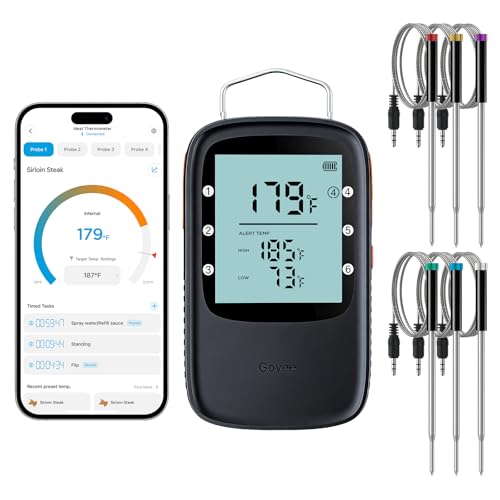
When the smoker is loaded like a freight train — two butts, a brisket, ribs on the second rack — four probes stop being enough. Govee’s answer is six: six probes, a base with a backlit LCD, app alerts and data storage, and a maker-rated 230-foot Bluetooth range, at a tier that keeps feast-day monitoring affordable.
It suits the big-cook household: holiday smokers, party pitmasters, and the cook who runs a full offset and wants every major piece of meat — plus the pit itself — under surveillance. Probe abundance is its whole argument, and for loaded smokers it is a compelling one.
Strengths
- Six probes: the most channels in this roundup — cover every meat and still dedicate one to the pit
- Maker-rated 230 ft Bluetooth range, the longest claim among the wired-base picks here
- App data storage lets you review past cooks — the graph archive that improves future cooks
Trade-offs
- Six cables is a management exercise at the lid; route them once, carefully, through the gasket or a port
- Bluetooth-only connectivity, with the usual walls-and-steel discount on the rated range
- Govee’s ecosystem spans many product categories; its BBQ app is capable rather than category-defining
| Specification | Detail |
|---|---|
| Probes | 6 |
| Connectivity | Bluetooth, 230 ft maker-rated |
| Base display | LCD with backlight |
| App | Alerts, timer, data storage |
The case for six probes is the case for information at scale. A loaded smoker is not one thermal environment — the end near the firebox runs hotter, the top rack differs from the bottom — and a single pit probe tells one location’s truth. With six channels, the Govee lets you map the pit (two ambient positions) while still covering the meats that matter, and feast-day cooks stop being an exercise in opening the lid to move one probe around, dumping heat each time.
Data storage is the sleeper feature. Smoking improves through records: last time’s stall duration, the pit’s overnight sag, the wrap timing that worked. An app that keeps the graphs turns every cook into notes for the next one, and over a season that archive is worth more than any single hardware specification in this guide.
Manage the cables with intention — a bundle through the lid gasket at one point, slack loops inside — and the Govee rewards the big-cook household with the fullest picture available at its tier.
Best for: feast-day and party smokers running loaded pits with many meats / Not suited for: single-meat minimalists or anyone who hates cable management
Check on Amazon — check the current price on Amazon before you buy, because listings, bundles and included accessories change over time.

TempPro TempSync Bluetooth Meat Thermometer, 2 Probes — Best Long-Range Value
TempPro’s TempSync makes one big promise in its verified title: 450 feet of Bluetooth range, the longest maker rating in this roundup, wrapped around a two-probe system for meat and pit. Two probes is the classic smoking minimum — one in the meat, one on the grate — and the TempSync aims to carry that pair’s signal further than its rivals.
It suits the smoker whose pit sits far from the kitchen — the bottom of the garden, the far patio — and who cooks one main meat at a time. As ever with range claims, read the number as an open-air rating; but starting from the highest rating is the right strategy when distance is your known problem.
Strengths
- 450 ft maker-rated Bluetooth range — the longest claim here, and range is this pick’s entire reason to exist
- Two probes cover the canonical smoking setup: meat plus grate-level pit temperature
- Value-tier positioning makes it an inexpensive experiment for distance-challenged setups
Trade-offs
- Real-world range through walls, floors and a steel lid will be a fraction of the open-air rating — test your geometry in the return window
- Two probes cap the ambition: a second meat means choosing which one goes unmonitored
- A newer brand ecosystem than ThermoWorks or Inkbird, with a correspondingly smaller community knowledge base
| Specification | Detail |
|---|---|
| Probes | 2 |
| Connectivity | Bluetooth, 450 ft maker-rated |
| Use | BBQ, oven, grill and smoker, per listing |
Range deserves a clear-eyed paragraph, because it is the most mis-sold number in this category. Bluetooth ratings are measured in open air, phone in hand, nothing between. Your reality adds a steel smoker (the probes’ base sits outside it, which helps), house walls, and a phone that lives in pockets and on counters. Every unit in this guide loses range to those facts; the TempSync’s strategy is to start with so much rated range that what survives the discount is still enough. For a pit at the garden’s end, that arithmetic can genuinely work where a 150-foot unit fades.
The two-probe format keeps the rest of the proposition simple: meat, pit, alarms, done. For the single-brisket household that is not a limitation but a match. The app covers alerts and monitoring without the configuration depth of the premium ecosystems — which, at 2 a.m. with a fading fire, is arguably the right amount of interface.
Buy it for distance, test it at your distance during the return window, and keep it if the signal holds. That is the honest way to shop any range claim, and this is the pick that gives the test its best chance.
Best for: smokers with distant pits who cook one main meat and need maximum Bluetooth reach / Not suited for: multi-meat cooks or anyone whose geometry truly needs Wi-Fi
Check on Amazon — check the current price on Amazon before you buy, because listings, bundles and included accessories change over time.
Comparison Table
Connectivity and probe count decide this category, so the table compares those first. Range figures are the manufacturers’ own ratings from their listings — expect real-world range through walls and steel to be shorter, as the guide explains. If you are choosing between two rows, choose by the cook you run most: the overnight brisket argues for Wi-Fi and alarms, the Sunday ribs for simplicity, the holiday load for probe count.
| Pick | Badge | Key spec | Best for |
|---|---|---|---|
| ThermoWorks Signals BBQ Alarm Thermometer (Wi-Fi & Bluetooth) | Best Overall | Wi-Fi + Bluetooth, multi-channel BBQ alarms | serious smokers running overnight and multi-meat cooks who need Wi-Fi reach |
| MEATER Pro Smart Meat Thermometer | Best Truly Wireless | Wireless probe, dual sensor, 1000°F maker rating | single-meat smokers who want zero cables and a guided app experience |
| MEATER Pro Duo Wi-Fi & Bluetooth Thermometer, 2-Probe | Best Premium Wireless | 2 wireless probes, Wi-Fi bridge, 6 sensors | two-meat and party-scale smokers who want wireless freedom with Wi-Fi reach |
| INKBIRD IBT-4XS Bluetooth Meat Thermometer, 4 Probes | Best Value Multi-Probe | 4 probes, rechargeable base, magnetic mount | value-minded smokers running multi-meat cooks who want a dedicated pit probe |
| Govee Bluetooth Meat Thermometer, 6 Probes | Best for Big Cooks | 6 probes, 230 ft maker-rated range, data storage | feast-day and party smokers running loaded pits with many meats |
| TempPro TempSync Bluetooth Meat Thermometer, 2 Probes | Best Long-Range Value | 2 probes, 450 ft maker-rated Bluetooth | smokers with distant pits who cook one main meat and need maximum Bluetooth reach |
How to Choose a Bluetooth Meat Thermometer for Smoking
Choose the architecture before the brand. If you cook one meat at a time and hate cables, go truly wireless (MEATER). If you run multiple meats or want a dedicated pit probe — and most serious smokers do — go wired multi-probe (ThermoWorks, Inkbird, Govee). If your house is large, your pit is distant, or you want alarms anywhere, Wi-Fi is not a luxury but the answer (Signals, MEATER Pro Duo). Every disappointment in this category is an architecture mismatch wearing a brand’s name.
Then count probes by your real cooks. The minimum serious smoking setup is two: meat plus grate-level pit temperature, because the lid thermometer reads dome air and lies by twenty degrees or more. Four probes cover two meats and a pit with a spare; six cover feast days. Buying probes you will never deploy buys cable clutter, so count honestly — but do not buy below two for smoking, whatever the grill guides say.
Finally, evaluate the alarm system as a safety device, because at 4 a.m. that is what it is. You want per-probe high and low alarms (the low pit alarm catches the dying fire; the high catches the flare), an app that can push through do-not-disturb habits, and ideally a base unit that alarms locally too. A thermometer that silently records a ruined brisket is a historian, not a guard.
Bluetooth range, honestly explained
Maker range figures — 150, 230, 450 feet in this guide — are open-air line-of-sight ratings. Real smoking geometry subtracts: the signal leaves a base beside a steel smoker, crosses a yard, penetrates walls, and finds a phone that may be in a pocket or a bedroom. Halving the rating is optimistic for through-house use; a quarter is common. Two cures exist: position the base with a clearer path to the house (height and window lines help), or step up to Wi-Fi models that hand the signal to your home network at the smoker. Judge every range claim in this guide — and every competitor’s — by that arithmetic.
One more subtlety: truly wireless probes transmit from inside the smoker, so their effective range is set by how much steel sits between probe and phone. Keeping the phone or the charger’s relay on the smoker’s side of the yard, within a clear line, makes wireless setups behave at their best.
Pit temperature: the probe that matters most
New smokers monitor the meat; experienced smokers monitor the pit and glance at the meat. Meat temperature over twelve hours is a slow, predictable arc; pit temperature is where cooks are won and lost — the overnight fade, the post-refuel spike, the wind-driven sag. A grate-level probe (clipped beside the meat, not touching it) reads the air your meat actually experiences, and its graph is the single most instructive record in barbecue. Whatever system you buy from this guide, dedicate a channel to the grate from your first cook.
Probe care: making the consumable last
Wired probes die at two places: the cable’s junction with the probe, kinked once too often at the lid, and the cable itself, pinched in gaskets cook after cook. Route cables with a gentle loop, never a sharp bend; close lids on the bundle at one chosen point rather than wherever it lands; and never submerge wired probes or wash wireless probes beyond their maker’s guidance. Store probes coiled loosely, not wound tight around the base. Treated this way, a probe set lasts years; treated carelessly, a season — and since replacement probes are the running cost of the wired architecture, care is literally money.
Calibration is the other quiet habit. Once or twice a year, check each channel in ice water (32°F) and boiling water (212°F at sea level). quality units in this guide hold their accuracy well, but a drifting probe discovered in a cup of ice water is a cheap save compared with one discovered in a brisket.
Smoking Smarter: Using the Data Your Thermometer Gives You
The graph is the teacher. After each cook, look at three things: how stable the pit line was (your fire management, graded honestly), how long the stall lasted (the plateau where meat temperature parks while moisture evaporates — every brisket, every time), and the total arc from placement to probe-tender. Over a season, those graphs calibrate your hands: you will refuel earlier, wrap by color and temperature together, and stop chasing the lid thermometer’s fictions.
Set alarms like a night watchman, not an optimist. Pit low alarm about 25 degrees below target wakes you for a fading fire while recovery is still easy; pit high about 25 above catches a spike before bark suffers; meat alarm at your wrap temperature, and a second at target. Then — the discipline that makes it all work — put the phone where the alarm will actually reach you, and let the thermometer do the watching it was bought for.
How to Set Up Your Thermometer for an Overnight Smoke
Overnight cooks are where remote thermometers earn their price. This setup sequence works for every pick in this guide, wired or wireless.
- Charge or battery-check everything the evening before — base, probes’ charger, phone. Overnight is no time to discover a tired battery at hour nine.
- Place the pit probe on the grate beside where the meat will sit, clipped clear of the grate bars and not touching meat or bone; route cables through the gasket or port in one bundle.
- Insert meat probes into the thickest part of each cut, avoiding bone and fat seams; for brisket, the thick end of the flat is the canonical spot.
- Connect and confirm every channel reads sensibly at ambient temperature before the meat goes on — a channel reading nonsense now is a probe to swap now, not at midnight.
- Set the watch: pit low and high alarms around your target, meat alarms at wrap and target temperatures, and the app’s alerts permitted through your phone’s night settings.
- Position the phone (and, for wireless probes, respect the relay’s placement) where alarms will reach you, do one last signal check from the bedroom, and then — the hard part — go to sleep and let the system work.
In the morning, read the graph before you touch the smoker. It will tell you how the night went — the fades, the recoveries, the stall — and whether the meat needs time, heat or patience. That five-second read, coffee in hand, is the entire return on this category’s investment.
Common Buying Mistakes
Mistake 1: Trusting the lid thermometer. Dome thermometers read the air at the top of the cooker and can be off by tens of degrees from grate level. Your pit probe is the truth; the lid dial is decoration with a needle.
Mistake 2: Buying Bluetooth-only for a distant pit. Rated range is open-air range. If your smoker sits far from where you sleep and live, Wi-Fi models exist precisely for you — architecture first, brand second.
Mistake 3: Probing the meat in the wrong spot. A probe tip in a fat seam or against bone reads fiction for twelve hours. Center it in the thickest muscle, and re-seat it if the early readings look impossible.
Mistake 4: Skipping the pit probe to save a channel. One meat plus pit beats two meats and no pit data at every skill level. The fire is the variable; the meat is the passenger.
Mistake 5: Setting only a ‘done’ alarm. By the time a done alarm matters, the cook is already saved or lost. The alarms that earn their keep are the pit’s low and high sentries in the small hours.
Mistake 6: Opening the lid to check what the thermometer already knows. Every peek costs heat and time. If the graph is healthy, the meat is fine — looking is not cooking, and smoking rewards the cook who trusts the instruments.
Final Recommendation
For the serious smoker, the ThermoWorks Signals is the instrument to own: Wi-Fi reach, professional alarm architecture and a maker’s reputation built on accuracy. It is the thermometer your brisket would choose.
The rest divide by architecture and ambition: the MEATER Pro for cable-free single-meat elegance, the Pro Duo for wireless two-meat cooks with Wi-Fi, the Inkbird IBT-4XS for four-probe value, the Govee for feast-day coverage, and the TempSync when distance is the whole problem. Whichever you choose, dedicate a probe to the grate, set the night alarms, and check price on Amazon at the listing — bundles and probe counts in the box are the details to confirm before ordering.
Short on time? Start with these three:
- ThermoWorks Signals BBQ Alarm Thermometer (Wi-Fi & Bluetooth) — Best Overall
- MEATER Pro Smart Meat Thermometer — Best Truly Wireless
- MEATER Pro Duo Wi-Fi & Bluetooth Thermometer, 2-Probe — Best Premium Wireless
Keep researching within this guide cluster: Best Bluetooth Meat Thermometer For Smokers Best Analog Meat Thermometers Best Blue Tooth Water Proof Digital Meat Thermometers Best Bbq Smokers Under $1000 Best Bbqs And Smokers
Frequently Asked Questions
What is the difference between Bluetooth and Wi-Fi meat thermometers?
Bluetooth connects the thermometer directly to your phone over a limited range — tens of feet in real houses, whatever the open-air rating says. Wi-Fi models join your home network, so your phone can check the cook from anywhere with internet. For smoking, Wi-Fi matters when the pit is far from where you spend the cook, especially overnight; Bluetooth suffices for patio-centered cooks.
How many probes do I need for smoking?
Two is the serious minimum: one in the meat, one at grate level for true pit temperature. Four covers two meats plus pit with a spare; six serves feast-day loads. More probes than your cooks need only adds cable management, so count by your largest regular cook, not your largest imaginable one.
Can wireless probes like MEATER really handle smoker heat?
Yes — smoking temperatures are gentle compared with the probes’ ratings. The MEATER Pro in this guide carries a maker rating up to 1000°F ambient, far beyond the 225–275°F world of smoking. The practical limits for wireless probes are Bluetooth range through steel, not heat; searing over open flame is where heat ratings get tested, not low-and-slow cooks.
Why does my pit temperature swing so much on the graph?
Some swing is the nature of live fire: fuel burns down, wind gusts, and adding wood spikes then settles. What the graph teaches is your pit’s rhythm — how long a fuel load lasts, how your dampers respond. Large, fast swings usually mean air leaks or over-frequent adjustments; small, slow waves are a healthy fire breathing. Judge trends over thirty minutes, not spikes over thirty seconds.
Where exactly should the meat probe go?
In the thickest part of the muscle, with the probe’s sensing tip near the center, clear of bone and fat pockets — both read wrong and mislead you for hours. For brisket, that is the thick end of the flat; for pork butt, the deepest part away from the bone. If early readings climb suspiciously fast, re-seat the probe; it is usually in a fat seam.
Do I still need an instant-read thermometer if I have a Bluetooth one?
Yes — they do different jobs. The Bluetooth system monitors the cook continuously; an instant-read checks doneness spot-by-spot at the end, and for brisket and butt the final judge is probe tenderness, which no number replaces. Use the remote system to know when to start checking, and the instant-read — plus the feel of the probe sliding in — to know when it is done.