Disclosure: airfryerkitchensupply.com is reader-supported. When you buy through links on our site, we may earn an affiliate commission at no extra cost to you.
Where to buy
A note on sourcing for this edition of our best blue tooth water proof digital meat thermometers guide: five of the six picks are linked to listings verified against live catalog data; the ThermoPro TP930 remains without a link, because verification returned no matching TP930 unit listing (only a replacement-probe listing references the model), and unverified products are never linked here. For the linked picks, use the links to check price on Amazon — and, critically in this category, still confirm the version and configuration on the listing, because wireless thermometer lines span multiple range variants and probe counts under similar names. For the TP930, search the exact product name instead.
Buy from a channel with painless returns, and run the ice-water and boiling-water accuracy test on day one (explained in the FAQ). A thermometer is a measuring instrument; the return window is your calibration laboratory, and a unit that misses its two known temperatures should go back while the exchange is free.
- MEATER Wireless Smart Meat Thermometer (MEATER Plus / MEATER Pro class) — Best Truly Wireless: check price on Amazon.
- ThermoPro TempSpike Wireless Meat Thermometer — Best Wireless Value: check price on Amazon.
- ThermoPro TP930 Bluetooth Meat Thermometer (4-Probe class) — Best Multi-Probe Bluetooth: unlinked pick, search the exact model name on Amazon to check price on Amazon.
- Inkbird IBT-4XS Bluetooth BBQ Thermometer — Best for BBQ Sessions: check price on Amazon.
- Govee Bluetooth Meat Thermometer — Best Budget Bluetooth: check price on Amazon.
- CHEF iQ Sense Smart Wireless Thermometer — Best Smart Features: check price on Amazon.
The best blue tooth water proof digital meat thermometers — to give this search its proper name, Bluetooth waterproof digital meat thermometers — solve a specific modern cooking problem: how to watch a brisket, a roast, or a grill full of chicken from somewhere other than beside the cooker, with a probe that can be washed properly when the cook is done. Wires through the oven door and dashes to check a dial are the old world; this category is the new one.
Two architectures divide it. Truly wireless probes (MEATER, TempSpike, CHEF iQ Sense) put everything in the probe — no cables at all, sealed bodies that wash clean, and a radio that must escape a metal cooker via a relay. Bluetooth base systems (ThermoPro, Inkbird, Govee) keep wired probes and put the radio in a base outside the cooker — more probes, easier links, cables to manage. ‘Waterproof’ means different things in each: the probe is the washable part in both, and no base or charger in this roundup wants a bath.
A sourcing note, plainly: links in this edition were published only after verification against live catalog data — five picks passed and are linked; the ThermoPro TP930 did not return a matching unit listing, so it stays not linked — and the guide tells you exactly what to confirm on each listing either way. In a category full of near-identical model names and range variants, that confirmation habit will serve you beyond this guide.
In this guide
Quick Picks
Six Bluetooth thermometers across both architectures — five linked in this edition, one (the TP930) unlinked, each with a clear job:
- Best Truly Wireless — MEATER Wireless Smart Meat Thermometer (MEATER Plus / MEATER Pro class). The probe is the whole thermometer — no wires, no transmitter box — and it is built to be washed. The benchmark for cable-free cooking.
- Best Wireless Value — ThermoPro TempSpike Wireless Meat Thermometer. ThermoPro’s take on the truly-wireless probe at a friendlier tier — the cable-free experience without the flagship price of entry.
- Best Multi-Probe Bluetooth — ThermoPro TP930 Bluetooth Meat Thermometer (4-Probe class). A Bluetooth transmitter with wired probes — the architecture that trades a little tidiness for capacity, range, and probes that shrug off washing.
- Best for BBQ Sessions — Inkbird IBT-4XS Bluetooth BBQ Thermometer. Inkbird’s four-probe Bluetooth system with a rechargeable base — a BBQ-community staple for long, monitored cooks.
- Best Budget Bluetooth — Govee Bluetooth Meat Thermometer. Govee’s app-connected thermometer at the entry tier — phone monitoring for cooks who are not ready to fund the flagship systems.
- Best Smart Features — CHEF iQ Sense Smart Wireless Thermometer. A smart wireless probe system that leans into guided cooking — predictions, prompts, and an app that coaches the cook to the finish.
How These Picks Were Chosen
We selected these six from the Bluetooth meat thermometer systems sold through major US channels, balancing the two architectures (truly wireless probes and Bluetooth base systems) across the realistic needs: single-probe convenience, multi-probe BBQ capacity, budget entry, and guided smart cooking. Five are linked in this edition after live catalog verification, as the introduction explains; the TP930 is presented unlinked because no matching unit listing could be confirmed, and no specifications are printed that we could not stand behind.
Judging weighted the factors that decide satisfaction in this category: temperature accuracy (the entire point), link reliability in and around metal cookers, probe washability — the ‘waterproof’ half of the keyword — app quality, and the honesty of range claims, which this category inflates more than any other in the kitchen.
- Accuracy first: a thermometer that reads wrong is a random number generator with an app.
- Link reliability: Bluetooth performance through and around metal cookers, judged by architecture and relay design, not headline range.
- Probe washability: sealed or stainless probes that clean up under the tap; bases and chargers honestly rated as dry-only.
- Capacity matched to the cook: one probe for a roast, four for a smoker session.
- App quality: alarms, presets, and graphs that work without an account-creation ordeal.
The 6 Best Blue Tooth Water Proof Digital Meat Thermometers

MEATER Wireless Smart Meat Thermometer (MEATER Plus / MEATER Pro class) — Best Truly Wireless
MEATER created the category this search is really about: a single probe that contains the sensor, the battery, and the Bluetooth radio, so the meat carries its own thermometer and nothing trails across the grill grates or out of the oven door. For waterproofing, the sealed probe design is inherently the most washable form a digital thermometer can take — there is no cable joint or transmitter to protect.
The linked listing is the MEATER Plus in Walnut — the line also has several generations and range variants, so confirm the exact model on the listing, particularly the connection range, which differs meaningfully between versions and matters if your smoker sits far from the kitchen.
Strengths
- Fully wireless probe: nothing to snag, melt, or route through a door seal.
- Sealed probe construction suits washing after greasy cooks — the waterproof brief, answered by design.
- App-guided cooks with ambient and internal sensing in the probe itself.
Trade-offs
- Premium tier — the most expensive architecture in this roundup per probe.
- Bluetooth range is the known constraint of in-probe radios; the signal must escape a metal cooker.
- One probe per unit: multi-meat cooks need multiple probes or a different system.
| Model | MEATER Plus Smart Meat Thermometer |
| Finish | Walnut |
| Connectivity | Bluetooth |
| Range | 165 ft (per listing title) |
| Use | Grill & oven |
The physics problem MEATER solves is worth understanding: a Bluetooth radio inside a steel oven or smoker is inside a partial Faraday cage, which is why these systems relay through a charger block or a second device near the cooker. Judge any truly-wireless thermometer by its relay story, not its headline range — the honest listings explain it, and the guide section below expands on judging range claims.
For the waterproof question specifically, the probe’s sealed body is the strongest answer in this roundup: it can be washed under the tap after a brisket without nursing a cable junction. The charger block, of course, stays dry — waterproof applies to the part that meets the meat and the sink, which is the part that matters.
Best for: grillers and roasters who want zero wires and a probe that washes clean without ceremony / Not suited for: budget buyers, or cooks who monitor four meats at once from a single base


ThermoPro TempSpike Wireless Meat Thermometer — Best Wireless Value
ThermoPro is the value workhorse of the thermometer world, and the TempSpike applies that formula to the wireless probe: a single cable-free probe with a charging case that doubles as the signal relay, an app connection, and the brand’s straightforward approach to alarms and presets. For most backyard cooks, it delivers the essential wireless experience — set the target, close the lid, watch from the couch.
The linked listing is the 600 ft TempSpike with the ultra-thinner probe; the line includes other range variants, so confirm which version a listing describes before comparing it against anything. ThermoPro’s broad retail presence also means replacement probes and support are easy to find, which matters for a device that lives in fire.
Strengths
- Truly wireless probe with a relay case — the modern architecture at a value tier.
- ThermoPro’s app and presets cover the standard meats without fuss.
- Brand scale: support, replacements, and availability are as good as this category gets.
Trade-offs
- Value-tier fit and finish; the probe and case feel like tools, not jewelry.
- Range depends on the variant — read the listing’s version details carefully.
- Single-probe system: big multi-meat cooks outgrow it.
| Model | TempSpike wireless meat thermometer |
| Range | 600 ft (per listing title) |
| Probe | Ultra-thinner probe, single |
| Connectivity | Bluetooth |
| Power | Rechargeable |
The TempSpike’s slot is the classic ThermoPro argument: the flagship experience is mostly software and sensing, and a value brand that nails those two things at a lower tier takes the rational buyer’s money. Where the savings show is in materials and in the outer limits of range — which most patio setups, with the cooker a few steps from the door, never approach.
Waterproofing follows the wireless-probe pattern: the sealed probe washes; the case does not swim. After a cook, rinse the probe, dry it before it goes back in the case (charging contacts prefer dry), and the system is ready for the next session. That small routine is the whole maintenance burden of the wireless architecture.
Best for: backyard cooks who want cable-free monitoring at a sensible tier / Not suited for: competition cooks needing multi-probe capacity or extreme range
Check the current price on Amazon
ThermoPro TP930 Bluetooth Meat Thermometer (4-Probe class) — Best Multi-Probe Bluetooth
Not every Bluetooth thermometer is a wireless probe. The TP930 class — a base transmitter with wired probes and Bluetooth to your phone — remains the capacity champion: multiple probes watch multiple meats (or meat plus pit temperature) at once, and the transmitter sits outside the cooker where its radio has a fighting chance. For brisket days and holiday turkeys with an audience, this is the proven layout.
The wired probes are also the waterproofing pragmatists of the roundup: stainless probes rinse clean under the tap, and only the transmitter needs protecting from weather and wash water. It is not linked here; confirm the probe count and the exact model on the listing, as ThermoPro’s numbering spans several near-identical systems.
Strengths
- Multiple probes: several meats, or meat plus ambient pit temperature, in one view.
- Transmitter outside the cooker means a more reliable Bluetooth link than in-cooker radios.
- Wired stainless probes are inexpensive to replace and easy to wash.
Trade-offs
- Wires return with this architecture — routing through the door seal and around grates.
- The transmitter is not waterproof; rain and wash water are its enemies.
- More parts to store, untangle, and eventually replace.
Competition and serious BBQ settled on this architecture for a reason: capacity and link reliability beat elegance when a twelve-hour cook is on the line. The app view of four temperatures — two meats, two zones — is information no single-probe system can offer, and pit temperature is the variable that decides brisket more than any other.
Probe care decides lifespan here. The weak point of every wired probe is the cable-to-probe junction: never submerge that junction, never let the cable kiss a hot grate, and wash by wiping and rinsing the probe shaft only. Treated that way, wired probes last for years; treated carelessly, they fail mid-cook, which is the worst failure timing in this category.
Best for: BBQ cooks running multiple meats or tracking pit temperature alongside the meat / Not suited for: minimalists who chose this category specifically to escape wires
This pick is currently listed unlinked: check price on Amazon by searching the exact model name, and confirm the listing matches the specification described here before ordering.
Inkbird IBT-4XS Bluetooth BBQ Thermometer — Best for BBQ Sessions
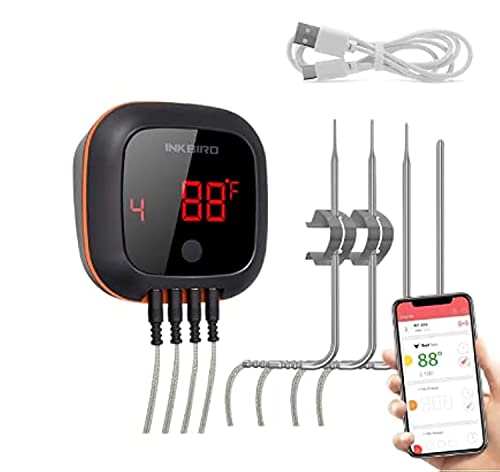
Inkbird built its name in the BBQ world with exactly this formula: a Bluetooth base unit, four wired probes, a phone app with graphs and alarms, and a rechargeable battery for long sessions. The IBT-4XS is the line’s representative here — the system smokers recommend to each other when a cook needs watching overnight or across a long afternoon. The linked listing is the 4-probe IBT-4XS; confirm the accessories in the box on the listing.
Like the ThermoPro base systems, its waterproofing story is the wired-probe one: stainless probes that rinse clean, a base that must stay dry. Within that architecture, Inkbird’s appeal is the session-focused feature set — temperature graphs over time are genuinely useful for learning your smoker’s behavior.
Strengths
- Four probes and session graphing: built for long BBQ cooks, not just doneness checks.
- Rechargeable base suits overnight and all-day sessions.
- A deep user community means tips, replacement probes, and troubleshooting are easy to find.
Trade-offs
- Wired architecture, with the cable-management that implies.
- The base is not waterproof — shelter it from rain and steam.
- App quality and phone pairing are the usual Bluetooth caveats; keep the phone reasonably close.
| Model | IBT-4XS Bluetooth food meat thermometer |
| Probes | 4 probes |
| Range | 150 ft (per listing title) |
| Power | Rechargeable base |
| Features | LED backlit timer alarm, magnet (per listing title) |
The graphing feature deserves its reputation: watching a brisket’s stall as a curve, and your pit’s temperature swings across a windy night, teaches more about your cooker than a season of guessing. For cooks on the BBQ learning curve — which is every cook, always — the data is the product, and Inkbird understood that early.
Position the base with the same care as the ThermoPro systems: on a dry, shaded surface near the cooker, with probe cables routed through the door’s gasket line rather than pinched in the hinge. The junction discipline from the TP930 section applies identically — the probes wash, the junctions and base do not.
Best for: smokers and BBQ learners who want four probes and cook data across long sessions / Not suited for: quick weeknight grilling, where a four-probe base is ceremony without benefit


Govee Bluetooth Meat Thermometer — Best Budget Bluetooth
Govee’s smart-home reach extends to the grill: a Bluetooth meat thermometer with wired probes and an app, at the budget end of this roundup. For the cook who wants phone alarms and a temperature graph without entering the premium tier, it is the low-risk way to learn whether app-connected cooking fits their style. The linked listing is the 2-probe version; confirm the probe configuration on the listing.
The honest budget framing: you are buying the Bluetooth monitoring experience — remote alarms, presets, no hovering — with value-tier hardware. Probes wash as wired probes do; the base stays dry; the app does the rest. If it converts you to monitored cooking, the upgrade path to the systems above is clear; if it does not, you have spent the least to learn that.
Strengths
- Entry-tier price of admission to app-monitored cooking.
- Bluetooth alarms free you from hovering over the grill.
- Part of a large smart-home ecosystem, with the app polish that implies.
Trade-offs
- Value-tier probes and base: treat the junctions gently and expect a finite lifespan.
- Fewer probes and simpler features than the BBQ-focused systems.
- Budget Bluetooth range: keep the phone within a sensible distance of the cooker.
| Type | Bluetooth meat thermometer with smart app |
| Probes | 2 probes |
| Range | 230 ft Bluetooth range (per listing title) |
| Features | App timer and alerts, smart LCD backlight (per listing title) |
Budget thermometers earn skepticism in one specific place: accuracy. The defense of this pick is procedural — whichever budget unit you buy, test it in boiling water (212F at sea level) and in ice water (32F) on day one, while returns are painless. A unit that reads both correctly has earned its place regardless of tier; a unit that misses goes back, and the category’s honest brands make that exchange easy.
Used within its limits — weeknight grilling, a roast in the oven, learning your grill’s hot spots with a second probe at grate level — a budget Bluetooth thermometer is a genuinely useful tool. Its limits are session length, probe count, and weather, and the sections above name the systems that lift each one.
Best for: curious cooks who want to try app-monitored grilling at the lowest sensible tier / Not suited for: overnight smokers or anyone whose cook cannot tolerate a budget link dropping


CHEF iQ Sense Smart Wireless Thermometer — Best Smart Features
CHEF iQ’s Sense takes the wireless probe idea and adds the layer some cooks actually want: guidance. Its system is built around smart features — estimated finish times, flip and rest prompts, and guided cook programs — delivered through an app that treats the probe’s data as coaching rather than mere telemetry. For cooks who are learning, or who simply want the machine to watch the clock, it is the most ambitious software in this roundup. The linked listing is the single-probe Gen3 set; multi-probe sets sit under the same Sense name, so confirm the set configuration on the listing.
The hardware follows the wireless pattern — sealed probe, charging base that stays dry — so the waterproof story is the familiar one: the part that meets meat and water is built for both. The differentiation is entirely in what the app does with the numbers.
Strengths
- Guided cooking: finish-time prediction and prompts reduce the mental load of a big cook.
- Wireless probe convenience with the washable sealed-probe design.
- Expandable multi-probe sets exist within the line for bigger cooks.
Trade-offs
- Software-led value: cooks who want raw data and no coaching pay for features they will mute.
- Premium-adjacent tier, and the experience depends on the app’s continued support.
- As with all in-cooker radios, range depends on the relay arrangement — read the listing’s details.
| Model | CHEF iQ Sense smart wireless meat thermometer (Gen3) |
| Probe | Ultra-thin probe, 5 sensors (per listing title) |
| Connectivity | WiFi, unlimited range (per listing title) |
| Heat rating | 1000°F heat safe (per listing title) |
| Use | BBQ, grill, oven, smoker, air fryer (per listing title) |
Prediction is the feature that changes behavior: a finish-time estimate that updates as the cook progresses turns ‘is it done?’ anxiety into planning — sides timed to the roast, guests timed to the table. Experienced cooks develop that instinct over years; a good guided system lends it to beginners on their first holiday turkey, which is a real and underrated service.
The counterpoint is dependence: an app-centric system asks you to trust updates, accounts, and a company’s longevity. CHEF iQ is an established smart-kitchen brand, which is the right kind of maker for that bet — but the bet is part of the purchase, and data-first cooks should take the ThermoPro or Inkbird routes instead.
Best for: cooks who want guidance and predictions, not just temperatures — especially newer cooks facing big occasions / Not suited for: data purists and anyone who distrusts app-dependent hardware
Check the current price on Amazon
Comparison Table
| Pick | Badge | Key spec | Best for |
|---|---|---|---|
| MEATER Wireless Smart Meat Thermometer (MEATER Plus / MEATER Pro class) | Best Truly Wireless | Fully wireless smart probe (MEATER Plus, Walnut), Bluetooth, 165 ft range per listing, sealed washable design | grillers and roasters who want zero wires and a probe that washes clean without ceremony |
| ThermoPro TempSpike Wireless Meat Thermometer | Best Wireless Value | Wireless probe with relay/charging case, 600 ft variant with ultra-thinner probe (verified listing), value tier | backyard cooks who want cable-free monitoring at a sensible tier |
| ThermoPro TP930 Bluetooth Meat Thermometer (4-Probe class) | Best Multi-Probe Bluetooth | Bluetooth base with multiple wired probes (unlinked — verify probe count) | BBQ cooks running multiple meats or tracking pit temperature alongside the meat |
| Inkbird IBT-4XS Bluetooth BBQ Thermometer | Best for BBQ Sessions | Bluetooth 4-probe BBQ system (IBT-4XS), rechargeable base, 150 ft range per listing | smokers and BBQ learners who want four probes and cook data across long sessions |
| Govee Bluetooth Meat Thermometer | Best Budget Bluetooth | Budget Bluetooth thermometer with app, 2 probes, 230 ft range per listing (verified listing) | curious cooks who want to try app-monitored grilling at the lowest sensible tier |
| CHEF iQ Sense Smart Wireless Thermometer | Best Smart Features | Smart wireless probe with guided-cooking app (Sense Gen3, single ultra-thin probe, WiFi — verified listing) | cooks who want guidance and predictions, not just temperatures — especially newer cooks facing big occasions |
Choose the architecture first: wireless probe for tidiness and easy washing, base system for probe count and link reliability. Then choose the tier. Every system here leaves its base or charger dry — the waterproof promise belongs to the probes, and any listing implying otherwise deserves your suspicion.
How to Choose a Bluetooth Waterproof Meat Thermometer
Start with the architecture decision, because it determines everything downstream. Truly wireless probes are the tidy, modern answer: nothing crosses the grill, the probe seals completely (which is what makes it genuinely washable), and the cook looks effortless. Their constraints are physics — a radio inside a metal box — and capacity: one probe per unit of currency. Base systems invert the trade: wires to manage, but three or four probes per base, a radio positioned outside the cooker for a stronger link, and replacement probes at pocket-money prices.
Then decode ‘waterproof’ like an engineer. In this category it almost always describes the probe: sealed wireless probes can be rinsed and washed; wired stainless probes can be rinsed along the shaft. It almost never describes the base, the charger, or the cable junction — those are splash-tolerant at best. A listing that prints an IP rating is being more honest than one that prints the word alone; either way, your care routine is the same: wash the probe, wipe the rest, submerge nothing with a battery door or a cable joint.
- Range claims: headline Bluetooth ranges are measured in open air. A cooker wall, a house wall, and a floor of elevation divide them drastically. Judge by relay design (charger-as-relay, base placement) and by whether the maker explains the relay at all.
- Probe count: one for roasts and grilling; two adds grate-level ambient; four runs a full smoker. Buy the count your biggest cook needs.
- Ambient sensing: wireless probes that also read the cooker’s air temperature replace a second probe — a genuine feature for oven and smoker accuracy.
- Battery reality: wireless probes charge in their case between cooks; base systems run on replaceable or rechargeable cells. Either is fine; a dead probe at hour nine of a brisket is not, so charge before long cooks.
Accuracy: The Only Spec That Cannot Be Faked at Home
Every other feature in this category can be evaluated from a listing; accuracy can be evaluated on your stove in five minutes, and you should. Ice water — a glass of crushed ice topped with water, stirred — is 32F (0C). Boiling water at sea level is 212F (100C), dropping slightly with altitude. A probe that reads both within a degree or two is a trustworthy instrument; a probe that misses either by several degrees goes back inside the return window, whatever its app looks like.
Placement is the other half of accuracy, and no thermometer can fix it. The probe’s sensing point must sit in the thermal center of the meat — the thickest part, away from bone (bone conducts heat differently and reads hot), away from fat seams (which read low and cook differently), and inserted far enough that the sensor is genuinely inside. Half of all ‘my thermometer lied’ stories are placement stories, and the how-to section below gives the placement routine.
Finally, understand response and averaging: digital probes sample and smooth, so a reading settles over seconds, not instantly. When checking a fast-cooking item, give the probe its moment. And for thin cuts — burgers, chops, fish — even the best leave-in probe is the wrong tool; an instant-read thermometer (a different purchase) owns that job. This category is for roasts, smokers, grills, and ovens, and within that territory it is transformative.
Waterproof, Water-Resistant, and Washable: Reading the Claims
The keyword says waterproof; the products say various things, and the differences matter at the sink. A sealed wireless probe is the closest to truly waterproof: no seams, no cable, designed to be washed under running water and, per its maker, often more. Wired probes are washable along the stainless shaft, with a hard rule at the junction where cable meets probe — water inside that joint corrodes the sensor connection and is the leading cause of wired probe death.
Bases, transmitters, and chargers live in the water-resistant world: a splash, a light drizzle, a steamy kitchen — fine; a rinse under the tap or a rain shower on the smoker shelf — not fine. Cook accordingly: the base sits under the eave, in the shade, on a dry board, and gets wiped rather than washed. This division of care is not a defect in any pick here; it is the physics of radios and batteries, and every honest listing in the category observes it.
Your maintenance routine follows from the claims: rinse and dry the probe after every cook (drying matters — wireless probes charge through contacts that prefer to be dry), wipe cables and bases with a damp cloth, and store probes straight rather than kinked. Do that and the waterproof half of this search pays out for years; ignore it and the junction fails first, mid-brisket, as is traditional.
Battery Life, Charging Habits, and Cooking Overnight
The overnight cook is this category’s defining use case — a brisket that goes on at midnight and finishes at noon — and it is a battery test as much as a cooking one. Wireless probes sip power from small cells and recharge in their cases; a probe that starts the night at a partial charge is a probe that may go silent at hour nine, which is precisely when the stall breaks and attention matters. The discipline is simple: long cooks start with a full charge, no exceptions, and the case lives plugged in near the cooker for the duration.
Base systems trade the problem rather than solving it: larger batteries, sometimes replaceable cells, and a transmitter that also powers an on-device display. That display is an underrated overnight feature — a 3 a.m. check should not require finding a phone, unlocking it, and opening an app. If your cooking includes regular overnight sessions, weigh the base-with-display architecture heavily; it is built for exactly that glance.
Phone battery is the third leg of the stool. An app polling a thermometer all night, with alarms armed, is a real load; plug the phone in beside the bed and confirm the alarm volume before sleep. The finest thermometer system in this roundup cannot wake a cook whose phone died politely at 4 a.m. — the system is the probe, the link, and the phone together, and it deserves to be set up as one.
How to Use a Bluetooth Meat Thermometer Well (Placement, Setup, and Care)
The technology is simple; the craft is in placement and routine. This is the working method for both architectures — wireless probes and wired base systems — from setup to cleanup.
- Charge and pair before the meat is out. Top up wireless probes or base batteries, pair the app, and set your target temperature and alarms while your hands are clean and the kitchen is calm. Technology setup during a cook is how alarms get missed.
- Find the thermal center. Identify the thickest part of the cut, away from bone and major fat seams. For a roast or brisket, that is the center of the thickest muscle; for poultry, the deepest part of the thigh and breast both deserve a check.
- Insert to the sensor. Push the probe in so its sensing point sits at that center — for wireless probes, up to the marked depth line or handle base; for wired probes, with the shaft’s middle at the meat’s middle. Angle along the grain for slicing friendliness later.
- Route and relay deliberately. Wired cables exit through the door’s gasket line, never pinched in a hinge or resting on a grate. Wireless systems: place the charger/relay near the cooker as the maker directs — it is the bridge your signal crosses.
- Cook to temperature, then verify. When the alarm sounds, spot-check with a second reading a centimeter away if the cut is large or the result surprises you. Carryover heat will raise the internal temperature during the rest — pull most roasts a few degrees early, per your recipe’s guidance.
- Rest, then wash the probe properly. Let the meat rest (the thermometer can keep watching the carryover climb — genuinely useful data). Then rinse the probe under the tap, wash with dish soap, dry it fully, and return wireless probes to their charger dry. Wipe bases and cables; submerge nothing else.
Keep a tiny cook log for the first few sessions: target, pull temperature, rest time, result. Bluetooth systems generate the data; the log is where it becomes knowledge about your cooker and your cuts. Three logged cooks will teach you more about your grill’s personality than a season of confident guessing — and they make the next cook’s alarm settings obviously right.
Calibrate your trust monthly with the two known temperatures: ice water at 32F and boiling water at 212F (adjusting the boiling point for altitude). A probe that holds both is a probe whose brisket alarm you can sleep through — which, for the overnight cooks this category exists to serve, is the entire point.
Common Buying Mistakes
Trusting the headline Bluetooth range
Open-air range figures collapse around metal cookers and house walls. Judge a system by its relay design and architecture — base outside the cooker, charger-as-relay near it — and test the link from your couch before the first real cook, not during it.
Inserting the probe into the wrong spot
Touching bone reads hot, sitting in a fat seam reads low, and a shallow tip reads the surface instead of the center. All three produce confident, wrong numbers. Find the thermal center, insert to the sensor, and spot-check big cuts in a second place.
Submerging wired probe junctions and bases
The fastest way to kill this category’s hardware. Probes rinse; junctions, cables’ ends, bases, and chargers get wiped. Water inside a cable junction corrodes the connection, and the probe dies weeks later, mid-cook, having forgotten to mention the cause.
Skipping the day-one accuracy test
Ice water and boiling water are free calibration standards sitting in your kitchen. Five minutes on day one — while returns are painless — separates a trustworthy instrument from a confident liar. Every cook in this category should start with that test, at every tier.
Cooking to the preset instead of the meat
App presets are averages wearing a uniform: the ‘medium rare’ target that suits a thick ribeye mis-serves a lean filet, and poultry presets cannot know your altitude or your stuffing. Use presets as a starting frame, then set the target your recipe and cut actually call for. The thermometer’s job is to report the meat in front of it, not the meat in the app’s imagination.
Using a leave-in probe for thin cuts
Burgers, chops, and fish fillets have no thermal center a leave-in probe can occupy honestly. That job belongs to an instant-read thermometer. Using the wrong instrument and blaming its readings is the category’s most avoidable disappointment.
Final Recommendation
Choose the architecture first. For cable-free cooking and the easiest washing, the wireless probes lead: MEATER for the benchmark experience, ThermoPro TempSpike for the same idea at a value tier, CHEF iQ Sense if you want the app to coach as well as measure. For capacity and session data, the base systems win: ThermoPro’s multi-probe class for all-round value, Inkbird’s IBT-4XS for BBQ-focused four-probe cooks, Govee for the budget on-ramp to app-monitored grilling.
Five picks are linked in this edition — use the links to check price on Amazon; for the unlinked TP930, search the exact product name. Either way, confirm the version, probe count, and range variant on the listing, and run the ice-water and boiling-water test the day your thermometer arrives. In a category of near-identical names, those three habits are the difference between the right system and a similar-looking one.
Then cook with the placement routine from the how-to section — thermal center, sensor depth, relay placed with intention — and wash the probe like the sealed instrument it is. Do that, and the temperature on your phone becomes the most trustworthy number in your kitchen.
Keep researching the cluster: Best Meat Thermometers Best Digital Meat Thermometers Best Wireless Meat Thermometers Best Meat Thermometers For Grilling Best Meat Thermometers For Smokers
Frequently Asked Questions
Are Bluetooth meat thermometer probes really waterproof?
The probes, effectively yes within their design: sealed wireless probes are built to be washed under running water, and wired stainless probes rinse clean along the shaft. The waterproof promise does not extend to bases, transmitters, chargers, or the junction where a cable meets its probe — those are wiped, never submerged. Any listing implying the whole system can swim is overselling.
Why does my Bluetooth thermometer lose connection at the grill?
Metal cookers block radio signals — your oven or smoker is a partial Faraday cage — and house walls divide the remaining range. Wireless probe systems relay through a charger block placed near the cooker; base systems put the transmitter outside the cooker for the same reason. Place the relay as directed, keep the phone on the same side of the house as the cooker, and test the link before a real cook.
How accurate are Bluetooth meat thermometers?
The good ones are accurate to within a degree or two — plenty for safe, well-judged cooking — but verify yours: ice water should read 32F (0C) and boiling water 212F (100C) at sea level. Run both tests on day one, while returns are free. Placement matters as much as the sensor: center of the thickest part, away from bone and fat seams.
Wireless probe or wired multi-probe system — which is better?
Different, not better. Wireless probes win on tidiness, washing, and single-roast convenience. Wired base systems win on probe count (several meats plus pit temperature), link reliability, and replacement cost. Match the architecture to your biggest cook: a Sunday roast argues wireless; a two-brisket smoker session argues wired and multiple.
Can I leave a Bluetooth probe in the meat on a hot grill?
These systems are designed for grill and smoker use, but every probe has a maximum ambient temperature at its handle or transmitter end — direct flame and flare-ups are the enemy, especially of wireless probe handles and wired cables. Keep probes over indirect heat where possible, route cables away from burners, and check the listing’s stated limits for your exact model before a high-heat cook.
Do I still need an instant-read thermometer if I own a Bluetooth one?
Yes — they are partners, not rivals. The Bluetooth leave-in probe owns long cooks and remote monitoring; the instant-read owns thin cuts, spot-checks, and verification of the leave-in’s surprising readings. Most serious cooks end up with both, and the pair together costs less than one ruined holiday roast.
How were the buy links in this guide verified — and why is one pick unlinked?
Links are published here only after verification against live catalog data. Five of the six systems matched a live listing and are linked; the ThermoPro TP930 returned no matching unit listing — only a replacement-probe listing references the model — so it remains without a link rather than linked on a guess. The products named are the established systems of their category; confirm the version and probe count on the listing, and test accuracy on arrival — the guide’s sections tell you exactly how.