Disclosure: airfryerkitchensupply.com is reader-supported. When you buy through links on our site, we may earn an affiliate commission at no extra cost to you.
Where to buy
Every pick in this guide to the best digital meat thermometers is a real model sold on Amazon, and every one was verified against Amazon’s own catalog before it earned a place here. Use the links in this box to check the current price on Amazon for each one:
- ThermoWorks Thermapen ONE — Check the current price on Amazon
- Lavatools Javelin PRO Classic — Check the current price on Amazon
- TempPro TempSwift TP19H — Check the current price on Amazon
- Alpha Grillers Meat Thermometer Digital — Check the current price on Amazon
- ThermoWorks ThermoPop 2 — Check the current price on Amazon
- Taylor Digital Instant Read Waterproof Meat Thermometer — Check the current price on Amazon
Listings in this category churn constantly — colors multiply, generations rename themselves, and lookalikes share photographs. The exact model links above are your guarantee that the thermometer arriving at your door is the one whose probe style, display, and water-resistance rating are described in its section below.
Why a Digital Thermometer Changes How You Cook
If you are shopping for the best digital meat thermometers, you are probably trying to solve one specific frustration: guessing. Guessing whether the chicken is done, guessing whether the steak is really medium-rare, guessing whether the pork roast can come out now or needs another ten minutes that will quietly dry it out. A good digital thermometer ends the guessing in about two seconds. You push a thin probe into the thickest part of the food, read an exact number instead of interpreting a slowly creeping dial, and make a decision based on temperature rather than color, firmness folklore, or the cooking time printed on a recipe written for a different oven and a different cut.
The digital category splits into three families, and choosing the right family matters more than choosing the right brand. Instant-read thermometers, which dominate this guide, live in a drawer and come out for spot checks: burgers on the grill, a turkey breast near the end of roasting, oil for frying, sugar syrup on the stove. Leave-in probe thermometers trail a heat-resistant cable to a base unit and watch one roast continuously. Wireless probe systems send the temperature to your phone and suit long smoker sessions. This guide concentrates on instant-read models because they are the most versatile purchase for most kitchens, and it includes the strongest verified examples at every tier from budget to professional.
One honest note about the market before the picks: digital meat thermometers are a category where the gap between a budget pick and a premium pick is real but narrow in daily use. Premium models read faster, survive drops and splashes better, carry stronger calibration credentials, and feel better built after a year of drawer life. Budget models read the same temperatures a second or two slower and ask you to be a little gentler with them. Nobody in this guide is a bad thermometer. The right question is which set of trade-offs matches how often you cook, how rough your kitchen is on small tools, and whether you also temp candy, frying oil, and bread dough or only meat.
In this guide
Quick Picks
Six verified instant-read thermometers, ordered by the job each one does best — the same badge sits atop each model’s full review, so you can jump straight to the thermometer that matches your cooking.
- ThermoWorks Thermapen ONE — Best Overall. The professional benchmark for instant-read thermometers: the fastest, most confidence-inspiring spot checks in this guide, in a folding body built for daily use. Buy it once and stop thinking about thermometers. — Check price on Amazon
- Lavatools Javelin PRO Classic — Best for Fast Backlit Reads. A professional instant-read with an ultra-fast two-second response, an auto-rotating backlit display, IP65 water resistance, and NSF certification — the thinking cook’s alternative to the premium benchmark. — Check price on Amazon
- TempPro TempSwift TP19H — Best Value Instant-Read. A one-second instant-read with an auto-rotating backlit display, motion activation, and a waterproof body claim — the strongest value specification in this guide, aimed squarely at everyday grill and candy work. — Check price on Amazon
- Alpha Grillers Meat Thermometer Digital — Best Budget. The budget benchmark: a one-to-two-second response, a bright backlit display, an IP67 waterproof rating, and pre-calibrated readiness out of the box — proof that the budget tier no longer means slow or fragile. — Check price on Amazon
- ThermoWorks ThermoPop 2 — Best Compact. ThermoWorks’ value instant-read: a compact, pocketable thermometer from the professional benchmark brand, positioned by its own maker as the best-value way into that ecosystem. — Check price on Amazon
- Taylor Digital Instant Read Waterproof Meat Thermometer — Best Wide Temperature Range. A folding-probe digital thermometer with a backlit display and a verified range from -40 to 450 degrees F — the widest confirmed span in this guide, from one of the oldest names in temperature tools. — Check price on Amazon
How These Picks Were Chosen
Verification came before everything else in this guide: brand and model went into Amazon’s catalog through the site’s own product-verification system, the returned listing title had to match the intended model word for word, and only a product that cleared that bar received a link here. That process sounds fussy, but this category needs it. Thermometer listings are full of near-duplicate models, renamed generations, and marketplace variants that share a product photo while differing in probe length, water resistance, and display. If a model could not be matched with certainty, it was left out rather than guessed at, and any pick that could not be linked is labeled unlinked with the reason stated in the open.
Beyond verification, four criteria decided the final six. Reading speed came first, because the entire point of an instant-read is that the grill lid or oven door stays open for seconds, not half a minute, while heat escapes and your hand hovers over hot grates. Accuracy and calibration came second: a thermometer that reads two degrees off will still cook safe food, but one that reads ten degrees off turns medium-rare into a rumor, so models with published accuracy credentials, NSF certification, or factory calibration earned preference. Third was survivability — water-resistance ratings, folding probes that protect the tip in a drawer, and bodies that tolerate being dropped on tile. Fourth was display design: backlighting for evening grilling, rotating displays for left-handed cooks and awkward angles, and digits large enough to read at arm’s length through steam.
What did not influence the picks: headline temperature ranges nobody cooks at, bundled extras treated as decoration rather than function, and any form of popularity score. A thermometer earns its place here by measuring temperature quickly, accurately, and repeatedly — everything else is a tiebreaker. The six below span the category’s real tiers, from budget to professional, so the guide works whether this is your first thermometer or your fourth.
The 6 Best Digital Meat Thermometers, Reviewed
Work through the reviews with the trade-offs column open widest: in a category this mature, every pick reads temperature well, so the honest frictions — tier, reach, certification, ceiling — are where your decision actually lives. Each review names who should buy it and who should not, lists three strengths against three trade-offs, boxes only the specs its verified listing supports, and ends in a one-line verdict.

ThermoWorks Thermapen ONE — Best Overall
The Thermapen ONE is for the cook who has already owned a cheap thermometer, watched it lag, fog, or die, and decided to simply buy the reference model and be done. It suits frequent grillers, serious home bakers who temp bread and custards, and anyone who cooks expensive cuts where a five-degree error costs real money. If you cook meat twice a month and mostly need a safety check on chicken, its talents are more than you require — the budget picks below will serve you honestly.
Strengths
- The fastest, most settled readings in this guide — the number stops moving almost as soon as the probe lands, so lids stay open for seconds
- Folding probe design protects the tip in a drawer and switches the unit on and off as you open and close it, with no buttons to hunt for
- A professional-grade build and calibration pedigree from the brand whose thermometers are the default reference in test kitchens
Trade-offs
- Sits firmly in the premium tier — it costs several times what the budget picks in this guide cost, in qualitative terms
- Instant-read only: there is no leave-in cable probe, so long smoker sessions still need a second tool watching the cook
- The folding hinge is a moving part; it is well made, but it rewards owners who do not pry or twist the probe sideways in dense meat
| Type | Digital instant-read, folding probe |
| Listing claim | No. 1 Recommended Instant-Read Thermometer (verified listing title) |
| Color verified | Cayenne Pepper Red |
What separates the Thermapen ONE in daily use is not a specification — it is the absence of doubt. Lesser thermometers make you negotiate: the number climbs, overshoots, settles, and you decide which value to believe while heat pours out of the grill. The ONE simply lands on the temperature and stays there, and that decisiveness changes behavior. You check more often, in more spots, because checking is cheap in time and attention. Thick chicken thighs get probed twice. A pork shoulder gets mapped at three points. The thermometer stops being an occasional referee and becomes part of how you cook, which is exactly what a premium tool should do.
It also travels across the whole kitchen better than its meat-first branding suggests. The thin probe tip that slides into a steak without tearing it also reads custard, caramel, frying oil, and the internal temperature of a loaf of bread with the same speed, and the rotating, backlit style of display ThermoWorks is known for keeps the number readable over a steaming pot. Treat it as the guide’s quality ceiling: every cheaper pick below is best understood by asking what it gives up relative to this one — a little speed, a little build confidence — and whether that sacrifice matters for your cooking.
Best for: Frequent cooks who want the fastest, most trustworthy spot checks and a thermometer that lasts for years / Not suited for: Occasional cooks who only need a basic safety check, or anyone who needs a leave-in probe for long smokes
Check on Amazon — check the current price on Amazon first — listings swap colors and bundle extras without warning.

Lavatools Javelin PRO Classic — Best for Fast Backlit Reads
The Javelin PRO Classic suits cooks who want professional credentials — speed, certification, water resistance — in a mid-to-premium package, and who grill after dark often enough to genuinely use a backlit display. The auto-rotating screen makes it the friendliest pick here for left-handed cooks and for probing from awkward angles across a wide grill. If your cooking happens in a bright kitchen at midday and you never temp anything thinner than a roast, some of its display cleverness is wasted on you, though never unwelcome.
Strengths
- Ultra-fast two-second response claimed in the verified listing, so spot checks barely interrupt the cook
- Auto-rotating backlit display stays readable upside down, left-handed, and over a dark grill at night
- IP65 water resistance and NSF certification, both stated in the verified listing, cover splashes, rinsing, and food-safety credibility
Trade-offs
- IP65 resists splashes and jets but is a step below full waterproof ratings — rinse it, do not soak it or run it through a dishwasher
- The compact body that makes it nimble also makes it easier to misplace in a crowded drawer than a larger unit
- Premium-adjacent pricing tier: it asks for a real commitment compared with the budget picks, even if it undercuts the flagship tier
| Type | Digital instant-read |
| Response | 2 seconds (listing claim) |
| Display | Auto-rotating, backlit |
| Water resistance | IP65 (listing claim) |
| Certification | NSF Certified (listing claim) |
The Javelin PRO’s party trick is ergonomic rather than electronic. Probing food is rarely done from a comfortable, square-on position: you reach across a grill, tilt a tray, or check a pan from the side, and a fixed-orientation display forces you to read digits sideways or upside down while your wrist hovers over heat. An auto-rotating display removes that small friction entirely, and over hundreds of cooks those small frictions are the difference between a tool you reach for and a tool that lives in the drawer. Combined with the two-second response, checks become a single smooth motion — probe, glance, done.
The NSF certification deserves a sentence of its own, because it is the credential that separates professional tools from gadgets in this category. Certification means the design has been assessed against food-equipment standards rather than merely described with confident adjectives, and for cooks who temp food for other people — a church cookout, a small catering side job, a family reunion brisket — that pedigree is a rational reason to choose this model over a cheaper twin. Its IP65 rating pairs with that: this is a thermometer built to be rinsed under the tap and wiped down like a working tool, not babied like a phone.
Best for: Evening grillers, left-handed cooks, and anyone who values certified, splash-proof professional design / Not suited for: Cooks who want full waterproof soaking tolerance, or strict budget buyers
Check on Amazon — check the current price on Amazon first — listings swap colors and bundle extras without warning.

TempPro TempSwift TP19H — Best Value Instant-Read
The TP19H is the pick for cooks who want flagship-style features — speed, rotating backlit display, motion wake-up — without paying flagship-tier money. It suits weeknight grillers, candy makers who need quick reads in syrup, and first-time thermometer buyers who want one tool that covers meat, oil, and sugar work from day one. If you prize long-haul build pedigree and certification over features per tier, the two professional picks above remain the better long-term buy.
Strengths
- One-second response claimed in the verified listing — the fastest headline figure in this guide
- Motion-activated wake and auto-rotating backlit display remove button fumbling when your other hand holds tongs
- Waterproof claim in the verified listing means confident rinsing after sticky candy or marinade work
Trade-offs
- Headline speed claims in this tier describe ideal conditions; dense, cold meat still takes a beat longer to settle in real use
- Feature-rich electronics mean more to go wrong over years of drawer life than a simpler professional unit
- The value tier shows in the hand: plastics and hinge feel are a step below the professional picks, even though readings are not
| Type | Digital instant-read |
| Response | 1 second (listing claim) |
| Display | Auto-rotating, backlit |
| Activation | Motion-activated (listing claim) |
| Water resistance | Waterproof (listing claim) |
Value picks earn their badge by deciding which flagship features actually change daily cooking, and the TP19H chooses well. Motion activation sounds like a gimmick until you have used it with greasy hands: pick the thermometer up and it is awake, set it down and it sleeps, and the battery is spent on readings rather than on a display glowing in a drawer. The rotating backlit display is the second feature that survives the novelty phase, for the same ergonomic reasons covered in the Javelin review — probing is an angled, one-handed job, and a display that meets your eye halfway makes checks faster and therefore more frequent.
The listing’s explicit mention of candy is a useful signal about probe and range design. Sugar work punishes slow thermometers because syrup temperatures move quickly near the end of a stage, and a one-second response turns a stressful hovering job into a calm one. The same speed serves frying oil, where overshoot means scorched food, and thin cuts like fish fillets, where a slow probe reads the pan as much as the fish. As a single first thermometer for a household that cooks widely, this is the guide’s easiest recommendation to defend.
Best for: First-time buyers and value hunters who want flagship features — speed, rotating backlit display, waterproof rinsing — in one tool / Not suited for: Buyers who prioritize certification pedigree and decade-long build over features
Check on Amazon — check the current price on Amazon first — listings swap colors and bundle extras without warning.

Alpha Grillers Meat Thermometer Digital — Best Budget
Alpha Grillers’ thermometer is for the cook who wants a genuinely capable instant-read at a budget-tier commitment: new grill owners, second-thermometer buyers who want one that lives at the grill, and gift buyers who need a tool that works the moment it is unwrapped. The listing itself leans into gifting, and the pre-calibrated, ready-to-use setup supports that. If you cook professionally or temp food for large groups, step up to a certified pick; for household duty, this is the value floor done right.
Strengths
- IP67 waterproof rating stated in the verified listing — the strongest water-resistance claim among this guide’s value picks, tolerant of thorough rinsing
- One-to-two-second response with a bright backlit display, both claimed in the listing, cover speed and night-grilling basics
- Pre-calibrated and ready to use out of the box, which removes the setup hesitation that keeps new owners from using a first thermometer
Trade-offs
- Budget-tier build: the body and hinge will not shrug off years of abuse the way the professional picks do
- No NSF certification is claimed in the listing, so it is a household tool rather than a credentialed one
- Accuracy in this tier depends on the factory calibration holding; an annual ice-water check (covered in the how-to section) is wise ownership, not optional fussiness
| Type | Digital instant-read |
| Response | 1–2 seconds (listing claim) |
| Display | Backlit |
| Water resistance | IP67 waterproof (listing claim) |
| Setup | Pre-calibrated, ready to use (listing claim) |
The interesting thing about this thermometer is what its specification says about the whole category: the features that defined premium instant-reads a few years ago — near-instant response, backlighting, real water resistance — have reached the budget tier intact. That does not make the premium picks pointless; it changes their argument from capability to confidence, longevity, and certification. For the large group of cooks whose thermometer checks chicken twice a week and steaks on weekends, capability was always the argument that mattered, and this model answers it completely.
The IP67 rating deserves emphasis because cleanup is where budget thermometers usually cut corners. A probe that has been in raw chicken needs a proper wash, not a nervous wipe, and a body rated for real water contact lets you wash the tool the way food safety actually requires. Pair that with the backlit display — still not universal in this tier — and the result is a thermometer with no daily-use asterisks. Buy it as a first thermometer, a grill-side second, or a gift, and spend the savings on better meat.
Best for: Budget buyers, new grill owners, and anyone who wants a washable, backlit instant-read that works out of the box / Not suited for: Professional use, or buyers who want certification and maximum long-term durability
Check on Amazon — check the current price on Amazon first — listings swap colors and bundle extras without warning.
ThermoWorks ThermoPop 2 — Best Compact
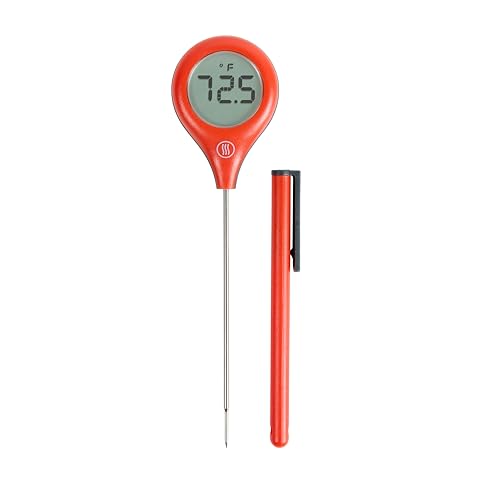
The ThermoPop 2 suits cooks who want ThermoWorks credibility in a smaller, simpler, more affordable form: apartment cooks with shallow drawers, bakers who temp dough and custards as often as meat, and anyone who finds full-size folding thermometers bulky for quick checks. Its own listing calls it the brand’s best-value instant-read, and that is exactly its role in this guide. If you probe thick roasts and whole birds constantly, a longer folding probe like its bigger sibling gives you more reach and clearance from heat.
Strengths
- Professional-brand calibration and build standards in the most compact body in this guide — it disappears into a pocket or apron
- Simple, focused design with nothing to configure: open, probe, read, which makes it the least intimidating pick for new thermometer users
- The value position inside a premium brand’s range means support, consistency, and quality control a no-name budget model cannot promise
Trade-offs
- Compact size means a shorter reach than full-size folding models — knuckles get closer to grill heat over wide grates
- It is a spot-check tool only, with no leave-in or wireless capability for long cooks
- Within its brand it is the value option, so cooks wanting the fastest possible reference-grade reads should still step up to the flagship pick
| Type | Digital instant-read, compact |
| Listing claim | Best Value Instant Read Thermometer (verified listing title) |
| Color verified | Cayenne Pepper Red |
Compact thermometers live or die on whether you actually carry them, and the ThermoPop 2 is designed around that behavioral truth. It rides in an apron pocket during a cook, clips into a drawer without dominating it, and comes out for the kind of quick, casual checks — is this dough warm enough, is this custard close, is this reheated portion properly hot — that a bulkier tool would not be fetched for. Frequency of use is a quality in itself: a slightly humbler thermometer that gets used forty times a month teaches you more about your cooking than a flagship used four times.
It is also the natural recommendation for the brand-loyal buyer on a budget. ThermoWorks built its reputation on thermometers that read true, and the ThermoPop line is that reputation’s accessible front door. You give up the flagship’s ultimate speed and full-size format; you keep the company’s calibration consistency. For small kitchens and bakers, that is not a compromise — it is the correct sizing of tool to task.
Best for: Small kitchens, bakers, and brand-conscious buyers who want professional credibility in a compact, simple tool / Not suited for: Grillers who need maximum probe reach over wide, hot grates
Check on Amazon — check the current price on Amazon first — listings swap colors and bundle extras without warning.
Taylor Digital Instant Read Waterproof Meat Thermometer — Best Wide Temperature Range
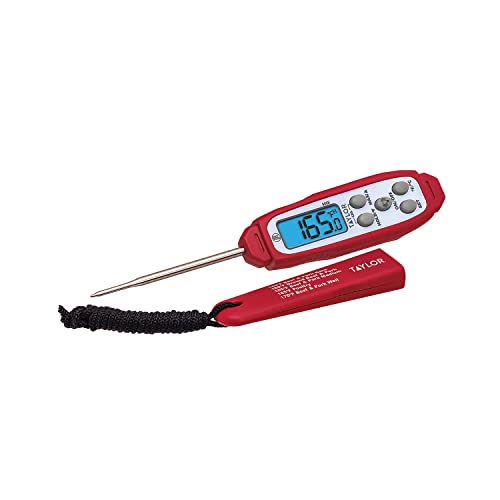
Taylor’s thermometer suits the cook whose temperature work ranges widest: freezer and fridge checks at the cold end, roasting and grilling in the middle, and candy and oil work toward the top of its verified 450-degree ceiling. The folding probe and included batteries make it a grab-and-go household tool. If your work regularly exceeds that ceiling — high-heat searing surfaces or deep candy stages beyond it — a professional pick with a higher rated range is the safer match, and deep-freezer specialists should confirm any thermometer’s low-end behavior before trusting it at the extremes.
Strengths
- Verified range of -40 to 450 degrees F in the listing — one tool honestly covers freezer checks through roasting and most frying and candy work
- Folding probe protects the tip in a drawer and keeps the unit compact, with a backlight for dim kitchens and evening grilling
- Batteries included per the listing, so it works out of the box, and Taylor’s long history in thermometers means a stable, conventional design
Trade-offs
- The 450-degree ceiling is real: it excludes the highest-heat tasks, so check your candy and searing habits before choosing it as your only thermometer
- The blue backlight, while readable, is a simpler display experience than the auto-rotating screens on the feature-led picks
- It aims at dependable household duty rather than professional certification, so credential-focused buyers should look at the certified picks above
| Type | Digital instant-read, folding probe |
| Range | -40 to 450 degrees F (listing claim) |
| Display | Backlit (blue) |
| Included | Batteries included (listing claim) |
Range is the specification buyers most often ignore and most often regret ignoring. A thermometer bought for steaks gets borrowed for everything temperature-shaped in a kitchen — proofing water, yogurt incubation, freezer audits after a power outage, oil for doughnuts — and a model verified from well below freezing to well above roasting temperatures simply says yes to more of those jobs. Taylor, a company whose name has been on dial thermometers for generations, builds this digital model to that generalist brief, and the folding probe keeps the generalist tool drawer-friendly.
The honest ceiling matters as much as the span. Four hundred fifty degrees covers roasting, grilling checks, and much frying and sugar work, but it is not a license to leave the probe in a screaming-hot pan. Read the verdict literally: this is the guide’s wide-range household pick, chosen for breadth across everyday tasks.
Best for: Generalist cooks who temp everything from freezers to frying oil and want one folding tool with a verified wide range / Not suited for: High-heat specialists whose regular work runs above 450 degrees F
Check on Amazon — check the current price on Amazon first — listings swap colors and bundle extras without warning.
Comparison Table
The six picks side by side. Note how the differences cluster around speed, water resistance, display design, and range rather than basic competence — every model here reads meat temperatures quickly and honestly.
| Pick | Badge | Key spec | Best for |
|---|---|---|---|
| ThermoWorks Thermapen ONE | Best Overall | Folding instant-read, professional tier | Daily drivers and serious grillers |
| Lavatools Javelin PRO Classic | Best for Fast Backlit Reads | 2-second read, IP65, NSF, rotating backlit display | Night grilling and awkward angles |
| TempPro TempSwift TP19H | Best Value Instant-Read | 1-second read, motion-activated, waterproof claim | Everyday grilling, candy and frying |
| Alpha Grillers Meat Thermometer Digital | Best Budget | 1–2 second read, IP67, backlit, pre-calibrated | First thermometers and grill-side spares |
| ThermoWorks ThermoPop 2 | Best Compact | Compact instant-read, premium-brand value tier | Pockets, aprons and shallow drawers |
| Taylor Digital Instant Read Waterproof Meat Thermometer | Best Wide Temperature Range | -40 to 450F range, folding probe, backlit | Whole-kitchen temperature work |
How to Choose the Best Digital Meat Thermometers for Your Cooking
Start with the family, not the brand. Instant-read thermometers — all six picks in this guide — are spot-check tools: they live in a drawer and answer a question in seconds. Leave-in probe thermometers trail a cable from the meat to a base unit and watch one item continuously, which suits a single large roast but tethers you to it. Wireless probes remove the cable and report to a phone, which suits long, unattended smoker sessions but adds charging, pairing, and app dependence to a job that is fundamentally simple. Most households should own an instant-read first, because it serves every cooking method including the grill, the oven, the stove, and the fryer, and add a leave-in or wireless tool later only if long cooks become a habit.
Speed is the second decision, and it is worth understanding what the numbers mean. Response time describes how quickly the sensor itself reacts; the practical figure you feel is how long the display takes to settle on a stable number while you hold the probe still in the food. One-to-two-second class thermometers make checks almost thoughtless. Five-to-eight-second class thermometers — common in older and cheaper designs — keep lids open long enough to matter on a grill and tempt you to accept the first number that appears, which is often still climbing. If you grill thin cuts like burgers, fish, and chicken breasts, where the temperature window between perfect and overdone is narrow and the probe target is small, speed is not a luxury; it is the feature that makes the reading true.
Accuracy and calibration form the third decision. A well-made digital thermometer should read within a degree or two of true across the cooking range, and the credible signals of that are certification marks, a maker with a calibration reputation, and designs that either hold factory calibration or allow checking against known points like ice water. You do not need laboratory precision to cook safely — food-safety temperatures have margins built in — but you do need consistency, because your own doneness preferences are learned against your thermometer’s numbers. A tool that reads three degrees high every time still teaches you your numbers; a tool that wanders teaches you nothing.
Finally, match the body to your kitchen’s hazards. Water-resistance ratings tell you how the tool may be washed: splash-resistant models get a careful wipe, IP65 models take a rinse, and IP67 waterproof models tolerate a confident wash after raw-chicken duty. Folding probes protect tips and fingers in drawers. Backlit and rotating displays matter if you grill at night or probe from the side. None of these change the temperature the tool reports — all of them change whether the tool survives and gets used, which is why this guide weights them as heavily as the electronics.
Instant-Read, Leave-In, or Wireless: Matching the Tool to the Cook
The instant-read’s weakness is the mirror of its strength: it only knows the temperature when you ask. For a brisket spending twelve hours in a smoker, asking every hour means opening the cooker, losing heat, and still missing the stall’s end at 3 a.m. That is the honest case for leave-in and wireless systems, and cooks who smoke monthly should budget for one as a second tool rather than expecting any instant-read — including this guide’s premium pick — to supervise a cook it cannot watch. Conversely, leave-in probes are clumsy spot tools: nobody trails a cable to check a burger, and wireless probes are too thick to read a thin fillet accurately because the sensor sits in a fat probe body that needs depth to measure the food instead of the air near it.
Thickness deserves its own warning because it is the least advertised specification in the category. An instant-read’s thin tip can sit fully inside a chicken breast or a pork chop and read the meat’s true center. A thick wireless probe in the same chop may span from surface to surface, averaging hot exterior and cool center into a number that describes neither. This is why professional kitchens, which can own any tool, still reach for thin instant-reads for service checks. Buy the thin tool first; let the connected tools earn their place as specialists afterward.
Budget tiers in this category are best understood qualitatively. The budget tier now delivers speed, backlighting, and waterproofing that were premium features recently, as the Alpha Grillers pick demonstrates. The mid tier adds display intelligence — rotation, motion wake — and stronger feature sets, as the TempPro and Lavatools picks show. The premium tier buys calibration pedigree, certification, build confidence, and support, as the ThermoWorks picks show. None of these tiers changes food safety; they change speed of trust. Choose the tier that matches how much of your cooking — and cooking for others — rides on the number.
Probe Care, Accuracy Checks, and Reading Technique
Technique decides accuracy more than electronics do. Always probe the thickest part of the meat, push the tip past the center and pull back slowly until the reading bottoms out — that lowest point is the true center temperature — and keep the tip away from bone, gristle, and large fat pockets, all of which read differently from the muscle you care about. On a grill, probe from the side of a steak or burger rather than down through the top, so the tip travels through the cool center plane instead of stopping halfway. Give the reading its full settle time; pulling early is the single most common cause of ‘my thermometer is wrong’ complaints about thermometers that are fine.
The ice-point check is the owner’s calibration test, and every digital thermometer owner should know it. Fill a glass completely with crushed ice, add just enough cold water to fill the gaps, stir, and wait a minute. Insert the probe into the center of the slurry without touching the glass. A truthful thermometer reads at or extremely near freezing. If yours reads several degrees off, note the offset — many cooks simply write it on a piece of tape on the storage sleeve — and if it reads wildly off or drifts between checks, retire it. Boiling water is the second known point, adjusted for altitude, but the ice check alone catches nearly every real-world failure.
Storage and washing complete the care picture. Wash the probe after every use — it has been inside raw meat — following the water-resistance guidance for your model: wipe splash-resistant bodies, rinse rated ones, and never put an electronic thermometer body in a dishwasher regardless of enthusiasm in a listing headline, a rule the companion guide to dishwasher-safe models in this cluster explains in full. Store folding models closed, keep probe tips from rattling against knives in a drawer, and treat a thermometer that has been dropped hard onto tile as a suspect until it passes an ice check. These small habits are why one owner’s budget thermometer outlives another owner’s premium one.
How to Use a Digital Meat Thermometer Correctly, Step by Step
Correct use is a short routine, and learning it once will improve every result you get from any pick in this guide — including the budget ones — more than upgrading hardware will.
- Start checking early. Begin temping before you expect doneness — roughly ten degrees before your target for roasts, a minute or two early for grill items — because carryover and fast finishes punish late first checks.
- Probe the thickest part. Aim for the center of the thickest muscle, away from bone and the pan or grate surface.
- Find the thermal center. Push slightly past the middle, then withdraw slowly and watch the reading fall to its lowest point; that minimum is the number that decides doneness and safety.
- Check more than one spot. On whole birds and large roasts, check the thigh’s innermost part and the breast’s thickest part; they finish at different times and both matter.
- Wait for the settle. Hold still until the display stops moving. A climbing number is a journey, not a reading.
- Rest and re-check when it matters. Large cuts rise as they rest; a final check after resting confirms the temperature the meat will actually be served at.
- Wash the probe immediately. Hot soapy water on the probe, cleaning the body only as its water rating allows, then dry and store it closed.
Two technique upgrades separate experienced users from beginners. The first is temping by plan rather than by anxiety: decide before the cook which spots you will check and at what point, so openings of the grill or oven are brief and purposeful. The second is learning your own offsets — how much your grill’s hot spots, your oven’s habits, and your resting setup move temperatures — by checking consistently with the same thermometer. A thermometer used with a routine becomes a measuring system; used randomly, even the best model in this guide is only a number generator.
For food safety, anchor your cooking to the widely published safe minimum temperatures for the major proteins — poultry highest, ground meats next, whole cuts of beef, pork, and fish lower with rest time for whole cuts — and remember that your thermometer’s job is to tell you the truth about the meat’s coldest point, since that point is what safety temperatures describe. When the coldest point has reached the safe temperature for its protein, the food is done by the only definition that protects the people eating it, whatever its color suggests.
Common Buying Mistakes
Judging doneness by color or juice. Meat color lies in both directions — poultry can stay pink when safe and beef can brown while still cool inside — and juice clarity is no more reliable. The thermometer exists precisely because these folk tests fail; using them anyway, with a good thermometer in the drawer, is the most common and most avoidable mistake in this category.
Probing the wrong place. A tip touching bone reads the bone’s temperature, a tip in a fat pocket reads the fat, and a tip barely under the surface reads the cooked exterior while the center stays raw. Every one of these errors produces a confident, wrong number. The fix is mechanical: thickest muscle, tip at the center, verified by the push-past-and-pull-back routine in the how-to section.
Reading too early. Displays climb toward the true temperature, and impatient cooks record the climb. On a fast thermometer the difference is a second of patience; on a slow one it can be several degrees of fiction. Hold until the number settles — if it is still moving, you do not have a reading yet.
Trusting a thermometer that has never been checked. Drops, heat exposure, and age can shift any thermometer. The ice-point test takes two minutes and a glass of ice water, and it converts blind faith into knowledge. Owners who skip it sometimes cook for months against an offset they never knew existed.
Washing the tool wrong. Soaking a splash-resistant thermometer, or dishwashing an electronic body, kills more thermometers than cooking ever does. Wash the probe thoroughly — food safety demands it — and treat the body exactly as its rating allows, no more.
Buying thickness for thin food. A chunky probe cannot honestly read a thin fillet or a smash burger. If your cooking is mostly thin cuts, prioritize a thin, fast instant-read like the picks in this guide over any bulky connected probe, however smart its app is.
Final Recommendation
The short version: buy the Thermapen ONE if you want the reference tool and an end to thermometer shopping. Buy the Lavatools Javelin PRO if you grill at night, cook left-handed, or value NSF certification with a rotating backlit display. Buy the TempPro TP19H if you want the richest feature set for the tier — motion activation, rotating backlight, waterproof rinsing — and the Alpha Grillers if you want the budget tier’s best argument, with IP67 washing confidence and out-of-box readiness. Choose the ThermoPop 2 for compact, brand-credible simplicity, and the Taylor for the widest verified temperature range across a whole kitchen’s worth of tasks.
Whichever you choose, the larger win is behavioral: a fast thermometer that lives within reach gets used on ordinary Tuesday chicken, not just holiday roasts, and ordinary meals are where food safety and doneness are actually decided most often. Pick the model whose trade-offs you will not resent, keep it in the drawer nearest the stove, check it against ice water once in a while, and let the guessing era of your cooking end.
- ThermoWorks Thermapen ONE (Best Overall) — Check price on Amazon
- Lavatools Javelin PRO Classic (Best for Fast Backlit Reads) — Check price on Amazon
- TempPro TempSwift TP19H (Best Value Instant-Read) — Check price on Amazon
Related guides in this thermometer cluster: Best Meat Thermometers Best Wireless Meat Thermometers Best Dishwasher Safe Meat Thermometers Best Analog Meat Thermometers Best Instant Read Meat Thermometers.
Frequently Asked Questions
How fast should a digital meat thermometer read?
For a true instant-read, look for the one-to-two-second class represented by most picks in this guide. That speed keeps grill and oven doors open briefly and makes the displayed number trustworthy, because you can afford to wait for it to settle. Slower thermometers still work for roasts, where temperatures move gradually, but they frustrate on thin, fast-cooking foods.
Can one digital thermometer handle candy and frying as well as meat?
Yes, if its verified range covers those jobs. Sugar stages and frying oils run far hotter than meat, so check the model’s rated ceiling — the Taylor pick in this guide is verified from -40 to 450 degrees F, which covers most frying and candy work, while meat-only models may top out lower. A thin, fast probe also matters in syrup, where temperatures move quickly.
What does an IP rating mean on a meat thermometer?
It describes water resistance. IP65 models, like the Lavatools pick, resist splashes and rinsing. IP67 models, like the Alpha Grillers pick, are rated waterproof for confident washing. No rating, or a vague splash-resistant description, means wipe the body carefully and wash only the probe. No electronic thermometer body belongs in a dishwasher.
How do I know if my thermometer is still accurate?
Use the ice-point test: a glass packed with crushed ice and a little cold water forms a slurry at freezing point, and a healthy thermometer inserted into its center reads at or very near that point. Check after any hard drop and a few times a year. A small, stable offset can be noted and allowed for; a wandering or wildly wrong reading means retirement.
Where exactly should I insert the probe?
Into the thickest part of the meat, with the tip at the center, away from bone, gristle, and fat pockets. Push slightly past the center and pull back slowly; the lowest reading you pass is the thermal center, and that is the number that decides both doneness and safety. For steaks and burgers, enter from the side so the tip travels through the center plane.
Is a digital thermometer better than an analog dial thermometer?
For most cooks, yes: digitals read in seconds instead of the better part of a minute, resolve single degrees instead of asking you to squint at a dial, and work in steam and dim light with backlit displays. Analog dials still earn a place as leave-in oven tools and no-battery backups, which is why this cluster covers both — but as your only thermometer, a digital instant-read is the stronger tool.