Disclosure: airfryerkitchensupply.com is reader-supported. When you buy through links on our site, we may earn an affiliate commission at no extra cost to you.
Where to buy
Every pick in this guide is a real analog dial thermometer sold on Amazon, and every model below was verified against Amazon’s own catalog before it earned a place here. Use the links in this box to check the current price on Amazon for each one:
- CDN IRM200 ProAccurate Ovenproof Meat Thermometer — Check the current price on Amazon
- Escali AH1 Oven Safe Meat Thermometer — Check the current price on Amazon
- Taylor Leave-In Meat Thermometer, 3-Inch Dial — Check the current price on Amazon
- CDN IRM200-GLOW Ovenproof Meat Thermometer — Check the current price on Amazon
- Taylor 1-Inch Instant Read Pocket Thermometer — Check the current price on Amazon
- Rubbermaid Commercial Pocket Food/Meat Thermometer — Check the current price on Amazon
Analog thermometers are inexpensive tools, but listings change, bundles change, and lookalike dials with the same brand name are common. Buying through the exact model links above is the simplest way to make sure the thermometer that arrives matches the one reviewed below.
Why Analog Still Earns a Drawer Slot
If you are shopping for the best analog meat thermometers, you probably already know the honest truth about this category: a dial thermometer will never beat a good digital instant-read on speed. What it beats everything on is independence. There is no battery to die the night before a holiday roast, no screen to fog over a steamy pot, no electronics to fail after one drop too many, and nothing to pair, charge, or update. An analog meat thermometer works by a bimetal coil inside the stem that unwinds as it heats, turning a needle across a printed dial. That mechanism has been in professional kitchens for decades because it is cheap, repairable in the sense that it can be recalibrated, and nearly impossible to kill with heat alone.
That said, this category also has real limits, and this guide will not pretend otherwise. A dial thermometer needs the stem buried deep enough in the food for the coil to sense temperature — usually the sensing area sits along the lower portion of the stem, not just at the tip. It also responds slowly compared with a thermocouple, so “instant read” on a dial package means something very different from instant read on a digital package. And because you are reading a needle against small printed numbers, dial size and print quality matter more than almost any other feature. Every pick below was chosen with those realities front and center.
The six thermometers in this guide split into two honest families. The first is the leave-in family: ovenproof dials you push into a roast before it goes into the oven or onto the grill, then watch climb through the glass or from the grill lid. The second is the pocket family: small instant-read-style dials you carry in a sleeve, pull out to spot-check, and put away. Both families have a legitimate job. The mistake most buyers make is expecting one thermometer to do both jobs equally well, so each pick below is badged for the job it actually does best.
One more piece of honesty before the picks: the analog market is full of no-name multipacks and white-label dials that look identical to the branded ones. Some of them are fine; many drift out of calibration quickly and cannot be adjusted back. That is why this guide sticks to established thermometer brands — CDN, Taylor, Escali, and Rubbermaid Commercial — whose dials are NSF certified or listed, and in the CDN cases recalibratable, so a thermometer that reads a few degrees off can be corrected instead of thrown away.
In this guide
Quick Picks
Six thermometers, six distinct jobs. The badge on each pick here is the same badge used at the top of its full review further down.
- CDN IRM200 ProAccurate — Best Overall. An ovenproof leave-in dial with a temperature guide printed right on its 2-inch face, NSF certification, and a waterproof build. The default choice if you want one analog thermometer that handles roasts, poultry, and grill work. Check price on Amazon
- Escali AH1 — Best Leave-In for Roasts. A big 2.5-inch dial labeled with doneness temperatures for beef, poultry, pork, and veal, so you read the target off the face instead of memorizing a chart. NSF certified and oven safe. Check price on Amazon
- Taylor Leave-In, 3-Inch Dial — Best for Easy Reading. The largest dial in this guide. If your eyes, your kitchen lighting, or your patience with tiny print is the limiting factor, this is the analog to buy. Check price on Amazon
- CDN IRM200-GLOW — Best for Grilling in Low Light. The IRM200 formula with a glow dial you can read at dusk on the patio, plus a waterproof, recalibratable build. Check price on Amazon
- Taylor 1-Inch Pocket Thermometer — Best Budget Pocket Pick. A tiny NSF-approved dial on a stainless stem, 0 to 220 degrees F, with a sleeve that doubles as a calibration case. The classic line-cook pocket tool at a budget-tier price. Check price on Amazon
- Rubbermaid Commercial Pocket Thermometer — Best for Easy Cleanup. A commercial-style pocket dial reading 0 to 200 degrees F that is dishwasher safe, which almost nothing else in this category can claim. Check price on Amazon
How These Picks Were Chosen
Every product named in this guide was verified through Amazon’s catalog data for this site before writing: exact model, exact dial type, exact feature set. That verification step matters in this category because analog thermometers are heavily white-labeled — the same photograph appears under a dozen brand names, and the only way to know a listing is the genuine branded model is to match the model number and feature list against the catalog record. Models that could not be verified with confidence were left out rather than guessed at.
Beyond verification, picks were judged on six criteria. First, dial legibility: face diameter, print size, and whether doneness targets are printed where you can use them. Second, calibration: whether the thermometer can be recalibrated when it drifts, because every bimetal dial drifts eventually. Third, certification: NSF certification or listing, which signals the thermometer was built to a food-safety standard rather than a novelty standard. Fourth, construction: stainless stems, ovenproof ratings where claimed, and waterproofing where claimed. Fifth, honest temperature range: a dial whose scale matches the work — a pocket dial that tops out around 200 to 220 degrees F is a food thermometer, not a fryer thermometer, and it is judged as one. Sixth, family fit: leave-in picks were judged on how well they monitor a long cook, pocket picks on how well they spot-check.
What was deliberately excluded: any thermometer with a digital display (that is a different guide), any dial without an identifiable manufacturer and model, any model with a known safety recall, and any listing whose features could not be confirmed. Prices were also excluded as a judging criterion beyond broad tier — analog thermometers cluster in the budget and mid-range tiers, and the right reason to pick one is the dial and the build, not a small price gap that may not exist by the time you read this.
The 6 Best Analog Meat Thermometers
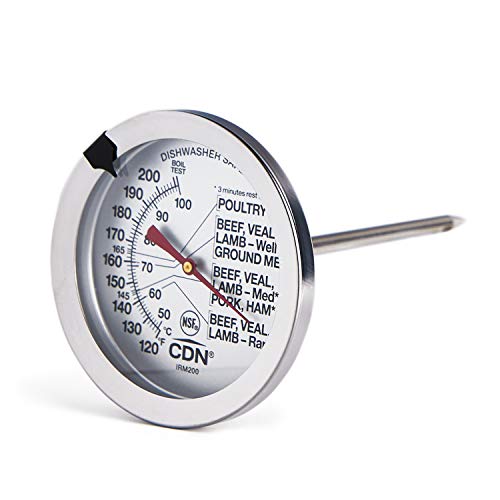
CDN IRM200 ProAccurate Ovenproof Meat Thermometer — Best Overall
The CDN IRM200 is the thermometer to buy when you want the analog format to behave as much like a complete system as a dial can. It is an ovenproof leave-in thermometer: you insert the stainless stem into the thickest part of a roast or a whole bird before cooking, close the oven door or grill lid, and let the dial do the monitoring. The 2-inch face carries a printed temperature guide, so the doneness targets for poultry, beef, pork, and roasting live on the thermometer itself rather than on a chart taped inside a cupboard door. It is NSF certified, which places it in the small group of consumer dials built to a professional food-safety standard, and it is waterproof, so it can be washed properly instead of wiped nervously.
Strengths
- Temperature guide printed on the 2-inch dial removes the guesswork of remembering doneness targets mid-cook.
- NSF certified and waterproof — a combination that is genuinely rare at this tier and makes cleanup straightforward.
- Ovenproof leave-in design handles the full arc of a roast, from raw to resting, without opening the door to probe.
Trade-offs
- Like every bimetal dial, it responds slowly; it is a monitoring tool, not a spot-check tool for thin cuts.
- The stem needs deep insertion to read accurately, so it is poorly suited to burgers, thin chops, or flat fish fillets.
- A 2-inch dial is readable at arm’s length but not across the kitchen; you will walk over to check it.
| Spec snapshot (verified) | |
|---|---|
| Type | Ovenproof leave-in analog dial |
| Dial | 2 inch, with printed temperature guide |
| Certification | NSF certified |
| Build | Stainless stem, waterproof |
In practice, the IRM200 earns its Best Overall badge through roast chicken and pork loin more than through any single specification. Whole poultry is where analog leave-in thermometers justify themselves: the bird goes in once, the thermometer goes in once, and the cook is a single rising needle instead of a series of door openings that dump oven heat and stretch cooking time. The printed guide matters most with poultry, because the difference between a safe bird and a dry bird is a narrow window, and reading the target directly off the dial removes the temptation to guess. On beef roasts, the same guide helps you pull at rare or medium-rare rather than discovering at the carving board that you overshot.
The honest limitation is the one shared by the whole category: response time. A bimetal coil needs time in the food to reach thermal equilibrium, so if your cooking style is built around fast checks on a grill full of mixed items, this dial will feel slow. Treat it as the roast thermometer it is, and it is excellent. Best for: home cooks who roast whole poultry, pork, and beef regularly and want one dependable leave-in dial. / Not suited for: cooks who mostly grill thin cuts and need fast spot-checks.
Check the current price on Amazon

Escali AH1 Oven Safe Meat Thermometer — Best Leave-In for Roasts
The Escali AH1 takes the leave-in idea and enlarges it. Its dial is 2.5 inches across — the second-largest face in this guide — and the face is temperature labeled for beef, poultry, pork, and veal, laying the doneness targets out by protein so a mixed household cooking different meats on different nights can read the right target at a glance. It is oven safe, built in stainless steel, and NSF certified. If the CDN IRM200 is the system pick, the AH1 is the readability pick within the leave-in family: everything about it is oriented toward making the dial itself the only reference you need during a roast.
Strengths
- Extra-large 2.5-inch dial with doneness temperatures labeled by protein — beef, poultry, pork, and veal.
- NSF certified, oven safe, stainless construction; built for repeated roast duty rather than occasional use.
- The larger face stays legible through an oven door window and in the glare of a grill lid better than small dials.
Trade-offs
- The big dial and long stem make it a dedicated leave-in tool; it is awkward as a quick spot-checker.
- Deep insertion requirement rules it out for thin or small items, same as any leave-in dial.
- Labeled doneness bands are a guide, not a substitute for knowing your own target temperatures and resting practices.
| Spec snapshot (verified) | |
|---|---|
| Type | Oven safe leave-in analog dial |
| Dial | 2.5 inch, doneness temperatures labeled for beef, poultry, pork, veal |
| Certification | NSF certified |
| Build | Stainless steel |
Where the AH1 shines is the Sunday-roast pattern: one large piece of meat, one long cook, one cook who does not want to hover. The protein-labeled face means a beef roast on Saturday and a pork roast on Sunday each get read against their own printed targets, and the 2.5-inch face means those targets can actually be read without pulling the roast out and losing heat. It is also a sensible pick for newer cooks, because the dial teaches the doneness map as you use it — after a few months of reading targets off the face, you will know them without looking.
The trade-off to accept is specialization. This is not the thermometer you grab to check a chicken breast on a weeknight; it lives in the roasting pan drawer and comes out when something big goes into the oven. Bought for that job, it is arguably the most user-friendly leave-in dial in this guide. Best for: roast-focused cooks and newer cooks who want doneness targets printed on a large, easy face. / Not suited for: cooks wanting one small thermometer for quick checks on everyday cuts.
Check the current price on Amazon

Taylor Leave-In Meat Thermometer, 3-Inch Dial — Best for Easy Reading
Every other feature debate in this category ends the moment eyesight enters the conversation. The Taylor leave-in thermometer carries a 3-inch dial — the largest in this guide — on a stainless steel stem, in a compact oven-safe leave-in format. That extra inch of face diameter sounds modest on paper and is transformative in a real kitchen: numerals get bigger, the needle’s position resolves more clearly, and the dial can be read at a distance and at an angle that would defeat a 1- or 2-inch face. Taylor is one of the oldest names in consumer thermometers, and this is its straightforward answer to the most common complaint about analog dials, which is not accuracy but legibility.
Strengths
- 3-inch dial is the most legible face in this guide — readable through oven glass and across a grill.
- Oven safe leave-in design in stainless steel, made for roasts and whole birds.
- Simple, single-purpose construction with nothing to configure, charge, or pair.
Trade-offs
- The large head makes it top-heavy in smaller or shallower items; it wants a substantial roast to sit in.
- It is a monitoring dial, with the slow bimetal response shared by the whole leave-in family.
- Compact stem reach means very large items may still need a spot-check with a second thermometer at the end.
| Spec snapshot (verified) | |
|---|---|
| Type | Oven safe leave-in analog dial |
| Dial | 3 inch |
| Build | Stainless steel |
Think of this Taylor as the pick for cooks who have quietly stopped trusting their current small dial because they cannot read it without picking up the roast — a common and completely reasonable failure mode. It is also the kindest pick for anyone cooking in a dim kitchen, cooking outdoors at dusk, or cooking with reading glasses somewhere other than on their face. The leave-in format compounds the benefit: insert once, then every check after that is a glance instead of a procedure.
Its limits are physical rather than conceptual. A 3-inch head needs meat with enough depth and mass to hold it upright and to bury the sensing portion of the stem, so weeknight chicken pieces and pork chops are not its work. For roasts, turkeys, and hams, it is the easiest analog read in this guide. Best for: anyone who finds small dials hard to read, and roast cooks who check through the oven door. / Not suited for: small cuts, shallow pans, or cooks who need a pocket spot-checker.
Check the current price on Amazon

CDN IRM200-GLOW Ovenproof Meat Thermometer — Best for Grilling in Low Light
The CDN IRM200-GLOW takes the Best Overall pick’s formula and fixes the one scenario where a standard dial genuinely struggles: reading a needle in the dark. Its 2-inch dial glows, which sounds like a gimmick until you are standing over a grill at dusk in November trying to decide whether the pork shoulder’s thermometer says what you hope it says. It is ovenproof for roasting work indoors, waterproof, and recalibratable — that last feature is the quiet professional touch, because a dial that can be brought back to true with an ice bath and a small adjustment will outlive several dials that cannot.
Strengths
- Glow dial stays readable in low light — evening grilling, dim kitchens, and smoker sessions that run past sunset.
- Recalibratable, so drift can be corrected instead of tolerated or thrown away.
- Waterproof ovenproof build on the proven IRM200 platform, with an easy-read 2-inch face.
Trade-offs
- Glow dials need light exposure to charge their glow; a thermometer stored in a dark drawer will glow weakly until it has seen light.
- Still a leave-in bimetal dial: slow response, deep insertion, wrong tool for thin cuts.
- The glow feature solves reading in the dark, not reading from far away — the face is 2 inches, not 3.
| Spec snapshot (verified) | |
|---|---|
| Type | Ovenproof leave-in analog dial |
| Dial | 2 inch glow dial, easy-read |
| Build | Waterproof, recalibratable |
| Use | Oven roasting, poultry, beef, BBQ |
The use case writes itself: grilling and smoking are disproportionately evening activities, and the final hour of a long cook is exactly when the thermometer matters most and the light is worst. A glow dial removes the phone-flashlight juggle from that moment. Indoors, the same feature helps in the low, warm light of a kitchen at night, and the recalibration ability makes this the pick most likely to still be accurate years from now, provided you actually do the ice-point check described later in this guide.
If you never cook after dark and your kitchen is bright, the standard IRM200 above gives you the same platform without the glow. If your grill sessions regularly end in the dark, this is the analog to own. Best for: grillers and smokers whose cooks run into the evening, and buyers who value recalibration. / Not suited for: cooks who only roast indoors in bright light and would never use the glow.
Check the current price on Amazon

Taylor 1-Inch Instant Read Pocket Thermometer — Best Budget Pocket Pick
Not every analog job is a roast. The Taylor pocket thermometer is the other classic form: a small 1-inch dial on a stainless stem, reading 0 to 220 degrees F, NSF approved, supplied with a protective sleeve that doubles as a calibration case. This is the thermometer format that has lived in cooks’ shirt pockets for generations, used for the ten-second question — is the chicken done, is the soup hot enough, is the reheated casserole through the danger zone — rather than for monitoring a cook from start to finish.
Strengths
- Genuinely pocketable: small dial, slim stainless stem, and a sleeve that protects both the stem and whatever it shares a drawer with.
- NSF approved with a 0 to 220 degrees F range that covers food temperatures end to end.
- The sleeve doubles as a calibration case, making the ice-point check described below a two-minute job.
Trade-offs
- A 1-inch dial is the hardest face in this guide to read; small print is the price of pocket size.
- “Instant read” on a bimetal dial still means waiting for the needle to settle — far slower than a digital instant-read.
- The range tops out at 220 degrees F, so this is a food thermometer only: no fryer oil, no candy, no grill-surface work.
| Spec snapshot (verified) | |
|---|---|
| Type | Pocket analog dial, instant-read style |
| Dial | 1 inch |
| Range | 0 to 220 degrees F |
| Certification | NSF approved |
| Included | Protective sleeve / calibration case |
Judged as a pocket tool rather than against digitals, the Taylor is easy to recommend. It costs very little, it asks for nothing — no battery, no boot-up, no care beyond a wash — and it answers the safety questions that actually matter in a home kitchen: poultry to temperature, leftovers reheated through, burgers checked at the center. Its calibration case is a bigger deal than it looks, because the single most common failure of cheap dials is silent drift, and a thermometer you can check against ice water in its own sleeve is a thermometer you can keep trusting.
Set expectations correctly and it will not disappoint: allow the needle time to settle, insert the stem far enough that the sensing section is in the food, and read the small dial up close. Best for: budget-minded cooks who want a no-battery spot-checker for everyday food-safety checks. / Not suited for: anyone who needs fast readings on a busy grill or who struggles with very small print.
Check the current price on Amazon

Rubbermaid Commercial Pocket Food/Meat Thermometer — Best for Easy Cleanup
Rubbermaid’s Commercial line builds for cafeterias and line kitchens, and this pocket thermometer shows it: a pocket-size instant-read dial on stainless steel, reading 0 to 200 degrees F, and — the feature that earns its badge — dishwasher safe. Almost every other analog dial asks to be hand-washed or merely wiped, because water intrusion is the classic dial killer. A thermometer you can put through the dishwasher removes the most common hygiene compromise in home kitchens, which is the quick wipe that does not actually clean a stem that has been in raw chicken.
Strengths
- Dishwasher safe — a rare, genuinely useful feature in this category and the best hygiene story here.
- Commercial-grade positioning from a line built for professional food service, in a pocket format.
- 0 to 200 degrees F range covers the full span of meat and food-holding temperatures.
Trade-offs
- Pocket format means a small dial and bimetal response time; it is a checker, not a monitor.
- The 200-degree ceiling rules out any high-heat use beyond food itself.
- Commercial styling is plain; there are no printed doneness guides on a dial this size.
| Spec snapshot (verified) | |
|---|---|
| Type | Pocket analog dial, instant-read style |
| Range | 0 to 200 degrees F |
| Build | Stainless steel, dishwasher safe |
| Use | Oven, grill, and meat cooking checks |
The household this pick suits best is the one that cooks meat often enough that thermometer hygiene is a real workflow, not a theory: families batch-cooking chicken for the week, anyone checking multiple pieces in sequence, anyone who has ever hesitated over whether a wiped stem is clean enough to go from raw poultry to a rested roast. Putting the thermometer in the dishwasher with the cutting boards ends that hesitation entirely.
As a measuring tool it is a competent, honest pocket dial — no more instant than any bimetal, no more legible than its size allows — but the cleanup advantage is not a marginal one. In a category where the tools are otherwise near-identical, the one you can actually sanitize wins its place. Best for: frequent meat cooks who prioritize hygiene and want a pocket dial they can dishwasher after raw-protein work. / Not suited for: cooks who want printed doneness guidance or a leave-in monitor.
Check the current price on Amazon
Comparison Table
| Pick | Badge | Key spec | Best for |
|---|---|---|---|
| CDN IRM200 ProAccurate | Best Overall | 2-inch dial with printed temperature guide, NSF certified, waterproof | One leave-in dial for roasts and poultry |
| Escali AH1 | Best Leave-In for Roasts | 2.5-inch dial labeled for beef, poultry, pork, veal; NSF certified | Roast cooks and newer cooks |
| Taylor Leave-In, 3-Inch Dial | Best for Easy Reading | 3-inch dial, stainless stem, oven safe | Anyone who finds small dials hard to read |
| CDN IRM200-GLOW | Best for Grilling in Low Light | 2-inch glow dial, waterproof, recalibratable | Evening grilling and smoking |
| Taylor 1-Inch Pocket | Best Budget Pocket Pick | 0–220°F, NSF approved, sleeve doubles as calibration case | Everyday spot-checks on a budget |
| Rubbermaid Commercial Pocket | Best for Easy Cleanup | 0–200°F, stainless, dishwasher safe | Frequent cooks who want sanitizable tools |
How to Choose an Analog Meat Thermometer
Choosing within this category is less about finding the “most accurate” dial — bimetal dials from reputable makers cluster closely — and more about matching the form to the cooking you actually do. Work through the five decisions below in order and the right pick usually selects itself.
Decision one: leave-in or pocket?
This is the fork that defines everything else. A leave-in thermometer is inserted before cooking and stays in the food, turning the cook into a single monitored rise. Choose leave-in if your cooking is roasts, whole poultry, hams, and other large items with cook times measured in tens of minutes or hours. A pocket thermometer is inserted briefly to answer a question, then removed. Choose pocket if your cooking is weeknight pieces — breasts, chops, burgers, reheated dishes — where the question is asked at the end, not throughout. Many serious home kitchens own one of each, and given the budget-tier pricing of analog tools, that two-thermometer answer is often the honest one.
Decision two: dial size and print
Dial diameter is the most underrated specification in this category. A 1-inch pocket dial is a tool you read at close range, deliberately, one check at a time. A 2-inch dial reads comfortably at arm’s length. A 2.5- to 3-inch dial reads through oven glass and across a grill. Be honest about your eyes, your lighting, and your distance from the food while it cooks, and buy the face that matches. A thermometer you cannot read is not a bargain at any price. Printed doneness guides are the second half of this decision: faces that carry protein targets, like the CDN IRM200 and Escali AH1 in this guide, convert memorization into reading, which is a real advantage for occasional roast cooks.
Decision three: calibration
Every bimetal thermometer drifts. Drops, thermal shocks, and years of use all move the needle’s zero point, and a drifted dial does not announce itself — it simply starts lying by a few degrees in one direction. The defense is calibration: models that can be recalibrated, like the CDN IRM200-GLOW, or that ship with a calibration-friendly sleeve, like the Taylor pocket pick, let you restore accuracy with an ice bath. If a dial cannot be adjusted at all, its useful life ends the day it drifts, however sturdy it feels. For a tool this inexpensive that may sound trivial, but the cost of a wrong reading is a ruined roast or an undercooked bird, not the price of the dial.
Decision four: range and certification
Match the scale to the job. Pocket dials in this guide read to 200 or 220 degrees F, which covers every meat and food-holding temperature and nothing beyond — they are not fryer, candy, or oven thermometers, and using them as such will destroy them. Leave-in ovenproof models are built for the oven environment itself. Certification is the other quiet filter: NSF certification or listing, carried by the CDN, Escali, and Taylor picks here, means the thermometer was manufactured to a food-contact standard. In a category flooded with unbranded lookalikes, that mark is the fastest credibility check available to a buyer.
Decision five: cleaning reality
A meat thermometer touches raw protein by design, so how it cleans is a safety feature, not a convenience feature. Waterproof models can be washed properly under the tap; the dishwasher-safe Rubbermaid Commercial pick goes further. Models that can only be wiped should be wiped with intent — hot soapy water on a cloth, stem fully cleaned, every time — and if that discipline sounds unlikely in your kitchen at the end of a long cook, weight the waterproof and dishwasher-safe picks more heavily.
Analog vs Digital: An Honest Comparison
Since many shoppers arrive at this guide cross-shopping formats, here is the trade without spin. A digital instant-read thermometer answers in seconds, reads to a tenth of a degree on a backlit screen, and costs more, needs batteries, and contains electronics that heat, steam, and drops eventually kill. An analog dial answers slowly, reads to the nearest few degrees on a printed face, costs very little, needs nothing, and tolerates abuse that would end a digital. For thin, fast-cooking food where a five-degree window decides the outcome in under a minute — a steak’s final sear, a fish fillet — digital is the right tool, and this site covers that category in its guide to the best digital meat thermometers. For long roasts, whole birds, smokers, backup duty, camping, and any kitchen where tools are expected to work after years in a drawer, analog is not a compromise; it is the appropriate technology. The cooks who get the most from analog are the ones who stop asking it to be digital.
Understanding Doneness Temperatures
A dial thermometer only helps if you know what number you are steering toward, so here is the working map. Poultry, whole or in pieces, is cooked to 165 degrees F. Ground meats are cooked to 160 degrees F for beef and pork, and 165 for ground poultry. Whole cuts of beef, pork, lamb, and veal are cooked to 145 degrees F followed by a rest, which is where personal preference enters for beef: rare and medium-rare steaks and roasts are pulled below that figure by cooks who accept the trade-off, and a printed dial guide will show those bands. Fish is generally cooked to 145 degrees F or until it flakes and turns opaque. Two practices matter as much as the targets. First, carryover: a roast’s internal temperature keeps rising after it leaves the heat, commonly by several degrees, so pulling a large roast slightly early and resting it is technique, not risk. Second, placement: the reading only describes the spot the stem is sensing, which is why the how-to section below spends so much time on where the stem goes.
Budget Tiers in This Category
Analog meat thermometers live almost entirely in the budget and lower mid-range tiers, and the differences between tiers buy features rather than fundamental accuracy. The budget tier buys a sound pocket dial from a real brand — NSF approval and a calibration sleeve included, as with the Taylor pocket pick. The step up buys size and systems: bigger faces, printed doneness guides, glow dials, waterproofing, and recalibration, as with the CDN and Escali leave-in picks (check price on Amazon). There is no meaningful premium tier in analog meat thermometers, and that is good news: the best tool in this guide costs a fraction of a single ruined holiday roast. Spend on the dial size and calibration story, not on decorative finishes or multipack quantity — five drifting no-name dials are worth less than one verified one.
How to Use an Analog Meat Thermometer
Technique matters more with a dial than with a digital, because the bimetal coil senses along a section of the stem rather than at a pinpoint tip. Follow these steps and an analog will read as true as it is capable of reading.
- Check calibration first. Fill a glass with crushed ice and water, stir, wait a minute, and insert the stem without touching the glass. A true dial reads 32 degrees F. If yours is off and the model allows adjustment, recalibrate per its design; if it cannot be adjusted, note the offset and do the math, or retire it.
- Insert into the thickest part. Push the stem into the center of the thickest section of meat, away from bone, gristle, and fat seams. Bone conducts heat differently from flesh and will corrupt the reading; fat reads hotter than the lean around it.
- Bury the sensing section. The dimple visible on many dial stems marks the sensing area; that section — not just the tip — must be inside the food. On thin items, insert the stem sideways through the edge so the sensing length lies along the center plane.
- For leave-in models, insert before cooking. Position the thermometer when the meat goes into the oven or onto the grill, angled so the dial faces where you will read it — toward the oven door glass or the front of the grill.
- Wait for the needle to settle. A bimetal needle climbs, overshoots slightly in your perception, and settles. Read only when it has genuinely stopped moving; with pocket checks, give it real time rather than digital time.
- Read at eye level, straight on. A needle read at an angle appears to point at a different number. Crouch, open the door briefly if you must, but get your eyes square to the face.
- Check more than one spot on large items. Whole turkeys and big roasts cook unevenly. Confirm the thigh and the breast, or two ends of a roast, and let the lowest reading govern.
- Wash the stem after every use. Hot soapy water, full stem, before the thermometer goes back in the drawer — or the dishwasher, if your model allows it.
Care, Storage, and Making a Dial Last
An analog thermometer’s enemies are shock and water where water should not be. Do not drop it on tile if you can help it, and if you do, run the ice-point check before trusting it again. Store pocket models in their sleeves; the sleeve exists to protect the stem’s calibration from drawer impacts as much as to protect your hand. Keep leave-in dials out of the self-cleaning oven cycle and away from direct flame flare-ups beyond their design; ovenproof means oven temperatures during cooking, not abuse. Finally, build the ice-point check into a rhythm — the start of grilling season, before the holiday roast — because the entire value of the tool is the trust you place in its needle, and trust in a bimetal coil should be verified, not assumed.
Common Buying Mistakes
- Expecting digital speed from a dial. Buyers who expect a two-second answer shake the thermometer, misread a still-climbing needle, and conclude analog is inaccurate. The format is slow by physics; judged on its own terms, it is dependable.
- Buying the smallest dial to save money. The savings are tiny and the print is tinier. If you cannot read the face comfortably in your own kitchen light, the thermometer will end up unused.
- Using a pocket dial as a leave-in. Pocket models are not built to live in an oven for hours; the dial face and seals suffer. Match the form to the job.
- Ignoring calibration entirely. The most expensive mistake in this category is trusting a drifted dial through a holiday meal. The ice-point check takes two minutes.
- Trusting multipack quantity over verified models. Bundles of anonymous dials look like value and behave like a lottery. One branded, certified, recalibratable thermometer is the better buy.
- Measuring next to bone. A stem resting against bone reports the bone’s temperature story, not the meat’s. Placement errors cause more bad meals than thermometer errors do.
- Assuming ovenproof means flameproof. Leave-in dials are made for oven and covered-grill environments, not for sitting in direct flare-up flame. Position roasts and thermometers accordingly.
Final Recommendation
Start where your cooking starts. If you roast whole birds and joints regularly and want one analog thermometer to anchor the drawer, buy the CDN IRM200 — its printed temperature guide, NSF certification, and waterproof leave-in build make it the most complete dial in this guide (check price on Amazon). If legibility is your deciding factor, step up in face size: the Escali AH1 for its protein-labeled 2.5-inch dial, or the Taylor 3-inch leave-in if you want the largest, easiest read of all. If your cooks run past sunset, the CDN IRM200-GLOW is the same idea built for the dark, with recalibration as its long-term bonus. And if your need is the everyday spot-check rather than the roast, the Taylor pocket dial is the budget classic, while the Rubbermaid Commercial is the one to choose when dishwasher cleanup after raw chicken matters — as it should (check price on Amazon).
Plenty of readers will land on the two-thermometer answer, and it is the right one for mixed cooking: one leave-in dial for roasts, one pocket dial for everything else, both verified, both cheap, neither needing a battery ever. If your cooking leans fast and thin rather than slow and large, compare these picks against Best Digital Meat Thermometers and the faster models in Best Digital Instant Read Meat Thermometers. Within the analog family itself, the closest sibling guide is Best Instant Read Analog Meat Thermometers, which narrows the field to the pocket format alone. And because cleanup came up so often in this guide, Best Dishwasher Safe Meat Thermometers is worth a look before you decide. For the broadest view of quick-check tools across formats, see Best Instant Meat Thermometers.
Frequently Asked Questions
Are analog meat thermometers accurate enough to cook safely?
Yes, provided two conditions hold: the thermometer is calibrated, and it is used with correct placement and patience. A verified bimetal dial from a reputable maker reads within a few degrees, which is entirely sufficient for the doneness targets that matter — poultry at 165 degrees F, ground meats at 160 to 165, whole cuts at 145 with a rest. The accuracy failures people blame on analog are usually placement failures (stem against bone, sensing section not buried) or readings taken before the needle settled. Run the ice-point check, insert correctly, wait for the settle, and an analog is a safe tool.
How long does an analog meat thermometer take to read?
Longer than any digital, and the exact time depends on how much of the stem is in the food and how large the temperature gap is. Expect to wait rather than glance: a pocket dial needs the needle to climb and visibly stop moving, which in practice means holding it in place well beyond the few seconds a digital needs. Leave-in dials sidestep the issue by riding along with the cook, which is why they are the better analog format for most people. If your cooking genuinely requires answers in seconds, buy a digital for that job and keep the analog for roasts and backup.
Can I leave an analog meat thermometer in the oven?
Only if it is an ovenproof leave-in model, like the CDN, Escali, and Taylor leave-in picks in this guide. Those are built with dials, seals, and stems rated for the oven environment for the length of a cook. Pocket thermometers are not leave-in tools: their smaller dials and construction are meant for brief insertion, and leaving one in a hot oven risks damaging the face and destroying its calibration. Check the format before the cook, not during it.
How do I calibrate an analog meat thermometer?
The ice-point method is the home standard. Fill a glass with crushed ice, add just enough cold water to fill the gaps, stir, and let it sit for a minute so the mixture stabilizes at 32 degrees F. Insert the thermometer stem into the ice water without letting it touch the sides or bottom of the glass, wait for the needle to settle, and read. If it does not read 32, a recalibratable model can be adjusted — typically by holding the nut under the dial and turning the dial to true — while a non-adjustable model should have its offset noted and factored in, or be replaced. Recheck after any hard drop.
Why does my analog thermometer read differently from my digital one?
Usually because they are measuring different things. A digital instant-read senses at a fine tip, so it reports the temperature of a small spot. A bimetal dial senses along a section of its stem, so it reports an average across that section — and if part of that section is in a hotter or cooler layer, or outside the food entirely, the average moves. Different insertion depths amplify the difference. Neither is necessarily wrong; the fix is to bury the dial’s sensing section fully in the thickest part of the meat and compare readings taken at the same location.
How long will an analog meat thermometer last?
Years, potentially decades, because there is so little to fail: no battery, no electronics, no screen. The practical limits are physical — a shattered dial lens, a bent stem, water intrusion in a non-waterproof model, or calibration drift that the model cannot correct. Recalibratable, waterproof models from established brands sit at the durable end of the category, which is why this guide weights those features heavily. Treat the dial gently, verify it against ice water now and then, and it is one of the longest-lived tools in the kitchen.