Disclosure: airfryerkitchensupply.com is reader-supported. When you buy through links on our site, we may earn an affiliate commission at no extra cost to you.
Where to buy
Every thermometer in this guide to the best instant meat thermometers is sold through Amazon, where listings confirm the exact model and color. Start with the ThermoWorks Thermapen ONE for the reference instrument, the ThermoPop 2 for value from the same maker, or the Lavatools Javelin PRO for the big backlit display. Budget and second-thermometer shoppers should compare the TempPro TP19H, the Alpha Grillers, and the Taylor folding digital.
The best instant meat thermometers share one job: to tell you the truth about the inside of your food in the few seconds you are willing to hold a probe there. That sounds simple, and it is the difference between chicken that is safe and juicy instead of safe and dry, a steak at the temperature you actually ordered from yourself, and a holiday turkey that ends arguments. This guide compares the best instant meat thermometers across the tiers that matter — the professional reference, the value pick from the same maker, the big-display alternative, and the budget instruments that have quietly become very good.
Three honest calibrations before the picks. First, speed claims are class claims: a ‘one-second’ thermometer settles almost immediately in a roast but every probe needs a moment in a thin chicken breast, and technique — probe placement in the thermal center — matters more than the last second of sensor speed. Second, accuracy is the spec that separates the tiers, and it is the one you cannot see in a photograph; this guide weights maker credibility on accuracy heavily, because a fast wrong number is worse than a slow right one. Third, an instant-read is a spot-check tool, not a leave-in probe: for long smokes you pair it with a leave-in or wireless thermometer, covered in the companion guides linked below. Every pick here was verified against Amazon’s catalog data; check the current price on Amazon from each pick’s link.
In this guide
Quick Picks
- ThermoWorks Thermapen ONE — Best Overall. The professional standard: a one-second-class instant read from the company that defines the category, with the accuracy and build that chefs and pitmasters treat as the reference instrument. Check the current price on Amazon.
- ThermoWorks ThermoPop 2 — Best Value. ThermoWorks’ value instrument: the same maker’s accuracy discipline in a simpler, rotating-display design at a fraction of the flagship’s price. Check the current price on Amazon.
- Lavatools Javelin PRO — Best Display and Features. A two-second professional read with a large auto-rotating backlit display and IP65 water resistance — the easiest readout in this guide, NSF certified. Check the current price on Amazon.
- TempPro TempSwift TP19H Instant Read — Best Budget Digital. A one-second-class budget digital with an auto-rotating backlit display, motion activation, and a waterproof body — the feature list of the premium tier at a starter price. Check the current price on Amazon.
- Alpha Grillers Meat Thermometer Digital — Best for Grill Kits and Gifting. A grilling-focused instant read with a 1-2 second response, a bright backlit display, and IP67 waterproofing — pre-calibrated, giftable, and built to live at the grill. Check the current price on Amazon.
- Taylor Digital Instant Read with Folding Probe — Best Backup and Travel. Taylor’s folding-probe digital: a wide -40 to 450°F range, a backlight, waterproof build, and batteries included — from America’s oldest name in measurement, at a backup-friendly price. Check the current price on Amazon.
How These Picks Were Chosen
We required every pick to be a true instant-read — a handheld probe that returns a trustworthy number in seconds — and then judged the field on the four things that decide ownership: accuracy credibility (the maker’s metrology reputation and any certification), settling speed in real food rather than in a water bath, display readability in the conditions people actually cook in, and build survival — water resistance, probe protection, and what happens when it is dropped, soaked, or left in a hot kitchen drawer.
That filter produces a list with a clear spine: ThermoWorks anchors both the flagship and the value tier because its accuracy discipline is the category’s reference; Lavatools earns its place on display and certification; and the three budget picks earn theirs on specific honest strengths — features, waterproofing, and range — rather than on pretending to be flagships. Where a listing’s speed figure is a class claim, the reviews say so. As everywhere in this program, prices live on the listings; thermometers are promoted constantly and printed figures would mislead within a month.
The 6 Best Instant Meat Thermometers, Reviewed

ThermoWorks Thermapen ONE — Best Overall
Every category has an instrument the professionals treat as the reference, and in instant-read thermometers it is the Thermapen. The ONE is ThermoWorks’ flagship: a reading that settles in about a second, accuracy that holds up against laboratory references, and a folding-probe build that feels machined rather than molded. Pitmasters trust it with a brisket that took fourteen hours; chefs trust it with a duck breast that forgives nothing. That trust is the product — the thermometer’s job is to end arguments about doneness, and this one ends them.
It suits serious home cooks, grillers and smokers who run long cooks, and anyone who has bought two cheap thermometers and done the math. The Cayenne Pepper Red of the verified listing is one of a wide color range, which matters more than it sounds: a distinctive color is how a thermometer avoids disappearing into a drawer of black utensils or a dark grill-side table at night.
Strengths
- Reference-class speed and accuracy — the reading you stop second-guessing
- Professional build quality with a folding probe that protects itself
- ThermoWorks’ calibration and support ecosystem behind it
Trade-offs
- Premium price, several times the budget picks — the cost is the point of debate
- No remote monitoring; it is a spot-check instrument, not a leave-in system
- Its excellence makes losing it hurt proportionally more
| Maker | ThermoWorks (per Amazon title) |
| Model | Thermapen ONE (per Amazon title) |
| Type | Folding instant-read thermometer (category standard) |
What a second of speed actually buys is technique. A fast thermometer lets you temp a steak in three places, check the thigh and the breast of a chicken separately, and probe a roast’s center without holding the oven door open and bleeding heat — measurements a slow thermometer discourages until you simply stop measuring. Accuracy compounds the effect: when the number is trustworthy, you cook to temperature instead of to time-plus-anxiety, and food safety stops being a guess wrapped in a prayer.
Ownership is correspondingly plain: it wakes when opened, reads, and goes back in the drawer. ThermoWorks supports calibration and service through its own channels, which is why these instruments stay in professional kitchens for years. If the budget allows one best thermometer, this is the one the rest of the category is measured against — including the other five in this guide.
Best for: Serious cooks, grillers, and smokers who want the reference instrument, once / Not suited for: Casual cooks who temp a burger twice a month and would rather spend the difference on ingredients
Check the current price on Amazon for the Thermapen ONE.
ThermoWorks ThermoPop 2 — Best Value
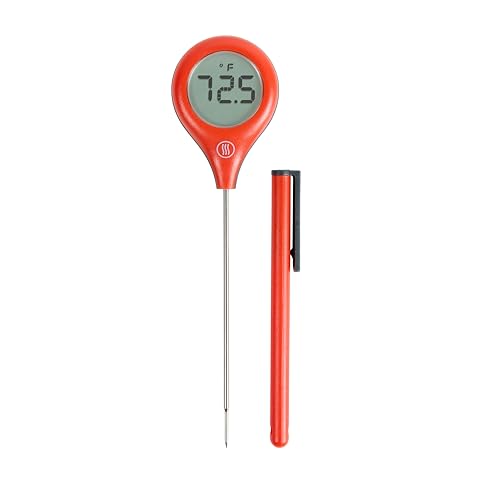
The ThermoPop 2 is the answer to the obvious question: what if I want ThermoWorks’ trustworthiness without the flagship’s price? It comes from the same maker, with the same commitment to honest accuracy, in a simpler pen-style body whose display rotates for left-handed use and awkward angles — a feature cooks appreciate the first time they temp a pan from the wrong side. Readings settle in a few seconds rather than the ONE’s one, which in practice is the difference between instant and merely fast.
It suits the great middle of home cooks: weeknight chicken, weekend roasts, holiday turkeys, and anyone building a first serious thermometer kit. Many households run the sensible two-tier system — a ThermoPop in the kitchen drawer and, later, a Thermapen at the grill — and find the Pop covers most of the year’s work without complaint.
Strengths
- ThermoWorks accuracy and support at a value tier
- Rotating display reads from any angle, either hand
- Simple, splash-resistant pen design that lives happily in a drawer
Trade-offs
- A few seconds to settle versus the flagship’s one — patience required on thin cuts
- No folding probe; the sleeve is the protection
- Fewer professional frills — it is an honest tool, not an instrument showcase
| Maker | ThermoWorks (per Amazon title) |
| Model | ThermoPop 2 (per Amazon title) |
The ThermoPop’s virtue is that it removes the excuses. At its tier there is no reason to cook a chicken to ‘probably done,’ no reason to rest a roast on hope, and no reason to own the drawer of dead cheap thermometers most kitchens accumulate. It is also the thermometer we hand to new cooks as a gift, because it teaches the habit — temp everything, learn your stove’s and grill’s real behavior — without a flagship’s price making the lesson precious.
If you read the Thermapen review and felt the pull but not the budget, this is not the consolation prize; it is the same maker’s discipline in a simpler suit, and for most households it is the correct purchase outright.
Best for: Most home cooks wanting trustworthy readings at a sensible tier / Not suited for: Competition pitmasters and others who measure in single seconds
Check the current price on Amazon for the ThermoPop 2.

Lavatools Javelin PRO — Best Display and Features
The Javelin PRO competes on the reading experience. Its display is the largest and clearest here, auto-rotating so the number is upright from either hand, and backlit so a midnight brisket check does not need a phone flashlight held in your teeth. The read itself is a two-second-class professional performance, the body is IP65 water resistant — shrugging off splashes, rain at the smoker, and a rinse under the tap — and the whole instrument carries NSF certification, the food-safety credential commercial kitchens look for.
It suits cooks who temp in difficult conditions: night smokers, grillers in bright sun where small displays wash out, cooks with eyesight that has opinions about tiny numerals, and anyone who has squinted at a thermometer and misread a digit at the critical moment. A misread is an accuracy failure no sensor can fix; the Javelin attacks that failure mode directly.
Strengths
- Biggest, clearest, auto-rotating backlit display in this guide
- Two-second-class reads with NSF certification
- IP65 body suits smokers, rain, and rinse-off cleaning
Trade-offs
- Priced in the professional tier, close to flagship territory
- The larger body is less pocket-slim than the pen-style picks
- Display sophistication is wasted on cooks who only temp in bright kitchens
| Read time | 2-second class (per Amazon title) |
| Display | Auto-rotating backlit (per Amazon title) |
| Water resistance | IP65 (per Amazon title) |
| Certification | NSF certified (per Amazon title) |
Live with the Javelin and the display argument wins converts. Probing a turkey from the oven’s far side, checking a grill full of chicken pieces in sequence, reading at arm’s length over a hot griddle — the number is just there, upright and lit, every time. The magnetic back and hang hole give it two homes (fridge door, grill hook) that keep it out of the drawer-of-loss, a small thing that determines whether a thermometer gets used on a Tuesday.
Against the Thermapen, the honest summary is: the ONE is the finer instrument; the Javelin PRO is the easier read, and it is NSF certified for those who cook for the public. Households choosing between them should choose by their conditions — night and glare argue Javelin; ultimate speed and the reference pedigree argue ONE.
Best for: Night smokers, glare-prone grillers, and anyone who values a big, unmissable readout / Not suited for: Minimalists who want the slimmest pen-style tool
Check the current price on Amazon for the Lavatools Javelin PRO.

TempPro TempSwift TP19H Instant Read — Best Budget Digital
TempPro’s TP19H is the budget pick for shoppers who read spec sheets: a one-second-class read, an auto-rotating backlit display, motion-activated waking so it is ready when picked up, and a waterproof body, at a price tier where competitors offer a slow probe and a prayer. On paper it embarrasses instruments costing several times more, which is exactly why this guide treats it with both enthusiasm and calibration.
The calibration: budget speed claims are measured under kind conditions, and a one-second-class budget read typically means the display reaches the neighborhood fast and settles shortly after — still genuinely quick in the hand. Accuracy at this tier is good rather than reference-class. For weeknight cooking, candy work, and the grill, that combination — fast, readable, waterproof, inexpensive — is precisely what most households need, and the TP19H is the strongest bundle of it we verified.
Strengths
- Premium-style features — speed, rotating backlit display, motion wake — at a budget tier
- Waterproof body survives kitchen and grill-side life
- Low cost makes it the natural second thermometer for the grill kit
Trade-offs
- Accuracy is good, not reference-class; verify critical cooks against a known reference occasionally
- Budget build and support versus ThermoWorks and Lavatools
- Feature-rich electronics at this tier are the long-term durability question
| Read time | 1-second class (per Amazon title) |
| Display | Auto-rotating backlit (per Amazon title) |
| Features | Motion-activated wake, waterproof body (per Amazon title) |
The TP19H’s best role in a serious kitchen is as the second thermometer: the one that lives at the grill, rides in the camping kit, and gets loaned without anxiety, while a reference instrument anchors the kitchen. In a starting kitchen it is simply the main thermometer, and a good one — the motion wake and the backlit rotating display are the two features owners actually praise weekly, because they are the ones that make temping effortless enough to become habit.
Buy it with the budget tier’s standard wisdom: keep the packaging through the first cooks, test it in ice water once (it should read at freezing), and let it earn your trust on chicken before it judges a competition brisket. At its price, it has very little to prove and proves most of it.
Best for: Budget buyers, beginners, and as a grill-side or travel second thermometer / Not suited for: Users who need certified reference accuracy for professional work
Check the current price on Amazon for the TempPro TP19H.

Alpha Grillers Meat Thermometer Digital — Best for Grill Kits and Gifting
Alpha Grillers sells to the grilling tribe specifically, and its thermometer is specced for that life: a one-to-two-second response, a bright backlit display for evening cooks, and IP67 waterproofing — the strongest water rating in this guide, meaning the instrument shrugs off not just splashes but a genuine dunking in the dish tub or a rain squall over the grill. It arrives pre-calibrated and ready to use, and the brand leans into gifting, because a thermometer is the rare grill gift that is both welcome and used weekly.
It suits grill-first households, tailgate and camping kits where waterproofing is survival rather than spec, and gift buyers who want to give a cook the tool that most improves their results. In the hand it is a straightforward, glove-friendly instrument without a learning curve.
Strengths
- IP67 waterproofing — the toughest water rating here
- Fast response and a bright display for evening grilling
- Pre-calibrated out of the box; gift-ready positioning
Trade-offs
- Grill-focused design; fewer refinements than the professional instruments
- Accuracy is household-good rather than reference-class
- Brand ecosystem is grilling accessories, not metrology
| Response | 1-2 second (per Amazon title) |
| Waterproofing | IP67 (per Amazon title) |
| Display | Bright backlit (per Amazon title) |
| Calibration | Pre-calibrated, ready to use (per Amazon title) |
The Alpha Grillers earns its place on a truth about thermometers: the one at hand beats the perfect one in the house. Its waterproof, knockabout build means it lives in the grill caddy through weather and washing, so it is there for every cookout — while a finer instrument kept indoors gets forgotten on the cooks that needed it most. For burgers, chicken pieces, and steaks at the grill, its speed and readability are entirely sufficient, and its survival odds are the best here.
Pair it with a reference thermometer indoors if you cook competitively; for the backyard, it is a complete answer. As a gift, it has the rare virtue of being opened, used the same weekend, and thanked for specifically.
Best for: Grillers, campers, and gift buyers wanting a tough, waterproof, ready-to-use tool / Not suited for: Precision-focused cooks who want reference-class accuracy above all
Check the current price on Amazon for the Alpha Grillers thermometer.
Taylor Digital Instant Read with Folding Probe — Best Backup and Travel
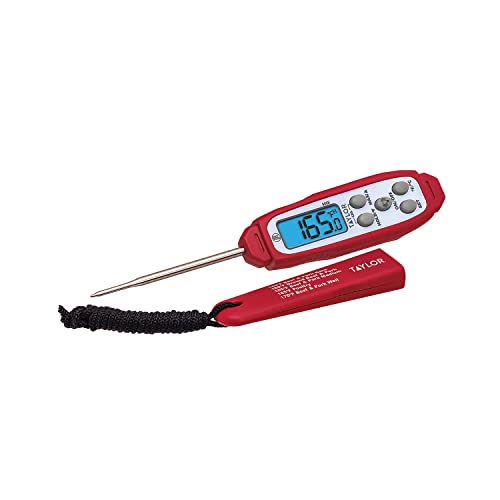
Taylor has made measuring instruments since the nineteenth century, and its folding digital is the value workhorse of this guide: a genuinely wide temperature range — from freezer territory at -40°F up to 450°F — a folding probe that protects itself in a drawer or a knife roll, a backlit display, and a waterproof body, with batteries in the box. The range deserves emphasis: it covers not just every meat but frying oil, candy stages within its span, and freezer checks, making it the most versatile single probe here per dollar.
It suits households wanting one inexpensive thermometer that does everything adequately, cooks building a travel or camping kit, and — its best role — as the backup: the second thermometer that verifies the first, settles the argument about a big roast, and saves Thanksgiving when the main instrument’s battery dies at the critical hour.
Strengths
- Widest verified range in this guide: -40 to 450°F
- Folding probe, waterproof body, backlight — the full basic feature set
- Taylor’s measurement heritage at a backup-friendly tier
Trade-offs
- Reads settle slower than the premium picks — patience on thin proteins
- Display and build are functional rather than refined
- Household accuracy class, not a reference instrument
| Range | -40 to 450 degrees F (per Amazon title) |
| Probe | Folding (per Amazon title) |
| Features | Waterproof, blue backlight, batteries included (per Amazon title) |
Every serious kitchen eventually learns the two-thermometer rule: instruments disagree, batteries die, and a lone reading at the moment of truth is a single point of failure. The Taylor is priced and built to be that redundancy. Keep it in the drawer charged with the one job of being believed when it agrees and investigated when it does not — and use its range for the odd jobs (oil, freezer, a water bath) that the grill-side picks never see.
As a primary thermometer for a starting kitchen it is entirely respectable, and as a household’s second it is close to perfect. Not every pick in a guide needs to be the flagship; some need to be the reason the flagship’s bad day does not become yours.
Best for: Backup duty, travel kits, and budget households wanting one wide-range tool / Not suited for: Speed-critical work on thin cuts, or reference-accuracy demands
Check the current price on Amazon for the Taylor digital folding thermometer.
Comparison Table
| Pick | Badge | Key spec | Best for |
|---|---|---|---|
| ThermoWorks Thermapen ONE | Best Overall | Instant-read, professional grade | Serious cooks, grillers, and smokers who want the reference instrument, once |
| ThermoWorks ThermoPop 2 | Best Value | Instant-read, rotating display class | Most home cooks wanting trustworthy readings at a sensible tier |
| Lavatools Javelin PRO | Best Display and Features | 2-second class, auto-rotating backlit display, IP65 | Night smokers, glare-prone grillers, and anyone who values a big, unmissable readout |
| TempPro TempSwift TP19H Instant Read | Best Budget Digital | 1-second class, motion-activated, waterproof | Budget buyers, beginners, and as a grill-side or travel second thermometer |
| Alpha Grillers Meat Thermometer Digital | Best for Grill Kits and Gifting | 1-2 second response, IP67 waterproof | Grillers, campers, and gift buyers wanting a tough, waterproof, ready-to-use tool |
| Taylor Digital Instant Read with Folding Probe | Best Backup and Travel | -40 to 450°F range, folding probe, backlit | Backup duty, travel kits, and budget households wanting one wide-range tool |
How to Choose the Best Instant Meat Thermometers
Decide first by how you cook. If you run long smokes, competition-style barbecue, or a lot of poultry — where the margin between safe and dry is a few degrees — accuracy class should drive you to the professional tier. If you temp weeknight dinners and weekend roasts, the value tier is honestly sufficient, and the money saved buys a leave-in probe for the smoker. Then decide by conditions: night cooking and glare argue for the biggest backlit display; a knockabout grill kit argues for waterproofing; a small kitchen argues for the folding probe that protects itself in the drawer.
Accuracy vs speed: what the numbers really mean
Accuracy is stated as a tolerance — how far the reading may sit from the true temperature — and the professional instruments in this guide hold tolerances several times tighter than the budget tier. In the kitchen that difference is the margin on a chicken thigh (where a few degrees is the whole game) and on a medium-rare steak (where it is the difference between the steak you wanted and the one you got). Speed is settling time: how fast the display stops moving at the true reading. Judge speed claims as classes — one-second class, two-second class — and remember the probe must first reach the food’s temperature, which thin foods do slowly regardless of electronics. Buy accuracy first, speed second, and features third; the market’s advertising runs in exactly the opposite order.
Probe placement: the technique that outranks the instrument
The best thermometer in the world reads the spot you put it in, and the most common doneness errors are placement errors. For poultry, temp the thickest part of the thigh without touching bone, and check the breast separately on large birds. For roasts and thick steaks, insert from the side into the geometric center — the thermal center is what ‘done’ means — and for a truly large roast, check two depths. For thin cuts, go in sideways so the probe’s sensing length sits inside the meat rather than through it. Resting matters too: temperatures rise a few degrees off the heat, so pull most meats slightly early and let carryover finish the job your thermometer predicted.
Displays, waterproofing, and the survival specs
The supporting specs decide whether the instrument is at hand and readable when needed. A backlit, auto-rotating display is not a luxury at a smoker at midnight or a grill in hard sun — it is the difference between a reading and a guess. Water resistance ratings run from splash-tolerant to IP67 submersible-class; grill-side and camping tools should live at the tough end, because they will be rained on, dropped in the dish tub, and hosed down with the grill tools. Folding probes protect the one fragile part in drawers and rolls; pen-style probes want their sleeve kept. Match the survival spec to where the thermometer will actually live.
Instant-read vs leave-in: the two-tool system
An instant-read answers ‘what is it now?’ — it cannot watch a brisket for you. Long cooks want a leave-in or wireless probe thermometer riding in the meat, alerting at targets, with the instant-read as the verification instrument at the end: probing for tenderness and confirming in several spots. Households that smoke should budget the pair rather than asking one tool to be both, and the instant-read is the half to buy first, because it serves every cook, not just the long ones. Our companion guides cover the wireless and Bluetooth classes when you are ready for the second half.
Thermometers for specific jobs: a quick matching guide
Match the instrument to the cook and the whole guide collapses into a shopping list. Weeknight chicken and pork chops — thin, fast, unforgiving — want the fastest settle you can afford, because your hand is over the heat and the margin is degrees: that is Thermapen and Javelin territory, with the ThermoPop close behind. Roasts and holiday birds are patient work where any pick here succeeds, and the second thermometer for cross-checking earns its keep — the Taylor’s moment. Long smokes pair a leave-in system with an instant-read for the finish; among these picks, the one you will reach for at hour twelve, in the dark, is the one with the biggest backlit display. Candy, frying, and sugar work want range and a probe that tolerates sustained heat at the sensing end — the Taylor’s 450°F ceiling covers most of it. Camping and tailgating want waterproofing and indifference to abuse: the Alpha Grillers’ IP67 build was designed in that world.
Notice what that matching exercise reveals: there is no orphan pick in this guide, because home cooking is not one job. Households that cook widely often end up, rationally, with two of these — a reference in the kitchen and a tough or budget instrument at the grill — and the combined cost of that pair is still less than a single ruined holiday bird or a season of overcooked chicken. Buy the pair in the order your cooking demands them.
What the premium actually buys, stated plainly
Shoppers deserve the unvarnished version of the tier ladder. The budget instruments here are genuinely good: they read quickly, survive water, and will cook a decade of weeknight dinners correctly. The premium buys three things on top of that foundation. First, tolerance: a tighter accuracy class that matters on poultry margins and competition work. Second, settling speed at the true reading, which compounds across every multi-spot check. Third, the maker’s bench: calibration services, replacement programs, and a support channel staffed by people who make instruments for a living. Whether those three are worth several times the price is a question about your cooking, not about the products — a pitmaster and a Tuesday-night cook can both answer correctly and buy opposite ends of this guide.
What the premium does not buy is immunity from technique. A flagship in a careless hand — probed into bone, pulled at the first digit, never verified in ice water — underperforms a budget instrument in a disciplined one. That is why this guide spends as many words on placement and verification as on products: the instrument ladder is real, but the technique ladder is taller, and it is free to climb.
Calibration checks any owner can do
Trust, but verify — with ice water. A properly made ice bath (mostly crushed ice, just enough water to fill the gaps) sits at freezing, and your thermometer should read at or very near it; boiling water at your altitude is the second classic check. Run the ice test when a thermometer is new, after a hard drop, and before a high-stakes cook. Professional instruments can be recalibrated or serviced through their makers; budget instruments that fail the test by a wide margin should be retired to non-critical duty. Two minutes of verification is what separates owning an instrument from owning a random-number generator with a probe.
How to Use an Instant Meat Thermometer Like a Professional
The instrument is half the skill. This is the checking routine that makes any thermometer in this guide produce professional results.
- Sanitize the probe before and between foods: a wipe with a sanitizing cloth or hot soapy water, especially after probing raw poultry before anything else. Cross-contamination via the probe is the quietest food-safety failure in home kitchens.
- Find the thermal center: insert the probe into the thickest part, from the side on steaks and chops, into the thigh’s thickest muscle on poultry, avoiding bone, fat seams, and the pan — each of those lies to you in a different direction.
- Wait for the settle, not the first number: watch the display until it stops climbing. On a fast instrument that is a second or two; on any instrument, pulling at the first digit you see systematically under-reads.
- Check more than one spot on anything large: a turkey gets thigh and breast; a pork shoulder gets two depths; a grill full of chicken pieces gets the thickest two pieces, not the convenient one.
- Read, decide, and account for carryover: pull most meats a few degrees before target and rest them — the temperature will coast up to finish. Your thermometer told you the present; cooking is predicting the next ten minutes.
- Record what you learn: note the pull temperature and the result for your signature cooks. Three entries in a notebook turn a thermometer from a safety device into a training system that makes every future cook better.
Run that routine and the differences between the instruments in this guide narrow to what they should be — speed, readability, and trust — because the technique, which is most of the result, will already be yours.
One professional habit deserves its own paragraph because it prevents the most expensive mistake in home cooking: temp early, not just at the end. A first check when you believe the food is two-thirds done tells you the trajectory — how fast this grill, this oven, this bird is actually moving — and converts the final check from a verdict into a confirmation. Cooks who temp only at the expected finish discover problems at the moment they can no longer fix them gracefully; cooks who temp early adjust heat, rotate pans, and rest with intention. The instrument makes the habit possible; the habit makes the instrument valuable. Build it from your next cook and the guide you are reading will have done its real work.
Common Buying Mistakes
Temp-ing by time and habit instead of temperature
The habit this entire category exists to break. Ovens lie, grills have hot spots, and two ‘identical’ chickens differ. The thermometer is the only witness that was actually inside the food.
Touching bone with the probe
Bone conducts heat differently from meat and sits near joints that cook last; a probe resting on bone reads the bone’s story, not the meat’s. Angle into the thickest muscle and, if the reading jumps oddly, reposition and read again.
Judging by the first number on the display
Every probe climbs to the reading. Pulling at the first stable-looking digit under-reads systematically — the exact direction of error that serves undercooked poultry. Wait for the true settle.
Buying speed and ignoring accuracy
A fast thermometer that is wrong by several degrees is a randomizer with good marketing. Accuracy class is the tier-defining spec; buy the most accurate instrument your cooking justifies, then enjoy its speed.
Leaving the thermometer in a hot oven door’s reach
Instant-reads are spot-check tools with electronics in the handle; propping one in an oven or leaving it on a hot grill shelf cooks the instrument, not the food. Probe, read, remove — and use a leave-in probe for monitoring.
Never verifying calibration
Drops and years shift readings, and a thermometer that has drifted several degrees is worse than none, because it lends false confidence to exactly the cooks where confidence matters. The ice-water test takes two minutes and tells you whether your instrument still deserves trust before the cook where trust matters most. Make it a seasonal habit — the first cold weekend of grilling season is a natural reminder — and log the result with the date on a card in the drawer, so drift over years is visible rather than suspected.
Final Recommendation
If the budget allows the reference, buy the Thermapen ONE and stop shopping — it is the instrument the category is measured by. The ThermoPop 2 delivers the same maker’s trust at the value tier and is the right answer for most households; the Javelin PRO is the pick when display conditions — night, glare, tired eyes — are your battleground. The TempPro TP19H, Alpha Grillers, and Taylor divide the budget honors by features, waterproof toughness, and range respectively, and each makes an excellent second thermometer behind a flagship.
Whichever you choose, learn the placement technique and run the ice-water check the day it arrives. A thermometer’s job is to end guessing — and a verified one, used well, does exactly that at every meal.
A final word for the cook still relying on the poke test, the cut-and-peek, or the juices-run-clear school of doneness: every one of those methods is a thermometer substitute invented before a good instrument cost less than the meat it judges. The cheapest pick in this guide costs less than one ruined brisket, one dried-out holiday turkey, or one anxious evening of serving chicken you were not sure about. Buy any of the six, build the temping habit, and the most repeated sentence in your kitchen becomes the calmest one: let me check.
Keep researching the cluster: Best Digital Instant Read Meat Thermometers Best Digital Meat Thermometers Best Bluetooth Meat Thermometers For Smoking Best Electronic Meat Thermometers Best Household Meat Grinders
Frequently Asked Questions
What temperature is chicken done?
Poultry is safe at 165°F in the thickest part, and experienced cooks often pull white meat slightly before that mark and let carryover finish it during the rest, which keeps it juicy while reaching safety. Dark meat stays pleasant to higher temperatures than breast meat. The thermometer’s job is to let you walk that line deliberately instead of overcooking everything by ten degrees out of caution.
Why does my thermometer read differently in different spots?
Because the food is genuinely different temperatures in different spots — that is not instrument error, it is the information you bought the instrument for. The reading that matters is the coldest spot in the thickest part, which is why the technique sections above insist on checking more than one location on anything large.
How fast is fast enough for an instant-read?
For most home cooking, a two-to-three-second settle is entirely workable; the one-second class earns its premium when you are checking many spots quickly — a grill full of chicken, a brisket probed in five places — or working over high heat where your hand’s comfort is the real time limit. Buy speed for your busiest scenario, not your average one.
Can I leave an instant-read thermometer in the oven?
No. Instant-read handles contain electronics and batteries that oven and grill heat will damage, and the probe is designed for spot checks. For monitoring during a cook, use a leave-in probe thermometer — wired or wireless — and verify with the instant-read at the end. The two-tool system is covered in the buying guide above.
How do I check my thermometer’s accuracy at home?
Make an ice bath: a glass packed with crushed ice and just enough water to fill the gaps. Stir the probe in it without touching the glass; a correct thermometer reads at freezing, 32°F. A boiling-water check is the second reference, adjusted for your altitude. Test when new, after drops, and before important cooks.
What is the difference between Thermapen and ThermoPop?
Both are ThermoWorks instruments with the maker’s accuracy discipline. The Thermapen ONE is the flagship: fastest settling, tightest tolerance class, folding professional build. The ThermoPop 2 is the value design: a few seconds to settle, a rotating display, a simpler pen body, and a much lower price. Most households are honestly served by the Pop; professionals and perfectionists buy the ONE.
Where should I store my instant-read thermometer?
Somewhere it will be grabbed without thought: a magnetic spot on the fridge or range hood for models that support it, a hook by the grill, or the front of the utensil drawer — never buried under gadgets. Folding models travel safely in a knife roll or camping kit with the probe closed. Keep it away from sustained heat (the top of a hot oven is not a shelf) and from the dish tub’s long soaks unless its rating, like the Alpha Grillers’ IP67, explicitly covers them.
Do I need a separate thermometer for candy and frying?
An instant-read with a high enough range covers many candy and oil tasks — the Taylor in this guide reaches 450°F — but dedicated candy and fry thermometers with pot clips and longer probes are more comfortable for sustained work in hot oil and syrup. For occasional frying and sugar work, the wide-range instant-read is sufficient; for weekly candy making, buy the specialist.