Disclosure: airfryerkitchensupply.com is reader-supported. When you buy through links on our site, we may earn an affiliate commission at no extra cost to you.
Where to buy
Below are the best electronic meat thermometers verified for this guide. Amazon carries the full electronic thermometer market, and every linked pick below was verified by exact brand and model against this site’s own catalog checks before a link was added — an unusually important step in a category where ThermoWorks, ThermoPro and TempPro sit one letter apart. Speed and accuracy figures in these reviews come only from the makers’ own verified listings. Use the links to check price on Amazon, and double-check the brand name on the listing you open: in this category, reading carefully is a product feature.
- ThermoWorks Thermapen ONE — Best Overall: Check the current price on Amazon
- MEATER Pro Smart Meat Thermometer — Best Wireless Probe: Check the current price on Amazon
- ThermoWorks Signals BBQ Alarm Thermometer — Best Leave-In Alarm System: Check the current price on Amazon
- INKBIRD IBT-4XS Bluetooth Meat Thermometer, 4 Probes — Best Budget Multi-Probe: Check the current price on Amazon
- ThermoWorks ThermoPop 2 — Best Value Instant-Read: Check the current price on Amazon
- Lavatools Javelin PRO Classic Digital Instant Read Thermometer — Best Compact Folding Pen: Check the current price on Amazon
The best electronic meat thermometers end the oldest argument in cooking — ‘it looks done’ — with a number. If you have ever cut into a chicken breast to check it and watched the juices run onto the board, sliced a steak two shades past the medium-rare you wanted, or served a pork shoulder an hour before the collagen gave up, the fix was never more experience or better instincts. It was a probe, a sensor and a display, used at the right moment.
Electronic models split into three families, and this guide is organized around using the right one for the job. Instant-read thermometers are pens: fast, precise, and made for checking anything in seconds. Leave-in probe systems plant a wired probe in the meat and watch a long cook for you, alarming at the target while you are elsewhere. Wireless probes cut the cord entirely, reporting from inside the roast to your phone. Serious cooks usually end up owning one of the first and one of the other two, and the picks below are chosen to combine without duplicating.
A word about names, because this category punishes careless reading. ThermoWorks, ThermoPro and TempPro are three different companies, and similar branding causes real mix-ups; an earlier check for this site found, for example, that a well-known ThermoPro wireless model could not be matched to a correct-brand listing while a similarly named TempPro product could. Every pick below was verified by exact brand and model against this site’s own catalog checks, and nothing is attributed to a brand that did not make it.
Accuracy claims are handled the same strict way: the only accuracy or speed figures in this article are the ones a maker’s own verified listing states. Where a listing does not state a figure, the review says what the design does rather than inventing a number, because a thermometer guide that fabricates precision would be missing its own point.
In this guide
Quick Picks
Three architectures, two picks each: two instant-read pens for verification, and leave-in and wireless systems for monitoring. Most serious kitchens end up with one from each family.
- ThermoWorks Thermapen ONE — Best Overall. The reference instant-read: ThermoWorks’ flagship pen, bought once and used on everything from steaks to custards. Check on Amazon
- MEATER Pro Smart Meat Thermometer — Best Wireless Probe. A cord-free probe whose listing states 1000°F heat resistance and long range — built for rotisserie, oven and grill cooks where cables fail. Check on Amazon
- ThermoWorks Signals BBQ Alarm Thermometer — Best Leave-In Alarm System. A leave-in monitoring station with Wi-Fi and Bluetooth alarms — the long-cook specialist from the same maker as the Thermapen. Check on Amazon
- INKBIRD IBT-4XS Bluetooth Meat Thermometer, 4 Probes — Best Budget Multi-Probe. Four probes, Bluetooth and a rechargeable base at a budget tier — the multi-meat smoker setup without the flagship price class. Check on Amazon
- ThermoWorks ThermoPop 2 — Best Value Instant-Read. ThermoWorks’ own value pen — the listing calls it its best value instant-read — for cooks who want the brand’s credibility at a friendlier tier. Check on Amazon
- Lavatools Javelin PRO Classic Digital Instant Read Thermometer — Best Compact Folding Pen. A folding pen whose listing promises ultra-fast 2-second readings and an auto-rotating display — the grill-station specialist. Check on Amazon
How These Picks Were Chosen
Verification came first, as it should for instruments. Each pick was matched by brand and model against this site’s own Amazon catalog checks, and only products whose returned listing title confirmed the exact model received a link. That discipline matters unusually in this category, because near-identical brand names are a real trap: ThermoPro and TempPro are different companies with confusingly similar names, and listings exist under both. A pick labeled with one brand and linked to the other would be a failure of exactly the accuracy this article is about, so brand and model were checked character by character.
The shortlist was then balanced across the three electronic architectures, because a roundup of six instant-read pens would fail half its readers. Instant-read models were judged on the speed and display behavior their listings state. Leave-in wired systems were judged on channel count and connectivity. Wireless probes were judged on the heat resistance and range their listings publish. Any accuracy figure discussed in this article is the figure a maker’s own listing states — nothing was borrowed from review folklore.
Finally, each pick had to own a distinct job: the reference instant-read, the value instant-read, the compact folding pen, the truly wireless probe, the multi-channel alarm station, and the budget multi-probe kit. Overlaps were cut even when the product was good, because a buyer choosing between near-twins needs a verdict, not an echo.
The 6 Best Electronic Meat Thermometers

ThermoWorks Thermapen ONE — Best Overall
The Thermapen ONE is the instant-read thermometer the rest of the category is measured against, and its verified listing introduces it in exactly those terms. ThermoWorks built its name on professional-grade temperature instruments, and the ONE is its flagship pen: a folding probe, a serious sensor, and a design brief that treats a reading as a measurement rather than an estimate. For a buyer who wants to purchase one thermometer and stop thinking about thermometers, this is the default answer.
What justifies a premium pen is not a single specification but the accumulation of them in daily use: a reading that settles before your hand gets hot, a display you can read at arm’s length in bad light, and a probe thin enough to slip into a chicken thigh or a burger without tearing it. Those are the qualities that turn a thermometer from a gadget into a habit, and habit is the entire point — a thermometer left in the drawer because it is slow or fiddly protects nothing.
Strengths
- The category’s reference instrument — the pen other pens are compared with
- Professional-grade maker with a reputation built on temperature tools alone
- Fast, decisive readings encourage the checking habit that actually improves cooking
Trade-offs
- Premium tier pricing for a single-function pen
- Instant-read only: it cannot sit in a closed smoker and alarm for you
- Popular enough that lookalike listings exist — verify the ThermoWorks brand on the listing
Key specs (from the verified listing)
- Type: instant-read folding pen thermometer
- Brand: ThermoWorks
- Listing finish: Cayenne Pepper Red
Use it as the referee of the whole kitchen. It verifies the leave-in probe’s story at the end of a brisket, settles arguments about reheated leftovers, checks oil, custards, bread and bath-warm proofing water, and audits the cheap dial thermometer in the oven that has been lying for years. Few tools in a kitchen get touched on as many different cooks.
Choose the Thermapen ONE if the budget stretches to one serious instrument. Its listing color here is Cayenne Pepper Red, and the model line is the point, not the shade: this is the pen cooks buy after the second disappointing budget pen, priced as the last one they intend to buy — check price on Amazon and compare it against the cost of one ruined brisket.
Best for: Any cook who wants one reference thermometer for everything / Not suited for: Anyone who only wants a leave-in alarm for long cooks
Check on Amazon — check price on Amazon before ordering, and confirm the exact model name on the listing matches the name above.

MEATER Pro Smart Meat Thermometer — Best Wireless Probe
The MEATER Pro is a truly wireless probe: no cable, no transmitter box clipped to the grate, just a probe that lives in the meat and reports to your phone. Its verified listing states a heat resistance figure of 1000°F and long-range Bluetooth, and describes certified accuracy — specifications that matter because a wireless probe’s electronics sit inside the cooker’s heat in a way a wired probe’s never do, and earlier wireless generations were limited exactly there.
The experience is the appeal. A rotisserie chicken, a roast in a closed oven, a steak being seared and flipped — all the cooks where a cable is a nuisance or an impossibility become monitorable. The app estimates time remaining and graphs the cook, and the probe’s clean profile means the lid closes on nothing and the meat turns without a tether snagging on the grate.
Strengths
- No cable at all — rotisserie and closed-oven cooks become monitorable
- A stated heat resistance figure high enough for serious searing environments
- App guidance with cook estimates frees you from hovering over the grill
Trade-offs
- Probe is thicker than a pen tip; thin steaks and cutlets are poor candidates
- Depends on charge and phone; a dead probe at cook time means no thermometer
- Costs a premium tier price for a single probe
Key specs (from the verified listing)
- Type: truly wireless smart probe
- Heat resistance: 1000°F, per the verified listing
- Connectivity: Bluetooth, long range per the listing
- Listing finish: Honey
Respect what wireless costs. The probe is thicker than an instant-read pen’s tip, so placement in thin cuts is limited; it must be charged and paired before the cook, which punishes spontaneity; and its ambient sensor sits at the probe’s handle end, so its pit-temperature story is local rather than grate-wide. None of that is a flaw so much as the physics of the format, and for the cooks it suits, the trade is gladly made.
Choose the MEATER Pro if cords are the reason your current probe system stays in its box. Verify its final readings with an instant-read pen on poultry and large roasts — the two tools together are the complete electronic setup this article keeps recommending.
Best for: Grill and oven cooks who hate cords / Not suited for: Thin cuts, or cooks who will not keep a probe charged
Check on Amazon — check price on Amazon before ordering, and confirm the exact model name on the listing matches the name above.

ThermoWorks Signals BBQ Alarm Thermometer — Best Leave-In Alarm System
Signals is ThermoWorks’ answer to the long cook: a BBQ alarm thermometer with both Wi-Fi and Bluetooth, per its verified listing, built to watch meat and pit temperatures for hours and to reach you wherever in the house — or beyond it — you happen to be. Where the MEATER deletes the cord, Signals professionalizes it: a base station at the cooker, wired probes into the meat and the pit, and alarms that treat a brisket’s timeline with the seriousness a brisket deserves.
The dual connectivity is the practical headline. Bluetooth serves the patio; Wi-Fi serves the sofa, the shop and the school run, reporting through your home network so a twelve-hour cook does not chain you to the backyard. For the cook who hosts while smoking — the normal case — that difference is the difference between monitoring the cook and being monitored by it.
Strengths
- Wi-Fi plus Bluetooth means alarms reach you beyond patio range
- Purpose-built for BBQ: monitors the cook so you can host instead of hover
- From the category’s reference maker, with a probe ecosystem to match
Trade-offs
- A system purchase at a premium tier, before extra probes
- Wired probes mean cable routing and care are part of every cook
- Far more instrument than a steak-and-chops cook will ever use
Key specs (from the verified listing)
- Type: leave-in BBQ alarm thermometer
- Connectivity: Wi-Fi and Bluetooth, per the verified listing
- Listing finish: Nautical Blue
A system like this rewards setup discipline: probes seated in the thickest part of the meat away from bone, cables routed clear of direct flame, alarms set before the lid closes. Do that and Signals becomes the quiet member of the cook team, flagging a stall, a fuel fade or a runaway pit while there is still time to act, and logging the cook so next time starts smarter.
Choose Signals if long cooks are your center of gravity and you want the monitoring station to be a ThermoWorks. It pairs naturally with the Thermapen ONE as its verification partner — one watches, one confirms — and between them a smoker cook is fully instrumented.
Best for: Smoker and BBQ cooks running long, multi-probe cooks / Not suited for: Quick weeknight cooks who need only a fast check
Check on Amazon — check price on Amazon before ordering, and confirm the exact model name on the listing matches the name above.
INKBIRD IBT-4XS Bluetooth Meat Thermometer, 4 Probes — Best Budget Multi-Probe
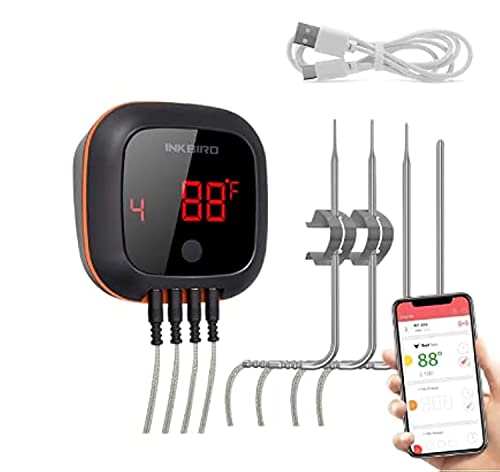
The INKBIRD IBT-4XS makes the multi-probe leave-in format affordable, and its verified listing is specific about what you get: four probes, Bluetooth reporting over a stated 150 ft range, and a rechargeable base. Four probes is the configuration that matches a real smoker load — two meats and a pit probe, or three meats and a pit probe — and getting there without a premium-tier price is this unit’s entire and legitimate appeal.
Rechargeable matters more than it sounds. Leave-in systems live or die on being ready when the cook starts, and a base that tops up from a cable rather than demanding a drawer battery hunt gets used more. The app handles alarms and graphs, and the format — probes in the meat, base at the cooker, phone in your pocket — is the same workflow the premium systems use, at a friendlier tier.
Strengths
- Four probes at a budget tier — matches real multi-meat smoker loads
- Rechargeable base is ready when the cook is; no battery hunt
- Full leave-in workflow: alarms and monitoring from your phone
Trade-offs
- Bluetooth only — no Wi-Fi for true leave-the-house monitoring
- Budget cables and probes reward careful handling and storage
- App polish is functional rather than premium
Key specs (from the verified listing)
- Probes: 4, per the verified listing
- Range: 150 ft Bluetooth, per the verified listing
- Power: rechargeable base unit
Set expectations by tier. Bluetooth range is a clear-air figure and walls, metal cookers and distance will tax it; probe cables on budget systems reward gentle handling and dry storage; and the app experience is functional rather than luxurious. None of that prevents excellent barbecue — the temperature inside a pork shoulder does not care what the graph looks like — provided the probes read true, which the ice-water test in this article’s how-to will confirm in a minute.
Choose the IBT-4XS if you smoke regularly, cook more than one protein at a time, and would rather spend the savings on meat. It is the value route into monitored cooking, and for many households it is where the leave-in journey sensibly starts.
Best for: Smoker cooks who want four probes without the premium tier / Not suited for: Cooks who need Wi-Fi range beyond the house
Check on Amazon — check price on Amazon before ordering, and confirm the exact model name on the listing matches the name above.
ThermoWorks ThermoPop 2 — Best Value Instant-Read
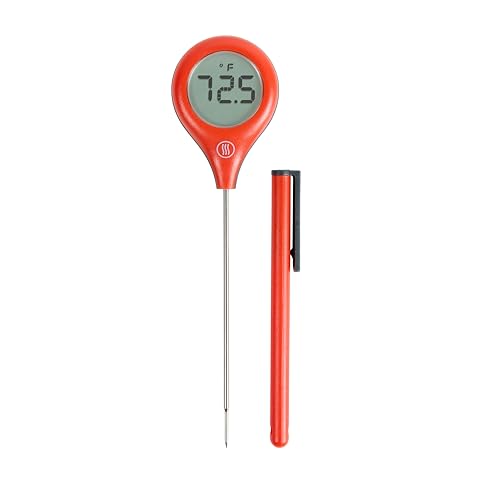
The ThermoPop 2 exists for the cook who wants ThermoWorks credibility without the flagship commitment, and its own listing says so, describing it as the maker’s best value instant-read thermometer. It keeps the essentials of the format — a fast electronic pen, a clear display, the same company’s calibration culture — and trims the flagship’s refinements to land in a friendlier tier.
That positioning makes it the smart second pen and the smart first pen alike. Households with two cooks end arguments by owning two thermometers; a ThermoPop 2 beside a Thermapen ONE gives a reference and a daily driver. As a first pen, it teaches the checking habit with a tool whose readings can be trusted while the budget recovers for the rest of the instrument drawer.
Strengths
- Genuine ThermoWorks instrument at a value tier
- Ideal second pen for two-cook households
- Keeps the essential format: fast electronic reading, clear display
Trade-offs
- A step plainer than the flagship in speed and refinement
- Instant-read only, like any pen — no leave-in monitoring
- Same lookalike caution applies: verify the brand on the listing
Key specs (from the verified listing)
- Type: instant-read pen thermometer
- Brand: ThermoWorks
- Listing finish: Cayenne Pepper Red
What you give up against the flagship is refinement, not honesty: the experience is a step plainer, and professional users who check temperatures hundreds of times a week will feel the difference in speed and ergonomics. Home cooks checking a roast, a tray of thighs and a loaf of bread will feel it far less, and will feel the savings immediately.
Choose the ThermoPop 2 if the Thermapen’s tier is the obstacle between you and cooking by temperature. A value pen that gets used beats a flagship that stays on a wish list, every single cook.
Best for: Households wanting a genuine ThermoWorks pen for less / Not suited for: Professionals who want the flagship’s speed and feel
Check on Amazon — check price on Amazon before ordering, and confirm the exact model name on the listing matches the name above.

Lavatools Javelin PRO Classic Digital Instant Read Thermometer — Best Compact Folding Pen
The Lavatools Javelin PRO stakes its claim on one number its listing states plainly: an ultra-fast 2-second reading. Speed is not a vanity metric on an instant-read pen — it is the difference between a check that happens and a check that gets skipped while a hand hovers over a hot grate — and a pen that settles in about two seconds gets used on every cut, every time, which is the entire discipline this article preaches.
Its listing also describes an auto-rotating display, a small feature with outsized daily value. Probes enter meat at whatever angle the grill allows, and a display that turns to face the cook — left-handed or right — removes the squint-and-tilt moment when readings get misread. In a compact folding format that rides in an apron pocket, the Javelin PRO is built around the reality of a crowded grill station.
Strengths
- A stated 2-second reading — fast enough to check every cut, every time
- Auto-rotating display reads correctly at any probe angle, either hand
- Compact folding form lives in an apron pocket at the grill
Trade-offs
- Pen only: no monitoring, alarms or app
- Challenger brand beside ThermoWorks’ depth of range and support
- Folding hinge and pocket carry reward basic care
Key specs (from the verified listing)
- Reading speed: 2 seconds, per the verified listing
- Display: auto-rotating, per the verified listing
- Type: folding instant-read pen
Against the ThermoWorks pair, Lavatools is the challenger brand: a specialist in this one tool, with a loyal following among grill cooks who prize the folding form and the stated speed. It will not double as a leave-in system and makes no claim to; judged purely as a pen — the tool used most often in this entire article — it is a serious one.
Choose the Javelin PRO if you want the fast, compact, apron-pocket option and the flagship pens feel like more than you need. Confirm its reading in ice water when it arrives, and it will earn its place at the grill within one cook.
Best for: Grill cooks who want a fast pen that lives in the apron pocket / Not suited for: Anyone needing alarms, apps or leave-in probes
Check on Amazon — check price on Amazon before ordering, and confirm the exact model name on the listing matches the name above.
Comparison Table
| Pick | Badge | Key spec | Best for |
|---|---|---|---|
| ThermoWorks Thermapen ONE | Best Overall | Flagship instant-read pen from ThermoWorks | Any cook who wants one reference thermometer for everything |
| MEATER Pro Smart Meat Thermometer | Best Wireless Probe | Truly wireless probe; listing states 1000°F heat resistance and long range | Grill and oven cooks who hate cords |
| ThermoWorks Signals BBQ Alarm Thermometer | Best Leave-In Alarm System | Leave-in alarm thermometer with Wi-Fi and Bluetooth, per listing | Smoker and BBQ cooks running long, multi-probe cooks |
| INKBIRD IBT-4XS Bluetooth Meat Thermometer, 4 Probes | Best Budget Multi-Probe | 4 probes, Bluetooth with stated 150 ft range, rechargeable | Smoker cooks who want four probes without the premium tier |
| ThermoWorks ThermoPop 2 | Best Value Instant-Read | Value instant-read pen from ThermoWorks | Households wanting a genuine ThermoWorks pen for less |
| Lavatools Javelin PRO Classic Digital Instant Read Thermometer | Best Compact Folding Pen | Listing states ultra-fast 2-second readings; auto-rotating display | Grill cooks who want a fast pen that lives in the apron pocket |
How to Choose an Electronic Meat Thermometer: Start With the Architecture
The first decision is not brand or budget; it is which of the three electronic designs your cooking actually needs, because each exists to solve a different problem. An instant-read thermometer is a verification tool: it lives in a drawer or apron, comes out for two seconds at a time, and answers the question ‘is it done?’ with a speed and precision no dial gauge approaches. If you grill steaks, roast chicken, fry cutlets or bake bread, this is the design you will use on nearly every cook, and it is where a first purchase belongs.
A leave-in probe system is a monitoring tool. Its probe stays in the meat, its cable or transmitter reports continuously, and its job is to watch a four-hour cook so you do not have to — sounding an alarm at a target temperature, tracking a stall, and keeping you honest about pit temperature as well. It earns its keep on brisket, pork shoulder, whole turkeys and reverse-seared roasts, and it is nearly useless for a Tuesday chicken breast. A wireless probe is the leave-in idea with the cord deleted: maximum placement freedom and a clean grill lid, paid for with a thicker probe, a charger to keep ready and a signal that must cross metal and distance.
Accuracy deserves a calm word. Reputable makers state an accuracy figure in their listings, and that stated figure is the only one this guide repeats; treat any roundup quoting tolerances it cannot source as decoration. In practice, the difference between a good thermometer and a great one at home is less the last fraction of a degree than speed, a readable display, and a thin probe tip that lands in the true center of the food. Technique — avoiding bone, fat pockets and pan contact — moves readings by more degrees than instrument tolerance ever will.
- Instant-read for verification and thin cuts; leave-in for monitoring; wireless for cord-free long cooks
- Confirm the exact brand and model on the listing — ThermoPro and TempPro are different companies
- Judge accuracy only by the figure the maker’s listing states, and test in ice water at home
- Probe count should match proteins cooked at once, not the biggest number on the box
- Keep cables out of flames and probe joints out of soaking water to make probes last
Reading Speed, Displays and Probes: The Specifications That Actually Matter
Speed is the instant-read specification with real consequences. A reading that settles in about two seconds, as the Javelin PRO’s listing states, gets taken; a reading that needs ten seconds of hovering over a hot grill gets estimated instead, which quietly defeats the purchase. Speed also compounds across a cook: checking six chicken thighs at two seconds each is a task; at ten seconds each it is an ordeal performed with a burning forearm.
Displays matter more than they are credited. A backlit screen is the difference between reading and guessing at dusk, an auto-rotating display serves left-handed cooks and awkward angles, and a large digit is worth more than a dozen app features on a tool whose whole job is to be glanced at. For leave-in systems, judge the base unit’s display the same way — you should be able to read pit and meat temperatures from across the patio without opening an app.
Probe construction decides lifespan. On wired systems, the cable is the consumable: keep it out of direct flame, route it through the grill’s port or a loose lid gap rather than crushing it in the seal, and never soak the joint where cable meets probe. On wireless probes, the limit is the electronics in the probe itself, which is why the heat resistance a listing states — like the MEATER Pro’s figure — is a genuine selection criterion for searing cooks rather than a bragging number.
How to Use an Electronic Meat Thermometer Correctly
Correct use is a short ritual. Decide your target before the food goes on the heat, not while it waits — resting meat keeps cooking, so pull temperatures account for carryover, and the time to remember that is before the probe goes in. Insert the probe or pen into the thickest part of the cut, aiming for the geometric center, and keep the tip away from bone, large fat seams and the pan or grate, each of which reads its own temperature rather than the meat’s.
For leave-in probes, insert from the side of a thick cut so the tip sits in the center with the shaft supported, and set the alarm a few degrees early if the cook is fast-moving. For instant-read checks, take two readings in different spots on large cuts and judge by the lowest; a single reading in a single place is an anecdote, not a measurement. Verify the whole system occasionally in a glass of stirred ice water, which every electronic thermometer should read at freezing once settled.
- Set your target and pull temperatures before cooking starts, allowing for carryover during resting
- Insert the probe tip into the center of the thickest part, clear of bone, fat seams and metal
- For leave-in probes, route cables away from direct flame and set alarms before walking away
- Verify doneness with an instant-read in at least two spots on large cuts; judge by the lowest
- Rest meat on a warm plate, then take a final confirmation reading before carving
- Wash the probe shaft, dry it fully, and store pens folded and probes uncabled-kinked
Troubleshooting Readings That Do Not Make Sense
A reading that jumps wildly usually means the tip is straddling a boundary — half in a fat pocket, half in lean — or touching bone or metal. Withdraw a quarter inch and re-read. A leave-in probe that reads suspiciously like the pit temperature has usually slipped out of the meat or was inserted too shallowly; reseat it deeper and confirm with the instant-read pen before trusting it again.
Slow readings on an instant-read pen point to a dying battery or a dirty probe tip far more often than to a failed sensor; clean the shaft, swap the battery, and retest in ice water. Wireless dropouts are a geometry problem before they are a product problem: move the charger or phone closer, keep the repeater out from behind the metal cooker body, and remember that range figures in listings are open-air numbers, not through-walls promises. When two thermometers disagree, the ice-water test settles which one to believe in under a minute.
Building the Two-Thermometer Kit Most Kitchens Actually Need
One thermometer is a purchase; two are a system, and the pairing matters more than either instrument alone. The classic kit is a reference instant-read pen plus a monitoring system, because the two designs check each other. The leave-in probe watches the long cook and calls you at the target; the pen then verifies that story in the exact thickest spot before resting, catching the slipped probe, the bone-adjacent tip and the fat pocket that a single sensor cannot know it fell into. When both agree, you can carve with a clear conscience.
Budget the kit in stages if you need to. The pen comes first, because it serves every cook including the ones a monitoring system cannot touch — thin cuts, frying, reheating, baking — and because it is the tool that builds the temperature habit. The monitoring system comes second, timed to the cooking that needs it: the first brisket, the holiday turkey, the rotisserie habit. Bought in that order, each purchase is justified by cooks already happening, and neither sits in a drawer waiting for a lifestyle to arrive.
Households with two cooks should think in duplicates as well as pairs. A second pen — the ThermoPop 2’s natural role — ends the apron-pocket custody battle and means a thermometer is always within reach at both the stove and the grill. Redundancy sounds like excess until the evening a battery dies mid-cook; then it is simply the kitchen working as designed.
Care and Storage That Keep an Electronic Thermometer Honest
Electronic thermometers fail quietly and mechanically far more often than they fail electronically. The folding pen dies by its hinge being forced with greasy hands or by living loose in a utensil drawer among heavier tools; give it a pocket, a magnetic spot on the fridge or its own slot, and it will outlast several grills. The wired probe dies by its cable: kinked at the same point every cook, crushed in a lid, draped across a burner, or soaked at the joint in the sink. Coil cables loosely, wash the shaft only, and store probes straight rather than wound tight around the base unit.
Batteries are the other quiet killer. A pen that takes ten seconds to settle is usually a pen asking for a battery, not a replacement thermometer, and the ice-water test distinguishes the two in a minute. Keep a spare battery wherever the thermometer lives — a thermometer revived during a cook is a lesson; one abandoned during a cook is a habit broken.
Finally, treat the ice-water check as a seasonal ritual rather than a repair step. Thirty seconds in stirred ice water at the start of grilling season confirms the instrument you are about to trust with a hundred dollars of brisket, and catches drift, damage and dying batteries while there is still time to fix them calmly. Accuracy is not a feature a thermometer has; it is a condition you verify.
A Short Note on Apps, Graphs and What They Cannot Do
Most leave-in and wireless systems now arrive with an app, and the app is genuinely useful: it carries the alarm to wherever you are, graphs the cook so a stall is visible rather than suspected, and remembers previous sessions well enough to make the next brisket less mysterious. Treat those as real benefits when choosing between systems, especially if you cook for a crowd and cannot stand beside the smoker.
But keep the hierarchy straight. The app is a messenger; the sensor is the instrument. A beautiful graph of a badly placed probe is a beautiful record of the wrong temperature, and no notification fixes a tip resting against bone. Choose the system whose probes, cables and base unit suit your cooker first, let the app break ties second, and keep the instant-read pen — which has no app at all — as the final word before anything is carved.
Common Buying Mistakes
Most thermometer disappointment is user error wearing a product’s name. Avoid these:
- Judging doneness by color, jiggle or juices — the three methods this purchase exists to retire
- Ordering the wrong near-identical brand: ThermoPro and TempPro are different companies; read the listing exactly
- Probing next to bone or through a fat seam and trusting a number that describes neither
- Leaving a wired probe’s cable draped over direct flame or crushed in a grill lid until it fails mid-cook
- Buying six probes for a one-protein household and a single pen for a four-meat smoker — match channels to your real cooks
- Skipping the ice-water check for years, then blaming the thermometer for a battery that died quietly
Final Recommendation
Match the instrument to the gap in your cooking. If you own no good thermometer, start with the ThermoWorks Thermapen ONE and let it be the reference everything else is checked against; add the ThermoPop 2 as the household’s second pen if cooks multiply. Grill and smoker cooks who walk away from long cooks should add the ThermoWorks Signals as the monitoring station, or the INKBIRD IBT-4XS when the budget sets the agenda. Choose the MEATER Pro when cords are the thing you hate, and the Lavatools Javelin PRO when a compact folding pen that lives in the apron is the one that will actually get used.
Whichever combination you land on, use it on the next cook, not a special occasion. Electronic thermometers pay for themselves in the first saved brisket and the first chicken that is juicy instead of cautious. Check price on Amazon for the models that fit your style, verify the exact brand and model on the listing one last time, and cook to temperature from now on.
Keep reading in this series: Best Meat Thermometers Best Digital Meat Thermometers Best Wireless Meat Thermometers Best Bluetooth Meat Thermometers Best Instant Read Meat Thermometers.
Frequently Asked Questions
What is the difference between ThermoPro and TempPro?
They are different brands with similar names, and both sell meat thermometers — which is why confusion is common. Check the brand printed on the device and the listing title character by character before ordering or when comparing a model number you read about, because accessories, apps and support belong to whichever company actually made your thermometer.
Instant-read or leave-in: which do I actually need?
Both, ideally, because they do different jobs. A leave-in probe monitors a long cook and alarms at the target; an instant-read verifies the result in the exact spot that matters and handles all the quick checks — thin cuts, reheats, breads — that a leave-in probe cannot. If the budget allows one, start with a good instant-read: it is used on every cook.
How accurate does a meat thermometer need to be?
For home cooking, the accuracy a reputable maker’s listing states — typically a degree or two either way on quality models — is plenty, provided the reading is fast and the probe tip is placed correctly. Technique errors, especially measuring near bone or in a fat pocket, cause far bigger mistakes than the instrument’s stated tolerance.
Can a wireless probe replace checking with an instant-read?
It complements rather than replaces it. A wireless probe reads where it sits, and thick cuts have gradients. Confirm with an instant-read in the thickest part before resting or serving, particularly for poultry and large roasts, and treat any disagreement as a reason to check a third spot.
Why does my thermometer read differently in different spots?
Because the food is genuinely at different temperatures in different spots — that is the instrument working, not failing. Always judge doneness by the lowest reading in the thickest part, away from bone and fat, and let carryover during resting finish the job.
How do I check my thermometer is still accurate?
Stir it into a glass of ice and water: a correct thermometer reads at freezing point once settled. Boiling water is the second classic check, adjusted for altitude. Recalibrate if your model supports it, and replace a probe whose cable has been pinched, melted or repeatedly soaked at the joint.