Disclosure: As an Amazon Associate, airfryerkitchensupply.com earns from qualifying purchases. Prices and availability change; check Amazon for the latest.
A Bluetooth meat thermometer pairs a probe, or several probes, with a phone app so you can watch the internal temperature of a roast, brisket, chicken or steak without opening the oven or the grill lid. Many also send an alert when the food reaches a target you set, which means you can step away from the cooking area and still know when to come back.
These are useful for home cooks who smoke, roast or grill often, and for anyone who wants less guesswork on large cuts. The six picks below range from wire-free probes to multi-probe units. We have not used these products ourselves, so confirm probe count, range, battery type and app support on the current listing before buying, since models and firmware change over time.
As an Amazon Associate we earn from qualifying purchases. Links below are affiliate links, and they do not change the product information we give.
In this guide
Quick Picks
- MEATER Plus
- ThermoPro TP25
- ThermoPro TempSpike
- Inkbird IBT-4XS
- Weber iGrill 2
- Govee Bluetooth Meat Thermometer
What to Look For
| Feature | Why it matters |
|---|---|
| Probe style | Wire-free probes are tidy; wired probes are simpler and often cheaper to replace |
| Number of probes | More probes let you track several cuts or the oven or grill temperature as well |
| Bluetooth range | Walls and distance shorten the usable range in practice |
| App quality | Alerts, guided cooks and clear graphs save time |
| Heat tolerance | Probe and cable limits decide whether it suits grills and smokers |
| Battery and charging | Check whether it uses replaceable cells or a rechargeable base |
Range is the claim to read most carefully. Makers often quote open-air figures, while a real kitchen has walls, appliances and a closed grill lid that all reduce the signal. Treat the stated range as a ceiling, not a promise.
Specs at a Glance
| Thermometer | Probe type | Connection | Notes |
|---|---|---|---|
| MEATER Plus | Wire-free, single probe | Bluetooth with a charging base | Base also acts as a signal booster |
| ThermoPro TP25 | Four wired probes | Bluetooth | Multi-probe app monitoring |
| ThermoPro TempSpike | Wire-free | Bluetooth with a booster | Check the listing for set contents |
| Inkbird IBT-4XS | Up to four wired probes | Bluetooth | Rechargeable base unit |
| Weber iGrill 2 | Wired probes | Bluetooth | Built for Weber app use |
| Govee Bluetooth meat thermometer | Wired probes | Bluetooth | Compact display and app alerts |
The 6 Best Bluetooth Meat Thermometers
Top pickBest for roasts and smokers where cables get in the way
1. MEATER Plus
The MEATER Plus is a wire-free probe that sits inside the meat and sends its readings to a phone app. The charging case doubles as a signal repeater, which extends range compared with relying on the phone alone. Because there is no cable to route, it is easy to use in an oven, on a rotisserie or inside a smoker.
The app offers guided cook settings and an estimate of how much time remains, which is helpful if you are new to roasting large cuts. Look at the listing for the current probe version, the stated heat limits and whether the set includes extras. A wire-free probe can also be harder to find if you lose it in a large pile of food, so mind where you place it.
Suits: roasts and smokers where cables get in the way. Strengths: a clean wire-free design and a helpful app. Weaknesses: one probe per set and it costs more than basic wired models. Skip it if you want to track several cuts at once.
Best for smoking and grilling with several items at once
2. ThermoPro TP25
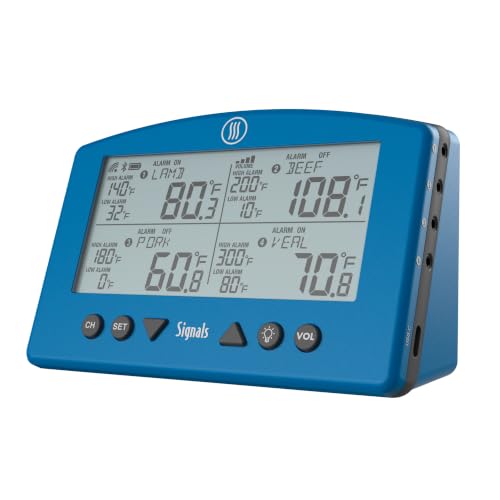
The TP25 is a multi-probe Bluetooth thermometer from ThermoPro, a brand known for affordable thermometers. It is designed to handle several probes at once, so you can watch a couple of cuts and the cooking chamber at the same time. The numbers show on the phone and on the unit’s own display.
It is a sensible pick for a smoker or grill where you want to keep an eye on pit temperature and the meat together. Check the listing for the probe count, cable length and the app compatibility with your phone. Wired probes are simple and the cables can be replaced, but they do need tidy routing so the lid or oven door does not pinch them.
Suits: smoking and grilling with several items at once. Strengths: multi-probe monitoring at a moderate cost. Weaknesses: cables to manage. Skip it if you want a wire-free probe.
ThermoPro TP25 Bluetooth meat thermometer
Best for oven roasts and smoker work without cables
3. ThermoPro TempSpike
The TempSpike is ThermoPro’s wire-free probe, designed for cooks who like the cleanliness of the MEATER style but want a different brand and setup. It sits in the meat and talks to a phone, usually with a booster that helps carry the signal over a longer distance.
Listings sometimes offer one-probe and two-probe sets, so check which one you are choosing and what is in the box. As with any wire-free probe, handle it carefully near very hot surfaces and follow the maker’s guidance on cleaning, because the electronics should not be immersed unless the listing says it is safe.
Suits: oven roasts and smoker work without cables. Strengths: wire-free convenience from a known thermometer brand. Weaknesses: set contents vary by listing. Skip it if you prefer wired probes.
ThermoPro TempSpike wireless meat thermometer
Best for barbecue and smoker use
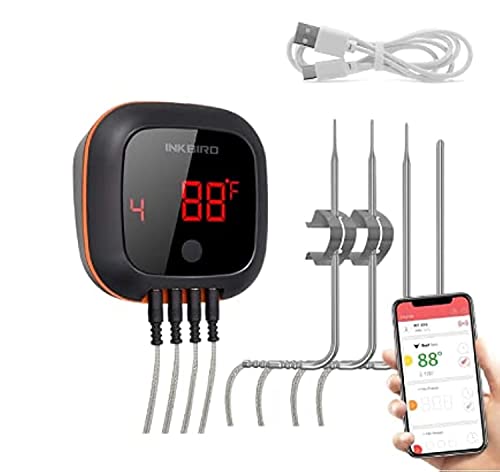
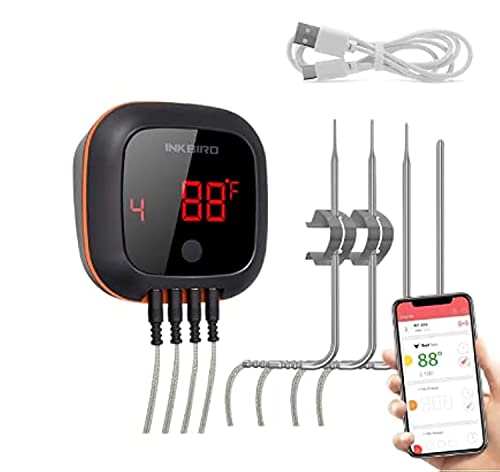
4. Inkbird IBT-4XS
The IBT-4XS is a small Bluetooth thermometer with ports for up to four probes. It is popular with barbecue fans because it is compact and works with a free app, with alerts when a probe hits its target. It runs from a rechargeable battery, so there is nothing to swap out mid-cook.
It suits cooks who want several probes without paying for a large unit. Review the listing for which probes are included, since some sets ship with fewer than four. Probe wires and the body have their own heat limits, so keep the unit itself away from direct flame and hot grates.
Suits: barbecue and smoker use. Strengths: four-probe capacity in a small body. Weaknesses: wired probes and a basic design. Skip it if you want a sleek wire-free setup.

Best for weber grill owners
5. Weber iGrill 2
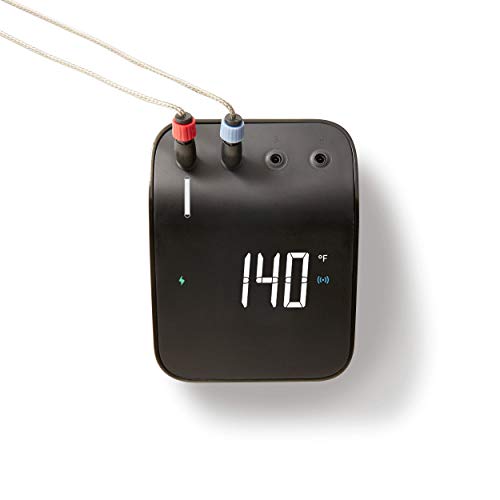
The iGrill 2 is Weber’s Bluetooth thermometer, built to work with the Weber app and to pair with many Weber grills. It supports multiple probes and shows readings on both the unit and a phone. It also has a magnetic back, so it can sit on a metal grill side table or the side of a cooker.
It makes the most sense if you already own a Weber grill and like staying within one brand. Check the listing for compatibility with your phone and with current versions of the app, since Bluetooth products depend on app support continuing. Also confirm what comes in the box, as probes may be sold separately.
Suits: Weber grill owners. Strengths: a well-known brand and multi-probe support. Weaknesses: depends on the maker’s app. Skip it if you want a stand-alone unit that does not rely on an app.

Best for casual grilling and roasting
6. Govee Bluetooth Meat Thermometer
Govee sells a Bluetooth meat thermometer with wired probes, a small display and app alerts. It aims at everyday cooks who want phone monitoring without a large investment. The unit is compact and fits easily near a grill or on a counter.
Because Govee sells several thermometer versions, read the listing carefully for the model number, probe count and any display or magnet features. Check the app reviews to see how reliable the connection is on your phone, and pay attention to the probe cable’s heat limit.
Suits: casual grilling and roasting. Strengths: an accessible, compact monitor. Weaknesses: model variations can be confusing. Skip it if you want a premium app experience.

Wired or Wire-Free Probes
Wire-free probes are neat. There is no cable to snake through an oven door gasket or a grill lid, and the probe is easy to insert into thick cuts. They also tend to cost more per probe and are harder to replace if one fails or gets lost.
Wired probes are the long-established choice. A single unit can run several probes at once, and a worn cable can often be swapped for a new one. The trade-off is routing: the cable has to leave the cooking chamber somehow, and it can be damaged by sharp edges or direct flame. If you smoke often, a multi-probe wired unit is usually the practical option. If you roast in the oven and want simplicity, a wire-free probe is hard to beat.
Many serious cooks own one of each. A wire-free probe handles the roast, while a wired probe tracks the oven or smoker chamber temperature so you can see when the heat is drifting.
Placement and First Use
Insert the probe into the thickest part of the meat, away from bone, fat pockets and the surface. Bone conducts heat differently and can give a misleading reading. For poultry, aim for the thickest part of the breast or thigh without touching bone. For a wire-free probe, follow the maker’s instructions on the minimum insertion depth, since part of the probe has to be inside the food to read correctly.
Pair the thermometer with your phone before the cook, not after the meat is already on the heat. Update the app, check the battery and run a quick test in a cup of water to be sure the readings look sensible. Make sure the phone stays within range, and keep in mind that metal grill lids, thick walls and other devices can weaken the signal.
Set your target temperature using trusted food safety guidance for the type of meat, and remember that the temperature usually keeps rising for a few minutes after the food comes off the heat. Many cooks pull the meat slightly early to allow for that carryover.
Accuracy and Calibration
Most consumer thermometers are accurate enough for home use, but no device is perfect. A simple check is an ice-water test: fill a glass with crushed ice and a little water, stir, and place the probe in the middle without touching the glass. A good probe should read close to the freezing point. If it is off by more than a small amount, check whether the maker offers a calibration option or whether the probe should be replaced.
Check the listing for the stated accuracy, and remember that the figure often applies only within a certain temperature range. A thermometer that is accurate in the meat range may be less precise near the extremes.
Keep probes clean, because residue can affect readings and food safety. Wash according to the maker’s directions, avoid soaking parts that should not get wet and store the probe where the tip will not bend or snap.
Reading the App and Alerts
Most apps let you pick a meat type and doneness, then notify you when the probe approaches the target. A pre-alert a few degrees early is handy, because it tells you to get ready to rest the meat or move it off the heat. Learn how to silence the alarm and how to change targets mid-cook before you need to do it in a hurry.
Graphs of temperature over time are more useful than they look. A long plateau in a brisket, often called the stall, is normal, and seeing it on the graph helps you resist the urge to crank the heat. Keep your phone charged, and turn off battery-saver modes that might pause the app in the background.
Care and Storage
- Wipe probes after each cook and wash them as the maker advises.
- Do not immerse electronics or charging bases unless the listing says they are waterproof.
- Coil cables loosely and avoid sharp bends near the connectors.
- Charge or replace batteries before a long cook.
- Keep the unit out of direct flame and off hot grates.
- Update the app and firmware when the maker releases updates.
Mistakes to Avoid
- Assuming the quoted range will work through walls and metal lids.
- Inserting the probe next to bone or into a fat pocket.
- Pairing the thermometer for the first time while food is already cooking.
- Pinching cables in an oven door or grill lid.
- Skipping a quick accuracy check on a new probe.
- Forgetting that temperature keeps rising after the food leaves the heat.
Pairing, Range and Signal Quirks You Should Know About
Wireless thermometers promise freedom from standing at the grill, but the connection has limits. Bluetooth range is stated in the listing, yet walls, metal grill bodies, distance and interference all reduce it in real homes. Think about where you will be while the food cooks. If you plan to relax in another room, check what the maker says about indoor range, and ask whether a repeater or a base unit is needed. Most devices pair with a phone through an app, so make sure the app supports your phone model.
- Stated range versus real range: Open-air numbers are best-case, so expect less through walls or around metal cookers.
- Base station or booster: Some systems include a unit that extends the signal.
- App support: Check the operating system versions the app works with.
- Connection loss behavior: Find out whether the probe stores data and reconnects.
- Battery in the probe and the base: Know how each is powered and how long it lasts.
Pair the device and test the connection indoors before the first real cook so you are not troubleshooting with food on the fire.
Wire-Free Probes or Wired Probes: Choosing a Design
The two main designs trade freedom for simplicity. A fully wire-free probe slides into the meat with no cable, which makes it handy for rotisserie cooking and tight spaces. A wired probe connects to a transmitter, which stays outside the cooker and can be easier to replace if the probe is damaged.
| Design | Strengths | Things to weigh |
|---|---|---|
| Wire-free | No cable to snag, flexible placement | Smaller battery, and signal passes through the meat and the cooker |
| Wired single probe | Simple and reliable | Cable must route through the door or lid |
| Wired multi-probe | Track several cuts or the cooker temperature | More cables to organize |
Whichever you choose, read the maker’s instructions on how deep to insert the probe and the maximum temperature it can handle.
Where to Insert the Probe and How to Read the Number
A thermometer is only as good as its placement. Insert the tip into the thickest part of the meat, avoiding bone, fat pockets and the pan. For poultry, follow guidance for the thickest part of the thigh or breast. For thin cuts, a wired probe may be easier to angle. Check that the probe does not touch the grill surface, which can give a false reading.
- Read the instructions to learn the minimum insertion depth for your probe.
- Place the tip in the center of the thickest area.
- Keep the cable away from flames and direct heat.
- Check the reading against official food safety guidance for the type of meat.
- Remember that temperatures can rise while meat rests, so follow your recipe.
Cleaning, Calibration and Caring for Probes
Wash probes according to the manual, since many are water-resistant but not made for soaking. Keep the charging contacts dry, and avoid exposing the device to temperatures above its stated limit. Many cooks check accuracy now and then using an ice-water bath, and the maker often describes a method for it. If the reading drifts or the probe cracks, replace it.
Alerts, Presets and Using the App Without Overreliance
Most wireless thermometers send notifications when food reaches a target temperature, and apps often include preset temperatures for common meats. These features are helpful, yet they should support your judgment rather than replace it. Preset numbers may not match your recipe or official food safety guidance, so check them before relying on an alert. Set a reminder that fires a little before the target, which gives you time to prepare the table, and keep a backup method on hand in case the phone battery or the connection fails.
- Target alerts: Set the temperature your recipe or guidance calls for, not just a preset.
- Pre-alerts: Useful for warning you that the target is near.
- Cook graphs: Show how the temperature rises, which helps plan resting time.
- Multiple probes: Track different cuts or the cooker temperature.
- Phone settings: Allow notifications and keep the screen from locking if the app needs it.
- Backup thermometer: A simple instant-read unit is a good second check.
Going Deeper: Judging a Bluetooth Meat Thermometer by Your Real Routine
The reviews above describe each pick on its own terms. This section steps back to the judgements underneath them, with particular attention to placing probes correctly in different cuts, keeping a Bluetooth connection alive across a garden or kitchen, and trusting alerts without hovering over the grill. Work through these points honestly and the shortlist usually narrows itself, because most appliance disappointment is not about quality — it is about a mismatch between a machine’s habits and a household’s habits.
Placement first: where it will actually live
Before comparing any features, decide where this Bluetooth meat thermometer will live and work. Measure the space it must fit, including room to open, lift, pour, load or clean whatever it handles, and the clearance the maker asks for around it. Think about what is nearby: water, sockets, storage for its accessories, and the surfaces it will share a counter or a room with. A machine that fits its place gracefully gets used daily; one that must be dragged out, assembled and put away for every use quietly stops being used at all, whatever its abilities. Several picks above differ mainly in footprint and format, and for many households that difference, not performance, is the decision.
Controls and the learning curve you will actually climb
Every appliance asks you to learn something: a control layout, a sequence, a set of presets, an app, or simply the timing that turns out right in your kitchen or your routine. Be honest about how much learning your household will enjoy. Some people delight in dialling in a process; others want two buttons and predictability, and both are right. The reviews above indicate where each pick sits on that spectrum. Remember that other people will use this machine too — a partner in a hurry, a teenager, a guest — and a control scheme that only its owner understands is a hidden cost that shows up on busy mornings.
Capacity and size, translated into your portions and your people
Capacity claims only mean something when translated into your servings, your pans, your loads or your group size. Think about your largest regular job, not your largest imaginable one: buying for a rare feast burdens every ordinary day with a bigger machine, more washing up and more storage. Equally, a machine that handles your everyday job only in multiple batches teaches you to dread it. Use the descriptions in the reviews above to picture your own typical load inside each pick, and prefer the size that swallows the typical load whole with a little room to spare — that little room is where ease lives.
Probe placement matters more than the app
Every thermometer in this guide lives or dies by where its probe sits. The sensing point must rest in the thermal centre of the cut — the thickest part, away from bone, fat seams and the pan or grate — because the probe can only report the temperature of the exact spot it occupies. The reviews above describe each pick’s probe design; match that to your cooking. Thick roasts forgive placement; thin cuts punish it. Learning placement on your most-cooked cuts, and re-checking a second spot when a reading surprises you, will improve your results more than any feature in any app.
Connection range in the real world, not the brochure
Bluetooth range is measured by physics, not optimism: walls, metal cooker lids, distance and your phone’s position all eat signal. The honest test is your own geography — grill to kitchen, smoker to sofa, oven to garden. Systems with a separate receiver or booster arrangement, as some picks above describe, exist precisely because a probe alone may struggle through a closed metal cooker and two walls. Before choosing, walk your likely path with your phone in mind and favour the architecture that covers it, because an alert that never arrives is worse than no alert at all.
Cleaning: the feature that decides year two
Ask, for each pick, what cleaning actually involves after a normal use — not a showroom use. Which parts come off, which go in a dishwasher or must be hand-washed, which corners trap residue, and what the maker says about descaling, filters or deep cleans. Then imagine doing it on a tired evening. A Bluetooth meat thermometer whose cleaning you accept will be cleaned often and will perform as described for years; one whose cleaning you resent will be cleaned late, and its performance and hygiene will drift. This is the least glamorous criterion in the guide and, in our judgement, the most predictive of long-term satisfaction.
Noise, heat and the small frictions of daily use
Appliances share your home’s air and hours. A machine used early in the morning, in an open-plan room, or while someone works nearby needs manners as well as power: tolerable noise, no alarming smells, controls that do not demand full attention, and a finish that does not show every fingerprint and splash. These frictions are rarely decisive alone, but they accumulate daily, and they are exactly what owners mention when they say a machine is fine but somehow annoying. The reviews above flag the character of each pick; trust those flags, because you will live with the character long after you have forgotten the feature list.
A Bluetooth Meat Thermometer in Everyday Life: Scenarios That Settle the Choice
The long, low cook
A brisket, a shoulder or a slow roast is the scenario these tools were born for: hours of cooking where opening the lid to check costs heat and time, and where the difference between done and perfect is a temperature reached slowly and then rested. A probe that reports patiently to your phone turns that wait from anxious hovering into a monitored background task. If long cooks are your main event, weight the reviews toward connection stability, probe arrangements that suit thick cuts, and alerts you can trust enough to actually leave the cooker alone.
The weeknight grill or roast
On a weeknight the thermometer’s job is smaller but just as valuable: certainty about chicken, chops or a roast while you make everything else. Speed of setup decides whether the tool gets used at all on a busy evening — a probe that pairs, places and reads without ceremony will be reached for nightly, while a fiddly one stays in the drawer. Judge the picks by their described routine, and be honest that on weeknights, convenience is a feature as real as accuracy.
Cooking for a crowd, several cuts at once
Feeding a group usually means several pieces of meat, of different thicknesses, finishing at different times. Multi-probe arrangements earn their complexity here: each cut gets its own reading and its own alert, and the cook stops playing memory games with tongs. If this is your regular scenario, the reviews’ notes on probe count and app clarity deserve the deciding vote. Plan where each probe’s cable or body will run before the meat goes on, because rearranging probes over a hot grill mid-cook is nobody’s favourite task.
The careful cook learning doneness
For a cook building confidence — especially with poultry, pork or expensive cuts bought for an occasion — a thermometer replaces folklore with knowledge. Cooking to temperature, and resting as guidance directs, produces the juiciness that timing charts promise and rarely deliver, and it does so repeatably. In this learning scenario, clear displays, sensible preset guidance used as a starting point rather than gospel, and readings you can verify against a second spot all matter. Within a few cooks, most people wonder how they ever cooked by prodding and hoping.
Living With It: Setup, Care and Troubleshooting in Detail
When the machine arrives, resist the first use for the length of one careful read: the maker’s setup instructions exist because the first run often involves a cleaning cycle, a priming step, a part fitted in a particular order, or packaging hidden in a place you would not think to look. Set it up in its real home, not on a temporary surface, and run its simplest job first so you learn its sounds, smells and signals while nothing important depends on the result. Keep the box and packaging until that first successful use is behind you; returning or exchanging any appliance is dramatically easier with its packaging intact.
Probes and their cables or bodies live a hard life of heat, grease and washing, so treat them as the maker directs: clean probes after every use, keep water and immersion within the limits the manual sets for each part, and never expose components to heat beyond what they are made for — a transmitter is not a probe, and the distinction matters. Store probes untangled and protected, since a kinked cable or a bent tip quietly ruins accuracy. If readings ever seem doubtful, test the probe in a known reference as the maker suggests and contact support if it disagrees, because a thermometer you cannot trust is worse than none.
Build cleaning into the use itself rather than treating it as a separate chore: the rinse, wipe or emptying done in the minute after use is almost always easier than the same job done dried-on, cooled-down or forgotten tomorrow. Keep the few cleaning things the maker recommends within reach of where the machine lives, because a brush or cloth stored in another room is a brush that will not be used. And keep the manual findable — a photo of its key pages on your phone is enough — because error signals, cleaning reminders and part names are all far easier to deal with in the maker’s own words than by guesswork and forums.
When something goes wrong, troubleshoot in a calm order before assuming the worst. Check the obvious physical things first: power, water, doors or lids properly closed, parts seated correctly, filters or reservoirs due for attention, and the settings you actually selected rather than the ones you meant to select. Then consult the manual’s troubleshooting section for that exact symptom, because most faults in most appliances are known, named and fixable at home. If a problem involves damage, burning smells, leaking where leaking should never happen, or anything electrical misbehaving, stop using the machine and contact the maker or a qualified professional — that boundary is not caution for its own sake, it is where home troubleshooting properly ends.
The Picks in This Guide, Compared in Plain Language
Comparison tables are useful, but they compress a lot. What follows restates, pick by pick, the role each option in this guide was chosen for, using only the positioning already given in the reviews and the comparison table above. Read it as a shortlist-narrowing exercise: find the description that sounds most like your household and your habits, then go back and re-read that product’s full review with fresh eyes. If two picks both sound right, the deciding factor is usually not a headline feature but a small everyday detail — how a Bluetooth meat thermometer is cleaned, where it will live, or who else will use it.
MEATER Plus. In the guide above, this pick is presented as the choice for wire-free, single probe, with the main point being bluetooth with a charging base. That positioning matters more than any single feature. If that description matches the way you actually live — the room, the people, the routine — then the compromises noted in its review are the ones you are most likely to accept happily. If it does not match, a nominally stronger pick on paper will still feel like the wrong purchase a month later, so let the fit with your routine lead and the feature list follow.
ThermoPro TP25. In the guide above, this pick is presented as the choice for four wired probes, with the main point being bluetooth. That positioning matters more than any single feature. If that description matches the way you actually live — the room, the people, the routine — then the compromises noted in its review are the ones you are most likely to accept happily. If it does not match, a nominally stronger pick on paper will still feel like the wrong purchase a month later, so let the fit with your routine lead and the feature list follow.
ThermoPro TempSpike. In the guide above, this pick is presented as the choice for wire-free, with the main point being bluetooth with a booster. That positioning matters more than any single feature. If that description matches the way you actually live — the room, the people, the routine — then the compromises noted in its review are the ones you are most likely to accept happily. If it does not match, a nominally stronger pick on paper will still feel like the wrong purchase a month later, so let the fit with your routine lead and the feature list follow.
Inkbird IBT-4XS. In the guide above, this pick is presented as the choice for up to four wired probes, with the main point being bluetooth. That positioning matters more than any single feature. If that description matches the way you actually live — the room, the people, the routine — then the compromises noted in its review are the ones you are most likely to accept happily. If it does not match, a nominally stronger pick on paper will still feel like the wrong purchase a month later, so let the fit with your routine lead and the feature list follow.
Weber iGrill 2. In the guide above, this pick is presented as the choice for wired probes, with the main point being bluetooth. That positioning matters more than any single feature. If that description matches the way you actually live — the room, the people, the routine — then the compromises noted in its review are the ones you are most likely to accept happily. If it does not match, a nominally stronger pick on paper will still feel like the wrong purchase a month later, so let the fit with your routine lead and the feature list follow.
Govee Bluetooth meat thermometer. In the guide above, this pick is presented as the choice for wired probes, with the main point being bluetooth. That positioning matters more than any single feature. If that description matches the way you actually live — the room, the people, the routine — then the compromises noted in its review are the ones you are most likely to accept happily. If it does not match, a nominally stronger pick on paper will still feel like the wrong purchase a month later, so let the fit with your routine lead and the feature list follow.
Wire-free. In the guide above, this pick is presented as the choice for no cable to snag, flexible placement, with the main point being smaller battery, and signal passes through the meat and the cooker. That positioning matters more than any single feature. If that description matches the way you actually live — the room, the people, the routine — then the compromises noted in its review are the ones you are most likely to accept happily. If it does not match, a nominally stronger pick on paper will still feel like the wrong purchase a month later, so let the fit with your routine lead and the feature list follow.
Wired single probe. In the guide above, this pick is presented as the choice for simple and reliable, with the main point being cable must route through the door or lid. That positioning matters more than any single feature. If that description matches the way you actually live — the room, the people, the routine — then the compromises noted in its review are the ones you are most likely to accept happily. If it does not match, a nominally stronger pick on paper will still feel like the wrong purchase a month later, so let the fit with your routine lead and the feature list follow.
Wired multi-probe. In the guide above, this pick is presented as the choice for track several cuts or the cooker temperature, with the main point being more cables to organize. That positioning matters more than any single feature. If that description matches the way you actually live — the room, the people, the routine — then the compromises noted in its review are the ones you are most likely to accept happily. If it does not match, a nominally stronger pick on paper will still feel like the wrong purchase a month later, so let the fit with your routine lead and the feature list follow.
One honest way to finish the comparison is to write down, in a single sentence, the job you most need this Bluetooth meat thermometer to do, and then check which pick’s stated role answers that sentence with the fewest conditions attached. Buyers who do this tend to be more satisfied than buyers who chase the longest feature list, because everyday satisfaction comes from the match between one main job and one well-chosen product, repeated daily, rather than from rarely used extras.
More Questions Buyers Ask About Bluetooth Meat Thermometers
Why do two spots in the same meat read differently?
Because meat is not one temperature. Thickness, fat, bone and proximity to the heat source create a landscape of temperatures inside a single cut, and each probe reports only its own location. That is why placement guidance emphasises the thickest part away from bone, and why checking a second spot is good practice rather than paranoia. Judge doneness by the most relevant reading — for safety, the coolest part of the thickest section — and let resting even things out.
Do I still need an instant-read thermometer?
Many cooks keep both, because they do different jobs. A leave-in Bluetooth probe watches a cook over time and alerts you; an instant-read checks a spot in seconds — a thin cut, a second location, a quick verification. If you must choose one first, choose by your cooking: long cooks favour the leave-in system in this guide, while a diet of quick, thin cuts may be served by spot checks alone. The two together are the complete answer, which is why so many grill drawers hold both.
Can the probe stay in a closed oven or smoker the whole time?
That is what leave-in probes are designed for, within each maker’s stated limits for the probe and any transmitter or cable. The reviews and manuals distinguish the parts: what goes in the heat, what stays outside it, and how cables route through doors or lids. Follow those distinctions exactly for your model. Used as designed, a probe should watch the whole cook; used beyond its design, heat damage arrives quietly and accuracy leaves with it.
How far from the cooker can I actually go?
As far as your own test proves, which will be less than ideal-condition claims and different in every home. Set the system up, start a harmless test cook or a warm-up, and walk your real route — kitchen, sofa, garden — watching the connection as the maker intends you to monitor it. Cookers with metal lids, masonry walls and distance are the usual signal-eaters, and receiver-based systems exist to bridge them. Knowing your true range before an important cook is the difference between a tool and a gamble.
How do I choose between two picks that both seem right?
Break the tie with routine and upkeep rather than features. Compare where each one lives in your home, what each asks of you in cleaning, how each one’s controls suit the least technical person who will use it, and which one’s compromises — stated plainly in its review above — you would mind least on an ordinary busy day. If it is still tied, choose the pick whose main job, as positioned in the comparison in this guide, matches the single sentence that describes what you most need this Bluetooth meat thermometer to do. Ties broken by daily-life fit age far better than ties broken by a longer feature list.
What should I check in the first days of ownership?
Run the machine through its main jobs while returns are still simple, and pay attention to fit, noise, cleaning and results rather than to novelty. Check that every included part was in the box, that removable parts come off and go back as the manual describes, and that nothing about its everyday use surprises you unpleasantly. Photograph and report any damage or defect promptly rather than working around it. A machine that suits your routine will usually prove it within the first week of honest use.
Bluetooth Meat Thermometer FAQ
How far does Bluetooth reach?
The quoted range is measured in open air. Indoors, walls and appliances shorten it considerably. Check the listing and plan for less than the stated figure.
Do I need Wi-Fi?
No, Bluetooth models connect straight to your phone. Wi-Fi models can send alerts from farther away, but they rely on a network. Check the listing to see which type you are buying.
Can the probe stay in the oven?
Most are made to stay in during cooking, but heat limits differ. Follow the maker’s guidance for the probe and cable.
Can I use one on a grill or smoker?
Many can, provided the probe and cable are rated for that heat. Keep the main unit away from flame and hot surfaces.
Is a wire-free probe worth it?
It is convenient and tidy, especially for oven roasts. It usually costs more per probe, so weigh that against how often you cook large cuts.
How many probes do I need?
One is enough for a single roast. Two or more help when you cook several items or want to track the oven or smoker temperature as well.
Can I wash the probe?
Wash according to the maker’s instructions. Many probes are safe to wipe or rinse, but charging contacts and electronics often should not be submerged.
What if the connection drops?
Move the phone closer, keep the unit away from metal and check the battery. A booster or a position with a clear line of sight often helps.
The Short Version
For a wire-free probe with a polished app, the MEATER Plus. For multi-probe value, the ThermoPro TP25. For a wire-free alternative, the ThermoPro TempSpike. For a compact four-probe unit, the Inkbird IBT-4XS. For Weber grill owners, the iGrill 2. For a simple everyday monitor, the Govee.