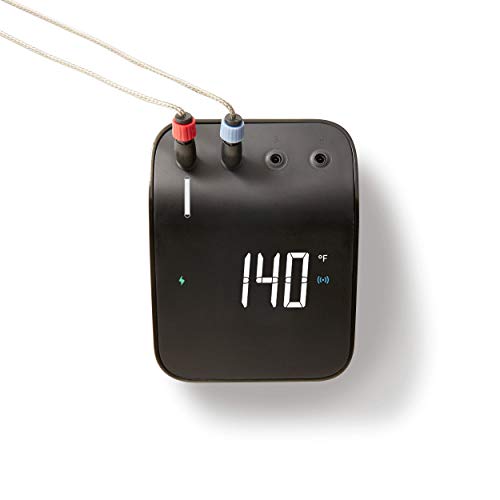
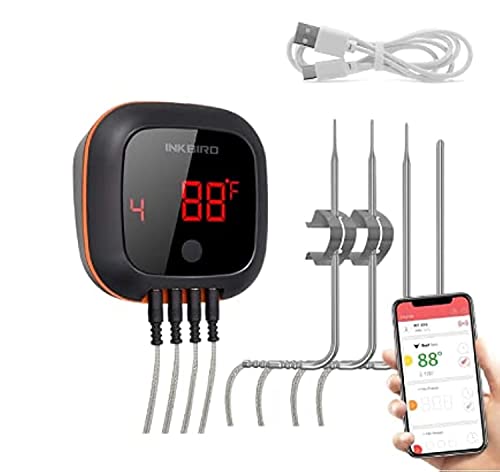
A smoker’s built-in dial often reads the air near the lid, not the meat or the grate, and it can be off by a surprising margin. A dedicated thermometer with a meat probe and a grate probe gives you the real picture across a long cook, with alarms so you can step away from the pit.
The six picks below range from multi-probe wired models to wireless probes and an instant-read. We have not used these products ourselves, so confirm probe count, range, battery type and app features on the current listing before buying. Accuracy and range claims are the makers’ own.
As an Amazon Associate we earn from qualifying purchases. Links below are affiliate links, and they do not change the product information we give.
What to Look For
| Feature | Why it matters |
|---|---|
| Probe count | More probes let you track meat, a second cut and the pit at the same time |
| Wireless range | Bluetooth reaches only so far; some units use a base station for longer range |
| Heat rating | Probes and cables must be rated for smoker conditions |
| Display | A backlit screen and loud alarm help during night cooks |
In this guide
Specs at a Glance
| Thermometer | Type | Probes | Notes |
|---|---|---|---|
| ThermoWorks Signals | Wi-Fi and Bluetooth | Several | High-end multi-probe unit |
| Meater Plus | Wireless probe | Single probe, multiple sensors | Fully wireless with range booster |
| Inkbird IBT-4XS | Bluetooth | Several | Budget-friendly, app-based |
| ThermoPro TP20 | Wireless remote | Two | Receiver plus base unit |
| Weber iGrill 2 | Bluetooth | Several | Works with the Weber app |
| Maverick ET-733 | Wireless remote | Two | Long-time barbecue brand |
The 6 Best Thermometers for Smokers

Top pickBest for long cooks with several cuts
1. ThermoWorks Signals Thermometer
A multi-probe thermometer that connects over Wi-Fi and Bluetooth for remote monitoring. ThermoWorks is a respected maker among barbecue cooks.
Suits: long cooks with several cuts. Strengths: strong app support and probe range. Weaknesses: more than you need for a single chicken. Skip it if you want a basic probe.


Best for cable-free cooking
2. Meater Plus Wireless Meat Thermometer
A fully wireless probe with no cable to snake through the lid. Internal and ambient sensors report to the app through a booster that extends range.
Suits: cable-free cooking. Strengths: clean, wire-free use. Weaknesses: a probe cannot be replaced if lost. Skip it if you want multiple cheap probes.

Best for value-minded cooks
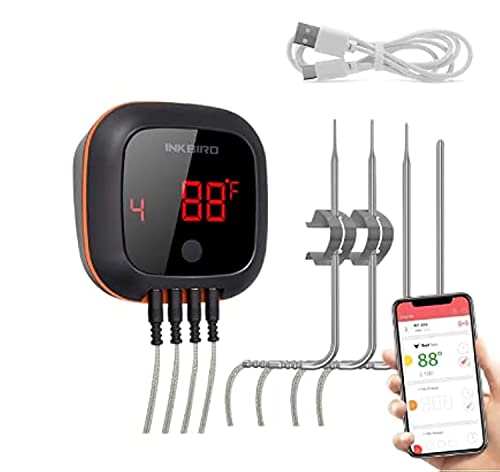
3. Inkbird IBT-4XS Bluetooth Thermometer
A Bluetooth thermometer with several wired probes and an app. It is a common pick for those who want multi-probe tracking without a heavy spend.
Suits: value-minded cooks. Strengths: many probes in one unit. Weaknesses: Bluetooth range is limited. Skip it if you smoke far from the house.

Best for a simple setup
4. ThermoPro TP20 Wireless Thermometer
A two-probe thermometer with a handheld remote that you can carry around the yard. It does not rely on a phone app.
Suits: a simple setup. Strengths: a handheld receiver and no app. Weaknesses: two probes only. Skip it if you want charts and phone alerts.
Best for weber owners
5. Weber iGrill 2 Bluetooth Thermometer
A Bluetooth thermometer that plugs into the Weber ecosystem with an app, alarms and several probe slots.
Suits: Weber owners. Strengths: tidy app and cook programs. Weaknesses: Bluetooth range limits. Skip it if you use a non-Weber smoker only.
Best for traditional remote monitoring
6. Maverick ET-733 Wireless Thermometer
A long-running remote thermometer with two probes and a handheld display. It has been a fixture of backyard barbecues for years.
Suits: traditional remote monitoring. Strengths: no phone needed. Weaknesses: a plain interface. Skip it if you want app alerts.
View Maverick ET-733 on Amazon
Care and Setup
- Route cables through the smoker vents rather than a pinched lid.
- Wipe probes with a damp cloth, never submerging connectors.
- Keep spare batteries on hand for long cooks.
- Store the unit dry and coil cables loosely.
- Update the app and firmware before a big cook so the connection stays stable.
Mistakes to Avoid
- Clipping the grate probe where it touches metal.
- Pushing the meat probe into fat or touching bone.
- Trusting a dial without testing it in boiling water.
- Leaving probes in the smoker overnight to cool.
Leave-In Probes Versus Instant-Read
Two kinds of thermometer do two different jobs, and many cooks eventually own both. A leave-in probe sits in the meat or on the grate for the whole cook and sends the reading to a display, receiver or phone. It tells you how the cook is progressing, lets you set alarms and removes the need to open the lid. An instant-read thermometer gives a reading within seconds when you insert it, and is used to check several spots at the end of the cook or to check meat before you wrap it.
Leave-in probes shine for long smokes, such as pork shoulder or brisket, where you want to watch the trend over hours. Instant-reads suit quick checks, thin cuts and verifying doneness in more than one place. Neither replaces the other, since a leave-in probe sits in one spot and may not represent the whole piece of meat.
When comparing, think about the situation. If you smoke a single piece of meat at a time, one leave-in probe and a pit probe may be enough. If you cook several items, count how many probes you need. Check the listing for whether probes can be replaced or extended, how long the cable is, and what the maker states for temperature ranges of both probe and cable. Match the thermometer to how you cook rather than to the longest feature list.
Wired, Wireless and App-Connected Models
Wired probes connect by cable to a base unit, which may sit on a shelf or attach to the smoker. They are simple, have no pairing steps and do not rely on a phone. Remote models add a receiver you can carry. Their range is limited by distance and walls, so check the stated range and treat it as a best-case figure.
Bluetooth models connect to a phone app. Their range is usually shorter than people expect, and walls, doors and distance reduce it. Models that connect through Wi-Fi can let you check from further away, but depend on your home network and the maker’s app or service. Fully wireless probes have no cable at all, which helps with lid seals, but they rely on internal batteries and radio signals that can be affected by metal.
Think about failure modes. If the app is out of date, the phone’s operating system changes, or the maker discontinues support, a connected thermometer can lose features. A simple wired model keeps working as long as its parts do. Read the listing to find out which phones are supported, whether an account is required and how alarms work when the phone is locked. For cooks who want both, many units offer a display on the unit plus an optional app.
Probe Placement and Cable Care
Where you put the probe affects what you learn. For the meat, insert the tip into the thickest part, away from bone, gristle and large fat pockets, and avoid touching the grate or pan. For poultry, thigh meat is a common target, and for roasts the center is the usual target. Follow the instructions of the maker for the correct insertion depth, since some probes have a sensing tip in a specific position.
For the pit probe, clip it at grate level near the meat, but not touching it or the metal. A probe placed near the firebox or the lid will show a different number than the temperature the meat is experiencing. If you are using more than one grate probe, consider keeping them at similar heights for easier comparison.
Cables are the weak point. Route them through a vent, a gap or the door’s edge so they are not crushed, and keep them off hot metal and away from flames. High heat can damage the insulation, and a kinked or squeezed cable can give odd readings. After use, let probes cool, wipe them with a damp cloth and keep the connectors dry. Do not submerge them unless the maker says it is allowed. Coil cables loosely and avoid tight bends. Replace probes that show cracked insulation, corrosion or erratic readings.
Checking Accuracy and Calibration
Any thermometer can drift or be faulty, so check it. The ice water test is common: fill a glass with crushed ice and a little water, stir, insert the probe without touching the sides and see whether it reads close to freezing. A boiling water test is another check, though boiling temperature varies with altitude and weather, so consider that when comparing readings.
Some thermometers allow calibration, while others do not. If a unit offers an offset setting, the manual explains how to use it. If a probe reads far from expected values, replace it instead of trying to compensate. Keep notes about how each probe behaves, since consistent small differences are easier to live with than unpredictable ones.
Also check readings against each other. Insert two probes side by side in ice water and compare. If one differs from the others, you may have a faulty probe. Because accuracy figures on listings are the makers’ own claims, a simple home check is more useful than any number.
Finally, remember that thermometers show temperature at the sensor only. Good practice is to check the meat in several spots near the end of the cook, and to follow recognized food safety guidance for the type of meat you are cooking.
Power, Durability and When to Replace
Long cooks demand reliable power. Check what type of batteries the receiver and probes use, how the maker describes battery life and whether the batteries are replaceable or rechargeable. Keep spares on hand for a long cook, and for rechargeable units, charge fully the night before. Some units show low battery warnings, which is worth looking for.
Consider weather and build. Smokers run in heat, smoke and sometimes rain, so look for a sturdy housing and, if the unit stays outside, a design intended for outdoor use. Magnets, stands and hooks make it easier to place the display where you can read it. A backlit screen helps in the dark, and a loud alarm helps if you are inside.
Check warranty terms and whether replacement probes are sold separately, since probes wear out before the base unit does. Read recent comments for patterns about connection stability and probe durability, remembering they are individual experiences.
Signs that it is time to replace a thermometer or probe include readings that jump or drift, probes with cracked or melted insulation, connectors that no longer hold, displays that dim or freeze with fresh batteries, and apps that fail to connect reliably. Clean and dry components after each cook, and store everything in a case to protect cables and tips.
Why Smokers Need Two Kinds of Temperature Information
Cooking in a smoker involves two temperatures that behave very differently. The first is the temperature of the air or cooking chamber, which is what the smoker controls through fuel and airflow. The second is the internal temperature of the meat, which rises slowly and tells you when food is done. A single thermometer cannot do both jobs well, which is why many cooks use at least two devices.
Built-in dials on a smoker lid can be inaccurate, partly because they sit high above the grate where the air may be hotter or cooler than at the food. A probe thermometer placed near the meat at grate level gives a more useful view of conditions around your cook. Check the cable length and the heat tolerance of probes, since cables must handle hot surfaces without damage.
For doneness, an instant-read thermometer provides quick spot checks, while a leave-in probe lets you watch the rise without opening the lid. Always follow official food safety guidance for safe internal temperatures, and let the recipe and the guidance rather than guesswork decide when food is ready. Check where in the meat to insert the probe, and avoid touching bone.
Thermometer Types at a Glance
| Type | Best use | Things to consider |
|---|---|---|
| Instant-read | Quick checks in several spots | Not designed to stay in the heat |
| Wired leave-in probe | Monitoring meat and chamber for long cooks | Cables need protecting from flame and drips |
| Wireless probe | No cable, connects to an app or display | Range, battery life and signal through metal |
| Multi-probe station | Several cuts at once | More setup and more cleaning |
| Grate clip probe | Chamber temperature at cooking level | Position away from direct fire |
Your cooking style decides the mix. A weekend cook may be happy with an instant-read and one probe, while a competitor might want several channels.
Features That Matter in Real Cooks
- Waterproof or splash-resistant bodies make cleaning easier.
- A backlit display helps at night.
- Alarms for target or high temperatures save repeated checking.
- Calibration options let you check accuracy.
- Clear temperature range specifications show whether the device suits your smoker.
Speed of response matters for instant-read units, while stability matters for long cooks. Read the maker’s description for response time and accuracy statements, understanding that real conditions vary.
Checking Accuracy and Caring for Probes
A simple ice water test is a common way to check accuracy, and the maker may explain how to adjust or calibrate. Do not drop probes into very hot places beyond their stated limit. Wipe them clean after each cook and avoid soaking connectors. Coil cables loosely to avoid breaks, and replace probes that show damage. Keep spare batteries on hand.
Placement Tips
Place chamber probes at grate height near the meat, away from direct flame and walls. Insert meat probes into the thickest part without touching bone or fat pockets. Check several spots on large cuts, and rest the meat after cooking as the recipe directs.
Mistakes That Lead to Misleading Readings
A thermometer is only useful when it tells the truth, and several habits distort what it says. Avoiding them makes every cook easier to manage.
- Trusting the lid dial blindly. The built-in gauge measures air high above the food. Compare it with a probe at grate level and use the probe for decisions.
- Touching bone or the pan. A probe tip resting on bone or a hot surface reads higher or lower than the meat. Place it in the center of the thickest part.
- Inserting too shallow. A tip near the surface follows the outside, not the middle. Push until the sensing area, as described by the maker, is in the center.
- Letting cables sit on hot metal. Cable insulation can melt. Route cables away from direct heat and use clips supplied by the maker.
- Ignoring battery warnings. Weak batteries can cause drift or sudden shutdowns. Replace them before a long cook.
- Skipping cleaning. Residue on probes may affect readings and hygiene. Wipe probes after use as the maker instructs.
Keep a simple routine. Before each cook, check the display, test the probes in ice water if you wish and place them where the cable will not touch fire. During the cook, avoid constant lid opening, which causes temperature swings and lengthens the time.
Keep notes of what each reading was at key points, because the pattern helps you improve next time. Meats may pause in temperature for a while during long cooks, which is normal, so look at the trend rather than one number. Follow the recipe and official food safety guidance for final doneness, and rest meat as directed before serving.
How to Narrow Down the Picks for Thermometers for smokers
With several strong options in this guide, the fastest way to a good decision is to stop comparing everything at once. Start by removing any pick whose basic format does not suit your space or routine, using the descriptions above. Then compare what remains on the two or three points that will affect you weekly, such as size in daily use, the controls you will touch every time and the cleaning the thermometer will ask of you. Features you will use twice a year should never outvote the ones you will use twice a day.
Read the honest limitation in each review as carefully as the strengths. A limitation that touches something you rarely do is a fair trade; a strength that serves a habit you do not have is worth nothing to you. This is why the same guide can honestly serve different households with different answers. Your job is not to find the best thermometer in the abstract, but the one whose strengths and weaknesses line up with your life with the fewest daily frictions.
Before you order, do a final reality check on the exact listing for the model you have chosen. Listings change, similar model names differ in small details, and the version in front of you is the one that will arrive. Confirm the dimensions, the requirements and what is included, and keep a note of what you checked. That five-minute habit prevents most disappointments, and it costs nothing but attention at the moment when attention matters most.
Choosing Thermometers for smokers: The Details That Decide Daily Satisfaction
A thermometer for smoking earns its place by telling the truth in a hot, smoky, greasy environment, so judge the picks in this guide by how they will actually be used. Think first about probes and cables: how many pieces of food you usually check, whether a probe will stay in the food during the cook, and how the cable routes out of the smoker without being pinched by a lid or door. A setup that fights your smoker’s shape will be used less, however capable it is.
Next, consider the display and how you will read it. During a long cook you may be checking from across the garden, in bright sun or in the dark with your hands full. A clear readout you can glance at, alerts you set and forget, and controls you can manage without a manual all matter more than a long list of preset programmes. If a model connects to a phone, think about range in your garden and whether you want cooking alerts arriving on the same device as everything else in your life.
Response and reliability shape trust. A thermometer you doubt gets double-checked, argued with and eventually ignored, so look for a design that reads steadily rather than jumping around, with probes that can be replaced when they eventually fail. Probes live a hard life near heat and moisture, and treating them as consumable parts rather than lifetime components is realistic. A model whose replacement probes are easy to find will serve you longer.
Finally, match the thermometer to your cooking pattern. An instant-read style suits quick checks on chicken, sausages and thinner cuts, while a leave-in probe suits brisket and pork shoulder over many hours. Many cooks end up wanting both styles eventually, but start with the one your most common cook needs. The thermometer’s real job is confidence: knowing when food is done, when it is resting and when it simply needs more time.
Real-Life Situations and How to Match Them
During a long smoke, a leave-in probe turns guesswork into a calm routine. You can watch a brisket climb, notice a stall without opening the lid and losing heat, and plan resting and serving around the food rather than the clock. For a garden gathering, that calm is worth as much as the food, because the cook is present with guests instead of repeatedly lifting the lid and apologising for the delay.
For shorter cooks, quick checks protect quality in both directions. Chicken comes off juicy instead of dried out for safety’s sake, sausages are served hot through, and fish is caught before it overcooks. A thermometer also settles arguments between appearance and reality: dark bark and smoke colour make food look done long before the centre agrees, and pale food can be perfectly cooked. Trust the reading over the look, every time.
If you cook several items at once, a thermometer habit keeps the batches honest. Pieces differ in thickness and position, and the piece nearest the heat is not the one to judge by. Checking the thickest part of the largest piece, away from bone, gives a reading that represents the batch. That single habit, repeated, is the difference between smoking by hope and smoking by knowledge.
Setup, First Use and Building Good Habits
Before a cook, check your thermometer the way the maker suggests and make sure probes are clean, undamaged and fully connected. Route cables away from direct flame and sharp lid edges, and place the probe tip in the thickest part of the food, avoiding bone, fat pockets and the cooking grate, each of which gives a misleading reading. A few seconds spent placing a probe well saves hours of cooking to a wrong number.
During the cook, resist moving the probe repeatedly. Each new hole lets juice escape and each repositioning gives a different story. Decide where the reading matters, place the probe once and let it work. If you use an instant-read model for checks, insert it at sensible milestones rather than constantly, and clean it between raw and cooked checks so you are not carrying juices from one food to another.
After serving, wash probes and cables as the maker directs, keeping connectors and electronics dry where required, and coil cables loosely rather than winding them tightly around your hand. Store the unit somewhere clean and dry, not rattling in a drawer of sharp tools. A thermometer that is looked after stays trustworthy, and trust is the entire point of owning one.
Cleaning, Care and Keeping It Working Well
Probe care decides how long accuracy lasts. Never leave a probe or cable in conditions the maker warns against, never immerse parts that should stay dry, and never yank a cable to free a stuck probe. Wipe probes promptly after use, because baked-on residue and smoke film are harder to remove later and unhygienic around food. If a probe has been trapped in a lid or kinked sharply, treat its readings with suspicion until you have checked it.
Keep a simple confidence check in your routine. If readings suddenly disagree with everything your hands and eyes tell you, test the thermometer as the maker recommends before your next important cook rather than mid-barbecue with guests waiting. Replacing a tired probe is a small cost compared with a ruined brisket or an undercooked chicken served to family.
Store spare batteries if your model uses them, because thermometers have a talent for dying at the start of the longest cook of the year. Note which probe belongs with which channel if they are not interchangeable. Small organisational habits like these keep the tool invisible in the best way: it is simply there, working, whenever the smoker is lit.
Mistakes to Avoid and Problems Worth Knowing
The classic mistake is cooking to time and appearance instead of temperature, then blaming the smoker for dry or underdone food. The second is probe placement: touching bone, sitting in a fat seam or poking through into the grate’s heat all produce confident, wrong numbers. Slow down, place the tip in the centre of the thickest part and let the reading settle before you act on it.
Another mistake is opening the smoker for every check, losing the heat and smoke the food needs, which is exactly the problem a leave-in probe exists to solve. Finally, do not ignore a thermometer that behaves oddly, jumping or freezing, in the hope it will recover during a long cook. Swap the probe or the batteries, check it properly, and cook with a tool you trust. Food safety and good eating both depend on that trust being earned.
Comparing the Picks in This Guide, One by One
ThermoWorks Signals Thermometer is worth a closer look when the strengths described in its review above line up with the job you do most often. Read its entry again with your own routine in mind rather than its position in the list, and ask whether its particular balance of size, style and upkeep suits your household. If the honest limitation mentioned in its review touches something you do daily, take that seriously and look again at the neighbouring picks before deciding.
With Meater Plus Wireless Meat Thermometer, the decision is about fit for your habits. Its review above sets out who it suits and where it falls short, so test those claims against your busiest week rather than your most ambitious one. A thermometer that handles your ordinary days gracefully will satisfy you far more than one chosen for an occasional special case, and the limitation that matters least in your real life is the one you can happily accept.
Treat Inkbird IBT-4XS Bluetooth Thermometer as the answer to a specific question: which household, cooking in which way, will be glad of this every week? Its entry above gives you the material to answer honestly. Compare its strengths with the pick before and after it in this guide, because the contrasts between neighbours are usually where the right choice reveals itself. Decide by the difference that will still matter to you in a year.
ThermoPro TP20 Wireless Thermometer rewards buyers who read its review for character rather than for a single standout point. Notice what it asks of you in return for its strengths, in space, attention or upkeep, and decide whether that exchange suits your home. Every pick in this guide makes such an exchange, and none of them is free. The buyers who end up happiest are the ones who chose their compromise deliberately instead of discovering it after delivery.
If Weber iGrill 2 Bluetooth Thermometer is on your shortlist, do one final practical check before deciding: re-read its listing details for the exact version on offer, confirm the dimensions and requirements against your space, and picture it in place on an ordinary evening. That small discipline catches the mismatches that reviews cannot, because listings change and model variations differ in details that matter. A pick that survives that check has earned its place in your home.
For Maverick ET-733 Wireless Thermometer, weigh the everyday experience its review describes: how it will feel to load, clean, open, empty or operate when you are tired and the meal matters more than the appliance. First impressions fade quickly, but the daily experience repeats for years. Choose the pick whose daily experience you would recommend to a friend in your situation, and you will rarely go wrong with the final decision.
One habit improves results with almost any thermometer: slow down at the decision points. Measure before you buy, prepare before you start, check before you assume something is finished, and clean before residue becomes a project. None of that requires talent or extra equipment. It is simply the difference between using an appliance and fighting it, and it shows in the results far more reliably than any single feature on a specification list.
Keep a small notebook, paper or digital, for the first month with a new thermometer. Note what worked, what surprised you and what you would do differently, in a sentence or two each time. Memory is generous to itself and quietly rewrites early struggles, while honest notes stay accurate. By the end of the month you will own a personal guide to your own equipment and habits, which is the most useful manual you will ever read.
When something disappoints, change one variable at a time. A different position, a smaller batch, a longer rest, a cleaner surface: single changes teach you cause and effect, while changing everything at once teaches you nothing and usually wastes food or money. This patient, experimental approach is how experienced cooks and careful owners actually improve, and it works for every appliance and ingredient in this guide.
Teach the other people in your household the basics of any shared thermometer. Most damage and most disappointing results come from someone who meant well but did not know the routine: the wrong setting, the wrong cleaner, the door left open, the part forced instead of fitted. A two-minute explanation and a note where it will be seen prevent more problems than any warranty, and they make the appliance a shared pleasure rather than one person’s responsibility.
Buy accessories and extras only after the basic routine is working. The right tray, tool or spare part, chosen to solve a problem you actually have, is money well spent. A drawer of hopeful gadgets bought on the first day is usually money parked. Live with the thermometer for a few weeks, let its real needs reveal themselves in use, and then equip it deliberately. Restraint at the start almost always leads to a better-equipped kitchen in the end.
Seasonal changes affect kitchens more than most people expect. Summer heat, winter cold, holiday quantities and everyday term-time routines all ask different things of the same thermometer. A quick review at the change of each season, checking cleanliness, storage, supplies and the habits that have drifted, keeps performance steady all year. It takes minutes, and it prevents the slow decline that owners often mistake for an appliance wearing out.
Finally, judge your choice by a fair standard after a month of real use. Not by the first attempt, which is always partly rehearsal, and not by the most ambitious occasion of the year, but by ordinary Tuesdays. If the thermometer handles those with ease, fits your space and habits, and asks only for care you are happy to give, you chose well, whatever any list, including this one, ranked first.
Read the current listing for your chosen thermometer one final time on the day you order, and save a copy of the details that decided you: the exact model name, the dimensions or size, what is included and the delivery and returns terms. Listings are edited, bundles change and similar versions sit side by side, so the version you checked is the version you should confirm. If anything has changed since your research, pause and re-check rather than assuming the difference is trivial.
Think about delivery and installation as part of the purchase, not as an afterthought. Who brings the thermometer into the home, what access do they need, and what happens to the packaging and, where relevant, the old appliance? Preparing the space, the route and the paperwork before the day turns a stressful event into a routine one. Keep the delivery note and check the item carefully before signing anything, because damage and missing parts are easiest to resolve at the door.
If you are buying the thermometer as a gift, choose for the recipient’s habits rather than your own taste, and include the receipt arrangements they would need for an exchange. A model that suits your kitchen, garden or routine may be entirely wrong for theirs. Practical gifts succeed when they fit the other person’s space and life, and a short conversation beforehand, however much it spoils the surprise, usually produces a gift that is used for years instead of stored for months.
Consider the end of the thermometer’s life before the beginning. Appliances and tools eventually need parts, repair or responsible disposal, and brands differ in how easy those are to arrange. Keeping the manual and model details, registering a product if the maker offers it and knowing where your local recycling or disposal point is all belong to ownership. A purchase that can be maintained and eventually retired responsibly is a better purchase than one that cannot.
When two picks remain tied after all your comparisons, let the tie be broken by your household rather than by a coin. Ask the people who will share the thermometer which they would rather use, clean and live with, and weigh the answer of whoever will use it most. Shared equipment succeeds when the main user is enthusiastic and everyone else is content. That small consultation prevents the quiet resentment that builds around an appliance only one person wanted.
Set a simple review point a month after buying your thermometer. By then the novelty has gone, the routine has formed and any real friction has shown itself clearly. Small adjustments made at that point, a different position, a better accessory, a changed habit, usually fix what the first impressions promised would be a bigger problem. Owners who review once, early, tend to stay satisfied for years, because they correct course while correction is still easy.
Keep the packaging of a new thermometer until you are certain it is staying. Boxes and inserts protect it if it must be returned, moved or stored, and they take up less room flattened or nested than the regret of having discarded them too early. Once the first weeks have passed and the routine is proven, recycle what you no longer need and keep only what genuinely protects the item in storage or transit.
Smoker Thermometer FAQ
Do I need wireless?
No. Wired remote units work well. Wireless adds convenience and often an app.
How do I check accuracy?
Many cooks test probes in ice water and boiling water to see if readings match expected values.
Where should the pit probe go?
Clip it at grate level near the meat, not near the firebox or lid.
Is an instant-read still useful?
Yes. A quick check confirms the final temperature in several spots before pulling the meat.
How many probes do I need?
One for the meat and one for the pit is enough for most cooks.
What does a good alarm do?
It lets you set a target for the meat and a high and low limit for the pit, so you hear about a flare-up or a dying fire before the cook is ruined.
How do I protect probe cables from heat?
Keep them away from direct flame and the firebox, route them through a vent or gap and avoid letting them rest on hot metal, since high heat can damage the insulation.
Can I leave a probe in during the whole cook?
Leave-in probes are made for that, as long as the maker says the probe and cable are rated for the temperature you are using. Keep cables away from flame and hot metal.
Why does my pit probe read differently from the smoker dial?
Dials usually read near the lid, while a pit probe at grate level reads closer to where the food sits. Differences are normal, and a grate-level probe is generally more useful.
Do wireless probes work inside a metal smoker?
Metal can block or weaken radio signals, so range may be shorter than listed. Check the maker's guidance, and try placing the receiver or booster near the smoker.
How do I clean a meat probe?
Let it cool, wipe it with a damp cloth or soapy sponge, and keep connectors dry. Do not submerge it unless the manual says it is allowed.
What should I do if a probe gives strange readings?
Check the connector, cable and placement, then test it in ice water. If it still reads oddly, replace the probe.
Is a high or low alarm useful for the pit?
Yes. A high and low limit warns you if the fire flares up or dies down, and gives you time to correct it before the cook suffers.
Can I use a smoker thermometer in the oven?
Many probes work in ovens, but check the maker's stated temperature ratings and cable limits before use.
Where exactly should I place the probe?
In the thickest part of the food, with the tip near the centre, away from bone, gristle, fat seams and the cooking grate. Each of those gives a reading that misleads: bone conducts heat differently, fat reads differently from meat, and a tip touching metal reports the grate rather than the food. Take a moment to place it well, because a carefully placed probe is the difference between information and noise.
Why do two checks give different readings?
Because different parts of the food are genuinely at different temperatures, especially in large or irregular pieces. That is normal, and it is why the thickest part is the one that matters for doneness. If readings in the same spot jump around wildly, suspect the probe, the connection or the batteries. A steady reading that varies by position is the food talking; a wild one is the tool asking for attention.
Can I leave a probe in for the whole cook?
Only if the probe and cable are designed for it, which the leave-in models in this style of guide are. Follow the maker’s limits, route the cable so it is not pinched or resting on hot metal, and never leave an instant-read thermometer in the smoker, because it is made for brief checks. Using each style as designed keeps readings reliable and probes alive.
How do I clean a probe between foods?
Wash or wipe it thoroughly between raw and cooked checks and between different foods, so juices from one item are not carried to another. Follow the maker’s directions about water and the electronic parts, and dry the probe before storing it. Cleanliness matters twice over here: for hygiene, and because baked-on residue insulates the tip and slows its response.
What should I do if the reading seems wrong mid-cook?
Check the simple causes first: probe placement, a cable trapped in the lid, a loose connection or a fading battery. Compare with a second check in a slightly different spot. If the tool still behaves oddly, swap the probe or batteries if you can, and cook conservatively rather than trusting a number you doubt. After the cook, test the thermometer properly before relying on it again.
Do I need a thermometer for short cooks as well as long ones?
Yes, and arguably it matters more, because short cooks give you less time to judge by feel. Sausages, chicken pieces and burgers can look done on the surface while the centre lags behind, and fish can pass its best point quickly. A quick check takes seconds and replaces guessing with knowing, which is a good trade at any length of cook.
How should I store a thermometer and its probes?
Clean, dry and somewhere they will not be crushed or kinked. Coil cables loosely, keep probes protected from sharp drawer-mates, and store spare batteries with the unit if it uses them. A thermometer that lives in a known, safe place gets used; one that has to be hunted for gets skipped, and skipped checks are how undercooked food reaches the table.
Can a thermometer help with resting as well as cooking?
Yes. Watching the temperature as food rests shows you when it has settled and helps you time carving and serving, especially with large smoked cuts where the rest is long. It also confirms that food you are holding stays at a safe temperature. The thermometer’s job does not end when the food leaves the heat; it ends when the food is served.
The Short Version
For top features, the ThermoWorks Signals. For wire-free cooking, the Meater Plus. For value, the Inkbird. For a simple remote, the ThermoPro TP20. For Weber users, the iGrill 2. For classic remote use, the Maverick ET-733.