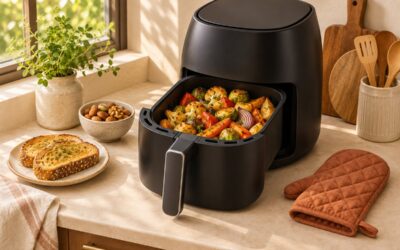
A wireless meat thermometer has a probe that stays in the food while a base unit or phone app shows the temperature from a distance. This is handy for roasts, smoked cuts, and anything that cooks for a long time in an oven, grill, or air fryer with enough space. Models differ in how they connect and how they are built.
We have not used these products ourselves, so this guide has no rankings and no personal results. It shows how to compare listings: what probe designs exist, how range and battery claims work, and which build details, such as the temperature limit and cleaning, are worth confirming with the maker.
As an Amazon Associate we earn from qualifying purchases. Links on this site are affiliate links, and they do not change the information we give.
What to Look For
| Factor | Why it matters | What to check |
|---|---|---|
| Probe count | More probes let you track several items. | One, two, or more probes and ports on the base. |
| Probe design | Affects how it fits in the food. | Fully wireless or wired probe, length, and tip shape. |
| Connection and range | Decides how far you can walk away. | Bluetooth or Wi-Fi, and the maker’s stated range. |
| Temperature limits | Must handle your cooking method. | Probe and cable heat limits listed by the maker. |
| Display and app | Shapes how easy it is to read. | Base screen, backlight, alarms, and app graphs. |
| Battery | Long cooks need steady power. | Battery type, charging dock, and stated hours. |
| Cleaning | Probes touch food directly. | Water resistance notes and wash instructions. |
Setup and Care Tips
- Read the maker’s guidance on where to insert the probe for the cut you are cooking.
- Pair the device and run a short check before the cook begins.
- Keep the base unit away from direct flame or heat that exceeds its limit.
- Wash probes as the maker directs and dry them before storing.
- Charge the unit or replace its cells ahead of a long cook.
Mistakes to Avoid
- Overlooking the probe’s heat limit when cooking at high settings.
- Counting on stated range through thick walls or a closed grill lid.
- Letting the probe tip touch bone or the pan.
- Skipping cleaning notes for models with removable parts.
- Choosing an app-only model when you prefer a base display.
FAQ
Is a fully wireless probe better than a wired one?
Each has trade-offs. Fully wireless probes have no cable to route, but they rely on a battery in the probe and a signal that must travel through the cooking space. Wired probes are simpler but need cable routing.
Will it work in an air fryer or oven?
Some can, if the probe and cable heat limits match your cooking temperature and the cable fits without being pinched by the door. Check the maker’s notes. Thin cables usually come with a maker-stated heat limit, and the sealing on a closing door can wear if the cable is pinched, so choose a route that does not squeeze it.
The Short Version
Choose the probe count and design that match your cooking style, check connection range and heat limits, and look for a display and battery you can rely on. Clear cleaning notes make everyday use easier. Think about where you cook most, whether that is an oven, a grill, a smoker, or an air fryer, and match the probe design and heat limits to that space. Always follow the maker’s directions and trusted food guidance for target temperatures.