Disclosure: airfryerkitchensupply.com is reader-supported. When you buy through links on our site, we may earn an affiliate commission at no extra cost to you.
Where to buy
The fastest way to compare the best bbqs and smokers in this guide is on Amazon, where each verified pick below links straight to its product page so you can check the current price on Amazon, confirm the exact configuration, and read the full manufacturer listing before you commit. Stock and configurations on smokers and smoker accessories shift through the season, so confirm dimensions, fuel type, and included accessories on the listing itself rather than relying on any roundup — including this one.
Every pick below is a combination machine — it grills and it smokes — and each was verified through Amazon’s catalog before earning a link. Check the current price on Amazon from the links and confirm which accessories are in the box.
- Char-Griller Texas Trio 3070 — Check the current price on Amazon
- Oklahoma Joe’s Canyon Combo — Check the current price on Amazon
- Oklahoma Joe’s Longhorn Combo — Check the current price on Amazon
- Masterbuilt Gravity Series 800 with Griddle — Check the current price on Amazon
- Traeger Woodridge Pro — Check the current price on Amazon
- recteq RT-B380 Bullseye — Check the current price on Amazon
Most households do not need a grill and a smoker. They need one machine that does both jobs without embarrassing itself at either, which is exactly the promise behind the best bbqs and smokers. The best bbqs and smokers combine grilling and smoking in a single footprint — gas-and-charcoal combos, pellet grills that sear, gravity-fed charcoal machines that do everything — and the category has matured to the point where the best of them genuinely replace two cookers. The mediocre ones, though, still do two jobs badly, so this guide is picky on your behalf.
We verified six combination cookers through Amazon’s catalog data and judged them on a double standard: each had to grill convincingly (real searing, usable direct heat) and smoke convincingly (stable low temperatures, real smoke flavor), not merely claim both on the box. The result spans dual-fuel combos for the indecisive, a flame-broiler pellet grill for sear-hungry pellet fans, a gravity charcoal machine that might be the best all-rounder in backyard cooking, and a pellet grill that doubles as a flat-top. Read the badges; each names the household that pick serves best.
In this guide
Quick Picks
If you only read one section, make it this one. These are the six best bbqs and smokers we would point a friend toward, each with a clear job. The detailed reviews further down explain the reasoning, the trade-offs, and who should skip each one.
- Char-Griller Texas Trio 3070 — Best Gas + Charcoal + Smoker Combo. Three burners of gas, a full charcoal grill, a side firebox for smoking, and a side burner — 1,390 sq in of everything. Check the current price on Amazon.
- Oklahoma Joe’s Canyon Combo — Best Dual-Fuel Combo for Smokers Who Grill. A dual-fuel rig with a real offset smoker heart: 3-burner propane on one side, charcoal smoker-grill on the other, 1,031 sq in. Check the current price on Amazon.
- Oklahoma Joe’s Longhorn Combo — Best Classic Combo, Proven Design. The long-running combo benchmark: a full offset smoker joined to a gas grill, 1,060 sq in, and years of owner knowledge. Check the current price on Amazon.
- Masterbuilt Gravity Series 800 with Griddle — Best All-Rounder (Smoke, Grill, Griddle). Gravity-fed charcoal with digital control, app connectivity, 800 sq in — and a griddle insert for smash burgers and breakfast. Check the current price on Amazon.
- Traeger Woodridge Pro — Best Pellet Grill-and-Smoker with WiFi. 970 sq in of pellet cooking with WiFIRE app control, Super Smoke mode, and a 500°F ceiling for stronger grilling. Check the current price on Amazon.
- recteq RT-B380 Bullseye — Best Compact Pellet Grill-and-Smoker. A kettle-style pellet grill that sears and smokes — the compact combo for smaller households and patios. Check the current price on Amazon.
How These Picks Were Chosen
Combination cookers fail in predictable ways, so we screened for those failures first. Gas-charcoal combos often give you a small, cramped version of each grill; we favored the ones with full-size cooking areas on both sides. Pellet grills often cannot sear; we favored direct-flame or high-max-temperature designs. Every pick was cross-checked — brand and model searched, listing title matched, ASIN used only from the verified match — and spec boxes quote only those verified listing details.
We also weighed the ownership reality of combos: more fuel systems means more maintenance, so build quality and parts support mattered more here than in single-purpose categories. No product prices or fixed ratings are printed anywhere in this guide; prices swing with season and sales, so each pick links to a live check instead. Badges reflect the primary job each machine does best, because even the best combo has a center of gravity — knowing it is how you avoid buying a smoker that grills when you needed a grill that smokes.
One more consideration belongs in every combo decision: who else cooks at your house. A machine with two personalities serves a two-cook household beautifully when each cook adopts a side — one masters the smoker’s rhythm, the other owns the grill’s timing — and the combo becomes shared ground rather than one person’s complicated appliance. If a partner, a teenager, or a parent will regularly cook on it, walk them through the side they will use before you buy, and weight their comfort in the decision. The best combo is the one the whole household will actually light, and a machine everyone understands gets used three times as often as a machine one person tolerates. That usage, compounded over seasons, is where the purchase quietly pays for itself — in meals cooked outdoors together, in skills shared across the household, and in a patio that becomes the family’s favorite room without ever getting a roof.
The 6 Best BBQs and Smokers

1. Char-Griller Texas Trio 3070 — Best Gas + Charcoal + Smoker Combo
The Texas Trio is the maximalist answer: a 3-burner gas grill for weeknights, a charcoal grill for weekends, a side firebox that turns the charcoal side into an offset smoker, and a side burner for sauces and sides — 1,390 square inches of total cooking space across the rig. Push-button ignition on the gas side, dual temperature gauges, and a footprint that replaces what used to be three separate appliances. For a household arguing about fuel, it simply refuses to take sides.
It suits families who grill far more than they smoke but refuse to give smoking up, and hosts whose events need every square inch. The compromises are the honest combo ones: the smoker side is a part-time offset that needs attention and seals like a consumer unit, and a rig this size is a project to assemble and a presence on the patio. Judged as a grill station that can genuinely smoke, rather than a pit that can sort of grill, it is the most complete package in this guide.
Strengths
- Gas, charcoal, offset smoking, and a side burner in one rig
- 1,390 sq in is the largest total area in this guide
- Push-button gas ignition keeps weeknight grilling effortless
Trade-offs
- Smoker mode is part-time — expect offset attention and consumer seals
- Large assembly and a large patio footprint
- More systems means more cleaning and upkeep
| Specification | Detail |
|---|---|
| Total cooking area | 1,390 sq in |
| Gas side | 3-burner with side burner |
| Smoker | Side firebox included |
| Ignition | Push button |
| Model | 3070 |
Run it with a division of labor: gas for vegetables and weeknight proteins, charcoal for steaks, the firebox lit for Saturday ribs. Owners who assign each side its job stop seeing a compromise and start seeing a kitchen. Keep the firebox side seasoned and covered — combo rigs rust first at their least-used end.
Ownership note: keep a small parts kit for a rig this complex — igniter, regulator hose washer, spare grates brush — because a combo down on a holiday weekend is usually a two-dollar part wearing a disguise.
Best for: Families wanting every fuel and method in a single station / Not suited for: Dedicated pitmasters wanting a sealed, competition-grade smoker
Check on Amazon — check the current price on Amazon and confirm the configuration before ordering.
2. Oklahoma Joe’s Canyon Combo — Best Dual-Fuel Combo for Smokers Who Grill
Where the Texas Trio is grill-first, the Canyon Combo comes from a smoker company, and it shows: the charcoal side is a genuine smoker-and-grill with offset character, while the 3-burner propane side handles the fast work. With 1,031 square inches total, it is sized for real events without the Trio’s sprawl. If your household’s center of gravity is smoked food with weeknight grilling support, this balance is the right way around.
It suits the cook who fires the smoker most weekends and the gas burners most weeknights, in that order. The propane side lights instantly for burgers and dogs while a butt rests; the charcoal side burns chunks and splits for the main event. As with all combos, neither side is the largest in its class — but both sides here are honestly sized, which is rarer than it should be, and the smoker side benefits from Oklahoma Joe’s offset design experience.
Strengths
- Smoker-first design from an offset specialist brand
- Instant propane side for weeknights and sides
- 1,031 sq in covers family events comfortably
Trade-offs
- Neither side matches a dedicated unit for capacity
- Two fuel systems to maintain and keep covered
- Offset side still wants fire attention on long smokes
| Specification | Detail |
|---|---|
| Cooking area | 1,031 sq in |
| Gas side | 3-burner propane |
| Charcoal side | Smoker and grill |
| Fuel | Dual fuel |
The Canyon’s best trick is parallel cooking: brisket resting while gas burners finish corn, beans moving to the warm charcoal side as guests arrive. Plan your event menu around that parallelism and the combo format stops being a compromise and becomes a workflow.
Ownership note: the smoker side seasons like any offset; a light oil coat inside the firebox after cooks in humid months keeps the Canyon’s hardest-working steel young.
Best for: Smoke-first households that still grill several nights a week / Not suited for: Purists wanting one fuel mastered deeply
Check on Amazon — check the current price on Amazon and confirm the configuration before ordering.

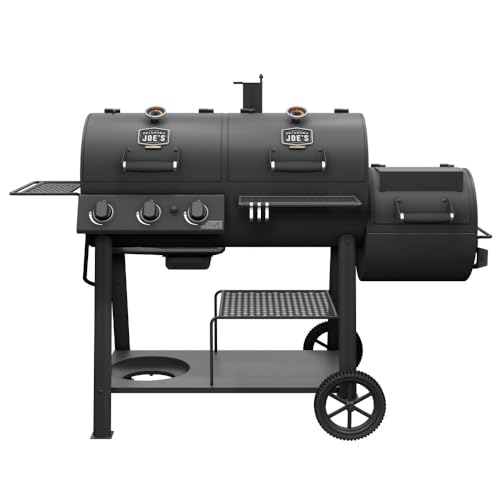
3. Oklahoma Joe’s Longhorn Combo — Best Classic Combo, Proven Design
The Longhorn Combo has been the category’s reference design for years: a proper offset charcoal smoker on one side, a gas grill chamber on the other, sharing one heavy frame and 1,060 square inches of total cooking area. Longevity matters in combos — a design sold for years accumulates parts availability, owner modifications, and troubleshooting knowledge that a new model cannot match, and the Longhorn has all three in depth.
It suits buyers who value the known quantity: the smoker side behaves like the offsets in our wood-smoker guide, with the same tending rhythm and the same gasket-upgrade path, while the gas side is a straightforward weeknight grill. If you want your combo purchase to be the end of your research rather than the start of a hobby forum habit, the Longhorn’s maturity is its argument.
Strengths
- Proven long-running design with deep parts and owner support
- Full offset smoker, not a token firebox
- 1,060 sq in across both chambers
Trade-offs
- Design maturity means fewer modern conveniences
- Heavy, long footprint needs a planned parking spot
- Smoker side needs the usual offset attention and sealing
| Specification | Detail |
|---|---|
| Cooking area | 1,060 sq in |
| Design | Offset smoker + gas grill combo |
| Fuel | Charcoal and gas |
Treat the Longhorn as two appliances sharing a frame and maintain them on separate schedules — the gas side’s burners and the smoker side’s grates age differently. Owners who do that report the rig outlasting expectations set by cheaper combos, which is the entire case for buying the established design.
Ownership note: the Longhorn’s longevity is its owners’ habit — separate maintenance for each chamber, logged or not, is what the decade-old survivors in owner groups all describe.
Best for: Buyers wanting the proven, supported combo design / Not suited for: Shoppers wanting the newest features and connectivity
Check on Amazon — check the current price on Amazon and confirm the configuration before ordering.

4. Masterbuilt Gravity Series 800 with Griddle — Best All-Rounder (Smoke, Grill, Griddle)
The Gravity Series 800 might be the single most versatile cooker in this guide. Its gravity-fed charcoal hopper and digital fan control deliver real charcoal smoke at low temperatures and genuine grilling heat when you turn it up, with app connectivity for monitoring. Then it does something no other pick does: a griddle insert swaps in, turning the same machine into a flat-top for smash burgers, fajitas, pancakes, and fried rice. Smoke, grill, griddle — three cooking cultures, one footprint, one fuel.
It suits the household that cooks outdoors constantly and diversely, and that has griddle envy every time a flat-top video crosses the feed. The 800 square inches handle family events, and charcoal flavor runs through everything it cooks. The trades are the gravity system’s moving parts — a fan and hopper to keep clean — and griddle seasoning to maintain. For the cook who will use all three modes monthly, nothing else here is close.
Strengths
- Smokes, grills, and griddles with real charcoal flavor
- Digital control with app connectivity over a charcoal fire
- 800 sq in covers family-size cooks in every mode
Trade-offs
- Fan and hopper system needs regular cleaning
- Griddle insert adds storage and seasoning upkeep
- Charcoal consumption rises at griddle and searing temperatures
| Specification | Detail |
|---|---|
| Cooking area | 800 sq in |
| Fuel | Gravity-fed charcoal |
| Control | Digital with app connectivity |
| Extras | Griddle insert |
| Model | MB20040221 |
Sequence a perfect Saturday on it: brisket smoked overnight on the hopper, rested while the griddle fries breakfast, then burgers smashed at lunch on the same charcoal fire’s descendants. That continuity — one cooker living the whole day with you — is why Gravity owners become so attached.
Ownership note: keep the griddle seasoned and stored dry, and the fan intake screened from ash; the Gravity’s two party tricks both fail from neglect, not from design.
Best for: Diverse outdoor cooks wanting smoke, grill, and griddle in one / Not suited for: Minimalists who cook one way and want zero moving parts
Check on Amazon — check the current price on Amazon and confirm the configuration before ordering.

5. Traeger Woodridge Pro — Best Pellet Grill-and-Smoker with WiFi
The Woodridge Pro is the pellet answer to the combo question: instead of two fuels, it stretches one fuel across both jobs. With 970 square inches, WiFi and WiFIRE app control, a digital sensor for tight temperature management, Super Smoke mode for low-temperature flavor, and a 500°F maximum that grills more convincingly than older pellet designs, it covers the weekly reality of most households — smoked weekends, grilled weeknights — from a single hopper of pellets.
It suits the convenience-first cook who wants one fuel to buy, one system to learn, and an app that makes overnight brisket a supervised-from-bed experience. Pellet searing still trails direct charcoal flame for crust, and pellet smoke remains the mild end of the spectrum even with Super Smoke — those are the standing pellet trades, stated plainly. In exchange you get the easiest ownership in this guide and a side shelf and layout designed by the company that invented the category.
Strengths
- 970 sq in with WiFIRE app control and digital sensing
- Super Smoke mode strengthens low-temperature flavor
- 500°F ceiling grills better than legacy pellet models
Trade-offs
- Pellet sear and smoke intensity still trail charcoal
- Single fuel means pellet supply is a standing errand
- Large footprint for a single-chamber cooker
| Specification | Detail |
|---|---|
| Cooking area | 970 sq in |
| Max temperature | 500°F |
| Connectivity | WiFi / WiFIRE app |
| Feature | Super Smoke Mode |
| Fuel | Wood pellets |
Use Super Smoke for the first hours of big cuts when meat takes on flavor most readily, then cook on to tenderness at standard settings, and finish chicken and steaks at the top of its range for the best crust it can give. Run that playbook and the Woodridge Pro covers ninety percent of a household’s outdoor cooking without a second machine ever being missed.
Ownership note: run the burn-off cycle after greasy cooks and vacuum the firepot on schedule — pellet combos ask little, but they ask it regularly.
Best for: One-fuel households wanting app-controlled smoking and grilling / Not suited for: Charcoal sear devotees or heavy-smoke traditionalists
Check on Amazon — check the current price on Amazon and confirm the configuration before ordering.

6. recteq RT-B380 Bullseye — Best Compact Pellet Grill-and-Smoker
The Bullseye takes the kettle grill — the most familiar shape in backyard cooking — and gives it a pellet heart. It runs on 100 percent wood pellets, and its maker positions it squarely at ribs, brisket, and chicken as well as searing and smoking, which is the combo brief in one sentence. The kettle format heats fast, uses pellets efficiently, and parks in spaces the big combos in this guide cannot enter, making it the small-household and small-patio answer to the whole category.
It suits couples and small families, kettle loyalists curious about pellets, and anyone whose combo needs are real but whose cooks are modest: a brisket or a couple of chickens, not a catering spread. Capacity is the deliberate trade — this is a compact cooker, and holiday-scale loads belong on the bigger picks. Within its size, the direct, kettle-style heat gives it a grilling personality that barrel pellet grills often lack.
Strengths
- Kettle format heats fast and grills with direct character
- Pellet convenience in a compact, patio-friendly size
- Efficient pellet use on smaller cooks
Trade-offs
- Compact capacity limits big events
- Kettle shape fits round loads better than long rib racks
- Fewer accessories and racks than full-size pellet grills
| Specification | Detail |
|---|---|
| Design | Kettle-style pellet grill |
| Fuel | 100% wood pellets |
| Use | Smoke, sear, grill |
Think of the Bullseye as the weeknight hero of this guide: lit in minutes, a chicken smoked after work, burgers seared on Friday, a brisket on the long weekend. Big combos earn their keep at parties; this one earns it every ordinary day, which for most households is the better bargain.
Ownership note: a kettle cover and a dry corner double this cooker’s life; its compact size makes it the easiest pick here to shelter properly, so no excuses.
Best for: Small households wanting pellet smoking and grilling in one compact unit / Not suited for: Hosts cooking for large groups regularly
Check on Amazon — check the current price on Amazon and confirm the configuration before ordering.
Comparison Table
Use this table to narrow the best bbqs and smokers list to two or three finalists, then read those full reviews above. The key specification column only uses details confirmed in the manufacturer’s Amazon listing title, so it stays honest even where a maker publishes fuller spec sheets elsewhere.
| Pick | Badge | Key spec | Best for |
|---|---|---|---|
| Char-Griller Texas Trio 3070 Check price | Best Gas + Charcoal + Smoker Combo | 1,390 sq in, gas + charcoal + firebox + side burner | Families wanting every fuel and method in a single station |
| Oklahoma Joe’s Canyon Combo Check price | Best Dual-Fuel Combo for Smokers Who Grill | 1,031 sq in dual-fuel, 3-burner propane + charcoal smoker | Smoke-first households that still grill several nights a week |
| Oklahoma Joe’s Longhorn Combo Check price | Best Classic Combo, Proven Design | 1,060 sq in offset smoker + gas grill | Buyers wanting the proven, supported combo design |
| Masterbuilt Gravity Series 800 with Griddle Check price | Best All-Rounder (Smoke, Grill, Griddle) | 800 sq in gravity charcoal + griddle, app control | Diverse outdoor cooks wanting smoke, grill, and griddle in one |
| Traeger Woodridge Pro Check price | Best Pellet Grill-and-Smoker with WiFi | 970 sq in pellet, WiFIRE, Super Smoke, 500°F max | One-fuel households wanting app-controlled smoking and grilling |
| recteq RT-B380 Bullseye Check price | Best Compact Pellet Grill-and-Smoker | Kettle-style pellet grill and smoker | Small households wanting pellet smoking and grilling in one compact unit |
How to Choose the Best BBQs and Smokers
Begin by naming your ratio. Count a typical month: how many cooks are grilling (fast, hot, weeknight) versus smoking (slow, low, weekend)? Grill-heavy households belong on the dual-fuel combos, where the grill side is full-size and the smoker is the supporting act. Smoke-heavy households belong on the Canyon or Longhorn, whose smoker sides are the real deal. Balanced households that cook everything belong on the Gravity 800 or the Woodridge Pro, the two single-chamber designs here that stretch one fuel across both jobs most convincingly.
Then judge each side separately, because combo marketing adds the numbers together. A total cooking area figure sums chambers you cannot combine for one cook — a brisket cannot span the gas and charcoal sides. Look at the largest single chamber and picture your biggest item in it. Check the smoker side for real draft and a firebox you can feed, and the grill side for burner count or max temperature, depending on fuel. If either side fails your biggest regular cook, the combo fails, no matter how impressive the summed total looks.
Finally, price the ownership, not just the machine. Combos carry two fuel supplies, two cleaning routines, and more parts; a cover is non-negotiable, and brands with deep parts catalogs — which is why proven designs score well here — save real money in year four. A combo that replaces two cookers you actually use is a bargain; a combo whose second side you light twice a year is an expensive way to store a lid.
Grilling vs Smoking: What a Combo Must Actually Do
Grilling is high heat, short time, direct radiation: it wants burners or coals close under the grate, fast preheat, and recovery when the lid opens. Smoking is the opposite: low, indirect, stable heat for hours, with smoke as an ingredient and stability as the whole game. A combo earns its name only if its design respects both physics. Gas sides grill brilliantly and smoke poorly without help; offsets smoke brilliantly and grill only over the firebox; pellet and gravity machines compromise by using controlled combustion that can run low for hours or hot for searing, within their ceilings.
Smoke quality differs across these picks in ways worth tasting before you commit, if you can: offset smoke is deepest, gravity charcoal is close behind, pellet smoke is mildest and cleanest. None is objectively correct — families divide on smoke intensity exactly as they divide on coffee strength — but buying a pellet combo expecting offset flavor is the category’s most common disappointment, and it is avoidable by reading the badge and verdict lines in this guide honestly.
One Machine or Two? The Honest Footprint Math
The case for a combo is space and simplicity: one footprint, one cover, one machine to learn deeply. The case against is specialization: a dedicated smoker smokes better than any combo’s smoker side, and a dedicated grill is usually bigger for grilling alone. The deciding question is how often the second job happens. Smoke monthly or more and grill weekly? A combo serves you. Smoke twice a year at holidays? Buy a great grill and a small dedicated smoker from our under-$400 guide, and store the smoker in the garage between its starring weekends.
Also walk your space before ordering any pick here: combos are the widest cookers in backyard cooking, and they need working room on the firebox side as well as the front. Measure the patio, the gate, and the storage spot with the lid open and the shelves up. The best combo is the one that fits your yard, your ratio, and your patience — in that order.
Maintaining a Combo: Two Machines’ Worth of Upkeep, One Routine
Combo ownership fails quietly when one half gets maintained and the other half gets forgotten, so run a single routine that touches everything: after cooking, brush the grates you used while they are warm; monthly, run the unused side for fifteen minutes to keep burners clear, seals supple, and spiders evicted from gas tubes; seasonally, empty and wipe the firebox and ash paths, check gas hoses and connections with soapy water for leaks, and oil the charcoal-side steel. Fifteen disciplined minutes on a schedule beats a weekend of restoration once a year, on every pick in this guide.
Keep the cover honest, too — a torn cover that ponds water on the lid is worse than a month of open sky. And store each fuel correctly: propane connections closed and the tank as its maker directs, charcoal bone-dry in a sealed bin, pellets indoors. Combos concentrate your whole outdoor kitchen in one frame; the routine above is what makes that concentration a convenience instead of a single point of failure.
Combo Cooking Workflows: Menus That Use Both Sides
The combo format shines brightest on menus designed for it. The classic is the reverse-sear steak night: steaks smoke low on the smoker side until nearly done, then finish over the grill side’s hardest heat for crust — two textures no single-mode cooker delivers alone. Barbecue day runs the other direction: the smoker side carries brisket and butts for hours while the grill side handles lunch, then vegetables, corn, and sauce-setting for the ribs at the end. Breakfast on the Gravity’s griddle while yesterday’s brisket rests is the third workflow owners brag about, and it is not close.
Design your menus this way deliberately for the first month — one both-sides menu a week — and the combo’s logic becomes habit. After that, you will find you have stopped thinking of it as a compromise machine at all. It is simply the cooker that is always the right one for the next step of the meal.
Designing Your Outdoor Cooking Space Around a Combo
A combo cooker is the anchor of an outdoor kitchen, and the space around it decides how much you enjoy it. Start with the working triangle adapted outdoors: the cooker, a landing surface for hot trays within one step, and storage for fuel and tools within two. The landing surface is the piece everyone forgets and everyone needs — a brisket coming off a smoker cannot be held in one hand while the other hunts for a table. A simple heat-proof side table, positioned on the smoker-door side rather than the pretty side, earns its footprint every single cook.
Think about traffic next. The cook’s path between cooker and kitchen door should never cross the guests’ path to the cooler, and the firebox side of a combo needs a no-standing zone that children and dogs learn once and respect forever. Lighting matters more than aesthetics: a cook checking bark color at midnight needs real light at the grate, not ambiance at the pergola. And plan the dull infrastructure — an outdoor outlet for pellet and gravity models and thermometer chargers, a hose reach for cleanup, and a grease plan that does not involve the patio’s best paving stones.
Finally, shelter the investment sensibly. A cover that fits the whole rig, a surface that drains away from the cooker rather than toward it, and a storage spot for the griddle inserts, probes, and small parts that combos accumulate will keep the machine ready rather than archaeological. None of this needs to be built in a weekend or cost like a renovation; it needs to be thought about once, in the right order, before the first season teaches the lessons the expensive way.
Do that thinking and the combo stops being a big appliance parked outside. It becomes a station — the place where your household’s best meals reliably happen, in every season you are willing to stand in.
Fuel Planning for a Two-Fuel Household
Combo ownership adds a small logistics habit: never let both fuels run low at once. Keep the propane tank’s spare or exchange planned before the holiday, the charcoal bin sealed and stocked by the bag rather than the panic trip, and pellets — for the pellet picks — bought ahead in the flavor you actually use. A combo’s promise is that some side of it is always ready; that promise is kept in the fuel closet, not on the patio.
Rotate stock like a pantry: oldest charcoal and pellets first, because both absorb humidity over time and lose their manners quietly. Mark bags with the month you bought them if your storage is generous. It is a thirty-second habit that prevents the one failure every combo owner eventually meets — a full house, a beautiful brisket, and a bin of fuel that will not burn right.
How to Smoke on a Combination Grill-and-Smoker
Combo machines smoke best when you set them up deliberately for the job instead of treating smoking as a grill setting. This sequence works across the dual-fuel and single-chamber picks in this guide.
- Choose the right chamber. On dual-fuel rigs, smoke on the charcoal or offset side; on pellet and gravity machines, use the main chamber at its lowest stable settings.
- Set up indirect heat. Food never sits over direct flame when smoking — use the firebox, a two-zone arrangement, or the smoker’s controlled low heat as designed.
- Add a water pan where the design allows. A pan of water buffers temperature swings and adds humidity, which helps combo chambers that run slightly hot or dry.
- Start the fire or the controller early. Give the machine 30 to 45 minutes to stabilize at smoking temperature before food goes on; combos have more steel and more air leaks to settle than dedicated smokers.
- Use chunks, not chips, for charcoal smoking. Two or three wood chunks in the coal bed give hours of smoke; chips burn off before the first hour ends.
- Monitor at grate level. A probe thermometer beside the food tells the truth that lid gauges on combo rigs rarely do.
- Resist rearranging. Combo chambers lose heat fast when opened. Plan placement once, close the lid, and let the machine work.
- Finish on the grill side when it helps. The combo’s gift: move smoked chicken or ribs to the hot side at the end for crisp skin and sauce set — smoke low, finish hot.
That last step is why combo owners stay combo owners. A reverse-sear steak or a crisped smoked chicken, finished steps from where it smoked, is a workflow two separate machines parked across a patio cannot match for convenience.
Common Buying Mistakes
Believing the summed cooking area
Combo totals add chambers you cannot cook across. Judge the largest single chamber against your biggest cook, or you will own a big number and a small brisket problem.
Smoking on the gas side with a chip box as an afterthought
It produces a hint of smoke, not barbecue. If smoking matters, use the side or machine designed for it — that discipline is the difference between a combo that works and one that disappoints.
Never cleaning the side you use less
The neglected half of a combo rusts, clogs, and fails first. Run both sides at least monthly, even briefly, and keep the whole rig covered and dry.
Buying a combo to avoid deciding
A combo is a decision — about ratio and compromise — not an escape from one. Buyers who skip the ratio question end up with the wrong center of gravity and a machine that is second-best at their main job.
Skipping the cover to save money
Two fuel systems, more seams, more hardware: combos are the most weather-vulnerable cookers in this guide. The cover is part of the purchase price, full stop.
Final Recommendation
For the household that wants everything, the Texas Trio is the complete station; for smokers who grill, the Canyon Combo and the proven Longhorn put the pit first. The Gravity Series 800 is our favorite single machine here — smoke, grill, and griddle with charcoal flavor and digital calm — while the Woodridge Pro is the one-fuel, app-controlled route and the Bullseye the compact pellet answer. Match the pick to your grilling-to-smoking ratio and every one of these will earn its patio space.
Then cook on it constantly. A combo learned deeply out-cooks a pair of strangers, and the second season on any of these machines is where the food gets genuinely good.
A closing thought on value, because combo machines invite a particular kind of buyer’s remorse when they are bought for the wrong reason. A combo is worth its money when both halves of it work regular shifts — when the grill side feeds the week and the smoker side owns the weekend, month after month. Judged that way, the right combo is not the one with the most features in this guide; it is the one whose two jobs match the two jobs your household actually has. Re-read the badge lines with your last month of cooking in mind, and let that month vote. Then commit without nostalgia for the dedicated machines you did not buy: the combo on your patio, learned deeply and used constantly, will feed your people better than a theoretical perfect pair you had no room to park. Outdoor cooking rewards the equipment that is present, seasoned, and understood — and a combo, chosen by ratio and run with intent, is all three from the day it arrives.
Start with the shortlist: Char-Griller Texas Trio 3070 — Check on Amazon; Oklahoma Joe’s Canyon Combo — Check on Amazon; Oklahoma Joe’s Longhorn Combo — Check on Amazon.
Keep exploring the cluster: Best Bbq Smokers Under $1000 Best Bbq Smokers Under $400 Best Bbq Wood Smokers Best Bbq Trailer Smokers Best Bluetooth Meat Thermometer For Smokers
Frequently Asked Questions
Are combo grill-smokers as good as dedicated units?
At their primary job, the best combos here are close; at their secondary job, they are good rather than great. A combo smoker side will not match a dedicated offset for evenness, and a pellet grill will not sear like charcoal. For most households the trade is worth it; for specialists it is not.
Which combo fuel is best?
It depends on your ratio. Gas plus charcoal gives the best grilling range; pellet gives the easiest smoking; gravity charcoal gives the best single-fuel flavor across both jobs. There is no universal winner — only the match to how you cook.
Can I really smoke a brisket on a combo?
Yes, on the smoker side of the dual-fuel rigs and on the pellet and gravity machines, all of which hold low temperatures for the many hours a brisket needs. Budget more attention on the offset-style sides and use a grate-level probe.
How much space does a combo need?
More than any other cooker type: the dual-fuel rigs are wide, and you need working room at the firebox as well as the front. Measure with lids open and shelves up before ordering, and confirm the assembled unit fits your gate or door.
Do combos cost more to maintain?
Somewhat: two fuel systems, more burners or parts, and more surface to keep clean and covered. The offset is that you maintain one machine instead of two, and proven designs with deep parts support keep long-term costs reasonable.
What is the best combo for a small patio?
The recteq Bullseye — a compact kettle-format pellet machine that genuinely smokes and sears. The Gravity 800 is the next step up if you want charcoal flavor and griddle ability in a still-manageable footprint.
Which side of a combo wears out first?
Usually the side you use most — burners and igniters on the gas side, fire grates and ash-exposed steel on the charcoal side — which is why the maintenance routine in this guide touches both halves on a schedule rather than waiting for symptoms. Parts for the proven designs here are widely available, and a combo maintained as one machine ages far more gracefully than one maintained as a favorite half.


