Disclosure: airfryerkitchensupply.com is reader-supported. When you buy through links on our site, we may earn an affiliate commission at no extra cost to you.
Where to buy
The fastest way to compare the best bbq wood smokers in this guide is on Amazon, where each verified pick below links straight to its product page so you can check the current price on Amazon, confirm the exact configuration, and read the full manufacturer listing before you commit. Stock and configurations on smokers and smoker accessories shift through the season, so confirm dimensions, fuel type, and included accessories on the listing itself rather than relying on any roundup — including this one.
All six picks below burn wood or charcoal-and-wood as their heat source and were verified through Amazon’s catalog before earning a link. Use the links to check the current price on Amazon and confirm the current configuration.
- Oklahoma Joe’s Highland Offset Smoker — Check the current price on Amazon
- Dyna-Glo Wide Body Vertical Offset DGO1890BDC-D — Check the current price on Amazon
- Weber Smokey Mountain Cooker 18-inch — Check the current price on Amazon
- Oklahoma Joe’s Bronco Pro 21.5-inch Drum Smoker — Check the current price on Amazon
- Kamado Joe Classic Joe Series II 18-inch — Check the current price on Amazon
- Char-Griller Smokin’ Pro Charcoal Grill and Offset Smoker — Check the current price on Amazon
There is a reason the best bbq wood smokers still define what barbecue is supposed to taste like. The best bbq wood smokers burn real wood — splits, chunks, or charcoal layered with hardwood — and that combustion, managed well, produces a depth of flavor that pellets and elements approximate but never quite duplicate. This category is also the most honest in barbecue: a wood smoker has no controller to hide behind, so the cook’s fire craft is the product. If that sounds like a warning, it is also an invitation, because learning to run wood is the most satisfying skill in outdoor cooking.
This guide compares six verified wood-burning picks across the formats that matter — a classic offset, two vertical offsets, a bullet water smoker, a drum smoker, a kamado, and a big barrel offset — and explains who each one suits. Every product was cross-checked through Amazon’s catalog data before it earned a link, specs come only from verified listing details, and the buying guide covers the part nobody can sell you: wood selection, fire management, and clean smoke. Master those, and any pick here will feed people memorably.
In this guide
Quick Picks
If you only read one section, make it this one. These are the six best bbq wood smokers we would point a friend toward, each with a clear job. The detailed reviews further down explain the reasoning, the trade-offs, and who should skip each one.
- Oklahoma Joe’s Highland Offset Smoker — Best Classic Offset. The benchmark consumer offset: 900 sq in, side firebox, and the traditional draft that defines wood-smoked flavor. Check the current price on Amazon.
- Dyna-Glo Wide Body Vertical Offset DGO1890BDC-D — Best Vertical Offset for Capacity. A wide-body vertical offset: side firebox, tall stacked chamber, big capacity in a modest footprint. Check the current price on Amazon.
- Weber Smokey Mountain Cooker 18-inch — Best Wood-and-Charcoal Water Smoker. The 18-inch bullet: charcoal and wood chunks over a water pan — the most forgiving path to real wood smoke. Check the current price on Amazon.
- Oklahoma Joe’s Bronco Pro 21.5-inch Drum Smoker — Best Drum Smoker. A heavy-duty drum that hangs ribs vertically and runs hot-and-fast or low-and-slow with unusual calm. Check the current price on Amazon.
- Kamado Joe Classic Joe Series II 18-inch — Best Kamado for Wood-Fired Versatility. Ceramic insulation, charcoal and wood, low-and-slow control and genuine high-heat ability in one 18-inch kamado. Check the current price on Amazon.
- Char-Griller Smokin’ Pro Charcoal Grill and Offset Smoker — Best Big Barrel Offset Value. 1,130 sq in of barrel grill plus a side firebox, dual damper control, and a warming rack — maximum area for the tier. Check the current price on Amazon.
How These Picks Were Chosen
We chose for craft and for honesty about workload. Every pick here burns wood as a primary fuel or as the defining flavor source over charcoal, holds enough capacity for real barbecue — brisket, butts, multiple racks — and has a design that experienced cooks respect: offsets with proper draft, a water smoker with decades of proof, a drum whose airflow makes it a rib machine, and a kamado whose ceramic mass makes it the efficiency champion. Each was verified by brand and model, with the listing title matched before any ASIN was used.
We deliberately spanned the workload spectrum. The kamado and drum hold temperature with near-appliance calm once lit; the bullet needs occasional vent attention; the offsets ask for a split every half hour or so and reward it with the deepest flavor. Rather than pretend one is best, each pick carries a badge for its job and a verdict naming who should skip it — because the wrong wood smoker for your patience level becomes the most expensive clothes rack on your patio.
No prices or fixed ratings are printed, per our standing rules — wood smokers are long-lived goods whose street prices swing with season and sales, so each pick links out for a live check. Spec boxes use only details confirmed in the verified listing titles.
The 6 Best BBQ Wood Smokers

1. Oklahoma Joe’s Highland Offset Smoker — Best Classic Offset
The Highland is the offset most wood-smoker journeys start on, and for good reason: a horizontal chamber with 900 square inches of cooking area, a side firebox you feed with charcoal and wood splits, and a traditional draft that pulls smoke across the food and out the stack. Run it correctly — small, hot, clean fire; splits pre-warmed; exhaust wide open — and it produces the reference flavor this entire category is judged by.
It suits learners who are serious: patient enough to tend a fire every 30 to 45 minutes, curious enough to log what the wind does to their draft. Its consumer steel leaks at the doors and loses heat in winter, and owners treat gaskets and a baffle tune as rites of passage. Accept that apprenticeship and the Highland teaches skills that transfer to any pit anywhere; expect it to behave like a pellet grill and you will list it for sale by autumn.
Strengths
- Traditional offset draft gives benchmark wood flavor
- 900 sq in fits briskets and rib spreads comfortably
- Huge owner community for mods and troubleshooting
Trade-offs
- Fire tending every 30–45 minutes is the job
- Door leaks and thinner steel raise fuel use
- Lid gauge reads far from grate temperature
| Specification | Detail |
|---|---|
| Cooking area | 900 sq in |
| Design | Offset smoker grill |
| Fuel | Charcoal and wood |
Burn a charcoal base for coals and splits for flavor, keeping the next split warming on the firebox lid so it catches instantly and burns clean. Cook by grate-level probe temperature, not the lid. The Highland rewards that discipline with bark and smoke ring that make guests ask what your secret is — and the secret is only ever the fire.
Ownership note: keep a grate-level probe as permanent equipment on this offset; the Highland’s lid gauge is decoration, and your fire deserves honest information.
Best for: Learners committed to mastering traditional offset cooking / Not suited for: Anyone wanting to start a cook and leave for the day
Check on Amazon — check the current price on Amazon and confirm the configuration before ordering.

2. Dyna-Glo Wide Body Vertical Offset DGO1890BDC-D — Best Vertical Offset for Capacity
Dyna-Glo’s wide-body vertical offset rearranges the offset formula for people short on patio but long on guest lists. The firebox sits at the side, heat and smoke rise through a tall, wide chamber, and food stacks across multiple levels — ribs high, butts mid-chamber, a pan of beans underneath catching drippings. Vertical stacking is thermally efficient: every grate gets the heat on its way up, and the footprint stays closer to a bookshelf than a boat.
It suits high-volume home cooks and small catering side-hustles that need offset flavor without offset acreage. The trade-offs are the vertical ones: heat stratifies, so the top runs hotter and rotating food between levels is part of the technique, and the firebox wants feeding on an offset’s usual rhythm. Door sealing, as with most consumer offsets, improves markedly with a gasket — plan on it and the Dyna-Glo becomes a steady, capacious wood cooker.
Strengths
- Big stacked capacity in a small footprint
- True offset firebox flavor and draft
- Efficient vertical heat path suits mixed loads
Trade-offs
- Temperature varies by level — rotation is part of the craft
- Firebox needs regular feeding like any offset
- Door seams benefit from an aftermarket gasket
| Specification | Detail |
|---|---|
| Design | Wide body vertical offset |
| Model | DGO1890BDC-D |
| Fuel | Charcoal and wood |
Learn its levels with thermometers on two grates during an empty run and you will know exactly where your brisket zone and your rib zone live. That map, plus a rotation habit, turns the stratification from a flaw into a tool — delicate items low, bark-building items high. For the patio-poor and guest-rich, this is the wood smoker that fits both halves of that sentence.
Ownership note: learn your levels with two cheap oven thermometers on an empty run and mark the hot and cool grates in your logbook — that map is this cooker’s user manual, written by you.
Best for: High-volume cooks with limited patio space / Not suited for: Set-and-forget cooks or anyone who hates rotating food
Check on Amazon — check the current price on Amazon and confirm the configuration before ordering.
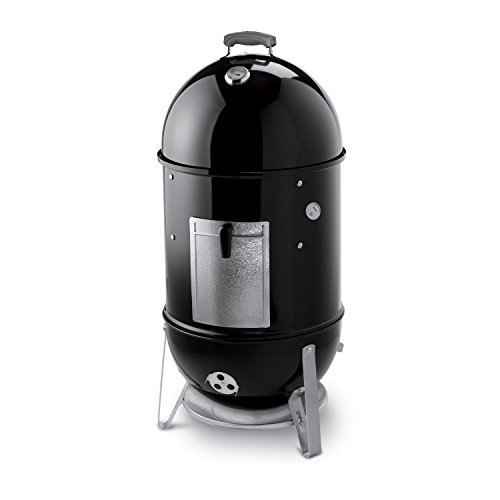
3. Weber Smokey Mountain Cooker 18-inch — Best Wood-and-Charcoal Water Smoker
Ask a room of pitmasters what they learned on and the Smokey Mountain is the most common answer. The 18-inch model is the sweet spot of the line: dual cooking grates over a water pan, a charcoal ring below where wood chunks smolder in sequence, porcelain-enameled steel, and dampers that give you genuine control. The water pan is the genius — a thermal battery that flattens temperature swings and humidifies the chamber, forgiving the mistakes every new wood cook makes.
It suits learners who want wood flavor with training wheels that never really come off — competition teams still win on these. An 18-inch grate fits a trimmed brisket, two chickens, or several racks of ribs halved, and a Minion-method charcoal load with buried chunks burns for hours between adjustments. It will not sear, it dislikes being opened, and its lower grate is awkward mid-cook; within its low-and-slow mission, it is close to perfect.
Strengths
- Water pan makes wood smoking forgiving for beginners
- Minion-method fires run for hours between adjustments
- Porcelain enamel and parts support promise a long life
Trade-offs
- No high-heat searing — it is a dedicated low-and-slow tool
- Lower grate access requires lifting the top load
- Uninsulated — winter cooks burn extra charcoal
| Specification | Detail |
|---|---|
| Size | 18-inch |
| Grates | Dual cooking grates |
| Finish | Porcelain-enameled |
| Control | Temperature control dampers |
| Fuel | Charcoal and wood chunks |
Bury three wood chunks in the charcoal ring rather than scattering them on top; as the Minion fire spreads, each chunk smolders in turn, giving even smoke for hours instead of a bitter blast at the start. That single technique is the difference between good and great bullet-smoker barbecue, and it costs nothing.
Ownership note: the water pan is also a humidity tool in dry climates — a fuller pan on windy winter days measurably steadies both temperature and bark formation.
Best for: Learners and purists wanting forgiving, classic wood smoke / Not suited for: High-heat grillers or cooks who peek constantly
Check on Amazon — check the current price on Amazon and confirm the configuration before ordering.
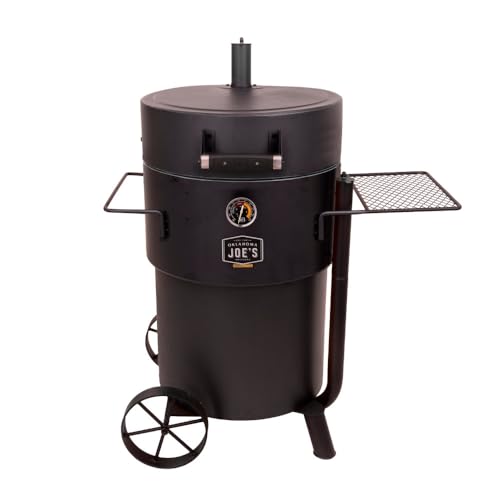
4. Oklahoma Joe’s Bronco Pro 21.5-inch Drum Smoker — Best Drum Smoker
Drum smokers are barbecue’s hot-rods, and the Bronco Pro is the factory-built version done right: a heavy-duty 21.5-inch drum with 366 square inches of cooking area, an intake system that actually meters air precisely, and hooks for hanging ribs and chickens vertically in the smoke column. Hanging food in a drum cooks it with a direct, dripping-onto-coals intensity that produces a flavor distinct from every other pick here — part smoke, part vaporized drippings, entirely addictive on ribs and poultry.
Drums also run efficiently and can push hot-and-fast temperatures for brisket cooks who subscribe to that school, then settle back to low-and-slow without drama. It suits rib specialists, chicken cookers, and anyone whose patio fits a drum but not an offset. Capacity is the honest limit: 366 square inches is focused, and while hanging multiplies what fits, a Bronco Pro is not the tool for a ten-brisket day.
Strengths
- Hanging-rib and chicken cooking is a category-best experience
- Precise intake control gives unusually steady drum temperatures
- Heavy-duty build and efficient charcoal use
Trade-offs
- 366 sq in is the smallest capacity here
- Drum flavor profile is distinct — taste it before committing
- Hanging hardware is a learning curve for flat-grate cooks
| Specification | Detail |
|---|---|
| Size | 21.5-inch drum |
| Cooking area | 366 sq in |
| Build | Heavy duty |
| Fuel | Charcoal and wood chunks |
Start with ribs hung by the hook, a chunk or two of hickory in the basket, and the intake set by the numbers from your first empty test burn. Drum owners become evangelists because the workflow is fast, the fuel use is low, and the rib results embarrass cookers three times the price. If ribs and chicken are your headline acts, this is your smoker.
Ownership note: hanging hooks reward a consistent rib size; buy racks in matched weights and the drum’s timing becomes repeatable to the quarter hour.
Best for: Rib and poultry specialists wanting drum flavor and efficiency / Not suited for: High-volume cooks needing maximum grate area
Check on Amazon — check the current price on Amazon and confirm the configuration before ordering.

5. Kamado Joe Classic Joe Series II 18-inch — Best Kamado for Wood-Fired Versatility
A kamado is the efficiency answer to wood smoking: thick ceramic walls soak up heat and hold it with miserly charcoal use, so an 18-inch Classic Joe II can run low-and-slow for many hours on a load of lump charcoal and wood chunks — and then, vents opened, climb to steak-searing and pizza temperatures no other pick here can approach. It arrives on a cart with side shelves and stainless steel grates, with 250 square inches of primary cooking space that expands with the divide-and-conquer style accessories kamado owners collect.
It suits the cook who wants one cooker for everything and values fuel economy and weather independence — ceramic shrugs at winter in a way thin steel cannot. The honest costs: it is heavy and fragile to move despite the cart, capacity is compact for parties, and ceramic cookers punish thermal shock and sloppy handling. Treat it as a permanent patio resident, learn its vents gently since kamados overshoot and hold overshoot, and it will out-cook everything you have owned.
Strengths
- Ceramic insulation gives unmatched fuel efficiency and winter performance
- Smokes low and sears genuinely hot — the widest range here
- Cart, side shelves, and stainless grates included
Trade-offs
- Heavy ceramic — choose its home carefully and rarely move it
- 250 sq in primary space is compact for crowds
- Overshooting temperature is slow to correct
| Specification | Detail |
|---|---|
| Size | 18-inch kamado |
| Cooking area | 250 sq in |
| Grates | Stainless steel |
| Model | KJ-23RHC |
| Includes | Cart and side shelves |
For smoking, run it with heat deflectors in place, lump charcoal, and two chunks of wood, approaching your target temperature from below in small vent steps. Kamado discipline is patience at the start; once the ceramic is heat-soaked and stable, it will hold a smoking temperature through weather that would have an offset owner rebuilding fires hourly.
Ownership note: never move a hot kamado, and let it cool at its own pace after high-heat cooks — ceramic rewards patience with decades of service and punishes haste exactly once.
Best for: One-cooker households wanting efficiency and full temperature range / Not suited for: Crowd caterers or anyone who moves their cooker often
Check on Amazon — check the current price on Amazon and confirm the configuration before ordering.

6. Char-Griller Smokin’ Pro Charcoal Grill and Offset Smoker — Best Big Barrel Offset Value
The Smokin’ Pro is the big-hearted generalist of wood smoking: a barrel charcoal grill with a side firebox for offset smoking, dual damper control, a chrome-plated warming rack, and 1,130 square inches of total cooking space — the largest figure in this guide. As a grill it sears for a crowd; as an offset it smokes briskets and ribs with the traditional draft; and its cast-iron-style barrel format has introduced more people to wood cooking than almost any design in history.
It suits backyard hosts whose cooks are big and whose style is flexible — burgers Thursday, brisket Saturday — and who accept the barrel-offset compromises: the firebox is modest, the steel is consumer weight, and even temperatures across that big chamber take practice and a baffle mindset. Owners who learn it produce serious barbecue; the design’s ceiling is set by the cook, not the cooker, which at this size-for-tier is exactly the right bargain.
Strengths
- Largest cooking area here at 1,130 sq in
- Grills and offset-smokes in one unit
- Dual damper control and a warming rack included
Trade-offs
- Modest firebox needs frequent feeding on long smokes
- Wide chamber has hot and cool zones to learn
- Consumer-weight steel wants a cover and dry storage
| Specification | Detail |
|---|---|
| Cooking area | 1,130 sq in |
| Design | Barrel grill with side firebox |
| Control | Dual damper control |
| Model | CG30044223 |
| Fuel | Charcoal and wood |
Map its zones with a biscuit test — a grid of cheap biscuits reveals hot and cool spots in one cook — then place food by that map forever after: brisket in the calm zone, items you want crisper near the firebox. Every big offset-style cooker has a map; the cooks who learn theirs stop fighting their smoker and start using it.
Ownership note: run the biscuit test twice a year; as gaskets age and seals change, the zone map shifts, and the cooks who re-map keep their results.
Best for: Hosts wanting maximum area and grill-plus-smoker flexibility / Not suited for: Precision cooks wanting even heat without zone management
Check on Amazon — check the current price on Amazon and confirm the configuration before ordering.
Comparison Table
Use this table to narrow the best bbq wood smokers list to two or three finalists, then read those full reviews above. The key specification column only uses details confirmed in the manufacturer’s Amazon listing title, so it stays honest even where a maker publishes fuller spec sheets elsewhere.
| Pick | Badge | Key spec | Best for |
|---|---|---|---|
| Oklahoma Joe’s Highland Offset Smoker Check price | Best Classic Offset | 900 sq in traditional offset | Learners committed to mastering traditional offset cooking |
| Dyna-Glo Wide Body Vertical Offset DGO1890BDC-D Check price | Best Vertical Offset for Capacity | Wide-body vertical offset, stacked grates | High-volume cooks with limited patio space |
| Weber Smokey Mountain Cooker 18-inch Check price | Best Wood-and-Charcoal Water Smoker | 18-inch bullet, water pan, dual grates | Learners and purists wanting forgiving, classic wood smoke |
| Oklahoma Joe’s Bronco Pro 21.5-inch Drum Smoker Check price | Best Drum Smoker | 21.5-inch drum, 366 sq in, hanging hooks | Rib and poultry specialists wanting drum flavor and efficiency |
| Kamado Joe Classic Joe Series II 18-inch Check price | Best Kamado for Wood-Fired Versatility | 18-inch ceramic kamado, cart included | One-cooker households wanting efficiency and full temperature range |
| Char-Griller Smokin’ Pro Charcoal Grill and Offset Smoker Check price | Best Big Barrel Offset Value | 1,130 sq in barrel + offset firebox | Hosts wanting maximum area and grill-plus-smoker flexibility |
How to Choose the Best BBQ Wood Smokers
Decide how much fire tending your life honestly holds. Offsets — the Highland and the Smokin’ Pro — demand a split every 30 to 45 minutes and give the deepest flavor. Vertical offsets like the Dyna-Glo ask the same rhythm with a smaller footprint. The bullet, drum, and kamado stretch that rhythm to hours: their charcoal beds and controlled intakes sip fuel and hold temperature while you do other things, with flavor built from chunks rather than whole splits. None of these is a compromise to apologize for; they are different sports sharing a flavor family, and picking the one matching your Saturdays is the entire decision.
Then match format to menu. Brisket-first cooks need a chamber that fits a packer flat with airflow around it — the offsets and the 18-inch bullet qualify. Rib and chicken specialists should look hard at the drum, whose hanging method is purpose-built for them. One-cooker households that also grill, roast, and bake belong on the kamado. High-volume mixed loads belong on the vertical offset or the big barrel. Write your five most-cooked items down and score each pick against that list; the right answer usually announces itself.
Judge construction by fire-relevant details: firebox size and grate quality on offsets, damper smoothness on bullets and kamados, intake precision on drums, and door fit everywhere. Ignore lid thermometers as a buying criterion — you will cook by probe temperature regardless. And confirm the assembled footprint against your space with the firebox door’s swing included; wood smokers are worked from the fire side, and cramped fire access makes every cook worse.
Wood Selection: The Flavor Pantry of a Wood Smoker
Wood is an ingredient, and species are its flavors. Oak is the neutral workhorse — clean, medium smoke that suits everything and offends no one, which is why Texas brisket culture is built on it. Hickory is stronger and bacon-adjacent, classic on pork and easily overdone on poultry. Mesquite burns hot and intense; use it for short cooks and bold beef, not long delicate smokes. Fruitwoods — apple and cherry — are mild and sweet, ideal for pork, poultry, and fish, with cherry adding a deep mahogany color. Pecan sits between oak and hickory and might be the most versatile wood in the country. Match the wood to the meat’s delicacy and the cook’s length, and blend: oak for the fire, fruitwood for the finish is a professional’s trick.
Form matters as much as species. Splits — small logs — are the fuel of offsets, sized to the firebox so they burn as flame, not smolder. Chunks serve charcoal cookers: fist-sized pieces buried in the coal bed smolder slowly and evenly. Chips are for short, hot smoke bursts and electric or gas assist, not for long smokes, where they burn off in minutes. Whatever the form, wood must be seasoned and dry: green wood steams, smolders, and makes bitter food, and resinous softwoods like pine have no place in any smoker, ever.
Buy wood like you buy charcoal — ahead, dry, and stored off the ground under cover. A moisture meter is a cheap education: wood in the teens-to-low-twenties percent moisture burns clean and sweet. If your splits hiss and weep at the ends in the fire, they are wet, and no vent setting will save that cook’s flavor.
Clean Smoke: The One Skill That Decides Everything
Every great wood-smoker cook is chasing the same thing: a clean-burning fire whose smoke runs thin and pale blue, nearly invisible. That smoke seasons food. The opposite — thick, white, billowing smoke from a smoldering, starved fire — deposits bitter, acrid compounds that no sauce can fix. The rules are simple and absolute: burn small and hot rather than large and choked; keep the exhaust fully open and control temperature at the intake or fire size; add wood that is pre-warmed so it ignites instead of smoldering; and never put food into a chamber full of white smoke — wait the few minutes for the fire to clean up.
Temperature discipline supports smoke quality. Wood cookers have happy bands — most of these picks run sweetest in the 225–275°F range where a small clean fire sustains itself. Chasing exact degrees with constant vent fiddling creates the very smolder you are avoiding. Settle into the band, let the cooker breathe, and make small changes with long pauses between them. Experienced pitmasters sound almost bored describing their fire management, and that boredom is the sound of clean smoke.
Building a Wood Supply: Sourcing, Splitting, and Storing
A wood smoker is only as good as its woodpile, so build the pile like part of the cooker. Source seasoned hardwood from firewood dealers who can tell you the species and when it was cut — mixed ‘hardwood’ loads are a lottery — or from orchard and tree-service wood where you control the seasoning yourself. Buy ahead by a season where you can: wood stacked now is next year’s clean fires. Split to your firebox’s size before stacking, because uniform pieces burn uniformly, and stack off the ground with airflow through the pile and a cover over the top only, so the sides can breathe.
Store the working supply near the smoker under cover, and keep a moisture meter in the drawer with your thermometers. A two-minute check of a fresh split — split it again and test the fresh face — tells you whether today’s fire will burn clean or fight you. Cooks who manage their woodpile this way stop experiencing ‘bad smoker days,’ because most bad smoker days were wet-wood days wearing a disguise.
Matching Wood and Technique to Each Cut
Brisket rewards restraint: a long cook amplifies whatever the fire gives it, so oak’s clean steadiness — with a modest share of pecan or hickory — is the professional pattern, and strong woods like mesquite belong in the first hour at most, if at all. Pork butts and ribs tolerate and enjoy more assertive smoke; hickory and apple together are a classic pairing, one for depth and one for sweetness. Poultry takes smoke fast and bitterly if you push it, so fruitwood and a shorter smoke exposure, with the cook finished at a slightly higher temperature for skin, is the experienced pattern.
Fish and cheese live at the delicate extreme — mild wood, gentle smoke, and in the cheese’s case a cold-smoke arrangement that keeps the chamber cool. The through-line is dosage: smoke is a seasoning applied over time, and the cook’s job is matching the wood’s strength and the exposure to the food’s delicacy. Every pick in this guide can execute that matching; the variable is always the hand on the firebox door.
Fire Management Drills: Practicing the Craft on Purpose
Skills grow fastest when practiced deliberately, and fire management is a skill with drills. Drill one is the empty hold: light your cooker, bring it to your smoking band, and hold it there for three hours with no food aboard, logging every adjustment and its effect fifteen minutes later. You will learn your dampers’ true authority and delay — the two numbers that govern everything — without a brisket riding on the lesson. Drill two is the recovery: deliberately let the fire fade for twenty minutes, then bring it back with the smallest intervention that works. Cooks who have rehearsed recovery do not panic at hour eight of a real cook; they have already met this situation and know its price.
Drill three is the clean-smoke standard: run a fire and watch only the stack for an hour, feeding and adjusting until the exhaust runs thin and pale for a full cycle between splits. Photograph it. That near-invisible wisp is your reference for every future cook, and having seen it on purpose — rather than by accident — recalibrates your eye permanently. Drill four is the weather drill: repeat the empty hold on a windy day and note what your cooker asks for differently. Wind is the variable that ruins more holiday briskets than any other, and it loses its power the first time you meet it with nothing at stake.
None of these drills costs more than fuel and an afternoon, and together they compress a season of accidental learning into a month of intentional learning. This is the unglamorous truth behind every pitmaster whose fire ‘just behaves’: it behaves because its owner practiced, logged, and learned the cooker as an instrument. The picks in this guide differ in format, size, and price of admission — the drills work identically on all of them, and they are the closest thing barbecue has to a guaranteed return on investment.
Finish the practice season with a full rehearsal cook — a brisket run exactly as you would for guests, timed, logged, and judged without mercy. If it passes, you are ready for the cooks that matter. If it does not, the log will tell you which drill to repeat. Either way, you will never again describe your results as luck, in any direction.
Seasoning and Maintaining a Wood Smoker
A wood smoker’s interior should look like a working fireplace, not a showroom: a dark, seasoned patina on the steel is protection and flavor memory, while flaking rust and rancid grease are neglect. After cooks, remove ash once it is fully cold — ash holds moisture against steel — and scrape the grates while the next fire warms them. The firebox deserves the most attention: it lives the hottest, wettest life, and a light coat of cooking oil on its interior surfaces between cooks in humid climates measurably slows its aging.
Once a season, do the full pass: check door seals and hinges, wire-brush loose rust and touch it as the maker directs, verify your thermometers, and inspect the stack’s cap and the grease drain’s path. An hour twice a year is the entire maintenance budget of a well-kept wood smoker — one more reason the format has survived every technology that was supposed to replace it.
How to Build and Run a Clean Fire in a Wood Smoker
This is the core routine behind every pick in this guide. Learn it once and it transfers to offsets, bullets, drums, and kamados alike, with only the fuel arrangement changing.
- Start with dry, right-sized fuel. Splits for offsets, chunks for charcoal cookers — seasoned hardwood only, sized so pieces ignite fully rather than smolder at the edges.
- Build a coal bed first. Light a chimney of charcoal and establish a glowing bed before wood becomes the main act; wood on bare steel makes smoke, wood on coals makes fire.
- Add wood in small pieces, one at a time. A small hot fire fed steadily beats a firebox stuffed full. Each addition should catch flame within a minute or two.
- Pre-warm the next piece. Rest the next split on the firebox or at the edge of the heat so it is hot and dry when it goes in — it will ignite cleanly instead of smoking.
- Set the exhaust wide open. Control temperature with intake air and fire size only. A choked exhaust traps stale smoke against the food.
- Wait for thin blue smoke before adding food. If the smoke is thick and white, give the fire air and time. Five patient minutes here decide the flavor of the next five hours.
- Feed on a rhythm, not a panic. Note how long your fire holds its band — typically every 30 to 45 minutes on offsets, far longer on charcoal cookers — and feed just before it fades.
- Judge by the fire, not the gauge. A glance at the coal bed tells you more than any dial: bright, compact, and flaming gently is right; dark, swollen, and smoking is a fire asking for air.
Keep a fire log for your first season: wood species, piece size, feed times, and the weather. Patterns will jump out — your cooker will tell you exactly how it wants to be run in your yard, and after that the craft becomes calm, repeatable, and genuinely enjoyable.
Common Buying Mistakes
Burning green or wet wood
Unseasoned wood steams and smolders, coating food in bitter residue and making temperature control impossible. Dry, seasoned hardwood is not a preference in wood smoking; it is the entry requirement.
Choking the exhaust to hold temperature
Closing the stack traps smoke and stales the chamber air. Always control heat at the intake or by fire size, and let the exhaust breathe freely.
Loading the firebox full to avoid tending
A stuffed firebox smolders between feeds and makes the dirtiest smoke of the day. Small, frequent additions are the technique — there is no shortcut version that tastes right.
Using softwood or lumber scraps
Pine and other resinous woods, and any treated or painted lumber, produce foul smoke and can be genuinely unsafe in food cooking. Hardwood splits and chunks only, from sources you trust.
Putting food on during the dirty start-up phase
The first smoke off a new fire is the worst smoke of the cook. Let the fire establish and clean up before the meat goes in — the brisket will be in there for twelve hours; it can wait ten minutes.
Final Recommendation
For the classic wood-smoker education, the Oklahoma Joe’s Highland remains the reference offset, and the Char-Griller Smokin’ Pro the big-area value route to the same craft. The Dyna-Glo wide-body vertical wins where patio is scarce and volume is not. Learners who want forgiveness should start on the Smokey Mountain 18, rib and chicken specialists on the Bronco Pro drum, and one-cooker households on the Kamado Joe, whose efficiency and range are unmatched here. Every pick burns real wood and makes real barbecue; they differ in rhythm, not in legitimacy.
Whichever you choose, invest your first season in the fire, not in accessories. Dry wood, a clean burn, and a logbook will make you a pitmaster faster than any gadget in this guide’s companion articles.
Start with the shortlist: Oklahoma Joe’s Highland Offset Smoker — Check on Amazon; Dyna-Glo Wide Body Vertical Offset DGO1890BDC-D — Check on Amazon; Weber Smokey Mountain Cooker 18-inch — Check on Amazon.
Keep exploring the cluster: Best Bbq Smokers Under $1000 Best Bbq Smokers Under $400 Best Bbq Trailer Smokers Best Bbqs And Smokers Best Blower Kit For Offset Smokers
Frequently Asked Questions
What is the easiest wood smoker for a beginner?
The Weber Smokey Mountain 18-inch. Its water pan buffers mistakes, its charcoal-and-chunk fire runs for hours between adjustments, and decades of owners have documented every situation you will meet. The kamado is the other beginner-friendly route if your budget reaches it, thanks to its efficiency and stability.
Can a wood smoker run overnight?
Charcoal-based wood cookers can: a full Minion load in the bullet or a heat-soaked kamado will hold smoking temperatures for many hours. Offsets cannot run unattended overnight — their fires need feeding roughly every half hour — unless you add a blower controller to a charcoal-burning setup, which our blower-kit guide covers.
Which wood is best for brisket?
Oak is the classic answer for its clean, medium smoke over a very long cook; many cooks blend in a little hickory or pecan for depth. Avoid mesquite for the full cook — its intensity overwhelms over twelve hours — though it is excellent for short, hot beef cooks.
Why does my smoked food taste bitter?
Almost always dirty smoke: wood smoldering instead of burning, a choked exhaust, or food loaded during the white-smoke start-up phase. Burn a smaller, hotter fire, keep the stack open, pre-warm your splits, and wait for thin blue smoke before the food goes on.
How much wood does a long cook use?
Offsets burn splits continuously — plan on a steady supply across the cook, roughly a small stack per long session depending on firebox and weather. Charcoal cookers use only a few chunks per cook over their charcoal base, which is why they are far cheaper to run.
Do wood smokers work in winter?
Yes, with more fuel and more patience. The kamado’s ceramic mass is least affected; thin-steel offsets are most affected and benefit from a windbreak and pre-warmed splits. Never move any cooker indoors or into a garage to escape weather — wood and charcoal fires belong outdoors, always.
How do I store splits so they stay ready?
Off the ground, stacked with airflow between rows, covered on top only so the sides can breathe, and rotated so the oldest, driest wood cooks first. Keep a working pile near the smoker under cover and the main pile seasoning further away. A moisture meter check on a fresh-split face takes seconds and tells you whether a batch is ready or still seasoning.


