Disclosure: airfryerkitchensupply.com is reader-supported. When you buy through links on our site, we may earn an affiliate commission at no extra cost to you.
Where to buy
The fastest way to compare the best bbq smokers under 400 in this guide is on Amazon, where each verified pick below links straight to its product page so you can check the current price on Amazon, confirm the exact configuration, and read the full manufacturer listing before you commit. Stock and configurations on smokers and smoker accessories shift through the season, so confirm dimensions, fuel type, and included accessories on the listing itself rather than relying on any roundup — including this one.
This is a budget tier, so value shifts fast with sales. Use the links to check the current price on Amazon for each model and confirm what is in the box — at this level, covers and extra grates are sometimes bundled and sometimes not.
- Weber Smokey Mountain Cooker 14-inch — Check the current price on Amazon
- Cuisinart 18-inch Vertical Charcoal Smoker COS-118 — Check the current price on Amazon
- Dyna-Glo Vertical Offset Charcoal Smoker DGO1176BDC-D — Check the current price on Amazon
- Masterbuilt 30-inch Analog Electric Smoker MB20070210 — Check the current price on Amazon
- Royal Gourmet CC1830W Charcoal Grill with Offset Smoker — Check the current price on Amazon
- Realcook 20-inch Vertical Charcoal Smoker — Check the current price on Amazon
Shopping for the best bbq smokers under 400 means accepting a clear trade and then making it work for you: at this level, the best bbq smokers under 400 are almost entirely charcoal and simple electric machines — no pellet augers, no WiFi controllers — but that is not the hardship it sounds like. Charcoal is where barbecue flavor starts, and the designs in this tier include one of the most beloved smokers ever made in its smaller sizes, a vertical offset that punches far above its class, and honest electric convenience for people who cannot tend a fire. What you give up is automation; what you keep is real smoke.
This guide verifies six picks through Amazon’s catalog data before linking them, and it is blunt about what budget steel means: thinner metal, simpler dampers, and more of the temperature work landing on you. Read the reviews for who each cooker suits, use the buying guide to decide between bullet, vertical offset, barrel, and electric formats, and your first season will taste far more expensive than it was.
In this guide
Quick Picks
If you only read one section, make it this one. These are the six best bbq smokers under 400 we would point a friend toward, each with a clear job. The detailed reviews further down explain the reasoning, the trade-offs, and who should skip each one.
- Weber Smokey Mountain Cooker 14-inch — Best Compact Water Smoker. The baby bullet: real Weber quality and water-smoker forgiveness in a size for couples and small patios. Check the current price on Amazon.
- Cuisinart 18-inch Vertical Charcoal Smoker COS-118 — Best Beginner Vertical. An 18-inch vertical with an integrated thermometer, water bowl, and dual vents — the friendly first smoker. Check the current price on Amazon.
- Dyna-Glo Vertical Offset Charcoal Smoker DGO1176BDC-D — Best Budget Offset Format. A vertical offset: firebox on the side, tall stacked cooking chamber — offset flavor logic in a small footprint. Check the current price on Amazon.
- Masterbuilt 30-inch Analog Electric Smoker MB20070210 — Best No-Fire Convenience. Plug-in smoking with analog simplicity: 535 sq in, chrome racks, no charcoal, no propane, no fire rules issues. Check the current price on Amazon.
- Royal Gourmet CC1830W Charcoal Grill with Offset Smoker — Best Grill-and-Smoker Combo. A 783 sq in barrel grill with a side offset firebox, wooden work table, and adjustable fire grates. Check the current price on Amazon.
- Realcook 20-inch Vertical Charcoal Smoker — Best Tall Vertical Value. A 20-inch vertical bullet-style smoker that splits the size difference between the baby Weber and full-size cookers. Check the current price on Amazon.
How These Picks Were Chosen
We picked for this tier by asking one question first: does this cooker make genuinely good barbecue without modifications? That filter kills most of the budget field. What survived are proven formats — Weber’s bullet design in two sizes, a Cuisinart vertical with the features beginners actually use, Dyna-Glo’s vertical offset format, a Royal Gourmet barrel with a side firebox, and Realcook’s tall vertical — plus one analog electric for the no-fire household. Each was cross-checked: brand and model searched, listing title matched, ASIN taken only from that verified match.
Specs in the mini boxes come only from those verified listing titles, and no product prices or fixed ratings appear anywhere in this guide — in a tier this price-sensitive, a printed number would be wrong within weeks, so each pick links out for a live check instead. We weighted heat retention, grate access, and fuel efficiency heavily, because in budget smokers those three things decide whether you cook weekly or give up by July. We also favored designs with large owner communities, since a budget cooker’s manual is thin and its fellow owners are the real support network.
The 6 Best BBQ Smokers Under $400
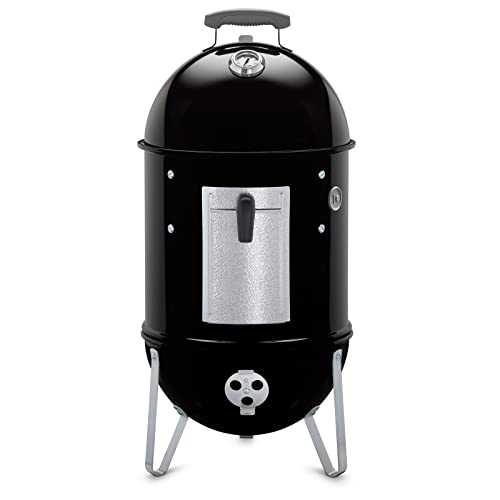
1. Weber Smokey Mountain Cooker 14-inch — Best Compact Water Smoker
The 14-inch Smokey Mountain is the smallest honest smoker in this guide and, for the right household, the smartest. It uses the same formula as its famous bigger siblings — dual cooking grates over a water pan, charcoal ring below, porcelain-enameled steel, and temperature control dampers — scaled for two to four people. A pork butt, a chicken, or a couple of racks of ribs cut in half are its natural cooks, and it sips charcoal compared with anything else here.
It suits couples, small patios and balconies where rules allow charcoal, and beginners who want to learn on the design with the deepest community knowledge in barbecue. Everything the internet knows about running a Smokey Mountain applies to this one at smaller scale. Its honest limit is geometry: a full packer brisket does not fit flat, so brisket people should step up to the 18 or 22 in our under-$1000 guide instead of fighting this one’s diameter.
Strengths
- Same porcelain-enameled build and damper control as the larger Webers
- Water pan makes temperatures forgiving for beginners
- Extremely fuel-efficient and easy to store
Trade-offs
- Too small for a full packer brisket laid flat
- Lower grate access means lifting the top food mid-cook
- Capacity tops out quickly for parties
| Specification | Detail |
|---|---|
| Size | 14-inch |
| Grates | Dual cooking grates |
| Finish | Porcelain-enameled |
| Control | Temperature control dampers |
| Fuel | Charcoal |
Run it with a small Minion-method charcoal load and it will hold smoking temperatures for hours on a modest amount of fuel, which quietly makes it one of the cheapest smokers here to own. If your household is two people who cook a butt on Saturday and ribs on Sunday, this little bullet will be busy every weekend while bigger cookers sit covered.
Ownership note: a second small chimney starter doubles your fire flexibility on this little cooker — one to light, one to add — for less than the cost of a bag of charcoal.
Best for: Couples and small spaces learning real charcoal smoking / Not suited for: Brisket-first cooks or anyone feeding a crowd
Check on Amazon — check the current price on Amazon and confirm the configuration before ordering.

2. Cuisinart 18-inch Vertical Charcoal Smoker COS-118 — Best Beginner Vertical
Cuisinart’s COS-118 is built to be someone’s first smoker, and its feature list reads like a beginner’s checklist: an 18-inch vertical format that fits brisket better than the baby bullet, an integrated thermometer so you are not cooking blind on day one, a water bowl for humid, buffered heat, dual vents for temperature control, and chrome-plated grates that clean up easily. The listing itself calls out brisket, camping, and tailgates, which is exactly the life this cooker is sized for.
It suits first-time smokers who want one box to contain the whole hobby — no separate thermometer purchase required to start, no offset fire to learn, just a vertical charcoal cooker that behaves predictably. The steel is budget-weight, so treat it as a cooker to learn on for several seasons rather than a lifetime heirloom, keep it covered, and it will teach you everything about fire and smoke that transfers to any upgrade later.
Strengths
- Integrated thermometer and water bowl included from day one
- 18-inch format fits brisket and family-size cooks
- Dual vents give real temperature control to learn on
Trade-offs
- Budget-weight steel will not match Weber longevity
- Lid thermometer still reads hotter than grate level
- Chrome grates need care to avoid rust over years
| Specification | Detail |
|---|---|
| Size | 18-inch vertical |
| Thermometer | Integrated |
| Water bowl | Included |
| Vents | Dual vents |
| Grates | Chrome-plated |
The smart first month with a COS-118: two pork butts, one chicken, one rack of ribs, in that order, logging vent positions each time. By the fourth cook you will know its draft personality in your yard. That knowledge — not the hardware — is what most beginners are actually buying in this tier, and this cooker teaches it at the friendliest price of admission here.
Ownership note: note the door gauge’s offset against a probe once, write it on the inside of the lid with a grease pencil, and the COS-118’s own thermometer becomes honest enough for daily use.
Best for: First-time smokers wanting a complete, forgiving starter kit / Not suited for: Buyers wanting a decades-long heirloom cooker
Check on Amazon — check the current price on Amazon and confirm the configuration before ordering.

3. Dyna-Glo Vertical Offset Charcoal Smoker DGO1176BDC-D — Best Budget Offset Format
Most budget offsets stretch horizontally and eat a patio. Dyna-Glo’s vertical offset turns the format upright: a side firebox feeds heat and smoke into a tall chamber where food stacks on multiple levels. That gives you the offset’s indirect, smoke-first cooking in the footprint of a filing cabinet, and the vertical stack is efficient — heat rising past every grate on its way out. For apartment-adjacent patios and small yards, it is the only way into offset-style cooking in this tier.
It suits cooks who want to learn firebox management — the core skill of offset barbecue — without a full-size pit, and who cook mixed loads: ribs up top, a butt in the middle, beans catching drippings below. Budget offsets leak smoke at the doors, and this one is no exception; a gasket kit is the standard first upgrade and transforms its temperature manners. Buy it as a skills teacher with a small footprint and it will not disappoint you.
Strengths
- True offset firebox cooking in a compact vertical footprint
- Stacked grates handle mixed loads efficiently
- Excellent platform for learning fire management
Trade-offs
- Door seams leak smoke until sealed with a gasket
- Firebox is small — fuel additions are frequent
- Thin steel loses heat on cold, windy days
| Specification | Detail |
|---|---|
| Design | Vertical offset |
| Model | DGO1176BDC-D |
| Fuel | Charcoal |
Run a small, hot, clean fire rather than a big smoldering one; in a small firebox that discipline is the whole game, and it produces the clean blue smoke that makes offset food taste expensive. Owners who master this little pit step up to big offsets later with zero relearning.
Ownership note: budget one afternoon for the gasket upgrade after your third cook, when you know exactly where your unit leaks — sealing a known leak beats sealing an imagined one.
Best for: Small-space cooks who want real offset technique / Not suited for: Anyone wanting long unattended cooks
Check on Amazon — check the current price on Amazon and confirm the configuration before ordering.
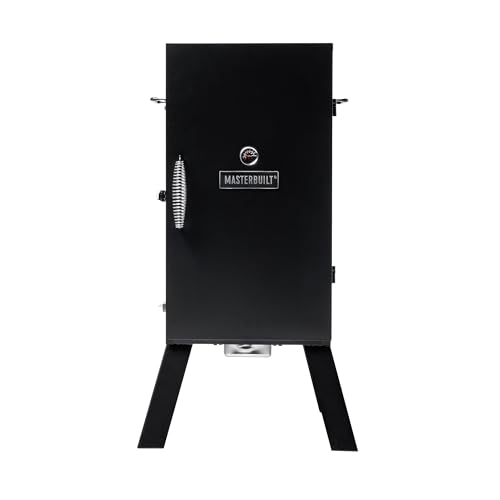
4. Masterbuilt 30-inch Analog Electric Smoker MB20070210 — Best No-Fire Convenience
Some households cannot burn charcoal or wood at all — apartment rules, fire restrictions, or simply a cook who wants smoked salmon and jerky without tending anything. This Masterbuilt is the honest answer in this tier: a 30-inch vertical electric smoker with analog temperature control, chrome smoking racks, and 535 square inches of cooking space. You load wood chips, set a dial, and the element does the rest. The smoke flavor is milder than charcoal — that is physics, not a flaw — but for fish, cheese, jerky, nuts, and weeknight chicken it is exactly right.
Analog control is a feature here, not a compromise: a dial has nothing to brick, no app to sunset, and it keeps the price in this tier. It suits set-and-mostly-forget cooks, cold-smoking-adjacent projects with the right technique, and anyone whose smoker will live in a garage or on a covered porch near an outlet. Keep the interior dry between cooks and the element will serve for years.
Strengths
- Electric heat works where open flame is restricted
- Analog dial is simple, durable, and cheap to own
- 535 sq in across chrome racks suits fish, jerky, and poultry
Trade-offs
- Mildest smoke flavor of any pick here
- Needs a nearby outdoor outlet
- Electric elements and moisture require dry storage habits
| Specification | Detail |
|---|---|
| Cooking area | 535 sq in |
| Control | Analog temperature control |
| Racks | Chrome smoking racks |
| Model | MB20070210 |
| Fuel | Electric with wood chips |
Get the most from it by using strong-flavored chips for short cooks and refilling the chip tray on long ones, since electric smokers generate smoke in pulses. For brisket traditionalists this is a side tool; for the household that wants smoked food on a Tuesday, it may become the most-used cooker in this entire guide.
Ownership note: wipe the interior dry after wet cooks and store it with the door cracked in dry weather; electric elements and lingering moisture are natural enemies.
Best for: No-flame households and easy fish, jerky, and poultry smoking / Not suited for: Charcoal flavor purists cooking competition brisket
Check on Amazon — check the current price on Amazon and confirm the configuration before ordering.

5. Royal Gourmet CC1830W Charcoal Grill with Offset Smoker — Best Grill-and-Smoker Combo
The Royal Gourmet CC1830W is for the household that wants one charcoal machine to grill burgers on Friday and smoke a butt on Saturday. As a barrel grill it offers 783 square inches, adjustable fire grates that raise and lower the charcoal to control searing heat, a front shelf and hooks for tools, and a wooden table surface that gives you somewhere to land a tray — a small thing until you have cooked without one. Clip on the offset firebox and the same barrel becomes an indirect smoker.
Combo units always compromise somewhere, and here it is smoker sealing and firebox size: it smokes happily for ribs and butts with some attention, but it will not run as evenly as a dedicated offset. As a grill-first household’s path into smoking, though, it is the most practical pick in this tier — you are buying a full-size charcoal grill that can smoke, not a smoker that sort of grills.
Strengths
- Full-size charcoal grill and offset smoker in one unit
- Adjustable fire grates give real searing control
- Wooden table, front shelf, and hooks make it easy to work at
Trade-offs
- Offset mode needs attention and seals imperfectly
- Assembly is a bigger project than the vertical picks
- Barrel steel is budget-weight — keep it covered
| Specification | Detail |
|---|---|
| Cooking area | 783 sq in |
| Model | CC1830W |
| Fire grates | Adjustable |
| Extras | Wooden table, front shelf, hooks |
| Fuel | Charcoal |
Learn it as a grill first — the adjustable grate height is genuinely useful — then run your first smoke with ribs, which forgive the firebox’s learning curve. If it hooks you on smoking, your next cooker can be a dedicated pit; if it does not, you still own a very serviceable grill. That low-regret profile is rare in this tier.
Ownership note: season the grates like cast iron and they will reward you; the barrel format’s grates live hard lives over direct coals and repay basic care disproportionately.
Best for: Grill-first households wanting to try smoking in one unit / Not suited for: Dedicated low-and-slow cooks wanting a sealed, even pit
Check on Amazon — check the current price on Amazon and confirm the configuration before ordering.

6. Realcook 20-inch Vertical Charcoal Smoker — Best Tall Vertical Value
Realcook’s 20-inch vertical occupies the gap in this lineup: bigger than the 14-inch Weber, lighter on the wallet than stepping up a tier, and built in the bullet tradition — stacked cooking levels over a charcoal base with a vertical profile that parks in a corner. Twenty inches of grate diameter is a meaningful jump: ribs fit with less trimming, a spatchcocked chicken lies flat, and a modest brisket becomes plausible instead of impossible.
It suits value shoppers who measured the 14-inch class and knew it was too small, and campers or tailgaters who want a cooker one person can move without drama. As with every budget vertical, plan on learning its vent behavior over the first few cooks and keeping it covered; the format is proven even if the brand is less storied than Weber. Judged purely on cooking diameter per tier, it is the value play of this roundup.
Strengths
- 20-inch grates fit food the 14-inch class cannot
- Bullet format is proven, simple, and easy to move
- Strong size-for-tier value
Trade-offs
- Brand support and community are smaller than Weber’s
- Budget fittings benefit from careful assembly
- No included extras — thermometer upgrade is on you
| Specification | Detail |
|---|---|
| Size | 20-inch vertical |
| Fuel | Charcoal |
| Design | Vertical smoker grill |
Assemble it slowly and squarely — most budget-smoker complaints trace back to a rushed, racked assembly that leaks at every joint. Done right, the Realcook cooks the way the format promises: steady, humid, charcoal-kissed food with very little money standing between you and your first successful ribs.
Ownership note: assemble it on a truly flat surface and re-snug the fasteners after the first hot cook — budget steel settles, and a ten-minute re-torque keeps the seams honest.
Best for: Value buyers needing more room than the compact class / Not suited for: Brand-loyal buyers wanting Weber-grade fit and support
Check on Amazon — check the current price on Amazon and confirm the configuration before ordering.
Comparison Table
Use this table to narrow the best bbq smokers under 400 list to two or three finalists, then read those full reviews above. The key specification column only uses details confirmed in the manufacturer’s Amazon listing title, so it stays honest even where a maker publishes fuller spec sheets elsewhere.
| Pick | Badge | Key spec | Best for |
|---|---|---|---|
| Weber Smokey Mountain Cooker 14-inch Check price | Best Compact Water Smoker | 14-inch, dual grates, water smoker | Couples and small spaces learning real charcoal smoking |
| Cuisinart 18-inch Vertical Charcoal Smoker COS-118 Check price | Best Beginner Vertical | 18-inch vertical, integrated thermometer, water bowl | First-time smokers wanting a complete, forgiving starter kit |
| Dyna-Glo Vertical Offset Charcoal Smoker DGO1176BDC-D Check price | Best Budget Offset Format | Vertical offset, side firebox, stacked grates | Small-space cooks who want real offset technique |
| Masterbuilt 30-inch Analog Electric Smoker MB20070210 Check price | Best No-Fire Convenience | 535 sq in electric, analog control | No-flame households and easy fish, jerky, and poultry smoking |
| Royal Gourmet CC1830W Charcoal Grill with Offset Smoker Check price | Best Grill-and-Smoker Combo | 783 sq in barrel grill + offset firebox | Grill-first households wanting to try smoking in one unit |
| Realcook 20-inch Vertical Charcoal Smoker Check price | Best Tall Vertical Value | 20-inch vertical charcoal smoker | Value buyers needing more room than the compact class |
How to Choose the Best BBQ Smokers Under 400
Pick your format first, because in this tier format is destiny. Bullet water smokers (the two Webers’ little sibling class and the Realcook) stack food over a water pan and are the most forgiving charcoal cookers ever designed — start there if you are new. Vertical offsets like the Dyna-Glo teach firebox craft in a small footprint and make the most traditional smoke, at the price of attention. Barrel combos like the Royal Gourmet grill first and smoke second. The electric Masterbuilt removes fire entirely for restricted or convenience-first households. Every format here makes real barbecue; they differ in how much of the work is yours.
Then size by grate diameter, not marketing area. On verticals, diameter decides what fits: 14 inches is a couples’ cooker, 18 inches is the family sweet spot that fits brisket, and 20 inches buys breathing room for ribs and chickens. Totals that sum warming racks and firebox grates flatter small cookers, so picture your largest single item — usually a brisket or a full rack of ribs — and choose the smallest cooker that fits it flat without touching the walls.
Finally, budget for the second purchase on day one: a cover, a probe thermometer if your pick lacks a decent one, charcoal, and chunks. That kit costs a fraction of the cooker and fixes the three things budget smokers skimp on — weather protection, temperature truth, and fuel quality. A cheap smoker with dry fuel and a real thermometer out-cooks an expensive one run blind, every weekend of the year.
What Budget Steel Really Means — and How to Beat It
Thin steel is the honest compromise of this tier. It heats fast, cools fast, and leaks heat on windy days, which translates to more fuel used and more vent adjustments from you. You beat it with placement and practice: park the smoker out of the wind, keep cooks in the 225–275°F band where budget cookers are happiest, use the water pan as the thermal battery it is, and resist constant lid-lifting that dumps the heat you are trying to keep. Owners in cold climates also learn to cook in the warmer part of the day in winter rather than fighting midnight frost.
Sealing is the other lever. Smoke leaking from door seams is heat and moisture leaving with it. A food-safe gasket kit on the offset and barrel picks, and careful square assembly on the verticals, tightens any of these cookers noticeably. Do not modify anything in a way that blocks designed airflow or vents — you are sealing seams, not redesigning the cooker — and never run any charcoal cooker anywhere but outdoors, well away from structures, with ash fully cold before disposal.
Fuel and Fire Basics for Budget Charcoal Smokers
Budget smokers reward good fuel habits more than expensive ones do. Use consistent briquettes for long cooks — they burn evenly and predictably — and add wood chunks, not chips, for smoke: two or three fist-sized chunks buried in the charcoal give hours of clean smoke without the acrid spikes of a pile of chips. Light with a chimney starter and the Minion method for long cooks: a ring of unlit charcoal with a small amount of lit coals in the center, so the fire spreads slowly for hours.
Judge smoke by color, not volume. Thin, pale-blue smoke is the goal; thick white billows mean a smoldering, dirty fire and bitter food. If your smoke turns white and heavy, open the exhaust fully, let the fire breathe, and wait for it to clean up before food goes on or the lid goes back down. That single skill — clean fire, patience at the start — is worth more than any upgrade you can bolt onto a budget cooker.
Getting Competition-Level Results on a Budget Cooker
Budget smokers have produced competition-winning barbecue for decades, and the techniques cost nothing. The first is fire discipline: a small, clean, consistent fire beats a big heroic one on every cooker in this guide. The second is consistency of inputs — the same briquettes, the same chunk size, the same water-pan habit — so that the only variable changing between cooks is the one you intended. The third is patience with the stall: budget cookers tempt you to open, poke, and adjust, and every intervention shows up on the plate. Wrap when the bark is set and the color is right, not when a clock says so, and rest every big cut longer than feels necessary.
The fourth technique is the logbook, already mentioned in this guide and worth repeating because it is the cheapest performance upgrade in barbecue. Record fuel load, vent positions, weather, and results. Within five cooks, a budget smoker stops being unpredictable — its personality is written down, in your handwriting, for your yard. That is when visitors start asking which expensive pit you bought, and you get to smile.
Upgrading a Budget Smoker: What Is Worth It and What Is Not
Two upgrades earn their money on almost every pick here: a quality probe thermometer, if your cooker lacks one, and a fitted cover. A third — a door or lid gasket on the offset and barrel models — pays for itself in fuel and stability within a season. A blower controller, covered in our companion guide, is the legitimate luxury: it transforms overnight cooking on the charcoal picks, and it costs a meaningful fraction of the cooker itself, so buy it after you know you love the hobby, not before.
What is not worth it: chasing every modification a forum recommends in your first month. Mods interact — seal the doors and the draft changes; change the draft and your vent notes are scrap. Change one thing at a time, cook twice, and judge. Budget smokers reward this discipline disproportionately, because their stock behavior is already good enough to learn on, and a cooker you understand beats a cooker you have merely improved.
The Budget Cooker Meal Plan: What to Cook in Your First Ten Cooks
Cook one: a pork butt, the most forgiving object in barbecue, chosen so your first experience of your new cooker is success. Cook two: a whole chicken, spatchcocked if your grate allows, to learn how your cooker treats skin and higher heat. Cook three: spare ribs, untrimmed and simply seasoned, to learn your cooker’s timing and your own preference for bite. Cook four: a second butt, this time changing exactly one variable — a different chunk wood, or a wrapped finish — so you can taste what that variable does. This is how a budget cooker becomes a laboratory instead of a lottery.
Cooks five through seven are for range within your format. On the verticals, hang or stack sausages and a cabbage; on the offset, run a meatloaf and learn its gentler zones; on the barrel, grill burgers at full blaze and notice how the same machine that smokes at dawn sears at dusk; on the electric, smoke nuts, cheese with care, and a side of salmon, and appreciate that your cooker does weeknight things the charcoal fleet cannot be bothered to light for. Each cook should end with one written sentence in a log — what surprised you — because surprise is data wearing a disguise.
Cook eight is your first brisket if your format fits one, run with modest expectations and the full workflow: early start, water pan where fitted, wrap on bark and color, rest without apology. Cook nine is a repeat of whichever earlier cook disappointed you most, with its one fix applied — redemption cooks are where technique actually forms. Cook ten is for people: a full load for friends, sized inside your proven range, served without a speech about the process. Watch the plates. Empty plates from a cooker in this tier, run by a cook ten cooks wiser than when they started, are the entire argument of this guide.
Notice what this plan never required: another purchase. Ten cooks of fuel and food cost less than most accessories, and they return something accessories cannot — a cooker whose behavior you can predict and hands that have done the work. Graduate to the blower kits and bigger pits later if you like; many cooks find, somewhere around cook seven, that they have stopped shopping entirely.
Reading Your Budget Smoker’s Signals
Budget cookers talk constantly; learning their language is free. A door that leaks a thin ribbon of smoke at one corner is telling you where its seal will eventually want a gasket. A fire that needs the intake wider every hour is telling you ash is choking the grate. A water pan that boils dry early is telling you the cooker ran hotter than its gauge admitted. Each signal has a cheap answer, and the cooks who thrive in this tier are simply the ones who learned to listen before the signals became failures.
Keep a mental — or written — baseline for your cooker on a calm day: vent positions, fuel load, and the temperatures they produce. Every future oddity is then measurable against that baseline, and troubleshooting becomes subtraction instead of guessing. That is the whole method, and it works on a cooker at any price; it just matters most where the engineering budget was smallest.
How to Set Up a Budget Charcoal Smoker for Its First Cook
A careful first setup fixes most budget-smoker complaints before they happen. Work through these steps once and every later cook gets easier.
- Assemble square and snug. Build on a flat surface, tighten fasteners evenly, and check that doors and sections sit flush — gaps you fix now are leaks you never chase later.
- Wash the grates, then season empty. Run the cooker hot and empty for its first burn to clear manufacturing residues, with a light coat of cooking oil on interior surfaces if the manual suggests it.
- Fill the water pan. Hot water in the pan brings the cooker to temperature faster and buffers swings during the cook.
- Arrange a Minion fire. Ring unlit briquettes around the charcoal pan with two or three wood chunks buried in the ring, then add a small chimney of lit coals to the center.
- Dial in with the intake. Leave the exhaust open and steer temperature with small intake vent changes, waiting ten minutes between adjustments — budget steel responds fast and overshoots if you chase it.
- Verify with a probe at grate level. Compare the lid or door gauge against a probe where the food sits and note the offset; that number is yours to remember for this cooker.
- Cook something forgiving. A pork butt or whole chicken for the first cook teaches vent positions without punishing mistakes.
- Close it down safely afterward. Shut vents to starve the fire, let ash cool completely outdoors, and store the ash in a metal container away from anything combustible.
Write down the vent positions that held your target temperature. Budget smokers have personalities, and that little note — intake half open, calm day, 250°F — is the beginning of your personal manual for your exact cooker in your exact yard.
Common Buying Mistakes
Skipping the probe thermometer to save money
Budget smokers ship with optimistic gauges or none at all. Cooking blind wastes more money in one ruined brisket than a basic probe thermometer costs. It is not an accessory in this tier; it is part of the cooker.
Using lighter fluid or instant-light charcoal
Petroleum flavors soak into porous budget steel and into food. A chimney starter and plain briquettes light just as fast and taste like nothing at all, which is the point.
Filling the cooker with wood chunks for maximum smoke
More wood is not more better. Too much smoldering wood makes bitter, acrid barbecue. Two or three chunks in a clean-burning charcoal fire is the professional ratio, not a compromise.
Judging doneness by time or color alone
Budget cookers swing with weather, so the same butt takes six hours one week and nine the next. Cook to probe tenderness and internal temperature, and let the schedule bend.
Leaving the smoker uncovered outdoors
Rain finds every seam in budget steel and rust follows quickly. A cover, or a dry corner of a garage once the cooker is fully cold, doubles the useful life of everything in this tier.
Final Recommendation
For most beginners, the Cuisinart COS-118 is the friendliest start: complete, forgiving, and brisket-capable. Couples and small patios should take the little Weber and its lifetime of community knowledge, while value shoppers needing diameter should take the Realcook 20-inch. The Dyna-Glo vertical offset is the pick for future pitmasters, the Royal Gourmet for grill-first households, and the Masterbuilt electric for anyone who cannot or will not tend a fire. Every one of them makes real barbecue this weekend — the tier asks for your attention, not your regret.
Cook often, log your vent positions, and let your second season decide whether you upgrade. Many excellent pitmasters started exactly here.
One last piece of honest perspective before you order. Every cooker in this tier has a personality quirk its owners joke about — a damper that wants a nudge, a door that leaks a ribbon of smoke, a gauge that dreams a little high. Those quirks are not defects in your purchase; they are the texture of cooking on honest, inexpensive steel, and they disappear into the background the moment the food starts landing on plates. What never disappears is the skill you are about to build. Fire management learned on a budget smoker is fire management, full stop — it transfers to every pit you will ever touch, including the expensive ones, whose owners are often quietly relearning lessons you will already own. So buy the pick that fits your space and your first menu, light it this weekend rather than researching it for another month, and let the first pork butt begin the education. The tier’s entire promise is that the barrier between you and real barbecue is not money. It never was. It is one free Saturday, a bag of briquettes, and the willingness to pay attention — and you clearly already have the third, because you read this far.
Start with the shortlist: Weber Smokey Mountain Cooker 14-inch — Check on Amazon; Cuisinart 18-inch Vertical Charcoal Smoker COS-118 — Check on Amazon; Dyna-Glo Vertical Offset Charcoal Smoker DGO1176BDC-D — Check on Amazon.
Keep exploring the cluster: Best Bbq Smokers Under $1000 Best Bbq Wood Smokers Best Bbqs And Smokers Best Blower Kit For Offset Smokers Best Bluetooth Thermometer For Smokers
Frequently Asked Questions
Can a smoker under $400 really cook brisket?
Yes. The 18 and 20-inch verticals fit a trimmed packer, the offset and barrel handle it with fire attention, and the technique matters more than the cooker: a clean fire, patience through the stall, and a long rest. Your first brisket will be good; your fifth will be the one people talk about.
Why are there no pellet grills in this tier?
Honesty: pellet grills carry an auger, a fan, a controller, and a heavier cabinet, and that hardware does not exist at this budget in any form we could verify and recommend. The pellet tier effectively starts in the under-$1000 band, which is where our companion guide picks it up.
How long will a budget smoker last?
Kept covered and dry, the porcelain-enameled Weber will run for many years; the painted budget steel cookers typically give several good seasons. Rust at seams and fire pans is what ends them, so dry storage and ash removal after every cook are the whole longevity secret.
Do I need to modify a budget smoker to make it work?
No — every pick here cooks well as delivered. A door gasket on the offset and barrel models and a probe thermometer are the two upgrades owners love most, but learn the cooker stock first so you know what a change actually improved.
What is the easiest pick here for a total beginner?
The water smokers. The pan buffers your mistakes, the format is documented by decades of owners, and a pork butt on a bullet is the highest success-rate first cook in barbecue. The electric Masterbuilt is easier still to operate, with milder smoke as its trade.
How much charcoal does a cook use?
A small vertical might use a few pounds across a long cook; the offset and barrel burn more, especially in wind or cold. Consistent briquettes and a Minion arrangement stretch fuel furthest. Store charcoal dry — damp fuel is the hidden cause of many temperature struggles.
Is it worth saving longer for a more expensive smoker instead?
Only if your honest plan is pellet convenience or very large cooks — the two things this tier genuinely cannot give you. For charcoal barbecue skill and flavor, these cookers are not a compromise to endure but the real thing in its original form. Many owners who “upgrade” keep their budget bullet or vertical for the cooks it does best, which tells you what the tier is actually worth.


