Disclosure: As an Amazon Associate, airfryerkitchensupply.com earns from qualifying purchases. Links on this page are affiliate links; they cost you nothing extra. Prices and availability change often, so check the current Amazon listing before you buy.
So, is a meat thermometer worth it for an ordinary kitchen, or is it one more gadget destined for the drawer of good intentions? The honest answer depends on three things: how often meat passes through your kitchen, what a ruined or risky meal costs you in money and confidence, and whether you will build the two small habits — washing the probe between checks and storing it sheathed — that ownership asks for. This article argues the question properly: what you actually get, what it really costs beyond money, who it pays off for, who should skip it, and the alternatives worth considering instead.
Is a Meat Thermometer Worth It? The Short Answer
Worth it if you cook meat most weeks, if chicken, burgers or a roast feature in your life, if you cook for children or older relatives, or if you have ever thrown away an expensive joint that came out wrong. Not worth it if meat appears in your kitchen a few times a year, or if you know a wash-after-every-use tool will be abandoned — in which case an entry-tier dial for the holiday bird is the proportionate buy. Key takeaways: the tool’s value is certainty about the only reliable doneness check there is; its costs are mostly attention, not money; and its worth compounds, because it teaches your instincts while it guards your dinners.
One principle sits underneath everything in this article, and it is worth stating plainly: temperature is the only reliable check of doneness. Colour is not. A chicken breast can look white and opaque at the edges while its centre is still underdone, a burger can brown beautifully on the outside long before the middle is safe, and pork can keep a blush of pink at a temperature that standard public food-safety guidance considers fully cooked. Judging by colour, by how clear the juices run, or by how long a recipe says a cut usually takes are all ways of guessing at the one number that actually decides both safety and quality. A thermometer replaces the guess with the number.
Standard public food-safety guidance — the figures published by government food-safety agencies and printed on countless packaging inserts — puts poultry at the top of the scale, ground meats in the middle, and whole cuts of beef, pork, lamb and fish lower, with a short rest for whole cuts before serving. You do not need to memorise a chart to cook well, but you do need to look your target up for the cut in front of you and then measure the coldest spot, because the coldest spot is the one that decides. That habit — target first, probe second, judgement third — is the entire skill this article is about.
In this guide
What You Actually Get
You get, first, the end of a specific and recurring anxiety: standing over a chicken, cutting into it to peek, watching juices run onto the board, and making a safety decision based on colour — a signal known to mislead in both directions. In its place you get a number, taken at the thickest part, that standard public food-safety guidance can be checked against directly. Second, you get the quality dividend that surprises most new owners: meat pulled at its target instead of five cautious minutes past it. Chicken that is juicy because it was allowed to be; pork with a blush that is safe and intended; a steak that lands where you aimed. Third, you get repeatability — the roast that worked can be made to work again, because the variable that mattered was recorded rather than remembered fondly and approximately.
Fourth, and quietly, you get an education. A few weeks of temping teaches you your oven’s true temperature versus its dial, your grill’s hot corner, how much carryover a big joint gains while it rests, and how differently two chicken breasts from the same pack can cook. That knowledge stays useful on the days you cook without the probe, and it is a large part of why owners describe the purchase as worth it long after the novelty fades. The monitored designs add a fifth return — time and freedom during long cooks — which is why smokers argue the case loudest; their corner of the market is surveyed in Bluetooth meat thermometers for smoking.
The Real Costs Beyond Money
Money is the smallest cost, and this article prints no prices — tiers run from entry dial models to premium systems, and the listing will show the current figures. The real costs are these. Attention: the probe must be placed deliberately — thickest part, centred, away from bone, fat and gristle — and a hurried stab produces a confident wrong number. Hygiene: the probe is washed between raw and cooked checks, every time, or it undermines its own purpose. Storage: a sharp probe needs a sheath or case and a home near the stove, kept from children’s hands; loose in a drawer it is a hazard and soon a bent, inaccurate tool. Maintenance: batteries or charging, a periodic check against iced and boiling water, cables kept from flame. Learning curve: a week of cooks to make targets and resting second nature. None of these is large. Together they explain the only common way the purchase fails: not that the tool disappoints, but that the habits never form and the tool stops being reached for.
How you handle the probe matters as much as where you put it. A probe that has just been inside raw chicken is, for hygiene purposes, raw chicken: wash it with hot soapy water, or wipe it thoroughly, before it goes into cooked food, into a second piece of meat you are about to serve, or back into its storage sleeve. The same rule applies between checks during one cook — probe the raw side of a half-cooked roast, wash, then probe again — because cross-contamination is how a careful cook undoes careful cooking. Keep a small bowl of hot soapy water or a clean damp cloth by the grill for exactly this job and it becomes a two-second habit rather than a chore.
Placement is the other half of accuracy. Always probe the thickest part of the meat, pushing the tip into the centre of that thickest mass, and keep the tip away from bone, fat seams and gristle. Bone conducts heat differently from muscle and can read hot while the meat beside it lags; a pocket of fat reads its own temperature, not the muscle’s; gristle and cartilage do the same. If a reading looks suspiciously fast or high, it usually means the tip is touching bone or sitting in fat — pull back slightly, angle into fresh muscle, and check again. On irregular pieces, take two readings in two spots and trust the lower one.
Who It Pays Off For
The Family Cook
You cook chicken, burgers and sausages weekly, for people including children. The safety case alone settles the question, and the quality case — no more dry chicken coaxed down with sauce — settles it again. An instant-read first; it will be used at nearly every dinner.
The Roast and Barbecue Cook
Your ingredients are expensive and your cooks are long. One saved brisket, one perfect holiday bird, repays the tool outright, and a monitoring probe returns hours of lid-lifting patrol per cook. This is the profile for whom premium tiers genuinely pay. If a smoker is also in your plans, electric smokers for beginners is the companion read.
The Learner
You are building skill and tired of inconsistent results you cannot diagnose. The thermometer converts vague disappointment into data — the centre was under, the rest was short, the oven runs cool — and data is what improvement eats. Few purchases teach this much per use.
Who Should Skip It
The Rare-Meat Household
If meat is a monthly guest, the habits will not form, the battery will be dead when needed, and the honest verdict is skip — or keep an entry dial, which asks nothing between its rare outings.
The Confident Traditionalist
Some experienced cooks genuinely do judge steaks well by touch and roasts by long familiarity with one oven. If your results are consistently where you want them and your household’s risk profile is low, the tool adds least for you — though even here, poultry and ground meat are the cases where instinct has the least to work with, and a basic instant-read is cheap insurance for exactly those nights.
The Gadget-Weary
If connected devices have burned you before, do not let a premium app-based system be your first thermometer. The worth-it case rests on the simple designs too: a plain digital instant-read or a radio-receiver leave-in asks for no account, no updates, no pairing — just a wash and a sheath.
Strengths and Trade-Offs of Owning One
Strengths
- Certainty on safety and doneness from the only direct measurement available to a home cook.
- An immediate quality dividend: meat served at its target instead of past it.
- Skill that compounds: the tool calibrates your oven knowledge and your instincts while it works.
Trade-Offs
- Habits are the price: washing between checks, sheathed storage, periodic accuracy checks.
- Full coverage of every cooking style can mean two designs, not one purchase.
- Connected models tie part of their value to apps and batteries staying alive.
Resting is part of measuring, not an afterthought. When meat comes off the heat, its temperature does not freeze: the hot outer layers keep pushing heat inward for a while, a carryover effect that is strongest on large roasts and whole birds, and juices that are still moving will flood out of a cut made too early. As a principle, judge a roast by the temperature it will reach after its rest, not only by the number at the moment you lift it out, and let the rest happen tented and undisturbed. Small cuts rest briefly; big joints rest longer. The thermometer’s job is not finished at the oven door — a final check after resting, in the thickest part, is the reading that counts.
Finally, check the checker. Thermometers drift, get dropped and age, so build the habit of verifying yours periodically at principle level: a glass of iced water, well stirred, should read at freezing point, and boiling water at a rolling boil should read at boiling point for your altitude. If a digital model reads a degree or two off in both tests, cook with that offset in mind or follow the maker’s recalibration steps; if a dial model is off, its adjustment nut exists for exactly this. Two minutes, twice a year, keeps every other reading in this article honest. And because probes are sharp, store them capped or sheathed — sleeve, magnetic case or a cork on the tip — in a drawer where children cannot grab a bare spike, and never loose in a washing-up bowl where a hand goes in blind.
Alternatives to Consider
If the full step feels like too much, these are the honest halfway houses — each a real product category, each with a defined job.
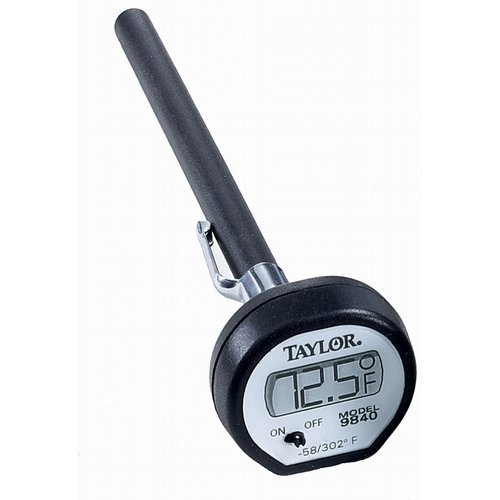
Taylor Classic Instant Read Thermometer — Best Entry-Tier Backup
The Taylor Classic is the old-school answer: an analogue dial thermometer with a stainless stem, a pocket sleeve with a clip, and no battery to die at the wrong moment. You push the stem into the meat, wait for the needle to settle, and read the dial. It has survived in kitchen drawers for decades because it is simple, tough and cheap enough — firmly entry tier — to own as a spare without thinking about it.
Best for: Beginners building the temping habit, and as a no-battery backup for any kitchen. Not suited for: Thin cuts, fast grill work, or anyone who wants an unambiguous digital number.
Tier: entry — check price on Amazon.
ThermoWorks ThermoPop — Best Mid-Tier Instant-Read
The ThermoPop takes the same design philosophy as its bigger sibling and trims it to the essentials: a short folding-style probe on a compact body, a display that rotates so you can read it from whichever hand and angle you approach the meat, and simple one-button operation. The rotating display sounds like a small thing until you are checking a chicken thigh from the left side of a crowded oven shelf and realise you no longer have to read numbers upside down. It is light, pocketable, and easy to wipe clean.
Best for: Home cooks who want a trustworthy everyday checker without paying flagship prices. Not suited for: Cooks who want a single tool that also monitors long cooks; pair it with a leave-in instead.
Tier: mid — check price on Amazon.
ThermoWorks Smoke — Best Leave-In for Smoking and Roasting
The Smoke is a leave-in system built around a simple idea: one probe watches the meat, a second watches the air inside your smoker, grill or oven, and a wireless receiver you carry with you reports both, with alarms you set for a target temperature and for a cooking-chamber range. There is no app to pair and no account to create; the base unit and receiver talk to each other over a direct radio link, which is exactly what you want at six in the morning when the brisket goes on and your phone is still on the nightstand.
Best for: Smokers and roast cooks who want alarms without apps, accounts or pairing rituals. Not suited for: Cooks who need to monitor from away from home; a Wi-Fi model is the better fit.
Tier: premium — check price on Amazon.

MEATER Plus — Best Truly Wireless Probe
The MEATER Plus removes the cable entirely. The probe itself is a slim metal spike that stays in the meat from the start of the cook to the end, sensing the internal temperature at its tip and the ambient temperature at its outer end, and it charges in a wooden block that also acts as a signal repeater for the companion app. With no wire to route through a door seal or lid, it is uniquely happy in places cables are awkward: a rotisserie, a small air fryer basket, a covered pan, or a grill you keep opening as little as possible.
Best for: Rotisserie, air fryer and tidy-kitchen cooks who hate cables and cook one main piece at a time. Not suited for: Batch cooks monitoring several meats at once, or anyone cooking mostly thin cuts.
Tier: premium — check price on Amazon.
The other alternatives are methods, not products, and they deserve a sentence each: the touch test, which serves experienced steak cooks passably and poultry not at all; recipe timings, which describe an average piece in an average oven; and cutting to look, which spends the juices to buy information colour cannot reliably give. Weighed against them in detail, the thermometer’s side of the ledger is set out in meat thermometer pros and cons.
How to Get the Most Value If You Buy
Keep it where you cook, sheathed, in the drawer or on the strip nearest the stove — proximity is usage. Temp early enough to act: a check with ten minutes of cooking left can change a decision; a check at the buzzer can only deliver news. Check two spots on anything irregular and trust the lower number. Build the wash into the motion — probe, wash, probe — until it is one gesture. Rest meat before the final judgement and let carryover finish the job your target assumed it would. Learn the technique properly once, from how to use a meat thermometer, and verify the tool against iced and boiling water when the seasons change. Finally, use it beyond meat — bread, custards, leftovers reheated for the family — because every extra job it does is value returned on the same purchase.
The Decision Checklist
- Do I cook meat at least a few times a month?
- Have I served meat that was underdone, or dried out from caution, in the last few months?
- Do I cook for children, older relatives, or anyone whose health raises the stakes?
- Do I ever cook a joint, bird or brisket whose failure would genuinely sting?
- Will I wash the probe between checks and store it sheathed, without resenting it?
- Do I know which design — instant-read, leave-in, wireless — matches my usual cooks?
Three or more yes answers: buy, at the tier your frequency justifies, using the meat thermometer buying guide to pick the model. Mostly no answers: keep the entry dial for the holiday bird and spend the money where your kitchen actually lives. Either way, you have now decided on evidence — which is, appropriately, exactly what the tool itself offers. The model-level evidence is gathered in the meat thermometer reviews.
The Cost of Getting It Wrong, Priced Honestly
Worth-it calculations usually count only the purchase. Run the other side of the ledger for a year of meat cooking without one. There is the visible waste: the joint carved too early and returned to the oven until it gave up, the chicken breasts dried past rescuing and quietly replaced by a takeaway, the brisket — a genuinely expensive piece of meat — pulled during the stall’s long plateau by a cook who could not see that the plateau was normal. There is the invisible waste: premium cuts cooked to a cautious grey that made them indistinguishable from cheap ones, which is money spent on quality and then spent again on undoing it. And there is the cost that does not appear in a budget at all: the meal where undercooked poultry reached the table, and the household’s luck was asked to cover the difference between colour and temperature. Nobody can put a tidy figure on that row, which is precisely why safety guidance is written in temperatures rather than in shades of pink. Against a year of those rows, even a premium-tier thermometer is a small line — and the entry tier is smaller than a single ruined joint.
Three Households, Three Answers
The Young Family on a Budget
Money is tight and the cooker is busy every night. Verdict: worth it, at mid tier or below. The reasoning is arithmetic as much as safety: this household cooks the highest-risk foods — chicken, burgers, sausages — the most often, wastes the most when a meal fails because there is no slack in the week, and gains the most from the quality dividend on cheap cuts cooked exactly right. The purchase that fits is a single digital instant-read, kept sheathed by the stove, and its cost is recovered the first time a week’s chicken all comes out juicy instead of half of it coming out chalk.
The Enthusiast With a Full Drawer
This kitchen already owns knives it could open a restaurant with, yet cooks meat by instinct and defends the instinct proudly. Verdict: worth it, and the enthusiast is often the most converted owner of all — because the thermometer does not argue with their skill, it audits their equipment. The oven that runs cool, the grill’s hot corner, the carryover on their favourite joint: the tool turns a decade of hunches into confirmed knowledge, and the monitored designs hand back the one thing enthusiasm cannot manufacture, which is time during a twelve-hour cook.
The Minimalist Who Cooks Mostly Plants
Meat appears for guests, a few times a year, and every drawer is curated. Verdict: mostly skip — with one exception. The exception is the holiday bird or the guest roast, the highest-stakes cook of this household’s year, performed with the least practice. An entry-tier dial, bought once and stored with the roasting tin it serves, is the proportionate answer: no battery to die in the drawer, no system to learn, a real number on the one day a real number matters most.
When the Answer Flips
Worth is not a permanent verdict; it flips with circumstances, in both directions. It flips to yes when a household starts cooking for a baby, a grandparent or anyone immunocompromised, because the safety row of the ledger suddenly outweighs everything else on the page. It flips to yes when a smoker, a rotisserie or a serious grill arrives, because long and expensive cooks punish guessing at a new scale. It flips to yes the first time a costly joint fails in front of guests. It flips towards no — or towards the drawer-dial compromise — when a household’s cooking genuinely changes: the children leave, the meat goes, the big roasts stop. The mature position is to re-ask the question when the cooking changes, rather than treating a thermometer as either a lifelong essential or a lifelong gimmick. It is neither. It is a tool whose value is set, meal by meal, by what is in your oven.
What Owners Actually Say After a Year
The pattern in long-term owners’ accounts is strikingly consistent, and it is not the pattern the packaging predicts. Few lead with safety, though all value it; most lead with confidence — the disappearance of the poke, the peek and the apologetic slice. They describe chicken becoming a weeknight food again instead of a worry, roasts becoming repeatable, and long cooks becoming social instead of vigilant. The complaints, where they exist, are the ones this article priced in from the start: a cable that met a flame, an app that wanted an update at the wrong moment, a probe stored loose once and never again. In other words, a year of ownership confirms the structure of the decision: the value is real and immediate, the costs are habits, and the households that formed the habits cannot imagine cooking meat without the number.
The Confidence Dividend, Examined
Ask a actuary to price a meat thermometer and they will count saved joints and avoided waste, and they will miss the largest return owners report: the removal of a recurring low-grade stress from an everyday activity. Cooking meat without a thermometer means making a safety judgement, under time pressure, with unreliable evidence, several times a week, in front of the people you feed. Each individual judgement is small; the accumulation is a background hum of doubt that cooks carry for years without naming it — the extra five minutes ‘just in case’ that dry the chicken, the exploratory cut that bleeds the roast, the held breath when a child takes the first bite of a burger. The thermometer retires that hum. Meals get calmer, cooks get bolder — new cuts, new techniques, the big joint at the holiday instead of the safe option — and boldness, in a kitchen, compounds into skill and pleasure. None of this fits in a price comparison, and all of it is why the worth-it verdict among owners is so rarely revisited: the tool did not just improve the food, it changed how cooking meat feels.
A Word on Borrowing, Registries and the Second Thermometer
Three edge cases complete the worth-it picture. Borrowing one for a single event — the holiday bird at a relative’s house — is rational if the borrow is real, but most cooks discover the borrowed thermometer arrives with a dead battery or not at all, which is an argument for the entry dial as the household’s own insurance. Adding one to a wedding or housewarming registry is among the highest-value lines on any such list: modest in cost, used for decades, and immune to the duplication that plagues registry glassware. And the second thermometer — the question owners ask a year in — follows the logic of this whole article: the second purchase is worth it when it covers the design the first one cannot, monitoring added to spot-checking or the reverse, and not worth it as a mere duplicate, unless the duplicate is a battery-free dial kept as insurance against the one dead-battery evening that would otherwise arrive, with perfect comic timing, on the day of the biggest roast of the year.
The Opportunity Cost, Considered Honestly
A fair worth-it analysis must ask what else the same money and drawer space could buy, because ‘worth it’ is always ‘worth it compared to what’. The honest rivals for a meat thermometer’s budget are few. A better knife improves every meal but answers no safety question. A heavier pan improves browning and heat retention, and still leaves the centre of the chicken a mystery. A cooking course improves everything eventually and nothing tonight. Measured by failures prevented per week of ordinary cooking, the thermometer is an unusually efficient purchase — it is one of the very few kitchen tools whose absence is felt as risk rather than mere inconvenience. The drawer-space comparison cuts the same way: the instant-read occupies less room than the average spatula, and even a monitored system with its base and cables is smaller than the average blender it will outwork. Where the opportunity cost genuinely bites is at the premium connected end, for households whose cooking is simple: there, the same outlay on a mid-tier instant-read plus a season of better meat is the wiser portfolio, and this article’s checklist exists to steer exactly that household away from overbuying.
Worth It, by the Numbers You Can Actually Track
If abstractions leave you unmoved, run the experiment owners quietly run: for one month, note every cook where the thermometer changed a decision — meat returned to the heat that looked done, meat pulled early that felt risky, a roast rested on evidence rather than hope. Most households that try this stop counting before the month ends, not because the tally is small but because the tool has stopped feeling like an experiment and started feeling like the stove’s missing dial. That, in the end, is the cleanest definition of worth it available for any kitchen purchase: the point at which using it requires no decision, and not using it would. The thermometer reaches that point faster than almost any tool in the drawer, because meat is cooked constantly, its failures are memorable, and its successes — juicy, safe, repeatable — arrive at the very next meal. Households still hesitating after the checklist are rarely hesitating about value; they are hesitating about habit, and the cheapest resolution of that hesitation is the entry-tier dial and three cooks of honest trial.
The Social Life of a Thermometer
One return on the purchase never appears in reviews, because it happens between people. The thermometer ends arguments. Every household that cooks meat has its standing dispute — the partner who likes the roast rarer than the cook dares serve it, the parent who sends chicken back for another ten minutes on principle, the guest whose confidence about doneness exceeds their evidence. A number, taken at the thickest part and checked against public guidance, settles these disputes without anyone losing face: the meat is at its target, the target is the standard one, and dinner proceeds. Cooks report, only half joking, that this alone justified the purchase — the tool as diplomat. There is a gentler version of the same effect when teaching children or new cooks: the thermometer gives a learner an objective success to aim at, feedback that is instant and unarguable, and the confidence that comes from hitting a number on purpose. Skills taught against a measurement stick; confidence built on evidence lasts. Priced against a decade of small domestic negotiations and a generation of cooks taught properly, the worth-it case acquires a row that no spreadsheet in this article has yet counted — and for some households it will be the row that decides.
The Question Behind the Question
It is worth noticing, before the checklist has the final word, what people are really asking when they ask whether a meat thermometer is worth it. They are rarely asking about money — the tiers are modest by kitchen standards, and everyone at the table knows a ruined joint costs more than a dial thermometer. They are asking whether they are the kind of cook who needs one, which is a question about identity dressed as a question about shopping. The traditionalist hears ‘worth it’ as ‘is my judgement insufficient?’; the gadget-sceptic hears it as ‘will this join the drawer?’; the anxious new cook hears it as ‘will this actually make me safer, or just busier?’. Each hearing has been answered in this article on its own terms: judgement is not insulted by a measurement, it is completed by one; the drawer claims only tools whose habits were never installed, and this one’s habits take seconds; and safety, uniquely among the promises kitchen products make, is not a matter of opinion — the coldest spot in the meat is either at a safe temperature or it is not, and only this tool can tell you which. Strip the identity question away and the shopping question answers itself, which is why so many owners, asked the same question a year after buying, look faintly puzzled by it: of course it was worth it — it is the tool that tells the truth about dinner.
If You Buy Only One Thing From This Article
Buy the habit first and the hardware second, in this order: learn where the thickest part of your regular cuts actually is, and how far bone and fat can bend a reading; decide where the probe will live, sheathed, before it arrives; and put the soapy bowl’s place at the stove into your cooking routine on day one. A household that installs those three habits will extract full value from any model in the roundups this article links to — and a household that skips them will underuse even the finest instrument in the category. That is the last and most honest sentence in the worth-it case: the tool is worth it in proportion to the cook’s willingness to meet it halfway, and meeting it halfway costs, in total, about ten seconds a meal.
The Verdict, Delivered Without the Build-Up
Everything in this article compresses, finally, into a judgement a reader can carry to the shop. A meat thermometer is worth it for the overwhelming majority of households that cook meat, because it is inexpensive in attention, modest in money, and unique in function: nothing else in the kitchen measures the one variable that decides whether dinner is safe and whether it is good. It is most worth it where the stakes and the frequency meet — family kitchens, roast and barbecue cooks, learners building skill, and anyone feeding people whose health brooks no guessing. It is least worth it where meat is rare, habits would not form, or a connected flagship would be bought to do a simple tool’s job. Between those poles sits the great middle of ordinary kitchens, and for them the evidence of this article — the saved joints, the ended arguments, the chicken that comes out juicy on purpose — points one way. Buy the design your cooking needs, at the tier your frequency justifies, keep it clean, sheathed and close, and the question will not need asking twice: the first month of dinners will have answered it in the only currency that matters, which is meals that come out the way you meant them to.
One Year Later: A Small Audit
Close the case the way an auditor would, with the household’s own numbers after a year of ownership. Count the cooks: in a meat-eating household, several hundred checks, each one a decision made on evidence. Count the failures that did not happen: the chicken that would have been served underdone on a colour judgement, the joints that would have marched past their prime on a cautious timer, the brisket that would have been pulled in the stall. Count the meals that were simply better — a category so routine by year’s end that nobody remarks on it, which is itself the finding. Then count the costs actually paid: a few batteries or charges, a sheath’s worth of care, a two-minute calibration check twice, and some hundreds of ten-second washes. Set the two columns side by side and the audit writes its own conclusion, the same one this article reached by argument: the thermometer was not merely worth it — it was, per use and per meal improved, among the cheapest consequential purchases the kitchen has ever made. The households for whom the audit would read differently are the ones this article identified at the start — the rare-meat kitchen, the unformed habit — and they were never really arguing about the tool. They were describing their cooking, and the tool, honestly assessed, simply follows the cooking.
What ‘Worth It’ Looks Like at the Table
There is a moment, a few weeks after the purchase, that owners recognise and non-owners cannot be argued into: the meal where nobody talks about the meat’s doneness at all. No negotiation at the carving board, no returned plate, no apologetic sauce doing rescue work, no cook hovering with a knife to check the middle piece one more time. The chicken is simply, unremarkably right — juicy because it was pulled at its number, safe because the number was the standard one, rested because the routine protects the rest. The conversation moves on to everything else a table is for. That unremarkable meal, repeated until it stops being remarkable, is the entire return on the purchase made visible, and it is why the worth-it question, once a household has lived the answer for a season, tends never to be asked again in that kitchen.
The Gift Test
One final, surprisingly reliable test of worth: would you give it? Kitchen tools that owners buy again as gifts — for the child leaving home, the friend who just bought a grill, the parent whose roasts deserve better — have passed a verdict no review can fake, because the giver is spending their own credibility along with their money. Meat thermometers pass this test constantly; they are among the most re-gifted-forward tools in the modern kitchen, passed hand to hand with the four-sentence technique attached. A product whose owners become its evangelists at their own expense has settled the worth-it question in the only court that ultimately matters.
Worth It for Whom? A Meat Thermometer Break-Even Test Based on Your Actual Routine
Buying a meat thermometer takes an afternoon; living with it happens at the grill, oven or stovetop, wherever food is cooking, while checking doneness at the thickest part without cutting the food open, and that daily reality is what this section judges. So work backwards from daily life: fix the routine, the space and the people in your mind first, and only then weigh the features that looked persuasive on a product page. Start with that the probe reaches the centre of the thickest piece without touching bone or pan. If that check fails, stop there, since the remaining virtues of any meat thermometer are built on a foundation your home has already rejected. Do not test your decision against a calm day. Test it against the rushed morning, the crowded evening or the week everything happens at once, because that is when a meat thermometer earns or loses its place.
If a guest can use the meat thermometer correctly without instruction, the design is intuitive; if they cannot, expect the same friction, softened only by habit, in your own routine. Shortlisted models, perhaps the Taylor Classic Instant Read Thermometer and the ThermoWorks ThermoPop, should each be put through the same checks in the same order, using the current listing details rather than an older screenshot or a remembered specification. Dead heats between two candidates are broken by weaknesses, not strengths: pick the meat thermometer whose compromises fall on the jobs you do least often. Every item leaves a footprint on the home beyond its dimensions: noise, mess, heat, moisture, effort or visual clutter. Weigh that footprint for a meat thermometer as seriously as its size.
- Count honest uses in a typical month before deciding.
- Set a one-month review date to test your own prediction.
- Add storage, cleaning and replacement-part costs to the reckoning.
- Decide the usage level below which it stops earning its place.
- State what the simpler alternative leaves undone.
Decide whether the placement is permanent or provisional, and buy accordingly, because a meat thermometer chosen for a fixed home and one chosen to move, fold or travel are different designs wearing similar names. Read the included-parts list as carefully as the feature list. Many disappointing first days with a meat thermometer are simply the discovery that an essential accessory was never in the box. Idle items still occupy your home. A meat thermometer with no proper resting place becomes clutter with a function, so settle its storage before it arrives rather than after. Prevention is unglamorous and effective: washing the probe after every use, drying it and storing it where the tip is protected, done consistently, protects performance better than any occasional rescue effort after problems have set in.
Edge cases matter here: thin cuts and small pieces, where probe placement matters more than the device itself. A meat thermometer chosen with that situation in mind will not need replacing the first time life deviates from the brochure. Most disappointment with a meat thermometer traces back to readings taken in the wrong spot, giving confidence the food has not earned. It is a slow, predictable process, which is good news, because predictable problems can be designed out before you buy. Routines change across the year, so ask whether the meat thermometer still makes sense in the opposite season, during holidays, or when the household grows, shrinks or rearranges the room it lives in. If the honest answer is that a borrowed, shared or simpler alternative covers your real need, believe it, because a meat thermometer that sits idle is not a bargain at any specification.
Try this decision exercise: write down three non-negotiable jobs, one acceptable compromise and one walk-away flaw. If a candidate survives that list, it deserves its place on the shortlist. Attention is a budget too. A meat thermometer that needs remembering, scheduling, monitoring or special handling spends it, so count that cost alongside the physical ones. Check for duplicated function in your own home first, because the item you already own that does part of this job changes what the new meat thermometer actually needs to be. Keep a brief note of when any problem started and what changed around then, because that record turns a vague complaint into a solvable question if you ever need parts, repair or a replacement decision.
Think about handing the task over: if someone else had to use, clean or reset the meat thermometer from your brief description alone, the design and your setup would pass or fail together. The first fortnight involves unlearning old habits as much as learning new ones, so allow the meat thermometer that adjustment period before delivering a final verdict, unless a basic fit check has failed. Keep the paperwork, digital or printed, in one known place: instructions, guarantee details and the measurements you took. Future you, troubleshooting at an inconvenient hour, will be grateful. Problems deserve a sequence, not a panic. Check the simple, free causes first, in the order a technician would, and only suspect the meat thermometer itself once those are ruled out.
Frequently Asked Questions
Is a meat thermometer worth it for a small household?
Yes, if that household cooks meat regularly — arguably more so, because small households cook smaller, thinner pieces that move through their safe-and-juicy window faster, and cook expensive cuts where one failure is a larger share of the week’s food budget. A single mid-tier instant-read covers the whole case; monitoring systems are the part a small household can usually skip.
Can a meat thermometer save money?
Indirectly but genuinely. It prevents the two expensive failures: meat thrown away because it was undercooked and doubted, and premium cuts ruined by overcooking. It also makes cheaper cuts more reliable — a modest joint cooked exactly to target eats better than a premium one cooked by hope. Against an entry or mid-tier purchase, a handful of saved meals across a year settles the account.
What if I only cook chicken and burgers?
Then the case is at its strongest, not its weakest. Chicken and ground meat are precisely the foods where colour misleads most and the safety stakes are highest, and both are cooked so often that even a small per-meal improvement compounds. A fast instant-read, used at the thickest part and washed between checks, is the whole investment.
Is a smart or wireless thermometer worth more than a basic one?
Only if you use what the premium buys: monitoring during long cooks, alarms that free you from the oven, or a cable-free probe for a rotisserie or air fryer. For spot-check cooking, a basic digital instant-read delivers the same core certainty for a mid or entry tier. Buy the capability your cooking calls for, not the most connected box on the shelf.
How long before it pays for itself in better meals?
Most owners would say the first properly cooked chicken or the first roast pulled exactly at target — often the first week. Unlike many kitchen purchases, the return is not gradual: the tool changes the outcome of the very next cook it is used at, provided the technique is right — thickest part, clean probe, judged after the rest.
What is the cheapest way to try before committing?
An entry-tier dial thermometer. It needs no battery, survives in a drawer, and teaches the essential habit — measure the thickest part, trust temperature over colour — on roasts and thick cuts. Its limits are speed and thin cuts. If the habit sticks and you find yourself temping everything, upgrade to a digital instant-read and keep the dial as the household backup.
Related Guides
Keep exploring: meat thermometer review; meat thermometer buying guide; sous vide machines; turkey air fryers.


