Disclosure: airfryerkitchensupply.com is reader-supported. When you buy through links on our site, we may earn an affiliate commission at no extra cost to you.
Where to buy
If you are shopping for the best working hand mixers, start with the shortlist below. Every hand mixer on this page was confirmed through Amazon’s own catalog data before it earned a place here, and each one is sold through Amazon with the attachments listed in its review below. If you already know which class of machine you need, the fastest route is the KitchenAid 9 Speed for heavy weekly baking, the Hamilton Beach 6-Speed if you want the lowest-cost tool that still works hard, and the KitchenAid Go Cordless if your outlet situation is the real problem. Use the links in each review to check the current price on Amazon, because hand mixer pricing moves around constantly and the configuration in the box matters more than a headline number.
- KitchenAid 9 Speed Hand Mixer (KHM926) — Check the current price on Amazon
- Cuisinart Power Advantage Plus 9-Speed (HM-90S) — Check the current price on Amazon
- Hamilton Beach 6-Speed Electric Hand Mixer (62682G) — Check the current price on Amazon
- KitchenAid 7 Speed Hand Mixer (KHM7210) — Check the current price on Amazon
- KitchenAid 5 Ultra Power Speed Hand Mixer (KHM512) — Check the current price on Amazon
- KitchenAid Go Cordless Hand Mixer (KHMR762) — Check the current price on Amazon
One honest note before the picks: a hand mixer is a working tool, not a stand mixer substitute. Every machine below will cream butter, whip cream, fold cake batter and handle a single batch of cookie dough without complaint. None of them should be asked to knead a double batch of stiff bread dough week after week — that job belongs to a stand mixer or your hands, and pretending otherwise is how motors die young.
Best Working Hand Mixers: Tools That Earn Their Drawer Space
The best working hand mixers are not the prettiest ones or the ones with the longest feature list — they are the ones that survive being used hard, several times a week, by someone who actually bakes. “Working” is the operative word in this search, and it changes what matters. A decorative mixer bought for twice-a-year holiday cookies can get away with a weak motor and flimsy beaters. A working mixer cannot. It needs torque that does not fade when the batter thickens, a low speed that genuinely starts slowly instead of spraying flour across the counter, beaters that do not flex or shed their finish, and a body you can hold for ten minutes of mashed potatoes without your wrist filing a complaint.
That framing also explains the shape of this list. You will find three KitchenAid models here, and that is not laziness — it is what the current market actually looks like when you filter for machines with a real service network, replaceable attachments and motors geared for sustained work rather than novelty. Around them sit the two classic rivals that working bakers have cross-shopped for years: Cuisinart’s nine-speed with its snap-on storage case, and Hamilton Beach’s six-speed, the budget workhorse that shows up in an enormous number of real kitchens because it simply keeps going. The sixth slot goes to KitchenAid’s cordless Go model, which sounds like a gimmick until you have tried to whip cream at a crowded holiday counter with every outlet already claimed by a slow cooker and a coffee maker.
What you will not find here: no-name rechargeable mini mixers with three speeds and a USB cable. Some of them are fine for frothing, but they are not working hand mixers by any honest definition — they stall in cookie dough, their batteries are not replaceable, and when the motor gives up there is no parts channel at all. This list is deliberately conservative. Every pick below is a machine a frequent baker can buy, use hard, clean easily and expect to still own in several years.
In this guide
Quick Picks
- KitchenAid 9 Speed Hand Mixer (KHM926) — Best Overall: the widest useful speed range in the group, a true slow start for dry ingredients, and the fullest attachment set (Turbo Beater II beaters, pro whisk, dough hooks and a blending rod) make it the default choice for someone who bakes weekly. Check price on Amazon
- Cuisinart Power Advantage Plus 9-Speed (HM-90S) — Best for Organized Kitchens: nine speeds with a SmoothStart ramp, a snap-on case that keeps beaters, whisk, dough hooks and spatula in one place, and a sturdy feel that suits bakers who hate drawer clutter. Check price on Amazon
- Hamilton Beach 6-Speed Electric Hand Mixer (62682G) — Best Budget Workhorse: a 250-watt motor, a QuickBurst button for thick spots, a bowl-rest notch and a snap-on storage case at the lowest tier in this roundup — the definition of a working tool bought without drama. Check price on Amazon
- KitchenAid 7 Speed Hand Mixer (KHM7210) — Best Mid-Range All-Rounder: seven speeds, the same Turbo Beater II design and a pro whisk, with a lockable swivel cord — most of the 9 Speed’s working character for bakers who will never touch dough hooks. Check price on Amazon
- KitchenAid 5 Ultra Power Speed Hand Mixer (KHM512) — Best Simple and Light: five speeds, an easy-release beater button and a lockable swivel cord in the lightest full-size body here — ideal for smaller households whose mixing is real but not heavy. Check price on Amazon
- KitchenAid Go Cordless Hand Mixer (KHMR762) — Best Cordless: seven speeds, a soft-start feature and a removable battery included in the box, for cooks whose counters and outlets never line up with where the bowl needs to be. Check price on Amazon
How These Picks Were Chosen
Because this search is about working machines, the selection criteria weighted durability signals over novelty. First, every candidate had to be a full-size corded (or, for the one cordless slot, full-power battery) hand mixer from a manufacturer with a real replacement-attachment channel — if you cannot buy a replacement beater in three years, the machine is disposable, and disposable tools did not make this list. Second, each product’s identity was verified against Amazon’s catalog data: the model number, attachment list and speed count in this article come from the manufacturer’s own listing data, not from secondary roundups that routinely mix up KitchenAid’s 5, 7 and 9 speed models.
Third, we weighed the details that separate a working mixer from a decorative one. Low-speed control mattered most: a mixer whose first speed is already fast will punish you every time you add flour or cocoa. Beater design came next — KitchenAid’s Turbo Beater design has no centre post, which means less batter trapped and easier cleaning, while traditional beaters like Hamilton Beach’s are cheaper to replace. Attachment breadth mattered for the top slots: dough hooks extend a hand mixer into light dough work, and a proper whisk attachment beats using beaters for cream. Finally, we considered storage and handling honestly — bowl rests, snap-on cases and swivel cords sound like trivia until you use the machine four times a week, at which point they are the difference between a tool you reach for and a tool you avoid.
Two deliberate exclusions are worth stating. Stand-and-hand convertible mixers were left out of this particular list because their hand units are heavier and their working character is different; they are covered in the stand mixer coverage on this site. And ultra-cheap mini cordless mixers were excluded for the stall-and-disposability reasons given in the introduction — a working list should not include tools we would not hand to someone who bakes every week.
The 6 Best Working Hand Mixers

KitchenAid 9 Speed Hand Mixer (KHM926) — Best Overall
If a hand mixer is going to be a working tool in your kitchen — out of the drawer several times a week, expected to handle everything from meringue to a stiff batch of oatmeal cookies — this is the one to build around. The KHM926’s nine speeds are not marketing padding: the bottom of the range is genuinely slow, which is what lets you fold flour into cake batter without wearing it, and the top of the range is fast enough to whip cream to firm peaks quickly. In between, the electronic control keeps the selected speed steady as the mixture thickens, so the mixer does not bog down audibly the way cheaper units do when the beaters hit a dense patch of dough.
Strengths
- Nine speeds with a soft, controlled start that keeps dry ingredients in the bowl instead of on the counter.
- The fullest attachment kit in this roundup: Turbo Beater II beaters, a pro whisk, dough hooks and a blending rod cover mixing, whipping, light dough work and blending tasks.
- Accessories are dishwasher-safe, and the beater eject is a single clean button press — small things that add up across hundreds of uses.
Trade-offs
- It sits in the premium tier for a hand mixer; light users will not use half of what they are paying for.
- The body is substantial — noticeably more to hold through a long potato-mashing session than the 5 Speed below.
- No storage case is included, so the four attachments live loose in a drawer unless you improvise.
The attachment set deserves a closer look, because it is what makes this a working machine rather than a single-purpose one. The dough hooks will not turn it into a bread machine, but they handle a single loaf’s worth of enriched dough — brioche-style mixes, pizza dough for two — without the wrist punishment of stirring by hand. The blending rod is the sleeper feature: it turns the mixer into a passable tool for smoothing a soup or sauce in the pot, which means one less appliance for small kitchens. Used within those limits, the motor never feels strained, and that restraint is exactly what keeps a working mixer alive for years.
Handling is well thought out. The lockable swivel cord moves to whichever side keeps it out of the bowl, the speed control is a thumb slide you can nudge mid-mix without looking, and the underbody is shaped so the mixer stands upright on the counter between additions. None of these details is glamorous; all of them are what you notice at use number two hundred.
Best for: frequent bakers who want one hand mixer that covers cakes, cookies, whipped work and light dough. / Not suited for: anyone who mixes twice a year and would be paying for capacity they never touch.

Cuisinart Power Advantage Plus 9-Speed Hand Mixer (HM-90S) — Best for Organized Kitchens
Cuisinart’s HM-90S is the other nine-speed that working bakers seriously cross-shop against KitchenAid, and its personality is different in ways that matter. Where KitchenAid leans on electronic finesse, the Cuisinart feels like a sturdier, more mechanical tool — and it solves the problem KitchenAid ignores: storage. The snap-on case clips to the base of the mixer and swallows the beaters, chef’s whisk, dough hooks and spatula, so the whole kit comes out of the drawer as one object and goes back as one object. Anyone who has fished a lone beater out from behind a drawer divider will understand why that earns this machine its own slot.
Strengths
- Snap-on storage case keeps the mixer and all attachments together — the best storage solution in this roundup.
- SmoothStart function ramps through the first three speeds gently, preventing the classic flour-cloud start.
- Automatic feedback keeps speed consistent under load, and the LED speed display is easy to read mid-task.
Trade-offs
- With the case attached, the stored footprint is taller than rivals — measure your drawer before assuming it fits.
- The traditional-style beaters trap a little more batter than KitchenAid’s centre-post-free design and take slightly longer to clean.
- It is one of the heavier corded models here, which matters during long whipping sessions.
In working terms, the HM-90S is at its best in a kitchen that runs in batches: weekend baking sessions where the mixer comes out, does six jobs in a row and goes away again. The one-touch beater eject, the swivel cord and the clearly marked speed control all support that rhythm. The motor has the grunt for thick cookie dough at mid speeds without the pitch drop that signals a struggling unit, and the whisk attachment produces properly aerated cream and egg whites rather than the half-hearted foam you get from using beaters for everything.
The honest limitation is dough. Like every hand mixer, it will manage a single batch of soft dough with its hooks, but the gearing is not built for stiff, low-hydration doughs, and forcing it there is how you shorten its life. Treat it as a powerful mixing and whipping tool with a light-dough bonus, and it will repay you with years of unglamorous, reliable service — which is precisely the brief for a working hand mixer.
Best for: batch bakers and tidy cooks who want nine speeds and every attachment stored in one grab-and-go case. / Not suited for: very shallow drawers, or anyone who prioritizes the lightest possible body.

Hamilton Beach 6-Speed Electric Hand Mixer (62682G) — Best Budget Workhorse
Every category has one product that working people buy in enormous numbers while reviewers overlook it, and in hand mixers it is this Hamilton Beach. The formula is simple: a 250-watt motor with six speeds, a QuickBurst button that gives a shot of extra power at any speed, traditional beaters plus a whisk, a snap-on storage case, and a bowl-rest notch that lets you park the mixer on the rim of the bowl instead of the counter. Nothing about it is precious, and that is the point — it is priced and built like a tool you use, not a tool you display.
Strengths
- QuickBurst delivers extra torque on demand, which genuinely helps when a batter suddenly thickens.
- Bowl-rest design and snap-on case: two practical touches many premium rivals skip.
- Replacement beaters are cheap and widely available, keeping lifetime ownership cost low.
Trade-offs
- The lowest speed is faster than KitchenAid’s or Cuisinart’s gentle starts — add flour in stages or expect some dusting.
- Six speeds give coarser control than the nine-speed models when you are finessing a delicate emulsion.
- Traditional beaters have a centre post, so batter collects there and cleaning takes a moment longer.
What makes it a working mixer rather than merely a cheap one is how it behaves under repetition. The motor does not whine or slow dramatically in standard cookie and cake work, the beater eject is positive, and the whole unit wipes down and clicks back into its case in seconds. For rental kitchens, first apartments, church-hall baking teams and anyone outfitting a second kitchen, it delivers ninety percent of the everyday experience at the lowest tier in this roundup.
Know its ceiling, though. Sustained heavy dough work is beyond its brief, and its first-speed manners mean dry-heavy recipes need a gentler hand at the start — stir the first additions in with a spoon, then let the machine take over. Bakers who bake daily and demand fine low-speed control should step up to the KitchenAid 7 or 9 Speed. Bakers who bake weekly and value their money will find this machine still working long after fancier gadgets have been retired.
Best for: value-focused regular bakers, second kitchens and anyone who wants a proven tool without premium pricing. / Not suited for: bakers who need a true slow speed for delicate folding, or heavy daily dough work.
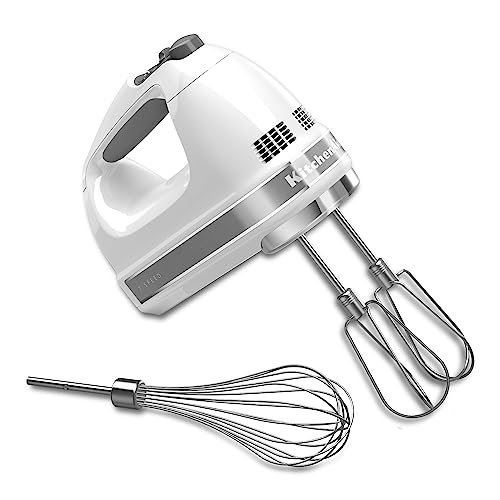
KitchenAid 7 Speed Hand Mixer (KHM7210) — Best Mid-Range All-Rounder
The KHM7210 is the quiet middle of KitchenAid’s line and, for a large share of working bakers, the smartest buy in it. You get seven speeds — enough granularity for everything from folding to whipping — the same Turbo Beater II beaters as the 9 Speed, a pro whisk attachment, and the lockable swivel cord, in a package that costs meaningfully less than the flagship because it leaves out the dough hooks, blending rod and the two top speeds most people rarely use.
Strengths
- Turbo Beater II design has no centre post, so less mixture is wasted and cleanup is faster.
- Seven speeds include a genuinely gentle low gear for incorporating dry ingredients.
- Soft-grip handle and swivel cord make long sessions easier on the wrist.
Trade-offs
- No dough hooks in the box, so bread-leaning bakers should look at the 9 Speed instead.
- No storage case — attachments live loose unless you add your own solution.
- The two missing top speeds are occasionally missed for very fast whipping of small quantities.
In daily work this mixer feels like the 9 Speed’s sibling rather than its poor relation. The electronic speed control holds its setting as batters thicken, the whisk produces clean, stable peaks for meringue and cream, and the beaters handle standard cookie dough with the steady, unhurried competence you want from a tool you will use for years. The body is a touch lighter than the flagship’s, which your forearm will appreciate during a double batch of mashed potatoes at a holiday meal.
Choose it when your mixing life is cakes, cookies, frostings, whipped work and batters — the vast majority of what home bakers actually do. Choose the 9 Speed instead only if dough hooks and the blending rod will genuinely come out of the drawer. That honest either/or is why both models earn places here: they are the same working philosophy at two different levels of kit.
Best for: weekly bakers who want KitchenAid’s core working quality without paying for attachments they will not use. / Not suited for: bakers who specifically want dough hooks or a blending rod included.
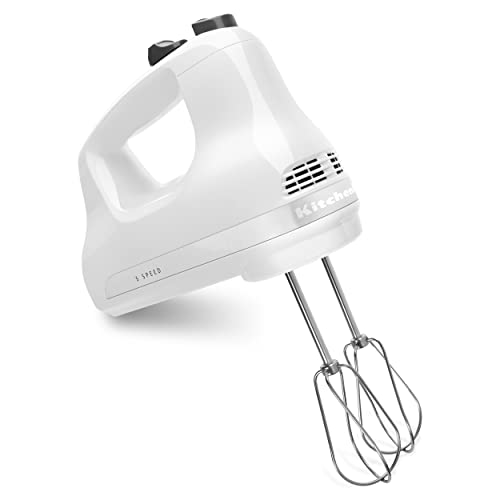
KitchenAid 5 Ultra Power Speed Hand Mixer (KHM512) — Best Simple and Light
Not every working kitchen works its mixer hard, and the KHM512 exists for the ones that work it steadily but lightly: the household that makes pancakes on Saturday, a cake or two a month, mashed potatoes, whipped cream for desserts — real, recurring use that never involves stiff dough or marathon sessions. Five speeds cover that repertoire completely, and the simpler control scheme is a virtue here: slide, mix, eject, rinse, done.
Strengths
- The lightest full-size body in this roundup — noticeably kinder during longer jobs.
- Lockable swivel cord and one-press beater eject keep handling friction-free.
- Turbo Beaters are dishwasher-safe and the whole unit stores in a small footprint.
Trade-offs
- Five speeds mean less finesse at both extremes — folding is a little brisker, whipping a little slower than the 7 and 9 Speed models.
- Only beaters in the box; no whisk attachment, so cream and egg whites take longer.
- The motor is tuned for light-to-medium work and will labour in thick cookie dough.
The working case for the KHM512 is reliability through simplicity. There is less to go wrong, the machine has been in KitchenAid’s range for years with a deep pool of replacement beaters behind it, and its light weight means it is the mixer smaller hands and older cooks actually enjoy using. In a kitchen where the mixer comes out twice a week for ordinary jobs, that ease of use is a working quality, not a compromise.
Be honest about the boundary, though: if your baking is trending heavier — weekly bread, big cookie batches, thick frostings in volume — this is the wrong tool and the 7 Speed is the right step. Bought for the work it is designed for, the KHM512 is one of the most sensible appliances in this entire roundup.
Best for: smaller households and lighter-duty regular use, and cooks who value a light, simple tool. / Not suited for: heavy dough, large batches or bakers who want a whisk attachment included.

KitchenAid Go Cordless Hand Mixer (KHMR762) — Best Cordless
The cordless slot on a working list has to be earned, because most battery hand mixers are toys. The KHMR762 earns it by being a real mixer first: seven speeds, a soft-start feature that protects against splatter, stainless steel beaters, and a removable rechargeable battery — included in this configuration — that can be swapped rather than sending the whole tool to landfill when a cell eventually fades. The freedom it buys is practical, not theatrical: whip cream at the stove, mix at the island where there is no outlet, carry the bowl to the mixer instead of the mixer to the bowl.
Strengths
- Genuine cordless freedom with seven speeds and a soft start — not a three-speed novelty.
- Removable battery design means a spare battery restores full runtime instantly and extends the tool’s service life.
- Flat base stands upright on the counter, and the body is balanced for one-handed use.
Trade-offs
- Runtime is finite: a long baking day with multiple heavy batches will need a charged spare or a corded backup.
- Peak power trails the corded KitchenAids in the thickest mixtures — work in stages with stiff dough.
- It carries a premium-tier price for the convenience, so it only makes sense if the cord is a real problem in your kitchen.
As a working tool, the Go makes most sense in two kitchens: the crowded one, where holiday cooking turns outlet access into a negotiation, and the open-plan one, where the baking happens at an island far from the wall. In both, the ability to pick the mixer up and work where the bowl is removes a small daily friction that corded owners simply accept. The seven speeds cover the standard repertoire — batters, frostings, whipped work, light dough in single batches — with the soft start keeping the first seconds tidy.
The discipline cordless demands is charging discipline: put the battery back on charge after baking day, or keep a spare in the drawer. Bakers who bake in long, heavy sessions every week should still make a corded model their primary tool and treat the Go as the flexible second. Bakers whose sessions are ordinary and whose counters are crowded may find it becomes the only mixer they reach for.
Best for: island kitchens, crowded counters and cooks who value freedom of movement over marathon runtime. / Not suited for: all-day heavy baking sessions without a spare battery, or strict budget buyers.
Comparison Table
| Pick | Badge | Key spec | Best for |
|---|---|---|---|
| KitchenAid 9 Speed (KHM926) | Best Overall | 9 speeds; beaters, whisk, dough hooks, blending rod | Weekly bakers who want the full kit |
| Cuisinart Power Advantage Plus 9-Speed (HM-90S) | Best for Organized Kitchens | 9 speeds with SmoothStart; snap-on storage case | Batch bakers who hate loose attachments |
| Hamilton Beach 6-Speed (62682G) | Best Budget Workhorse | 6 speeds, 250W motor, QuickBurst, bowl rest | Value buyers and second kitchens |
| KitchenAid 7 Speed (KHM7210) | Best Mid-Range All-Rounder | 7 speeds; Turbo Beater II, pro whisk | Weekly cake-and-cookie bakers |
| KitchenAid 5 Ultra Power (KHM512) | Best Simple and Light | 5 speeds; lightest body in the group | Light, steady household use |
| KitchenAid Go Cordless (KHMR762) | Best Cordless | 7 speeds; removable battery included | Island kitchens and crowded counters |
How to Choose a Working Hand Mixer
Choosing a working hand mixer is really about matching the machine to the heaviest job you do regularly — not the heaviest job you can imagine, and not the lightest one either. Start by writing down, honestly, what the mixer will actually do in a normal month. If the list is batters, frostings, whipped cream and the occasional tray of cookies, almost any full-size mixer here will serve you, and your decision should turn on weight, storage and price tier. If the list includes weekly cookie dough in double batches, thick frostings for layered cakes, or regular mashed-potato duty for a crowd, you need the stronger end of the range: the KitchenAid 9 Speed, the Cuisinart HM-90S or, on a budget, the Hamilton Beach with its QuickBurst reserve.
Speed count matters, but not the way marketing suggests. What you are really buying with more speeds is a slower first speed and finer steps in the middle. A nine-speed mixer’s lowest gear can turn slowly enough to fold flour without a dust cloud; a cheap five-speed’s lowest gear often cannot. If you bake delicate cakes — chiffon, sponge, anything where dry ingredients meet foam — that gentle start is worth more than any other single feature. Conversely, if your mixing is mostly robust batters and potatoes, six honest speeds beat nine theoretical ones.
Attachments are the second decision, and they should be made by inventory, not aspiration. Dough hooks extend a hand mixer into single-batch dough work; if you never make dough, they are drawer ballast and the KitchenAid 7 Speed’s simpler kit is the smarter buy. A whisk attachment, by contrast, earns its place in almost every kitchen, because whipping cream or egg whites with beaters takes longer and gives a coarser result. Storage is the third decision: in a small kitchen, the Cuisinart’s and Hamilton Beach’s snap-on cases are not cosmetic — they are the difference between a kit that stays together and attachments that migrate to the back of a drawer and effectively disappear.
Finally, think in budget tiers rather than prices, because hand mixer pricing shifts constantly. The budget tier (where the Hamilton Beach lives) buys honest everyday power with coarser low-speed manners. The mid tier (KitchenAid 5 and 7 Speed, Cuisinart on promotion) buys gentler starts, better beaters and whisk attachments. The premium tier (KitchenAid 9 Speed and the cordless Go) buys either the full attachment kit or cordless freedom. None of the tiers is a mistake; buying a tier below your actual workload is the mistake, because an underpowered mixer does not save money — it just delays the second purchase.
What Actually Wears Out on a Working Hand Mixer
Since this article is about machines that work for a living, it is worth being concrete about how hand mixers actually fail, because the failure modes should steer your choice. The first is motor strain from dough. Hand mixer motors are geared for speed, not torque; forcing them through stiff, low-hydration dough heats the windings and wears the gears, and the damage is cumulative — the mixer that “suddenly” died at Christmas usually spent two years being overloaded. The second failure mode is the beater set: cheap beaters flex, lose their finish and eventually wobble, and a mixer whose manufacturer no longer sells replacement beaters becomes scrap the day that happens. Every brand on this page has a deep, current replacement-parts channel, which is a major reason they are on this page.
The third wear point is the cord and its entry point into the body, which is why the swivel cords on the KitchenAid models matter more than they appear to: a cord that can rotate to either side is a cord that spends less of its life bent at a hard angle against the bowl rim. The fourth is simple neglect — batter dried into the beater vents and eject mechanism. A working mixer cleaned in the two minutes after use, with its beaters washed rather than left soaking in the bowl, will outlast a neglected premium model every time. Buy the machine whose ecosystem you can maintain, and maintain it like a tool, because that is what it is.
How to Use a Hand Mixer Without Wrecking the Mix or the Motor
Good hand-mixer technique is mostly about sequencing. Start every job at the lowest speed, with the beaters already submerged in the mixture before you switch on — starting in mid-air and plunging in is how batter ends up on the wall. Add dry ingredients in two or three stages rather than all at once, letting each addition mostly disappear before the next; this is kinder to the motor and eliminates the flour cloud entirely, even on the Hamilton Beach whose first speed runs a little brisk. Move the mixer through the bowl in a slow figure-eight rather than holding it in one spot, and tilt the bowl slightly toward the beaters when whipping small quantities so the mixture actually passes through them.
For whipped cream and egg whites, chill the bowl if you can, start at medium until the mixture thickens, and only then climb to high speed — going straight to maximum splashes liquid up the sides and produces a coarser foam. For cookie dough, cream the butter and sugar thoroughly first (this is where a hand mixer genuinely shines), add flour at the lowest speed, and stop the moment the dough comes together; if the final addition makes the motor pitch drop noticeably, finish those last folds with a spatula rather than forcing the machine. For dough hooks, work with a single batch, keep the speed low, and let the hooks pull the dough rather than pushing the mixer into it.
When you finish, eject the beaters directly into the sink or dishwasher, wipe the body with a damp cloth before anything dries on it, and never — this is the rule that kills more mixers than any recipe — immerse the motor body in water or run it under the tap. Two minutes of correct shutdown is the cheapest longevity insurance a working appliance can have.
Common Buying Mistakes
The most common mistake is buying for the fantasy job: choosing a mixer around the bread you intend to start making, when your actual life is cakes and cookies. That logic inverts good buying — it leads people to skip the whisk attachment they would use weekly in favour of dough hooks they will use twice, or to reject a lighter model that suits their real work because it cannot do work they never do. The second mistake is the mirror image: buying the cheapest mixer on the shelf for a genuinely heavy workload, then replacing it every eighteen months and spending more than the good tool would have cost once.
Third, buyers routinely ignore the lowest speed. Spec sheets shout about maximum wattage and top speeds, but working comfort is decided at the bottom of the range; a mixer that cannot start gently makes every cake a small mess. Fourth, people forget to check what is in the box — “hand mixer” listings differ enormously in attachments, and discovering your whisk or dough hooks were never included, after the return window, is a recurring and avoidable annoyance. Fifth, cordless buyers forget the ecosystem question: a cordless mixer whose battery is sealed inside is a tool with an expiry date, while a removable-battery design like the KitchenAid Go can be kept working with a fresh pack. Finally, do not buy a hand mixer as a stand mixer substitute for a heavy baking habit. If you are making bread weekly or doubling every recipe, the honest purchase is a stand mixer, and this site’s stand mixer coverage is the right place to look — a hand mixer asked to do that job will disappoint you and die doing it.
Final Recommendation
For most people searching for the best working hand mixers, the answer is the KitchenAid 9 Speed (KHM926): it has the gentlest start, the steadiest power and the fullest attachment kit, and it is built to be used hard for years. If your kitchen runs on batch sessions and tidy storage, the Cuisinart HM-90S is an equally serious tool with the best case in the business. On a strict budget, the Hamilton Beach 6-Speed is the rare cheap appliance that genuinely deserves the word workhorse. The KitchenAid 7 Speed is the value sweet spot for cake-and-cookie bakers, the 5 Ultra Power is the right light tool for lighter workloads, and the KitchenAid Go Cordless solves a real problem for the right kitchen. Match the machine to the work you actually do, and any of the six will earn its place.
Related reading in this programme: Best Stand Mixers For Baking · Best Stick Mixers · Best Starter Mixers · Best Stand Mixers For Bread Making · Best Smoothie Mixers
Matching the Mixer to Your Baking Week
It helps to think about hand mixers the way tradespeople think about drills: the right choice depends on your duty cycle. A light duty cycle — a few mixing jobs a week, none of them heavy — is served best by the KitchenAid 5 Ultra Power or the Hamilton Beach, and spending more buys features that will sit idle. A medium duty cycle — weekend baking most weeks, holiday surges, regular cookie and cake production — is the natural home of the KitchenAid 7 Speed and the Cuisinart HM-90S, whose gentler low speeds and whisk attachments get used constantly at this rhythm. A heavy duty cycle — baking several times a week, teaching kids to bake, supplying a small bake sale or a big family’s dessert habit — justifies the KitchenAid 9 Speed’s full kit and steadier electronics, because at that tempo the difference between a tool that strains and a tool that cruises is the difference between replacing it in two years and in ten.
Two special cases cut across the duty cycles. The first is physical: if grip strength or wrist comfort is a concern, weight and handle design outrank every other specification, and the lighter KitchenAid models or the balanced cordless Go deserve priority over raw capability. The second is the two-mixer kitchen, which sounds extravagant and is actually common among serious bakers: a corded flagship that lives in the baking zone, plus either the budget Hamilton Beach or the cordless Go as the roving second tool for sauces, dressings, whipped toppings and small jobs at the stove. Because hand mixers are compact and the budget tier is genuinely inexpensive, that pairing often serves a working kitchen better than any single premium purchase — one more reason this list leads with honest duty matching rather than a single winner for everyone.
Frequently Asked Questions
Can a hand mixer really replace a stand mixer for regular baking?
For cakes, cookies, frostings, whipped cream and batters, yes — a good hand mixer covers the great majority of home baking. Where it cannot substitute is sustained heavy work: large or stiff bread doughs, double batches of dense dough, and long kneading. If those are weekly events in your kitchen, buy a stand mixer for them and keep the hand mixer for everything else.
How many speeds does a working hand mixer actually need?
Five speeds are enough for light work, seven cover nearly everything, and nine add a gentler low end and finer control. The number matters less than the quality of the lowest speed — a slow, controlled start prevents splatter and is the feature frequent bakers feel most.
Why do hand mixers die, and how do I avoid it?
Overloading is the main killer: forcing the motor through stiff dough or oversized batches overheats it over time. Work in single batches, finish the stiffest final folds by hand, keep vents clear of dried batter, and never immerse the motor body in water. Used that way, a quality hand mixer lasts for years.
Are dough hooks on a hand mixer worth having?
Only if you actually make dough in single, reasonably soft batches — enriched doughs, pizza dough for two, soft rolls. For stiff bread dough they are the wrong tool. If dough is not part of your routine, a model without hooks, like the KitchenAid 7 Speed, is the smarter spend.
Is a cordless hand mixer powerful enough for everyday work?
The KitchenAid Go Cordless handles standard batters, frostings and whipped work comfortably across its seven speeds. Its limits are runtime on very long baking days and peak torque in the thickest mixtures, so heavy daily bakers should treat it as a flexible second tool or keep a spare battery charged.
What is the difference between Turbo Beaters and traditional beaters?
KitchenAid’s Turbo Beater design has no centre post, so less mixture clings to the beaters, more of your batter stays in the bowl, and washing up is quicker. Traditional beaters, like Hamilton Beach’s, work perfectly well and are cheaper to replace, but they trap more mixture around the centre post.


