Disclosure: airfryerkitchensupply.com is reader-supported. When you buy through links on our site, we may earn an affiliate commission at no extra cost to you.
Where to buy
A stick mixer — the immersion blender you plunge straight into the pot — lives or dies by motor honesty, shaft length, and how it treats the bottom of your pans. Every pick below was confirmed as the exact model named. Bundles differ (some include choppers, whisks, and beakers), so check the current price on Amazon for the configuration you want before buying.
- Vitamix 5-Speed Immersion Blender (625-Watt) — check price on Amazon
- KitchenAid Variable Speed Corded Hand Blender (KHBV53) — check price on Amazon
- Braun MultiQuick 7 3-in-1 Immersion Blender — check price on Amazon
- Cuisinart Smart Stick Variable Speed Hand Blender (CSB-179) — check price on Amazon
- Breville Control Grip Immersion Blender (BSB510XL) — check price on Amazon
- Mueller Ultra-Stick Immersion Hand Blender (500W) — check price on Amazon
The best stick mixers earn their drawer space by deleting jobs from your life: the soup blended in the pot instead of poured, scalding, into a jug blender; the sauce emulsified where it sits; the baby food puréed in its own pan; the whipped cream whisked in the jug it will be served from. A stick mixer — immersion blender, hand blender, same tool — is the most frequently used ‘second blender’ in most kitchens and the primary one in small ones, and choosing well means matching its motor, shaft, and attachments to the food you actually make, because the category spans featherweight smoothie sticks and commercial machines that purée ten-gallon pots.
The honest dividing lines are three. Power and blade design decide whether fibrous soups go silky or stay stringy — a weak stick mixer does not fail loudly, it fails by leaving you chewing celery threads in a leek soup and blaming the recipe. Shaft length and head design decide which pots you can work in and whether the tool sucks itself onto the pan bottom mid-blend. And the attachment ecosystem — whisk, chopper, beaker — decides whether this is a one-trick stick or the compact food-prep system that small kitchens actually need.
The six picks below cover that span deliberately: a premium 625-watt Vitamix for the silkiest results, KitchenAid’s variable-speed all-rounder, Braun’s ergonomically clever MultiQuick 7 system, Cuisinart’s quiet variable-speed Smart Stick, Breville’s control-grip comfort pick, and Mueller’s high-power value bundle. Every one is a real, orderable model verified for this article — and the reviews are blunt about the jobs each should not be asked to do, because a stick mixer pushed past its design is how pan bottoms get scratched and motors get cooked.
One clarification before the picks, because the name causes real confusion in this category: a stick mixer is not a smaller stand mixer and not a stronger hand mixer. It blends by immersion, in the vessel, with a blade — which makes it the right tool for liquids and purées and the wrong tool for doughs, batters, and anything that needs beating rather than blending. Several kitchens on this list’s readership will own all three tool types eventually; the stick’s claim is that it gets used most, because its jobs arrive daily and its washing-up takes a minute.
In this guide
Quick Picks
Six sticks for six kitchens: maximum power, best all-round system, smartest ergonomics, quietest running, comfort grip, and the value bundle.
- Best Overall / Most Powerful: Vitamix 5-Speed Immersion Blender (625-Watt) — a 625-watt motor and 4-prong blade from the blending specialists — the silkiest soups here. — Check on Amazon
- Best All-Rounder: KitchenAid Variable Speed Corded Hand Blender (KHBV53) — variable-speed trigger control, a removable 8-inch arm, and a blending jar — the balanced everyday system. — Check on Amazon
- Best Ergonomics / Smart Speed: Braun MultiQuick 7 3-in-1 Immersion Blender — squeeze-sensitive speed control and a 3-in-1 system with food-processor ambitions. — Check on Amazon
- Best Quiet, Controlled Blender: Cuisinart Smart Stick Variable Speed Hand Blender (CSB-179) — a stated quiet 300W motor, variable speed, 8-inch shaft, and chopper/whisk kit in stainless. — Check on Amazon
- Best Comfort for Long Blending: Breville Control Grip Immersion Blender (BSB510XL) — 15 speeds and a comfort-grip design with a bell-shaped base made to spare your pans. — Check on Amazon
- Best Value Bundle: Mueller Ultra-Stick Immersion Hand Blender (500W) — a 500W motor, 8 speeds plus turbo, and whisk, frother, and beaker in the box — maximum kit per pound. — Check on Amazon
How These Picks Were Chosen
Each model was cross-checked against Amazon listing data through this site’s provider account — brand-and-model search, title matched to the intended machine, ASIN taken only from the listing response. Stick mixers are sold in shifting bundles (the same motor unit with different accessory sets), so we verified and named the specific configuration the listed and flag bundle-dependence wherever it changes the recommendation.
Criteria were the jobs stick mixers actually do. Blending performance came first, judged by motor class and blade/shaft design rather than marketing wattage alone — the ability to keep moving through a thick soup without stalling or overheating. Second, control: variable speed or a well-judged two speeds, because a stick that only runs at full blast paints the kitchen with anything thinner than purée. Third, ergonomics and cleaning — grip comfort over a big pot’s worth of blending, a shaft that detaches and rinses clean, and controls operable with one hand while the other holds the pot steady.
We excluded the two failure archetypes of the category: underpowered novelty sticks that cannot finish a fibrous soup, and 220-volt import listings unsuited to standard home use in this market, one of which surfaced in the listing result and was deliberately left off. What remains is the honest middle and top of the category.
The verification pass for this list excluded two seductive errors: a 220-volt import stick that surfaced in the listing result (unsuited to standard home circuits in this market, however impressive its wattage) and several listings whose titles blurred the line between stick mixers and unrelated appliances. What survived is six machines the listed under their own names, matched model by model — the same discipline as every guide in this series, applied to a category where bundle photography routinely promises more than the box contains.
The 6 Best Stick Mixers

Vitamix 5-Speed Immersion Blender (625-Watt) — Best Overall / Most Powerful
Vitamix built its name on making difficult blends smooth, and its immersion blender applies that obsession at stick scale: a stated 625-watt motor driving a 4-prong stainless blade through five speeds. This is the pick for the cook whose stick work is serious — large pots of fibrous soup, root-vegetable purées, hummus-adjacent thicknesses, sauces in quantity — and who wants the texture a jug blender gives without moving the food. If your soups have ever stayed stringy, this is the machine that ends the argument.
Strengths
- Strongest motor class here — keeps moving through thick, fibrous blends lesser sticks stall in
- 5 speeds span gentle emulsions to full purée power without a single blast setting
- 4-prong blade design pulls ingredients down into the work for even results
Trade-offs
- Premium positioning for a stick — smoothie-only households will not use its headroom
- Power demands respect: full speed in a shallow pan is a splatter lesson
- Bundle is blending-focused; chopper/whisk ecosystems are other brands’ game
| Motor | 625 watts (Amazon listing) |
| Speeds | 5 |
| Blade | 4-prong stainless |
Power in a stick mixer is not about machismo; it is about what happens at minute two in a pot of roasted squash soup. Weak motors fade as the blend thickens and the load rises, leaving the cook tilting and hunting for pockets; the Vitamix’s motor class simply continues, and the 4-prong blade keeps the vortex fed so the whole pot homogenises instead of the layer near the blade. The result is the texture difference between ‘blended’ and ‘silky’ — the thing guests notice in a soup without knowing why.
Five speeds matter more here than on weaker machines because the power is real: start slow to establish the vortex without eruptions, climb for the purée, drop back for emulsifying a vinaigrette or finishing a mayonnaise where a blast would break the emulsion you are building. It is the connoisseur’s stick — bought for texture, kept for a decade, and honestly more machine than a smoothie-and-soup-once-a-month kitchen requires. Know your blending life before paying for its ceiling.
Best for: serious soup and purée cooks wanting jug-blender texture in the pot / Not suited for: occasional smoothie makers on a budget

Check on Amazon — check the current price on Amazon before you buy, because configurations and included accessories vary by listing.

KitchenAid Variable Speed Corded Hand Blender (KHBV53) — Best All-Rounder
The KHBV53 is the stick mixer as a well-mannered system: a variable-speed trigger that gives you the whole range under one finger, a removable 8-inch blending arm that reaches into real pots and rinses clean, and an included blending jar with a lid for smoothies, dressings, and storing what you made. It suits the everyday cook whose stick jobs vary daily — soup Monday, smoothie Tuesday, sauce Wednesday — and who values control and tidiness over maximum violence.
Strengths
- Trigger-style variable speed is the most intuitive control here — squeeze for more, ease for less
- Removable 8-inch arm balances pot reach with easy cleaning and storage
- Included lidded jar makes blend-and-store a one-vessel habit
Trade-offs
- Motor class is everyday, not Vitamix — the thickest fibrous loads take longer
- System expands via specific accessories; check compatibility before assuming attachments fit
- Trigger control rewards a steady hand; beginners may pulse unintentionally at first
| Shaft | Removable 8-inch blending arm |
| Control | Variable speed trigger |
| Included | Blending jar with lid (Amazon listing) |
The trigger is this machine’s thesis. Other sticks give you buttons and presets; KitchenAid gives you a continuous range married to your grip, and after a week it feels like the obviously correct interface — you lean into a thick patch, ease off as a sauce comes together, and never look at the tool. That analogue feel pairs with sensible system design: the arm pops off for the sink, the jar’s lid turns leftovers into storage, and the whole kit stores like a utensil rather than an appliance.
Its honest ceiling is load. Daily soups, sauces, smoothies, whipped tasks with the whisk ecosystem — all squarely in its gift, done with more grace than rivals. The giant pot of fibrous stew or the double batch of hummus will take patience and rests where the Vitamix would simply proceed. For the median kitchen, which lives overwhelmingly in the first category, the KHBV53 is the balanced buy: control, system, and brand support in one drawer-friendly package.
Best for: everyday cooks wanting one controlled, tidy stick system / Not suited for: maximum-load purée work in very large pots
Check on Amazon — check the current price on Amazon before you buy, because configurations and included accessories vary by listing.

Braun MultiQuick 7 3-in-1 Immersion Blender — Best Ergonomics / Smart Speed
Braun’s MultiQuick 7 approaches the stick mixer’s two oldest annoyances — speed control and splatter — with intelligence: its control responds to how firmly you squeeze, so speed follows intention without a dial, and the system design (this 3-in-1 configuration adds food-processor function alongside blending) aims at the small kitchen that wants one motor to prep, chop, and blend. The ergonomic handle is shaped for the long, tilted work of big pots, and Braun’s long hand-blender lineage shows in the details.
Strengths
- Squeeze-sensitive speed makes control one-handed and instinctive
- 3-in-1 system extends one motor across blending and processing tasks
- Ergonomic handle and balanced weight reduce fatigue in large pots
Trade-offs
- Squeeze control has a learning curve — the first blends may surge unexpectedly
- System attachments are proprietary; expanding the kit means Braun parts
- Processor capacity is compact — batch prep for crowds still wants a full-size machine
| System | 3-in-1 immersion blender & food processor |
| Control | Adjustable / squeeze-sensitive speed |
Every stick mixer owner knows the splatter moment: full speed engaged in a half-full pan of something thin, and the kitchen wears it. Braun’s speed-follows-squeeze design attacks that moment at its root — the tool cannot lurch to full power faster than your hand asks — and once learned, it makes the cook measurably tidier and the emulsions measurably better, because fine sauces live at speeds a two-button stick cannot hold. It is the most thoughtful control philosophy on this list, and cooks who blend often feel the difference daily.
The 3-in-1 system framing is the second half of the value: chopping and processing attachments turn drawer space into prep capability, which is the small kitchen’s eternal equation. Judge the bundle on the attachments you will genuinely use — a chopper that dices onions weekly earns its cupboard; a whisk you already own in triplicate does not. Matched to a cook who preps as much as they blend, the MultiQuick 7 is the cleverest purchase here.
Best for: frequent blenders and small kitchens wanting a prep system / Not suited for: button-and-dial traditionalists or maximum-power purée work
Check on Amazon — check the current price on Amazon before you buy, because configurations and included accessories vary by listing.
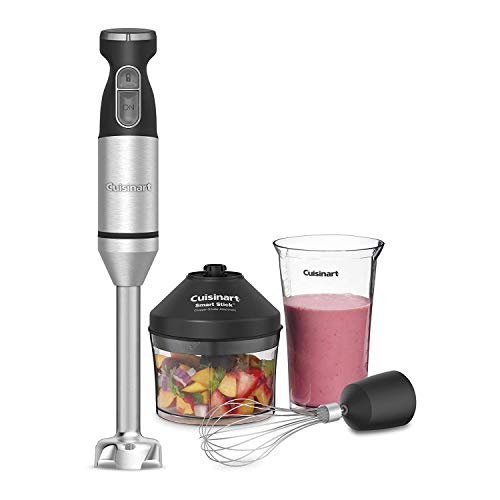
Cuisinart Smart Stick Variable Speed Hand Blender (CSB-179) — Best Quiet, Controlled Blender
The CSB-179’s listing leads with a word stick mixers rarely claim: quiet. Its 300-watt motor is positioned as a quiet runner with variable speed control, an 8-inch shaft for real pots, and a chopper and whisk in the system — the configuration for the cook who blends early, blends often, and shares walls or a household with people who sleep. Stainless construction and Cuisinart’s kitchen pedigree complete a package aimed at refined everyday use rather than maximum force.
Strengths
- Quiet-motor positioning suits early mornings and thin walls
- Variable speed plus 8-inch shaft covers sauces to soups with control
- Chopper and whisk included — a complete small-prep system in the box
Trade-offs
- 300W class means the thickest, most fibrous loads are patience work
- Quiet is relative — it is still a blender, not a library
- Stainless finish shows water spots; the tidy will wipe it down
| Motor | 300 watts, quiet design (Amazon listing) |
| Shaft | 8 inch |
| Included | Chopper, whisk (Amazon listing) |
Noise is an underrated appliance spec because it taxes every use. A stick mixer you hesitate to run at 7am before work, or during a baby’s nap, is a stick mixer that gets used less — and unused tools are the worst value in any kitchen regardless of power. The Smart Stick’s quiet positioning, paired with genuinely useful variable speed, makes it the household diplomat on this list: smoothies before school, soup during naps, sauces while a conversation continues in the same room.
The included chopper and whisk matter to the value case: this is a system price, not a stick price, and judged as a system — blend, chop, whisk — it covers the small-prep triangle completely. Its power ceiling is the honest trade: fibrous purées want the Vitamix’s muscle or this machine’s patience in smaller batches. For the household whose blending is daily and domestic rather than industrial, the CSB-179’s manners may be worth more than watts.
Best for: households valuing quiet running and a complete in-box system / Not suited for: heavy fibrous purée work in large batches
Check on Amazon — check the current price on Amazon before you buy, because configurations and included accessories vary by listing.

Breville Control Grip Immersion Blender (BSB510XL) — Best Comfort for Long Blending
Breville designed the Control Grip around a truth about stick blending: it is hand work. Long sessions over a stockpot punish a bad grip and a badly shaped handle, and this machine’s namesake grip, 15-speed range, and thoughtfully shaped blending head — designed to reduce suction onto the pan bottom and to be kind to pan surfaces — serve the cook who blends big pots often: the soup maker, the sauce batcher, the meal-prepper whose Sunday is a row of containers.
Strengths
- Ergonomic grip design reduces hand fatigue across long blending sessions
- 15 speeds give fine gradations for emulsions and delicate sauces
- Head design reduces pan-bottom suction and is considerate of pan surfaces
Trade-offs
- 280W class (per listing) is finesse over force — the thickest loads take time
- Premium pricing for comfort features a light user may never appreciate
- Brushed stainless rewards a wipe-down habit to stay handsome
| Speeds | 15 (Amazon listing) |
| Motor | 280W class (Amazon listing) |
Suction is the stick mixer’s secret wrestling match: a flat head seals against the pan bottom, the motor strains, the cook pulls, and the sudden release redecorates the stove. Breville’s head geometry is designed against that seal, and in long blending sessions the difference compounds — smoother movement around the pot, less fighting, more even results. Add a grip shaped by people who clearly held prototypes for entire afternoons, and the Control Grip becomes the marathon runner of this list: not the strongest, but the one still comfortable at kilometre twenty.
Fifteen speeds sound like abundance and function as precision: the low end is genuinely low, which is where mayonnaise, hollandaise, and vinaigrettes live, and the gradations let a sauce cook ride the exact line between emulsified and broken. If your stick work leans saucy, soupy, and frequent — rather than maximal — Breville’s comfort-and-control package is a considered, grown-up buy that your hands will thank you for weekly.
Best for: soup and sauce makers blending long and often / Not suited for: maximum-power seekers or the tightest budgets
Check on Amazon — check the current price on Amazon before you buy, because configurations and included accessories vary by listing.

Mueller Ultra-Stick Immersion Hand Blender (500W) — Best Value Bundle
The Mueller Ultra-Stick is the value maximalist’s answer: a stated 500-watt heavy-duty motor, eight speeds plus a turbo setting, and a bundle that includes the blending shaft, a whisk, a milk frother, and a measuring beaker — the coffee drink, the whipped cream, the smoothie, and the soup all covered by one purchase at the budget end of this list. For a first stick mixer, a second-home kitchen, or a gift that equips completely, its completeness is the argument.
Strengths
- 500W class motor is strong company at this price point
- Full bundle included: whisk, frother, and beaker cover drinks to desserts
- 8 speeds plus turbo spans gentle folding of ingredients to full purée effort
Trade-offs
- Refinement trails the premium brands — fit, finish, and noise are budget-class
- Turbo enthusiasm in thin liquids will teach splatter lessons quickly
- Long-term durability expectations should be set by its tier, not the Vitamix’s
| Motor | 500 watts (Amazon listing) |
| Speeds | 8 + turbo |
| Included | Shaft, whisk, frother, beaker (Amazon listing) |
Judge the Mueller the way its buyers do: as a kit. Purchased separately, a stick with this motor class plus a whisk, a frother, and a beaker from the premium brands costs multiples; here the whole triangle of small blending arrives in one box, and for a new kitchen that arithmetic is decisive. The 500-watt class motor is genuinely useful headroom — soups and smoothies are dispatched without the strain that makes budget sticks feel apologetic — and eight speeds give a beginner room to learn control instead of a single blast.
The tier’s taxes are the usual ones: plastics and finish that feel budget, a noise signature with more enthusiasm than polish, and a lifespan expectation set by price rather than by the decade-scale of the Vitamix. None of that prevents it from being the right buy for its audience — first kitchens, second homes, students graduating to real cooking — who need capability now, completely, at a price that leaves money for ingredients. Value is a virtue; this is the list’s honest expression of it.
Best for: first kitchens and bundle buyers wanting the complete kit at once / Not suited for: buy-once-for-a-decade shoppers or the noise-sensitive
Check on Amazon — check the current price on Amazon before you buy, because configurations and included accessories vary by listing.
Comparison Table
| Pick | Badge | Key spec | Best for |
|---|---|---|---|
| Vitamix 5-Speed Immersion Blender (625-Watt) | Best Overall / Most Powerful | 625W, 5 speeds, 4-prong blade | serious soup and purée cooks wanting jug-blender texture in the pot |
| KitchenAid Variable Speed Corded Hand Blender (KHBV53) | Best All-Rounder | Variable trigger, 8-inch arm, jar included | everyday cooks wanting one controlled, tidy stick system |
| Braun MultiQuick 7 3-in-1 Immersion Blender | Best Ergonomics / Smart Speed | 3-in-1 system, smart speed control | frequent blenders and small kitchens wanting a prep system |
| Cuisinart Smart Stick Variable Speed Hand Blender (CSB-179) | Best Quiet, Controlled Blender | 300W quiet, variable, chopper + whisk | households valuing quiet running and a complete in-box system |
| Breville Control Grip Immersion Blender (BSB510XL) | Best Comfort for Long Blending | 15 speeds, comfort grip | soup and sauce makers blending long and often |
| Mueller Ultra-Stick Immersion Hand Blender (500W) | Best Value Bundle | 500W, 8 speeds + turbo, full bundle | first kitchens and bundle buyers wanting the complete kit at once |
Read the table by load and by hand: heavy fibrous blending points to the Vitamix’s motor class; daily varied work to KitchenAid’s trigger or Braun’s squeeze; quiet households to Cuisinart; long sessions to Breville’s grip; and new kitchens to Mueller’s complete box. Every pick blends soup — they differ in how thick, how long, and how pleasantly.
How to Choose a Stick Mixer
Power, honestly translated
Stick mixer wattage is quoted as enthusiastically as stand mixer wattage, so translate by task instead of by number. Smoothies, soft soups, sauces, and baby food are light work that every pick here handles. Fibrous and thick work — roasted root soups, bean purées, hummus-thickness blends, big pots — is where motor class separates the list: the 500–625W machines keep their composure as loads thicken, while 280–300W machines succeed through smaller batches and patience. Neither is a defect; the defect is only a mismatch between the motor and the menu. Write down your three commonest blends and buy for the heaviest.
Blade and shaft design share the credit with the motor. A head that keeps a vortex fed (multi-prong blades, bell shapes that resist suction) produces even results at lower stress than a flat head on a bigger motor. This is why the premium picks feel stronger than their numbers and why design-led mid-priced sticks punch at the weight of cruder powerful ones.
Speed control is splatter control
A stick mixer’s speed range decides your kitchen’s cleanliness and your sauces’ fate. Single-speed and blast-first designs throw thin liquids and break emulsions; variable triggers, squeeze controls, and honest low speeds let you start inside the food gently and climb only as the blend allows. If you make mayonnaise, vinaigrette, or hollandaise — emulsions that form at low speed and break at high — control is not a luxury feature; it is the difference between a sauce and a puddle. Conversely, if your life is soup and smoothies, a well-judged two speeds serve perfectly and the money saved is real.
Turbo buttons deserve a warning label in every kitchen: they are for the final seconds of a thick purée, never for starting a blend and never near the surface. Every experienced stick cook has one turbo story involving a ceiling; buy control so yours stays theoretical.
Shafts, pans, and the non-stick question
Shaft length matches pot depth: an 8-inch arm is the versatile standard for home pots; longer commercial shafts exist for stockpots most homes do not own. More important is the head’s relationship with your pans. Blades must never contact the pan — good designs guard them — and cooks using non-stick interiors should favour the gentler head designs and keep the stick moving rather than parked and grinding in one spot. Stainless shafts tolerate heat and tomato stains better than plastic, which can discolour and, in cheap forms, flex under load.
Detachable shafts are the cleaning feature that decides long-term affection. A shaft that pops off and rinses or dishwashes clean in seconds gets washed properly every time; a fixed shaft gets wiped and slowly becomes the drawer smell nobody discusses. Every pick here detaches — keep it that way when you shop beyond this list.
Attachments: system or stick?
Decide whether you are buying a stick or a system. A whisk attachment turns the stick into a cream-and-eggs tool that genuinely rivals a hand mixer for small jobs. A chopper attachment creates a mini food processor for onions, herbs, nuts, and breadcrumbs — the small-prep work that a full-size processor is too much washing for. A beaker with a lid closes the loop for smoothies and dressings. Bundles that include the pieces you will use weekly (Cuisinart’s and Mueller’s boxes, Braun’s system) are real value; attachments bought separately later cost more and arrive after the habit has failed to form.
The counter-rule: do not pay for a system to store it. If your kitchen already owns a beloved food processor and hand mixer, the pure stick (Vitamix, Breville) concentrates your money on blending quality, where it will be felt. Systems serve small and new kitchens; specialists serve equipped ones.
Reading stick mixer listings without being fooled
Three listing habits deserve a buyer’s scepticism. First, wattage without context: peak figures flatter weak motors, so weigh the brand’s reputation for blending and the blade design alongside the number. Second, bundle photography: count the attachments actually named in the specification, because hero images have a way of including the whole accessory catalogue. Third, shaft material and length stated vaguely — ‘stainless’ should mean the shaft and blade housing you will immerse, and length should be a number, since it decides which of your pots the tool can serve.
The listing-verified listings behind this guide were read exactly that way, which is why the reviews quote figures only where the listing states them plainly. Apply the same reading to any model you consider beyond this list and the category becomes much easier to shop.
Care Habits That Keep a Stick Mixer Sharp for Years
Stick mixers die of three neglects. The first is thermal: long continuous runs in thick blends heat small motors, so work in bursts with brief rests on the heaviest pots — the blend finishes faster anyway, because repositioning between bursts evens the result. The second is the sink soak: motor units are not waterproof, and a shaft left soaking can wick water toward seals; rinse, wash promptly, and dry rather than abandon in the washing-up. The third is drawer chaos — blades nicked by utensil jumbles, shafts bent under pans. A hook, a drawer divider, or the original box keeps the tool true.
Once a season, inspect the blade edges and the shaft coupling: dull blades announce themselves as longer blending times and stringier results long before they fail outright, and a coupling that clicks or wobbles is asking for retirement before it strands you mid-soup. These are five-minute checks that separate the decade-long stick from the two-year disappointment — the same discipline, at smaller scale, that keeps every good kitchen tool good.
Stick Mixers and the Small-Kitchen System
In a small kitchen, appliances compete on a brutal metric: jobs per cubic inch of storage. This is where the stick mixer quietly beats the jug blender it is so often compared against. A jug blender does one category of work superbly and occupies a counter postcode; a stick system — motor, shaft, whisk, chopper, beaker — lives in a drawer and covers soups, sauces, smoothies, whipped cream, chopped onions, breadcrumbs, and baby food. For the cook whose kitchen is a galley, a studio flat, or a camper, the stick is not the compromise purchase. It is the correct architecture, and the jug is the luxury that must justify its footprint.
The same logic scales down further: a stick system is the first ‘real’ appliance that makes sense in a student kitchen, a first flat, or a holiday home, because it travels, stores, and washes like a utensil while performing like a machine. Several picks on this list are bought exactly as that foundation — and their owners’ later, larger kitchens often keep the stick in daily use long after the jug blender arrives, because reaching for the drawer is faster than assembling the countertop.
Baby Food, Elderly Meals, and the Quiet Jobs Sticks Do Best
Two of the stick mixer’s most valuable jobs rarely appear in its marketing. The first is baby and toddler food: steamed vegetables and fruits puréed in the cooking pan, in exactly the quantity a week of weaning needs, with texture you control day by day from silk to mash — no special appliance, no tiny proprietary pots. Every pick here does it; the variable-speed models do it most gracefully, because texture gradation is a speed exercise. The second is texture-modified meals for elderly or recovering family members, where soups and soft foods must be genuinely smooth, in small fresh batches, without hauling out a countertop machine three times a day.
In both jobs the virtues that matter are the unglamorous ones this guide has weighted throughout: control at low speed, a shaft that rinses clean in seconds, and a size that invites daily use. If either job is in your household’s near future, it should steer the purchase more than smoothie dreams — toward the controlled, easy-cleaning middle of this list.
When the Stick Is the Wrong Tool — Said Plainly
Affection for stick mixers should not survive contact with three jobs. Bread and pizza dough will stall or burn out any stick ever made; that is kneading work, for hands, hooks, and stand mixers. Nut butters ask for sustained high-power grinding that overheats stick motors and dulls their blades; a food processor or high-performance jug blender owns that job. And large volumes of crushed-ice drinks are a jug blender’s home ground, full stop. Naming these limits is not a criticism of the six picks here — it is the boundary that keeps them alive for the decade of soups, sauces, and purées they are genuinely for. Tools die at their boundaries, in every category, and the cooks who respect boundaries are the ones whose drawers are full of old, working tools.
How to Use a Stick Mixer Without Painting the Kitchen
Technique, not power, is what separates silky in-pot blending from a splattered stove. This sequence works for every pick on the list and every soup, sauce, and purée you will meet.
Step 1: Submerge before you switch on
Lower the head fully into the food, tilted slightly to release trapped air, before touching the control. A stick started in air or half-submerged throws food first and blends second — the order is the whole trick.
Step 2: Start low and build the vortex
Begin at the lowest speed until a gentle vortex forms and the surface stays calm. Climb gradually as the blend thickens and stabilises. Thin liquids may never need more than the bottom half of the range.
Step 3: Move in slow sweeps, not stabs
Draw the stick in slow figure movements around the pot, lifting slightly — never clear of the surface while running — to fold the top layer down. Stabbing creates pockets; sweeping homogenises.
Step 4: Tilt for the edges, rest for the heat
Angle the head to catch the pot’s edges and the corners where fibres hide. On thick blends, pause every half-minute or so: reposition, let the motor breathe, and check texture with a spoon rather than by faith.
Step 5: Stop before you lift
Release the control and let the blade stop fully before raising the head out of the food. The dripping, spinning lift is responsible for most stick-mixer messes and all of the memorable ones.
Rinse the shaft immediately after use — thirty seconds under the tap now beats soaking and scrubbing later — and dry it before it goes away. The cooks whose stick mixers live on the counter within reach are the ones whose technique made the tool feel effortless; it is learned in three pots of soup.
Common Buying Mistakes
Starting at full speed
The classic error, responsible for splattered kitchens and broken emulsions alike. Low first, always — power is applied as the blend earns it, not before.
Blending in a shallow or overfilled pan
A stick needs depth to work and headroom to vortex. Blend in the deepest suitable vessel, and never fill past two-thirds when a stick is going in — the blend rises as it moves.
Asking a light stick to do a heavy pot
Motor classes exist. Forcing a 280W finesse stick through a stockpot of fibrous stew cooks the motor and strands the soup; batch it down or step up a class.
Scraping the blade along non-stick surfaces
Parked, grinding contact damages pan coatings and dulls blades. Keep the stick moving, let the guard do its job, and favour gentle head designs on delicate pans.
Storing it dirty ‘for later’
Dried soup on a shaft is a hygiene problem and a corrosion start. The detachable shaft exists so cleaning takes under a minute — spend the minute.
Blending with the head half out of the food
A half-submerged head throws food and draws air into emulsions. If the pot is too shallow for the shaft, change vessel — the tool is telling you the geometry is wrong.
Final Recommendation
For texture above all, the Vitamix is the stick to buy; for everyday grace, the KitchenAid KHBV53; for clever control and system value, the Braun MultiQuick 7; for quiet households, the Cuisinart CSB-179; for long-session comfort, the Breville Control Grip; and for a complete kit at a budget, the Mueller Ultra-Stick. Match the motor to your heaviest regular blend and the control to your sauciest one, and any of them will earn its drawer.
Check the current price on Amazon for the exact bundle — with stick mixers, the included attachments are half the value, and they vary by listing.
The shortlist in one line: Vitamix 5-Speed Immersion Blender (625-Watt), KitchenAid Variable Speed Corded Hand Blender (KHBV53), Braun MultiQuick 7 3-in-1 Immersion Blender, Cuisinart Smart Stick Variable Speed Hand Blender (CSB-179), Breville Control Grip Immersion Blender (BSB510XL), Mueller Ultra-Stick Immersion Hand Blender (500W).
Keep exploring the cluster: Best Stand Mixers Under $200 Best Stand Mixers For Wedding Cake Making Best Hand Mixers Best Affordable Stand Mixers Best Starter Mixers
Frequently Asked Questions
What is the difference between a stick mixer and a hand mixer?
A stick mixer (immersion blender) blends in the container with a shaft and blade — soups, sauces, smoothies. A hand mixer beats with twin beaters — batters, creams, doughs. They complement rather than replace each other, though whisk attachments let a stick cover small whipping jobs.
How powerful a stick mixer do I need for soup?
Soft soups are easy work for any pick here. Fibrous or thick soups — roasted roots, beans, squash in large pots — reward the 500W-plus class (Vitamix, Mueller) or smaller batches in the finesse machines.
Can a stick mixer replace a jug blender?
For soups, sauces, and smoothies in the pot or beaker, largely yes — with less washing. For ice-crushing drinks, nut butters, and perfectly silky large-volume work, a jug blender (especially a high-performance one) still leads.
Is a stick mixer safe for non-stick pans?
Use the guarded head as designed, keep it moving, and never grind it parked against the coating. Designs like Breville’s, shaped to reduce suction and contact, are the considerate choice for delicate pans.
Why does my stick mixer splatter?
Almost always technique: started before submersion, run too fast for a thin liquid, or lifted while still spinning. The how-to sequence above — submerge, start low, stop before lifting — cures nearly all of it.
Corded or cordless stick mixer?
Corded models (all the picks here) give full, sustained power for pot work without battery anxiety. Cordless suits light, mobile tasks. For soup-and-sauce households, corded remains the dependable default.
Can a stick mixer crush ice?
Small amounts in a smoothie, in the beaker, with the stronger motors — yes, briefly. Dedicated ice crushing as a habit belongs to jug blenders; ice is the fastest way to dull a stick’s blades and strain its motor.
How do I stop the stick sucking onto the pan bottom?
Tilt the head slightly, keep it moving, and avoid pressing it flat to the base. Designs like Breville’s reduce the effect; technique eliminates most of what remains.


