Disclosure: airfryerkitchensupply.com is reader-supported. When you buy through links on our site, we may earn an affiliate commission at no extra cost to you.
Where to buy
A starter mixer — for a first podcast, a bedroom studio, a small stream, or a duo’s first gigs — should be simple enough to use on day one and honest enough to keep using in year two. Every pick below is a real analogue or USB mixer confirmed. Bundles vary by listing, so check the current price on Amazon for the exact configuration before buying.
- Behringer XENYX 302USB — check price on Amazon
- Mackie Mix5 5-Channel Compact Mixer — check price on Amazon
- Yamaha MG06X 6-Input Compact Mixer — check price on Amazon
- Behringer XENYX 502S — check price on Amazon
- Pyle 6-Channel Audio Mixer with Bluetooth — check price on Amazon
- Allen & Heath ZED-6 — check price on Amazon
The best starter mixers solve a beginner’s actual problem, which is rarely ‘not enough channels’. It is this: you have a microphone, maybe a guitar or a keyboard, a computer, and a head full of questions about gain, phantom power, and why everything hums. A good first mixer answers those questions with its layout — clear gain knobs, honest metering, a USB connection that just works — and stays out of the way while you learn the craft it is quietly teaching you. A bad first mixer either overwhelms you with a recording-studio panel or underwhelms you with toy controls you outgrow by the third episode.
This list assumes the most common starter briefs: podcasting and voice work, streaming, home recording of voice plus one instrument, small live setups for a singer with tracks, and the first PA for a duo or a small room. If your starter question was about kitchen mixers, this is the wrong page — these are audio mixers, the small desks that sit between microphones and computers. Within that world, the six picks below split by ambition: the tiniest sensible desk, the classic compact all-rounder, the effects-equipped singer’s choice, the modern streaming-ready design, the budget multi-input option, and the quiet-quality compact for buyers who already know they will stay with the hobby.
One principle runs through every review: buy the mixer for your second year, not your first week. Beginners grow inputs — a second microphone for a co-host, a guitar alongside the voice, a phone for call-ins — and the starter mixers worth owning have a channel or two of headroom waiting. But headroom is not a licence to buy a 16-channel desk for a one-microphone podcast; unused channels are unused money and a bigger, more confusing panel. The sweet spot is one step bigger than today.
A word about who this list is not for, because starter is a stage, not a size. If you already record a band, run sound for a hundred-seat room, or mix a multi-microphone podcast with per-voice editing, you have graduated past this page and should be shopping the larger desks in our stereo and streaming guides. Everything here assumes the honest beginning: one or two voices, a source or two, and an operator who is learning by doing — which is to say, the beginning almost every audio person alive once had.
In this guide
Quick Picks
Six first desks: the mini USB classic, Mackie’s compact quality, Yamaha’s singer-friendly compact, a streaming-era Behringer, Pyle’s input-rich budget board, and Allen & Heath’s small-but-serious ZED.
- Best Tiny First Mixer: Behringer XENYX 302USB — a 5-input mini desk with a proper mic preamp and USB — the smallest sensible start in audio. — Check on Amazon
- Best Compact Quality Start: Mackie Mix5 5-Channel Compact Mixer — Mackie’s build quality in a 5-channel analogue compact — for live and utility use without USB. — Check on Amazon
- Best for Singers Starting Out: Yamaha MG06X 6-Input Compact Mixer — two mic channels and Yamaha SPX effects in a compact — the practice-room and small-gig favourite. — Check on Amazon
- Best Modern Streaming Starter: Behringer XENYX 502S — a 5-input analogue desk with a USB streaming interface — designed for the mic-plus-computer creator. — Check on Amazon
- Best Input-Rich Budget Start: Pyle 6-Channel Audio Mixer with Bluetooth — six channels, Bluetooth, USB input, phantom power, and 3-band EQ — maximum features per pound. — Check on Amazon
- Best Buy-Once Starter: Allen & Heath ZED-6 — an ultra-compact six-input desk from a touring-mixer maker — the starter you do not replace. — Check on Amazon
How These Picks Were Chosen
Each mixer was cross-checked against Amazon listing data via this site’s provider account: brand-and-model search, title match, ASIN from the listing response only. Where the listed a near-identical sibling (an effects versus non-effects variant, for instance), we chose the variant that best fits a starter’s brief and named it exactly.
Criteria were a beginner’s real needs, tested against the questions first-time buyers actually ask. Does it power a condenser microphone (phantom power)? Does it connect to a computer without a second interface (USB)? Can one person run it while performing or presenting — are the important controls on top, labelled in plain language, and forgiving of mistakes? Does it have the one effect a beginner genuinely uses — a touch of reverb for a singer — without burying the panel in a hundred presets? And does the brand publish clear guidance, because a starter mixer’s manual is part of the product.
We excluded two categories deliberately: toy-grade boards whose noisy preamps teach beginners that their voice is the problem, and full studio desks whose routing depth belongs to a later stage. Everything here is a desk a beginner can succeed on in week one and respect in year two.
The long list behind these six was filtered with one more question that rarely appears in buying guides: could a complete beginner get a good result on this desk tonight, with only its manual for company? Desks that demanded routing knowledge, menu systems, or companion software before the first sound were set aside regardless of their other merits. A starter mixer’s first job is a successful first evening; everything else is year two’s business.
The 6 Best Starter Mixers
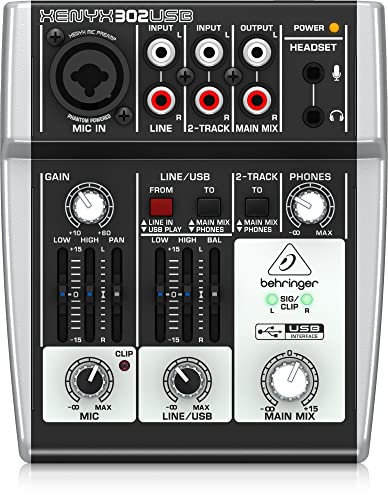
Behringer XENYX 302USB — Best Tiny First Mixer
For the solo podcaster, the voiceover beginner, or the streamer with one microphone and one computer source, the 302USB is the classic first step: one XENYX mic preamp channel for your microphone, line inputs for a phone or music source, a USB audio interface built in, and a panel small enough to understand in an afternoon. It sits beside a laptop, not across a desk, and it teaches the core grammar — gain, pan, level — without a single menu.
Strengths
- Mic preamp plus USB in a genuinely desk-friendly mini format
- Simple, legible panel — an ideal first teacher of gain and levels
- Line inputs cover a phone, keyboard, or backing-track source alongside the mic
Trade-offs
- One mic input is the ceiling — a co-host means a new mixer
- No onboard effects; singers wanting reverb must add it in software
- Mini controls are less precise than full-size faders and knobs
| Inputs | 5 (1 mic preamp) |
| Interface | USB audio |
The 302USB’s longevity as a recommendation comes from restraint: it does the three things a solo beginner needs — a decent microphone channel, a way to mix in music or a second source, and a clean path into the computer — and declines everything else. That restraint is educational. With one mic channel, you learn gain staging properly because there is nowhere to hide; with a simple two-band EQ you learn that mic placement beats knob-twisting, which is the most valuable lesson in all of audio, delivered by a very small box.
Its limits are the honest kind: they arrive exactly when your ambitions do. A second voice, a stereo instrument rig, a live gig — each is a clear, understandable reason to upgrade, and by then this little desk has taught you enough to choose its successor wisely. Many owners keep it afterwards as a utility mixer for a second room or a travel kit. As a first purchase in audio, it is close to risk-free.
Best for: solo podcasters, voiceover beginners, and single-mic streamers / Not suited for: co-hosted shows or anyone recording two microphones at once
Check on Amazon — check the current price on Amazon before you buy, because configurations and included accessories vary by listing.

Mackie Mix5 5-Channel Compact Mixer — Best Compact Quality Start
The Mix5 is the starter pick for buyers whose mixing is live rather than recorded: the singer with backing tracks at small gigs, the duo needing a microphone and two sources into one PA, the community hall that needs a simple desk anyone can run. Mackie’s reputation was built on small mixers that survive being carried around, and the Mix5 carries that DNA — a metal-chassis compact with one mic channel, clear controls, and no computer in the signal path at all.
Strengths
- Rugged compact build suited to gigs, halls, and being carried in a bag
- Dead-simple analogue operation — no drivers, no menus, no surprises
- Trusted brand lineage in small-format mixers, with controls that feel deliberate
Trade-offs
- No USB interface — recording to a computer needs a separate interface or recorder
- One microphone channel limits it to solo-voice setups
- No onboard effects for singers who want reverb at live shows
| Channels | 5 |
| Design | Analogue compact, no USB |
There is a category of starter buyer the USB desks serve badly: the one who needs sound in a room, not sound in a file. For them the Mix5’s omissions are features. Nothing to configure, nothing to update, nothing between the microphone and the speaker except honest analogue circuitry and their own two hands. Village halls, school assemblies, buskers, fitness instructors, market traders with a PA — this is their desk, and its simplicity under pressure (a show starting in ten minutes, an unfamiliar volunteer at the controls) is a genuine professional virtue.
If recording is even a secondary goal, though, be honest at the point of purchase: the Mix5 will need help to reach a computer, and the Behringer or Yamaha picks flank it precisely because they include that path. Buy the Mix5 for live utility and it will serve for a decade; buy it hoping to podcast and you have purchased a second problem. The distinction is not quality — it is species.
Best for: small live gigs, halls, and utility PA mixing / Not suited for: podcasters and home recordists who need USB
Check on Amazon — check the current price on Amazon before you buy, because configurations and included accessories vary by listing.

Yamaha MG06X 6-Input Compact Mixer — Best for Singers Starting Out
Singers starting out need one thing small desks often deny them: a little reverb, built in, so practice and small performances sound like music instead of a dry announcement. The MG06X answers with Yamaha’s SPX effects in a compact six-input frame with two microphone channels — enough for a singer plus a partner, or voice plus an instrument microphone — and the clean, quiet operation Yamaha’s MG line is known for. It is the practice-room and first-gig mixer that vocalists keep recommending to each other.
Strengths
- Built-in SPX effects give singers the reverb that makes practice and gigs feel finished
- Two mic channels cover duos and voice-plus-instrument setups
- Quiet, clean Yamaha sound with a layout beginners find calm and logical
Trade-offs
- No USB recording path — like the Mix5, it is a live/utility desk first
- Compact format means shared controls and fewer routing options as you grow
- Effects are a fixed menu; tweakers will eventually want outboard or software control
| Inputs | 6 (2 mic) |
| Effects | Built-in SPX |
The MG06X understands something psychological about starting out: beginners practise more when they sound good. A dry microphone through a bare desk is honest to the point of discouragement; a tasteful reverb tail turns a bedroom practice into something that feels like the goal, and singers return to it daily. Yamaha’s effects heritage — SPX units defined studio reverb for a generation — means the built-in sounds here are musical rather than novelty, which is rarer in small desks than it should be.
As a starter’s live desk it is nearly perfectly judged: enough inputs for the realistic first rigs, phantom power for a condenser at home, and a build that tolerates being the band-practice mixer, the gig mixer, and the rehearsal-room fixture in rotation. Its one structural limit is the same as the Mackie’s — no USB — so recordists should look at the streaming-ready picks below. Singers, duos, and small acoustic acts: start here and you may not need to move for years.
Best for: singers, duos, and acoustic acts starting out live / Not suited for: podcasters who need to record straight to a computer
Check on Amazon — check the current price on Amazon before you buy, because configurations and included accessories vary by listing.
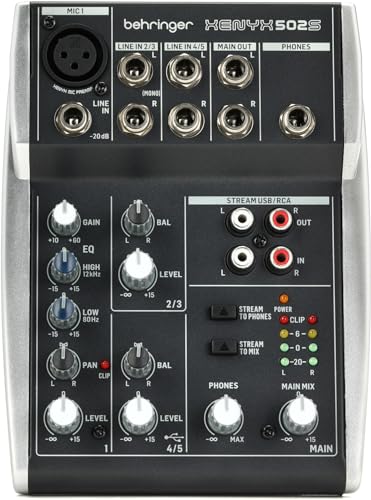
Behringer XENYX 502S — Best Modern Streaming Starter
The 502S is the 302USB’s idea updated for how beginners actually start now: streaming and creating on a computer, with one good microphone, game or music audio to blend, and a strong preference for hardware knobs over software mixers. Its USB streaming interface is the centre of the design — the mix leaves for the computer as one clean stereo picture — while the analogue panel keeps gain and levels under your fingers where they belong during a live broadcast.
Strengths
- USB streaming interface purpose-built for creators going live or recording
- Analogue controls keep mic gain tactile and adjustable mid-stream
- Five inputs cover mic plus computer/game/music sources for a solo creator
Trade-offs
- Still a one-mic-preamp desk — co-hosts need the bigger siblings
- Streaming focus means fewer live-PA niceties than the Mackie or Yamaha
- Plastic-era Behringer build asks for desk duty, not gig-bag abuse
| Inputs | 5 (1 mic preamp) |
| Interface | USB streaming |
What the 502S gets right is the modern beginner’s signal flow. A software-only setup forces a new streamer to mix with a mouse while performing; this desk restores the physical layer — mic gain here, music level there, headphones in your ears — and sends the finished blend to the streaming software as a single source. That simplicity removes the most common beginner failure (audio routing confusion) while keeping the skills real: the gain staging and balancing you learn here are the same ones used on the largest desks in this category’s family tree.
Choose it with the same honesty as its smaller sibling: one microphone is the design centre. The moment a second voice becomes regular — a podcast partner, a duo stream — the correct move is its larger streaming siblings (the 1002SFX and 1202SFX in our streaming guide) rather than adapters and workarounds. Within the solo brief, the 502S is the most current answer on this list to the question most beginners are actually asking.
Best for: solo streamers and creators starting with one microphone / Not suited for: two-voice shows or live PA work
Check on Amazon — check the current price on Amazon before you buy, because configurations and included accessories vary by listing.

Pyle 6-Channel Audio Mixer with Bluetooth — Best Input-Rich Budget Start
Some starters know their rig is plural from day one: a microphone, a keyboard, a phone for backing tracks, maybe a second mic for a partner — and a budget that forbids the established brands’ larger desks. Pyle’s six-channel board answers with sheer provision: Bluetooth for wireless track playback, USB computer input, an MP3 player, 48V phantom power for condenser mics, and 3-band EQ per channel. For community events, karaoke hosts, house parties, and first PA setups, that feature density at this tier is the entire argument.
Strengths
- Six channels plus Bluetooth and USB cover mixed, real-world source piles
- Phantom power supports proper condenser microphones for recording and voice
- 3-band EQ per channel gives more shaping than most budget rivals
Trade-offs
- Preamp quietness and build refinement sit below Mackie/Yamaha/Allen & Heath standards
- Feature-rich panels can overwhelm a true beginner — budget an evening to learn it
- Long-term support and resale are weaker than the legacy brands
| Channels | 6 |
| Features | Bluetooth, USB, MP3, 48V phantom |
The Pyle is the pragmatist’s starter: it assumes your sources are many and your standards are forming. Bluetooth backing tracks alone justify it for dance teachers, karaoke hosts, and event DJs, who otherwise live on adapters; phantom power means the condenser microphone you buy next year works the day it arrives; and six channels mean the desk stops being the bottleneck when a second performer joins. It is a lot of mixer, deliberately, for people whose needs are broad rather than deep.
The trade is refinement. Next to the Yamaha its preamps are less quiet, next to the Mackie its knobs feel less deliberate, and a recording perfectionist will hear the difference on a delicate voice session. But starters rarely need perfection on day one — they need everything to connect, work, and make sense, at a price that leaves money for the microphone and speakers that matter more. Judged on that brief, the Pyle earns its place without apology.
Best for: events, karaoke, and multi-source first setups on a tight budget / Not suited for: quiet-studio recording perfectionists
Check on Amazon — check the current price on Amazon before you buy, because configurations and included accessories vary by listing.

Allen & Heath ZED-6 — Best Buy-Once Starter
The ZED-6 is for the beginner who already suspects they are not a beginner for long: the musician starting a home setup, the podcaster with an ear, the small-venue tech who wants a compact desk with a professional pedigree. Allen & Heath build touring consoles; the ZED-6 is that DNA in ultra-compact form — clean preamps (including guitar-friendly high-impedance inputs in the ZED tradition), a musical EQ, and a build that feels like equipment rather than accessory.
Strengths
- Preamp and EQ quality a clear step above the budget tier — recordings and gigs both benefit
- Professional brand heritage with the support and longevity that implies
- Compact six-input layout still beginner-legible despite the serious internals
Trade-offs
- No USB on this model — recording needs an interface, as with the Mackie
- No onboard effects; singers wanting reverb look to the Yamaha
- Costs more than feature-heavier budget boards — you are paying for sound, not features
| Inputs | 6 |
| Design | Ultra-compact analogue |
Every category has a ‘buy once’ option, and this is the starter mixers’ version. The ZED-6’s advantage is audible rather than listed: quieter preamps mean cleaner recordings and less hiss at live gain; a well-voiced EQ means small adjustments do musical things instead of harsh ones. Beginners cannot always name that difference, but they feel it as ‘my voice sounds like me on this desk’ — and they keep the desk when the hobby becomes the work, demoting it to sub-mixer or travel duty rather than selling it.
Its omissions are the purist’s usual ones: no USB, no effects, no Bluetooth. If your starter brief is recording-first, the streaming picks serve you better today. But if your brief is sound-first — a musician’s first desk, a quality compact for a small venue, a mixer to learn on that will never embarrass you — the ZED-6 is the grown-up choice, and the one on this list most likely to still be in your rig in ten years.
Best for: musicians and quality-first beginners buying for the long term / Not suited for: streamers needing USB or singers needing built-in reverb
Check on Amazon — check the current price on Amazon before you buy, because configurations and included accessories vary by listing.
Comparison Table
| Pick | Badge | Key spec | Best for |
|---|---|---|---|
| Behringer XENYX 302USB | Best Tiny First Mixer | 5-input mini, 1 preamp, USB | solo podcasters, voiceover beginners, and single-mic streamers |
| Mackie Mix5 5-Channel Compact Mixer | Best Compact Quality Start | 5-channel analogue compact | small live gigs, halls, and utility PA mixing |
| Yamaha MG06X 6-Input Compact Mixer | Best for Singers Starting Out | 6-input, 2 mic, SPX effects | singers, duos, and acoustic acts starting out live |
| Behringer XENYX 502S | Best Modern Streaming Starter | 5-input USB streaming desk | solo streamers and creators starting with one microphone |
| Pyle 6-Channel Audio Mixer with Bluetooth | Best Input-Rich Budget Start | 6-channel, Bluetooth + USB | events, karaoke, and multi-source first setups on a tight budget |
| Allen & Heath ZED-6 | Best Buy-Once Starter | 6-input pro-pedigree compact | musicians and quality-first beginners buying for the long term |
Split the table by destination: if the mix goes to a computer, choose a USB pick (302USB, 502S, or the Pyle); if it goes to a room, choose a live desk (Mix5, MG06X, ZED-6) and add effects (Yamaha) or pedigree (Allen & Heath) to taste. Channel count comes last, after that one decision.
How to Choose Your First Starter Mixer
First question: where does the sound go?
Every starter decision flows from one fork. If your audience hears you through a computer — podcast, stream, recording — you need a USB interface in the desk, full stop; it collapses a two-box problem (mixer plus interface) into one and removes the beginner’s worst wiring headaches. If your audience is in the room with you — gigs, classes, halls — a plain analogue desk is simpler, tougher, and never asks for a driver. Mixed lives exist (the gigging singer who also records), and they are served either by a USB desk used live, or by accepting an interface purchase later. Decide the primary destination and let the secondary one compromise.
Do not let a salesperson reverse this logic with feature lists. Bluetooth, effects, and extra channels are all secondary to the destination question, because a desk that cannot reach your audience’s ears cleanly has failed before the features matter.
Microphones: preamps, phantom power, and the second mic
Dynamic microphones (the rugged handheld kind) work into any input here. Condenser microphones — the sensitive studio kind most podcasters and singers graduate to — need 48V phantom power, so check for it if a condenser is in your future; most picks here include it. The preamp itself is the mixer’s voice: quiet preamps let you turn up a soft speaker without turning up hiss, which is why the Allen & Heath and Yamaha picks justify themselves to anyone recording delicate material.
Then the headroom question: how many microphones will you honestly use in year two? One-mic desks (302USB, 502S, Mix5) are perfect until a co-host appears, and then they are simply done. If a partner, a duo act, or voice-plus-instrument-mic is plausible, start with two mic channels (MG06X, ZED-6, Pyle) and save yourself the re-buy.
Effects: the one beginner feature that matters
Of all onboard extras, exactly one changes a beginner’s daily experience: a simple reverb for singers. It makes practice pleasurable and small gigs sound finished. Everything beyond that — delays, choruses, pitch tricks — is garnish that most starters use twice. If you sing live, weight the Yamaha’s SPX effects properly in your decision; if you speak (podcasts, streams), built-in effects are nearly irrelevant because your software provides them and your voice sounds best nearly dry. Buy the effect your genre uses; ignore the other thirty presets entirely.
A related trap: mixers advertising huge effect counts as their headline are usually compensating for ordinary preamps. Judge the desk by its quietest channel at working gain, not by its longest feature list.
Size the desk one step up — and no further
The growth rule that serves starters best: one spare input beyond today’s rig. A solo podcaster with a phone for call-ins is a three-input life; a singer-guitarist is two channels today and three when a partner harmonises. Desks one step up stay legible while you learn and absorb the first growth spurt. Desks three steps up intimidate, cost more, and — worst of all — their unused complexity makes beginners blame themselves for the desk’s over-provision. Your confidence in month one is a real feature; protect it.
Budget follows the same logic. In starter territory, the microphone and headphones or speakers usually deserve more of the total spend than the desk does. A mid-list mixer with a good microphone outperforms a flagship compact desk with a poor one every single time.
Analogue warmth, digital convenience, and other first-desk myths
Beginners meet two myths early. The first is that analogue desks sound warm and USB desks sound cold; in this price class, what you actually hear is preamp quality and gain staging, and a well-made USB desk (or a well-made analogue one) beats a poorly made example of either. Buy the implementation, not the ideology. The second myth is that more EQ bands mean more control; in starter hands, a simple two or three-band EQ with sensible frequencies teaches faster and errs gentler than a parametric maze. The mixers here were chosen partly for EQ that a beginner can succeed with on the first evening.
A third, quieter myth: that a starter desk must be replaced to record ‘properly’. A clean stereo recording from a humble desk, of a good performance in a decent room, is properly recorded by any honest standard. The industry ran on humbler tools than these for decades.
Your First Session: A Calm Setup Routine
Unbox calmly and wire in this order: speakers or headphones last and turned down, sources in, microphone in, then power. Set every gain to zero, every EQ to its centre detent, and the master level low. Speak or sing at your real performance volume — not a timid test voice — and raise the channel gain until the loudest moments approach, but never reach, the top of the meter or the red. Then bring the channel and master faders up until the room level is right. That order (gain first, levels second) is the whole secret of clean audio, and it never changes, on any desk, at any size.
If something hums, work methodically: it is almost always a cable, a shared power strip issue, or a computer connection — swap one thing at a time and listen. Beginners who change five things at once learn nothing and fix things by luck. Write down the settings that worked; your future self, setting up in a hurry before a gig or a recording, will be grateful for the photograph of the panel you took today.
The Upgrade Path: What Your Second Mixer Will Be
A good starter mixer teaches you what your second one must have, and it is worth knowing the map in advance so the first purchase points the right way. Podcasters who add video discover they want a second mic channel and cleaner preamps. Singers who start gigging want effects that travel and a desk that survives a car boot. Home recordists who fall for the craft want more inputs and eventually a multitrack interface beside the mixer, not instead of the skills it taught. None of these futures require today’s desk to be bigger — they require it to be honest, so the lessons transfer.
This is also why the buy-once ZED-6 and the humble 302USB can both be correct first purchases for different people: one buys headroom in quality, the other buys headroom in budget, and both teach real mixing. The wrong first purchase is the one that teaches workarounds — noisy preamps you learn to shout over, missing phantom power you learn to route around — because workarounds fossilise into habits. Choose the desk whose limitations are about size, not about sound, and your second purchase will be an expansion rather than a correction.
Desk, Microphone, Room: Where a Beginner’s Money Actually Goes
If a starter has a fixed sum, the order of sonic importance is almost never the order of shopping excitement. The room comes first and costs least: a smaller, softer space — curtains, a duvet fort for voice work, distance from hard walls — improves a recording more than any equipment swap. The microphone comes second: it is the transducer, the point where sound becomes signal, and its character survives every later upgrade. The desk comes third, faithfully passing along whatever the first two give it. Beginners invert this order constantly, buying an impressive desk to amplify an untreated room through a mediocre microphone.
None of that makes the desk unimportant — a noisy preamp can ruin what a good room and microphone captured — but it should set the desk’s share of the budget. The picks on this list are priced so the system balances: a mid-list desk, a good microphone, and a free afternoon spent on the room will outperform any flagship compact desk plugged into chaos. Spend like an engineer and your starter setup will embarrass setups that cost twice as much.
Practising Mixing When Nothing Is at Stake
The fastest way to shorten the beginner phase is deliberate practice with nothing riding on it. Record five minutes of your voice at three different gain settings and listen to what over-gain actually sounds like, so you recognise it forever. Mix a song under your speaking voice until the balance feels like radio, then check it on a phone speaker, where bad balances confess. If you sing, practise the sound check itself — gain, a touch of EQ, a breath of reverb — until it takes ninety seconds, because at a real gig it will need to. None of this requires an audience, a deadline, or talent; it requires the desk, a recorder, and a few unglamorous evenings. The starters who do it stop being starters measurably sooner, on exactly the equipment on this list.
How to Set Up a Starter Mixer for Your First Recording or Gig
Whether the destination is a laptop or a PA speaker, the setup grammar is identical. Work through these steps once, slowly, and every later setup becomes a two-minute routine.
Step 1: Connect everything with levels down
Master and channel levels to zero, gains to zero, speakers last. Connect the microphone (switch phantom power on only if it is a condenser), your instrument or music source, and the USB cable if your desk has one and your destination is a computer.
Step 2: Set the computer side (USB desks only)
In your recording or streaming software, select the mixer as both input and output device. Speak and confirm the software’s meter moves with your voice. If it does not, the problem is almost always this selection step — not the desk.
Step 3: Gain-stage the microphone
Speak or sing at true performance volume and raise the channel gain until peaks are strong but never in the red. This single adjustment decides your noise floor and your clarity; everything after it is balancing, not fixing.
Step 4: Balance sources against the voice
Bring in music, tracks, or the second channel underneath the voice. The voice is the reference in almost every starter scenario — podcasts, streams, singing — so set everything else relative to it, not the reverse.
Step 5: Add polish last, sparingly
A touch of EQ if the voice is boxy or harsh, a hint of reverb if you sing and your desk offers it. Small moves, listened to honestly. Then record or play a test minute and listen back before the real thing — the cheapest quality control in audio.
Photograph the panel when it sounds right. Starter mixers get moved, borrowed, and knocked; a photo of your working settings is a reset button no manufacturer includes, and it turns your second setup into a copy of your first success.
Common Buying Mistakes
Buying channels you will never use
A 16-channel desk for a one-mic podcast wastes money, desk space, and confidence. The panel you cannot read at a glance is a panel you will set wrong under pressure.
Forgetting phantom power
The condenser microphone arrives, produces near-silence, and gets returned as faulty — when the desk simply lacked (or had switched off) the 48V it needed. Check before you buy, switch on before you panic.
Recording through a non-USB desk by improvisation
Headphone-out into a laptop mic socket is hissy, fragile, and mono in the worst way. If recording matters, buy the USB desk now rather than the adapter adventure later.
Setting gain by the fader
Cranking the channel fader while the gain whispers gives you a loud, noisy signal. Gain first, fader second — the order is the technique.
Spending the whole budget on the desk
The microphone and what you listen on shape your sound more than the mixer’s badge does. Split the budget like an engineer, not a collector.
Learning on maximum volume
Beginners set gains by turning everything up until it sounds impressive, which bakes distortion and noise into every habit. Set levels by the meter and the loudest real moment, then let the speakers — not the desk — provide the volume.
Final Recommendation
Solo creators should start with the Behringer 502S (streaming) or 302USB (smallest, simplest); live beginners with the Yamaha MG06X if they sing, the Mackie Mix5 if they need rugged utility; multi-source budget setups with the Pyle; and quality-first buyers with the Allen & Heath ZED-6, the desk least likely to be replaced. Every one of them teaches real mixing — the differences are destination, effects, and how far they travel with you.
Check the current price on Amazon for the configuration you choose, and put the money you save toward the microphone — it will do more for your sound than any upgrade within this list.
The shortlist in one line: Behringer XENYX 302USB, Mackie Mix5 5-Channel Compact Mixer, Yamaha MG06X 6-Input Compact Mixer, Behringer XENYX 502S, Pyle 6-Channel Audio Mixer with Bluetooth, Allen & Heath ZED-6.
Keep exploring the cluster: Best Starter Mixers For Streaming Best Stereo Mixers Usb Best Standalone Dj Mixers Best Audio Mixers Best Stick Mixers
Frequently Asked Questions
What is the difference between a starter mixer and an audio interface?
An interface converts sources to computer audio, usually one or two at a time with minimal hands-on mixing. A mixer blends several sources with physical controls and may include USB to reach the computer. Creators who balance voice against music live usually prefer the mixer.
Do I need phantom power?
Only for condenser microphones — but most beginners graduate to one, so a desk with 48V phantom power is the safer purchase. Dynamic microphones neither need it nor mind it being available on the channel.
How many channels does a beginner need?
Count your sources, add one spare. Solo voice plus music is three to five inputs; a duo or voice-plus-instrument starts at two microphone channels. Bigger is not better — legibility is.
Can a starter mixer work for both streaming and small gigs?
A USB desk can do both: it feeds a PA from its main outputs live, and a computer over USB at home. Pure analogue live desks (Mix5, MG06X, ZED-6) gig beautifully but need an interface to record.
Why does my microphone sound hissy?
Usually gain structure: the channel gain is too low and something downstream is cranked to compensate, amplifying noise. Set gain properly at the channel first — the setup section above walks through it.
Should a singer buy a mixer with effects?
A simple built-in reverb genuinely improves practice and small gigs, which is why the Yamaha MG06X exists on this list. Speaking-focused creators can skip effects entirely; their software provides them.
Can I use a starter mixer with a smartphone?
Often, yes — many streamers and podcasters connect a phone as a music or call-in source on a line input, and some record to the phone via adapters. Check your phone’s audio connections; the mixer side is the easy half.
How do I stop my mixer humming?
Work through it in order: one power strip for the whole setup, balanced cables for the microphone, gain set properly rather than cranked downstream, and the computer and desk on the same outlet where possible. Most hums surrender to one of those four.


