Disclosure: airfryerkitchensupply.com is reader-supported. When you buy through links on our site, we may earn an affiliate commission at no extra cost to you.
Where to buy
A stereo mixer with USB is the bridge between real sources — microphones, instruments, players — and the computer that records or streams them. Every pick below is a genuine stereo-bus mixer with USB audio, confirmed. Several ship in multiple channel counts; check the current price on Amazon for the exact size and configuration you intend to buy.
- Yamaha MG10XU 10-Input Stereo Mixer with Effects — check price on Amazon
- Yamaha MG12XU 12-Input Mixer with Effects — check price on Amazon
- Allen & Heath ZED-10FX — check price on Amazon
- Behringer XENYX X1204USB — check price on Amazon
- Mackie ProFX12v3 — check price on Amazon
- Soundcraft Notepad-8FX — check price on Amazon
The best stereo mixers usb searches come from a practical place: you have analogue sources and a digital destination. A singer and a keyboard that must reach a laptop as one clean stereo picture. A small band recording rehearsals. A church, school, or community studio whose services and events are both amplified in the room and captured to a computer. A stereo mixer with a USB interface collapses what used to be two purchases — mixer plus interface — into one desk, and sends the finished stereo mix down one cable while the same mix feeds the room’s speakers.
That ‘one stereo picture’ is the category’s defining trade, and this guide treats it honestly. USB stereo mixers send the main mix — two channels — to the computer. That is perfect for live-to-stereo work: streams, service recordings, rehearsal tapes, stereo keyboard rigs, DJ-to-laptop capture. It is the wrong tool if your process needs every microphone on its own track for later editing; that job belongs to multitrack interfaces, and no amount of mixer quality changes it. Buyers who understand which side of that line they live on are happy with these desks for a decade. Buyers who discover it afterwards are the ones writing frustrated reviews of excellent mixers.
Within the stereo-USB brief, the six picks below separate by scale and philosophy: Yamaha’s MG-XU line in two sizes for effects-equipped all-round work, Allen & Heath’s ZED with its recording-pedigree preamps, Behringer’s XENYX value benchmark, Mackie’s ProFX with its modern effects engine, and Soundcraft’s compact Notepad for the smallest serious stereo rigs. Channel counts run from eight to twelve-plus because stereo sources — keyboards, players, media — eat pairs of inputs faster than beginners expect.
A clarification the category needs: ‘stereo mixer’ describes the mix bus — everything blends to a stereo main output — not a limitation to two inputs. The desks here take eight to twelve-plus inputs and deliver them as one stereo programme, which is how the overwhelming majority of live and recorded small-rig audio is actually consumed. Headphones, streams, PAs, and archives are all stereo destinations; the mixer’s job is to make the journey from many sources to that stereo picture clean, controllable, and repeatable.
In this guide
Quick Picks
Two Yamahas sized for small and medium rigs, an Allen & Heath for recording quality, the Behringer value standard, Mackie’s effects-rich ProFX, and Soundcraft’s compact Notepad.
- Best Overall Stereo USB Mixer: Yamaha MG10XU 10-Input Stereo Mixer with Effects — ten inputs, SPX effects, and USB in the MG format that defined the category — the default done right. — Check on Amazon
- Best for Growing Small Rigs: Yamaha MG12XU 12-Input Mixer with Effects — the MG formula at 12 inputs with a 4-bus architecture — headroom for bands and bigger rooms. — Check on Amazon
- Best for Recording Quality: Allen & Heath ZED-10FX — three dedicated stereo line channels, DI inputs, and A&H preamps — built for stereo sources. — Check on Amazon
- Best Value Stereo USB Mixer: Behringer XENYX X1204USB — 12 inputs, mic compressors, British EQ, and 24-bit effects with USB — the feature benchmark for value. — Check on Amazon
- Best for Live Effects and Gigging: Mackie ProFX12v3 — Onyx preamps and the GigFX engine in a 12-channel USB desk built to be carried to shows. — Check on Amazon
- Best Compact Stereo USB Desk: Soundcraft Notepad-8FX — a small-format console with USB I/O and Lexicon effects — the compact desk with a studio accent. — Check on Amazon
How These Picks Were Chosen
Every model was cross-checked against Amazon listing data via this site’s provider account: brand-and-model search, title match, ASIN from the listing response only. This category is full of near-identical siblings — the same desk with and without effects, with and without USB — so we verified the exact USB variant intended and name it precisely in each review; the non-USB siblings were excluded even where they are excellent.
Criteria centred on the stereo brief. USB implementation came first: clean two-way audio (to the computer for recording, back for playback and backing tracks) without driver drama. Second, stereo input provision — dedicated stereo channels with their own level control, because keyboardists, DJ rigs, and media players are first-class citizens here, not guests on pairs of mono channels. Third, the quality of the main stereo bus itself: headroom, noise, and EQ that shapes a finished mix, since the stereo mix is the product being recorded. Effects were weighted as the live bonus they are — most of these desks serve a room and a recording simultaneously.
We also favoured desks whose makers document the USB workflow clearly. A stereo mixer is often bought by a non-engineer — a worship volunteer, a teacher, a band member — and the manual’s clarity about recording setup is part of the product’s real quality.
For this list we verified the USB variant of each model specifically, because every desk here has a non-USB sibling that looks identical in a photograph and disappoints in a recording session. The Amazon titles matched are the USB configurations, and the reviews name them exactly — if you shop beyond this list, apply the same discipline and read the full model suffix before anything else.
The 6 Best Stereo Mixers with USB

Yamaha MG10XU 10-Input Stereo Mixer with Effects — Best Overall Stereo USB Mixer
The MG10XU is the category’s reference point: a 10-input stereo mixer with USB audio and Yamaha’s SPX effects, sized for the classic small rig — a few microphones, a stereo keyboard, a media player, a computer coming and going. Its listing calls it a stereo mixer outright, which is the brief exactly: sources are blended to a stereo bus that feeds speakers and the USB recording simultaneously, with effects that let a singer or a service sound finished in both places at once.
Strengths
- Balanced provision: mic channels, stereo channels, USB, and effects in one coherent desk
- SPX effects are musical and proven across decades of small-venue work
- Yamaha’s layout and documentation suit volunteer and non-engineer operators
Trade-offs
- Stereo mix to USB only — multitrack recording needs a different product class
- Ten inputs fill quickly in band contexts with stereo keyboards and playback
- Effects are shared across the mix rather than per-channel
| Inputs | 10 |
| Effects | SPX |
| Interface | USB stereo |
Why does this desk keep winning its category? Because its compromises are invisible in use. The preamps are quiet enough for a spoken service and a soft singer; the stereo channels treat a keyboard as a citizen rather than an afterthought; the USB path behaves the same in a DAW, a streaming tool, and a simple recorder, so the volunteer who learned it for Sunday uses the same desk for Saturday’s rehearsal tape. In small-rig audio, that absence of friction is the quality that matters — more than any single specification, it is why the MG format became the default answer.
Its ceiling is the category’s ceiling, reached honestly: when a band wants every drum mic on its own track, or a podcast scales past stereo into per-voice editing, the MG10XU’s job is done and an interface takes over. Until that day — which for churches, schools, duos, keyboard rigs, and streamers may never come — this is the stereo USB desk against which the others are measured, and most of them know it.
Best for: small venues, duos, keyboard rigs, and stream/record combos / Not suited for: multitrack studio recording
Check on Amazon — check the current price on Amazon before you buy, because configurations and included accessories vary by listing.

Yamaha MG12XU 12-Input Mixer with Effects — Best for Growing Small Rigs
The MG12XU is the same idea with the two things growing rigs ask for: more inputs and a 4-bus architecture. Twelve inputs absorb a small band — several mics, stereo keys, playback — without the repatching shuffle, and the extra buses let you subgroup (all vocals on one pair of faders, for instance), which is the moment a small desk starts feeling like a system. USB and SPX effects carry over from its sibling, so the operator’s knowledge transfers intact.
Strengths
- 12 inputs cover small bands and fuller small-venue rigs in one desk
- 4-bus design enables subgrouping — a genuine step up in live control
- Same Yamaha operation and effects as the MG10XU, so skills and habits transfer
Trade-offs
- Larger footprint and cost for rigs that would never fill ten channels
- Still a stereo picture over USB — the bus count helps live, not multitrack recording
- More desk to learn for a true beginner than the 10-input sibling
| Inputs | 12 |
| Buses | 4 |
| Effects | SPX |
| Interface | USB stereo |
The honest way to choose between the two Yamahas is to count your largest realistic input list and add the stereo sources twice — because a keyboard, a DJ rig, or a media player consumes a pair. Rigs that total eight or fewer live happily on the MG10XU forever. Rigs at ten to twelve, or rigs whose operator wants vocals grouped for one-fader control during a service or set, are MG12XU rigs, and buying the smaller desk first is the classic false economy of small audio: the upgrade costs more than the difference would have.
The 4-bus point deserves emphasis because it is the least marketed and most used upgrade here. Subgrouping is how small-desk operators survive dynamic shows — ride the vocal group against the band group, mute a whole section between segments — and once an operator has mixed with subgroups, returning to a pure 2-bus desk feels like driving without a gearbox. If your rig’s future includes a band, a choir section, or any multi-source programme, this is the Yamaha to buy.
Best for: small bands, growing venues, and operators wanting subgroups / Not suited for: solo and duo rigs that will never pass eight inputs
Check on Amazon — check the current price on Amazon before you buy, because configurations and included accessories vary by listing.

Allen & Heath ZED-10FX — Best for Recording Quality
Look at the ZED-10FX’s input list and its intent is unmistakable: alongside its mic/line/DI channels sit three dedicated stereo line channels — a desk designed by people who expect keyboards, players, and stereo rigs as primary sources, not adaptations. Add Allen & Heath’s preamp pedigree, onboard effects, and USB I/O, and you have the stereo mixer’s stereo mixer: the pick for project studios, keyboard-led acts, and anyone whose recording quality matters as much as their live sound.
Strengths
- Three true stereo channels serve keyboards and players as first-class sources
- DI-capable inputs take guitars and basses directly with proper impedance
- A&H preamp and EQ quality lift recordings audibly above the budget tier
Trade-offs
- Fewer mic channels than band-focused rivals — vocal-heavy rigs count carefully
- Premium for its size; feature-per-pound buyers will look at Behringer first
- Compact panel means some controls are shared or smaller than live-only desks
| Channels | 10 (3 stereo line) |
| Effects | Onboard FX |
| Interface | USB I/O |
The ZED-10FX rewards the buyer who reads input lists instead of channel counts. Ten ‘channels’ on many desks means ten mono strips and a prayer for stereo sources; here the architecture starts from the stereo reality of modern small rigs — a workstation keyboard, a playback laptop, a DJ or media source — each landing on a proper stereo channel with its own level, while guitars go straight into DI inputs without a separate box. Project-studio and keyboard-led buyers feel that design respect in every session, and the recording path’s quality (this is a desk from a company whose name is a recording credential) keeps the takes worth keeping.
Where it concedes is microphone count and raw feature theatre: a five-vocal band is not its rig, and its effects menu is a working set rather than a fireworks show. Neither matters to its intended owner. If your stereo sources outnumber your microphones and your recordings matter, the ZED-10FX is not merely on this list — it is the reason the list has a quality tier.
Best for: keyboard rigs, project studios, and stereo-source-heavy setups / Not suited for: vocal-heavy bands needing many mic channels
Check on Amazon — check the current price on Amazon before you buy, because configurations and included accessories vary by listing.

Behringer XENYX X1204USB — Best Value Stereo USB Mixer
The X1204USB is the desk that made this category affordable without making it embarrassing: twelve inputs, XENYX mic preamps with per-channel compressors (a genuinely useful live feature — one knob taming a dynamic singer or a variable speaker), British-style EQ, a 24-bit multi-effects processor, and the USB interface, in the 2/2-bus format small rigs actually use. For bands on budgets, community studios, and rehearsal rooms that record, it remains the value reference.
Strengths
- One-knob compressors on mic channels solve the commonest live problem simply
- Full feature set — EQ, effects, USB — at a price that leaves budget for microphones
- 12-input provision covers small bands and multi-source small venues
Trade-offs
- Build and component feel sit below Yamaha/Mackie/A&H standards
- Preamps are good rather than quiet-class-leading on delicate material
- Feature depth means a learning curve for volunteer operators
| Inputs | 12 |
| Buses | 2/2 |
| Effects | 24-bit multi-FX |
| Interface | USB |
The compressor point is worth dwelling on, because it is this desk’s quiet superpower in real rooms. Small-venue audio’s daily enemy is the unpredictable source — the speaker who whispers then projects, the singer who eats the mic on choruses. A one-knob compressor per mic channel, set conservatively, smooths that reality before it reaches the faders, and it does so in a language a volunteer can learn in one sound check. Expensive desks do this with more finesse; almost no desk at this level does it at all, and rooms notice the difference every single week.
Set against the Yamahas, the X1204USB trades refinement for provision: slightly noisier at the extremes, slightly less elegant in the hand, noticeably richer in features per pound. For a budget-governed rig — the school, the start-up studio, the band funding itself — that trade is usually correct, and it is why this model has been the category’s value answer for so long. Buy it for the features you will use weekly, not the ones you will admire once.
Best for: budget bands, community studios, and rehearsal rooms that record / Not suited for: buyers prioritising build refinement and the quietest preamps
Check on Amazon — check the current price on Amazon before you buy, because configurations and included accessories vary by listing.

Mackie ProFX12v3 — Best for Live Effects and Gigging
The ProFX12v3 is the gigging stereo desk: twelve channels, Mackie’s Onyx preamps, the GigFX effects engine for the reverbs and delays live vocals live on, and USB for the recording and playback that modern sets include. Its design centre is the working small act — band, duo-with-tracks, worship team — that needs one desk to amplify the room and capture the night, built by a company whose small mixers have survived decades of load-ins.
Strengths
- Onyx preamps deliver clean gain for live vocals and recording alike
- GigFX engine provides the live effects vocabulary singers actually use
- Gig-ready build and layout from a small-mixer specialist
Trade-offs
- Effects-forward design is more than talk-only rigs need
- Twelve channels is oversize for solo/duo minimalists (the 10v3+ sibling exists for them)
- Stereo USB picture, as with the whole category — no multitrack
| Channels | 12 |
| Preamps | Onyx |
| Effects | GigFX |
| Interface | USB |
Mackie’s small-desk heritage shows in the decisions a spec sheet cannot list: controls spaced for real hands under stage lighting, a layout that a guest engineer reads instantly, and preamps — the Onyx line — that recording people respect in rooms far above this price. For the act that records its gigs (for promotion, for the congregation, for the archive), that preamp quality is the difference between a souvenir recording and a usable one, and the GigFX engine means the live sound and the recorded sound share the same polish.
Against the Yamaha MG12XU, the choice is temperament: Yamaha’s calm, documented, volunteer-friendly system versus Mackie’s performer-first, effects-forward energy. Both are correct answers for different rooms. Acts and venues whose programme is performance-led — voices up front, effects as part of the sound, recordings as a product — will feel at home on the ProFX from the first sound check.
Best for: gigging bands, worship teams, and acts recording their shows / Not suited for: talk-only or minimal duo rigs
Check on Amazon — check the current price on Amazon before you buy, because configurations and included accessories vary by listing.
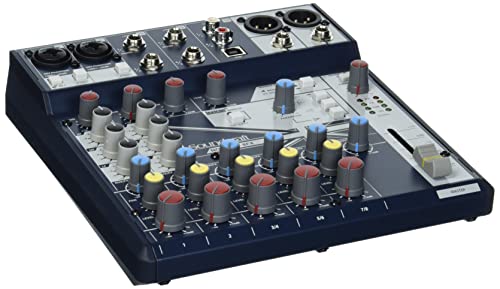
Soundcraft Notepad-8FX — Best Compact Stereo USB Desk
The Notepad-8FX is the compact end of serious: a small-format Soundcraft console with USB I/O and Lexicon effects — Lexicon being a name recording people associate with reverbs they actually like — sized for the solo performer with a stereo source, the small podcast-plus-music desk, the keyboardist’s submixer, or the home studio whose footprint is a shelf. It proves the category’s floor is not toys: eight channels of grown-up design in a carry-anywhere format.
Strengths
- Lexicon effects give compact-desk vocals a genuinely studio-flavoured polish
- Small format suits shelves, keyboard rigs, and portable small acts
- Soundcraft console design keeps operation musical and uncluttered
Trade-offs
- Eight channels cap ensemble ambitions — count a band’s inputs before falling for the size
- Compact controls are less forgiving for large hands and fast live riding
- Fewer routing options than the 12-channel desks for complex rooms
| Format | Small-format, 8 channels |
| Effects | Lexicon |
| Interface | USB I/O |
Compact desks usually announce their compromises in the effects section first — thin, novelty reverbs that owners switch off by week two. The Notepad’s Lexicon effects invert that: the polish is the point, and a solo singer with a stereo keyboard or tracks gets a finished, recordable sound from a desk that fits in a gig bag’s front pocket. Soundcraft’s console instincts keep the rest honest — sensible gain ranges, EQ that behaves — so the small format never feels like a toy that happens to pass audio.
Its discipline is the count. Eight channels with stereo sources in the mix means a duo-plus-tracks is comfortable and a band is not; buy it for the rig it fits and it will feel like a bespoke tool. Keyboardists in particular should note it as a submixer: blend your boards into one stereo pair here, hand the main desk two cables, and keep your own effects and levels under your own hands — a professional trick at a starter size.
Best for: solo performers, keyboard submixing, and compact home studios / Not suited for: bands or any rig counting past eight inputs
Check on Amazon — check the current price on Amazon before you buy, because configurations and included accessories vary by listing.
Comparison Table
| Pick | Badge | Key spec | Best for |
|---|---|---|---|
| Yamaha MG10XU 10-Input Stereo Mixer with Effects | Best Overall Stereo USB Mixer | 10-input, SPX FX, USB stereo | small venues, duos, keyboard rigs, and stream/record combos |
| Yamaha MG12XU 12-Input Mixer with Effects | Best for Growing Small Rigs | 12-input, 4-bus, USB stereo | small bands, growing venues, and operators wanting subgroups |
| Allen & Heath ZED-10FX | Best for Recording Quality | 10-ch, 3 stereo, USB I/O | keyboard rigs, project studios, and stereo-source-heavy setups |
| Behringer XENYX X1204USB | Best Value Stereo USB Mixer | 12-input, compressors, USB | budget bands, community studios, and rehearsal rooms that record |
| Mackie ProFX12v3 | Best for Live Effects and Gigging | 12-ch, Onyx, GigFX, USB | gigging bands, worship teams, and acts recording their shows |
| Soundcraft Notepad-8FX | Best Compact Stereo USB Desk | 8-ch compact, Lexicon FX, USB | solo performers, keyboard submixing, and compact home studios |
All six send a stereo mix over USB; they differ in input architecture and temperament. Count stereo sources as pairs, microphones singly, then choose: Yamaha for system calm, Allen & Heath for stereo-source architecture and recording quality, Behringer for features per pound, Mackie for live performance, Soundcraft for compact polish.
How to Choose a Stereo Mixer with USB
Stereo USB means stereo: confirm that is your workflow
The USB connection on every desk here carries the main stereo mix to the computer and a stereo return back. That is ideal for recording a finished performance — a service, a set, a stream, a rehearsal — and for playback duties like tracks and break music. It cannot deliver each microphone as a separate track for later editing. If your process is ‘record everything, mix later’, stop here and buy a multitrack interface instead; if your process is ‘mix it live, capture the result’, these desks are precisely the tool and the stereo limitation will never once bother you. Hybrid users record the stereo mix as the safety and the programme, and many professional live recordings are made exactly that way.
Also confirm the return path matters to you: USB playback through the desk lets the computer be a source — tracks, call-ins, video sound — blended on a real channel. Desks differ in how that return is routed and controlled, and for streaming and tracks-based acts it is a daily-use detail worth checking in the manual before purchase.
Count inputs the way sources actually connect
Channel counts lie politely. A ’12-channel’ desk might offer four mic inputs, two stereo channels, and assorted line inputs — perfect for one rig, wrong for another. Count your own rig in its native units: microphones singly, stereo sources (keyboards, DJ rigs, players, laptops) as dedicated stereo channels where possible, and instruments that need DI or line inputs. Then compare against the desk’s actual input list — the ZED-10FX’s three stereo channels, for example, are worth more to a keyboard rig than a higher headline number elsewhere.
Leave one source of headroom: the guest vocalist, the second keyboard, the playback device you add next season. Desks are outgrown at the input panel before anywhere else, and the price step to the next size is smallest on the day you first buy.
Effects: shared, live, and honestly weighted
Onboard effects in this class are a shared resource — one engine, blended into channels as needed — voiced for live work: reverbs and delays that make voices and rooms sound finished. For live-plus-record rigs that is exactly right, and the brand of the engine is a fair quality signal: Yamaha’s SPX, Lexicon in the Soundcraft, Mackie’s GigFX, and Behringer’s 24-bit processor are all working tools with different flavours. Judge them as live polish, not studio processing; your DAW’s plugins remain the deep toolbox for recordings, and the desk’s effects remain the sound the room — and the live capture — actually heard.
If your programme is talk-only, effects approach irrelevance and should not drive the choice at all: preamp quietness and layout clarity matter more. Buy the desk for your programme’s real needs, not its most festive night of the year.
The room and the recording are one system
A stereo USB desk usually serves two masters at once — the PA in the room and the computer capturing it — and the craft is that neither should compromise the other. Set the room sound first with the main mix; the recording inherits it. Keep recording levels conservative (the stereo bus that sounds powerful in a room can clip a USB feed if the desk’s USB send follows a hot master), and monitor the recording on headphones at least once per setup. Desks with clear metering and a documented USB level path — read the manual’s recording section before buying — save their owners from the silent heartbreak of a distorted archive of a great night.
Finally, think physically: these desks live on tables in halls, on keyboard stands, in small studio corners. Footprint, power supply type, and whether the USB connection is a sturdy standard socket all matter across years of load-ins. The best stereo mixer is the one that is set up, correctly, every time — because it is easy to set up.
Power, placement, and the practical life of a desk
Small mixers live unglamorous lives — hall cupboards, keyboard stands, the corner of a classroom — and their practical details decide their working lifespan as much as their circuits. Prefer desks whose power supplies are standard and replaceable; a lost proprietary brick can orphan an otherwise perfect mixer. Note whether the USB socket is a sturdy full-size type, because that cable gets plugged by volunteers in the dark. And measure the desk against its actual home: a mixer that must be set up and struck for every use should be the size that makes that ritual two minutes, not ten.
None of this appears in feature lists, and all of it appears in year three of ownership. The brands on this list have survived decades of exactly this practical life, which is a quieter recommendation than any specification.
Submixing: The Stereo Trick Professionals Use Weekly
One under-taught use of a compact stereo USB desk is as a submixer inside a larger rig. A keyboard player blends three boards into one stereo pair on a Notepad or ZED, applies their own effects and levels, and hands the main desk two cables and a finished sound. A drummer’s electronic kit, a DJ’s two decks plus sampler, a podcast’s music-and-effects sources — all can arrive at the main desk as one governed stereo feed. This is how big shows stay manageable, and it gives a small desk a second career long after a growing rig buys a bigger main mixer.
The same logic serves home studios: instruments that live together (the keyboard corner, the electronic drum kit) submix permanently, freeing the main interface’s inputs and keeping the setup ritual to powering on. If your rig grows, the compact desk you buy today is not replaced by that growth — it is promoted into it. Buy quality at this size and it never becomes waste.
Stereo Sources Deserve Stereo Thinking
Mono habits die hard in small rigs: a keyboard patched into two mono channels with the pan knobs wherever they were left, a playback laptop squeezed through a single input, a DJ rig summed by accident. A stereo mixer with proper stereo channels exists to protect the width your sources already have. Set stereo channels’ balance at centre, keep their levels matched by listening rather than by knob position, and reserve panning decisions for mono sources — voices centred, a guitar a breath off-centre, effects returns wide. The stereo image of a small rig is mostly the discipline of not collapsing it.
Recordings expose stereo carelessness mercilessly: the keyboard that leaned left all night, the backing track whose right channel never arrived because a cable failed silently. The headphone check in our setup sequence is where stereo is verified — play a source you know is wide, confirm both ears agree, and only then trust the desk. Stereo is half the product this category sells; it deserves its two minutes of verification.
When the Stereo Desk Meets the Stream
Streaming has quietly become the stereo USB desk’s second career: a worship service, a school concert, a duo’s weekly broadcast all ride the same USB cable the recording used to. The desk’s virtues transfer perfectly — real faders for the live balance, a finished stereo feed the streaming software simply receives, and no routing matrix to fail on air. The one streaming-specific discipline is level: streaming platforms normalise loudness, so a conservative, consistent stereo feed beats a hot, pumping one, and the operator who rides the master gently gives the platform a better programme to normalise.
If your venue or act is adding streaming to an existing stereo setup, you may already own the right tool: check the desk for USB before buying anything. Many rigs discover their mixer was stream-ready for years, waiting only for a cable and a test recording.
Meters, Headroom, and the Sound of ‘Too Much’
Every stereo desk here gives you a meter bridge or ladder, and learning to read it is the cheapest sound-quality upgrade in this entire guide. Headroom — the distance between your loudest peaks and the top of the meter — is not wasted level; it is where transients live, the crack of a snare, the consonant of a voice, the moment the whole band leans in. A mix run permanently at the top of the meter sounds smaller, not bigger, because those transients have nowhere to go and the stereo bus flattens them into fatigue. Aim for peaks that visit the top occasionally rather than live there, and let the PA or the platform provide the loudness. The recording will sound more powerful for it — the oldest paradox in audio, and the truest.
How to Set Up a Stereo USB Mixer for Recording and Live Sound
One desk, two destinations — the room and the computer. This sequence sets both correctly and is the same for every pick on this list.
Step 1: Wire sources by type
Microphones to mic inputs (phantom on only for condensers), stereo sources to stereo channels, instruments to DI/line inputs, speakers to the main outputs, and the USB cable to the computer. All gains and levels down before power.
Step 2: Select the desk in your software
In your recorder or streaming tool, choose the mixer as input and output. Play a known file from the computer and confirm it arrives on the desk’s USB return channel at a healthy level.
Step 3: Gain-stage each source at performance level
One at a time, set each channel’s gain so its loudest real moments sit strong but safely below the top. Stereo sources: check both sides are balanced — a lopsided keyboard patch is a recording flaw you cannot fix later.
Step 4: Build the stereo mix for the room
Balance channels, pan deliberately (keep voices and bass near the centre; let stereo sources be stereo), and add effects sparingly for the room’s size. What the room hears is what the recording gets — make it good here.
Step 5: Verify the recording before the event
Record one full minute at performance energy and listen back on headphones: level, balance, no clipping, no hum. Adjust the desk’s USB send or master conservatively if the recording runs hot. This minute is the cheapest insurance in live audio.
Save a photograph of the finished panel and a note of the software settings. A stereo USB desk’s whole value is repeatability — the same good sound, in the room and on the recording, every time you set it up. Keep that photograph and those notes with the desk itself — a phone snapshot in a shared album the whole team can reach — because the person setting up is not always the person who learned it, and a stereo rig’s consistency across different operators is exactly what separates a system from a habit.
Common Buying Mistakes
Expecting multitrack from a stereo desk
The category’s founding misunderstanding. Stereo USB means the finished mix, two channels. If per-track editing is your process, buy the interface class instead — no mixer setting will conjure tracks that were never sent.
Counting channels instead of inputs
Headline numbers blend mic, line, and stereo inputs into one figure. Count your microphones and your stereo sources against the actual input list, or the second keyboard arrives to find nowhere to live.
Running the master too hot for the recording
A powerful room level can overload the USB feed. Record a test at real volume and set levels for the recording’s headroom, not the room’s excitement.
Ignoring the stereo return path
Computer audio coming back through the desk — tracks, call-ins, video — is half the system’s value. Desks route it differently; learn yours before the event, not during it.
Skipping the headphone check
Rooms lie, especially small reverberant ones. The recording tells the truth, and headphones are how you hear it before your audience does.
Patching stereo sources into mismatched channels
A keyboard across two mono channels with different gains or EQ is a lopsided recording waiting to happen. Use true stereo channels for stereo sources — they exist precisely to prevent this.
Final Recommendation
The Yamaha MG10XU is the stereo USB default and the MG12XU its growth size; the Allen & Heath ZED-10FX is the recording-quality, stereo-source specialist; the Behringer X1204USB the value benchmark with live-saving compressors; the Mackie ProFX12v3 the gigging performer’s desk; and the Soundcraft Notepad-8FX the compact polish. All of them turn real sources into a clean stereo picture a computer can keep.
Check the current price on Amazon for the size you counted — in this category the right size at a fair price beats the wrong size at a discount, every time.
The shortlist in one line: Yamaha MG10XU 10-Input Stereo Mixer with Effects, Yamaha MG12XU 12-Input Mixer with Effects, Allen & Heath ZED-10FX, Behringer XENYX X1204USB, Mackie ProFX12v3, Soundcraft Notepad-8FX.
Keep exploring the cluster: Best Starter Mixers For Streaming Best Starter Mixers Best Standalone Dj Mixers Best Audio Mixers Best Stick Mixers
Frequently Asked Questions
What does USB do on a stereo mixer?
It sends the finished stereo mix to a computer for recording or streaming, and returns computer audio to the desk for playback — tracks, call-ins, video sound — as a source in the mix.
Can I record each microphone separately with one of these?
No — these desks send the stereo mix only. Per-track recording requires a multitrack interface. Many users happily record the stereo mix as the programme and find it entirely sufficient for live material.
How many inputs do I need for a keyboard rig?
Count each stereo keyboard as one stereo channel, plus microphones and playback. A two-board rig with one vocal mic typically lands on a 10-input desk with at least two true stereo channels — the ZED-10FX’s architecture exists for exactly this.
Are built-in effects good enough for live vocals?
Yes, for live work: the SPX, Lexicon, GigFX, and Behringer engines here are working live effects, voiced for rooms. Studio recordings can add finer processing in software afterwards on the captured stereo mix.
Which is better for a church or school — Yamaha or Behringer?
Both serve widely. Yamaha’s documentation and calm layout suit volunteer teams; Behringer’s compressors and value suit budget-governed setups with variable speakers. Either outlasts its welcome more slowly than the operator learns it.
Can a stereo mixer be a submixer later?
Absolutely — compact stereo desks graduate into submixer duty (keyboards, electronic drums, DJ rigs) inside larger systems. It is one of the best reasons to buy quality at this size.
Can I use a stereo USB mixer for a podcast with three hosts?
Yes, if the desk has three mic inputs and your process is live-to-stereo: the show is mixed as it records. If you need per-host tracks for editing, that remains multitrack-interface territory.
Does USB audio quality differ between these desks?
All deliver clean stereo digital audio suitable for broadcast and release. Differences that matter are noise floor at the preamps and level behaviour, not the USB itself — which is why the guide weights preamps and metering.


