Disclosure: airfryerkitchensupply.com is reader-supported. When you buy through links on our site, we may earn an affiliate commission at no extra cost to you.
Where to buy
Every model in this guide to the best affordable stand mixers is a current machine sold on Amazon by the brand or an authorised seller, and each pick below links to its exact listing so you can check the current price on Amazon before you buy. Stand mixer listings vary by colour and bundle more than almost any kitchen category, so confirm the bowl size, the included tools and the model number on the listing match the pick described here.
- KitchenAid Artisan Series 5 Tilt-Head Stand Mixer (KSM150PS) — Check on Amazon and confirm the bowl size and tool set on the listing before ordering.
- Cuisinart Precision Master 5.5-Quart Stand Mixer (SM-50) — Check on Amazon and confirm the bowl size and tool set on the listing before ordering.
- KitchenAid Classic Series 4.5-Quart Tilt-Head Stand Mixer (K45SS) — Check on Amazon and confirm the bowl size and tool set on the listing before ordering.
- Hamilton Beach 4-Quart Electric Stand Mixer — Check on Amazon and confirm the bowl size and tool set on the listing before ordering.
- Aucma 6.5-Qt Tilt-Head Stand Mixer — Check on Amazon and confirm the bowl size and tool set on the listing before ordering.
- Kitchen in the Box 3.5QT Stand Mixer — Check on Amazon and confirm the bowl size and tool set on the listing before ordering.
The best affordable stand mixers are not the cheapest stand mixers on the internet, and that distinction matters. Below the tier covered here sits a layer of ultra-cheap machines with weak motors, tiny bowls and no repair path at all. The affordable tier that actually works starts with the six machines in this guide: real planetary mixing, bowls sized for real recipes, and brands that will still sell you a replacement beater in five years.
Affordability in this category is really about cost per year, not cost per box. A mixer that kneads, whips and creams reliably for a decade is cheaper than a bargain machine replaced twice in the same period. That is why this guide mixes household-name machines at their lowest sensible tiers with a couple of budget-brand outliers that earn their place on capacity or size rather than prestige.
Every pick was chosen for a different baker. There is a benchmark all-rounder, a big-bowl value play, the cheapest respectable way into a premium ecosystem, an honest entry-level machine for occasional baking, a capacity outlier for batch bakers, and a genuinely compact option for one-to-two-person kitchens. Read the trade-offs as carefully as the strengths — in the affordable tier, knowing what a machine cannot do is what keeps you from buying the wrong one. None of these six asks you to pretend a budget machine is a professional one, and that honesty is the point of the guide.
In this guide
Quick Picks
KitchenAid Artisan Series 5 Tilt-Head Stand Mixer (KSM150PS) — Best Overall
The Artisan is the affordable stand mixer benchmark for a reason: a 5-quart bowl that suits real family baking, 10 speeds with a genuinely gentle stir setting, and the deepest attachment ecosystem in the category. It costs more than the budget tier, but it is the cheapest mixer most people never replace. Check the current price on Amazon
Cuisinart Precision Master 5.5-Quart Stand Mixer (SM-50) — Best for Frequent Bakers
Cuisinart’s Precision Master gives you a slightly larger 5.5-quart bowl and 12 speeds at a friendlier tier than the Artisan, with a full set of tools in the box — whisk, paddle, dough hook and a splash guard with a pour spout. A strong value pick for bakers who mix often. Check the current price on Amazon
KitchenAid Classic Series 4.5-Quart Tilt-Head Stand Mixer (K45SS) — Best Brand-Name Value
The Classic Series is the entry point into KitchenAid ownership: the same tilt-head layout, 10 speeds and full attachment-hub compatibility as the Artisan, in a slightly smaller 4.5-quart bowl. For smaller households it is the smartest way to buy the badge without overspending. Check the current price on Amazon
Hamilton Beach 4-Quart Electric Stand Mixer — Best Budget
Hamilton Beach’s 4-quart stand mixer is the honest budget option: planetary mixing, 7 speeds, a splash guard and all three core tools — whisk, flat beater and dough hook — at the lowest tier in this guide. For occasional bakers, it does the essential jobs without the essential-brand price. Check the current price on Amazon
Aucma 6.5-Qt Tilt-Head Stand Mixer — Best Big Bowl on a Budget
Aucma’s pitch is simple: the biggest bowl in this guide — 6.5 quarts — driven by a 660-watt motor, at a budget tier. If your baking problem is batch size rather than brand prestige, this is the value outlier, with dough hook, wire whip and beater included. Check the current price on Amazon
Kitchen in the Box 3.5QT Stand Mixer — Best for Small Kitchens
A genuinely small stand mixer for one-to-two-person households: a 3.5-quart dishwasher-safe bowl, 10 speeds, and the three core tools in a footprint that fits apartments and compact kitchens. It is not trying to feed a family — it is sized for how small households actually bake. Check the current price on Amazon
How These Picks Were Chosen
We started with the full affordable market — every stand mixer positioned below the premium and professional tiers — and cut it down with four filters. First, real mixing action: every pick uses planetary mixing, where the beater orbits the bowl while spinning, because single-axis budget mixers leave unmixed pockets that ruin batters. Second, honest capacity: bowl sizes were matched to the batch sizes each machine can genuinely handle, not the most optimistic number on the box. Third, the core tool set: a pick had to include a flat beater, a whisk and a dough hook, because a stand mixer missing any of the three is only doing part of the job. Fourth, a plausible ownership story: replacement tools available, a brand with a track record, and no pattern of early motor failures.
Each surviving model was then assigned the badge that describes the buyer it serves best, not a generic ranking. Motor figures are quoted only where the manufacturer’s own listing states them, and we treat wattage as a rough guide rather than a promise — drivetrain design and gearing matter as much as the number. Where a budget brand’s long-term support is thinner than a household name’s, we say so in the review rather than hiding it, because at this tier the trade-off between price and longevity is the decision you are actually making.
Two real-world behaviours weighed heavily in the final ordering. The first is dough behaviour: how steadily the machine holds speed when a hook engages a firm dough, whether the head flexes, and whether the body stays planted on the counter. The second is small-batch behaviour, the affordable category’s quiet weakness — a big, deep bowl that cannot properly engage two egg whites or a half-batch of buttercream is a daily annoyance that spec sheets never mention. Picks that handled both ends of the batch range credibly ranked above picks that only shone at one extreme, which is why the ordering here rewards versatility over any single headline number.
The 6 Best Affordable Stand Mixers
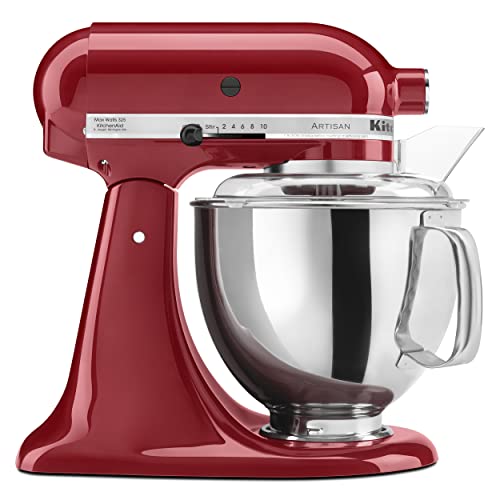
KitchenAid Artisan Series 5 Tilt-Head Stand Mixer (KSM150PS) — Best Overall
The Artisan is where the affordable category stops being a compromise. It suits the home baker who makes cakes and cookies weekly, kneads a loaf or two of bread dough at a time, and wants one machine to last a decade or more. It does not suit production bakers who regularly push double batches of stiff dough — that workload belongs to larger bowl-lift machines.
Strengths
- Proven tilt-head design with 10 speeds, including a slow stir that folds without splashing flour everywhere
- Huge attachment ecosystem — pasta, grinding, grain milling and more — all driven from the front hub
- Metal-heavy build and a long track record of serviceability compared with disposable budget mixers
Trade-offs
- Sits at the top of the affordable tier; the budget picks below cost noticeably less
- Tilt-head design needs overhead clearance, so low cabinets can be a problem
- Included flat beater is not a flex-edge design, so bowl scraping is still a manual job
Key specs (verified)
- Bowl: 5-quart stainless steel (verified via Amazon listing)
- Speeds: 10
- Design: tilt-head, pouring shield included
What separates the Artisan from cheaper machines is not raw power on paper but behaviour under load. The drivetrain holds speed steadily when a dough hook starts working, instead of surging and labouring the way light budget mixers do. For enriched doughs, pizza bases and thick cookie dough, that steadiness is the difference between a mixer that helps and a mixer you have to supervise.
The planetary mixing action that KitchenAid builds across this line means the beater reaches around the bowl rather than spinning in one circle, so you scrape less and re-mix less. In practice, creaming butter and sugar comes together evenly, and egg whites whip without the unmixed ring at the bottom that plagues single-axis cheap mixers.
Ownership is the other half of the value case. Replacement beaters, bowls in other sizes, and attachments are everywhere, and independent repair shops know these machines well. An affordable mixer that can be repaired is cheaper over ten years than a bargain mixer that gets landfilled in year three — and that is exactly the maths this pick is built on.
Best for: regular home bakers who want one long-lived machine for cakes, cookies and single-loaf doughs. / Not suited for: bakers who routinely double stiff bread recipes or have very low wall cabinets.
Check the current price on Amazon

Cuisinart Precision Master 5.5-Quart Stand Mixer (SM-50) — Best for Frequent Bakers
The Precision Master suits bakers who want capacity and speed control without paying the KitchenAid premium. Twelve speeds give finer control at the low end for folding and at the high end for whipping, and the 5.5-quart bowl swallows family-size batches. It does not suit buyers who care about the front-hub attachment ecosystem — Cuisinart’s add-on range is far smaller.
Strengths
- 12 speeds offer finer low-speed control than most rivals at this tier
- Generous 5.5-quart stainless bowl handles bigger batches than 4.5-quart rivals
- Complete tool set in the box, including a splash guard with pour spout
Trade-offs
- Smaller attachment ecosystem than KitchenAid, so future add-ons are limited
- Head and body use more non-metal materials than the Artisan
- Fewer colour choices and a less established long-term repair network
Key specs (verified)
- Bowl: 5.5-quart stainless steel (verified via Amazon listing)
- Speeds: 12
- Included tools: chef’s whisk, mixing paddle, dough hook, splash guard with pour spout
In daily use, the Precision Master’s party trick is control. The extra low gears make it easier to incorporate flour without a white cloud over the counter, and the dial-style control is simple to nudge mid-mix with messy hands. For bakers who move between delicate sponges and heavy fruit-cake batters in the same session, that range earns its keep.
The bowl deserves a mention: at 5.5 quarts it takes a double batch of most cookie recipes and a large loaf’s worth of dough without riding up the hook. The included splash guard actually fits and stays put, which sounds trivial until you have used budget guards that rattle loose the moment the paddle starts moving.
Where you give ground versus the Artisan is the long game. Cuisinart supports the machine and sells replacement tools, but there is no equivalent of the KitchenAid hub universe — no pasta rollers or grain mills driven by this motor. If your baking ambitions are strictly mixing, whipping and kneading, that gap may never matter, and the money saved is real.
Best for: frequent bakers who want a big bowl and fine speed control for less than the benchmark brand. / Not suited for: cooks who want powered attachments like pasta rollers and meat grinders.
Check the current price on Amazon

KitchenAid Classic Series 4.5-Quart Tilt-Head Stand Mixer (K45SS) — Best Brand-Name Value
The Classic suits smaller households and new bakers who want KitchenAid build and hub compatibility at the lowest tier the brand offers. The 4.5-quart bowl is right-sized for one-to-four-person baking. It does not suit big-batch bakers — double cookie batches and large doughs will test its limits, and the Artisan’s extra half-quart and refinements are worth it if you bake for crowds.
Strengths
- Full compatibility with KitchenAid’s powered hub attachments, unlike most budget rivals
- Durable metal construction and planetary mixing that reaches around the bowl
- 10 speeds cover everything from a gentle stir to fast whipping
Trade-offs
- 4.5-quart bowl is tight for double batches and large doughs
- Fewer included extras than the Artisan — no pouring shield in the box
- Smaller motor headroom shows on very stiff, low-hydration doughs
Key specs (verified)
- Bowl: 4.5-quart (verified via Amazon listing)
- Speeds: 10
- Design: tilt-head, metal construction, attachment-hub compatible
Think of the Classic as the Artisan’s sensible sibling. The mixing experience — the planetary action, the speed range, the way the tilt head locks and lifts — is recognisably the same, and for the cakes, batters and single doughs that make up most home baking, you will not feel short-changed.
The compromises are about headroom, not quality. A 4.5-quart bowl means a double batch of chocolate-chip cookie dough rides close to the rim, and stiff bagel-style dough makes the machine work hard. Used within its design brief — standard loaves, celebration cakes, whipped cream, meringues — it is entirely capable, and it will accept every hub attachment you might buy later.
That upgrade path is the real argument. Budget-brand mixers are dead ends: when you outgrow them, you replace the whole machine. With the Classic, the machine you buy on day one can gain a pasta roller next year and a grain mill the year after, which spreads the cost of the hobby instead of restarting it.
Best for: smaller households and first-time stand mixer buyers who want the KitchenAid ecosystem at its lowest tier. / Not suited for: big-batch bakers who regularly mix for parties or bake sales.
Check the current price on Amazon

Hamilton Beach 4-Quart Electric Stand Mixer — Best Budget
This Hamilton Beach suits occasional bakers: the weekend cake, the holiday cookie marathon, mashed potatoes and whipped cream without dragging out a hand mixer. It does not suit committed bread bakers. At 300 watts with a lighter build, sustained stiff dough is beyond its comfort zone, and pretending otherwise is how budget mixers die young.
Strengths
- Planetary mixing action for full bowl coverage, rare at this tier
- All three core tools plus a splash guard included in the box
- Light, compact body is easy to store and move — good for small kitchens
Trade-offs
- 300-watt motor labours on stiff doughs; keep bread work light and small
- Lighter construction means it can walk on the counter at high speed with heavy loads
- 7 speeds give less fine control than 10- or 12-speed rivals
Key specs (verified)
- Bowl: 4-quart (verified via Amazon listing)
- Speeds: 7
- Motor: 300 watts; planetary mixing; splash guard, whisk, flat beater and dough hook included
Judge this mixer by the jobs most households actually do. Creaming butter, beating cake batter, whipping cream and egg whites, stirring together a standard cookie dough — it handles all of that willingly, and the planetary action means it genuinely mixes rather than just stirring the middle of the bowl. For the price tier, that competence is the whole story, and it delivers.
The limits are equally clear. The motor is rated at 300 watts and the machine is light, so a big, stiff dough will slow it, heat it and make it shuffle across the counter. The fix is behavioural, not technical: mix dough in smaller batches, let the machine rest, and use the dough hook at low speed only. Treated that way, it survives; abused, it will not.
Storage is an underrated strength. Many budget buyers have small kitchens, and this machine’s modest footprint and weight mean it can live in a cupboard rather than colonising the counter. A mixer that is easy to get out is a mixer that gets used — which is more than can be said for some heavier machines.
Best for: occasional bakers and small households who want stand-mixer convenience at the lowest sensible tier. / Not suited for: regular bread bakers or anyone planning heavy, stiff doughs.
Check the current price on Amazon

Aucma 6.5-Qt Tilt-Head Stand Mixer — Best Big Bowl on a Budget
The Aucma suits batch bakers: big families, bake-sale producers and anyone who doubles recipes as a matter of habit. The 6.5-quart bowl and strong motor rating handle volume that would overwhelm the 4-quart budget picks. It does not suit buyers who prioritise quiet refinement, colour-matched design, or a decades-deep repair network — this is a capacity-per-money play, not a heirloom play.
Strengths
- Largest bowl here at 6.5 quarts — double and triple batches fit properly
- 660-watt motor rating is strong for the budget tier
- Tilt-head design with the three core tools included
Trade-offs
- Budget-brand fit and finish; expect more noise and vibration than premium rivals
- Long-term parts and service network is thinner than the big brands
- Large footprint — measure your counter and cabinet clearance before buying
Key specs (verified)
- Bowl: 6.5-quart (verified via Amazon listing)
- Motor: 660 watts
- Design: tilt-head; dough hook, wire whip and beater included
Capacity changes what you can cook. A 6.5-quart bowl takes a triple batch of cookie dough, a big enriched celebration dough, or enough mashed potatoes for a holiday table in one go. Bakers who constantly hit the rim of a 4.5-quart bowl will feel the difference immediately, and the motor rating gives the machine a fighting chance of turning that volume rather than stalling in it.
The honest caveats are about refinement. Budget machines at this size tend to be louder, the speed steps less granular, and the head can flex slightly under a full, heavy load. None of that stops it mixing; it just feels less polished than the KitchenAid and Cuisinart picks while it does the same work.
Think about lifespan expectations too. With sensible use — dough hooks at low speed, no forcing frozen butter, a rest between back-to-back heavy batches — owners get good service from machines like this. But if it does fail in year four, replacement rather than repair is the realistic path, and the low entry tier is what makes that maths acceptable.
Best for: batch bakers and big households who need maximum bowl capacity at a budget tier. / Not suited for: buyers seeking a quiet, refined, keep-for-decades machine.
Check the current price on Amazon

Kitchen in the Box 3.5QT Stand Mixer — Best for Small Kitchens
This compact mixer suits singles, couples and small-space bakers who mix half-batches, single cakes, small doughs and whipped toppings. Right-sizing is its whole philosophy. It does not suit family baking: a 3.5-quart bowl cannot take double batches, and anyone regularly baking for four or more should step up to at least the 4.5-quart class.
Strengths
- Small footprint and light weight suit apartments, studios and crowded counters
- 10 speeds — unusually granular control for a compact budget machine
- Dishwasher-safe bowl keeps cleanup painless
Trade-offs
- 3.5-quart capacity rules out double batches and large doughs
- Small-batch focus means keen bakers may outgrow it quickly
- Budget-brand longevity and parts support are limited
Key specs (verified)
- Bowl: 3.5-quart, dishwasher-safe (verified via Amazon listing)
- Speeds: 10
- Included tools: dough hook, beater, egg whisk; sized for 1–2 people
Most ‘small kitchen’ mixer advice tells you to buy a big machine and store it in a cupboard, where it slowly becomes furniture you resent. This pick takes the opposite view: a mixer sized to the baking you actually do, light enough to move with one hand and small enough to earn permanent counter space in a tight kitchen.
Within its lane, it is well equipped. Ten speeds is generous at this size and tier, and the tool set covers the core jobs — a hook for small doughs, a beater for batters, a whisk for eggs and cream. A single loaf of sandwich bread, a layer cake, a batch of muffins: all comfortably in scope, with the dishwasher-safe bowl making the aftermath easy.
The boundary is batch size, and it is a hard boundary. Flour-heavy double batches will climb out of a 3.5-quart bowl, and stiff doughs in quantity are not its job. Buy it as the right tool for one-to-two-person baking and it is a pleasure; buy it as a cheap substitute for a family mixer and you will be disappointed for predictable reasons.
Best for: singles, couples and small kitchens baking in one-to-two-person quantities. / Not suited for: families or anyone who doubles recipes by default.
Check the current price on Amazon
Comparison Table
| Pick | Badge | Key spec | Best for |
|---|---|---|---|
| KitchenAid Artisan Series 5 Tilt-Head Stand Mixer (KSM150PS) — Check on Amazon | Best Overall | 5-quart stainless steel (verified via Amazon listing) | regular home bakers who want one long-lived machine for cakes, cookies and single-loaf doughs. |
| Cuisinart Precision Master 5.5-Quart Stand Mixer (SM-50) — Check on Amazon | Best for Frequent Bakers | 5.5-quart stainless steel (verified via Amazon listing) | frequent bakers who want a big bowl and fine speed control for less than the benchmark brand. |
| KitchenAid Classic Series 4.5-Quart Tilt-Head Stand Mixer (K45SS) — Check on Amazon | Best Brand-Name Value | 4.5-quart (verified via Amazon listing) | smaller households and first-time stand mixer buyers who want the KitchenAid ecosystem at its lowest tier. |
| Hamilton Beach 4-Quart Electric Stand Mixer — Check on Amazon | Best Budget | 4-quart (verified via Amazon listing) | occasional bakers and small households who want stand-mixer convenience at the lowest sensible tier. |
| Aucma 6.5-Qt Tilt-Head Stand Mixer — Check on Amazon | Best Big Bowl on a Budget | 6.5-quart (verified via Amazon listing) | batch bakers and big households who need maximum bowl capacity at a budget tier. |
| Kitchen in the Box 3.5QT Stand Mixer — Check on Amazon | Best for Small Kitchens | 3.5-quart, dishwasher-safe (verified via Amazon listing) | singles, couples and small kitchens baking in one-to-two-person quantities. |
How to Choose an Affordable Stand Mixer That Fits Your Baking
Start with batch maths, not marketing. Bowl size is the single most consequential spec in this category, and the right answer comes from your recipes, not from a size chart. A standard single batch of cookie dough, one layer cake or one loaf of bread sits comfortably in 4 to 4.5 quarts. If you habitually double recipes, bake for a big household, or make large enriched doughs, you need 5.5 quarts or more — which is why the Cuisinart and Aucma picks exist. Conversely, one-to-two-person bakers mixing half-batches are better served by a compact 3.5-quart machine than by a big bowl in which small quantities just smear around the bottom unmixed.
Tilt-head versus bowl-lift. Every pick in this guide is a tilt-head design, and that is deliberate: at the affordable tier, tilt-heads are simpler, lighter and easier to live with. The head tips back so you can swap tools and scrape the bowl without a fight. The cost is clearance — measure the space between your counter and wall cabinets with the head raised before you buy, because a mixer that cannot open under your cabinets will live on the counter permanently or not get used. Bowl-lift machines, which raise the bowl to a fixed head, are sturdier for very stiff doughs but mostly live above this guide’s tier.
Read motor claims sceptically. Wattage numbers in this category are marketing-friendly and measured inconsistently between brands. A well-geared 300-watt machine with planetary action will out-mix a poorly designed higher-watt rival, and what actually matters for dough is torque at low speed plus a drivetrain that does not surge. Use the wattage figures in our spec boxes as a rough tier indicator, then weight the review’s load behaviour notes more heavily than the number.
Count the tools, then check the ecosystem. A flat beater, a whisk and a dough hook are non-negotiable, and all six picks include them. Beyond that, decide whether powered attachments matter to you. If pasta rolling, meat grinding or grain milling are on your future list, the two KitchenAid picks are the only ones here with a deep powered-hub ecosystem, and that future-proofing is worth real money. If mixing is all you will ever ask of the machine, the budget brands give you the same three core jobs for less.
Budget Tiers, Explained Honestly
The affordable market splits into three honest tiers. The entry tier — where the Hamilton Beach, Aucma and Kitchen in the Box picks sit — buys you competent mixing for standard recipes, with lighter builds and thinner long-term support. It is the right tier for occasional bakers and for anyone testing whether stand mixing fits their cooking life at all. The mid tier, represented by the Cuisinart Precision Master and the KitchenAid Classic, buys sturdier construction, better speed control and brands with real service networks. The top of affordable, where the Artisan sits, buys the benchmark ownership experience: the deepest accessory ecosystem, the strongest repair culture and the best chance the machine is still working in fifteen years.
None of these tiers is the ‘wrong’ one. The mistake is mismatching tier to workload: an entry-tier machine fed a weekly diet of stiff double doughs will die young and feel like a false economy, while a top-tier machine used twice a year for birthday cakes is money parked on the counter. Match the tier to how often and how heavily you bake, and every pick in this guide is good value.
How to Use a Stand Mixer Without Wearing It Out
Most affordable mixers that fail early are killed by technique, not defects. These habits will keep any pick in this guide alive:
- Start slow, always. Begin every mix at the lowest speed and let dry ingredients get incorporated before raising the speed. This prevents flour clouds and, more importantly, avoids the shock load of a beater slamming into a dry, dense mass at full power.
- Respect the dough hook’s speed limit. Knead on low speed only — speed 2 on most machines. Higher speeds overheat the motor and can walk a light mixer across the counter.
- Watch batch size on stiff doughs. If the head starts flexing, the motor note drops sharply, or the dough climbs the hook and stalls, split the batch. Two comfortable halves beat one abusive whole.
- Let it rest between heavy jobs. Back-to-back dough batches build heat in the drivetrain. Ten minutes of rest between heavy mixes is cheap insurance at this tier.
- Scrape once, properly. Stop midway through creaming or batter mixing, scrape the bowl bottom and sides with a spatula, then continue. One proper scrape replaces minutes of over-mixing that toughens cakes.
- Keep it clean and dry. Wipe the head and hub after use, wash tools promptly, and never immerse the mixer body. Flour dust left in vents and seams is a slow, silent source of wear.
Noise, Weight and Counter Reality
Three ownership details rarely appear on product pages, and all three decide whether an affordable mixer gets used or gets hidden. The first is noise. Stand mixers are not quiet appliances, and budget models are generally louder than premium ones because lighter housings and simpler gearing transmit more sound. If you bake early in the morning in a small apartment, expect to be heard; there is no silent pick in this tier, only less-loud ones, and the heavier KitchenAid and Cuisinart bodies have a small edge simply through mass.
The second is weight and storage. A stand mixer that lives in a low cupboard and weighs as much as a small child will be used less than a lighter machine that lives on the counter. Be honest about your own habits: if the mixer must be stored away, the compact Kitchen in the Box and the relatively light Hamilton Beach are realistic in a way a big, heavy machine is not. If it will live out permanently, measure the counter footprint and the raised-head clearance, and leave room to actually slide the bowl in and out.
The third is cleaning. Removable bowls and tools that tolerate the dishwasher save real time across hundreds of bakes. Stainless bowls like those on the Cuisinart and KitchenAid picks are effectively immortal and easy to sanitise, while coated beaters should be treated gently — chips in the coating are the most common cosmetic failure on affordable mixers, and hand-washing the tools is the simplest way to avoid it. None of this is glamorous, but ownership is made of exactly these details, and they are worth weighing alongside speeds and bowl sizes.
What About Attachments and Expandability?
Stand mixers are unusual kitchen purchases because some of them are platforms, not just appliances. The front hub on the two KitchenAid picks accepts powered attachments that turn the mixer into a pasta roller, a meat grinder, a grain mill, a spiraliser and more. If there is any chance your cooking will grow in those directions, that expandability has real cash value: each attachment costs far less than a separate dedicated machine, and it borrows a motor you already own and trust.
The other picks take the opposite deal, and it is a legitimate one. The Cuisinart, Hamilton Beach, Aucma and Kitchen in the Box machines are mixing-only tools, and their lower prices reflect that focus. If your ambitions begin and end with cakes, cookies, bread and whipped things, you are not missing anything — you are simply not paying for a hub you will never use. The buying mistake is not choosing either direction; it is choosing accidentally, then discovering a year later that the machine you own cannot grow the way your cooking has.
Ownership Notes: Bowls, Beaters and Everyday Reality
A second bowl is the most useful accessory most bakers can buy, whatever the brand. Recipes that whip egg whites separately and then fold them into a batter are miserable with one bowl and trivial with two, and a spare bowl also rescues you when the first is full of dough that needs to proof in place. On the KitchenAid and Cuisinart picks, extra bowls are easy to find; on the budget brands, check availability before you need one, because the day you need it is not the day to discover it is discontinued.
Beater choice matters more than most owners realise. The standard flat beater is the workhorse for creaming and batters. A flex-edge beater, which scrapes the bowl as it turns, genuinely reduces stopping-and-scraping on machines that offer one, and is worth having if your platform supports it. Burnished metal beaters tolerate the dishwasher better than coated ones, which can chip if they rattle against other items — hand-washing coated tools takes thirty seconds and doubles their cosmetic life.
Finally, plan where the mixer lives before it arrives. A stand mixer is a commitment of counter or cupboard space, and the bakers who love their machines are the ones who removed the friction: a permanent counter spot with clearance, or a low, easy shelf. If lifting a heavy mixer out of a high cupboard sounds like a chore you will avoid, choose one of the lighter picks and give it counter space. The best affordable stand mixer is ultimately the one that is out, plugged in and ready when the baking idea strikes — features you never use because the machine is buried help no one.
Common Buying Mistakes
- Buying the biggest bowl by default. Oversized bowls mix small batches badly. Match the bowl to your typical batch, not your biggest-ever bake.
- Believing wattage equals dough ability. Gearing, torque and planetary action matter more than the headline number, especially at low speeds.
- Forgetting cabinet clearance. A tilt-head mixer needs room to open. Measure before ordering, not after delivery.
- Ignoring the tool set. A bargain mixer missing a dough hook or whisk is not a bargain — price the missing tools into the comparison.
- Planning to knead everything. Very stiff, low-hydration doughs in large quantities are professional workloads. Be honest about yours, or buy up a tier.
- Skipping the ecosystem question. If you will want powered attachments later, only some brands offer them. Buying the wrong platform means replacing the whole machine later.
Final Recommendation
For most people, the KitchenAid Artisan is the affordable stand mixer to buy: it is the benchmark because it mixes properly, lasts, and grows with you through its attachment hub (check the current price on Amazon). If the budget is tighter, the Cuisinart Precision Master gives you more bowl and more speeds for less (check the current price on Amazon), and the KitchenAid Classic keeps you inside the KitchenAid ecosystem at its lowest tier. Occasional bakers should save their money and take the Hamilton Beach (check the current price on Amazon); batch bakers should take the Aucma’s big bowl; small households should take the compact Kitchen in the Box and enjoy a mixer that actually fits their kitchen.
Still deciding between the wider field? Compare these picks with the broader roundups in this series: Best Affordable Mixers Best Affordable Kitchen Mixers Best Affordable Hand Mixers Best Affordable Mixers For Baking Best Affordable Electric Mixers Best 6 Qt Standing Mixers — each covers a neighbouring slice of the mixer market with the same no-nonsense approach to strengths and trade-offs.
Related guides
Frequently Asked Questions
What size stand mixer do I need for bread dough?
For single loaves from standard recipes, a 4.5 to 5-quart bowl is enough, and every mid-tier pick here handles that workload. If you regularly bake two loaves at once or large enriched doughs, step up to the 5.5-quart Cuisinart or the 6.5-quart Aucma, and always knead at low speed.
Is a tilt-head or bowl-lift mixer better on a budget?
At the affordable tier, tilt-head is the better buy for most people: the machines are lighter, simpler and easier to scrape and clean. Bowl-lift designs are stronger for very stiff doughs but generally sit above this price class.
Can an affordable stand mixer replace a hand mixer?
For batters, doughs, whipped cream and meringues, yes — and it frees your hands while it works. A hand mixer still wins for tiny jobs like whipping two egg whites in a small bowl, where a big stand mixer bowl is clumsy. Many households happily keep both.
How long should an affordable stand mixer last?
With sensible use — right-sized batches, low-speed kneading, rest between heavy jobs — the brand-name picks here are decade-class machines, and the budget picks should give years of service on lighter workloads. Abuse with oversized stiff doughs is what shortens lives at this tier.
Are stand mixer attachments worth buying?
Only if you will use them, and only on platforms that offer them. The KitchenAid picks accept a deep range of powered hub attachments, from pasta rollers to grain mills. If you bake only, the three included tools cover nearly everything and extra attachments are money better kept.
Why does my mixer leave unmixed flour at the bottom of the bowl?
Usually the beater-to-bowl clearance needs a small adjustment, or the batch is too small for the bowl. Stop, scrape the bottom with a spatula, and continue at low speed. Persistent problems on a new machine are a warranty conversation, not something to live with.
Is it worth paying more for a metal-body mixer?
If you bake weekly or knead regularly, yes: metal-heavy bodies flex less under load, run steadier, and tend to anchor the machine to the counter instead of letting it walk. For light, occasional use, a lighter machine is a reasonable saving — just keep batch sizes honest and hold the machine steady at high speeds with heavy loads.

