Disclosure: airfryerkitchensupply.com is reader-supported. When you buy through links on our site, we may earn an affiliate commission at no extra cost to you.
Where to buy
Every pick in this guide to the best affordable mixers is sold on Amazon, and that is where we recommend buying. Mixers range from drawer-sized hand models to counter-dominating stand mixers, and Amazon’s listings make it easy to compare the exact configuration — bowl size, included attachments, colour — before you commit. Use the links in this section for the fastest route to each pick, or the Check on Amazon buttons inside each review. Prices on mixers move often with sales and colour choices, so check the current price on Amazon rather than trusting any number quoted in an older roundup or a screenshot.
- Hamilton Beach 4 Quart Electric Stand Mixer, 7 Speeds — Best Overall: Check the current price on Amazon
- Hamilton Beach 6-Speed Electric Hand Mixer with QuickBurst (62682G) — Best Budget: Check the current price on Amazon
- KitchenAid Classic Series 4.5 Quart Tilt-Head Stand Mixer (K45SS) — Best for Long-Term Value: Check the current price on Amazon
- Cuisinart Power Advantage Plus 9-Speed Hand Mixer (HM-90S) — Best Hand Mixer: Check the current price on Amazon
- Aucma Stand Mixer, 6.5-Qt, 660W Tilt-Head — Best for Big Batches: Check the current price on Amazon
- Hamilton Beach Classic Stand and Hand Mixer, 2-in-1, 4 Quarts — Best for Small Spaces: Check the current price on Amazon
A note before the picks: “mixer” is one of the broadest words in the kitchen. This guide covers the two families home cooks actually mean — hand mixers and stand mixers — and the six picks below were chosen to cover both, because the most affordable mixer is the one that matches how you actually cook. A stand mixer you never have counter space for is not a bargain, and neither is a hand mixer you dread using for a ten-minute dough.
Introduction
Shopping for the best affordable mixers starts with a decision that has nothing to do with brands: hand or stand? Everything else — wattage, speeds, bowl size — is secondary to that fork in the road. A hand mixer lives in a drawer, costs very little, and handles batters, frostings, whipped cream and mashed potatoes with ease, as long as you are willing to stand there and hold it. A stand mixer costs more and takes real counter or cupboard space, but it works hands-free, kneads dough a hand mixer should not attempt, and turns ten-minute jobs into set-it-and-check-it jobs. Most kitchens eventually own one of each, but if the budget allows one purchase now, this guide is built to make that purchase the right one.
The affordable end of the mixer market is genuinely good right now, and also genuinely confusing. Established names like Hamilton Beach, KitchenAid and Cuisinart sell proven models at budget tiers because their designs have been in production for years. At the same time, the very bottom of the market is crowded with no-name stand mixers quoting enormous wattage numbers from lightweight plastic bodies, and hand mixers whose first speed is fast enough to redecorate your kitchen with flour. The picks below deliberately favour verified, currently sold models from makers with a track record, over spec-sheet fireworks.
Each pick was verified individually against the manufacturer’s current listing before it earned a place here, and each one is assigned a badge for the job it does best rather than ranked in a single line — because the best affordable mixer for a studio apartment is not the best affordable mixer for a family that bakes bread every Sunday. Read the badge that matches your life, then read that review closely. The buying guide after the reviews explains the hand-versus-stand decision in full, the how-to section covers getting your first mixes right with either type, and the FAQ answers the questions buyers ask most before they commit.
In this guide
Quick Picks
Six mixers, two families, one shared standard: each had to mix thoroughly, survive regular use, and justify its price against everything else in the affordable tier. Here is the short version.
Hamilton Beach 4 Quart Electric Stand Mixer, 7 Speeds — Best Overall. The stand mixer most people should buy first: true planetary mixing action, a 300-watt motor, seven speeds, and whisk, flat beater, dough hook and splash guard all in the box. It earns the top badge because planetary action covers the whole bowl, a feature cheap stand mixers often fake, and because a complete kit in the box means no accessory spending later. Check on Amazon
Hamilton Beach 6-Speed Electric Hand Mixer with QuickBurst (62682G) — Best Budget. The least money that buys a genuinely good mixer. Its 250-watt motor has honest headroom for thick cookie dough and stiff frosting, not just thin batters, and the QuickBurst button gives a short extra surge of power exactly when a batter turns heavy mid-mix. If you bake occasionally and store your tools in a drawer, start here. Check on Amazon
KitchenAid Classic Series 4.5 Quart Tilt-Head Stand Mixer (K45SS) — Best for Long-Term Value. The metal-bodied entry into the KitchenAid system, with a 4.5-quart bowl, ten speeds and the attachment hub that accepts pasta rollers, grinders and more later. Metal construction and a proven drivetrain give it a lifespan budget plastic mixers cannot match, which is why it wins on value measured in years rather than dollars. Check on Amazon
Cuisinart Power Advantage Plus 9-Speed Hand Mixer (HM-90S) — Best Hand Mixer. The hand mixer for people who want stand-mixer range in a drawer: nine speeds, SmoothStart anti-splatter on the low gears, and the most complete kit here — beaters, whisk, dough hooks and spatula, all stored in the case. It is the pick for organised bakers who whip, fold and knead soft doughs with one tool. Check on Amazon
Aucma Stand Mixer, 6.5-Qt, 660W Tilt-Head — Best for Big Batches. The capacity-per-dollar champion, with the biggest bowl in this guide at 6.5 quarts and a 660-watt motor rating that leads the affordable class on paper. Holiday-scale mashed potatoes, triple batches of cookie dough and big enriched doughs all fit without the mixer wearing the ingredients. Check on Amazon
Hamilton Beach Classic Stand and Hand Mixer, 2-in-1, 4 Quarts — Best for Small Spaces. One footprint, two tools: a stand mixer whose head lifts off to become a hand mixer for quick jobs, with a 4-quart bowl on the stand for longer ones. It earns its badge because two tools in one footprint is the only maths that works in a small kitchen, and the stand function is real hands-free mixing, not a gimmick. Check on Amazon
How These Picks Were Chosen
Every model in this guide was verified as a real, currently sold product through the maker’s own listing data before writing began — no remembered model numbers, no discontinued favourites, no renderings of products that do not exist. From that verified shortlist, we applied the affordable brief strictly: a pick had to sit in the budget or entry tier of its family, not merely be the cheapest version of a premium machine. Two well-known premium lines were excluded on that basis alone, even though they are excellent mixers.
Within the brief, picks were judged on the things that decide daily satisfaction: whether the mixing action actually reaches the whole bowl, whether the lowest speed is slow enough to fold flour without a dust cloud, whether the attachment set in the box covers the jobs the buyer will actually do, and whether the machine’s construction matches its workload — metal where dough stress demands it, honest plastic where lightness is the point. Badges were then assigned by use case rather than by a single ranking, because a mixer’s job changes completely between a studio flat and a farmhouse kitchen. Where a tier is thin — truly cheap stand mixers with metal gears, for example, essentially do not exist — the reviews say so plainly instead of padding the list.
The 6 Best Affordable Mixers

Hamilton Beach 4 Quart Electric Stand Mixer, 7 Speeds — Best Overall
This is the affordable stand mixer formula done completely: planetary mixing action, a 300-watt motor, seven speeds, and whisk, beater and dough hook plus a splash guard in the box. It suits first-time stand mixer buyers, small families and bakers who mix weekly but not heavily. As the general pick in a guide that covers both mixer families, it wins because it removes the most friction from the most cooking: hands-free mixing, full bowl coverage and no accessory shopping afterwards. It is less suited to frequent lean-bread bakers, whose dough loads will test a mixer at this tier.
Strengths
- Planetary mixing action covers the whole bowl, a feature cheap stand mixers often fake
- Complete kit in the box: whisk, flat beater, dough hook and splash guard
- Carry handle and lighter body make it genuinely easy to store in a cupboard
Trade-offs
- 4-quart bowl suits standard batches; double batches crowd it
- Lighter construction walks slightly on the counter under stiff dough
- Seven speeds are enough, but low-speed finesse trails the KitchenAid models
| Motor | 300 watts |
| Bowl | 4 quart |
| Speeds | 7 |
| Attachments | Whisk, flat beater, dough hook |
| Included extra | Splash guard, mixing guide |
The single most important stand mixer feature is planetary action — the beater spins while also travelling around the bowl — and it is the feature budget models most often quietly omit, leaving a ring of unmixed batter at the bowl’s edge. This Hamilton Beach has true planetary action, and that is why it headlines the affordable end of this guide: the mixing itself is right, even if the body is lighter than the premium machines.
Around that core, the details are practical. The splash guard with its pour spout keeps flour in, the mixing guide printed for the machine maps speeds to tasks so beginners are not guessing, and the handle on top acknowledges the truth that a mixer this light will live in a cupboard and travel to the counter. For cakes, cookies, frostings and soft doughs in standard batch sizes, it does the whole job for a fraction of the premium price.
For a first mixer, that completeness matters more than any single specification. You can bake a cake the day it arrives, knead a soft dough the same weekend, and whip cream without buying anything else — and when a recipe occasionally exceeds it, the failure is a crowded bowl, not a broken machine. That is the right kind of limit for a first stand mixer to have.
Best for: first-time stand mixer buyers who want the complete job done in one box / Not suited for: bakers who regularly knead double batches of lean bread dough
Check the current price on Amazon

Hamilton Beach 6-Speed Electric Hand Mixer with QuickBurst (62682G) — Best Budget
This is the hand mixer for anyone who wants one dependable tool for cakes, cookies, whipped cream and the occasional batch of mashed potatoes without paying for features they will never touch. It suits first-apartment kitchens, occasional bakers and anyone replacing a worn-out mixer on a tight budget. In a guide spanning both mixer families, it is the reminder that for a large share of home cooking, the affordable answer is a good hand mixer and a drawer. It is less suited to bakers who knead heavy bread dough weekly, because no hand mixer in this class is built for that job.
Strengths
- 250-watt motor has honest headroom for thick cookie dough and stiff frosting, not just thin batters
- QuickBurst button gives a short extra surge of power exactly when a batter turns heavy mid-mix
- Snap-on storage case keeps the beaters attached to the mixer, so nothing gets lost in a drawer
Trade-offs
- Traditional beaters are not the easiest shape to clean in the corners, and dough can climb them on thick mixes
- No dough hooks or whisk in the box, so attachments for bread or meringue cost extra later
- Plastic housing keeps it light but does not feel as solid as the metal-bodied models above it in price
| Motor | 250 watts |
| Speeds | 6, plus QuickBurst boost |
| Attachments | Traditional beaters |
| Storage | Snap-on storage case |
| Extra feature | Bowl Rest edge notch |
What makes this model the default affordable recommendation is how little it asks you to think about. The speed lever sits where your thumb already rests, the first speed is genuinely slow enough to fold flour into a batter without dusting the counter, and the Bowl Rest notch on the back lets you set the mixer down on the rim of the bowl between additions instead of laying it on the counter in a puddle of batter. Those are small things, but they are the things you notice every single time you bake.
In longer sessions the motor is the story. Affordable hand mixers often quote peak wattage and then fade when a dough thickens; this one holds its speed through oatmeal cookie dough and cream-cheese frosting without the pitch of the motor climbing into strain. It will still slow on a double batch of stiff dough, and that is your cue to finish by hand rather than force it. Treat it as a batter-and-dough-assist tool rather than a kneading machine and it lasts for years.
As the budget pick in a mixed guide, its role is to be the floor: the least you can spend and still own a mixer that behaves properly. Everything above it in this guide buys capacity, hands-free working or finer control — all real things, but none of them necessary for the weekly reality of cakes, cookies and whipped cream in a normal home kitchen.
Best for: occasional bakers and small kitchens that need one dependable drawer-sized mixer / Not suited for: weekly bread bakers who need dough hooks and hands-free kneading
Check the current price on Amazon

KitchenAid Classic Series 4.5 Quart Tilt-Head Stand Mixer (K45SS) — Best for Long-Term Value
The Classic is the entry point to the KitchenAid stand mixer system: a metal-bodied, tilt-head machine with a 4.5-quart bowl and the attachment hub that opens the door to pasta rollers, grinders and more later. It suits regular bakers who want a machine for a decade, not a season. In this guide it is the deliberate counterweight to the cheaper stand mixers: it costs more on day one and less over its life. It is less suited to very large families or double-batch bread bakers, who should look at 5.5-quart and bowl-lift models.
Strengths
- Metal construction and a proven drivetrain give it a lifespan budget plastic mixers cannot match
- Attachment hub accepts the wide KitchenAid accessory range, so the machine grows with you
- 59-point planetary mixing reaches around the bowl for thorough, even results
Trade-offs
- Highest price among the affordable stand mixers here, though it is the entry KitchenAid
- 4.5-quart bowl is tight for double batches of bread dough
- Tilt-head design needs overhead clearance to open fully under cabinets
| Bowl | 4.5 quart, stainless steel |
| Speeds | 10 |
| Design | Tilt-head, metal construction |
| Mixing action | 59-point planetary touchpoints |
| Attachments | Flat beater, dough hook, wire whip; attachment hub for optional KitchenAid attachments |
There is a reason the Classic is the default recommendation in affordable stand mixers despite costing more than the plastic-bodied competition: stand mixers are stressed machines, and metal gears and a metal body are what survive ten years of bread dough. The tilt-head design is the friendlier format for home kitchens, too — the head lifts back so the bowl and beater come off without a wrestling match, and adding ingredients mid-mix is easy.
The 59 touchpoint figure describes the beater’s planetary path around the bowl, and in practice it means less unmixed flour hiding at the bottom and fewer scraping stops. Capacity is the honest limit: a single loaf, a standard cake, a batch of cookies — all comfortable. Two loaves at once will push dough up the hook. Buy it as a long-term single-batch machine and it is the best value in this guide measured in years, not dollars.
The long-term argument deserves one more sentence, because it is the whole badge: a mixer bought once and used for a decade is cheaper than a budget mixer bought three times, and it is better company in the kitchen every one of those years. If your baking habit is established rather than experimental, skip a tier and buy this one first.
Best for: regular bakers buying a ten-year machine and future attachment options / Not suited for: strict budgets or double-batch bread routines
Check the current price on Amazon

Cuisinart Power Advantage Plus 9-Speed Hand Mixer (HM-90S) — Best Hand Mixer
Cuisinart’s 9-speed is the specification hunter’s affordable hand mixer: nine speeds, SmoothStart anti-splatter, and a storage case that holds the beaters, whisk, dough hooks and even a spatula. It suits organised bakers who want the full attachment set in one tidy package, and in this mixed guide it represents the ceiling of what a hand mixer can be — the pick for people who have decided against a stand mixer but not against capability. It is less suited to anyone who prefers the lightest possible mixer, since the full-featured body carries a little more weight.
Strengths
- SmoothStart ramps up gently on the three lowest speeds, keeping flour in the bowl
- Most complete kit here: beaters, whisk, dough hooks and spatula, all stored in the case
- Nine speeds with a simple control layout that is easy to learn
Trade-offs
- Slightly heavier than basic models during long whipping sessions
- Case storage is tidy but bulky in a shallow drawer
- Beater shape is conventional, without the easy-clean or flex-edge tricks of rivals
| Motor | 220 watts |
| Speeds | 9, with SmoothStart |
| Attachments | Beaters, whisk, dough hooks, spatula |
| Storage | Snap-on storage case holds attachments |
Cuisinart’s party trick is SmoothStart, and it is a good one. On the lowest three speeds the motor spools up gradually rather than snapping to speed, which means the first second of mixing — the second when flour clouds and milk splashes happen — stays calm. Paired with nine speeds, it gives this mixer the widest usable control range of any hand mixer in this guide.
The storage case deserves its own mention because it solves the actual problem of owning attachments: losing them. Everything clips into one case that stands in a cupboard, so the dough hooks you need twice a year are findable when you need them. For bakers who value a complete, self-contained kit over shaving the last few dollars off the price, this is the hand mixer to beat.
Choose it when your mixing is varied — meringue one day, soft dough the next, frosting in between — and your kitchen cannot or will not host a stand mixer. It is the strongest evidence in this guide that “hand mixer” does not have to mean “basic mixer.”
Best for: organised bakers who want stand-mixer range from a drawer-sized tool / Not suited for: buyers who want the lightest possible mixer for long whipping sessions
Check the current price on Amazon

Aucma Stand Mixer, 6.5-Qt, 660W Tilt-Head — Best for Big Batches
The Aucma is the capacity-per-dollar champion: a 6.5-quart bowl and a 660-watt motor at a budget price, in a wide range of colours. It suits large families, batch bakers on a strict budget, and anyone whose first priority is bowl size. In a guide where most bowls are 4 to 4.5 quarts, it is the pick that changes what batch sizes are even possible at an affordable price. It is less suited to buyers who prioritise long-term parts availability and brand support, where the established names are safer.
Strengths
- Biggest bowl in this guide at 6.5 quarts, for genuinely large batches
- 660-watt motor rating leads the affordable class on paper
- Full hook, whip and beater set included at a budget price
Trade-offs
- Long-term durability and parts support are less proven than the big brands
- Fit and finish trail Cuisinart and KitchenAid; expect more plastic in the trim
- Suction-cup stability helps, but stiff doughs still test a light frame
| Motor | 660 watts |
| Bowl | 6.5 quart |
| Design | Tilt-head |
| Attachments | Dough hook, wire whip, beater |
Every affordable stand mixer guide needs one pick that simply maximises size for the money, and this is it. A 6.5-quart bowl changes what you can attempt: holiday-scale mashed potatoes, triple batches of cookie dough for a bake sale, and big enriched doughs all fit without the mixer wearing the ingredients. The 660-watt motor, whatever allowance you make for rating methods, is paired to gearing that handles those loads at sensible speeds.
The honest caveats are about time, not today. Aucma does not have KitchenAid’s decades of parts catalogues and service networks, and the trim and tolerances feel built to a price. For a baker who needs capacity now and accepts that a budget machine may be replaced sooner, that trade is rational. For a baker buying a ten-year machine, it is the reason to save for the metal-bodied picks above it in this guide.
Its role in this guide is specific: it is the answer when the question is “how much mixer can I get for this money?” If your household cooks in volume — big families, big gatherings, big batches — the bowl size will make you happier every week than a fancier badge on a smaller machine.
Best for: large families and batch bakers who need maximum bowl capacity per dollar / Not suited for: buyers prioritising decades of parts support and premium fit and finish
Check the current price on Amazon
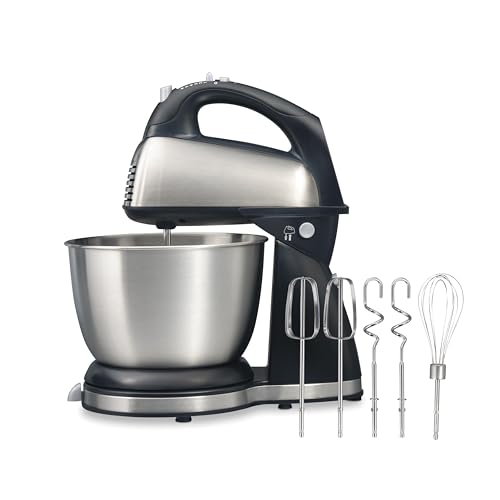
Hamilton Beach Classic Stand and Hand Mixer, 2-in-1, 4 Quarts — Best for Small Spaces
The 2-in-1 is the space-saver’s answer: a stand mixer whose head lifts off to become a hand mixer for quick jobs, with a 4-quart bowl on the stand for longer ones. It suits small kitchens, first apartments and bakers who cannot justify storing two mixers. In this guide it is the bridge pick — the machine for people who read the hand-versus-stand debate and honestly cannot choose. It is less suited to heavy dough, where a dedicated stand mixer’s frame and motor have the advantage.
Strengths
- Two tools in one footprint: stand mixing for batches, hand mixing for quick jobs
- QuickBurst boost carries over from Hamilton Beach’s hand mixer line
- Stand locks the mixer head steady for hands-free creaming and whipping
Trade-offs
- Peak-power rating flatters it; sustained heavy dough is beyond its brief
- Stand is lightweight and can shift under load if not on a dry counter
- Jack-of-all-trades design means the stand function trails dedicated models
| Motor | 290 watts peak power |
| Bowl | 4 quart |
| Speeds | 6, plus QuickBurst |
| Design | 2-in-1: stand mixer with detachable hand mixer head |
Compromise products usually fail at both jobs; this one succeeds because the two jobs share so much. The mixer head is a full Hamilton Beach hand mixer — six speeds, QuickBurst, bowl rest — and the stand simply holds it at the right angle over a bowl that rotates for coverage. For creaming butter, whipping cream and mixing cake batter, the stand does the holding while you add ingredients with both hands, which is the actual luxury a stand mixer sells.
Where the compromise shows is at the extremes. Stiff dough will slow it and walk the lightweight stand, and the bowl is not the deep, fixed bowl of a dedicated machine. But for the small kitchen that would otherwise own only a hand mixer and a tired arm, the 2-in-1 adds real hands-free mixing for very little money or space. Judge it as a hand mixer that gained a stand, and it is excellent value.
If you are furnishing a first kitchen, this is also the pick that postpones a decision gracefully: live with both formats in one box for a year, learn which one you reach for, and let that knowledge guide the bigger purchase later. Few affordable appliances teach you that much about your own cooking.
Best for: small kitchens and first apartments that need both formats in one footprint / Not suited for: heavy dough bakers who need a dedicated stand mixer’s frame
Check the current price on Amazon
Comparison Table
The table below compresses the six picks into the four facts that decide most purchases: what it is, what it does best, its key specification, and who should buy it. Badges match the Quick Picks and the review headings, so you can move between the table and the full reviews without translating.
| Pick | Badge | Key spec | Best for |
|---|---|---|---|
| Hamilton Beach 4 Quart Electric Stand Mixer, 7 Speeds Check on Amazon | Best Overall | 300W, 7 speeds, planetary action, full attachment set | First-time stand mixer buyers who want the complete job done in one box |
| Hamilton Beach 6-Speed Electric Hand Mixer with QuickBurst (62682G) Check on Amazon | Best Budget | 250W motor, 6 speeds + QuickBurst | Occasional bakers and small kitchens that need one dependable drawer-sized mixer |
| KitchenAid Classic Series 4.5 Quart Tilt-Head Stand Mixer (K45SS) Check on Amazon | Best for Long-Term Value | 4.5-qt tilt-head, 10 speeds, metal construction | Regular bakers buying a ten-year machine and future attachment options |
| Cuisinart Power Advantage Plus 9-Speed Hand Mixer (HM-90S) Check on Amazon | Best Hand Mixer | 9 speeds, SmoothStart, storage case with attachments | Organised bakers who want stand-mixer range from a drawer-sized tool |
| Aucma Stand Mixer, 6.5-Qt, 660W Tilt-Head Check on Amazon | Best for Big Batches | 6.5-qt bowl, 660W motor, lowest cost per quart | Large families and batch bakers who need maximum bowl capacity per dollar |
| Hamilton Beach Classic Stand and Hand Mixer, 2-in-1, 4 Quarts Check on Amazon | Best for Small Spaces | Mixer head detaches for hand use, 290W peak power | Small kitchens and first apartments that need both formats in one footprint |
How to Choose Between a Hand Mixer and a Stand Mixer
Start with an honest inventory of your last twenty mixing jobs. If they were batters, frostings, whipped cream, egg whites and mashed potatoes, a hand mixer does all of them well, stores in a drawer, and leaves most of the budget unspent. If the list includes bread dough, pizza dough, double batches or anything you currently avoid because your arm gives up, a stand mixer is not a luxury — it is the tool that makes those jobs exist in your kitchen at all. The second question is storage. A stand mixer needs a permanent home, on the counter or in a cupboard you can lift it out of without a struggle; a mixer that is annoying to retrieve is a mixer that stops being used. The third question is batch size: standard recipes fit every machine in this guide, but double batches separate the 4-quart bowls from the 5.5- and 6.5-quart ones.
Within each family, three specifications matter more than the rest. For both types, the lowest speed matters most — a true slow speed folds flour without a cloud and starts thick batters without splashing, and it is the first thing cheap mixers get wrong. Second, the mixing action: stand mixers need planetary action to reach the bowl’s edge, and hand mixers need beater shapes that pull mixture from the bottom rather than skimming the top. Third, the included attachments decide your real cost. A stand mixer with beater, whisk and dough hook in the box is complete; a hand mixer with beaters only will send you shopping the first time a recipe calls for a whisk. Wattage, by contrast, is the least comparable number on the box — makers measure it differently, and gearing and motor design matter as much as the headline figure.
What “Affordable” Should Mean in Each Mixer Tier
Affordable means something different in each family, and confusing the tiers is how buyers end up disappointed. In hand mixers, the budget tier is genuinely excellent: the moving parts are simple, the loads are modest, and the best budget models in this guide will outlast many premium kitchen gadgets. Spending more buys control — more speeds, slower starts, better attachments — not basic competence. In stand mixers, the budget tier is a compromise zone: the machines mix well, but they buy their price with lighter bodies, smaller bowls and less proven longevity. That does not make them bad purchases; it makes them purchases to make with open eyes, sized to weekly rather than daily heavy use.
The middle path, and the one this guide is built around, is to spend where your workload is. A household that bakes a cake a month should buy the budget hand mixer and keep the change. A household that bakes weekly should buy the complete-kit hand mixer or the entry stand mixer. A household that kneads should buy the metal-bodied stand mixer, because dough is the job that destroys underbuilt machines. In every case, the budget framing inside the search — affordable — is a tier, not a product price: check the current price on Amazon for the exact model and colour you choose, because mixer pricing moves with sales more than almost any other kitchen category.
How to Use a Mixer Well: Speeds, Attachments and First Mixes
Good mixing is mostly speed discipline. Use this sequence for almost any recipe and either type of mixer will reward you. Cream butter and sugar on a medium speed until the mixture lightens in colour — that trapped air is your cake’s rise, and rushing it costs texture. Add eggs one at a time at a lower speed, letting each disappear before the next. Add dry ingredients in two or three additions on the lowest speed, alternating with liquid if the recipe says so, and stop the moment the last streak of flour vanishes: overmixing from this point develops gluten and toughens cakes. For whipped cream and egg whites, start medium to build structure, then go high, and stop early and often to check — both go from perfect to overdone in seconds.
- Match the attachment to the job. Flat beater or standard beaters for batters, creaming and potatoes; whisk for cream, egg whites and anything whose point is air; dough hook for dough, and only dough.
- Start every mix on the lowest speed. The first five seconds decide whether your ingredients stay in the bowl. Move up a speed at a time as the mixture comes together.
- Scrape once, deliberately. Even planetary stand mixers leave a thin layer at the very bottom of the bowl. Stop halfway through a batter, scrape the bottom and sides with a spatula, and finish — one scrape, not a ritual.
- Let the stand mixer work, but stay in the room. Hands-free does not mean unattended: a walking mixer under dough load can travel, and a bowl that was fine at speed two may splash at speed six.
- For dough, respect the flour limit. Every mixer has a comfortable flour quantity; exceeding it strains the motor and under-kneads the dough. Split big batches rather than forcing one.
- Wash attachments promptly. Dried batter in beater wires is a chore; a rinse straight after use is seconds. Most attachments in this guide are dishwasher-safe, but check the listing for your model and wash wooden-handled or coated pieces by hand.
Two habits will extend any mixer’s life more than anything else. First, never use the mixer to do a spoon’s job on a mixture that has effectively set — cold, stiff dough straight from the fridge should warm up first. Second, listen to the motor: a healthy mixer changes pitch smoothly, while a straining one labours and slows. When you hear strain, you are past the machine’s brief — finish by hand, and size your next batch to the machine you own.
Common Buying Mistakes
Buying a stand mixer for a kitchen with nowhere to put it
The most common affordable-mixer regret is not a bad machine; it is a good machine that lives in a box in a hallway because the counter is full and the cupboards are deep. Measure the storage spot before you buy, including the tilt-head’s clearance when it opens under a cabinet. If the honest answer is “nowhere,” a top-tier hand mixer plus a drawer will make you happier than a stand mixer you have to excavate.
Judging mixers by wattage alone
Wattage is measured inconsistently across brands — some quote peak power, some quote working power — and a well-geared 300-watt stand mixer will out-mix a poorly geared model with a much bigger number on the box. Use wattage only as a rough sanity check within one brand’s range, and judge across brands by mixing action, bowl design, attachments and the workload the maker actually rates the machine for.
Counting speeds instead of testing the slowest one
Nine speeds are useless if speed one is already fast enough to throw flour across the kitchen. The speeds you will use most are the bottom three, for folding, starting batters and adding dry ingredients. Slow-start features and genuinely gentle low gears — highlighted in the reviews above — are worth more than a long speed list, especially for bakers who work with flour daily.
Forgetting the attachment bill
A cheap mixer with beaters only is not finished being bought. The first recipe that needs a whisk or dough hooks sends you back to the shop, and proprietary attachments are rarely cheap. Compare the total cost of the kit you will actually own — which is why the complete-kit picks in this guide often beat a superficially cheaper rival.
Asking a hand mixer to be a bread machine
Dough hooks on a hand mixer are for bringing soft doughs together, not for kneading lean bread dough for ten minutes while you hold the machine against its resistance. Doing it anyway overheats motors and tires arms. If bread is a weekly habit, that is the stand mixer’s job — specifically, a stand mixer with the frame and motor for it, as flagged in the reviews.
Final Recommendation
If you buy one mixer from this guide, make it the Hamilton Beach 4 Quart Electric Stand Mixer — Best Overall Check the current price on Amazon — if you have the storage for it, because it completes the most jobs for the most kitchens at an affordable tier. If storage or budget says no, the Hamilton Beach 6-Speed Hand Mixer — Best Budget Check the current price on Amazon — is the least money that buys a mixer that behaves properly, and it will cover the majority of home mixing without complaint. Bakers with an established weekly habit should stretch to the KitchenAid Classic — Best for Long-Term Value Check the current price on Amazon — and buy once. Big-batch households should take the Aucma’s bowl seriously, hand-mixer loyalists should take the Cuisinart 9-speed’s kit seriously, and small kitchens should let the 2-in-1 postpone the hand-versus-stand decision entirely.
- Hamilton Beach 4 Quart Electric Stand Mixer, 7 Speeds — Best Overall: Check the current price on Amazon
- Hamilton Beach 6-Speed Electric Hand Mixer with QuickBurst (62682G) — Best Budget: Check the current price on Amazon
- KitchenAid Classic Series 4.5 Quart Tilt-Head Stand Mixer (K45SS) — Best for Long-Term Value: Check the current price on Amazon
Related guides in this series: Best Affordable Hand Mixers Best Affordable Kitchen Mixers Best Affordable Electric Mixers Best Affordable Mixers For Baking Best Affordable Mixers Bed Bath And Beyond
Frequently Asked Questions
Is a hand mixer or a stand mixer better value for money?
For most households, a hand mixer is better value: it costs far less, stores in a drawer, and handles the majority of home mixing — batters, frostings, whipped cream, mashed potatoes — completely well. A stand mixer earns its higher price when you knead dough regularly, mix double batches, or simply bake often enough that hands-free working saves you real time every week. Value follows workload, not specifications.
How many watts does an affordable mixer actually need?
Less than the boxes suggest, because wattage is not measured consistently between brands. As a rough guide within a single brand’s range, a hand mixer in the low hundreds of watts handles batters and soft doughs, and a stand mixer needs enough power paired with proper gearing to knead without slowing dramatically. Mixing action, motor design and the maker’s rated workload tell you more than the wattage figure alone.
Can an affordable stand mixer knead bread dough?
Yes, within limits. The stand mixers in this guide knead standard single-loaf batches of most doughs, especially softer and enriched doughs. Very stiff lean doughs and double batches strain budget machines — the reviews flag which picks handle dough best, and splitting a big batch into two kneads is always kinder to the motor than forcing one.
What attachments should come in the box?
For a stand mixer, look for a flat beater, a wire whisk and a dough hook as the complete core set, plus a splash or pouring shield if you add flour often. For a hand mixer, beaters are the minimum; a whisk transforms whipped cream and egg whites, and dough hooks extend the machine to soft doughs. Buying a mixer whose box already contains the set you need is almost always cheaper than adding proprietary attachments later.
How long should an affordable mixer last?
A budget hand mixer used weekly should last for years, because the loads are modest and the mechanism is simple. Affordable stand mixers vary more: lighter models are built for regular but not punishing use, while metal-bodied machines like the KitchenAid Classic are decade-scale purchases. Matching the machine to your workload — especially dough — is the biggest factor in how long any of them lasts.
Are expensive mixer colours and finishes worth paying for?
Only if the mixer lives on your counter and you will enjoy looking at it daily — which is a legitimate reason, since a stand mixer is furniture-sized. Functionally, colour variants of the same model mix identically. If a premium finish pushes a model out of the affordable tier for you, choose the standard finish and keep the same machine.

