Disclosure: airfryerkitchensupply.com is reader-supported. When you buy through links on our site, we may earn an affiliate commission at no extra cost to you.
Where to buy
Every pick in this guide to the best affordable mixers for baking is sold on Amazon, and that is where we recommend buying. Baking makes specific demands of a mixer — gentle folding speeds, thorough creaming, dough strength — and Amazon’s listings let you verify each model’s attachments, bowl size and speed range against the demands of your own baking before you commit. Use the links in this section for the fastest route to each pick, or the Check on Amazon buttons inside each review. Mixer prices move often, so check the current price on Amazon rather than trusting any figure quoted in an older roundup.
- KitchenAid Classic Series 4.5 Quart Tilt-Head Stand Mixer (K45SS) — Best Overall for Baking: Check the current price on Amazon
- Cuisinart Precision Master 5.5-Quart Stand Mixer (SM-50) — Best for Big Batches: Check the current price on Amazon
- KitchenAid 9 Speed Hand Mixer (KHM926) — Best Hand Mixer for Baking: Check the current price on Amazon
- Hamilton Beach 6-Speed Electric Hand Mixer with Easy Clean Beaters (62639J) — Best Budget for Bakers: Check the current price on Amazon
- KitchenAid 5.5-Qt Bowl-Lift Stand Mixer (KSM55) — Best for Bread Dough: Check the current price on Amazon
- KitchenAid 6 Speed Hand Mixer with Flex Edge Beaters (KHM6118) — Best for Cakes: Check the current price on Amazon
A note on scope before the picks: “for baking” is the most demanding lens a mixer can be judged through, because baking uses every technique a mixer knows — creaming, folding, whipping and kneading — and punishes weakness in any of them. A mixer that is fine for mashed potatoes can still ruin a cake with a violent first speed. The six picks below were chosen specifically against baking’s full checklist, not borrowed from a general list.
Introduction
The best affordable mixers for baking are not simply the best affordable mixers with a different title, because baking asks questions other cooking never poses. Can the mixer cream butter and sugar to genuine lightness, trapping the air a cake’s crumb depends on? Can it fold flour at a speed gentle enough not to undo that work in ten seconds? Can it whip egg whites to a stable meringue, and then fold them into a batter without knocking the air back out? And if your baking includes bread, can it knead — really knead, for minutes at a time — without walking across the counter or fading? A mixer that answers all four is a baking mixer. This guide’s six picks each answer at least three of the four brilliantly at an affordable price, and the badges tell you which three.
The affordable tier rewards baking buyers in a specific way: the features that matter most for baking are control features, not power features, and control has become cheap. Slow-start motors, genuinely gentle first speeds, flex-edge beaters that scrape as they mix, and complete whisk-and-hook kits all exist at budget prices now — they are concentrated in this guide. What affordable money still cannot buy is everything at once: the biggest bowl, the strongest dough frame and the finest speed control in one budget machine. Baking buyers should therefore start from their own repertoire. A cake-and-cookie baker, a bread baker and a batch baker need three different machines, and each gets a dedicated pick below.
Every model was verified as a real, currently sold product through the maker’s own listing before writing began. The reviews assess each pick against baking’s techniques specifically, with honest trade-offs; the buying guide after them maps mixer features to baking tasks one by one; the how-to section gives the mixing sequence that produces reliable bakes from any machine here; and the FAQ answers the questions bakers ask most, including the eternal one about whether a hand mixer can handle bread. (Short answer: soft doughs yes, lean loaves no — and the long answer is in the reviews.)
In this guide
Quick Picks
Six mixers judged through baking’s four tests — creaming, folding, whipping, kneading — and badged by the baking they do best. Here is the short version.
KitchenAid Classic Series 4.5 Quart Tilt-Head Stand Mixer (K45SS) — Best Overall for Baking. The complete baking partner: ten speeds from a gentle stir to a firm whip, planetary action that reaches the whole bowl, and beater, whip and hook in the box. It earns the top badge because 59-point planetary mixing reaches around the bowl for thorough, even results — the evenness cakes are made of — and because its metal build survives a decade of baking seasons. Check on Amazon
Cuisinart Precision Master 5.5-Quart Stand Mixer (SM-50) — Best for Big Batches. Twelve speeds and a 5.5-quart die-cast machine for bakers whose normal batch is a double. It earns the batch badge because its bowl handles bigger cookie and cake batches than the Classic, so bake-sale and holiday volumes stop being two-bowl problems. Check on Amazon
KitchenAid 9 Speed Hand Mixer (KHM926) — Best Hand Mixer for Baking. Nine well-spaced speeds, a pro whisk and a dough hook in a hand mixer’s body. It earns its badge because nine speeds give real control from slow folding to fast whipping — the full baking range, including a meringue-fast top end and a fold-gentle bottom end, without a stand mixer’s footprint. Check on Amazon
Hamilton Beach 6-Speed Electric Hand Mixer with Easy Clean Beaters (62639J) — Best Budget for Bakers. A 275-watt hand mixer with beaters that rinse clean and dough hooks and a whisk in the box. It earns the budget badge because the full attachment set in the box — beaters, dough hooks and a whisk — covers baking, bread and meringue at the bottom of the price range, where rivals ship beaters only. Check on Amazon
KitchenAid 5.5-Qt Bowl-Lift Stand Mixer (KSM55) — Best for Bread Dough. The fixed-head, bowl-lift format with eleven speeds and a 5.5-quart bowl, built for the one job that breaks lesser mixers. It earns the bread badge because the bowl-lift frame stays rock-steady under heavy dough loads, so the hook kneads the dough instead of rocking the machine. Check on Amazon
KitchenAid 6 Speed Hand Mixer with Flex Edge Beaters (KHM6118) — Best for Cakes. Flex Edge beaters that sweep the bowl wall as they turn, plus a Pro whisk. It earns the cake badge because flex edge beaters scrape the bowl while mixing, reducing unmixed pockets and scraping stops — and unmixed pockets are where cake texture goes to die. Check on Amazon
How These Picks Were Chosen
Verification came first, as always: every model confirmed as real and currently sold through the maker’s own listing, with specifications taken from those listings rather than from reviews or memory. The baking lens then re-ranked the field. General-purpose virtues — a pretty finish, a long cord — counted for little; baking virtues counted for everything. Creaming performance, judged by low- and mid-speed control; folding, judged by the gentleness of the slowest speed; whipping, judged by whisk design and top-speed usefulness; and kneading, judged by frame design, motor behaviour and the maker’s own flour guidance, all weighed more than headline wattage.
The result is a list with deliberate variety: two stand mixers for range and batches, one bowl-lift specialist for dough, and three hand mixers that prove how far the format has come for bakers without stand-mixer space or budget. Badges name the baking each machine does best, and the trade-offs name what it does worst, because a baker choosing between them needs both halves of that sentence. One honest gap should be stated here: no affordable mixer in this guide — or anywhere — combines a bowl-lift dough frame with a hand mixer’s price. Bread bakers on the tightest budgets should read the budget pick’s dough notes carefully and size their loaves to it.
The 6 Best Affordable Mixers for Baking

KitchenAid Classic Series 4.5 Quart Tilt-Head Stand Mixer (K45SS) — Best Overall for Baking
The Classic is the entry point to the KitchenAid stand mixer system: a metal-bodied, tilt-head machine with a 4.5-quart bowl and the attachment hub that opens the door to pasta rollers, grinders and more later. It suits regular bakers who want a machine for a decade, not a season. For baking specifically, it is the most complete affordable answer: creaming, folding, whipping and single-loaf kneading all sit comfortably within its range. It is less suited to very large families or double-batch bread bakers, who should look at 5.5-quart and bowl-lift models.
Strengths
- Metal construction and a proven drivetrain give it a lifespan budget plastic mixers cannot match
- Attachment hub accepts the wide KitchenAid accessory range, so the machine grows with you
- 59-point planetary mixing reaches around the bowl for thorough, even results
Trade-offs
- Highest price among the affordable stand mixers here, though it is the entry KitchenAid
- 4.5-quart bowl is tight for double batches of bread dough
- Tilt-head design needs overhead clearance to open fully under cabinets
| Bowl | 4.5 quart, stainless steel |
| Speeds | 10 |
| Design | Tilt-head, metal construction |
| Mixing action | 59-point planetary touchpoints |
| Attachments | Flat beater, dough hook, wire whip; attachment hub for optional KitchenAid attachments |
There is a reason the Classic is the default recommendation in affordable stand mixers despite costing more than the plastic-bodied competition: stand mixers are stressed machines, and metal gears and a metal body are what survive ten years of bread dough. The tilt-head design is the friendlier format for home kitchens, too — the head lifts back so the bowl and beater come off without a wrestling match, and adding ingredients mid-mix is easy.
The 59 touchpoint figure describes the beater’s planetary path around the bowl, and in practice it means less unmixed flour hiding at the bottom and fewer scraping stops. Capacity is the honest limit: a single loaf, a standard cake, a batch of cookies — all comfortable. Two loaves at once will push dough up the hook. Buy it as a long-term single-batch machine and it is the best value in this guide measured in years, not dollars.
Through the baking lens, the ten speeds are the quiet triumph: a stir gentle enough for folding flour into a sponge, mid speeds that cream butter to real lightness, and a top end that builds a firm meringue. One machine, the whole technique range, no compromises a baker will feel weekly — that is what Best Overall for Baking means here.
Best for: regular bakers who want one complete, long-lived baking machine / Not suited for: double-batch bread bakers or strict budgets
Check the current price on Amazon

Cuisinart Precision Master 5.5-Quart Stand Mixer (SM-50) — Best for Big Batches
The SM-50 is the KitchenAid alternative for buyers who want a metal body and a big bowl without paying KitchenAid money: 5.5 quarts, 12 speeds and a die-cast housing. It suits batch bakers, families, and anyone whose recipes regularly outgrow a 4-quart bowl. It is less suited to bakers who want the vast third-party and attachment ecosystem that surrounds KitchenAid.
Strengths
- Largest bowl among the established brands here at 5.5 quarts, with room for double batches of cookies
- 12 speeds give finer control than most rivals at any price here
- Die-cast metal body feels substantial and stays planted under load
Trade-offs
- No powered attachment hub ecosystem comparable to KitchenAid’s
- Tilt-head still needs clearance under cabinets
- Heavier than the budget plastic models; plan a permanent counter spot
| Bowl | 5.5 quart, stainless steel |
| Speeds | 12 |
| Design | Tilt-head, die-cast metal body |
| Attachments | Chef’s whisk, mixing paddle, dough hook |
| Included extra | Splash guard with pour spout |
Cuisinart’s argument is capacity per dollar, and it is a strong one. The 5.5-quart bowl swallows a double batch of chocolate-chip cookie dough without the mixer straining at the rim, and the 12 speeds include a genuinely slow stir for folding and enough top end for firm meringue peaks. The die-cast body gives it the planted, no-drama feel under load that plastic-bodied budget mixers lack.
What you give up versus KitchenAid is the ecosystem: no equivalent wall of attachments, fewer third-party accessories, and a smaller community of recipes written around it. If your mixing life is bowls and beaters — cakes, cookies, doughs, frostings — that loss barely registers, and the SM-50 is arguably the most mixer you can buy at this tier. If you dream of rolling pasta with a hub attachment later, buy the KitchenAid instead and know why you did.
Batch baking has a rhythm problem smaller mixers create: mix, bake, wash, mix again, while the oven sits idle and the afternoon disappears. A bowl that takes the double batch in one go keeps the oven fed and the baker sane — during holiday baking, that is not a convenience, it is the whole day going well or badly.
Best for: batch bakers and families whose standard recipe is a double / Not suited for: bakers who want a powered attachment hub ecosystem
Check the current price on Amazon
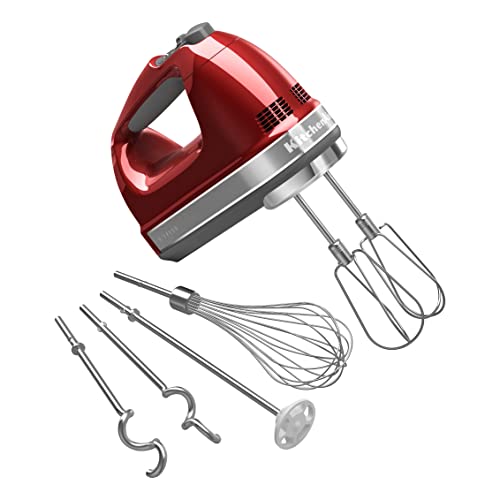
KitchenAid 9 Speed Hand Mixer (KHM926) — Best Hand Mixer for Baking
The 9-speed KitchenAid is the hand mixer for bakers who want stand-mixer range without stand-mixer storage: nine speeds, a pro whisk, a dough hook and a blending rod in one kit. It suits ambitious home bakers in small kitchens and anyone who makes meringue, whipped cream and soft doughs regularly. It is the least “budget” hand mixer here, so strict bargain hunters should look at the Hamilton Beach picks instead.
Strengths
- Nine well-spaced speeds give real control from slow folding to fast whipping
- Pro whisk and dough hook included, covering meringue and soft doughs out of the box
- Gentle low speeds keep dry ingredients in the bowl
Trade-offs
- Top of the affordable hand mixer band; the price approaches entry stand mixer territory
- More attachments mean more pieces to store, even with the included bag
- Heavier in the hand than the 5-speed model on long whipping jobs
| Speeds | 9 |
| Attachments | Turbo Beater II, Pro whisk, dough hook, blending rod |
| Cleaning | Dishwasher-safe accessories |
| Storage | Accessory storage bag |
Nine speeds sounds like marketing until you whip egg whites and then fold them into a batter in the same session. The bottom speeds on this mixer are slow in a way cheap mixers never manage — slow enough to fold without knocking the air out — and the top speeds are fast enough to build a stable meringue without your arm giving up. That range is the whole argument for the model, and it delivers it.
The accessory set is equally considered. The Pro whisk is a proper multi-wire whisk rather than a token loop of metal, the dough hook handles enriched doughs credibly, and even the blending rod earns its place for drinks and dressings. If a stand mixer will not fit your kitchen or your budget but your baking ambitions are real, this is the hand mixer that respects them.
Baking is where hand mixers usually get exposed — a sponge cake needs a whip and a fold in the same five minutes, and a cheap mixer does one of them badly. This model does both properly, which is why it, and not a cheaper hand mixer, carries the baking badge among the hand-format picks.
Best for: ambitious bakers in small kitchens who whip, fold and mix soft doughs regularly / Not suited for: strict bargain hunters or lean-bread bakers
Check the current price on Amazon

Hamilton Beach 6-Speed Electric Hand Mixer with Easy Clean Beaters (62639J) — Best Budget for Bakers
Choose this version if you like the Hamilton Beach formula but actually bake bread and whip egg whites, because the box includes dough hooks and a whisk alongside beaters designed to release batter instead of trapping it. It suits regular home bakers who want one hand mixer that covers the full recipe range. It is less suited to minimalists who only ever make boxed cake mix and would never use the extra attachments.
Strengths
- Easy-clean beater shape sheds batter and washes clean without the usual trapped residue in the wires
- Full attachment set in the box: beaters, dough hooks and a whisk cover baking, bread and meringue
- 275-watt motor is the strongest in Hamilton Beach’s affordable hand mixer line
Trade-offs
- Costs a step more than the basic 62682G, which matters if you truly only mix batters
- Black finish shows flour dust more than white or stainless finishes do
- Storage case is handy but makes the stored footprint taller than the mixer alone
| Motor | 275 watts |
| Speeds | 6 |
| Attachments | Easy-clean beaters, dough hooks, whisk |
| Storage | Snap-on storage case |
The easy-clean beaters are not a gimmick. Their smooth, open profile means cake batter rinses off under the tap instead of setting into the tight wire junctions that make traditional beaters a sponge-and-patience job. Anyone who has picked dried frosting out of beater wires will understand why this version exists, and why bakers who mix several times a week tend to prefer it.
The dough hooks deserve a realistic note: on a hand mixer they are for bringing a soft dough together and for short kneads of enriched doughs like brioche or cinnamon-roll dough, not for ten minutes of lean bread dough. Used that way, with the mixer moving around the bowl so the hooks keep finding new dough, they work well and save your arms. The whisk, meanwhile, is a proper balloon shape that whips cream quickly and folds air into egg whites without the splashing you get from using beaters at high speed.
Budget baking is a kit problem before it is a power problem: a cheap mixer missing its whisk makes every meringue a compromise. This model’s completeness at the bottom of the range is its baking argument — every core technique is available from day one, and the beaters’ easy-clean shape means a three-recipe afternoon does not end with a sink of soaking wires.
Best for: budget bakers who need the full technique range — batter, meringue, soft dough — in one box / Not suited for: lean bread bakers or minimalists who only mix boxed batters
Check the current price on Amazon

KitchenAid 5.5-Qt Bowl-Lift Stand Mixer (KSM55) — Best for Bread Dough
Bowl-lift design trades the tilt-head’s easy access for stability: the bowl cranks up to the beater and the head never moves, which is why serious bread bakers prefer it. This 5.5-quart model suits dough-heavy bakers and anyone whose mixer will live under low cabinets, since nothing needs to tilt. It is less suited to casual bakers who will find the bowl handling fussier than a tilt-head for everyday cakes.
Strengths
- Bowl-lift frame stays rock-steady under heavy dough loads
- 11 speeds, the widest range in this guide, including gentle folding gears
- 5.5-quart bowl is the largest KitchenAid capacity in this line-up
Trade-offs
- Bowl snaps on and off a lift arm, which is less casual than a tilt-head bowl
- Removing the beater with the bowl raised takes a little practice
- Premium positioning; bread-occasional bakers will not use its strengths
| Bowl | 5.5 quart, stainless steel |
| Speeds | 11 |
| Design | Bowl-lift |
| Attachments | Flat beater, dough hook, wire whip |
If your baking is mostly bread, this is the KitchenAid format to buy. A tilt-head mixer nods slightly under a stiff dough as the head flexes on its hinge; a bowl-lift’s fixed head and cranked bowl remove that flex entirely, so the dough hook keeps working the dough instead of rocking the machine. The 5.5-quart bowl then gives that dough somewhere to go, handling larger single batches comfortably.
The 11 speeds include genuinely slow gears for folding and a half-step range that helps with delicate batters, so it is not a one-trick dough machine. The compromises are ergonomic: the bowl mounts on pins and lifts by lever, and scraping the bowl means lowering it first. Bakers who prioritise dough performance accept that trade happily; cake-first bakers usually prefer the Artisan. Know which baker you are and the choice makes itself.
Kneading is the most violent thing a home mixer does, and it is where affordable machines separate into the built-for-it and the merely willing. This is the built-for-it pick: if your weekends smell of proofing dough, the frame, the bowl and the gearing here are the affordable route to bread that does not cost you a motor every few years.
Best for: bread bakers who knead weekly and want a frame built for dough / Not suited for: casual cake bakers who will find bowl-lift handling fussy
Check the current price on Amazon

KitchenAid 6 Speed Hand Mixer with Flex Edge Beaters (KHM6118) — Best for Cakes
Flex Edge beaters carry a soft edge that sweeps the bowl wall as they turn, cutting down the stop-and-scrape routine every baker knows. This model suits bakers who hate unmixed pockets at the bottom of the bowl and anyone who creams butter and sugar often. It is less suited to buyers who need dough hooks included, since the kit centres on the flex beaters and whisk.
Strengths
- Flex Edge beaters scrape the bowl while mixing, reducing unmixed pockets and scraping stops
- Pro whisk included for cream and egg whites
- Integrated storage clip keeps beaters attached without a separate case
Trade-offs
- Flex edges are a wear item over years of use and eventually need replacing
- No dough hook in the box
- Six speeds, not nine, so slightly less top-end finesse than the KHM926
| Speeds | 6 |
| Attachments | Flex Edge beaters, Pro whisk |
| Storage | Integrated storage clip |
| Cleaning | Dishwasher-safe beaters |
Every baker knows the rhythm: mix, stop, scrape, mix, stop, scrape. The Flex Edge beater exists to break that rhythm. Its flexible edge rides the bowl wall and folds the outer layer of batter back into the path of the beaters, so creamed butter actually creams evenly and the last spoonful of flour at the bottom of the bowl gets incorporated instead of appearing as a white streak in the finished cake.
The trade-off is honest: a flexible edge is a consumable in a way plain steel is not, and heavy dough work is not this beater’s friend — switch to sensible speeds and let the whisk handle the light work it was designed for. For cake, cookie and frosting bakers, though, this is the most thoughtfully specialised affordable hand mixer in the guide, and the one that most visibly improves the texture of finished bakes.
Cake is the most unforgiving bake: its crumb shows every unmixed pocket and every under-creamed lump in cross-section. A beater designed to eliminate exactly those faults is not a luxury for a cake baker — it is the closest thing a hand mixer offers to a guarantee, and it is why this specialised model earns a place beside the bigger all-rounders.
Best for: cake, cookie and frosting bakers who want even texture without stop-and-scrape mixing / Not suited for: bakers who need dough hooks or who mix heavy doughs
Check the current price on Amazon
Comparison Table
The table compresses the six picks into the facts that decide most baking purchases: the badge, the key specification behind it, and the baker each machine belongs to. Shortlist here, then read the full reviews.
| Pick | Badge | Key spec | Best for |
|---|---|---|---|
| KitchenAid Classic Series 4.5 Quart Tilt-Head Stand Mixer (K45SS) Check on Amazon | Best Overall for Baking | 4.5-qt tilt-head, 10 speeds, metal construction | Regular bakers who want one complete, long-lived baking machine |
| Cuisinart Precision Master 5.5-Quart Stand Mixer (SM-50) Check on Amazon | Best for Big Batches | 5.5-qt bowl, 12 speeds, die-cast metal body | Batch bakers and families whose standard recipe is a double |
| KitchenAid 9 Speed Hand Mixer (KHM926) Check on Amazon | Best Hand Mixer for Baking | 9 speeds, pro whisk and dough hook included | Ambitious bakers in small kitchens who whip, fold and mix soft doughs regularly |
| Hamilton Beach 6-Speed Electric Hand Mixer with Easy Clean Beaters (62639J) Check on Amazon | Best Budget for Bakers | 275W motor, easy-clean beaters, full attachment set | Budget bakers who need the full technique range in one box |
| KitchenAid 5.5-Qt Bowl-Lift Stand Mixer (KSM55) Check on Amazon | Best for Bread Dough | 5.5-qt bowl-lift, 11 speeds, most stable under load | Bread bakers who knead weekly and want a frame built for dough |
| KitchenAid 6 Speed Hand Mixer with Flex Edge Beaters (KHM6118) Check on Amazon | Best for Cakes | Flex Edge beaters scrape the bowl as you mix | Cake, cookie and frosting bakers who want even texture without stop-and-scrape mixing |
How to Choose a Mixer for Baking: Match the Machine to the Technique
Baking is four techniques wearing one name, and the right mixer is the one whose strengths match the techniques you actually use. Creaming — butter and sugar beaten to lightness — needs sustained mid-speed work and a beater that reaches the bowl’s edges; planetary stand mixers and flex-edge hand mixers excel here. Folding — flour or whipped whites incorporated without losing air — needs a genuinely slow lowest speed, which is the single most underrated specification in this guide: test for it in every review above. Whipping needs a proper wire whisk and a top speed with real pace; beaters alone whip slowly and splash. Kneading needs a frame, and this is where format decides: stand mixers knead, bowl-lift stand mixers knead best, and hand mixers assist soft doughs only.
With your techniques ranked, the remaining choices are practical. Bowl size should match your typical batch — 4.5 quarts for standard recipes, 5.5 for doubles — because an oversized bowl mixes small quantities badly. Attachment completeness matters more in baking than anywhere else, since baking uses all three core attachments: beater, whisk and hook. And speed range matters more than speed count: nine speeds that span from a true fold to a true whip beat twelve that cluster in the middle. Buy against your repertoire, not against a spec sheet, and check the current price on Amazon for the exact configuration — baking mixers are heavily promoted around holiday seasons, and timing is a legitimate part of “affordable”.
Baking on a Budget: Where to Spend and Where to Save
The affordable baking tier has a clear value map. Spend on the slowest speed and the whisk: gentle folding and proper whipping are the two techniques that most visibly change finished bakes, and both are available cheaply if you choose deliberately — the hand mixer picks in this guide prove it. Spend on the frame if you knead: dough destroys underbuilt machines, and the bowl-lift pick exists because replacing mixers is the most expensive way to buy one. Save on capacity you do not use, on finishes, and on attachment hubs for hobbies you do not have. A cake baker in a small kitchen with the Flex Edge hand mixer will out-bake a neighbour with an oversized stand mixer and no whisk discipline, every weekend of the year.
One more budget truth: baking mixers are bought for seasons, not weeks. The machine you choose in a quiet month will face the holiday season’s triple batches and the birthday season’s layer cakes. Size and strength for your busiest realistic month — not your busiest imaginable day, and not your quietest week — and the affordable tier will carry you through all of them.
How to Mix for Baking: The Sequence That Makes Recipes Work
Most baking failures blamed on mixers are sequence failures. This order of operations suits every machine in this guide and nearly every cake, cookie and sponge recipe you will meet.
- Bring ingredients to the temperature the recipe assumes. Butter for creaming should be cool and pliable, eggs at room temperature so they emulsify instead of curdling the batter. A mixer cannot fix cold, hard butter into a light cream — it can only throw it around the bowl.
- Cream butter and sugar longer than feels necessary. Medium speed, several minutes, until the mixture is visibly paler and fluffier. This is where a cake’s rise is manufactured; under-creamed butter is the most common cause of dense cakes.
- Add eggs one at a time, at a lower speed. Let each egg fully incorporate before the next. If the mixture begins to curdle, a spoonful of the recipe’s flour restores the emulsion.
- Alternate dry and wet additions, starting and ending with dry. Each addition at the lowest speed, mixed only until it disappears. This protects both the batter’s air and its tenderness.
- Stop the moment the last flour streak vanishes. Every second of mixing after this point develops gluten and toughens the crumb. Scrape the bowl’s bottom once, deliberately, before this final stage — not after.
- For meringue-based bakes, whip first, fold by hand. Use the whisk and the top speeds to build the foam, then fold it into the batter with a spatula, not the mixer, unless your mixer’s slowest speed is genuinely gentle — the 9-speed hand pick in this guide is the exception that can fold mechanically.
- For dough, knead at low speed and watch the dough, not the clock. Dough is done when it is smooth, elastic and pulls from the bowl’s sides — the windowpane test beats any timer. Stop the machine if the dough climbs the hook, reposition it, and continue.
Follow that sequence and the differences between the machines in this guide shrink to their proper size: capacity, comfort and longevity. Ignore it, and no mixer at any price will save the bake — which is why technique gets a section in a buying guide.
Baking Mixer Care: Keeping Creaming and Kneading Performance for Years
A baking mixer ages in two places: the motor, which workload decides, and the attachments, which care decides. Coated beaters and hooks keep their finish longest when washed by hand and dried before storage, because dishwasher heat and detergent are hard on coatings over hundreds of cycles. Wire whisks should never be stored loose in a drawer where their wires bend; a bent whisk whips unevenly forever after. Flex-edge beaters deserve a specific note: the flexible edge is a working surface, so inspect it when you wash it, and replace the beater when the edge cracks or stiffens — a worn flex edge silently stops scraping, and your cakes will show it before you notice it.
The machine itself asks for little: keep the vents free of the flour dust that baking generates in unusual quantity, wipe the hinge or lift mechanism where batter migrates, and run the motor for a few seconds every month or two if the mixer sits unused, so the gearing stays distributed with lubricant. Bakers who follow those habits, and who respect their machine’s dough limits, routinely get a decade from the metal-bodied picks in this guide — and several years of hard holiday service from the budget ones.
Common Buying Mistakes
Buying for the bake you imagine, not the bake you make
Aspirational purchasing is the baking aisle’s favourite trap: the sourdough setup for a household that makes a cake a month, or the cake specialist for a committed bread baker. Write down your last ten bakes before you shop. The mixer that serves those ten is the right one; the badges in this guide are organised by exactly that evidence.
Ignoring the slowest speed
Bakers test top speeds and forget that folding — the technique that decides sponges, soufflés and delicate cakes — happens at the bottom of the dial. A mixer whose slowest speed is frantic will cost you air in every recipe that has any. The reviews above call out gentle low speeds wherever they exist; weight them as heavily as any other feature.
Under-sizing the bowl for holiday baking
A mixer bought for weekly singles meets December eventually. If your baking year has a genuine peak season — holiday cookies, bake sales, celebration cakes — size for a machine that survives it, whether that means the 5.5-quart bowls above or a deliberate plan to mix in two batches. Motors rarely die in March; they die in the third batch of December.
Using the whisk for everything
The whisk is for air. Using it on thick batter strains its wires and mixes poorly; using beaters for meringue whips slowly and splashes. Baking uses all three core attachments because each does a job the others do badly. A mixer missing one of the three is missing part of the craft — check the box contents against the technique list before you buy.
Kneading lean dough in a hand mixer
It bears repeating in a baking guide: dough hooks on a hand mixer bring soft doughs together, and that is their limit. Ten minutes of lean dough against a hand mixer’s resistance overheats the motor and exhausts the baker. Bread-regular households should buy the frame for the job — the bowl-lift pick — and hand-mixer households should choose enriched, softer doughs, which are delicious and entirely within reach.
Final Recommendation
Match the machine to your repertoire and any of these six will serve you well. The all-round baker should buy the KitchenAid Classic — Best Overall for Baking Check the current price on Amazon. The batch baker should take the Cuisinart SM-50’s bowl — Best for Big Batches Check the current price on Amazon. The bread baker should buy the frame, in the KitchenAid bowl-lift — Best for Bread Dough Check the current price on Amazon. Small-kitchen bakers get stand-level range from the KitchenAid 9-speed hand mixer, budget bakers get the full kit from the Hamilton Beach 62639J, and cake bakers get the most specialised tool in the guide from the Flex Edge KHM6118.
- KitchenAid Classic Series 4.5 Quart Tilt-Head Stand Mixer (K45SS) — Best Overall for Baking: Check the current price on Amazon
- Cuisinart Precision Master 5.5-Quart Stand Mixer (SM-50) — Best for Big Batches: Check the current price on Amazon
- KitchenAid 5.5-Qt Bowl-Lift Stand Mixer (KSM55) — Best for Bread Dough: Check the current price on Amazon
Related guides in this series: Best Affordable Mixers Best Affordable Hand Mixers Best Affordable Kitchen Mixers Best Affordable Electric Mixers Best Affordable Mixers Bed Bath And Beyond
Frequently Asked Questions
What type of mixer is best for baking cakes?
For most cake bakers, a stand mixer with planetary action or a hand mixer with flex-edge beaters, because cakes are won on even creaming and complete incorporation. The Classic and the Flex Edge hand mixer in this guide represent the two formats at their baking best. What matters most is thorough mixing without overmixing — control at low speeds, and a beater that reaches the whole bowl.
Can a hand mixer handle baking as well as a stand mixer?
For cakes, cookies, frostings and meringues, yes — the best hand mixers here cover the full technique range, including folding and whipping, and their results in those categories match a stand mixer’s. The stand mixer pulls ahead on dough, on double batches, and on any job where you want both hands free while the machine works.
How big a bowl do I need for baking?
A 4.5-quart bowl handles standard cakes, cookie batches and single loaves. Choose 5.5 quarts if double batches are your normal, and think in terms of your busiest baking month rather than your average week. Remember that oversized bowls mix small quantities poorly, so bigger is only better if your batches are too.
Why does my cake come out dense even with a good mixer?
Usually the sequence, not the machine: butter and sugar under-creamed, cold eggs curdling the batter, or flour mixed a few seconds too long. The how-to section above gives the order of operations that fixes all three. If density persists, check that your mixer’s beater clearance is right — a beater passing too high leaves the bottom layer of batter unmixed and heavy.
Is a bowl-lift mixer worth it for home baking?
For bread-heavy home baking, yes: the fixed head and cranked bowl stay steady through long kneads that make tilt-heads nod and walk. For cake-and-cookie baking, a tilt-head is easier to live with day to day — simpler bowl handling, easier additions. Buy the lift for dough, the tilt for everything else.
What attachments do I need for baking?
Three: a flat beater for creaming and batters, a wire whisk for cream and egg whites, and a dough hook if bread is in your repertoire. Add a splash or pouring shield if you add flour to a running mixer often. Everything beyond that — hub attachments, extra bowls — is an upgrade for a specific habit, not a baking necessity.

