Disclosure: airfryerkitchensupply.com is reader-supported. When you buy through links on our site, we may earn an affiliate commission at no extra cost to you.
Where to buy
Every pick in this guide is sold through Amazon, which keeps ordering, delivery and returns in one place. Use the links below to check the current price on Amazon for each model before you decide — prices and stock on smokers move with the season, and the listing page is the only place to see today’s number.
- Weber Smokey Mountain Cooker 22-inch — check price on Amazon
- Dyna-Glo Wide Body Vertical Offset Charcoal Smoker — check price on Amazon
- Cuisinart 18-inch Vertical Charcoal Smoker COS-118 — check price on Amazon
- Weber Smokey Mountain Cooker 18-inch — check price on Amazon
- Pit Barrel Cooker Premier Series 18.5-inch — check price on Amazon
- Sophia & William Vertical Offset Charcoal Smoker — check price on Amazon
If you are shopping for the best wood burning vertical smokers, start with a simple truth: “wood burning” on a vertical smoker almost always means a charcoal fire flavored with real wood chunks, not a pit that runs on split logs alone. A true log-burning offset needs a horizontal firebox and constant tending; a vertical cabinet or bullet design burns a charcoal bed, and the wood chunks you bury in that bed are what lay down the smoke. That is not a compromise — it is why vertical smokers hold temperature so well. The fire sits directly under or beside a tall, narrow cooking chamber, heat rises in a straight line through the food, and a water pan in the middle evens out spikes. For brisket, pork shoulder and ribs, that steady column of heat is exactly what you want.
The six models below cover the real shapes this category takes: the classic bullet (Weber Smokey Mountain in two sizes), the vertical offset cabinet (Dyna-Glo and Sophia & William, where the firebox hangs off the side), the hanging drum (Pit Barrel Cooker), and a compact budget bullet (Cuisinart). All six burn charcoal and wood chunks. All six were confirmed as current Amazon listings before they earned a link here, and each one solves a different problem — capacity, budget, footprint, or how much fire management you actually enjoy. Read the reviews with your own cooks in mind: how many racks of ribs at once, how long your longest cook runs, and whether you want to check the fire every hour or every four.
In this guide
Quick Picks
- Best Overall — Weber Smokey Mountain Cooker 22-inch: the benchmark bullet smoker, with dual cooking grates, porcelain-enameled steel and damper control that holds a steady low-and-slow temperature for hours. Check the current price on Amazon
- Best Vertical Offset — Dyna-Glo Wide Body Vertical Offset Charcoal Smoker: a side firebox keeps direct heat away from the food while the wide body swallows full racks and multiple shoulders. Check the current price on Amazon
- Best Budget — Cuisinart 18-inch Vertical Charcoal Smoker COS-118: a simple, light bullet that teaches you fire control without a big spend. Check the current price on Amazon
- Best for Beginners — Weber Smokey Mountain Cooker 18-inch: the same proven design in a smaller, more forgiving size that uses less charcoal per cook. Check the current price on Amazon
- Best for Hanging Meat — Pit Barrel Cooker Premier Series 18.5-inch: ribs and poultry hang vertically over the coals, cooking evenly with almost no vent fiddling. Check the current price on Amazon
- Best Large Capacity — Sophia & William Vertical Offset Charcoal Smoker: a big multi-grate cabinet with a warming tray and push-out ash tray for party-size loads. Check the current price on Amazon
How These Picks Were Chosen
We started with a hard filter: the smoker had to be genuinely vertical (bullet, drum or upright cabinet), had to burn charcoal with real wood as the smoke source, and had to be a current, orderable product — every model here was matched against Amazon listing data by brand and model name, and only listings whose listed title matched the product earned a buy link. Models that exist mainly as direct-from-fabricator pits with no reliable Amazon listing were left out rather than linked on a guess.
From there we weighed the things that decide whether a vertical smoker gets used every weekend or rusts in a corner. First, temperature stability: how well the design, steel weight and damper layout hold a low-and-slow range without constant adjustment. Second, real capacity — not the headline square inches, but how many racks of ribs lie flat, whether a full packer brisket fits, and how the vertical space is actually divided. Third, fuel behavior: charcoal consumption per hour, how easy it is to add fuel mid-cook, and whether ash chokes the fire on long cooks. Fourth, build honesty: lid and door seals, grate quality, thermometer placement, and how the smoker handles weather. Finally, we matched each surviving model to the cook it suits best instead of ranking them on one scale, because a 14-inch bullet and a wide-body offset are answers to different questions.
The 6 Best Wood Burning Vertical Smokers

Weber Smokey Mountain Cooker 22-inch — Best Overall
The Smokey Mountain is the smoker other vertical smokers get measured against, and the 22-inch version is the one to buy if you cook for a crowd. Two cooking grates stack inside a porcelain-enameled bullet body, a water pan sits between the fire and the food, and three bottom dampers plus a top vent give you precise control over the charcoal bed. It suits the cook who wants one smoker that handles everything — a full packer brisket on one grate, ribs above it, chicken for the neighbors — and who would rather learn one cooker deeply than own three shallow ones. It is not the pick for someone who wants to set a dial and walk away for twelve hours; you will adjust dampers as weather changes, and that involvement is part of the deal.
Strengths
- Porcelain-enameled steel bowl, lid and center section resist rust and clean up easily season after season.
- Huge usable capacity: full briskets and multiple rib racks fit without trimming or shoehorning.
- Damper control is fine-grained enough to hold a steady low temperature through long overnight cooks once you learn your vent settings.
Trade-offs
- The access door for adding charcoal and water is functional but not perfectly sealed; many owners upgrade the gasket.
- At 22 inches it is a substantial footprint and a two-hand carry when assembled.
- No built-in hanging system — you cook on grates unless you add aftermarket hooks.
The reason this cooker wins is predictability. The water pan acts as a thermal buffer, so the temperature curve flattens out instead of spiking every time you lift the lid. Bury three or four fist-sized wood chunks in the charcoal, light a small amount of coals on top using the minion method, and the fire creeps through the bed for hours laying down clean smoke the whole way. The built-in lid thermometer reads near the top grate, so most owners pair it with a probe at grate level — a small habit that pays off in consistency. Parts, covers and replacement grates are everywhere because the design has been in production for decades, which matters more over a ten-year ownership span than any single feature.
Best for: the all-purpose backyard cook who wants one proven vertical smoker for brisket, pork and ribs at family scale / Not suited for: cooks who want push-button temperature control or a tiny patio footprint
Check the current price on Amazon

Dyna-Glo Wide Body Vertical Offset Charcoal Smoker — Best Vertical Offset
Most vertical smokers put the fire directly under the food. The Dyna-Glo Wide Body moves it to a side firebox, so heat and smoke travel sideways and up into a wide cabinet instead of blasting the bottom rack. That offset layout suits cooks who struggled with scorched bottom racks on a bullet, and anyone who wants to add charcoal or wood mid-cook without lifting grates of food out of the way — the firebox has its own door. The wide body earns its name: full-length rib racks and big shoulders fit without curling, and the vertical stack of grates gives you distinct temperature zones from bottom to top. It is not for the minimalist; an offset cabinet has more seams, more assembly and more surface to season than a bullet.
Strengths
- Side firebox means refueling never disturbs the food, and ash can be managed during the cook.
- Wide cabinet fits full racks and large cuts flat, with multiple grates for big mixed loads.
- Offset heat path softens the harsh direct heat that can dry out the lowest rack in under-fire designs.
Trade-offs
- Thinner steel than premium pits, so wind and cold weather pull more heat out of the cabinet.
- Door seams benefit from a gasket upgrade if you want the tightest smoke retention.
- Assembly is a real project — set aside an afternoon and a second pair of hands.
Cooking on a vertical offset is a different rhythm from a bullet. You build the fire in the side box, let the cabinet come up to temperature, and then manage the cook with the firebox damper and chimney rather than vents under the food. The payoff is control: a flare-up in the firebox does not translate into a flare-up under your brisket. Wood chunks go straight onto the charcoal in the firebox, and because the smoke has a short, clean path into the chamber, the flavor reads closer to a traditional offset than most verticals manage. Zone cooking is the quiet advantage — chicken on the hotter lower grates, ribs up top where the heat is gentler, all in one session.
Best for: cooks who want offset-style fire management and easy refueling in a vertical footprint / Not suited for: buyers who want the lightest possible assembly or a sealed, set-and-forget cooker
Check the current price on Amazon

Cuisinart 18-inch Vertical Charcoal Smoker COS-118 — Best Budget
The Cuisinart COS-118 is the honest entry point: an 18-inch bullet with two cooking grates, a water pan and a simple vent system, at a price that lets you find out whether smoking is your hobby before you fund it like one. It suits apartment-adjacent patios, tailgaters, and beginners who will learn more from one season on a basic cooker than from a month of reading. The light build is the trade — thin steel means the temperature follows the weather more than a heavy cooker does, and cooks on windy winter days will work harder. Within those limits it produces genuinely good barbecue, because the fundamentals (indirect heat, water pan, wood chunks on charcoal) are all present.
Strengths
- Low cost of entry with the complete vertical-smoker layout: two grates, water pan, vents and a lid thermometer.
- Light and compact enough to move, store and take to a campsite or tailgate.
- Simple controls make it a good teacher — every adjustment has a visible effect.
Trade-offs
- Thin steel loses heat in cold or windy conditions; plan on more charcoal and more attention.
- Capacity suits a couple of chickens or a few racks, not a party load.
- Fit and finish are basic; latches and handles are functional rather than refined.
Treat this smoker as a skills investment. Because it responds quickly to vent changes, you learn cause and effect fast: close the intake and watch the temperature fall within twenty minutes, crack it and watch it climb. That feedback loop is slower and harder to read on a massive insulated cooker. Use lump charcoal or quality briquettes, keep the water pan filled for low cooks, and put your wood chunks under the top layer of charcoal so they smolder instead of flaming. Plenty of owners cook on a COS-118 for years and upgrade only when capacity — not quality — becomes the limit.
Best for: beginners and small households who want real wood-smoke flavor on a tight budget / Not suited for: large gatherings or unattended overnight cooks in cold weather
Check the current price on Amazon
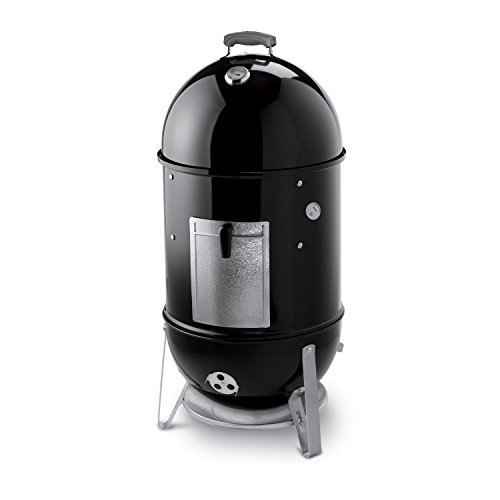
Weber Smokey Mountain Cooker 18-inch — Best for Beginners
The 18-inch Smokey Mountain is the smaller sibling of our top pick, and for many households it is the smarter buy. The design is identical — porcelain-enameled bullet, water pan, dual grates, three bottom dampers — scaled to a size that burns less charcoal per cook and fits a couple’s worth of food with room to spare: two pork shoulders, or three racks of ribs with a rib rack, or a mid-size brisket with light trimming. It suits the learner who wants the proven Weber ecosystem and decade-long parts support without feeding a 22-inch fire for a two-person dinner. It is not the choice if you regularly cook for ten; you will feel the grate diameter on big weekends.
Strengths
- Same build quality, enamel finish and damper design as the 22-inch, in a thriftier size.
- Uses noticeably less charcoal per session, which compounds over a season.
- Enormous owner community means every question you will ever have already has an answered thread.
Trade-offs
- Full packer briskets usually need a trim or a slight bend over a chunk of wood to fit at first.
- Still a hands-on cooker — no electronic temperature control.
- The door seal is the same known weak point as its bigger sibling.
What makes the 18-inch the beginner pick is forgiveness per dollar of fuel. A smaller charcoal bed is easier to light with the minion method, easier to hold steady, and cheaper to experiment on — a failed cook costs you a small bag of charcoal, not half a big one. The water pan nearly fills the diameter, so the buffering effect is strong and temperature swings are gentle. Start with pork shoulder, the most forgiving cut in barbecue; by your third cook you will be reading the dampers by instinct. When you outgrow it, it holds resale value and makes a superb second cooker for sides and chicken while a bigger pit handles the main event.
Best for: new smokers and small households who want the proven Weber design at a manageable size / Not suited for: regular large-party cooks who need maximum grate area
Check the current price on Amazon

Pit Barrel Cooker Premier Series 18.5-inch — Best for Hanging Meat
The Pit Barrel takes the vertical idea literally: food hangs from hooks on steel rods suspended over a charcoal basket in a porcelain-coated drum. Ribs hang vertically and baste themselves as fat renders down their length; whole chickens hang by the cavity and cook evenly on all sides; there are no vents to tune because the drum is engineered to run at its own steady temperature with the rods set as designed. It suits the cook who values results over ritual — people who want ribs that rival any cooker in this guide with the least fire management of any pick here. It is not for the tinkerer who enjoys playing with dampers, nor for cooks who need precise low temperatures for delicate fish; the barrel runs where it runs, in a versatile middle range.
Strengths
- Hanging cooks ribs and poultry remarkably evenly, with self-basting as juices run down the meat.
- Almost no temperature management — light the basket as directed and the drum settles in.
- Surprising capacity: multiple racks of ribs hang side by side in a modest footprint.
Trade-offs
- Temperature is largely fixed by design; fine control for very low or very high cooks is limited.
- Hanging requires hooks and a little confidence — a dropped rack is a bad day.
- Grate cooking is possible but the drum is optimized for hanging first.
The physics are the pitch. In a horizontal cooker, the side of the rib facing the fire cooks faster; in the barrel, every rib hangs in the same column of rising heat, the end nearest the coals only slightly hotter, and the meat effectively rotates its own juices. Wood chunks go in the charcoal basket and the smoke wraps the hanging meat for the full cook. Brisket works too, hung until the bark sets and finished wrapped on the grate. If your barbecue ambitions center on ribs, chicken and the occasional brisket — and your weekends are busy — this is the lowest-effort path to top-tier results in the vertical category.
Best for: rib and poultry fans who want excellent results with minimal fire tending / Not suited for: cooks who demand precise, adjustable low temperatures or mostly cook delicate fish
Check the current price on Amazon

Sophia & William Vertical Offset Charcoal Smoker — Best Large Capacity
When the guest list outgrows a bullet, this is the shape to look at: a tall vertical offset cabinet with a headline 961 square inches of cooking area spread across multiple removable grates, a side firebox, a warming tray on top and a push-out ash tray that makes cleanup after a long cook far less miserable. It suits the household that hosts — graduation parties, holiday hams plus turkey plus sides, a freezer-filling day of shoulders. The warming tray is genuinely useful, holding finished food and warming sauce while the last items finish. It is not a small or light purchase in footprint terms, and like all thin-to-midweight steel offsets it rewards a sheltered spot out of the wind.
Strengths
- Large multi-grate cabinet swallows party-size loads with room for pans and sides.
- Push-out ash tray and side firebox access make long cooks and cleanup easier.
- Warming tray adds holding space that hosts actually use during a big service.
Trade-offs
- Big footprint and assembly effort; measure your patio before ordering.
- Steel weight is mid-tier, so plan on gasket tweaks and wind shelter for best stability.
- More grates and seams mean more surfaces to season and keep clean.
Capacity changes what you cook, not just how much. With this much vertical room you can run a true mixed service: brisket low, shoulders in the middle, chicken and sausage finishing hot near the firebox side, beans catching drippings underneath. The offset layout keeps the fire serviceable all day — add a wood chunk or a shovel of charcoal through the firebox door without unloading the cabinet. Season it thoroughly before the first real cook, run a biscuit test to map hot spots across the grates, and write down what you learn; a big cabinet rewards a cook who knows its zones.
Best for: hosts and batch cooks who need maximum vertical capacity with offset fire control / Not suited for: small patios or buyers who want a light, portable cooker
Check the current price on Amazon
Comparison Table
| Pick | Badge | Key spec | Best for |
|---|---|---|---|
| Weber Smokey Mountain Cooker 22-inch | Best Overall | Dual grates, water pan, porcelain-enameled bullet | All-purpose family smoking |
| Dyna-Glo Wide Body Vertical Offset | Best Vertical Offset | Side firebox, wide multi-grate cabinet | Offset fire management, full racks |
| Cuisinart COS-118 18-inch | Best Budget | Two grates, water pan, compact bullet | Learning on a budget |
| Weber Smokey Mountain Cooker 18-inch | Best for Beginners | Dual grates, water pan, smaller charcoal bed | Small households, first smoker |
| Pit Barrel Cooker 18.5-inch | Best for Hanging Meat | Hooks and rods, porcelain-coated drum | Ribs and poultry, low effort |
| Sophia & William Vertical Offset | Best Large Capacity | 961 sq in headline area, warming tray, ash tray | Party-size mixed loads |
Compare the field side by side: Weber 22-inch, Dyna-Glo Wide Body, Cuisinart COS-118, Weber 18-inch, Pit Barrel Cooker, Sophia & William.
How to Choose a Wood Burning Vertical Smoker
Decide which vertical layout matches your cooking style. Bullets (Smokey Mountain, COS-118) put the fire under a water pan and are the most temperature-stable per dollar. Vertical offsets (Dyna-Glo, Sophia & William) move the fire to a side box, giving gentler heat on the bottom rack and refueling access at the cost of more seams and assembly. Drums (Pit Barrel) hang the food and trade fine temperature control for simplicity. None is universally best; each is best at a different job.
Size by your biggest realistic cook, not your average one. Grate diameter decides what fits more than total square inches. A full packer brisket needs roughly a 22-inch grate or a wide cabinet; ribs need length or a hanging system. If your biggest cook is two shoulders for a family dinner, an 18-inch bullet is plenty and will save you charcoal on every session. If you host twice a year, buy for those days and accept a bigger fire on small days.
Judge temperature control by the whole system. Dampers, door seals, steel weight and the water pan work together. A heavy, well-sealed cooker with mediocre dampers will out-cook a light, leaky cooker with beautiful vents. Look for multiple intake dampers low on the body, a real exhaust vent on the lid, and doors that sit flush. Plan on a probe thermometer at grate level regardless of the lid gauge.
Think about fuel logistics. How do you add charcoal at hour nine? Bullets with access doors let you add through the side; some designs require lifting the whole body. Offsets win here — the firebox is always reachable. Also consider ash: a long cook makes a lot of it, and ash smothering the fire is the number one cause of late-cook temperature crashes. Ash pans and push-out trays are not glamorous, but they decide whether hour ten goes smoothly.
Budget in tiers, honestly. The budget tier buys you the fundamentals in thin steel — fine for learning and fair-weather cooking. The mid tier buys enamel finishes, better grates and seals that hold temperature with less attention. The upper tier of this category buys capacity and heavier construction. Across all tiers, reserve part of your budget for the unglamorous essentials: a good probe thermometer, a chimney starter, gloves, and a cover. A mid-tier smoker with those accessories out-cooks a premium smoker without them.
How to Set Up and Run a Vertical Smoker for the First Time
Step 1 — Season the cooker. Before food ever goes in, wipe down the interior, coat the inside surfaces lightly with cooking oil, and run a charcoal fire for a couple of hours. This burns off manufacturing residues and lays down the first layer of seasoning that protects the steel.
Step 2 — Learn the minion method. Fill the charcoal ring with unlit briquettes and bury three or four wood chunks in the bed. Light a small number of briquettes in a chimney — a coffee-can-sized amount — and pour them into a shallow well in the center. The fire spreads slowly outward, giving you hours of steady heat and smoke instead of a hot spike at the start.
Step 3 — Fill the water pan. For low-and-slow cooks, fill the pan with hot water before the food goes on. Hot water brings the cooker up to temperature faster and the pan buffers swings for the whole session. Check and top it up on very long cooks.
Step 4 — Set the vents and wait. Open the exhaust fully and start with intakes about half open. Give the cooker a full thirty minutes to settle before judging the temperature; vertical smokers respond slowly, and chasing the gauge every five minutes guarantees oscillation. Adjust one damper at a time, in small steps.
Step 5 — Cook by probe, not by clock. Place a probe at grate level for the true cooking temperature and a probe in the thickest part of the meat. Pork shoulder and brisket are done by feel and internal temperature together — the probe should slide in with little resistance. Rest every large cut, wrapped, for at least an hour before slicing.
Step 6 — Clean while it is warm. Brush the grates, empty the ash once it is fully cold, and wipe the water pan before residue hardens. Ten minutes after each cook is what keeps a vertical smoker cooking like new in year five.
Common Buying Mistakes
Expecting split-log flavor from a charcoal fire — or the reverse. Vertical smokers burn charcoal with wood chunks; the smoke flavor is real but cleaner and milder than a stick-burner’s. If you want heavy offset smoke, buy an offset. If you want steady heat with genuine wood flavor and a life outside the cook, a vertical is right.
Buying by headline square inches. Manufacturers count every grate and sometimes the warming rack. What matters is whether your actual food fits: measure your largest brisket and your rib racks, and compare against grate diameter and cabinet width.
Ignoring the door and lid seal. A leaky cooker burns more charcoal, swings more, and smokes up the neighborhood instead of the meat. Check fit in person when you can, and budget for a gasket kit on mid-tier models — it is the cheapest performance upgrade in this category.
Skipping the probe thermometer. Lid thermometers read the air near the lid, not at the grate, and can be far off. Every disappointing first brisket story starts with trusting the lid gauge. A simple dual-probe unit fixes it.
Using wood chips instead of chunks. Chips burn off in minutes in a charcoal fire. Chunks — fist-sized pieces buried in the bed — smolder for hours. Save chips for gas grills and electric smokers where they belong.
Forgetting wind. A vertical smoker is a tall chimney; wind across the top vent can pull heat out or push it in. If your patio is exposed, plan a windbreak spot, and weight that need when choosing between thin and heavy steel.
Final Recommendation
For most people, the answer is the Weber Smokey Mountain Cooker 22-inch: it is the most proven, most supported and most versatile vertical smoker in this guide, and it will still be cooking well long after trendier designs are discontinued. If you cook for two and want the same design with a smaller fuel bill, take the 18-inch Smokey Mountain. If refueling without disturbing the food is your priority, the Dyna-Glo Wide Body Vertical Offset is the pick, and hosts feeding a crowd should look at the Sophia & William Vertical Offset. Ribs-and-chicken cooks who hate tending fires will be happiest with the Pit Barrel Cooker, and anyone testing the waters should start on the Cuisinart COS-118 and upgrade when capacity, not curiosity, demands it.
Keep exploring the cluster: Best Firewood Smokers, Best Charcoal And Wood Smokers, Best Bbq Wood Smokers, Best Electric Wood Smokers, Best Traditional Smokers.
Wood and Charcoal Strategy for Vertical Cookers
The fuel bed is where a vertical smoker’s flavor and stability are decided, so it deserves more thought than “fill it and light it.” Start with the charcoal itself. Briquettes burn slower and more predictably than lump, which is why most long vertical cooks run on them; lump burns hotter and cleaner-tasting but with more variation piece to piece, suiting shorter cooks like chicken. Whichever you choose, consistency matters more than brand debates — pick one fuel, learn how a full bed behaves in your cooker, and change one variable at a time.
Wood placement matters as much as wood choice. Bury chunks in the bed rather than laying them on top: a chunk surrounded by charcoal smolders in a low-oxygen pocket and produces the thin, clean smoke you want, while a chunk sitting on top in open air tends to flame, and flaming wood makes harsh, acrid smoke. Spread three or four chunks through the bed so new wood engages as the fire front spreads — that sequencing is what gives a ten-hour cook smoke at hour eight, not just hour one. If your meat tastes bitter, the cause is almost never “too much wood” in total; it is dirty smoke from wood that caught fire or from a fire starved of air. Open the exhaust fully, always, and control temperature from the intake side.
Match wood species to the meat with a light hand. Pork shoulder forgives almost anything and loves hickory or oak with a chunk of apple. Brisket traditionally runs on oak or hickory; mesquite is powerful and better in small doses blended with oak. Poultry drinks in smoke quickly, so fruitwoods — apple, cherry, peach — keep it balanced. Ribs sit in the middle and take well to hickory-cherry blends. Keep a simple log: wood, amount, placement, result. Six cooks of notes will teach you more than a shelf of barbecue books.
Running a Vertical Smoker in Wind, Cold and Rain
Weather is the vertical smoker’s one real enemy, because a tall cooker with a top vent interacts with moving air in ways a kettle never does. Wind sweeping across the exhaust can act like a vacuum and pull heat through the cooker, or gust pressure can stall the draft entirely; the symptom is a temperature that swings without you touching a vent. The fixes are humble: turn the cooker so the door faces away from the wind, set up a simple windbreak — a sheet of plywood, a fence corner, even a parked car at a respectful distance — and make smaller, earlier vent adjustments than you would on a calm day.
Cold weather mainly costs fuel and patience. The steel of the cooker is a heat sink you must warm before the chamber stabilizes, and thin-steel models lose heat through their walls all cook long. Start with hot water in the pan, light a slightly larger initial fire, and expect to feed the cooker more charcoal than the same cook in July. Insulation blankets made for popular bullet models exist for a reason; on a budget model, even a welding blanket draped safely over the body — clear of vents and fire — transforms winter performance. Rain is simpler: it cools the lid and saps heat, so cook under a covered patio edge if you can, keep the lid closed, and add thirty minutes of patience to every estimate. None of this requires a different smoker; it requires respecting that the cooker and the weather are one system, and the cooks who internalize that stop having “mystery” bad days.
Planning Capacity: What Actually Fits on Each Style
Capacity claims cause more buyer’s remorse in this category than any other spec, so let us translate the six picks into food. A full packer brisket, before trimming, is a long cut — it needs either a 22-inch round grate (where it fits diagonally and relaxes flat as it shrinks) or a wide cabinet shelf. On an 18-inch bullet it fits only with a bend over a wood chunk or a foil-wrapped brick at the start, a legitimate technique that works because the brisket shrinks as it cooks, but one you should know about before the meat is already seasoned.
Ribs are a length problem. A full rack of spare ribs runs long; on round grates you either cut racks in half, roll them, or use a rib rack that stands them on edge — a rib rack turns an 18-inch bullet into a four-to-six-rack cooker, which is why small households rarely outgrow one. Cabinets like the Dyna-Glo and Sophia & William take racks flat and whole, which competition cooks prefer because flat ribs cook and glaze evenly. Hanging changes the math entirely: the Pit Barrel takes multiple full racks side by side on hooks in a footprint smaller than any of them, because it uses the drum’s height instead of its diameter.
Poultry is a height problem. Whole chickens and turkeys need vertical clearance — spatchcocking (removing the backbone and flattening the bird) is the universal solution, cutting the height in half and, as a bonus, cooking the bird faster and more evenly. A turkey on a bullet usually goes on the top grate with the water pan below; on the barrel it hangs beautifully by the cavity. Shoulders and butts are the easy citizens of every design: dense, forgiving, and stackable in cabinets two to a grate.
The practical rule: write down your three biggest cooks of the year — not your dreams, your actual calendar — and buy the smallest cooker that handles the second-biggest. The biggest cook of the year can borrow a neighbor’s grate space, a second cook in sequence, or a rib rack. Buying for the single biggest day means feeding an oversized fire 51 weekends a year, and oversized cookers are less stable, not more, when run nearly empty.
Keeping a Vertical Smoker Cooking Like New
Vertical smokers die of neglect in a predictable order: ash first, grates second, steel third. Ash is hygroscopic — it pulls moisture from the air and holds it against the steel as a corrosive paste, which is why the single most valuable habit in this entire guide is emptying the ash pan or bowl after every cook, once it is fully cold. Ten minutes with a small metal bucket is the difference between a cooker that lasts three seasons and one that lasts ten years.
Grates want a hot brush-down after each cook and a deeper clean when buildup starts flaking onto food. The interior walls, counterintuitively, should not be scrubbed to bare metal: the dark seasoning layer is protective and contributes to stable cooking. Only remove loose, flaking deposits. The water pan is the exception — empty and rinse it every time, because old pan water grows genuinely unpleasant things between cooks. Check door and lid fit at the start of each season, replace tired gasket tape while the weather is good, and oil the exterior of painted steel lightly if rust freckles appear. Store the cooker covered, with vents cracked open so the interior stays dry rather than sealed damp. That is the whole program — and every pick in this guide will repay it.
Frequently Asked Questions
Do vertical smokers really burn wood, or just charcoal?
They burn charcoal as the heat source and real wood chunks as the smoke source. The chunks smolder in the charcoal bed for hours, so the flavor is genuine wood smoke — cleaner and steadier than a pure log fire, which is very difficult to run in a small vertical chamber.
How much charcoal does a vertical smoker use on a long cook?
It depends on size and weather, but a mid-size bullet typically runs a full ring of briquettes for a long low-and-slow session, with the minion method stretching that bed across many hours. Larger and thinner-steel cookers use more; cold and wind increase consumption on every design.
Can I cold smoke cheese or fish in a vertical smoker?
Not safely with a full charcoal fire — even a small fire makes more heat than cold smoking allows. A tiny, well-separated smolder or a smoke tube can work in cold weather, but most owners use a dedicated cold-smoke setup. Vertical smokers excel at hot smoking and low-and-slow barbecue.
What wood chunks should I start with?
Hickory is the classic all-purpose choice for pork, oak is a milder middle ground that suits brisket, and fruitwoods like apple and cherry are gentler for poultry and ribs. Start with one wood per cook so you learn what each contributes, and use two to four chunks — more wood is not more better; oversmoked meat tastes bitter.
Do I need the water pan, or can I run it dry?
The water pan is a temperature buffer first and a moisture source second. Filled, it flattens temperature swings, which is why most vertical designs include it. Running it empty or sand-filled gives a hotter, more responsive cooker that some experienced cooks prefer for poultry skin — but learn with water first.
How long will a vertical smoker last?
Porcelain-enameled steel models like the Weber bullets routinely last a decade or more with a cover and basic ash discipline. Thin painted steel needs more attention to rust. The biggest lifespan killer is wet ash left sitting in the cooker — empty it after every cook.
Can I use a vertical smoker on a wooden deck or in a garage?
On a deck, yes with precautions: set the cooker on a fireproof mat, keep it well away from railings and siding, and never leave a lit cooker unattended. In a garage or any enclosed space, never — charcoal produces carbon monoxide, which is odorless and lethal in enclosed air. Vertical smokers are outdoor-only appliances, full stop, and the same rule applies to covered patios with low ceilings unless ventilation is genuinely open on multiple sides.


