Disclosure: airfryerkitchensupply.com is reader-supported. When you buy through links on our site, we may earn an affiliate commission at no extra cost to you.
Where to buy
Shopping for the best firewood smokers starts with the architecture decision, and all six cookers below are sold on Amazon. Firewood smokers range from compact verticals you can carry to the garden to full offsets that arrive as serious freight, so use the links to confirm the exact model, read the delivery and assembly notes on the listing, and check price on Amazon at the moment you buy. If a listing bundles a cover, basket or extra grates, that is worth weighing — with outdoor cookers, the bundle often decides the real value.
- Weber Smokey Mountain Cooker 22-Inch — Check the current price on Amazon
- Weber Smokey Mountain Cooker 18-Inch — Check the current price on Amazon
- Weber Smokey Mountain Cooker 14-Inch — Check the current price on Amazon
- Oklahoma Joe’s Highland Offset Smoker — Check the current price on Amazon
- Cuisinart 18-Inch Vertical Charcoal Smoker (COS-118) — Check the current price on Amazon
- Masterbuilt Gravity Series 600 Digital Charcoal Grill and Smoker — Check the current price on Amazon
The best firewood smokers exist for one reason: flavour that only burning wood can give. Pellets are wood, technically — but they are wood processed, dried, compressed and fed by an auger under electronic control. A firewood smoker burns the tree itself: splits and logs in an offset firebox, or charcoal and wood chunks in a vertical barrel, tended by a cook who reads the smoke and feeds the fire. The difference is not nostalgia. It is a deeper, more complex smoke character and a bark on the meat that experienced eaters can identify blind.
This guide covers both great firewood architectures. The vertical water smokers — led by Weber’s Smokey Mountain line — burn charcoal with wood chunks and are the most forgiving way into wood-fired flavour, holding temperature with a steadiness that surprises everyone who expects drama. The offset firebox design burns splits outright and delivers the full Texas experience, attention included. And one digital gravity-fed pick burns real charcoal and wood with electronic temperature control, for cooks who want the fuel without the all-day tending.
Every cooker here was verified against Amazon’s catalogue, and the details quoted — sizes, cooking areas, included features — come from those verified listings. What follows is an honest map of the firewood landscape: which design suits which cook, what the wood itself demands of you, and where each of the six picks earns its place.
In this guide
Quick Picks
Six ways to cook with real wood, from the most forgiving vertical to the full offset ritual. If you are new to firewood, start at the top of the list; if you are chasing the deepest smoke, look toward the offset and gravity picks.
- Best Overall Firewood Smoker: Weber Smokey Mountain Cooker 22-Inch — the benchmark vertical — dual cooking grates, porcelain-enamelled body and damper control, burning charcoal and wood chunks for hours at a steady temperature. — check price on Amazon
- Best for Beginners: Weber Smokey Mountain Cooker 18-Inch — the same beloved design in the middle size — dual grates and damper control, sized for couples and small families learning the craft. — check price on Amazon
- Best Compact and Portable: Weber Smokey Mountain Cooker 14-Inch — the baby of the family — dual grates and real damper control in a body small enough for balconies, tailgates and camping trips. — check price on Amazon
- Best True Stick Burner: Oklahoma Joe’s Highland Offset Smoker — the genuine article — a side firebox burning real splits, with 900 square inches of chamber for the deepest smoke flavour in this guide. — check price on Amazon
- Best Budget Vertical: Cuisinart 18-Inch Vertical Charcoal Smoker (COS-118) — an 18-inch vertical with an integrated thermometer, water bowl and dual vents per the listing — the accessible route into the water-smoker style. — check price on Amazon
- Best Set-and-Forget Wood Fuel: Masterbuilt Gravity Series 600 Digital Charcoal Grill and Smoker — a gravity-fed charcoal hopper, digital control and WiFi per the listing — real charcoal and wood flavour with the tending done by gravity and a fan. — check price on Amazon
How These Picks Were Chosen
Verification ran by brand and model; each returned title was matched to the cooker described before its ASIN was recorded, and every size, grate count and feature quoted here comes from those verified listings. All six picks verified from the site’s existing Smokers cache, which holds the API responses for this product group.
The shortlist deliberately spans the firewood spectrum rather than ranking six near-identical verticals: three sizes of the benchmark water smoker (because size is the real decision there), the true split-burning offset, the budget vertical that makes the method accessible, and the gravity-fed digital cooker that trades ritual for control. Pellet grills were excluded — pellets are processed fuel fed automatically, and this guide is about cooking over wood you can pick up and split.
The 6 Best Firewood Smokers for Cooking with Real Wood

Weber Smokey Mountain Cooker 22-Inch — Best Overall Firewood Smoker
If one firewood smoker has introduced more people to real smoked meat than any other, it is the 22-inch Smokey Mountain. The Amazon listing confirms the formula: dual cooking grates inside a porcelain-enamelled vertical body, with temperature controlled by dampers. Charcoal provides the steady heat bed; wood chunks laid on the coals provide the smoke. It is a system of beautiful simplicity — no electronics, no moving parts, nothing to fail in year nine.
Strengths
- Legendary temperature stability once the dampers are set — long, calm cooks
- Dual grates give serious capacity: multiple briskets or a party’s worth of ribs
- Porcelain-enamelled steel shrugs off weather and cleans easily
Trade-offs
- Burns chunks and charcoal rather than full splits — offset purists want the firebox ritual
- Water pan management is part of the routine on long cooks
- Accessing the lower grate mid-cook means lifting the upper one — plan your loading order
| Type | Vertical water smoker |
| Size (per listing) | 22-inch |
| Grates (per listing) | Dual cooking grates |
| Fuel | Charcoal with wood chunks |
The Smokey Mountain’s genius is thermal mass and airflow discipline: the water pan buffers temperature swings, the vertical chimney effect draws a steady draught, and the dampers give the cook precise, repeatable control. A full charcoal load can carry a brisket through a long cook with minimal intervention — the closest thing to set-and-forget that honest fire allows. For the cook who wants wood flavour as a reliable weekend tool rather than a performance, the 22-inch is the reference design, and its enormous owner community means every question you will ever have already has an answer.
Two ownership details explain this cooker’s decades-long production run. First, parts: grates, pans, dampers and doors remain available for models many years old, so a worn component is a purchase, not a funeral. Second, predictability: once a cook learns their damper settings for a given weather, the cooker repeats its performance with metronome loyalty, which is why competition teams and caterers — people whose reputations ride on repeatability — keep Smokey Mountains in their fleets alongside far more expensive equipment. It is not the most exciting smoker in this guide; it is the one whose results you can promise other people.
Best for: most cooks who want real wood smoke with manageable effort / Not suited for: split-burning purists or cooks wanting a searing grill in the same unit
Check on Amazon — check the current price on Amazon before you decide, as listings and included accessories change over time.
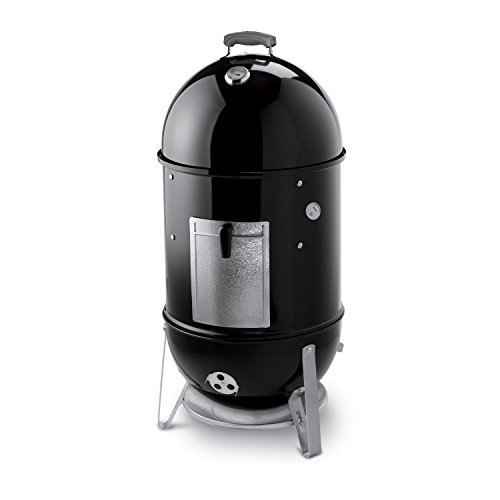
Weber Smokey Mountain Cooker 18-Inch — Best for Beginners
The 18-inch Smokey Mountain is the size most instructors quietly recommend for a first firewood smoker. It keeps everything that makes the design great — dual cooking grates, porcelain-enamelled body, damper-based temperature control, per the Amazon listing — while using less charcoal per cook and fitting smaller patios. A whole chicken, a rack or two of ribs, a modest brisket flat: the everyday repertoire of a learning smoker fits without waste.
Strengths
- Same stability and build as the 22-inch, in a thriftier, smaller package
- Uses less fuel per cook — economical while you learn
- Dual grates still allow a main dish plus a side to smoke together
Trade-offs
- Full packer briskets and large rib racks need trimming or creative placement
- Same water-pan routine as its siblings
- Growing families may trade up to the 22-inch within a few seasons
| Type | Vertical water smoker |
| Size (per listing) | 18-inch |
| Grates (per listing) | Dual cooking grates |
| Fuel | Charcoal with wood chunks |
There is a teaching argument for the 18-inch beyond size: smaller cookers respond a little faster, so the feedback loop between damper adjustment and temperature change is quicker, and the craft is learned faster. Its cooks are also cheaper to ruin — an experimental rub on a chicken costs less than on a giant brisket. Start here, master fire and smoke on forgiving cuts, and you will know with certainty whether the 22-inch, an offset, or contentment is your next step.
The 18-inch rewards a specific beginner’s discipline: cook the same forgiving cut — a pork butt or a whole chicken — several times before ranging wider. Because the cooker is smaller and a little more responsive than its big sibling, each repetition teaches the damper language quickly, and the variables stay few enough to actually learn from. Owners who follow that path typically find that by their fifth cook they are adjusting vents by feel and predicting the cooker instead of reacting to it — the moment firewood smoking turns from anxiety into pleasure.
Best for: beginners, couples and small families entering wood-fired smoking / Not suited for: large gatherings or cooks who regularly smoke whole packer briskets
Check on Amazon — check the current price on Amazon before you decide, as listings and included accessories change over time.
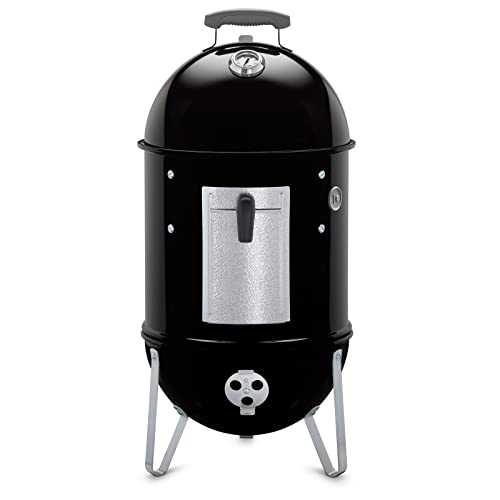
Weber Smokey Mountain Cooker 14-Inch — Best Compact and Portable
The 14-inch Smokey Mountain answers a question the bigger cookers cannot: what if the smoking has to travel, or the home is a balcony? Per the Amazon listing it keeps the family’s essentials — dual cooking grates, porcelain-enamelled construction, temperature control dampers — in the smallest vertical Weber makes. It smokes a chicken, a small pork butt or a couple of fish fillets with the same clean wood character as its siblings.
Strengths
- Genuinely portable: tailgates, campsites, balconies and small patios
- Same build quality and damper control as the larger models
- Sips charcoal — the cheapest Smokey Mountain to run
Trade-offs
- Capacity is the compromise: small cuts only, one main at a time
- Small fuel load means long cooks need a mid-cook charcoal top-up
- Enthusiasts will treat it as a second smoker rather than their only one
| Type | Vertical water smoker |
| Size (per listing) | 14-inch |
| Grates (per listing) | Dual cooking grates |
| Fuel | Charcoal with wood chunks |
Do not mistake the 14-inch for a novelty. Its small chamber heats fast, holds its temperature with the family discipline, and produces smoked food that embarrasses far larger, cheaper cookers. RV travellers, apartment dwellers with a tolerant balcony, and tailgaters who want ribs instead of burgers all find it transformative. It is also the classic second smoker for owners of big offsets who want a small, quick fire for a weeknight chicken — a role it fills perfectly.
Portability changes the smoking calendar in ways owners underestimate. A cooker that travels goes to the lake house, the campsite and the friend’s garden — which means smoked food appears in places and seasons where a fixed cooker would never be fired. The 14-inch also heats and cools quickly, making it the right tool for shorter smokes: fish, cheese-adjacent projects with care, sausages and chicken pieces. Households that own both a large smoker and the 14 routinely report the small one lighting more often, which is the highest compliment a cooker can earn.
Best for: small spaces, travel, tailgating and as a second, quick smoker / Not suited for: family feasts or long, large brisket cooks
Check on Amazon — check the current price on Amazon before you decide, as listings and included accessories change over time.

Oklahoma Joe’s Highland Offset Smoker — Best True Stick Burner
Vertical smokers burn chunks on charcoal; the Highland burns wood itself. Its side firebox takes splits of oak or hickory as the primary fuel, and the smoke that reaches the meat in its 900-square-inch chamber (per the Amazon listing) has passed through a living flame. That is the oldest method in barbecue and, in the judgement of many who have eaten both ways, the most delicious — the pick for the cook who wants the firewood experience undiluted.
Strengths
- Burns real splits — the deepest, most complex smoke character available at home
- 900 sq. in. chamber fits full briskets and multiple racks
- Firebox access lets you tend the fire without opening the cooking chamber
Trade-offs
- Demands active tending: small additions of wood throughout the cook
- Conventional flow cooks hotter near the firebox — rotate meat
- Heavy cooker; assembly and placement are a two-person commitment
| Type | Offset stick burner |
| Cooking area (per listing) | 900 sq. in. |
| Fuel | Wood splits over a charcoal bed |
| Positioning | Mid tier |
The Highland is a commitment device: it asks for your afternoon and repays it in bark, smoke ring and the particular satisfaction of a fire well kept. Technique is the whole game — a small, hot, clean-burning fire, fed a split at a time, with the chimney breathing freely. Cooks who master it describe a quality of barbecue that no shortcut reproduces. If the verticals in this guide are the sensible route into firewood, the Highland is the romantic one, and romance, in barbecue, is a legitimate specification.
In a firewood guide, the Highland’s role is to represent the split fire honestly, including its appetite. A long brisket cook on an offset consumes a meaningful stack of splits — armfuls, not handfuls — and the cook should lay in that supply before lighting anything, because a fire starved mid-cook while someone drives to buy wood is a fire mismanaged. The reward for that logistics is the flavour benchmark of this entire guide: bark with real depth, a smoke ring like a signature, and meat that tastes of a place and a tradition, not of an appliance.
Best for: purists who want to burn splits and tend a live fire / Not suited for: hands-off cooks or anyone smoking in a hurry
Check on Amazon — check the current price on Amazon before you decide, as listings and included accessories change over time.

Cuisinart 18-Inch Vertical Charcoal Smoker (COS-118) — Best Budget Vertical
The Cuisinart COS-118 brings the vertical water-smoker concept to the budget tier: an 18-inch body with chrome-plated grates, a water bowl, dual vents for airflow control and an integrated thermometer, all confirmed in the Amazon listing. It is the same architecture as the Smokey Mountains — charcoal bed, wood chunks, water buffering the heat — at a price that lowers the cost of finding out whether firewood smoking is your hobby.
Strengths
- Budget tier access to genuine wood-and-charcoal smoking
- Water bowl and dual vents give the classic vertical control scheme
- Light, simple construction suits camping and tailgates as the listing suggests
Trade-offs
- Thinner materials than the Weber picks: more weather sensitivity, more tending
- Integrated thermometer is a guide, not gospel — a separate probe is wise
- Long-term durability trails the porcelain-enamelled competition
| Type | Vertical charcoal smoker |
| Size (per listing) | 18-inch |
| Features (per listing) | Integrated thermometer, water bowl, dual vents |
| Positioning | Budget tier |
The honest role of the COS-118 is the trial run. It smokes real food with real wood flavour — ribs, chickens, small briskets as its listing suggests — and it teaches the vertical method faithfully. What the budget buys away is refinement: the steel is lighter, the seals are looser, and the cook supplies a little more attention to hold temperature. For a first season of smoking, or a portable second cooker, that trade is entirely rational, and many owners upgrade later with full knowledge of what the extra money should fix.
The COS-118 teaches the same vertical method as the Weber picks, and its budget construction has one unexpected teaching benefit: because its seals are looser, its owner learns airflow management actively rather than assuming it. That skill transfers perfectly if an upgrade comes later. Practical ownership notes: site it out of the wind, expect to add charcoal on the longest cooks, and treat the integrated thermometer as a rough guide while a separate probe tells the truth. Do those things and the food — which is, after all, the point — comes out genuinely smoked and genuinely good.
Best for: budget buyers and campers wanting the vertical water-smoker method / Not suited for: buy-it-for-life shoppers or unattended long cooks
Check on Amazon — check the current price on Amazon before you decide, as listings and included accessories change over time.

Masterbuilt Gravity Series 600 Digital Charcoal Grill and Smoker — Best Set-and-Forget Wood Fuel
The Gravity Series 600 is the firewood family’s modern branch: a hopper holds charcoal (with wood chunks layered in for smoke), gravity feeds it into the fire as it burns down, and a digital controller with WiFi — per the Amazon listing — holds your set temperature with a fan. The fuel is real, the smoke is real, and the all-day tending of the offset is replaced by a hopper you fill and a temperature you dial, across 600 square inches of cooking space.
Strengths
- Real charcoal and wood flavour with digital temperature holding
- Gravity-fed hopper enables long cooks without repeated fire tending
- WiFi monitoring suits cooks who cannot hover over the cooker all day
Trade-offs
- Burns charcoal and chunks, not splits — the offset’s deepest smoke remains distinct
- Electronics and a fan are components that can fail, unlike a pure fire cooker
- Premium tier, and it needs power at the cooker
| Type | Gravity-fed digital charcoal smoker/grill |
| Cooking area (per listing) | 600 sq. in. |
| Control (per listing) | Digital with WiFi |
| Fuel | Charcoal with wood chunks |
Judge the Gravity 600 by the problem it solves: the flavour gap between pellet convenience and offset authenticity. Layer wood chunks through the hopper and ash pan and the smoke character is unmistakably real-fire, while the controller holds temperature through a brisket cook with a steadiness no human tender matches. It grills hot as well as smoking low, which the pure smokers here do not. For the cook whose life cannot spare a day of fire tending but whose palate refuses pellets, it is not a compromise — it is the answer.
The gravity hopper rewards a layering technique worth learning in week one: charcoal as the base fuel, with wood chunks distributed through the hopper and a chunk or two in the ash pan where embers fall, so smoke production stays present across the whole cook rather than front-loaded. Owners also discover its second identity as a hot grill — the same fire that idles at smoking temperature can be driven high for steaks, which makes the 600 the only pick here that plausibly replaces a household’s grill as well as adding a smoker. That dual role is the heart of its value case.
Best for: busy cooks wanting real-fire flavour with digital temperature control / Not suited for: purists who want to burn splits and tend the fire personally
Check on Amazon — check the current price on Amazon before you decide, as listings and included accessories change over time.
Comparison Table
| Pick | Badge | Key spec | Best for |
|---|---|---|---|
| Weber Smokey Mountain Cooker 22-Inch | Best Overall Firewood Smoker | Type: Vertical water smoker; Size (per listing): 22-inch | most cooks who want real wood smoke with manageable effort |
| Weber Smokey Mountain Cooker 18-Inch | Best for Beginners | Type: Vertical water smoker; Size (per listing): 18-inch | beginners, couples and small families entering wood-fired smoking |
| Weber Smokey Mountain Cooker 14-Inch | Best Compact and Portable | Type: Vertical water smoker; Size (per listing): 14-inch | small spaces, travel, tailgating and as a second, quick smoker |
| Oklahoma Joe’s Highland Offset Smoker | Best True Stick Burner | Type: Offset stick burner; Cooking area (per listing): 900 sq. in. | purists who want to burn splits and tend a live fire |
| Cuisinart 18-Inch Vertical Charcoal Smoker (COS-118) | Best Budget Vertical | Type: Vertical charcoal smoker; Size (per listing): 18-inch | budget buyers and campers wanting the vertical water-smoker method |
| Masterbuilt Gravity Series 600 Digital Charcoal Grill and Smoker | Best Set-and-Forget Wood Fuel | Type: Gravity-fed digital charcoal smoker/grill; Cooking area (per listing): 600 sq. in. | busy cooks wanting real-fire flavour with digital temperature control |
The table’s real story is fuel and attention. The verticals burn charcoal with wood chunks and ask for occasional damper checks; the offset burns splits and asks for your afternoon; the gravity cooker burns charcoal and chunks and asks only for a full hopper. Flavour depth runs roughly in the opposite direction to convenience — which is why the right pick is a decision about your life first and your palate second.
How to Choose the Best Firewood Smokers: Vertical, Offset or Gravity
Choose the architecture before the brand. Vertical water smokers are the forgiving school of firewood: a charcoal bed for steady heat, wood chunks for smoke, a water pan buffering every mistake, and dampers that hold a temperature for hours. They suit beginners and busy cooks, produce superb barbecue, and their one honest limit is that chunks-on-charcoal smoke, while excellent, is a shade gentler than a split fire’s. Most home smokers should start here — and many should stay here happily for life.
Offsets are the graduate school: splits burning in a firebox, the cook as thermostat, the deepest smoke and the most demanding afternoon. Gravity-fed digital cookers are the modern compromise — real fuel, electronic discipline — for cooks whose schedules forbid tending but whose standards forbid pellets. Neither graduate nor compromise is ‘better’; they are answers to different questions about how you want to spend a Saturday.
- First firewood smoker, family cooking, calm cooks: a vertical water smoker.
- Deepest smoke, live-fire craft, time-rich weekends: an offset stick burner.
- Real-fire flavour on a workday schedule: the gravity-fed digital cooker.
- Small spaces and travel: the 14-inch vertical, without hesitation.
Wood selection: species, size and dryness
Dryness outranks species. Seasoned wood — split and dried until it is light for its size and cracks at the ends — burns clean and sweet; green or wet wood smoulders bitter regardless of variety. For species: oak is the balanced default, hickory the strong traditional voice (use a lighter hand), and apple or cherry the gentle choice for poultry, fish and cheese. In vertical smokers the format is chunks, fist-sized, laid on the charcoal; in offsets it is splits, roughly wrist-thick, fed one at a time onto a glowing bed.
The clean-fire principle, in one paragraph
Great smoke is nearly invisible: thin, pale and blue-tinged, from a hot, well-fed fire. Bad smoke is thick and white, from a choked or green fire, and it deposits bitterness no rub or sauce can rescue. Every technique in firewood cooking — small fires, free airflow, dry wood, patience before loading the meat — serves that single distinction. Learn to read smoke colour and you have learned the heart of this entire guide.
How Much Smoker Do You Actually Need?
Capacity in firewood smokers should be sized to your typical cook, not your legendary one. A smoker run half-empty is inefficient but happy; a smoker crammed beyond its airflow is neither. The 18-inch vertical covers couples and small families completely. The 22-inch exists for briskets whole and ribs in quantity. The offset’s chamber suits the cook who hosts. And the 14-inch — so easily dismissed as small — is exactly right for the enormous number of real cooks whose smoking life is a chicken, a small butt, a side of salmon, done beautifully and often.
Running costs follow size: bigger cookers burn more charcoal per cook regardless of how much food is inside. Over a season, the difference between the 14 and the 22 is a real line in the household budget and a real amount of ash to dispose of. Buy the size your Tuesdays need, borrow or improvise for the one legendary Saturday, and your firewood smoking will be cheaper, calmer and more frequent.
Building a Wood Supply: Sourcing, Splitting and Seasoning
A firewood smoker is only as good as its woodpile, and building that pile is a skill with a calendar. The best sources are local: tree surgeons, firewood merchants who can name their species, and orchard prunings for fruitwood. Buy by species, not by the anonymous ‘mixed hardwood’ load, because smoking is cooking and the wood is an ingredient. Oak is the foundation to stock deeply; hickory, apple and cherry are the accents to hold in smaller quantities. Avoid anything treated, painted, or of unknown origin, and be wary of wood stored against houses for years, which may have been sprayed.
Seasoning is time plus airflow. Split wood dries far faster than rounds, and a stack built off the ground, covered on top and open at the sides will season most hardwoods across a single warm season. The signs of readiness are tactile: the wood feels light for its size, the bark loosens, the ends show cracks, and two pieces knocked together ring rather than thud. Cooks in a hurry can buy kiln-dried or pre-seasoned smoking wood in chunks and splits — more expensive per cook, but immediately reliable, and the sensible choice for a first season while your own pile matures.
Storage near the cooker should hold a cook’s worth plus a margin: an offset brisket day consumes a stack you can picture — several armfuls of splits — while a vertical’s chunk supply for a cook fits in a bucket. Keep a dry reserve under cover for the day the main pile is rained on, because firewood cooking with wet wood is not a challenge to rise to; it is a mistake to avoid. The woodpile, maintained a season ahead, is what separates households that smoke often from households that mean to.
Firewood Flavour Pairings: Matching Smoke to Meat
Pairing wood to food follows one principle: match intensity to intensity, so the smoke seasons rather than shouts. Beef — brisket above all — carries the strongest smokes happily: oak as the base, hickory in support, the classic Texas combination that built the tradition. Pork is the great generalist, at home with oak, hickory, apple or cherry, and mixed-wood cooks are traditional for shoulders and ribs. Poultry and fish ask for a lighter hand: fruitwoods and alder-style gentleness, shorter exposure, and a cleaner, smaller fire, because delicate flesh takes smoke quickly and holds bitterness just as fast.
Cheese, nuts and vegetables — the cold and warm smoking projects that become a firewood cook’s winter hobby — want the gentlest smoke of all, in short sessions, and are an excellent use for the compact vertical in this guide. Sausages sit in the middle: oak or fruitwood, steady moderate smoke, and attention to temperature above all. Across every pairing, the clean-fire rule dominates the species choice — a clean oak fire beats a dirty hickory fire on any meat, every time — which is why this guide returns to fire management in every section. Species is the accent; combustion is the language.
Keep notes as you pair. A line per cook — wood, cut, result — builds, within a season, a personal pairing table no book can give you, tuned to your cooker, your wood supply and your family’s palate. That notebook is the true graduation certificate of the firewood school, and every cook in this guide’s audience is capable of earning it by autumn.
Ash, Storage and Putting the Cooker to Bed
Firewood cooking ends with two residues — ash and grease — and the cookers in this guide live or die by how faithfully both are handled. Ash first: it leaves the cooker only when stone cold, because ash insulates embers so effectively that a fire can survive invisibly for a day or longer. A metal ash bucket with a fitted lid is the correct vessel, stored on paving or earth away from structures until its contents are certainly dead. Cooled completely, wood ash has garden uses in many households, but the route from cooker to garden always passes through that metal bucket and a patient wait.
Grease is the slower enemy. In vertical smokers it collects in and around the water pan; in offsets it migrates along the chamber floor toward the drain or the low corner. Warm — not hot — scraping after a cook, while residues are still soft, takes minutes; the same job after a month of cooks takes an afternoon and a temper. Foil lining the water pan or the offset’s low spots is a legitimate labour-saving tradition, replaced each cook, that keeps the deep cleans rare and shallow.
Storage closes the ritual. A cover that actually fits, a position out of the worst weather, vents left slightly open against condensation, and — for the digital gravity cooker — a hopper emptied of charcoal that would otherwise drink the damp: these are the whole liturgy. Firewood itself stores nearby but never inside the cooker, where it would harbour moisture and pests. Put to bed this way, a firewood smoker wakes in spring exactly as it slept, ready for the first clean fire of the season — and the cook who kept the ritual will taste the difference.
How to Smoke with Firewood: A First Cook, Step by Step
This sequence works, with small adaptations, on every cooker in this guide. The cut is a pork butt — firewood smoking’s most forgiving teacher — and the goal of the first cook is not perfection but calibration: learning your cooker’s voice.
- Choose dry wood: seasoned chunks for a vertical or gravity cooker, wrist-thick splits for an offset.
- Light a chimney of charcoal fully — grey, ashed-over coals — and build your fire bed in the cooker.
- For verticals, fill the water pan with hot water; for offsets, let the chamber come up to temperature with a clean, small fire.
- Wait for clean smoke: thin and pale. Thick white smoke means wait longer — this patience is the craft.
- Season the meat, place it fat side toward the heat, and set a probe at grate level beside it.
- Hold your temperature band with dampers (vertical), fire size and intake (offset), or the controller (gravity) — small corrections, early.
- Feed the fire little and often; never let it die to embers and never bury it in fresh wood.
- Cook to tenderness, not to the clock: the probe should slide into the meat with almost no resistance.
- Rest the meat wrapped before pulling or slicing — the juices you keep are the reward for the whole day.
Clean the cooker while the lessons are fresh: ash out when cold (ash plus moisture corrodes steel), grates brushed, water pan emptied. Then write down what the fire did — fuel used, damper positions, weather. Firewood cooks keep notebooks because firewood cooking is a craft, and crafts compound. Your fifth cook will be visibly better than your first, and the notebook is why.
Common Buying Mistakes
Mistake 1: Loading meat into dirty smoke. The thick white smoke of a young or choked fire is bitter. Wait for the smoke to thin and pale before the meat goes on — ten patient minutes at the start decide the flavour of the entire cook.
Mistake 2: Buying green or mystery wood. Wood should be seasoned, identified hardwood. Wet wood smoulders, softwood resins taste harsh, and treated or painted timber must never touch food fire. A known dry hardwood — oak above all — is the beginner’s best friend.
Mistake 3: Chasing temperature with big corrections. Fire responds slowly and then all at once. Small damper moves, single splits, early additions: the calm hand holds the steady temperature. Every wild swing in the fire writes itself into the meat.
Mistake 4: Sizing for the party, cooking for two. An oversized smoker burns fuel and patience on everyday cooks. Size to your typical cook and let the rare feast be the exception that borrows a second cooker or cooks in shifts.
Mistake 5: Cooking to time instead of tenderness. Firewood cooking varies with weather, fuel and the individual cut. Times are planning estimates; the probe’s feel is the verdict. Serving by the clock is how good meat becomes merely adequate.
Final Recommendation
For most readers, the 22-inch Smokey Mountain is the firewood smoker to buy — the deepest bench of owner knowledge, the calmest fire, and capacity for anything a home cook reasonably attempts. Beginners and smaller households should take the 18-inch without a flicker of doubt, travellers the 14-inch, and budget buyers the Cuisinart as an honest apprenticeship. The Highland offset is the purist’s reward, and the Gravity Series 600 is the modern answer for real-fire flavour on a schedule.
However you enter, enter with dry wood and patience, and the fire will teach you the rest. The guides below cover the firebox design in depth and the wider smoker family on this site:
- Best Overall Firewood Smoker: Weber Smokey Mountain Cooker 22-Inch — check price on Amazon
- Best for Beginners: Weber Smokey Mountain Cooker 18-Inch — check price on Amazon
- Best Compact and Portable: Weber Smokey Mountain Cooker 14-Inch — check price on Amazon
- Best True Stick Burner: Oklahoma Joe’s Highland Offset Smoker — check price on Amazon
- Best Budget Vertical: Cuisinart 18-Inch Vertical Charcoal Smoker (COS-118) — check price on Amazon
- Best Set-and-Forget Wood Fuel: Masterbuilt Gravity Series 600 Digital Charcoal Grill and Smoker — check price on Amazon
Best Firebox Smokers Best Offset Smokers Best Charcoal Smokers Best 3 In1 Smokers Best Pellet Smokers
Frequently Asked Questions
What is the difference between a firewood smoker and a pellet smoker?
A firewood smoker burns wood in recognisable form — splits in an offset firebox, or chunks over charcoal in a vertical or gravity cooker — with the cook managing the fire directly or through simple dampers. A pellet smoker burns compressed wood pellets fed automatically by an auger under electronic control. Both make real smoke; the firewood route offers deeper smoke character and craft involvement, the pellet route offers appliance convenience.
What wood is best for smoking meat?
Seasoned oak is the most versatile starting point — balanced smoke that suits beef, pork and poultry. Hickory is stronger and traditional for pork and bacon-style flavours; apple and cherry are gentler and excellent with poultry, fish and cheese. Whatever the species, dryness matters most: seasoned, dry wood burns clean, while green wood makes bitter smoke.
How long does a firewood smoker hold temperature?
It depends on the design. Vertical water smokers are famous for holding a steady band for many hours on one charcoal load with minimal damper attention. Offsets need feeding at intervals throughout the cook — that tending is their nature. The gravity-fed pick holds a set temperature electronically as long as its hopper has fuel.
Can beginners really manage a firewood smoker?
Yes — starting with the right design. A vertical water smoker forgives beginner errors with its water buffer and stable dampers, and forgiving cuts like pork butt tolerate temperature swings. Beginners who start on an offset also succeed, but the learning curve is steeper and the first cooks demand more attention.
Do I need to soak wood chunks before smoking?
Soaking is a persistent myth worth retiring: wood absorbs very little water, and what it does absorb must steam off before the wood can smoke, delaying clean smoke. Dry chunks placed on hot coals begin producing good smoke promptly. Spend the soaking time on seasoning the meat instead.
How do I store firewood for smoking?
Split, stacked off the ground with airflow around it, and covered on top against rain while the sides stay open to dry. Seasoned wood keeps well for a long time stored this way. Keep your smoking wood separate from any treated, painted or unknown timber, which must never be burned around food.


