Disclosure: airfryerkitchensupply.com is reader-supported. When you buy through links on our site, we may earn an affiliate commission at no extra cost to you.
Where to buy
If you are shopping for the best vacuums with suction power, the first thing to know is that suction is the one specification manufacturers actually print — if you know where to look. Cordless sticks and robot vacuums publish their pull in air watts (AW) or pascals (Pa), and those numbers are printed right in the verified listings used for this guide: the strongest pick below is rated at 280AW, the strongest robot at 10,000Pa. That makes this one of the few vacuum categories where a buyer can compare real, manufacturer-stated pulling power instead of marketing adjectives, and it is exactly how the six picks below were ranked.
The second thing to know is that the two units are not interchangeable. Air watts describe suction at the cleaner head of a stick or handheld machine; pascals describe the pressure differential a robot generates inside a sealed body. A 10,000Pa robot and a 280AW stick are both genuinely strong for their format, but they clean differently: the stick puts that power where you point it, the robot spreads it across a whole floor plan on a schedule. This guide keeps the two formats side by side, labels every number with the unit its manufacturer used, and never converts one unit into the other, because no honest conversion exists.
Every pick below was verified connection before a single Amazon link was attached: the ASIN, the product name and the suction figure all come from the listed listing title, not from a retailer’s summary page. Where a listing states a runtime, a dustbin size or a filtration type, that is printed in the pick’s spec box; where the listing is silent, the spec box says so by omission rather than guessing. We never print fixed prices — use the links to check the current price on Amazon, because suction-class machines are discounted unevenly and often.
- Dyson Gen5detect Cordless Vacuum (Best Overall Suction): available on Amazon — check the current price on Amazon before you order.
- Tineco Pure One A50S Cordless Stick Vacuum (Best Suction-Per-Size Balance): available on Amazon — check the current price on Amazon before you order.
- Tineco A30S Cordless Vacuum Cleaner (Best Runtime With Strong Suction): available on Amazon — check the current price on Amazon before you order.
- Dyson V11 Origin Cordless Vacuum (Best Proven Mid-Tier Suction): available on Amazon — check the current price on Amazon before you order.
- DREAME R10 Cordless Stick Vacuum (Best Value Strong Suction): available on Amazon — check the current price on Amazon before you order.
- roborock Q10 S5+ Robot Vacuum and Mop (Best Robot Suction): available on Amazon — check the current price on Amazon before you order.
In this guide
Quick Picks
Ranked by the suction figure each manufacturer states in its own verified listing, with format and runtime used as tie-breakers.
- Best Overall Suction: Dyson Gen5detect Cordless Vacuum — the strongest verified stick figure in this guide at 280AW, with up to 70 minutes of runtime and HEPA filtration. Check the current price on Amazon.
- Best Suction-Per-Size Balance: Tineco Pure One A50S Cordless Stick Vacuum — 220AW of stated suction with a large 1L dustbin and a brush designed to sense and tackle large debris. Check the current price on Amazon.
- Best Runtime With Strong Suction: Tineco A30S Cordless Vacuum Cleaner — 200AW suction, a stated 60-minute runtime and a 1L bin, with a ZeroTangle brush for hair-heavy homes. Check the current price on Amazon.
- Best Proven Mid-Tier Suction: Dyson V11 Origin Cordless Vacuum — 185AW across three power modes with up to 60 minutes of runtime, from Dyson’s long-running V11 line. Check the current price on Amazon.
- Best Value Strong Suction: DREAME R10 Cordless Stick Vacuum — 120AW stated suction, up to 60 minutes of runtime and LED headlights, at the value end of this guide. Check the current price on Amazon.
- Best Robot Suction: roborock Q10 S5+ Robot Vacuum and Mop — 10,000Pa stated suction with 70-day self-emptying, sonic mopping and auto mop lift for carpeted homes. Check the current price on Amazon.
How These Picks Were Chosen
The method for this guide was deliberately narrow. First, the current Amazon catalog was searched for full-size cleaning machines — cordless sticks, convertibles and robots — whose own listing titles state a suction figure in air watts or pascals. Handheld-only car vacuums, vacuum sealers and replacement parts were excluded, because a strong handheld is not an answer to a whole-home suction question. Six machines survived with clear, non-duplicated listings: five cordless sticks spanning 120AW to 280AW, and one self-emptying robot at 10,000Pa.
Second, each surviving listing was read for the supporting specifications that decide whether headline suction is usable: runtime, because a 280AW mode that lasts ten minutes cleans one room; dustbin capacity, because strong suction fills a small cup fast; and filtration, because power that exhausts fine dust back into the room is wasted. Those figures appear in each pick’s spec box exactly as the listing states them. Runtime claims are manufacturer figures for the lowest or mixed mode where the listing phrases them that way, and this guide treats them as ceilings, not promises.
Third, duplicates and near-duplicates were removed. Several brands sell the same machine under two listings or two colorways; only one listing per machine appears here. No pick carries a price, a star rating or a review count, because all three change constantly and none of them measures suction. What decides the order below is the verified number, the format it arrives in, and how much of a home that format can realistically clean on one charge.
The 6 Best Vacuums With Suction Power

Dyson Gen5detect Cordless Vacuum — Best Overall Suction
The Gen5detect sits at the top of this ranking for a simple reason: 280AW is the highest suction figure any verified stick listing in this guide states, and it arrives with the runtime to use it — up to 70 minutes across three power modes, with an illumination cleaner head that reveals dust on hard floors and whole-machine HEPA filtration behind it. This is the pick for buyers who want the strongest stated pull in a hand-guided format and will actually use the lower modes for daily cleaning, reserving full power for carpet deep cleans and edges.
Strengths
- Highest verified suction figure here: 280AW, stated in the listing itself
- Up to 70 minutes of runtime, so max power is not the only usable mode
- HEPA filtration and an illumination head that shows dust you would otherwise miss
Trade-offs
- Premium tier machine — check the current price on Amazon against the rest of this list before committing
- Full-power mode trades runtime away fast; the 70-minute figure belongs to gentler modes
- A stick format still means you do the pushing — no self-emptying dock is stated in the listing
| Suction (as listed) | 280AW |
| Power modes | 3 |
| Runtime (as listed) | Up to 70 minutes |
| Filtration (as listed) | HEPA filtration |
| Format | Cordless stick, all floor types |
Suction at this level changes what a cordless stick is for. Weaker sticks are maintenance tools that keep tidy floors tidy; a 280AW machine is a primary vacuum that can pull embedded grit out of carpet pile, which is the job that used to belong exclusively to corded uprights. The three power modes matter more than the headline number: run the middle mode for whole rooms, drop to the lowest for daily hard-floor passes where runtime stretches, and save the top mode for the rug by the door, the stairs and the strip along the baseboards where debris concentrates.
The honest limit is physics, not marketing. Suction figures are measured at the machine, and real-world pickup also depends on the cleaner head sealing against the floor and the bin not being packed full. Empty the bin before it reaches its fill line, wash or replace filters on the maker’s schedule, and the Gen5detect will keep delivering something close to its stated pull; neglect both and any vacuum on this page, this one included, quietly becomes a much weaker machine.
Best for: buyers who want the strongest stated suction in a stick format and clean a mixed-floor home themselves / Not suited for: buyers who want hands-off scheduled cleaning, or who only ever clean one small hard-floor room
Check on Amazon — check the current price on Amazon, and confirm the exact configuration on the listing before ordering.

Tineco Pure One A50S Cordless Stick Vacuum — Best Suction-Per-Size Balance
The A50S is the pick for buyers who looked at the 280AW flagship above, checked the price gap, and asked the sensible question: how much suction do I actually give up by stepping down one tier? The verified answer is 220AW — still deep into primary-vacuum territory — paired with a 1L dustbin that is larger than most stick bins and a power brush built to handle large debris without choking. For homes with kids, pets or a gravel-prone entryway, bin capacity is not a footnote; it is the difference between finishing the floor and stopping mid-room to empty.
Strengths
- 220AW stated suction — second strongest stick figure in this guide
- 1L dustbin swallows more debris between empties than typical stick cups
- PureCyclone separation helps the filter stay cleaner, which protects suction between services
Trade-offs
- Runtime is not stated in the verified listing title, so treat battery endurance as a question to confirm on the listing page
- A sensing power brush adds head complexity compared with a plain suction head
- Still a premium-tier stick, not a budget buy
| Suction (as listed) | 220AW |
| Dustbin (as listed) | 1L, described as larger |
| Brush (as listed) | 3DSense Power Brush |
| Separation (as listed) | PureCyclone Tech |
| Format | Cordless stick |
The A50S makes its case on the unglamorous side of suction: keeping it. Cyclonic separation spins coarse debris out of the airstream before it reaches the filter, and a bigger bin means the debris layer sitting against the intake stays thinner for longer. Both details attack the most common reason owners conclude a vacuum has ‘lost suction’ within a year — it has not lost anything; its filter is blinded and its bin is packed. A machine designed around separation and capacity holds its stated performance closer to day one for more of its life.
Who should pick it over the Dyson above? Households whose floors produce volume — cereal, litter, tracked-in grit, pet hair by the handful — rather than fine dust alone. The 60AW gap at the top matters most on deep carpet pile; on hard floors and low rugs, pickup is limited by the head and the bin long before it is limited by the motor, and that is exactly the territory where the A50S is specified strongest.
Best for: busy households producing lots of coarse debris who want near-flagship suction with a bigger bin / Not suited for: buyers who need a stated runtime figure before they will consider a cordless machine
Check on Amazon — check the current price on Amazon, and confirm the exact configuration on the listing before ordering.

Tineco A30S Cordless Vacuum Cleaner — Best Runtime With Strong Suction
The A30S is the balanced spec sheet of this guide: 200AW of stated suction, a stated 60-minute runtime, the same 1L larger dustbin as its A50S sibling, and a ZeroTangle brush aimed squarely at homes where hair wraps around a normal brush roll until pickup dies. If your household includes long hair, a shedding dog, or both, the anti-tangle brush is not a gimmick — wrapped hair is a suction problem, because a matted roll lifts the head off the floor and breaks the seal that suction needs.
Strengths
- 200AW stated suction with a full 60-minute stated runtime — the strongest endurance pairing here
- ZeroTangle brush attacks hair wrap, the most common cause of fading pickup in pet homes
- 1L bin and PureCyclone separation, same capacity story as the A50S
Trade-offs
- One step down in headline suction from the A50S and two from the Gen5detect
- Anti-tangle combs help, but long hair still needs an occasional manual clear-out
- Stick format means stairs and upholstery need the handheld conversion, not a hose
| Suction (as listed) | 200AW |
| Runtime (as listed) | 60 minutes |
| Dustbin (as listed) | 1L, described as larger |
| Brush (as listed) | ZeroTangle Brush |
| Separation (as listed) | PureCyclone Tech |
Read the A30S as the guide’s honesty pick: every figure a buyer needs is stated in its own listing — suction, runtime, bin size, brush type — so the comparison against its rivals is arithmetic rather than guesswork. In practice, 200AW is comfortably past the threshold where a stick stops being a crumb tool. It will pull sand out of an entryway rug, lift litter scatter, and deep-clean a bedroom carpet without the second pass that weaker sticks demand.
The runtime figure deserves the usual translation: 60 minutes is the maker’s number, achieved in the gentlest mode on hard floors. Carpet work in higher modes will return less. Even halved, though, 30 minutes of strong-mode cleaning covers the traffic lanes of most homes, and the sensible routine is the same as with every pick here — daily maintenance in low mode, weekly deep passes in high mode, bin emptied before it packs.
Best for: pet and long-hair households that want strong suction, long stated runtime and an anti-tangle brush in one machine / Not suited for: buyers chasing the absolute highest AW figure regardless of brush and bin design
Check on Amazon — check the current price on Amazon, and confirm the exact configuration on the listing before ordering.
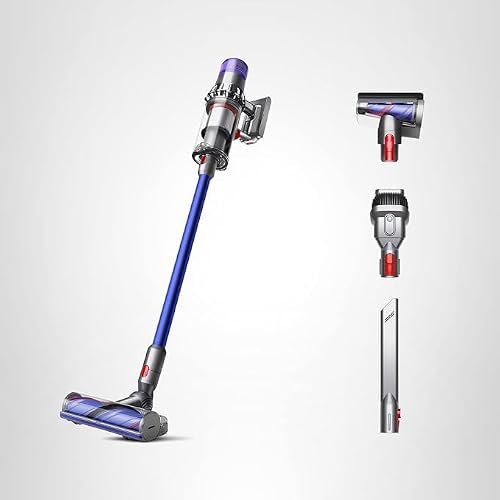
Dyson V11 Origin Cordless Vacuum — Best Proven Mid-Tier Suction
The V11 Origin is the guide’s steady-hand pick: 185AW of stated suction, three power modes, up to 60 minutes of runtime, and a listing that states deep cleaning on both hard floors and carpets plus pet-hair detangling. The V11 platform has been in service for years, which carries a practical advantage no spec sheet shows — filters, batteries and cleaner heads are widely stocked, and any local repair shop has seen one. For buyers who keep appliances a long time, that ecosystem is worth real money.
Strengths
- 185AW stated suction with three modes to trade power against runtime
- Up to 60 minutes of stated runtime matches the endurance leaders here
- Mature platform: consumables and spares are easy to source years later
Trade-offs
- A generation behind the Gen5detect on headline suction and dust illumination
- Bin size is not stated in the verified listing title — confirm on the listing if capacity matters to you
- Pet-hair detangling helps, but dense undercoat still needs periodic brush cleaning
| Suction (as listed) | 185AW |
| Power modes | 3 |
| Runtime (as listed) | Up to 60 minutes |
| Stated strengths | Deep cleans hard floors and carpets; detangles pet hair |
| Format | Cordless stick |
There is a useful lesson in the V11’s numbers: the jump from 185AW to 280AW is real, but it is not the jump from ‘cannot clean carpet’ to ‘can’. The V11 already sits well above that line, and on hard floors — where most homes do most of their vacuuming — its pickup is limited by head design, not motor pull. Where the extra money for the flagship earns its keep is deep-pile carpet and whole-home single-charge coverage in high mode; where it does not is a mostly hard-floor apartment.
Buy the V11 Origin if your decision is about total ownership rather than a spec-sheet contest: a known machine, a stated hour of runtime, suction that handles every normal floor job, and a parts pipeline that will still exist when the first filter wears out. That combination is why it holds a place in a guide ranked by suction — 185AW is not a consolation prize; it is the point where returns start diminishing for most homes.
Best for: long-term owners who want strong, stated suction on a mature, easy-to-maintain platform / Not suited for: buyers who want the newest detection features or the highest available AW figure
Check on Amazon — check the current price on Amazon, and confirm the exact configuration on the listing before ordering.

DREAME R10 Cordless Stick Vacuum — Best Value Strong Suction
The R10 is where this guide’s ranking meets a budget. Its 120AW stated suction is the lowest figure here — and it still doubles what the weakest big-brand sticks offer, while matching the leaders on stated runtime at up to 60 minutes and adding LED headlights and an anti-tangle brush. For hard floors, area rugs and everyday debris, 120AW is genuinely sufficient: pickup on smooth floors is about sealing the head and moving debris into the airstream, not about winning a numbers contest.
Strengths
- 120AW stated suction is honest, primary-vacuum power for hard floors and low rugs
- Up to 60 minutes of stated runtime — no endurance penalty for the lower price tier
- LED headlights and an anti-tangle brush, two features budget sticks usually skip
Trade-offs
- Deep-pile carpet is where 120AW shows its limit — expect extra passes on thick rugs
- Value-tier fit and finish; expect more plastic in the wand and head than the premium picks
- Converts to a handheld for stairs, but the bin is sized for maintenance cleaning, not renovation debris
| Suction (as listed) | 120AW |
| Runtime (as listed) | Up to 60 minutes |
| Brush (as listed) | Anti-tangle brush |
| Lighting (as listed) | LED headlights |
| Format | Cordless stick, converts to handheld |
The R10 is the right answer for a specific, common home: mostly hard floors, a few low rugs, a cat or short-haired dog, and a buyer who would rather spend the flagship difference on a second tool — a wet mop, a handheld, a robot — than on suction they will rarely use. Its spec sheet is balanced rather than spiky: nothing is class-leading, nothing is missing. That balance is exactly what a first ‘real’ cordless vacuum should look like.
Set expectations correctly and it will not disappoint. Keep it for floors, crumbs, litter and hair; do not ask it to renovate a shag rug or substitute for a shop vacuum on plaster dust. Within its brief, the combination of stated suction, stated runtime and headlights that reveal the dust line along the baseboards makes it the easiest recommendation in this guide for smaller homes.
Best for: smaller and mostly hard-floor homes that want real, stated suction without flagship pricing / Not suited for: deep-pile carpet households or anyone cleaning up heavy construction debris
Check on Amazon — check the current price on Amazon, and confirm the exact configuration on the listing before ordering.

roborock Q10 S5+ Robot Vacuum and Mop — Best Robot Suction
The Q10 S5+ represents the other unit of suction in this guide: 10,000Pa, the strongest robot figure among the verified listings, in a machine that also sonic-mops, lifts its mop pads over carpet, resists hair tangles with a dual anti-tangle design, and empties itself into a dock rated for 70 days. A robot’s suction works differently from a stick’s — it is maintenance power, applied everywhere, often, without you — and 10,000Pa is enough of it to keep hard floors grit-free and low carpet honestly clean between deeper sessions.
Strengths
- 10,000Pa stated suction — flagship-class for a robot
- 70-day self-emptying dock turns vacuuming into a genuinely background chore
- Auto mop lift and dual anti-tangle design suit mixed floors and pet hair
Trade-offs
- Pa and AW are different units — this figure cannot be ranked directly against the sticks above
- A robot cannot do stairs, upholstery or inside the car; most owners still keep a stick or handheld
- Mopping is maintenance mopping — dried-on spills still need a real mop
| Suction (as listed) | 10,000Pa |
| Self-emptying (as listed) | 70-day capacity |
| Mopping (as listed) | Sonic mopping with auto mop lift |
| Brush system (as listed) | Dual anti-tangle design |
| Format | Robot vacuum and mop with dock |
The case for the robot in a suction guide is frequency. A stick at 280AW used twice a week loses, on total debris removed, to a robot at 10,000Pa that runs every day while the house is empty — grit never gets ground into carpet backing, and the deep-clean sessions get easier. The self-emptying dock is what makes that frequency real: robots with small onboard bins get skipped when they are full, and skipped robots clean nothing. Seventy days of stated dock capacity removes the excuse.
Place it honestly in a cleaning system: the Q10 S5+ owns the floors day to day; a stick owns the stairs, the sofa and the spill response. If you can only buy one machine and your home has stairs or heavy carpet, buy the stick. If your floors are one level and your enemy is daily dust, hair and tracked-in grit, the robot’s stated 10,000Pa, applied relentlessly, is the strongest practical suction on this page.
Best for: single-level homes that want strong suction applied daily and automatically, with mopping included / Not suited for: multi-level homes, deep-pile carpet, or buyers who want one machine that also does stairs and upholstery
Check on Amazon — check the current price on Amazon, and confirm the exact configuration on the listing before ordering.
Comparison Table
| Pick | Badge | Key spec | Best for |
|---|---|---|---|
| Dyson Gen5detect Cordless Vacuum | Best Overall Suction | 280AW suction; up to 70 min runtime; HEPA filtration | buyers who want the strongest stated suction in a stick format and clean a mixed-floor home themselves |
| Tineco Pure One A50S Cordless Stick Vacuum | Best Suction-Per-Size Balance | 220AW suction; 1L dustbin; PureCyclone separation | busy households producing lots of coarse debris who want near-flagship suction with a bigger bin |
| Tineco A30S Cordless Vacuum Cleaner | Best Runtime With Strong Suction | 200AW suction; 60 min runtime; 1L dustbin; ZeroTangle brush | pet and long-hair households that want strong suction, long stated runtime and an anti-tangle brush in one machine |
| Dyson V11 Origin Cordless Vacuum | Best Proven Mid-Tier Suction | 185AW suction; 3 power modes; up to 60 min runtime | long-term owners who want strong, stated suction on a mature, easy-to-maintain platform |
| DREAME R10 Cordless Stick Vacuum | Best Value Strong Suction | 120AW suction; up to 60 min runtime; LED headlights | smaller and mostly hard-floor homes that want real, stated suction without flagship pricing |
| roborock Q10 S5+ Robot Vacuum and Mop | Best Robot Suction | 10,000Pa suction; 70-day self-emptying; sonic mopping | single-level homes that want strong suction applied daily and automatically, with mopping included |
How to Choose a Vacuum When Suction Is the Priority
Start by refusing to compare numbers across formats. Air watts (AW) are used for sticks and handhelds; pascals (Pa) for robots; some corded machines still quote amps, which measure electrical draw, not cleaning power at all. Within one format and one unit, the stated figure is a fair ranking tool — that is how the picks above are ordered. Across formats, compare the job instead: area covered per session, carpet depth handled, and how often the machine will actually run.
Then match suction to your deepest carpet, not your average floor. Hard floors need very little pull; debris sits on the surface and any sealed head collects it. Low-pile rugs need moderate suction plus agitation. Deep-pile and high-traffic carpet is where headline figures earn their money, because grit migrates to the pile base and only strong, sustained airflow extracts it. If your home is 90 percent hard floor, a mid-tier figure with a good head beats a flagship figure with a mediocre one.
Runtime is the second half of the suction specification
A maximum-power mode that empties the battery in ten minutes is a spot-cleaning tool, whatever the box says. Read runtime claims as best-mode figures and plan around the middle mode: enough power for carpet, enough minutes for the whole home. The picks in this guide state runtimes from 60 to 70 minutes, which in real mixed-mode use translates to a comfortable whole-home session for most floor plans. Homes over roughly 2,000 square feet of cleanable floor should either prioritize the longest stated runtime or accept a two-session routine.
Filtration decides where the finest dust ends up
Strong suction moves a lot of air, and everything suspended in that air exits through the exhaust unless the filtration catches it. HEPA filtration, stated on the Gen5detect above, is the specification to look for if anyone in the home has dust sensitivity. Whatever the filter class, it only performs when maintained: a clogged filter strangles airflow, and the vacuum’s suction at the head falls long before the motor weakens. Budget the minutes, not just the money — five minutes of filter care a month protects the entire suction investment.
Bin size and separation protect suction between services
Cyclonic separation and a realistically sized bin are suction features, not conveniences. As a bin fills, debris blankets the intake screen and airflow drops; as a filter loads, the same thing happens from the other side. The 1L bins and PureCyclone separation on the two Tineco picks exist precisely to slow that decay. Whatever you buy, empty at the fill line rather than past it, and the machine you tested on day one is the machine you still own on day ninety.
Air Watts, Pascals and Amps: What the Numbers Actually Mean
Air watts measure the useful cleaning power at the point where air enters the cleaner head — a blend of airflow and suction pressure that correlates well with pickup on carpet. Pascals measure pressure differential alone, which is why robot figures look enormous next to stick figures while describing a different, smaller machine. Amps measure how much electricity a corded motor consumes; a high-amp motor can still clean poorly if the head and airflow path are badly designed, which is why modern cordless makers abandoned amps as a headline.
The practical rule: rank within a unit, never across units, and treat any listing that will not state a figure at all as a mid-tier machine until proven otherwise. Every pick in this guide states its figure in its own verified listing title — that transparency is itself a quality signal, because manufacturers hide weak numbers and publish strong ones.
Matching Suction to Each Zone of the Home
A whole home is not one cleaning problem; it is four or five different ones sharing a roof, and the right suction strategy treats them separately. Thinking in zones explains why a single mid-strength machine often satisfies a household better than a flagship used carelessly — and why the strongest pick in this guide still is not the right pick for every reader.
Entryways and mudrooms: the grit front line
More abrasive debris enters through the doors than the rest of the home generates in a week: sand, road grit, gravel dust. This zone rewards raw suction and a bin you empty often, because grit is heavy and fills cups fast. It is where the flagship modes of the Gen5detect and the A50S earn their keep, and where a robot earns its dock — daily passes here stop grit migrating deeper into the home on shoe soles, which quietly protects every other floor you own.
Living areas: the runtime zone
Living rooms and open-plan spaces are large, mixed-surface and cleaned in long runs, so this zone rewards the middle modes: enough suction for the rug, enough battery for the whole space. The stated 60-to-70-minute runtimes on this guide’s picks are sized for exactly this work. Edge cleaning matters here more than peak power — debris lines form along baseboards and sofa feet, and headlights, like those on the DREAME R10 and the Gen5detect, reveal them before they become permanent.
Bedrooms and nurseries: the filtration zone
Where people sleep, what the vacuum exhausts matters as much as what it collects. Fine dust raised during cleaning settles on bedding for hours, so this zone rewards sealed filtration — HEPA, as stated on the Gen5detect — and gentler modes run earlier in the day, giving airborne dust time to settle and be collected by the next pass rather than breathed overnight. Suction still matters for mattress-adjacent carpet, but filtration is the specification to prioritize here.
Stairs, cars and above-floor work: the conversion zone
Every stick in this guide converts to a handheld, and this zone is why. Stair treads concentrate grit on their edges where a full head cannot seal; car footwells concentrate it in corners. Short bursts of maximum suction are the correct tool here, which reframes the flagship modes: even if you never use 280AW on open floor, you will use it on the stairs and the car, where runtime is irrelevant and pull is everything. Judge a machine’s top mode by this zone, and its middle mode by all the others.
How to Test and Keep Real Suction After You Buy
You cannot laboratory-test a vacuum at home, but you can run three honest checks in the first week. Sprinkle a line of dry rice along a baseboard and make one slow pass — a well-sealed head takes it all without scattering. Work a handful of sand into a rug, weigh nothing, just watch: two slow passes should leave the pile visibly clean. Finally, clean the same room on consecutive days and compare what the bin collects; a strong machine’s second-day haul falls sharply because the first day actually emptied the carpet.
- Empty the dustbin before it reaches the printed fill line — packed debris is the number one cause of ‘lost suction’.
- Rinse or tap-clean washable filters monthly and let them dry fully before refitting; replace non-washable filters on the maker’s schedule.
- Clear the brush roll of wrapped hair weekly in pet homes; a matted roll breaks the head’s seal against the floor.
- Check the hose and wand path for blockages whenever pickup drops suddenly — a single sock or toy can halve performance.
- Store cordless machines with the battery neither flat nor baked by heat; a healthy battery is what delivers full suction in high modes.
Follow that routine and the figure you bought is the figure you keep. Skip it, and within a few months the strongest machine in this guide will clean like the weakest — suction is a system of motor, filter, bin and seal, and the owner maintains three of the four.
Common Buying Mistakes
Comparing pascals to air watts. A robot’s 10,000Pa and a stick’s 280AW are different measurements of different machines. Ranking them against each other produces confident nonsense; rank within the format you actually intend to buy.
Buying maximum suction for a hard-floor home. On smooth floors, head design and edge sealing matter more than motor pull. Overspending on AW for a wood-and-tile apartment buys noise and weight, not cleaner floors.
Ignoring runtime until the first whole-home clean. The stated runtime belongs to the gentlest mode. If your home needs carpet mode everywhere, plan on a fraction of the headline minutes and choose accordingly.
Letting the bin and filter strangle the machine. Most ‘weak vacuum’ complaints are maintenance complaints. A packed bin or blinded filter can cut real pickup in half while the motor runs perfectly.
Expecting a robot to replace every other vacuum. Robots cannot climb stairs, clean upholstery or reach inside a car. Budget for the pair — robot for floors, stick for everything else — or choose the stick alone.
Trusting a listing that hides its numbers. If a vacuum’s suction figure appears nowhere in its listing, assume the maker had a reason. Every pick here states its figure up front.
Final Recommendation
If suction is the whole question, the ranking answers itself: the Dyson Gen5detect’s verified 280AW is the strongest stated pull in a hand-guided machine, with the runtime and HEPA filtration to make it usable daily. The Tineco Pure One A50S at 220AW and the A30S at 200AW are the value-conscious steps down, trading a slice of headline power for bigger bins and, on the A30S, an anti-tangle brush pet homes will feel every week. The Dyson V11 Origin at 185AW is the long-ownership pick, and the DREAME R10 proves that 120AW, honestly stated with a 60-minute runtime, is all the suction a hard-floor home actually needs. For hands-off floors, the roborock Q10 S5+ brings a stated 10,000Pa and a 70-day self-emptying dock to the daily grind.
Whichever you choose, protect the number you paid for: empty the bin early, keep the filter clean, clear the brush. Suction is the rare specification you can verify from the listing before you buy — and the rare one you can personally maintain after.
- Dyson Gen5detect Cordless Vacuum — best overall suction.
- Tineco Pure One A50S Cordless Stick Vacuum — best suction-per-size balance.
- Tineco A30S Cordless Vacuum Cleaner — best runtime with strong suction.
- Dyson V11 Origin Cordless Vacuum — best proven mid-tier suction.
- DREAME R10 Cordless Stick Vacuum — best value strong suction.
- roborock Q10 S5+ Robot Vacuum and Mop — best robot suction.
Best Vacuums Without A Beater Bar Best Suction Cordless Vacuums Best Dyson Cordless Stick Vacuums Best Robot Vacuums For Pet Hair And Berber Carpet Best Bagged Vacuums For Allergies Best Bissell Canister Vacuums
Frequently Asked Questions
What is a good suction power for a cordless vacuum?
For a stick vacuum measured in air watts, roughly 100–150AW handles hard floors and low rugs well, 150–220AW is strong all-round performance, and figures above that — up to the 280AW verified on the strongest pick in this guide — are flagship territory aimed at deep carpet. Judge the figure alongside runtime: power you can only use for ten minutes cleans very little.
Are pascals or air watts better for comparing vacuums?
Neither is ‘better’ — they measure different things and are used by different formats. Pascals describe pressure differential and are the standard unit on robot vacuums; air watts blend airflow and suction and are standard on sticks. Compare Pa against Pa and AW against AW, and never convert between them.
Does more suction always mean better cleaning?
No. Suction is one part of pickup; the cleaner head’s seal, brush design and the machine’s filtration decide how much of that power becomes collected debris. On hard floors, a mid-power machine with a well-sealed head out-cleans a powerful machine with a leaky one. Excess suction on delicate rugs can even seal the head down and make the vacuum hard to push.
Why does my vacuum lose suction over time?
Almost always maintenance, not motor failure: a dustbin packed past its fill line, a filter blinded with fine dust, hair wrapped around the brush roll breaking the head’s seal, or a partial blockage in the wand or hose. Work through those four in order and most ‘dead’ vacuums return to full strength in ten minutes.
Is a robot vacuum’s suction enough for carpet?
A strong robot — the verified pick here states 10,000Pa — keeps low and medium carpet honestly clean with daily runs, because frequency compensates for lower per-pass power. Deep-pile carpet still benefits from a weekly pass with a powerful stick. Think of the robot as maintenance suction and the stick as extraction suction.
Should I buy the highest suction figure I can afford?
Only if your floors justify it: deep carpet, heavy pet traffic, lots of tracked-in grit. Hard-floor homes gain more from runtime, headlights and a bigger bin than from extra air watts. Match the machine to the deepest carpet you own, not to the biggest number on the page.
Do suction figures differ between the listing and the box?
They should not, but marketing rounds aggressively. This guide uses only the figure stated in each machine’s verified listing title — 280AW, 220AW, 200AW, 185AW, 120AW and 10,000Pa — because that is the number attached to the exact product you would receive. If a listing page and its title ever disagree, trust the manufacturer’s own specification sheet for that model and treat the purchase as unconfirmed until they match.
Can I use maximum suction on every floor?
You can, but you should not. Maximum modes drain batteries in minutes, can seal a lightweight rug to the cleaner head so it will not move, and add noise without adding pickup on hard floors where debris already sits loose. Reserve full power for deep carpet, edges and stairs; clean everything else in the middle mode and the machine will feel stronger all week, because its filter and bin stay cleaner.


