Disclosure: airfryerkitchensupply.com is reader-supported. When you buy through links on our site, we may earn an affiliate commission at no extra cost to you.
Where to buy
All six vacuums in this guide are sold through Amazon, and each name below links to its listing so you can check the current price on Amazon, confirm which attachments are in the box, and check the battery configuration before ordering. Cordless vacuums are sold in several configurations under similar names — with and without extra batteries, stations, and tool sets — so confirm the exact bundle on the listing rather than assuming the configuration you saw in a video is the one in the box.
- Samsung Bespoke AI Jet Ultra Cordless Stick Vacuum with All-in-One Clean Station — Check on Amazon
- Tineco A30S Cordless Vacuum Cleaner — Check on Amazon
- Dyson V8 Plus Cordless Vacuum — Check on Amazon
- DREAME R10 Cordless Stick Vacuum Cleaner — Check on Amazon
- Shark Pet Cordless Stick Vacuum IX141 — Check on Amazon
- Levoit Cordless Vacuum Cleaner — Check on Amazon
Introduction: suction is the point — and the most misread spec in the category
People searching for the best suction cordless vacuums usually have a specific frustration behind the search: a cordless stick that glides over crumbs and leaves them behind, a machine that works on hardwood and gives up on carpet, or pet hair that gets pushed around instead of picked up. Suction is the fix they are shopping for. It is also the spec most easily manipulated by marketing, because there is no single enforced way to advertise it. Brands quote air watts (AW), pascals (Pa), or nothing at all, measure at different points in the machine, and usually quote the maximum mode — the mode you will use for five minutes before the battery fades.
This guide handles the suction question honestly. Where a listing states an air-watt figure in its verified catalog title, we print it: 400AW on the Samsung, 200AW on the Tineco A30S, 120AW on the Dreame R10, and 115AW on the Dyson V8 Plus. Where a brand does not state a comparable figure — Shark and Levoit describe their suction in words rather than air watts — we say exactly that instead of converting or guessing, because converting between brands’ test methods produces numbers that look precise and mean nothing. Air watts measured by different makers under different conditions are a rough ranking tool within a brand’s own line, not a laboratory comparison across brands.
Every vacuum below was confirmed through Amazon’s catalog data before earning a link. The picks span the realistic range: a flagship with an auto-empty station, two strong mid-range machines, a compact classic, a lightweight pet model, and an anti-tangle specialist — because the strongest suction in the world is wasted if the brush roll is wrapped in hair or the battery dies two rooms from the end.
In this guide
Quick Picks
| Pick | Badge | Why it stands out | Link |
|---|---|---|---|
| Samsung Bespoke AI Jet Ultra with Clean Station | Strongest Stated Suction | 400AW stated suction, all-in-one clean station that empties the bin, anti-tangle pet tool | Check on Amazon |
| Tineco A30S | Best Mid-Range Suction | 200AW stated suction, 60-minute runtime, large 1L dustbin, ZeroTangle brush | Check on Amazon |
| Dyson V8 Plus | Best Compact Classic | 115AW, detangling cleaner head, converts to handheld, up to 40 minutes | Check on Amazon |
| DREAME R10 | Best Runtime Balance | 120AW stated suction with up to 60 minutes of runtime and LED headlights | Check on Amazon |
| Shark Pet Cordless IX141 | Best Lightweight for Pet Hair | Lightweight build, XL dust cup, LED headlights, removable handheld, 40-minute runtime | Check on Amazon |
| Levoit Cordless Vacuum | Best Anti-Tangle Design | Anti-tangle brush for pet hair, up to 50 minutes, lightweight for carpets and hard floors | Check on Amazon |
One sentence of orientation before the details: buy suction for the floor you actually have — deep carpet eats suction that hard floors never ask for — and buy runtime for the home you actually have, because a flagship that dies mid-house is worse than a mid-range machine that finishes.
How These Picks Were Chosen
We required every pick to be a complete cordless stick vacuum — machine, floor head, and battery as one product. Replacement batteries and bare tool-only bodies were excluded: a battery pack is a component, not a vacuum, and at least one such listing circulates in this category’s search results. Each candidate was then verified against Amazon’s catalog data, and we recorded the listing title, any stated suction figure, stated runtime, dustbin size where published, and the brush and filtration features the listing names.
Scoring weighed four things. First, stated suction — with the honesty rule above: figures are printed only where the brand publishes them in air watts, and cross-brand comparisons are treated as approximate. Second, the delivery system: suction at the motor is not suction at the floor, and the brush roll design — especially anti-tangle designs for pet hair — decides how much of the motor’s work becomes pickup. Third, runtime at realistic power, because maximum-mode minutes are few on every machine and the standard mode is where whole-home cleaning happens. Fourth, the ownership details: dustbin capacity, whether the bin empties without a dust cloud, filtration, and how the machine stores and charges.
The six picks deliberately span price tiers and philosophies — we do not print prices, but the flagship-with-station and the lightweight pet stick plainly live in different tiers, and the guide positions each qualitatively so you can shop your tier first and compare within it.
The 6 Best Suction Cordless Vacuums

Samsung Bespoke AI Jet Ultra with All-in-One Clean Station — Strongest Stated Suction
Samsung’s Bespoke AI Jet Ultra is the flagship statement in this category: a stated 400AW of suction — the highest figure among the picks here, per its listing — paired with an All-in-One Clean Station that empties the dustbin into a bagged base when you dock the machine, plus an anti-tangle pet tool in the box. The station matters more than it might sound: emptying a stick vacuum’s small bin over a trash can is the dusty chore that owners quietly hate, and the station removes it while also charging the machine. For a household that vacuums daily — shedding dogs, kids, high-traffic entryways — the combination of maximum stated suction and hands-off emptying is the premium experience in this guide.
Strengths
- 400AW stated suction, the strongest published figure in this guide
- Clean Station empties the bin into the base — less dust exposure, less frequent bin handling
- Anti-tangle pet tool included for upholstery and stairs
Trade-offs
- Flagship tier: the station model is the premium configuration, and replacement station bags are an ongoing consumable cost
- Maximum suction mode draws the battery down quickly, as it does on every cordless — plan whole-home cleaning on standard mode
- The station needs a permanent home with an outlet, which small apartments may not spare
Mini spec box
- Stated suction: 400AW
- Dock: All-in-One Clean Station (auto-empty)
- Included highlight: anti-tangle pet tool
- Model: VS90F40DMK/AA, Satin Black (2025)
Buy the Samsung if suction headroom is your top priority and your home justifies a flagship: large floor area, real carpet, serious pet hair. It is the machine in this guide least likely to meet a mess it cannot handle — and the station means you will actually keep up with emptying it, which is where lesser vacuums quietly lose their suction to clogged bins and filters.
Best for: large homes, heavy pet households, and buyers who want maximum stated suction plus auto-empty. Not suited for: small apartments without dock space, or budget-first shoppers.
Check on Amazon to check the current price on Amazon and confirm the bundle.

Tineco A30S — Best Mid-Range Suction
The Tineco A30S is where this category’s value curve bends: a stated 200AW of suction, up to 60 minutes of runtime, a large 1L dustbin, Tineco’s ZeroTangle brush designed to resist hair wrap, and PureCyclone filtration, in a mid-range machine. The specification reads like a checklist of the flagship features that actually matter — strong stated suction, a bin big enough to finish a house, a brush that does not need scissors work weekly — without the station and the flagship tier that comes with it.
Strengths
- 200AW stated suction with 60-minute maximum runtime — a strong pairing for whole-home cleaning
- 1L dustbin is genuinely large for a stick vacuum, so emptying interrupts less often
- ZeroTangle brush and PureCyclone system target pet-hair households directly
Trade-offs
- No auto-empty station — the bin is emptied by hand the traditional way
- The 60-minute figure is a maximum at the gentlest setting, as with all brands; carpet work on higher modes will run shorter
- Ergonomic dual-handle design suits most users, but try the grip style if you have wrist issues — check the listing photos
Mini spec box
- Stated suction: 200AW
- Runtime: up to 60 minutes
- Dustbin: 1L
- Brush: ZeroTangle; filtration: PureCyclone
For most households, this is the pick. It has enough stated suction for real carpet, enough runtime and bin for a whole home, and the anti-tangle brush that pet owners otherwise pay flagship prices to get. If your home is mostly hard floors, you can step down this guide happily; if it is wall-to-wall carpet with two dogs, step up to the Samsung.
Best for: most family homes with mixed floors and pets. Not suited for: buyers who specifically want auto-empty, or mostly-hard-floor homes that do not need 200AW.
Check on Amazon to check the current price on Amazon.

Dyson V8 Plus — Best Compact Classic
The Dyson V8 platform is the design that defined the modern cordless stick, and the V8 Plus remains the compact, well-balanced version of it: 115AW of stated suction, a detangling cleaner head, whole-machine filtration positioning from Dyson, conversion to a handheld in seconds, and up to 40 minutes of runtime across 2 power modes. Its suction figure is the most modest in this guide’s stated-AW group, and the honest context is that the V8 was engineered around hard floors and everyday carpet maintenance rather than maximum extraction — on hard floors, where pickup depends more on the head design than raw suction, it remains thoroughly capable.
Strengths
- Balanced, compact handling — the easiest machine here to carry up stairs and use as a handheld
- Detangling head reduces hair-wrap maintenance
- Two power modes keep operation simple; the platform’s accessories and parts are widely available
Trade-offs
- 115AW is maintenance-level suction for deep carpet, not extraction-level; heavy carpet homes should look at the Tineco or Samsung
- 40 minutes maximum runtime suits apartments and smaller homes best
- The bin is compact — expect to empty it more often than the Tineco’s 1L bin
Choose the V8 Plus if your home is mostly hard floors with rugs and low-pile carpet, and you value handling and handheld versatility over headline suction. It is also the natural pick for a second vacuum — the one that lives upstairs or handles daily crumbs — where its size is a virtue and its suction ceiling rarely matters.
Best for: apartments, hard-floor homes, and anyone prioritizing handling and handheld use. Not suited for: deep-pile carpet or large homes needing long runtime.
Check on Amazon to check the current price on Amazon.

DREAME R10 — Best Runtime Balance
The Dreame R10 pairs a stated 120AW of suction with up to 60 minutes of runtime, an anti-tangle brush, and LED headlights that reveal the dust line along baseboards — a specification that reads modest until you notice the balance: it matches the Dyson’s suction class while offering half again the maximum runtime, which is the trade most real households would choose. The headlights are not a gimmick; the strip of floor along walls and under cabinets is where cordless vacuums most often leave debris behind, simply because the operator cannot see it.
Strengths
- 120AW stated suction with up to 60 minutes runtime — the best balance of the two in this guide
- LED headlights expose debris along edges and under furniture
- Anti-tangle brush keeps pet-hair maintenance low
Trade-offs
- 120AW is mid-strength: fine for hard floors and everyday carpet, not the choice for deep-pile extraction
- No auto-empty or station option in this configuration
- As with every brand, the 60-minute figure is the maximum at low power
The R10 is the apartment and mid-size home pick: long enough runtime to finish without a mid-clean charge, enough suction for the floors most apartments have, and the headlights that make a visible difference on hard floors. If your floors are mostly hard with area rugs, it is arguably better matched to your home than the flagships above it.
Best for: apartments and mid-size homes with mostly hard floors. Not suited for: large carpeted homes or buyers wanting a dock station.
Check on Amazon to check the current price on Amazon.

Shark Pet Cordless Stick Vacuum IX141 — Best Lightweight for Pet Hair
Shark’s IX141 is the pet-focused lightweight of the group: a 40-minute runtime, an XL dust cup for a stick vacuum, LED headlights, a removable handheld, and a design brief built around pet hair pickup on carpets and hard floors. One honesty note belongs in this review rather than the fine print: Shark does not publish an air-watt figure in this listing’s title, describing the machine’s suction in words instead. That does not make the IX141 weak — Shark’s pet models are popular precisely because their pickup is well-regarded — but it does mean we will not rank its suction numerically against the AW-stated machines, and neither should you based on any converted number you find elsewhere.
Strengths
- Lightweight build that encourages the quick daily cleans pet hair actually requires
- XL dust cup for a stick — fewer interruptions during a whole-home pass
- LED headlights and a removable handheld cover furniture, stairs, and car interiors
Trade-offs
- No published AW figure in the listing title, so suction comparisons rest on the brand’s description rather than a number
- 40-minute maximum runtime suits small-to-mid homes
- The brush roll is not billed as anti-tangle in the title — pet owners should expect periodic hair removal from the roll
Buy the IX141 if your home is small-to-mid-sized, your floors are mixed, and your real problem is visible pet hair that needs frequent light passes rather than occasional deep extraction. It is the machine most likely to be grabbed daily, and in pet households the vacuum used daily beats the vacuum that is strongest monthly.
Best for: pet owners in small-to-mid homes who clean little and often. Not suited for: spec-sheet shoppers who want a published suction figure, or large carpeted homes.
Check on Amazon to check the current price on Amazon.
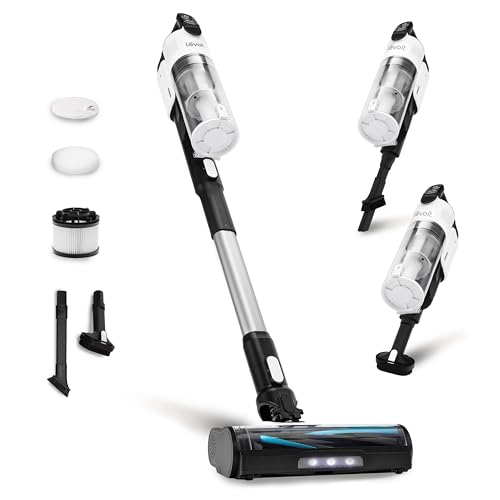
Levoit Cordless Vacuum Cleaner — Best Anti-Tangle Design
Levoit’s cordless vacuum makes its case on the brush roll: an anti-tangle design aimed squarely at pet hair, up to 50 minutes of runtime, and a lightweight build positioned for both carpets and hard floors. Like Shark, Levoit describes this model’s suction in words — “powerful suction” — rather than a published air-watt figure in the listing title, so it is presented here on its design merits: if your current vacuum loses more time to cutting hair off the brush roll than to vacuuming, an anti-tangle head is not a luxury feature, it is the feature.
Strengths
- Anti-tangle brush design targets the pet-hair maintenance chore directly
- Up to 50 minutes of runtime — generous for its class
- Lightweight and versatile across carpets and hard floors
Trade-offs
- No published AW figure in the listing title; suction is described qualitatively by the brand
- Mid-tier positioning: deep-pile extraction is not its brief
- Confirm the included tools on the listing — configurations vary
Choose the Levoit if hair wrap is your household’s recurring annoyance and your floors are the typical hard-floor-and-rugs mix. Between this and the Shark, the decision is maintenance style: the Levoit sells freedom from brush-roll hair; the Shark sells a bigger cup and headlights. Either is a rational pet-household pick.
Best for: pet households tired of brush-roll maintenance, mixed-floor homes. Not suited for: buyers who want a published suction figure or deep-carpet extraction.
Check on Amazon to check the current price on Amazon.
Comparison Table
| Pick | Badge | Key spec | Best for | Link |
|---|---|---|---|---|
| Samsung Bespoke AI Jet Ultra | Strongest Stated Suction | 400AW stated, auto-empty Clean Station | Large homes, heavy pet hair | Check on Amazon |
| Tineco A30S | Best Mid-Range Suction | 200AW stated, 60 min, 1L bin, ZeroTangle | Most family homes | Check on Amazon |
| Dyson V8 Plus | Best Compact Classic | 115AW stated, up to 40 min, handheld conversion | Apartments, hard floors | Check on Amazon |
| DREAME R10 | Best Runtime Balance | 120AW stated, up to 60 min, LED headlights | Mid-size hard-floor homes | Check on Amazon |
| Shark IX141 | Best Lightweight for Pet Hair | 40 min, XL cup, LED headlights (no AW published) | Frequent light pet cleans | Check on Amazon |
| Levoit Cordless | Best Anti-Tangle Design | Anti-tangle brush, up to 50 min (no AW published) | Hair-wrap-weary pet homes | Check on Amazon |
How to Choose a Cordless Vacuum for Suction
Learn what the suction numbers mean — and what they do not. Air watts (AW) estimate the useful cleaning power at the suction opening, combining airflow and pressure. Pascals (Pa) measure pressure alone and produce impressively large numbers that say little about pickup by themselves. Neither figure is measured under one universal standard across brands, so treat AW as a way to compare models within a brand’s line and as a rough class indicator across brands: the 400AW class, the 200AW class, and the 115–120AW class in this guide are genuinely different classes of machine, but a 200AW claim from one maker and a 185AW claim from another are not a photo finish you should bet money on. And remember that every headline figure is measured in the machine’s maximum mode.
Match suction to flooring honestly. Hard floors need modest suction and a head that seals and sweeps well; most debris sits on the surface. Low-pile carpet needs more, because dirt works down to the backing. High-pile and plush carpet need the most, plus a brush that agitates without bogging down. If your home is hard floors with two rugs, the 115–120AW class will serve you for years and the money saved is real. If your home is carpeted wall to wall, buy from the 200AW class upward and do not apologize for it.
Runtime is a floor-plan question. Maximum runtimes are measured on the gentlest mode with a non-motorized tool in many brands’ testing, and motorized heads on carpet draw far more. A useful rule: take the stated maximum, assume roughly half to two-thirds of it for real mixed cleaning, and compare that against your home. Apartments finish easily on 40 stated minutes; large homes should shop the 60-minute class or a swappable-battery design — and if a second battery matters to you, confirm the listing’s bundle includes it or budget for it separately.
The brush roll is where suction becomes pickup. A powerful motor behind a hair-wrapped roll cleans badly. Pet households should weight anti-tangle designs — the Tineco’s ZeroTangle, the Levoit’s anti-tangle brush, the Samsung’s pet tool — as heavily as the suction figure. Hard-floor households should look for soft-roller or combination heads that will not scatter debris or scratch delicate floors, and everyone should check that the roll removes easily for the cleaning it will eventually need anyway.
Filtration and emptying decide whether you keep using it. Sealed HEPA-grade filtration matters most for allergy-sensitive households; note that this guide reports filtration systems as the listings name them (such as Tineco’s PureCyclone) and does not upgrade any claim beyond the listing’s words. Emptying is the other lived reality: a station like Samsung’s removes the dust-cloud moment entirely, a 1L bin like Tineco’s reduces how often it happens, and a small bin emptied over a trash can is the classic cordless compromise. Choose the compromise you will actually keep up with, because a vacuum with a full bin and a clogged filter has no suction at all, whatever its badge says.
How to Get the Most Suction From the Vacuum You Buy
Technique recovers more pickup than most upgrades do. Move slowly on carpet — a cordless head needs a beat over each strip for the brush to agitate and the airflow to lift debris — and overlap passes by a third. Use maximum mode surgically: entryways, under the dining table, the litter zone, rather than as your default, so the battery and the motor’s best work are spent where the dirt is. On hard floors, let the head’s seal do the work at standard power; extra suction mostly adds noise.
Maintenance is suction. Empty the bin before it passes the fill line — an overfilled bin chokes airflow measurably — and wash or replace filters on the maker’s schedule, because a loaded filter is the number-one cause of “my vacuum lost suction” complaints that are not the vacuum’s fault. Check the brush roll monthly even on anti-tangle designs, clear the head’s air path and the wand of any partial blockage (a single stuck crayon or hairpin can halve performance), and store the machine on its charger so it is always at full strength when you grab it. Batteries prefer being used and charged regularly over sitting discharged for months.
Finally, match the tool to the mess. The crevice tool is not an accessory, it is the edge-cleaning system; the mini motorized tool (or pet tool) does stairs and upholstery better than the floor head ever will; and the handheld conversion is the fastest way to deal with the dry spill that happens daily. Owners who use the full kit consistently report the same discovery: the vacuum was stronger than they thought — they were only using half of it.
Common Buying Mistakes
Comparing pascals to air watts. They are different measurements. A huge Pa number and a modest AW number can describe similar machines, and marketing departments know it. Compare like with like, or compare classes, not digits.
Believing the maximum-mode runtime. The 60-minute figure is real — at the gentlest setting. Budget your floor plan against a realistic fraction of it, especially on carpet.
Buying suction your floors cannot use. A 400AW flagship on an all-hardwood studio is not wrong, but it is wasted; the same money buys the right-sized machine plus a second battery or a robot for daily upkeep.
Ignoring the brush roll. In pet homes, the brush design decides daily satisfaction more than the motor does. Anti-tangle is a headline feature, not a footnote.
Forgetting the consumables. Filters, and station bags where a station is used, are recurring costs and recurring chores. Check what your pick consumes before you buy it.
Storing the vacuum discharged. Lithium batteries age fastest when left empty. Keep the machine on its charger or top it up after cleaning, and it will hold its runtime for years longer.
Final Recommendation
For most homes, the Tineco A30S is the sweet spot: 200AW stated suction, a 1L bin, an anti-tangle brush, and 60-minute maximum runtime in the middle tier. If maximum power and hands-off emptying justify a flagship, the Samsung Bespoke AI Jet Ultra is the strongest stated suction in this guide. Hard-floor apartments should take the Dreame R10 for its runtime balance or the Dyson V8 Plus for its handling, and pet households choosing between frequent light cleans and anti-tangle freedom should compare the Shark IX141 and the Levoit.
Related guides: Best B And D Hand Held Cordless Vacuums and Best Corded Cordless Vacuums.
Suction vs. Pickup: Why the Floor Head Decides What the Motor Promises
There is a gap between the suction a motor generates and the dirt a vacuum picks up, and the floor head lives in that gap. Pickup happens when three things coincide: the head seals against the floor well enough to channel airflow through the debris zone rather than around it, the brush agitates embedded dirt up into that airflow, and the air path from head to bin stays clear. A mid-powered machine with a well-sealed head and a clean roll will out-clean a flagship with a worn brush seal and a bin past its fill line — which is why this guide treats head design, anti-tangle engineering, and bin size as suction features, not accessories.
Head design also explains why the same vacuum can feel brilliant on one floor and hopeless on another. On hard floors, a head that rides too high lets the airflow skirt under the debris and scatter it; soft rollers and low-profile heads solve this by contact. On carpet, the problem inverts: the head must let the brush reach the pile without sealing so hard against the carpet that the motor strains and the machine becomes hard to push. Better machines balance this with vents, gate adjustments, or head designs that float across pile heights. When you read a listing, look for how the head handles your specific floor rather than the motor’s headline number — the listing photos of the head’s underside tell you more than the banner graphic does.
Edge performance is the third piece. Every stick vacuum leaves a margin along baseboards that the head’s width cannot reach, and the honest solutions are headlights to reveal the margin (the Dreame and the Shark), a head shape that cleans close on at least one side, and the crevice tool for the final pass. Owners who accept the two-pass reality — floor head for the field, crevice tool for the edges — consistently get cleaner floors from mid-range machines than owners who expect one pass from a flagship.
The Second-Year Experience: Batteries, Storage, and Living With a Stick
Most vacuum reviews end at the unboxing; ownership does not. The second year of a cordless stick is decided by three things this guide wants you to weigh now. The first is the battery’s life trajectory. Lithium packs lose capacity gradually, and the loss shows first in maximum mode: the mode that ran eight minutes in year one runs six in year three. Machines with removable batteries — confirm on the listing — let you restore full performance with a fresh pack instead of replacing the vacuum, and households planning to keep a machine five years should treat a replaceable battery as a core feature.
The second is storage reality. A stick vacuum lives on a wall dock, in a closet, or — in the Samsung’s case — on a floor station, and where it lives decides whether it gets used for the thirty-second crumb emergency or only for Saturday cleaning. Measure the dock’s spot before ordering: near the kitchen or entry is worth more than near the laundry, because proximity is what converts a chore into a reflex. Wall docks need a stud or proper anchors; renters should confirm whether the dock can stand in a closet or lean, and station owners need a permanent footprint with an outlet.
The third is the accessory ecosystem in daily life. The tools in the box will migrate — the crevice tool to a kitchen drawer, the pet tool to the stairs closet — and the machines whose tools store on the dock keep their full capability assembled. None of this appears in a suction figure, and all of it decides whether the strongest vacuum in this guide or the most convenient one ends up being the vacuum its owner actually praises. Buy the suction your floors need; then buy the ownership experience your habits need, and be suspicious of any choice that forces you to trade one entirely for the other.
Matching These Picks to Real Homes: Five Scenarios
The studio apartment with hard floors. Your dirt is crumbs, dust, and tracked-in grit on a surface that shows everything. Runtime is a non-issue at this size; handling and edge visibility are everything. The Dreame R10’s headlights and 60-minute ceiling are more than sufficient, and the Dyson V8 Plus is the alternative if you value the handheld conversion for shelves and the car. Anything above this class is money spent on suction your floor cannot use.
The family house with carpet and a shedding dog. This is the demanding case: carpet that holds hair at the backing, a dog that reloads it daily, and enough rooms that runtime and bin size bind. The Tineco A30S is the value answer — 200AW, 1L bin, ZeroTangle brush — and the Samsung is the no-compromise answer, adding the strongest stated suction and a station that keeps the bin empty despite daily use. The Shark and Levoit can serve as the daily-pass machine alongside a stronger weekly vacuum, a two-machine pattern many pet homes settle into happily.
The mostly-hardwood house with area rugs. Suction needs are moderate; head behavior on wood — no scattering, no scratching — and rug pickup are the tests. The Dreame R10 and Dyson V8 Plus both fit, and the choice between them is runtime versus handling. Use standard mode on the wood and reserve higher modes for the rugs, and either machine will feel strong because the floors are asking the right amount of it.
The townhouse with stairs. Weight and handheld conversion dominate. Every trip up the stairs is a carry, and the stairs themselves are cleaned with the handheld and a crevice or mini tool. The Dyson V8 Plus’s balance and the Shark IX141’s light build are the natural fits; the flagship and the station stay downstairs by design, which is fine if the townhouse’s main mess is downstairs and a problem if it is not.
The allergy-sensitive household. Filtration and emptying hygiene outrank raw suction. Look for sealed filtration systems as the listings describe them, prefer the Samsung’s station for dust-free emptying or a large-bin machine emptied outdoors, and vacuum more often at standard power rather than occasionally at maximum — frequent passes remove the fine dust reservoir that occasional deep cleans stir up. No vacuum in this guide is a medical device, and this guide makes no health claims; these are housekeeping practices, and households with medical concerns should follow their clinician’s advice on top of them.
A Word on Renewed and Refurbished Cordless Vacuums
Shoppers in this category will meet renewed and refurbished versions of popular models, sometimes at tempting discounts, and they deserve a clear-eyed paragraph rather than a reflexive yes or no. A renewed cordless vacuum can be a sensible buy: the machines are typically inspected, cleaned, and fitted with a tested battery. But the battery is exactly where the risk concentrates, because a lithium pack’s remaining life is invisible in a photograph and a refurbished unit’s pack may be original. If you shop renewed, buy only from the manufacturer’s own renewed program or a seller who states the battery’s condition and the warranty length in writing, and treat any listing that does not label the unit as renewed — clearly, in the title — as a listing to avoid. None of the six picks in this guide is a renewed listing; every link above goes to the standard retail version, and where a model’s renewed variant exists, it is a different listing that you should evaluate on its own stated terms.
The same caution applies to no-name lookalikes that borrow the silhouette of famous models. Suction claims from unknown brands, in pascals with five digits, are the least verifiable numbers in the category. The verified brands in this guide publish conservative-by-comparison figures and honor warranties; that boring reliability is worth more than a spectacular claim nobody will stand behind.
Frequently Asked Questions
Is 115AW enough suction for a home?
For hard floors, rugs, and low-pile carpet, yes — machines in the 115–120AW class, like the Dyson V8 Plus and Dreame R10 in this guide, handle everyday debris well. For deep or plush carpet, or heavy embedded pet hair, shop the 200AW class and above.
Why do brands quote different suction units?
Because there is no single enforced advertising standard. Air watts combine airflow and pressure into an estimate of cleaning power; pascals measure pressure only. Compare figures within the same unit and treat cross-brand comparisons as approximate class rankings, not precise measurements.
Does maximum mode damage battery life?
It drains the battery much faster per session, which is normal and expected. Used occasionally for dirty zones, it is exactly what the mode is for. Run whole-home cleans on standard mode and save maximum for the entryway and under-table zones. Think of the battery as a budget you spend across the house: standard mode is the steady wage that covers everything, and maximum mode is the overtime you authorize for the two rooms that earn it. Owners who make that mental shift stop running out of charge mid-clean within the first week, because the machine was never short on power — it was short on allocation.
Why did my cordless vacuum lose suction over time?
Almost always maintenance, not motor failure: an overfilled bin, a loaded filter, a hair-wrapped brush roll, or a partial blockage in the head or wand. Work through those four in order and most “dead” vacuums return to full strength.
Are auto-empty stations worth it?
For daily vacuuming households and anyone sensitive to dust, the Samsung’s Clean Station removes the messiest recurring chore and keeps the bin — and therefore the suction — consistently clear. The trade-offs are the station’s footprint and its ongoing bag cost. Occasional cleaners will not miss it.
Should I buy a second battery with my cordless vacuum?
If your home is large, your floors are mostly carpet, or you clean in long single sessions, a second battery turns a mid-clean interruption into a ten-second swap — but only buy it if your model’s battery is user-removable, and confirm that on the listing before assuming. Apartment and hard-floor households rarely need one; the runtime ceiling of the machines in this guide already exceeds the job. Also note that a second battery is a component purchase: buy the manufacturer’s pack for your exact model rather than a third-party pack of uncertain quality, because battery quality is both a performance and a safety question.
How loud are high-suction cordless vacuums?
Maximum modes are noticeably louder than standard modes on every machine in this category, because the motor is doing more work. If you vacuum while others sleep, plan the loud passes for waking hours and use standard mode — which is far quieter — for maintenance cleans. No listing in this guide’s verified data publishes a decibel figure we can stand behind, so we do not print one; treat any precise decibel claim you meet elsewhere with the same caution as a converted suction figure.
What is the difference between a stick vacuum’s standard and maximum modes in daily use?
Standard mode is the workhorse: it is the mode the runtime figures are built around at the gentler end, it is quieter, and on hard floors it picks up essentially everything the maximum mode does. Maximum mode multiplies suction for carpet extraction and ground-in debris, at the cost of draining the battery several times faster and making noticeably more noise. The practical pattern used by most owners is standard everywhere, maximum in the dirty zones — entryway, kitchen, pet areas — and that pattern is what the picks in this guide were evaluated against.
Can a cordless stick replace a full-size vacuum entirely?
For most apartments and hard-floor homes, yes. For large, fully carpeted homes, a strong cordless in the 200AW class and above can serve as the main vacuum, with the understanding that deep-clean days will use maximum mode and possibly a mid-clean charge or second battery. The households that report the smoothest transition are the ones that change their pattern along with their machine: instead of one long weekly session, they clean in shorter, more frequent passes — ten minutes after dinner, a quick entryway pass on muddy days — which plays to the cordless format’s strengths of instant readiness and adequate runtime, and keeps the bin and filter ahead of the dirt instead of behind it.


