Disclosure: airfryerkitchensupply.com is reader-supported. When you buy through links on our site, we may earn an affiliate commission at no extra cost to you.
Where to buy
Every robot below was verified, and each one earned its place on evidence from its own listing: pet hair named in the title, hard floors named in the title, and a brush or suction design that addresses the actual problem — hair wrapping around rollers and gritty litter tracked across wood. Hardwood changes the robot equation: there is no carpet to hide debris in, hair tumbleweeds drift to the edges, and a robot that scatters litter with a badly matched brush makes the floor look worse than it found it. Use the links to check the current price on Amazon.
Roborock Q7 M5+ Robot Vacuum and Mop — check price on Amazon
Shark AV2501AE AI Robot Vacuum with XL Self-Empty Base — check price on Amazon
Shark AI Ultra Robot Vacuum AV2511AE — check price on Amazon
iRobot Roomba 105 Vac with AutoEmpty Dock — check price on Amazon
Roborock Q5+ Robot Vacuum with Self-Empty Dock — check price on Amazon
Lefant M210 Pro Robot Vacuum — check price on Amazon
Best Robot Vacuums for Pet Hair and Hardwood Floors: Hair Control on Bare Wood
The best robot vacuums for pet hair and hardwood floors solve a specific pairing of problems. Pet hair on hardwood does not behave like pet hair on carpet: it does not embed, it migrates — collecting along baseboards, under radiators, in the corners where the robot’s path is least certain. Litter and kibble, the other hard-floor constants of pet homes, are heavy, scatter-prone particles that a fast-spinning side brush can fling further than the robot ever travels. And the hair that does reach the brush roll wraps, tightens and slowly strangles suction on machines whose rollers were designed for dust, not for a shedding dog. So this list is built from listings that answer those three problems in their own words: anti-tangle and anti-wrap brush systems, self-empty bases that stretch maintenance intervals across weeks of shedding, LiDAR navigation that cleans in deliberate rows instead of random bounces, and suction figures stated in the listings themselves.
Two of the six also mop, and the mop question on hardwood deserves an early, honest word, because more hardwood is damaged by good intentions and standing water than by any vacuum: robot mopping is maintenance mopping — it lifts paw-print film and light dust between real cleans, it does not replace them, and on hardwood you should always use the least water the machine allows and never leave a damp pad parked on the wood. The picks below were chosen for their vacuuming credentials first; mopping is a bonus where a listing includes it.
In this guide
Quick Picks
Best Overall — Roborock Q7 M5+. Its listing combines 10,000 Pa suction, a dual anti-tangle system named for pet hair and carpet, PreciSense LiDAR navigation and up to seven to nine weeks of self-emptying. That is the complete hard-floor pet brief in one machine. Check the current price on Amazon
Best Self-Empty with HEPA Base — Shark AV2501AE. The listing specifies an XL HEPA self-empty base with 60-day capacity, bagless, plus LiDAR navigation and explicit pet-hair positioning. For allergy-managed pet homes, the base is the story. Check the current price on Amazon
Best for Hair Wrap — Shark AI Ultra AV2511AE. Matrix Clean navigation, HEPA filtration and anti-hair wrap per its listing, built for carpet, hard floors and pet hair. If your current robot’s roller wears a permanent hair scarf, start here. Check the current price on Amazon
Best Simple Self-Empty — iRobot Roomba 105 Vac. A vacuum-only Roomba with 7,000 Pa power-lifting suction, LiDAR navigation and an AutoEmpty dock rated in the listing at 75 days. No mop, no fuss, a dock that swallows weeks of hair. Check the current price on Amazon
Best Long Runtime — Roborock Q5+. Up to seven weeks of hands-free cleaning per its listing, 180 minutes of maximum run time, and explicit positioning for hard floors, carpets and pet hair. Big hardwood homes that need long, mapped runs should look here. Check the current price on Amazon
Best Budget — Lefant M210 Pro. Six cleaning modes, 120 minutes of runtime and a listing that names pet hair and hard floor directly, at the budget tier of this list. The sensible first robot for a pet household testing the concept. Check the current price on Amazon
How These Picks Were Chosen
Every pick was cross-checked against Amazon listing data: searched by brand and model, the listed title matched to the product we intended to recommend, and the ASIN taken from the listing response. Nothing here carries an invented ASIN, and every performance figure in this article — suction in pascals, runtime in minutes, self-empty capacity in days or weeks — is quoted from the product’s own Amazon listing title, not from review folklore. Where a listing expresses capacity as a range (the Q7 M5+’s seven to nine weeks), we print the range.
The filters were specific to this search’s pairing. Both halves had to be named: a listing that said “pet hair” but never mentioned hard floors, or vice versa, did not make the cut. Brush behaviour mattered next — anti-tangle and anti-hair-wrap systems outrank plain rollers because hair wrap is the number-one maintenance failure in pet homes. Navigation mattered third: LiDAR machines clean hardwood in visible, complete rows and handle the edges where hair collects, so they dominate this list; the one budget exception earns its place on price and explicit hard-floor positioning. Finally, self-empty capacity was weighed heavily, because a robot whose bin chokes on hair every second day fails the entire premise of hands-free cleaning in a shedding household.
Key Takeaways
- On hardwood, hair migrates to edges and corners — navigation quality and edge cleaning matter as much as suction.
- Anti-tangle and anti-wrap brush systems are the difference between weekly and daily roller maintenance in a pet home.
- Self-empty docks (60 to 75 days, or seven to nine weeks, per these listings) are close to essential when the bin fills with hair, not dust.
- LiDAR navigation cleans in deliberate rows and maps rooms; random-bounce robots leave hard-floor hair behind.
- Robot mopping on hardwood is light maintenance only — minimum water, never park a wet pad on wood.
- Judge every number in a listing comparatively: capacities rank the docks honestly, but a shedding household will always empty sooner than the day-count printed on the box, because pet hair fills bins by volume long before it fills them by weight.
The 6 Best Robot Vacuums for Pet Hair and Hardwood Floors

1. Roborock Q7 M5+ — Best Overall
The Q7 M5+ reads like a point-by-point answer to this search. Its listing states 10,000 Pa of suction, a dual anti-tangle system explicitly for pet hair and carpet, PreciSense LiDAR navigation, app control, and self-emptying for up to seven to nine weeks. On hardwood, that combination does the three jobs that matter: the suction handles litter and grit without needing carpet agitation, the anti-tangle brushes keep long hair from winding the rollers into silence, and the LiDAR map means the robot works the room in complete rows — including the baseboard lines where hair actually accumulates — instead of wandering until the battery fades.
Strengths
- Dual anti-tangle system named for pet hair in the listing — the core maintenance problem, addressed by design.
- 10,000 Pa suction per the listing, ample for litter, kibble and grit on bare wood.
- Self-emptying for up to 7–9 weeks per the listing, matched to shedding-household bin volumes.
Trade-offs
- It also mops; hardwood owners should use minimal-water settings and never leave a damp pad parked on wood.
- Self-empty convenience depends on dock bags, an ongoing consumable.
- Premium-mid positioning within this list.
Key specs (from the Amazon listing)
- Suction: 10,000 Pa
- Brush system: dual anti-tangle, for pet hair and carpet
- Navigation: PreciSense LiDAR
- Self-empty: up to 7–9 weeks
- Functions: vacuum and mop, app control
Who it suits: the pet household that wants the full modern package — mapped, self-emptying, tangle-resistant — and will actually use the app to schedule around the dog’s shedding seasons and set no-go zones around water bowls and litter trays. It is the machine against which the rest of this list is priced and judged, in this guide and in most households that compare them side by side.
Best for: most pet homes with hardwood, wanting the complete feature set. / Not suited for: buyers who want vacuum-only simplicity or the lowest possible running costs.
Check the current price on Amazon

2. Shark AV2501AE — Best Self-Empty with HEPA Base
Shark’s AV2501AE makes its case at the dock. The listing specifies an XL HEPA self-empty base, bagless, with 60-day capacity — a meaningful detail for pet homes, because the base is where weeks of hair and dander end up, and a filtered, sealed, bagless base is the strongest containment story in this list. The robot itself adds LiDAR navigation, Wi-Fi and Alexa compatibility, and explicit positioning for pet hair across carpet and hard floor, so the hardwood half of the brief is covered in the listing’s own words.
Strengths
- XL HEPA self-empty base with 60-day capacity per the listing — containment where the hair actually collects.
- Bagless base: no dock bags to buy, unlike most self-empty rivals.
- LiDAR navigation for complete, row-based coverage of hard floors.
Trade-offs
- Vacuum-only: no mopping function for paw-print film.
- The base is XL in fact as well as name; give it floor space and clearance.
- Emptying a bagless base is a dustier job than swapping a sealed bag, even with HEPA filtration on the exhaust side.
Key specs (from the Amazon listing)
- Self-empty base: XL, HEPA, bagless, 60-day capacity
- Navigation: LiDAR
- Control: Wi-Fi, Alexa compatible
- Positioning: pet hair, carpet and hard floor
Choose the AV2501AE if anyone in the home manages allergies alongside the pets, or if the arithmetic of dock bags annoys you: the bagless HEPA base trades a slightly dustier monthly empty for zero consumable cost, and its capacity figure is the largest day-count on this list.
Best for: allergy-conscious pet homes and bag-free self-emptying. / Not suited for: buyers wanting mopping, or minimal base footprint.
Check the current price on Amazon

3. Shark AI Ultra AV2511AE — Best for Hair Wrap
The second Shark earns its place on a different credential: anti-hair wrap, stated in its listing alongside Matrix Clean navigation for carpet, hard floors and pet hair, HEPA filtration, powerful suction, LiDAR mapping and Wi-Fi. Hair wrap is the slow failure of pet-home robots — long hair winds the brush roll tighter every run until pickup fades and the owner is on the floor with scissors. A roller system designed to resist that wrapping changes the maintenance rhythm of the whole household, and Shark pairs it with a navigation pattern built to pass over each area methodically rather than once and away.
Strengths
- Anti-hair wrap per the listing — the specific fix for long-hair households.
- Matrix Clean navigation: deliberate, repeated-pass coverage that suits scattered hard-floor debris.
- HEPA filtration per the listing, in the robot itself.
Trade-offs
- This configuration’s listing does not claim a self-empty base, so the onboard bin needs regular emptying in shedding season.
- Vacuum-only; no mopping.
- Anti-wrap reduces roller maintenance; it does not eliminate filter and side-brush care.
Key specs (from the Amazon listing)
- Navigation: Matrix Clean, LiDAR mapping
- Brush: anti-hair wrap, per listing
- Filtration: HEPA, per listing
- Control: Wi-Fi
This is the pick for long-haired dogs and long-haired humans in combination — the households whose current robot needs scissor surgery weekly. If your pets are short-haired and your real problem is bin volume, the self-empty picks above and below will serve you better; if wrap is your nemesis, this is your machine.
Best for: long-hair households tired of cutting hair off rollers. / Not suited for: owners wanting maximum hands-free intervals between any maintenance at all.
Check the current price on Amazon

4. iRobot Roomba 105 Vac — Best Simple Self-Empty
The Roomba 105 Vac is the list’s argument for restraint. Its listing describes a vacuum-only robot — no mop to manage, no water near your hardwood — with 7,000 Pa power-lifting suction, LiDAR navigation, multi-surface cleaning and an AutoEmpty dock that self-empties for 75 days. Seventy-five days is the longest hands-free interval claimed anywhere in this list, and in a shedding household that figure is the difference between a robot you maintain monthly-ish and one you maintain constantly. iRobot’s part in the story is software maturity: the Roomba line’s mapping and scheduling behaviour is the benchmark the rest of the market chases.
Strengths
- 75-day self-empty interval per the listing — the longest here.
- Vacuum-only: no mop water anywhere near hardwood floors.
- LiDAR navigation and multi-surface cleaning per the listing.
Trade-offs
- The listing does not claim an anti-tangle brush system, so roller checks stay on your schedule.
- No mopping at all — paw-print film is a manual job.
- Dock bags are an ongoing cost of the AutoEmpty convenience.
Key specs (from the Amazon listing)
- Suction: 7,000 Pa power-lifting
- Navigation: LiDAR
- Self-empty: AutoEmpty dock, up to 75 days
- Functions: vacuum only
Choose the 105 Vac if your priorities are a robot that disappears into the routine — scheduled runs, a dock that swallows a season of hair, an app the whole household already understands — and you do not need the robot to mop or to boast the highest suction figure. It is, in short, the grown-up appliance pick of this entire list.
Best for: set-and-forget households wanting the longest emptying interval. / Not suited for: buyers who want mopping or anti-tangle brush claims.
Check the current price on Amazon
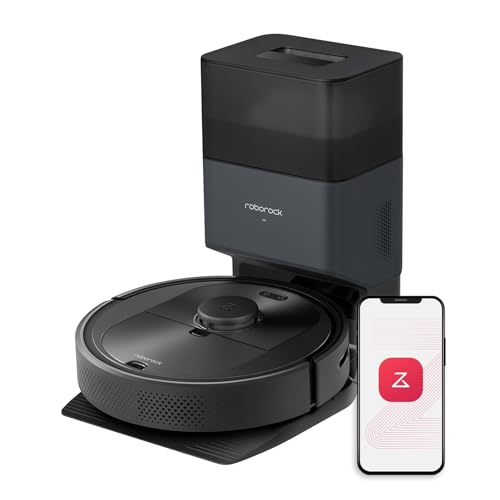
5. Roborock Q5+ — Best Long Runtime
The Q5+ is the elder statesman of this list, and its listing figures explain its staying power: a self-empty dock good for up to seven weeks of hands-free cleaning, 2,700 Pa maximum suction, 180 minutes of maximum run time, Alexa compatibility, and positioning that names hard floors, carpets and pet hair in one breath. The headline for hardwood homes is the runtime: big open-plan wood floors are where robots earn their keep, and a machine that maps and runs for three hours covers ground that shorter-runtime rivals split across charges and days.
Strengths
- 180-minute maximum runtime per the listing — the long-legged option for large hardwood areas.
- Self-empty dock, up to 7 weeks hands-free per the listing.
- Hard floors, carpets and pet hair all named in the listing’s positioning.
Trade-offs
- 2,700 Pa is the lowest suction figure here — adequate on bare wood, less headroom for deep carpet work.
- Vacuum-only in this configuration; no mop.
- An established model: it trades the newest brush systems for proven, mapped reliability.
Key specs (from the Amazon listing)
- Suction: 2,700 Pa max
- Runtime: 180 mins max
- Self-empty: up to 7 weeks
- Control: Alexa compatible
Pick the Q5+ for the big-floorplan house: long mapped runs, a dock that asks little, and a record of doing exactly this job. In smaller homes its runtime advantage evaporates and the newer anti-tangle machines above make more sense; in a sprawling hardwood home it remains quietly ideal.
Best for: large hardwood floorplans needing long, mapped runs. / Not suited for: small homes, or buyers prioritising the newest anti-tangle hardware.
Check the current price on Amazon

6. Lefant M210 Pro — Best Budget
The M210 Pro closes the list at the budget tier with the essentials honestly stated in its listing: powerful suction positioning, six cleaning modes, 120 minutes of runtime, self-charging, voice control, and an explicit “ideal for pet hair and hard floor” brief. What you do not get at this tier is LiDAR mapping or a self-empty dock, and the article will not pretend otherwise: this is a simpler robot that covers hard floors competently, returns itself to charge, and asks you to empty its bin as part of the weekly rhythm.
Strengths
- Pet hair and hard floor named directly in the listing — the search’s brief, at budget tier.
- 120-minute runtime and self-charging per the listing.
- Six cleaning modes and voice control give scheduling and spot-clean flexibility.
Trade-offs
- No LiDAR mapping in the listing: coverage is less systematic than the mapped picks, and edges need occasional manual follow-up.
- No self-empty dock; bin emptying is frequent in shedding season.
- Budget build and brush system: roller maintenance is manual and regular.
Key specs (from the Amazon listing)
- Runtime: 120 mins
- Modes: 6 cleaning modes
- Charging: self-charging (auto-return)
- Control: voice control
The M210 Pro is the right first robot for a pet household that is robot-curious rather than robot-committed: a flat with hardwood and one cat, a small house testing whether scheduled cleaning changes life. If it does — and it usually does — the upgrade path leads to the mapped, self-emptying machines above, and the Lefant retires to a bedroom zone.
Best for: first-time robot buyers and smaller hardwood homes on a budget. / Not suited for: large homes or anyone wanting mapped, self-emptying automation.
Check the current price on Amazon
Comparison Table
| Pick | Badge | Key spec (from listing) | Best for |
|---|---|---|---|
| Roborock Q7 M5+ | Best Overall | 10,000 Pa; dual anti-tangle; LiDAR; self-empty 7–9 weeks | Most pet homes with hardwood |
| Shark AV2501AE | Best Self-Empty with HEPA Base | XL HEPA bagless base, 60-day capacity; LiDAR | Allergy-conscious pet homes |
| Shark AI Ultra AV2511AE | Best for Hair Wrap | Anti-hair wrap; Matrix Clean; HEPA | Long-hair households |
| iRobot Roomba 105 Vac | Best Simple Self-Empty | 7,000 Pa; LiDAR; AutoEmpty 75 days | Set-and-forget owners |
| Roborock Q5+ | Best Long Runtime | 180-min runtime; self-empty up to 7 weeks | Large hardwood floorplans |
| Lefant M210 Pro | Best Budget | 120-min runtime; 6 modes; pet hair and hard floor | First robot, smaller homes |
How to Choose a Robot Vacuum for Pet Hair on Hardwood
Start with the hair, because the hair decides the maintenance rhythm. Long hair wraps; short hair clumps; undercoat does both and multiplies seasonally. If wrapping is your enemy, the anti-tangle and anti-wrap listings (roborock Q7 M5+, Shark AV2511AE) are your shortlist. If volume is your enemy — multiple shedding animals, bins that fill in days — the self-empty capacities decide: 75 days (Roomba 105), 60 days bagless (Shark AV2501AE), seven to nine weeks (Q7 M5+), seven weeks (Q5+). Match the dock to the dog.
Navigation is the second decision, and on hardwood it is not a luxury. Hair collects at edges, and only mapped, row-cleaning robots work edges systematically. Every LiDAR pick here will produce a map you can edit — set no-go zones around water bowls, litter trays and the fragile rug fringe in the next room, and schedule kitchen runs after meals when kibble scatter peaks. Random-navigation budget robots still clean, but they clean statistically: fine for a studio, frustrating across a whole house.
Suction figures need context. On bare wood, even the Q5+’s 2,700 Pa lifts hair, litter and grit, because nothing is embedded; the larger figures (7,000–10,000 Pa) buy headroom for the rugs and carpets the robot crosses on its rounds, and for heavier debris. Do not pay for suction you cannot use while ignoring the brush system you will maintain weekly. Filtration is the fourth factor: HEPA appears in the Shark listings — in the AV2501AE’s base and the AV2511AE itself — and matters most in homes where dander sensitivity and pets genuinely coexist.
Finally, the mop question. Two picks here vacuum and mop; on hardwood, treat mopping as a damp dusting between real cleans, use the lowest water setting, and lift the pad off the floor when the robot docks. If your wood is oiled, waxed or otherwise water-shy, the vacuum-only picks (Roomba 105 Vac, Q5+, both Sharks, Lefant) remove the temptation entirely.
Upgrade Paths: How Pet Homes Grow Into Their Robots
Most pet households do not buy their final robot first, and the sensible paths are worth mapping. The commonest journey starts at the budget tier — the Lefant M210 Pro proving the concept in a flat or small house — and upgrades when the household feels the two frictions this guide keeps naming: bin volume and edge completeness. The upgrade that resolves both is a mapped, self-emptying machine, and owners who already know their shedding load can choose its dock size intelligently the second time: the 60- and 75-day and seven-to-nine-week listings exist in ascending order of hair.
The second journey is the two-robot household, which sounds extravagant and is often rational: a self-emptying flagship owns the main pet floor, and the retired budget robot owns a bedroom level or a finished basement where hair loads are lighter and its simpler navigation suffices. Because robots map multiple floors, even a single machine can commute if someone carries it — but in a shedding household the dock is the point, and docks do not commute. If your home has two hair-heavy floors, plan honestly for two docked machines eventually, and buy the flagship for the heavier floor first.
The third path is specialisation within one machine’s life: the anti-wrap Shark bought for a long-haired dog’s decade, replaced later by a capacity-first model when the household’s animals change. Coats change, animals age, homes move. The listings will keep competing on suction; your durable criteria — brush behaviour, dock capacity, navigation, filtration — will keep identifying the right machine at each stage, which is why this guide teaches the criteria alongside the picks.
Hardwood-Specific Setup: Getting the First Week Right
1. Walk the route first. Pick up cables, tassels, pet toys and the lightweight rug the robot will push around. Hardwood shows every obstruction failure as a half-cleaned room.
2. Place the dock on the wood with clearance on both sides, against a wall, away from water bowls. Self-empty docks need the approach space the manuals describe; cramped docks cause failed returns and missed empties.
3. Run the mapping pass in daylight with doors in their normal positions. Edit the map immediately: label rooms, add no-go zones at litter trays, food bowls and any fine-rug fringe.
4. Schedule around the shedding, not the clock. Daily light runs in shedding season beat twice-weekly deep runs for hard-floor hair, because hair that sits on wood migrates into corners and under furniture where pickup is hardest.
5. Set edge and spot habits. Use spot mode after litter spills and kibble scatter rather than re-running whole rooms; it saves the brush and the battery for the scheduled work.
6. Establish the maintenance rhythm in week one: check the roller on the day the dock first empties, learn how your pets’ hair actually loads the machine, and set filter and side-brush replacements on a calendar rather than on memory.
Common Buying Mistakes
Buying suction and ignoring the brush. In pet homes the brush system decides your weekly maintenance burden; anti-tangle and anti-wrap designs exist precisely because standard rollers fail here.
Skipping the self-empty dock to save money. With shedding pets, a hand-emptied bin fills with hair in days, and a full bin silently ends cleaning quality. The dock is not a luxury in this category; it is the mechanism that makes the robot’s promise true.
Expecting robot mopping to clean hardwood. It maintains; it does not clean. Paw-print film and dried spills still need a real mop, and excess robot water is a hardwood hazard, not a feature.
Letting the robot eat the environment. Cables, fringe, socks and toy mice end runs and strain brushes. Ten minutes of floor discipline buys months of unattended cleaning.
Running the robot through a pet accident. The most expensive mistake in the category, and entirely preventable: check the floor before unsupervised runs, every time, in any home where accidents are possible. A thirty-second scan protects the robot, the floor and your afternoon.
Judging the robot in week one. Maps improve, schedules settle, pets habituate and owners learn the dock’s real interval for their animals’ hair. A robot that seems merely adequate in its first chaotic week is often, by week four, the most reliable cleaner in the house. Reserve judgement until the routine exists — then judge it firmly, on completed runs and collected hair, not on novelty either way.
Ignoring the edges. Hard-floor hair lives at baseboards. If your chosen robot’s edge behaviour is weak, plan a weekly hand pass along skirting with a stick vacuum, or choose a mapped model with strong edge modes from this list.
Pet Hair by Animal: Matching the Robot to the Shedding
Double-coated dogs. The heavyweight case: undercoat sheds in seasonal blankets and tumbleweeds form daily on wood. Prioritise dock capacity and anti-tangle hardware — the Q7 M5+ and Roomba 105 Vac exist for this household — and schedule daily runs through the coat-blowing weeks, because hair left on hardwood migrates under every piece of furniture you own.
Long-haired cats. Less volume, more wrap: fine, long strands wind rollers and side brushes and drift into corners as near-invisible films. The Shark AV2511AE’s anti-wrap positioning is aimed at exactly this coat, and edge performance matters more than raw suction, since cat hair collects along skirting and behind doors.
Short-haired dogs and cats. Short hair does not wrap much, but it is stiff, plentiful and excellent at hiding on wood until the light catches it. Any pick here handles it; the decision shifts to navigation and dock size. Short hair also works into rug pile at room edges, so a robot that transitions onto rugs without drama earns its keep.
Multi-pet homes. Volume and variety combine: plan on the largest dock you can place, the strongest brush story, and a maintenance rhythm written on a calendar. Multi-pet owners are also the group most likely to need no-go discipline — litter zones, feeding stations and water bowls all sit in the robot’s patrol area.
“Hypoallergenic” breeds and light shedders. The robot’s job becomes dust and dander management more than visible hair. Filtration rises in importance — the HEPA listings from Shark are your shortlist — and run frequency can relax to every other day.
The Maintenance Calendar Nobody Mentions at Purchase
Robots are sold as effortless and maintained as appliances; the truth is a small, regular rhythm that pet homes feel more than most. Weekly: glance at the brush roll and side brush, pull free the hair that even anti-tangle systems eventually collect, and check the wheels for wound strands — a wheel wrapped in hair is a wheel grinding grit across your hardwood. Every few weeks: tap out or wash filters as the maker directs, wipe the sensors and charging contacts, and inspect the dock’s intake path, because self-empty systems move a season of hair through a narrow throat and pet homes find its limits first. Seasonally: replace side brushes and filters on schedule rather than on failure, and re-run the map after any furniture rearrangement, since pet homes rearrange around animals more than most.
None of this is onerous — it totals minutes a month — but it is the difference between a robot that performs in year two as it did in week two and one that quietly fades. The picks in this list were chosen partly to minimise the calendar: anti-tangle brushes stretch the weekly glance, big docks stretch the emptying, and HEPA bases keep the dustiest job contained. Buy the machine whose calendar fits the household you actually run.
Dock Economics: Bags, Bagless and the Cost of Hands-Free
Self-emptying splits into two economies. Bagged docks (roborock, Roomba) seal each load of hair away — the cleanest emptying experience, at a per-bag cost that pet homes incur more often than the day-counts suggest, because hair fills by volume. Bagless docks (the Shark AV2501AE) eliminate the consumable and ask you to empty a container of compacted hair and dust yourself, HEPA filtration notwithstanding. Neither is wrong; they price the same convenience differently, in money or in contact with the dirt. Decide which currency your household prefers before choosing, because the dock, once placed, tends to stay for the machine’s life.
The other running costs are shared: filters, side brushes, main brushes and mop pads where fitted. Pet homes should budget these at the fast end of makers’ schedules. Even so, the total cost of robot ownership in a pet home compares well with the alternative it replaces — your own hours, weekly, on your knees with a dustpan at the baseboards — which is why this category keeps growing despite the consumables.
Hardwood Varieties: What Your Finish Asks of the Robot
Site-finished and prefinished solid hardwood. The standard case, and every pick here is built for it. Your jobs are grit discipline — prompt pickup of litter and tracked-in sand so wheels and brushes are not grinding it — and dock placement that does not park the machine’s weight in one spot for years.
Engineered wood and laminate-look wood floors. More moisture-sensitive at the seams. Vacuum freely; mop minimally or not at all, which argues for the vacuum-only picks if your household cannot resist using a mop function just because it exists.
Oiled and waxed finishes. These finishes dislike standing water and some cleaning solutions outright. Vacuum-only robots are the honest recommendation, and even their wheels should be kept clean, since a gritty wheel on a soft oil finish is a slow sander.
Dark-stained and high-gloss floors. They show hair and dust sooner than any other floor — which is an argument for frequency over power. A daily light run from any pick here keeps a dark floor looking kept; a weekly heroic run never quite catches up with what the light reveals each morning.
Wide-plank and bevelled floors. Debris settles in the bevels between planks. Suction at the head matters more than brush aggression here; the stronger-suction picks (Q7 M5+, Roomba 105 Vac) pull bevel dust that weaker machines skate over.
Pets Meet Robot: Behaviour Notes From Real Households
Most pets habituate to a robot within days, especially when runs happen on a predictable schedule and the machine’s first introductions happen while it is off and smellable. Nervous animals do better with daytime runs they can supervise from a sofa than with night runs that startle. Schedule around the animals’ patterns rather than against them: run the kitchen after meals, the litter zone when the cat is elsewhere, and bedrooms when the dog is out on its walk.
Two safety disciplines matter. First, the accident rule: if your pet has indoor accidents, do not run the robot unsupervised until you have checked the floor — a robot that encounters pet waste distributes it with mechanical thoroughness, and every robot owner community treats this as the category’s defining cautionary tale. Check first, run second. Second, the toy and cable rule from the mistakes section applies double in pet homes, because the floor population of small, drag-able objects is simply higher. A robot that completes its runs is a robot whose environment was prepared; the preparation is five minutes, and it is the owner’s real job in the partnership.
Reading the Numbers: Suction, Runtime and Capacity Claims
Listings compete on numbers, and a pet-and-hardwood buyer should know which ones are load-bearing. Suction in pascals is measured at the head under test conditions; on bare wood the practical differences between 2,700 Pa and 10,000 Pa show up at rug transitions and with heavy debris, not in hair pickup, which is mostly airflow and brush contact. Treat the figure as headroom, not as a ranking. Runtime minutes are likewise quoted at low-power, hard-floor settings — which, happily, is exactly your setting on hardwood, so the Q5+’s 180 minutes and the Lefant’s 120 are more honest for you than for a carpet household. Expect less at higher suction and on rugs, and size your choice by mapped area per charge rather than by the box figure.
Self-empty capacities — 60 days, 75 days, seven weeks, seven to nine weeks — are calculated on typical household debris, and pet homes are not typical: hair is bulky, and a two-dog household in shedding season will empty sooner than the claim. Use the figures comparatively (they rank the docks correctly) rather than calendrically. The same caution applies to “hands-free” language generally: it means hands-free between maintenance rituals, not maintenance-free, and the calendar section above is the honest version of the promise. None of this diminishes the picks — their listings state figures plainly enough to compare — but a buyer who reads numbers as rankings among these six, rather than as guarantees, will choose better and be disappointed less.
Final Recommendation
Most pet-and-hardwood households should buy the Roborock Q7 M5+: anti-tangle brushes, LiDAR rows, strong suction and weeks of self-emptying in one listing. Allergy-managed homes should look at the Shark AV2501AE’s HEPA bagless base; long-hair homes at the AV2511AE’s anti-wrap roller; set-and-forget buyers at the Roomba 105 Vac’s 75-day dock; big floorplans at the Q5+’s runtime; and the robot-curious at the Lefant M210 Pro, which covers the brief honestly at budget tier.
Related guides in this series: Best Robot Vacuums For Pet Hair And Berber Carpet, Best Robot Vacuums For Tile And Carpet And Pet Hair, Best Robot Vacuum For Hardwood Floors And Area Rugs, Best Robot Vacuums That Transition From Hardwood To Carpet.
Frequently Asked Questions
Will a robot vacuum scratch hardwood floors?
The robots themselves roll on soft wheels and are designed for hard floors — every listing here names hard floors as a home surface. The realistic scratch risk is grit trapped under a wheel or brush, which is another reason to keep the roller and wheels clean and to clear sharp litter and grit promptly rather than letting the robot grind it around.
How often should a robot run in a pet home?
Daily in shedding season is the rhythm that keeps hard-floor hair from migrating into corners; every other day suffices for light shedders. Frequent short runs also keep the bin loading gradual, which suits both dock and non-dock models.
Do I still need a regular vacuum?
Yes, for stairs, upholstery, car interiors and the occasional deep clean — and for the baseboard pass if your robot’s edges are weak. The robot owns the daily floor maintenance; the upright or stick owns everything vertical and everything occasional.
Are self-empty docks worth it with pets?
More than in any other household type. Hair fills bins by volume, not weight, so pet homes hit “full” fastest. The capacities in these listings — 60 days, 75 days, seven-plus weeks — exist because manufacturers know whose bins fill first.
Can the robot handle litter and kibble?
Yes, within reason: the suction figures here are ample for scattered litter and kibble on bare wood. Sweep up genuine piles first — a robot pushing through a mound of litter mostly redistributes it — and use spot mode for the scatter zone afterwards.
What size home can one robot cover?
Judge by mapped area per charge and by whether the robot resumes after recharging, not by room count. The long-runtime Q5+ suits sprawling single floors; the 120-minute Lefant suits flats and small houses. Multi-floor homes either carry the robot between floors (it will map each) or accept that the main pet floor is the robot’s territory and the rest stays manual.
My pet is afraid of the robot. What helps?
Predictability. Run it at the same times, in the same order of rooms, and let the animal observe from a safe height with the machine first switched off and investigable. Most pets habituate within days. Avoid night runs for nervous animals, and never use the robot to herd or chase a pet toward a room — the machine’s job is the floor, and trust, once lost, is slow to rebuild.
Is mopping safe on my hardwood?
Light, lowest-water maintenance mopping is how these machines are meant to be used, and the vacuum-only picks remove the question entirely. Never leave a wet pad parked on wood, never use a robot mop on standing water, and follow your flooring maker’s guidance for oiled or waxed finishes.


