Disclosure: airfryerkitchensupply.com is reader-supported. When you buy through links on our site, we may earn an affiliate commission at no extra cost to you.
Where to buy
Every verified pick in this guide to the best robot vacuum for hardwood floors and area rugs is sold on Amazon, and each name below links straight to its listing so you can check the current price on Amazon, confirm the exact size, colour or pack count, and read the full listing details before you order. Listings change pack sizes and options often, so treat the listing — not any roundup, including this one — as the final word on what is in the box.
- roborock Q5+ Robot Vacuum with Self-Empty Dock — Check on Amazon
- iRobot Roomba 105 Vac Robot Vacuum — Check on Amazon
- Shark AV2501S AI Ultra Robot Vacuum — Check on Amazon
- eufy C10 Robot Vacuum Self Emptying — Check on Amazon
- Roborock Q7 L5 Robot Vacuum and Mop Combo — Check on Amazon
- ECOVACS DEEBOT N20e+ Robot Vacuum and Mop — Check on Amazon
The best robot vacuum for hardwood floors and area rugs has to be two machines in one body. On bare hardwood it needs controlled, thorough pickup that does not scatter grit ahead of the brush or drag debris across a finish you care about. On an area rug it needs the traction and agitation to pull embedded dust and hair out of pile — without chewing fringe, bunching a lightweight rug into a wall, or giving up at the rug’s edge. Most robots are tuned for one surface and tolerate the other; the six in this guide were chosen because their listings and designs speak to both halves of the job.
Every pick below was cross-checked against its Amazon listing, and the figures quoted — suction in pascals, runtimes, self-empty capacities — are the manufacturers’ own listing claims, presented as claims rather than lab results. Suction numbers in particular are not comparable across brands in any strict sense, because each maker measures differently; treat them as a rough guide to a model’s class, and weight navigation, brush design and dock behaviour more heavily, since those decide how a mixed-floor home actually gets cleaned.
One honest framing note: an area rug is where robot vacuums earn or lose their keep. Rug thickness, fringe, and how the rug sits — pad or no pad, curled corners or flat — matter as much as the robot. The buying guide below explains how to read your own rugs before choosing, and the setup section explains the small changes, like securing a rug pad and clearing tassels, that turn a frustrating robot into a reliable one regardless of which model you buy. Budget a few minutes for those changes and every robot in this guide performs a class better than its spec sheet suggests.
In this guide
Quick Picks
The short version: the roborock Q5+ is the balanced default for mixed floors with its self-empty dock and long runtime. The Roomba 105 Vac is the pick for tidy, mapped, row-by-row cleaning. Homes with shedding pets should look first at the Shark AV2501S, and anyone whose rugs sit under low furniture should look at the slim eufy C10. Full reasoning for all six follows, with a comparison table that separates the self-empty docks from the charging-base models at a glance.
| Pick | Badge | Why it stands out | Check |
|---|---|---|---|
| roborock Q5+ Robot Vacuum with Self-Empty Dock | Best Overall | The balanced mixed-floor default: self-empty dock rated for up to 7 weeks, 180-minute runtime, and a listing that names hard floors, carpets and pet hair. | Check on Amazon |
| iRobot Roomba 105 Vac Robot Vacuum | Best for Neat, Mapped Cleaning | LiDAR navigation and cleaning in neat rows, with a 7,000 Pa suction claim and multi-surface positioning from iRobot. | Check on Amazon |
| Shark AV2501S AI Ultra Robot Vacuum | Best for Pet Hair | Matrix Clean navigation, home mapping and a 30-day-capacity bagless HEPA self-empty base, positioned by Shark for pet hair. | Check on Amazon |
| eufy C10 Robot Vacuum Self Emptying | Best Slim Profile | A 2.85-inch slim body that slides under low furniture, with LiDAR mapping, carpet detection and a self-empty station rated for 8 weeks. | Check on Amazon |
| Roborock Q7 L5 Robot Vacuum and Mop Combo | Best Vacuum-and-Mop Combo | 8,000Pa suction claim, dual anti-tangle system and multi-level LiDAR mapping, with light mopping for hardwood maintenance. | Check on Amazon |
| ECOVACS DEEBOT N20e+ Robot Vacuum and Mop | Best Long Runtime | A stated 300-minute runtime — the longest here — with auto self-empty, ZeroTangle brush positioning and smart mapping for hardwood, carpet and tile. | Check on Amazon |
How These Picks Were Chosen
We filtered the robot-vacuum market for the hardwood-plus-rugs brief using four tests. First, navigation: LiDAR or structured mapping scored ahead of random-bounce designs, because a robot that knows the room cleans the rug as a deliberate zone instead of an accident, and returns to the hardwood in neat rows rather than wandering. Second, surface transition: the listing or design had to speak to both hard floors and carpet or rugs, not just one. Third, ownership friction: self-empty docks, runtime and dustbin arrangements decide whether a robot is a weekly help or a daily chore, so they were weighed heavily. Fourth, verified data: every figure in this guide comes from the model’s own listing as returned by Amazon listing data.
We excluded models sold as Renewed from the main picks, because a refurbished robot’s battery and brush wear are unknowns a buyer cannot inspect in advance; where a renewed listing appeared in research it was left out rather than quietly included. We also left out mop-led hybrids whose vacuum specifications were thin, on the reasoning that this brief is won or lost on vacuuming. Two picks do mop as a secondary function, and their reviews say plainly that the mop is a light maintenance tool, not a substitute for washing a floor.
Finally, a note on suction figures. Pascal ratings dominate listings — 2,700Pa on the oldest design here, up to 8,000Pa on the newest — but pickup on a rug depends on brush agitation and airflow at the head, and pickup on hardwood depends on not scattering debris. We report each listing’s figure because it is part of the product’s identity, and then we judge the robot on the whole design rather than crowning the biggest number.
The 6 Best Robot Vacuums for Hardwood Floors and Area Rugs
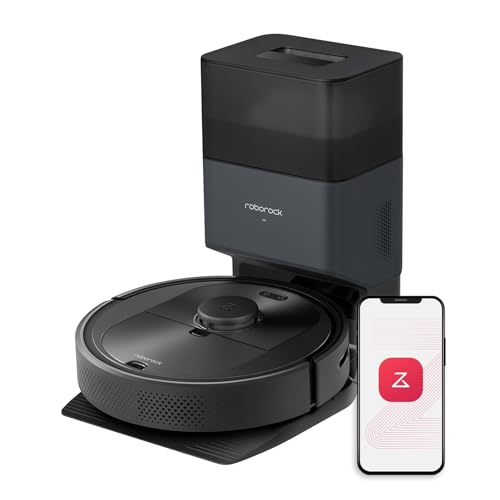
1. roborock Q5+ Robot Vacuum with Self-Empty Dock — Best Overall
The Q5+ is the pick that asks the least of its owner while covering the whole brief. Its self-empty dock is rated by the listing for up to seven weeks of hands-free cleaning, its runtime stretches to 180 minutes, and roborock positions it explicitly for hard floors, carpets and pet hair — the exact trio a hardwood home with area rugs presents. It is a vacuum-only machine, which keeps its design focused on the job this guide cares about.
Strengths
- Self-empty dock stretches emptying intervals to weeks, which is what makes daily runs realistic
- Long 180-minute maximum runtime covers larger mixed-floor plans in one session
- A mature, widely owned model with a listing aimed squarely at hard floors and carpet
Trade-offs
- 2700Pa is a modest suction figure next to newer rivals — judge it on whole-design pickup, not the number
- Vacuum only: no mopping function for sticky hardwood patches
- Self-empty convenience depends on the dock’s bags/filters ecosystem, an ongoing consumable cost
| Dock | Self-empty dock, hands-free for up to 7 weeks (per listing) |
|---|---|
| Suction | 2700Pa max (manufacturer figure, per listing) |
| Runtime | Up to 180 minutes (per listing) |
| Surfaces | Hard floors, carpets and pet hair (per listing) |
| Voice | Compatible with Alexa (per listing) |
On hardwood, the Q5+ behaves the way a mapped robot should: methodical coverage, edges handled deliberately, and debris collected rather than pushed around, provided the side brush is kept clean. On area rugs, its brushroll agitates pile effectively for surface and mid-pile debris; deep grit in a thick rug still belongs to an upright vacuum’s weekly pass, and no robot in this guide changes that. What the Q5+ changes is frequency — a rug vacuumed daily by a robot accumulates far less embedded dirt between deep cleans.
The dock is the ownership story. Self-emptying sounds like a luxury until you have emptied a small robot bin over a trash can for the fortieth time, shaking out the dust you just removed from your floors. Weeks between interventions is the difference between a robot that runs on schedule and one that quietly stops being used. Budget for the dock’s consumables as part of the purchase, and the Q5+ is the easiest robot here to live with.
Its honest limitation is generational: newer models post higher suction figures and add mopping. If your floors are mostly low-pile rugs and hardwood and you value proven, low-friction ownership over headline numbers, that limitation matters less than it appears on a spec table.
Best for: Most mixed hardwood-and-rug homes wanting set-and-forget cleaning / Not suited for: Homes wanting mopping in the same machine, or the newest flagship features
Check on Amazon — check price on Amazon for the current listing, pack options and delivery terms.

2. iRobot Roomba 105 Vac Robot Vacuum — Best for Neat, Mapped Cleaning
The Roomba 105 Vac is iRobot’s answer for buyers who want orderly, mapped cleaning without stepping up to a self-empty system. Its listing leads with LiDAR navigation and cleaning in neat rows — the pattern that makes a robot’s work look deliberate on open hardwood — alongside a 7,000 Pa suction claim and multi-surface positioning that covers the rug half of this brief.
Strengths
- LiDAR mapping produces systematic, row-by-row coverage rather than random wandering
- A strong stated suction figure for rug pickup in this class
- iRobot’s long track record in robot vacuums and wide parts availability
Trade-offs
- This configuration ships with a charging base only — no self-empty dock, so bin emptying is manual and frequent
- Vacuum only; no mopping
- A newer model line, so long-term ownership data is thinner than for the Q5 generation
| Suction | 7,000 Pa Power-Lifting Suction (manufacturer figure, per listing) |
|---|---|
| Navigation | LiDAR (per listing) |
| Pattern | Cleans in neat rows (per listing) |
| Base | Charging base (this configuration — no self-empty dock) |
| Surfaces | Multi-surface cleaning (per listing) |
Row-by-row cleaning is more than an aesthetic pleasure. On hardwood it means missed strips are rare, and on an area rug it means the robot works the pile in passes instead of bouncing off at angles. LiDAR mapping also underpins the practical features mixed-floor homes need: repeatable room coverage and a robot that returns to where it left off rather than improvising. For a home whose rugs are defined zones in an otherwise bare floor plan, that structure is exactly right.
The trade is the base. With a charging base rather than a self-empty dock, the onboard bin is your chore — after most full-home runs, realistically. In a smaller apartment that may be a two-minute task every few days; in a pet-hair household it becomes daily. iRobot sells a dock configuration of this model as a separate listing; if the Roomba approach appeals and your budget stretches, compare that configuration before ordering this one, and be sure which base is in the box.
Suction claims aside, judge the 105 Vac as a navigation-first robot: tidy, mapped, and honest about what it is. For smaller mixed-floor homes that run it often, it is a thoroughly sensible machine.
Best for: Smaller hardwood-and-rug homes that value mapped, tidy cleaning and don’t mind emptying a bin / Not suited for: Larger homes or heavy-shedding homes, where a self-empty dock earns its cost quickly
Check on Amazon — check price on Amazon for the current listing, pack options and delivery terms.

3. Shark AV2501S AI Ultra Robot Vacuum — Best for Pet Hair
Shark built the AV2501S for the household where hair is the main enemy. Its listing combines Matrix Clean navigation — a grid-pattern pass designed to cover an area more than once from different angles — with home mapping and a bagless self-empty base holding a stated 30 days of debris, filtered through HEPA. On area rugs, that multi-angle approach is genuinely useful: hair lies in the pile in every direction, and a grid pass worries more of it loose than a single straight run.
Strengths
- Matrix Clean’s multi-angle grid suits rug pile, where debris hides in every direction
- Bagless self-empty base avoids dock-bag purchases; 30-day stated capacity
- HEPA filtration in the base is a thoughtful touch for hair-and-dander homes
Trade-offs
- 30 days of capacity is shorter than the biggest rivals’ stated intervals
- No suction figure is stated in the listing title, so there is no verified number to compare
- Bagless emptying means briefly handling the collected dust when the base is emptied
| Navigation | Matrix Clean, with home mapping (per listing) |
|---|---|
| Base | Self-empty base, 30-day capacity, bagless, HEPA (per listing) |
| Positioning | Pet hair (per listing) |
| Colour | Dark grey |
Pet hair on hardwood behaves differently from pet hair on rugs: on bare floors it drifts into corners and under furniture, on rugs it weaves into pile. The AV2501S addresses the second problem with its cleaning pattern and the first with mapping that keeps coverage systematic. Shark’s anti-hair-wrap brushroll design philosophy across its robot line also matters here, though buyers should confirm the brush arrangement on the current listing, since configurations evolve.
The bagless base deserves a balanced word. Avoiding proprietary bags saves money and waste, and the 30-day capacity is honestly stated rather than inflated. But when the base does need emptying, you are tipping collected hair and dust into a bin yourself — a small, dusty moment that bagged docks hide from you. Allergy-sensitive households should weigh that moment; everyone else will likely take the savings.
As a pet-focused, mapped, self-emptying robot at a mid-market position, the AV2501S is the easiest recommendation in this guide for homes where a dog or cat is the main source of floor debris.
Best for: Homes with shedding pets and a mix of hardwood and rugs / Not suited for: Buyers who want the longest possible self-empty intervals, or who prefer bagged docks
Check on Amazon — check price on Amazon for the current listing, pack options and delivery terms.

4. eufy C10 Robot Vacuum Self Emptying — Best Slim Profile
The eufy C10 solves the problem nobody mentions until they own a robot: the dustiest floor in the house is the hardwood under the sofa, and most robots are too tall to go there. At a stated 2.85 inches high, the C10 slides under low-clearance furniture that stops taller LiDAR-turret designs, while still carrying LiDAR smart mapping, carpet detection and a self-empty station rated for eight weeks of hands-free running.
Strengths
- Slim 2.85-inch body reaches under low sofas and beds where dust actually accumulates
- Carpet detection speaks directly to the hardwood-to-rug transition at the heart of this brief
- Eight-week stated self-empty interval is the longest in this guide
Trade-offs
- The listing title does not state a suction figure, so power comparisons rest on design, not numbers
- Slim bodies typically carry smaller onboard bins — the dock does the heavy lifting here
- Edge expansion brush is one more moving part to keep clean of wrapped hair
| Height | 2.85 inches (per listing) |
|---|---|
| Navigation | Smart mapping with LiDAR (per listing) |
| Base | Self-emptying, up to 8 weeks hands free (per listing) |
| Features | Edge expansion brush; carpet detection (per listing) |
Carpet detection matters more than it sounds. A robot that recognises a rug’s edge can change its behaviour at the boundary — the moment where lesser robots hesitate, climb halfway, or push a lightweight rug ahead of them. Combined with LiDAR mapping, the C10 treats rugs as known zones in a known map, which is the correct architecture for mixed floors. Its edge expansion brush targets the baseboard line on hardwood, where grit and hair collect and where a round robot’s main brush cannot reach.
The slim design’s compromises are capacity and clearance at the dock rather than cleaning ability: the onboard bin is small, so the self-empty station is not an accessory but a necessity, and the robot needs its dock placed with the usual clearances on a hard, flat surface. Measure your lowest furniture before falling for the height figure — if your sofa clears four inches, every robot here fits, and the C10’s special talent is wasted; if it clears three, the C10 is close to your only mapped option.
For low-furniture homes, that one measurement makes this the standout pick; for everyone else it remains a well-specified, long-interval self-empty robot.
Best for: Homes with low-clearance sofas and beds over hardwood, plus area rugs / Not suited for: Homes with high-clearance furniture throughout, where taller flagship robots fit equally well
Check on Amazon — check price on Amazon for the current listing, pack options and delivery terms.

5. Roborock Q7 L5 Robot Vacuum and Mop Combo — Best Vacuum-and-Mop Combo
The Q7 L5 is the newest-generation machine in this guide, and its listing shows it: an 8,000Pa suction claim, a dual anti-tangle brush system, LiDAR navigation with multi-level mapping, and a mop function for hardwood maintenance. For a home split across two floors of hardwood and rugs — or one floor plus a rug-covered lower level — multi-level mapping is the feature that turns one robot into whole-house coverage.
Strengths
- Highest stated suction figure among these picks, on paper
- Dual anti-tangle design targets the hair-wrapping that plagues rug-heavy homes
- Multi-level mapping suits split-level and two-storey mixed-floor homes
Trade-offs
- This configuration is self-charging only — no self-empty dock in the listing
- Roborock’s mop is a maintenance wipe for hardwood, not a deep clean, and must be kept off rugs by setup
- Newer model: fewer long-term ownership reports than the Q5 generation
| Suction | 8,000Pa (manufacturer figure, per listing) |
|---|---|
| Brush system | Dual anti-tangle system (per listing) |
| Navigation | LiDAR, multi-level mapping (per listing) |
| Functions | Vacuum and mop combo (per listing) |
| Base | Self-charging base (this configuration — no self-empty dock) |
Anti-tangle design is an underrated headline. On rugs, hair does not just sit in the pile — it migrates to the brush ends and winds around axles until pickup fades and error messages appear. A dual anti-tangle system attacks that maintenance spiral directly, and in a home with long hair or pets it can matter more week to week than the suction figure printed beside it. The 8,000Pa claim, as with all such figures, is the manufacturer’s own; the honest reading is that this is a strong current-generation vacuum, not that it picks up some multiple of a rival.
The mop needs expectation management. A combo robot’s mop pad damp-wipes hardwood to lift fine dust and light marks between real mops — worthwhile on bare floors, useless and unwanted on rugs. Set rug zones carefully in the map so the mop stays where it belongs, and never treat the combo as a reason to retire the bucket entirely.
Choose the Q7 L5 if your home spans levels or your rugs shed hair into every brush you own. Choose the Q5+ instead if a self-empty dock matters more than the newest brush system — that is the real fork between these two roborocks.
Best for: Multi-level homes and hair-heavy rug homes wanting the newest brush design / Not suited for: Single-level homes that would rather have a self-empty dock than a mop function
Check on Amazon — check price on Amazon for the current listing, pack options and delivery terms.

6. ECOVACS DEEBOT N20e+ Robot Vacuum and Mop — Best Long Runtime
The DEEBOT N20e+ leads with endurance: a stated 300-minute runtime, the longest figure in this guide, paired with auto self-empty and ECOVACS’ ZeroTangle brush positioning for pet hair. Its listing names hardwood, carpet and tile — the full mixed-floor set — and adds smart mapping and Alexa compatibility. For a large, open, mixed-surface floor plan, runtime is not a vanity figure; it is the difference between one complete clean and a robot that recharges mid-job.
Strengths
- 300-minute stated runtime covers very large mixed-floor plans in a single session
- Auto self-empty plus anti-tangle positioning makes a low-maintenance pairing
- Explicit hardwood/carpet/tile positioning matches this brief exactly
Trade-offs
- The listing title states no suction figure, so there is no verified power number to quote
- It is also a mop combo — the same rug-zone care applies as with any hybrid
- Very long runtimes matter only if your floor plan needs them; small apartments will never use the headroom
| Runtime | 300 minutes (per listing) |
|---|---|
| Base | Auto self-empty (per listing) |
| Brush | ZeroTangle, positioned for pet hair (per listing) |
| Navigation | Smart mapping (per listing) |
| Surfaces | Hardwood, carpet and tile (per listing) |
Think of runtime as floor-plan insurance. A robot that runs out of charge mid-clean will usually recharge and resume if its mapping supports it, but the clean stretches across hours and the schedule slips. In a big open-plan space — hardwood living area, rug under the table, carpeted den beyond — 300 minutes of headroom means the whole job finishes inside one morning run. ECOVACS pairs that endurance with a self-empty base, so both ends of the ownership chore, charging and emptying, are stretched as far apart as this class allows.
ZeroTangle is ECOVACS’ answer to the same brush-wrapping problem the Roborock Q7 addresses: hair management at the brush is what keeps rug pickup consistent between maintenance sessions. As ever, anti-tangle means less tangling, not none — plan a quick brush check every few weeks and the system holds up its end.
If your home is compact, this robot’s talents are partly wasted and a cheaper pick serves as well. If your mixed floors sprawl, the N20e+ is the endurance pick of the six.
Best for: Large, open mixed-floor homes that need maximum single-session coverage / Not suited for: Small apartments, where its runtime headroom will never be used
Check on Amazon — check price on Amazon for the current listing, pack options and delivery terms.
Comparison Table
Suction figures are each manufacturer’s own listing claim and are not measured on a common standard — use them to place a model in its generation, not to declare a winner. The columns that should drive your choice are the base (self-empty or not), the navigation system, and the surface features your rugs actually need day to day.
| Pick | Badge | Key spec | Best for |
|---|---|---|---|
| roborock Q5+ Robot Vacuum with Self-Empty Dock | Best Overall | Self-empty dock (up to 7 weeks per listing); 2700Pa max suction; 180 mins max runtime | Most mixed hardwood-and-rug homes wanting set-and-forget cleaning |
| iRobot Roomba 105 Vac Robot Vacuum | Best for Neat, Mapped Cleaning | 7,000 Pa suction (per listing); LiDAR navigation; cleans in neat rows; multi-surface | Smaller hardwood-and-rug homes that value mapped, tidy cleaning and don’t mind emptying a bin |
| Shark AV2501S AI Ultra Robot Vacuum | Best for Pet Hair | Matrix Clean; home mapping; 30-day capacity bagless HEPA self-empty base (per listing) | Homes with shedding pets and a mix of hardwood and rugs |
| eufy C10 Robot Vacuum Self Emptying | Best Slim Profile | 2.85-inch height (per listing); LiDAR smart mapping; carpet detection; self-empty, 8 weeks (per listing) | Homes with low-clearance sofas and beds over hardwood, plus area rugs |
| Roborock Q7 L5 Robot Vacuum and Mop Combo | Best Vacuum-and-Mop Combo | 8,000Pa suction (per listing); dual anti-tangle system; LiDAR; multi-level mapping; mop combo | Multi-level homes and hair-heavy rug homes wanting the newest brush design |
| ECOVACS DEEBOT N20e+ Robot Vacuum and Mop | Best Long Runtime | 300-min runtime (per listing); auto self-empty; ZeroTangle; smart mapping | Large, open mixed-floor homes that need maximum single-session coverage |
How to Choose a Robot Vacuum for Hardwood Floors and Area Rugs
Start by reading your own floors. Count the rugs, note their pile height and whether they have fringe, and check the clearance under your lowest sofa. Those three facts eliminate more models than any spec sheet: thick high-pile rugs challenge every robot’s climbing and agitation; fringe challenges every robot’s brushes; low furniture challenges every robot’s height. A home with flatweave rugs and tall furniture can buy almost anything in this guide and be happy. A home with a shag rug, tassels and a low platform bed needs the careful end of the list.
Navigation decides how rugs get cleaned
LiDAR and structured mapping robots clean a rug as a deliberate zone, in passes, and handle the hardwood around it in rows. Random-navigation robots clean by probability — fine in a small room, wasteful across a mixed floor plan, and likelier to treat a rug as an obstacle-rich area to escape. For the hardwood-plus-rugs brief, mapping is the single most valuable feature class, which is why every pick in this guide maps.
Brush design beats suction headlines on rugs
Rug pickup is mostly agitation: a brush that works the pile loosens debris so airflow can lift it. Bristle and combo brushes agitate firmly; rubber extractors resist hair wrapping and are gentler on delicate rug fibres. Anti-tangle systems reduce the maintenance that otherwise erases a robot’s advantage. On hardwood the same brush must not scatter grit — a well-sealed head and sensible side-brush behaviour matter more than raw pascals.
Self-empty docks are a behaviour feature
A robot only cleans often if running it is effortless. Self-empty docks stretch the emptying chore from days to weeks, and that difference is what turns a robot into a daily habit. Bagged docks hide dust completely but consume bags; bagless docks save the consumable and ask you to tip out the debris yourself. Neither is wrong — but choose consciously, because the dock, not the robot, is what you will interact with most.
Runtime and mapping for multi-room, multi-level homes
Match runtime to your floor plan with headroom: measure your cleanable area honestly and remember that stated runtimes are maximums, usually on the gentlest setting. Multi-level mapping matters if the robot will work on more than one floor; without it, each floor means a fresh, simpler clean. Dock placement matters too — a self-empty base needs clear space around it on a hard surface, ideally not on your best rug.
Getting Area Rugs Robot-Ready
Ten minutes of rug preparation saves months of robot frustration. Fit a non-slip rug pad under lightweight rugs: a pad stops the robot pushing the rug ahead of itself, keeps corners flat instead of curled into obstacles, and adds a little cushion that helps the brush work the pile. Tuck or trim fringe where you can — fringe is the number-one cause of brush tangles and stuck-robot rescues, and on valuable rugs a pad with the fringe folded beneath is kinder than cutting. Check rug thickness against the robot’s climbing ability honestly: most robots handle ordinary rug edges well and struggle with very thick, soft pile, where wheels sink and brushes labour.
Then set the software up to match the physical home. Map with the rugs in their final positions, name the rug zones, and schedule rug-heavy rooms when you are nearby for the first week so you can rescue the one tangle you did not predict. After that probation week, a mapped robot on a prepared rug is close to invisible labour — which is the entire point of owning one.
Dark rugs, thresholds and other edge cases
A few honest edge cases deserve naming. Very dark or black rugs can confuse cliff sensors on some robots, which read the dark surface as a drop and refuse to climb on; if your rug is near-black, check the model’s behaviour with dark flooring in its listing details before ordering, and test it supervised on day one. Metal threshold strips between hardwood rooms are usually crossed easily, but a tall or rounded strip can stop a robot or shake loose debris out of its bin — watch the first crossing. Long-pile bath mats and door mats are best treated as shake-out items rather than robot territory: they are small, they move, and they tangle. Finally, robot vacuums and rug warranties both assume reasonable use — dragging a robot repeatedly over a delicate hand-knotted fringe is a choice, not an accident, and the pad-and-tuck method exists precisely to avoid it.
A realistic division of labour
Even the best robot here is a maintenance cleaner. The working arrangement in most mixed-floor homes is: robot runs several times a week everywhere, an upright or canister vacuum deep-cleans rug pile weekly or fortnightly, and a real mop handles hardwood spills and grime on its own schedule. Buyers who expect the robot to replace all three are the ones who return robots; buyers who slot it into that system tend to keep it for years.
How to Set Up a Robot Vacuum for Mixed Floors
Setup decides whether the first week builds trust or resentment, so do it in order. First, place the dock on a hard, flat surface — not on a rug — with clear space in front and to the sides, near the centre of the home if you can. Second, walk the route the robot will take and remove the classic traps: charging cables, sock piles, curtain hems that pool on the floor, and pet toys. Third, prepare the rugs as described above — pads under light rugs, fringe managed, corners flat.
Fourth, run the mapping clean with doors open to every room the robot should know, and let it finish without rescuing it unless it is truly stuck; interruptions teach the map bad habits. Fifth, review the map in the app: name rooms, mark any no-go zones such as pet bowls and delicate floor lamps, and confirm the rug zones match reality. Sixth, schedule conservatively at first — one full clean while you are home — and watch where the robot struggles. Most struggles trace back to one cable or one rug corner, and fixing that single thing fixes the pattern.
Finally, put brush and filter maintenance on a calendar rhythm from day one: empty or check the base on its stated cycle, clear the brush ends every few weeks, and wipe the sensors when you do. Robots rarely die; they fade, almost always through neglected brushes and filters, and a five-minute monthly routine prevents the fade entirely.
Keep a small log for the first month — which room needed a rescue, which rug corner misbehaved, when the brush needed clearing. Patterns emerge fast, and one or two physical fixes, a moved cable here and a pad under a rug there, usually eliminate nearly every interruption. After that first month, most owners stop thinking about the robot entirely, which is the surest sign the setup was done properly.
Common Buying Mistakes
Choosing by suction number alone. Pascal figures are not measured on a common standard across brands. Navigation, brush design and dock behaviour predict your experience far better.
Ignoring fringe. Tasselled rug edges are the leading cause of tangles and stuck robots. Pad, tuck or choose a different rug for robot rooms — but decide before the first run, not after the third rescue.
Placing the dock on a rug. Self-empty bases need a hard, flat, clear site. A dock wobbling on pile causes failed docking that looks like a robot fault.
Expecting a robot to deep-clean thick rugs. Robots maintain; uprights restore. A weekly deep pass on high-pile rugs is part of the system, not an admission of failure.
Letting the mop pad near the rugs. On vacuum-and-mop combos, set rug zones properly so damp pads stay on hard floors where they belong.
Skipping brush maintenance because the dock is self-emptying. The dock empties the bin, not the brush. Wrapped hair quietly strangles pickup for weeks before any error appears.
Running the first clean unsupervised in a cluttered home. The mapping run teaches the robot your floor plan. Cables, socks and pooled curtains during that first pass become permanent features of its world — tidy first, then map.
Final Recommendation
Start with the roborock Q5+ unless a specific need points elsewhere: it is the low-friction, proven, mixed-floor default. Point to the Roomba 105 Vac for tidy mapped rows in a smaller home, the Shark AV2501S when pet hair rules the house, the eufy C10 when low furniture hides your dustiest hardwood, the Roborock Q7 L5 for multi-level homes and anti-tangle priorities, and the ECOVACS N20e+ when the floor plan is simply large.
Related guides in this cluster go deeper on each angle: see the Best Robot Vacuums For Wood Floors for bare-floor specialists, the Best Robot Vacuums That Transition From Hardwood To Carpet for the transition problem in isolation, and the Best Robot Vacuums For Dog Hair if shedding is your main battle. Rug owners should also read the Best Robot Vacuum For Fringe Rugs, and budget shoppers the Best Robot Vacuums Under $300.
Related guides
Frequently Asked Questions
Will a robot vacuum scratch hardwood floors?
A well-maintained robot should not scratch them: its wheels and brush are designed for hard floors. The real risk is debris — grit trapped under a wheel or a worn brush can mark a finish. Keep brushes and wheels clean, clear sharp debris before a run, and the risk stays very low.
Can robot vacuums handle thick area rugs?
They handle low and medium pile well. Very thick, soft, high-pile rugs challenge climbing and can bog wheels down; on those, expect surface cleaning only, or exclude the rug as a no-go zone and deep-clean it with an upright. Measure your rug’s pile honestly against the robot’s design.
What should I do about rug fringe?
Manage it physically: a rug pad with the fringe tucked beneath, or fringe folded under the rug edge, prevents most tangles. Software no-go strips at the fringe line are the backup. Leaving loose fringe in a robot room is the most reliable way to own a stuck robot.
Is a self-empty dock worth it for a small apartment?
It depends on debris volume, not floor area. A small apartment with a shedding dog fills a robot bin fast, and the dock earns its place; a small, pet-free apartment may find manual emptying perfectly tolerable and prefer the Roomba 105 Vac’s simpler base.
Do suction ratings in pascals tell me which robot cleans rugs best?
Only loosely. Each brand measures its own figure, and rug pickup depends heavily on brush agitation and head sealing. Treat pascals as a generation marker, then judge navigation, brush system and dock — the features that decide real mixed-floor results.
Can one robot clean two floors of a house?
Yes, if it supports multi-level mapping, like the Roborock Q7 L5 in this guide. You carry the robot between floors (docks usually stay on one), and it recognises which map it is on. Without multi-level mapping, the robot can still clean a second floor as a fresh, unmapped clean.
How often should a robot run in a home with area rugs?
Several shorter runs a week beat one heroic weekend clean: rugs shed their surface debris into the room daily, and frequent passes keep pile from packing dirt down. Most owners in mixed-floor homes settle on three to five scheduled runs a week.
Are bagged or bagless self-empty docks better?
Bagged docks seal the dust away completely and empty in seconds without a dust cloud, at the cost of ongoing bag purchases. Bagless docks, like the Shark’s in this guide, cost nothing per cycle but ask you to tip the debris out yourself. Allergy-sensitive homes usually prefer bags; budget- and waste-conscious homes usually prefer bagless. Both beat a robot-only bin you empty by hand after every single run.
My robot pushes my lightweight rug around. What fixes it?
A non-slip rug pad underneath is the main fix — it anchors the rug firmly and flattens its corners. Heavier edging, furniture legs on the rug’s corners, and mapping the rug as a defined zone all help. If a rug is very light and small, like a bath mat, the honest answer is to lift it before a run and shake it outside instead.


