Disclosure: airfryerkitchensupply.com is reader-supported. When you buy through links on our site, we may earn an affiliate commission at no extra cost to you.
Where to buy
The fastest way to shop this shortlist is the retailer link under each pick. Availability, sizes and colour options change often, so use the links below to check the current price on Amazon and confirm the exact configuration before you order:
- roborock Q7 M5+ Robot Vacuum and Mop — Check on Amazon
- Roborock Q7 L5 Robot Vacuum and Mop Combo — Check on Amazon
- Shark AV2501S AI Ultra Robot Vacuum — Check on Amazon
- iRobot Roomba 105 Vac Robot Vacuum — Check on Amazon
- Tikom Robot Vacuum and Mop Combo G8000 Max — Check on Amazon
- ILIFE A30s Robot Vacuum — Check on Amazon
Wood floors change what a robot vacuum must be good at. Carpet hides a robot’s failures; hardwood publishes them — every crumb, hair and line of grit stands out on a smooth surface, and the floor itself is an asset that a careless machine can mark. So the best robot vacuums for wood floors are judged here on a wood-specific brief: navigation that covers in efficient rows instead of wandering, brushes that sweep debris in rather than scattering it across the boards, a body low enough to work under the furniture where hard-floor dust actually collects, and — where a mop is fitted — honesty about the difference between a damp maintenance wipe and a wash. Every pick was verified, with brand-stated figures quoted as brand figures, because suction numbers are not measured on one shared standard across makers.
Scratch anxiety deserves a straight answer at the start. A maintained robot — clean wheels, a brush free of wrapped grit — is gentle on sealed wood; the damage stories in this category almost always trace to a neglected machine dragging trapped grit on a wheel or a jammed brush. The care routine in this guide’s how-to section is therefore part of the product: five minutes a week is what stands between a robot and the floor it serves.
Suction headlines get one warning and no more: pascals are quoted per maker, and on hard floors they matter less than brush design and navigation, because debris on wood needs sweeping into the intake, not heroics against gravity. Read the picks for their systems, not their biggest numbers.
The picks below are ordered by completeness of system for a typical wood-floor home, not by price or by suction figure. Readers with a specific constraint — no bags, no mop, no dock, a value ceiling — will find their machine flagged in its badge and can read that review first with the guide’s blessing; the ordering is a default, not a command.
In this guide
Quick Picks
Best Overall — roborock Q7 M5+ Robot Vacuum and Mop. The complete wood-floor system: LiDAR row navigation, a mop for maintenance films, dual anti-tangle brushes and a dock that empties the bin for a stated seven to nine weeks.
Best Without the Dock — Roborock Q7 L5 Robot Vacuum and Mop Combo. Most of the flagship’s brain without the dock: LiDAR navigation, multi-level mapping and anti-tangle brushes, at the cost of emptying the bin yourself.
Best Bagless Self-Empty — Shark AV2501S AI Ultra Robot Vacuum. The bagless alternative: Matrix Clean navigation, home mapping and a self-empty base that holds a stated 30 days without disposable bags.
Best Simple Brand-Name — iRobot Roomba 105 Vac Robot Vacuum. The establishment name, current form: LiDAR navigation and neat-row cleaning from the brand that invented the category, in a vacuum-only machine.
Best Value Combo — Tikom Robot Vacuum and Mop Combo G8000 Max. The value route to a mapped-feeling daily clean: vacuum-and-mop format, app and remote control, and a stated 150-minute maximum runtime for larger floor plans.
Best Vacuum-Only LiDAR — ILIFE A30s Robot Vacuum. Vacuum-only, but with the full navigation suite: LiDAR mapping, no-go zones and app control, for owners who want mapping without a mop anywhere near their boards.
How These Picks Were Chosen
All six machines were verified through the airfry site’s Amazon listing data: robot-vacuum searches for hard and wood floors returned the candidates, titles were matched to products, and ASINs came from the listing. A machine qualified on its stated design — LiDAR or mapped navigation for row coverage, anti-tangle brush systems where hair is the load, mop function where the title claims it, and self-empty options for households that want the bin problem gone.
The spread is deliberate: two self-emptying LiDAR systems at the top, a matrix-navigation self-empty model, a slim value machine, a vacuum-only LiDAR unit for purists, and the establishment name in its current entry form. Same-brand siblings appear only as genuinely different models; colour variants were never counted as picks.
A note on figures: where this guide quotes suction or runtime, the number is the maker’s, taken from the verified title, and it is used to place the machine within its own maker’s range rather than to duel across brands. Cross-brand figure duels are the category’s favourite marketing sport and its least reliable information; the comparisons that decide ownership — navigation class, format, dock, ritual — are all directly observable, and this guide rests its ranking on them.
The 6 Best Robot Vacuums for Wood Floors

roborock Q7 M5+ Robot Vacuum and Mop — Best Overall
The Q7 M5+ leads because wood floors reward exactly its combination: PreciSense LiDAR navigation for mapped, row-by-row coverage, a vacuum-and-mop format for the film that dry dusting leaves, a dual anti-tangle brush system for hair, and self-emptying stated at seven to nine weeks. Its suction is quoted at 10,000Pa, the maker’s figure.
Strengths
- LiDAR mapping cleans wood in visible, efficient rows — nothing missed, nothing done twice
- Self-empty dock removes the daily bin ritual for a stated 7-9 weeks
- Dual anti-tangle design suits hair, which on wood migrates to every edge
Trade-offs
- A mop pad is a maintenance wipe, not a scrub — dried-on spills still need a human
- Dock footprint and bag costs are part of the true purchase
- Top suction figures are maker-measured; judge the system, not the number
| Navigation | LiDAR (per Amazon title) |
| Self-empty | 7-9 weeks stated (per Amazon title) |
| Format | Vacuum and mop combo |
Navigation is the wood-floor specification that matters most, because wood shows the map of what was missed. A random-bounce robot leaves a lived-in floor looking half-cleaned in a pattern anyone can read; a LiDAR machine’s rows leave it uniformly done. The Q7’s mapping also enables the features wood households actually use: room selection for the kitchen after dinner, no-go zones around the pet bowls and the delicate rug fringe.
The self-empty dock changes the ownership rhythm more than any cleaning figure. Robot vacuums fail socially when their tiny bins demand daily attention; a dock that takes weeks of debris converts the robot into an appliance you schedule rather than a pet you service. On wood, where the load is light but constant — dust, hair, tracked grit — that interval stretches furthest.
Set the mop’s water level conservatively on real wood, especially older boards and any floor whose finish is worn at the joints. The mop’s job is the grey film, not a soaking; every maker in this list agrees in their manuals even when their marketing forgets, and this guide sides with the manuals.
Best for: most wood-floor homes wanting the full system / Not suited for: buyers wanting the cheapest route to daily clean floors
Check on Amazon — check the current price on Amazon before you order.

Roborock Q7 L5 Robot Vacuum and Mop Combo — Best Without the Dock
The Q7 L5 is the dockless sibling strategy: the same LiDAR navigation family, multi-level mapping and dual anti-tangle system as the M5+, with suction stated at 8,000Pa and a vacuum-and-mop format — but you empty its bin by hand. For many wood-floor homes, that is the smart saving, because wood debris is light and the bin fills slowly.
Strengths
- LiDAR row coverage and multi-level mapping for multi-floor homes
- Anti-tangle brushes for hair on hard floors
- No dock to house, power or feed with bags
Trade-offs
- Manual bin emptying — the chore the flagship’s dock abolishes
- Suction stated lower than the M5+ (maker figures, both)
- Mop is maintenance-grade, as with every combo here
| Navigation | LiDAR, multi-level mapping (per Amazon title) |
| Suction | 8,000Pa (maker figure, per Amazon title) |
| Format | Vacuum and mop combo, no self-empty dock |
Multi-level mapping is the feature multi-storey wood homes feel daily. A robot that remembers the ground floor’s oak and the landing’s boards, and knows which it is on when set down, gets carried between floors without a re-mapping ritual. The L5’s stated mapping depth is aimed exactly at that household, and it is rarer at this level than it should be.
The honest arithmetic of the missing dock: on carpet, bins fill with fibre and dust quickly; on wood, the load is surface debris and hair, and many households find a twice-weekly ten-second empty perfectly tolerable. If that is you, the L5 buys the same navigation intelligence for less money and less hallway furniture. If it is not you, the M5+ above exists precisely for your temperament.
Buy the dockless version only if the bin routine genuinely suits you — a robot whose bin stays full cleans nothing, and the most common cause of robot disappointment is not suction but neglect. Judge your own habits as honestly as this guide judges specifications.
Best for: multi-floor wood homes happy to empty a bin / Not suited for: households that know they will neglect bin duty
Check on Amazon — check the current price on Amazon before you order.

Shark AV2501S AI Ultra Robot Vacuum — Best Bagless Self-Empty
Shark’s AV2501S answers the dock question differently: a bagless self-empty base with a stated 30-day capacity and HEPA filtration in the base, driven by Matrix Clean navigation and home mapping. For households allergic to the idea of buying bags forever, this is the self-empty pick.
Strengths
- Bagless base removes the recurring bag cost of rival docks
- Matrix Clean makes multiple passes in a grid — thorough on visible debris
- Base HEPA filtration stated, keeping emptied dust contained
Trade-offs
- 30-day stated capacity is shorter than the Roborock dock’s claim
- Bagless emptying of the base itself is a dustier job than swapping a bag
- Navigation is Shark’s own system, not LiDAR — mapping style differs
| Navigation | Matrix Clean with home mapping (per Amazon title) |
| Self-empty | 30-day capacity, bagless, HEPA base (per Amazon title) |
| Format | Vacuum only |
Matrix Clean’s grid logic suits wood’s visibility problem in its own way: where LiDAR optimises the route, Shark’s multiple angled passes optimise the pickup, crossing debris from several directions. On a surface where one missed crumb announces itself, that thoroughness-first philosophy has real merit, and Shark’s hair handling has a loyal following among pet households for a reason.
The bagless base deserves its honest trade-off spelled out: you save the bags and you inherit the emptying. Tipping a month of floor debris into a bin is a brief dust event, best done outdoors or slowly; bagged docks seal the mess away at a per-bag price. Neither is wrong — but choose with your eyes open, because you will perform the ritual for years.
Shark’s stated pet-hair positioning aligns with wood’s reality: hair on boards does not hide, it tumbleweeds. A machine and base designed around hair volume serves the wood-floor pet home better than its specifications alone suggest.
Best for: pet homes wanting self-emptying without bags / Not suited for: buyers wanting the longest hands-free interval
Check on Amazon — check the current price on Amazon before you order.

iRobot Roomba 105 Vac Robot Vacuum — Best Simple Brand-Name
The Roomba 105 Vac brings iRobot’s current entry platform to the brief: suction stated at 7,000 Pa, LiDAR navigation and cleaning in neat rows, per its Amazon title. It is a vacuum-only machine — no mop — which for wood purists is a position, not an omission: some households want the dry work automated and the wet work kept manual and deliberate.
Strengths
- LiDAR navigation and neat rows from the category’s founding brand
- Vacuum-only focus suits owners who mop by hand on purpose
- iRobot’s parts and support ecosystem is the category’s most established
Trade-offs
- No mop at all — the film on wood is your job
- This configuration has no self-empty dock
- Entry platform: fewer refinements than flagship rivals
| Navigation | LiDAR, cleans in neat rows (per Amazon title) |
| Suction | 7,000 Pa (maker figure, per Amazon title) |
| Format | Vacuum only, charging base |
There is a real philosophy in the vacuum-only pick. Mopping is where robot claims outrun physics — pads smear as readily as they lift if over-wet or under-changed — and a household with fine wood may rationally automate the daily dry load, which is 95% of the work, and keep a weekly proper mop in human hands. The 105 serves that philosophy with the category’s most mature support network behind it.
Neat rows matter to the eye on wood more than any suction figure: a Roomba that finishes with visible order leaves the room looking cleaned rather than merely visited. Combined with LiDAR mapping, the 105 covers the wood-floor brief’s core — coverage, order, gentleness — without paying for mopping hardware you may never wet.
Check the exact configuration when ordering: this listing is the charging-base version, while a sibling configuration pairs the same robot with an AutoEmpty dock. The robot is the same; the ownership rhythm is not, and the difference is worth the ten seconds it takes to confirm.
Best for: wood purists who mop manually and value support / Not suited for: buyers wanting mopping or self-emptying included
Check on Amazon — check the current price on Amazon before you order.

Tikom Robot Vacuum and Mop Combo G8000 Max — Best Value Combo
Tikom’s G8000 Max is the budget-conscious combo: suction stated at 5000Pa, up to 150 minutes of runtime, app and remote control, positioned for hard floors and pet hair. It lacks the flagship navigation story, and this guide will not pretend otherwise — its case is coverage-by-endurance and price-tier practicality for wood’s light debris load.
Strengths
- Long stated runtime covers big wood floor plans in one outing
- Vacuum-and-mop format at a value tier
- Remote included — useful for households that dislike apps
Trade-offs
- Navigation is not LiDAR-class; coverage is less methodical than the top picks
- Suction figure is the list’s most modest (maker figure)
- Brand ecosystem and parts depth are thinner than iRobot or Roborock
| Runtime | 150 min max (per Amazon title) |
| Suction | 5000Pa (maker figure, per Amazon title) |
| Control | App and remote (per Amazon title) |
Wood is the kindest surface to a value robot. The debris is visible, light and mostly loose; a machine does not need flagship suction to lift it, and long runtime lets a simpler navigator compensate with persistence. Where a value robot embarrasses itself on carpet — deep debris, tangled hair in pile — wood forgives, which is why the G8000 Max earns a place here that it might not in a carpet guide.
The remote deserves a kind word: app control is this category’s default assumption, but households with older users, guest houses or simple preferences often run a robot better with physical buttons. A robot that gets used daily by its actual owner beats a smarter one stranded in an unopened app.
Set expectations on the mop as with all combos — maintenance film only — and on mapping: run it in one main space rather than expecting whole-house cartography. Within those honest bounds, this is the pick that gets a large wood floor cleaned daily for the least commitment.
Best for: large wood floors on a value budget / Not suited for: buyers wanting LiDAR mapping precision
Check on Amazon — check the current price on Amazon before you order.
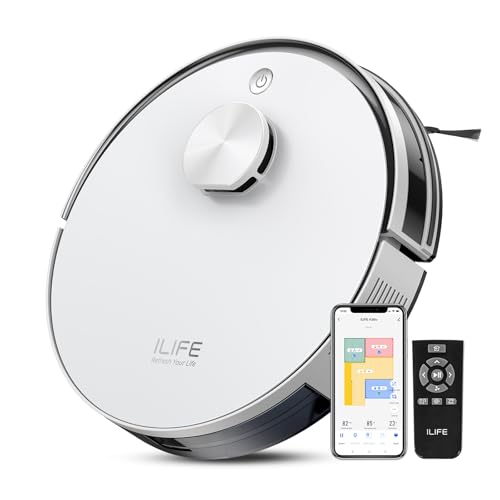
ILIFE A30s Robot Vacuum — Best Vacuum-Only LiDAR
The ILIFE A30s is the specialist’s pick: a vacuum-only machine with LiDAR navigation, home mapping, no-go zones and app, voice and remote control, suction stated at 10,000Pa maximum and 150 minutes of runtime. It exists for the owner who wants flagship navigation discipline and no mop hardware at all.
Strengths
- LiDAR mapping with no-go zones — protect rugs, bowls and delicate areas precisely
- Vacuum-only purity for owners wary of robot mopping on wood
- Long stated runtime for big single-level floor plans
Trade-offs
- No self-empty dock in this configuration
- Vacuum-only means the wood film is manual work
- Suction quoted as a maximum figure — real modes run below it
| Navigation | LiDAR with no-go zones (per Amazon title) |
| Runtime | 150 mins (per Amazon title) |
| Format | Vacuum only |
No-go zones are the feature wood-floor owners underestimate until they own them. The fringe rug, the dog’s water station, the antique chair’s footprint, the cable corner — a mapped machine that can be told, once, to leave a rectangle alone forever is a machine that stops needing supervision. The A30s states that capability plainly, and for complicated rooms it outweighs suction figures entirely.
ILIFE built its name on hard-floor machines, and the vacuum-only focus shows in the brief it serves: tangle management and runtime over spectacle. Paired with a human’s weekly mop, this is the two-system household’s robot — the dry specialist in a division of labour that plays to both parties’ strengths.
Note the ‘max’ in its suction claim and set your comparisons accordingly: every maker quotes a peak, and working modes run lower. Judge this machine, as the guide judges all six, on navigation, format and fit for your rooms — the axes that decide satisfaction a year in.
Best for: owners wanting LiDAR discipline without any mop / Not suited for: buyers wanting self-emptying convenience
Check on Amazon — check the current price on Amazon before you order.
Comparison Table
| Pick | Badge | Key spec | Best for |
|---|---|---|---|
| roborock Q7 M5+ Robot Vacuum and Mop | Best Overall | 10,000Pa stated, self-empty 7-9 weeks, dual anti-tangle, LiDAR (per Amazon title) | most wood-floor homes wanting the full system |
| Roborock Q7 L5 Robot Vacuum and Mop Combo | Best Without the Dock | 8,000Pa stated, LiDAR, multi-level mapping, dual anti-tangle (per Amazon title) | multi-floor wood homes happy to empty a bin |
| Shark AV2501S AI Ultra Robot Vacuum | Best Bagless Self-Empty | Matrix Clean, home mapping, 30-day HEPA bagless base (per Amazon title) | pet homes wanting self-emptying without bags |
| iRobot Roomba 105 Vac Robot Vacuum | Best Simple Brand-Name | 7,000 Pa stated, LiDAR navigation, cleans in neat rows (per Amazon title) | wood purists who mop manually and value support |
| Tikom Robot Vacuum and Mop Combo G8000 Max | Best Value Combo | 5000Pa stated, 150 min max runtime, app and remote (per Amazon title) | large wood floors on a value budget |
| ILIFE A30s Robot Vacuum | Best Vacuum-Only LiDAR | 10,000Pa max stated, LiDAR, no-go zones, 150 mins (per Amazon title) | owners wanting LiDAR discipline without any mop |
How to Choose a Robot Vacuum for Wood Floors
Rank navigation first. Wood exposes coverage, so a mapping machine that cleans in rows — LiDAR systems from Roborock, iRobot and ILIFE in this list, or Shark’s matrix approach — will leave a visibly better result than a random navigator at any suction figure. Mapping also buys the control features wood homes use most: room selection, no-go zones and multi-floor memory.
Decide the mop question honestly. A combo’s mop is a damp maintenance pass that lifts the grey film between real mops; it is genuinely useful at that job and genuinely not a scrub. If your wood is precious, delicate or old, the vacuum-only picks let you keep water entirely in human hands. If your wood is modern, sealed and busy, a combo’s weekly damp pass will visibly extend the interval between proper mops. Either position is defensible; buying a combo expecting it to wash is not.
Then choose the ownership rhythm: self-empty dock or not, bags or bagless. The robot’s cleaning ability is only half the purchase; the other half is the maintenance ritual you will actually perform. A flagship left unemptied loses to a modest machine that is serviced, every week of the year.
Brushes, Wheels and the Truth About Scratching
Sealed wood is scratched by grit, not by robots in good order. The grit arrives trapped: wound around a brush with hair, embedded in a wheel tread, or caught under a jammed side brush, then dragged. That is why anti-tangle brush designs — stated on the Roborock picks — matter beyond hair convenience: a brush that does not wrap stays clean, and a clean brush is a gentle brush.
Wheels deserve the same respect. Check them weekly, flick out embedded stones and grit with a fingernail, and wipe the brush and underside whenever the bin is emptied. Five minutes, no tools, and the machine that results is welcome on any sealed floor in the house. The horror stories in this category are maintenance stories wearing a product story’s clothes.
One boundary: unsealed, waxed or very soft historic boards deserve a conversation with the floor’s own care guidance before any robot, and the vacuum-only, gentlest-running pick — used supervised at first — is the prudent way in. Modern sealed hardwood, laminate and engineered boards are the robot’s home ground and need no such ceremony.
Living With the Robot: Scheduling and Zones
Run the robot when the house is empty or asleep, on a schedule, rather than on demand when the floor already looks dirty. Daily light passes keep wood at its just-cleaned baseline, because hard-floor debris accumulates visibly within a day in a busy house; a robot run daily at low drama outperforms a heroic weekly clean on this surface.
Use the map’s tools as housekeeping, not garnish: a kitchen zone after dinner, an entryway zone on wet days, no-go zones around water bowls, cables and the good rug. The mapped picks in this guide all support some version of that targeting, and it is where owners report the magic — the floor is not just clean, it is clean where and when life dirties it.
Battery, Runtime and the Size of Your Floor Plan
Runtime figures, like suction, are maker-stated maxima — the Tikom and ILIFE picks here claim 150 minutes, which in real rooms translates to generous but lesser working time once navigation, suction mode and age take their share. The planning rule is to match the claim to your floor with headroom: a machine that must recharge mid-clean will finish the job, but the pause breaks the spell and, in a busy house, sometimes the schedule.
Single-level wood homes of ordinary size are comfortably inside every pick’s endurance; sprawling open plans are where the flagship docks earn their keep a second way, topping up the robot between sessions without any human involvement. Measure your cleanable area honestly — furniture footprints do not need cleaning — and buy the runtime that covers it in one outing, with the map doing the rest.
Engineered Wood, Laminate and LVP: Cousins, Not Twins
This guide’s brief says wood, but most ‘wood’ floors in modern homes are engineered boards, laminate or luxury vinyl wearing wood’s photograph. Robots treat them all kindly — the surfaces are hard, smooth and sealed — with two notes. Laminate and LVP tolerate a combo’s damp mop well but dislike pooling water at joints, so keep mop levels modest; engineered wood follows its finish, and a worn finish at high-traffic joints deserves the same conservatism as old solid boards.
The navigation and brush logic is identical across all four surfaces, which is why these picks serve the whole hard-floor family. If your home mixes them with tile and a rug or two, the mapped picks handle the transitions and the no-go zones protect the textiles — one machine, one map, whole ground floor.
Pet Hair on Wood: The Tumbleweed Problem
Hair behaves differently on wood than on carpet: instead of lodging in pile, it migrates — gathering at edges, under furniture and in corners, and forming the tumbleweeds that make a clean house look neglected within hours. Robots are disproportionately good at this problem because the hair is loose and the robot passes daily; the features that matter are edge coverage, anti-tangle brushes for the volume, and a bin or dock sized for hair’s bulk, which is greater than its weight suggests.
Pet households should weight the Shark and the self-emptying Roborock picks accordingly, and should run the robot daily without exception: hair management on wood is a frequency game, and the machine that plays it every day wins it. The weekly brush check matters doubly here, because hair is the wrapping material the anti-tangle designs exist to defeat.
Docks, Bags and the Real Cost of Hands-Free
A self-empty dock is a subscription disguised as furniture: the convenience is real, and so is the consumable. Bagged systems trade money for hygiene — a sealed bag every month or two, no dust event, ever. Bagless systems trade a small dust event for zero consumables. Over a machine’s five-plus-year life, either can win; the deciding factor is the household’s tolerance, not arithmetic. What is not optional is honesty at purchase: read the configuration in the title, as this guide flagged for the Roomba’s two versions, because ‘self-empty’ in a headline and a charging base in the box is the category’s most common disappointment.
Placement of the dock matters more than its type. It needs a permanent home with clearance in front, on the floor the robot serves most, where its occasional emptying roar will not ambush sleepers. A dock exiled to a cupboard is a dock that gets unplugged, and an unplugged dock is a very expensive charging stand.
Thresholds, Chair Legs and Other Real-World Obstacles
Specification sheets assume a tidy plane; houses offer thresholds, chair forests, table pedestals and the occasional sleeping dog. Robots earn their keep in that clutter, and the mapped picks’ advantage compounds there: a machine that knows the room returns methodically after every detour, while a random navigator’s coverage dissolves into the obstacles. Help any robot by lifting dining chairs onto the table on cleaning days if your household can bear the ritual — the floor beneath a dining set is where wood homes hide a week’s crumbs.
Cable management is the other unglamorous enabler. A charging cable across a doorway will defeat or entangle every robot in this guide eventually; route cables along walls, use the no-go zones for the unavoidable nests, and the machine’s map stays clean and its runs stay boring. Boring is the goal: a robot whose work is uneventful is a robot doing it perfectly.
When the Floor Is the Antique: Historic and Hand-Finished Wood
Some wood floors are furniture you walk on — hand-scraped, waxed, a century old — and they deserve a paragraph of their own. For these, choose the gentlest system in the list: a vacuum-only mapped machine, run supervised for its first weeks, with the weekly brush discipline performed twice as often. Keep mop hardware away entirely; water and wax finishes have a long and unhappy history, and no convenience justifies it.
Test in the least visible room first, inspect the boards after the early runs in raking light, and let evidence, not anxiety, decide. Most owners find a maintained robot perfectly safe even on old sealed floors; the ones who skip the inspection ritual are the ones who write the warnings. This guide’s position is simply that precious floors earn precious process.
The Second Robot Question: Upstairs, Downstairs
Multi-floor homes eventually ask whether one robot can commute. It can — carried, with multi-level mapping like the Q7 L5’s doing the remembering — and for many households the carry is a fair price for one machine. But be honest about friction: a robot that must be carried is a robot that gets carried less over time, and floors cleaned ‘when someone remembers’ are not robot-cleaned floors at all.
The pragmatic pattern is a flagship where the wood and the life are — usually downstairs — and, if upstairs earns it later, a simpler mapped machine of the same family so the app and the habits transfer. The picks in this guide were spread across price tiers partly to make that two-machine future coherent rather than a second research project.
Noise, Timing and Living Alongside the Machine
A robot vacuum is a sound you invite into the house’s quiet hours, and models differ more in tone than in volume: a lower, steadier note disappears into a household’s background, while a whining, hunting note announces itself room by room. Self-empty docks add their own brief thunder — seconds, but at a volume that argues against 2 a.m. scheduling in small homes. Set the timetable for when the house is awake or empty, and the machine becomes infrastructure instead of interruption.
Children and pets calibrate to a scheduled robot within days; it is the unscheduled, manually triggered run that startles. One more argument for the set-and-forget pattern this guide keeps recommending: the robot’s predictability is a feature the whole household, on two legs and four, ends up using.
What ‘Best’ Means on a Floor You Can Read
Wood is the most honest test surface in the category, and it clarifies what this guide means by best. Not the strongest suction, not the longest feature list — the machine whose system leaves the floor uniformly clean, whose ownership ritual fits the household, and whose maintenance keeps it gentle on the boards for years. Ranked that way, the flagship’s premium is mostly navigation and dock, the value pick’s compromise is mostly method, and every pick here is defensible for the household it was matched to.
That is also why this guide refuses to crown by number. Two readers with identical floors and different habits should buy different robots from this list, and both should be right. The reviews are written to make that matching possible — format, ritual and rooms first, figures second — which is the only honest order on a floor that shows everything.
How to Keep a Robot Vacuum Gentle on Wood: The Weekly Five Minutes
This routine is the difference between a robot that preserves a floor and one that endangers it.
- Empty the bin or check the dock, and while you are there, turn the robot over on a towel — never drag it across the wood to the counter.
- Pull the main brush and clear wrapped hair from its ends and bearings; check that it spins freely before refitting.
- Inspect both wheels and the front caster: flick out any embedded grit or stones with a fingernail, and wipe the treads.
- Wipe the underside, brush housing and cliff sensors with a dry cloth; check the side brush for trapped debris and bent bristles.
- If your model mops, rinse the pad properly or swap it — a gritty mop pad is the one component that can genuinely mark a floor.
- Set the robot back on its dock and confirm the next scheduled run and your no-go zones are as you left them.
Five minutes, weekly, and the machine stays what it was designed to be: a soft-footed appliance on a hard floor. Skip the routine for a season and no specification in this guide can protect the boards from what accumulates underneath.
Common Buying Mistakes
Mistake one: shopping by suction headline. On wood, navigation and brushes decide the result; pascals are maker-measured and matter least on the surface where debris lies loose. Mistake two: expecting a combo’s mop to wash. It maintains; it does not scrub, and dried-on spills mocked by a damp pad will still be there, slightly smeared, when the robot docks.
Mistake three: neglecting the weekly brush and wheel check, then blaming the robot for marks that trapped grit made. Mistake four: buying a dockless robot while knowing your household will not empty bins — the honest self-knowledge in the Q7 L5 review exists to prevent exactly this. Mistake five: running a random-navigation robot on a showcase floor and judging the whole category by its patchwork.
Mistake six: judging the first run. A mapping robot’s first outing is reconnaissance — slower, odder, incomplete by design — and owners who review it that day return machines that would have been methodical by the third run. Give any pick here three scheduled cleans before verdict, and judge the third map, not the first wander. The same patience applies in reverse: a machine still patchy after a week of maps has told you something true, and no loyalty is owed to it.
Final Recommendation
For most wood-floor homes, the roborock Q7 M5+ is the complete answer: mapped rows, a maintenance mop, anti-tangle brushes and weeks of self-emptying. The Q7 L5 keeps the brains for households happy to empty a bin, the Shark AV2501S serves pet homes that refuse bags, and the vacuum-only ILIFE A30s and Roomba 105 respect owners who keep water in their own hands. Whichever you choose, keep the weekly five minutes — the floor will repay the discipline.
And a last word for the sceptical: if you currently sweep your wood floors by hand every day and resent it, any mapped pick here will feel like a small miracle by the end of the first week. If you sweep weekly and barely mind, the same machines will feel like a luxury rather than a rescue — buy the simpler end of the list and enjoy it as one. The floor, as ever, will show the difference either way.
Keep reading in this series: Best Robot Vacuums For Bare Floors Best Robot Vacuums For Tile Floors Best Robot Vacuums Mops Best Robot Vacuums For Dog Hair Best Robot Vacuums Under $300 Best Shark Robot Vacuums
Frequently Asked Questions
Will a robot vacuum scratch hardwood floors?
A maintained robot will not scratch sealed hardwood; scratches in this category come from grit trapped in a wheel or brush and dragged. The weekly five-minute check in this guide — brush clear, wheels clean, mop pad rinsed — removes that risk. Unsealed or historic boards deserve extra caution and a supervised start.
Is a robot mop safe on wood floors?
A combo’s damp maintenance mop is safe on modern sealed wood when used with modest water settings, as the makers’ own manuals direct. It is not safe to flood any wood floor, and no robot does that unless misconfigured. Owners of delicate or worn finishes often choose the vacuum-only picks and mop by hand — a rational position this guide supports.
LiDAR or camera navigation — which is better for wood?
For coverage you can verify with your eyes, LiDAR’s mapped rows are the benchmark in this list, with Shark’s matrix grid a thorough alternative philosophy. The practical difference shows in missed patches and repeat passes, both of which wood makes visible. Any mapped system beats random navigation on this surface.
How often should a robot run on wood floors?
Daily, lightly, on a schedule. Hard floors show a day’s debris, and frequent passes keep the baseline at just-cleaned with less effort per run. Weekly heroic cleans let grit accumulate and migrate; daily maintenance is both kinder to the floor and better looking.
Do I need a self-empty dock?
Need, no; value, often. The dock converts bin duty from days to weeks, which is the difference between a robot that is always ready and one that is often full. Bagged docks seal debris away at a running cost; Shark’s bagless base avoids bags and asks you to tip out the base instead. Choose by your household’s honest habits.
Can one robot handle wood and rugs together?
Yes — the mapped picks here transition between hard floors and low rugs, raise or spare their mops by model, and let you fence delicate textiles with no-go zones. Deep-pile rugs remain any robot’s hard mode, but the wood-plus-low-rug home is this category’s home ground.


