Disclosure: airfryerkitchensupply.com is reader-supported. When you buy through links on our site, we may earn an affiliate commission at no extra cost to you.
Where to buy
Every model below was verified against the airfry site’s Amazon catalogue data before it earned a link, and each listing was checked for the same thing: does it actually claim to clean both hardwood and carpet well, or is it a hard-floor specialist with carpet as an afterthought? All six passed that test on paper; the reviews explain where each one is strongest once the surfaces change mid-clean.
- Roomba 105 Vac (charging base version) — Check the current price on Amazon
- roborock Q7 M5+ — Check the current price on Amazon
- Shark Matrix Plus 2-in-1 — Check the current price on Amazon
- Roomba 105 Vac with AutoEmpty Dock — Check the current price on Amazon
- roborock Q5+ — Check the current price on Amazon
- Shark AV2501S AI Ultra — Check the current price on Amazon
Prices in this category move constantly with promotions, so each pick links to its live Amazon listing — check the current price on Amazon rather than trusting any number printed in a guide. If a model shows a dock in its name, the dock is included in that listing; if it does not, budget for the dock version separately if hands-off emptying matters to you.
Finding the best robot vacuums that transition from hardwood to carpet sounds simple until you watch a robot actually do it: it hums across the hardwood lifting grit from the seams, reaches the rug or the carpeted doorway, and then either climbs, adjusts and keeps cleaning — or hesitates, spins, and leaves the carpet edge exactly as dirty as it found it. That two-second moment at the threshold is what this guide is really about.
Mixed flooring is now the default in most homes. Kitchens, halls and living areas run hard; bedrooms, stairs landings and rugs run soft. A robot vacuum has to be two machines in one body: gentle and thorough on boards or tile, where debris sits on the surface and can be scattered by an over-aggressive brush, and forceful on carpet, where the dirt is inside the material and has to be pulled out of the pile. Models that are brilliant at one and mediocre at the other are why so many robots end up retired to a single room.
So this roundup applies one test above all others: credible performance on both surfaces in a single mapped run. Suction figures, brush design, navigation style, runtime and self-emptying all get judged through that lens. The six robots below passed, at different strengths and different levels of hands-off convenience — from a straightforward LiDAR all-rounder to a 10,000 Pa carpet specialist with a dock that swallows weeks of debris.
In this guide
Quick Picks
Short on time? These are the six, in the order most mixed-floor homes should consider them. The full reviews below explain the trade-offs behind each badge.
| Pick | Badge | Why it stands out | Check price |
|---|---|---|---|
| iRobot Roomba 105 Vac Robot Vacuum with Charging Base | Best Overall | LiDAR navigation, 7,000 Pa suction and explicit multi-surface cleaning make it the most balanced transition specialist here. | Check price on Amazon |
| roborock Q7 M5+ Robot Vacuum and Mop | Best Suction for Carpet | 10,000 Pa suction, dual anti-tangle brushes and a self-empty dock rated for up to 7–9 weeks, plus mopping for the hard floors. | Check price on Amazon |
| Shark Matrix Plus Robot Vacuum & Mop Combo (AV2610WA) | Best for Pet Hair | Matrix Clean navigation built for carpet and hard floors, HEPA self-empty base with 60-day capacity and sonic mopping. | Check price on Amazon |
| iRobot Roomba 105 Vac Robot Vacuum with AutoEmpty Dock | Best Hands-Off Value in the Roomba Line | The same 7,000 Pa, LiDAR, multi-surface 105 Vac, upgraded with a dock that self-empties for up to 75 days. | Check price on Amazon |
| roborock Q5+ Robot Vacuum with Self-Empty Dock | Best for Large Mixed-Floor Homes | 180-minute runtime, self-empty dock for up to 7 weeks and a listing that names hard floors, carpets and pet hair in one breath. | Check price on Amazon |
| Shark AV2501S AI Ultra Robot Vacuum | Best Self-Empty Shark Without Mopping | Matrix Clean, home mapping and a 30-day HEPA bagless self-empty base, in a vacuum-only package for buyers who skip mopping. | Check price on Amazon |
Two patterns are worth noticing before you read on. First, every pick here uses systematic navigation — LiDAR or camera mapping — because random-bounce robots are the ones that miss carpet edges. Second, four of the six offer a self-empty dock, and on carpet that is not a luxury: carpet fills bins several times faster than hardwood, so the dock decision shapes how the robot fits your week.
How These Picks Were Chosen
We started from the airfry catalogue’s verified Amazon listings and filtered for robots whose own product descriptions claim multi-surface or carpet-and-hard-floor cleaning — not hard-floor robots that merely tolerate a rug. Models whose listings named only hard floors, or whose brush and suction design clearly suited a single surface, were cut at this stage.
From that pool we prioritised four things. Navigation had to be systematic, because mapped rows are what guarantee the transition zone itself gets cleaned rather than crossed. Suction had to be credible for carpet extraction, judged alongside brush design — anti-tangle and anti-wrap brushes matter as much as the Pascal figure. Runtime had to cover a realistic mixed-floor home in one or two outings. And the dock question — bagged, bagless or none — had to be answerable honestly for each pick.
- Verified listing only: every ASIN in this guide was confirmed through Amazon data before receiving a link.
- Multi-surface by design: each pick’s own listing claims carpet and hard-floor capability.
- No fixed prices and no star ratings are printed — both change too fast to be honest in a static guide.
- Recalled or discontinued-flagged models were excluded regardless of reputation.
A note on suction numbers: Pascal figures are quoted from each listing exactly as the brands state them, and brands do not all measure identically. Treat them as a ranking signal inside one brand’s range and a rough signal across brands — the reviews weigh brush design, navigation and real cleaning pattern alongside the number, which is how you should too.
The 6 Best Robot Vacuums That Transition From Hardwood to Carpet

1. iRobot Roomba 105 Vac Robot Vacuum with Charging Base — Best Overall
The Roomba 105 Vac is the pick that treats the hardwood-to-carpet transition as its main job rather than a footnote. Its Amazon listing calls out multi-surface cleaning directly, and the combination of LiDAR navigation with cleaning in neat rows matters more on mixed floors than raw suction alone: the robot plans the room instead of bouncing across the threshold between surfaces, so the strip of carpet edge that random-navigation robots miss gets covered on every run.
Suction is listed at 7,000 Pa, which is the right zone for this task. Hardwood needs enough pull to lift grit out of board seams without scattering it, and low- to medium-pile carpet needs sustained airflow at the brush to pull embedded dust up. A robot that is strong on one surface and weak on the other forces you back to a stick vacuum, which defeats the point of the purchase.
Strengths
- LiDAR mapping keeps runs systematic across both surfaces instead of random bouncing
- 7,000 Pa suction is strong enough for carpet pile without scattering debris on hardwood
- Neat-row cleaning covers the carpet edge and threshold zones other robots skip
Trade-offs
- This base version has no self-empty dock, so the onboard bin needs manual emptying
- Vacuum-only model — there is no mopping function if you also want damp cleaning
- LiDAR turret adds height, which can block it from the lowest-clearance furniture
| Suction | 7,000 Pa Power-Lifting Suction (per Amazon title) |
| Navigation | LiDAR, cleans in neat rows (per Amazon title) |
| Surfaces | Multi-surface cleaning (per Amazon title) |
| Dock | Charging base — no self-empty dock in this version |
In a mixed-floor home the daily pattern is what decides satisfaction: scheduled runs that start on hardwood, climb onto the rug or carpeted room, and return without getting stranded. The 105 Vac’s mapping keeps a record of the rooms, so you can send it to the carpeted bedroom on one day and the open-plan hard floor on another, rather than running the whole home every time. That room-level control is the practical difference between a robot you use daily and one that ends up as an occasional novelty.
Brush behaviour at the transition is the detail to watch in the first week. Drive the robot over your thickest threshold and your deepest rug edge and watch whether it climbs cleanly or hesitates. Most modern robots, this one included, handle standard transitions well, but a very tall saddle strip between rooms is a physical limit no software can fix — knowing yours in the return window is the smart way to buy.
Best for: homes with a genuine mix of hardwood and carpet that want one dependable daily robot / Not suited for: buyers who want a self-empty dock or mopping included at this step

2. roborock Q7 M5+ Robot Vacuum and Mop — Best Suction for Carpet
If your carpet is the problem surface — deeper pile, heavy foot traffic, pet hair worked down into the fibres — the Q7 M5+ brings the strongest listed suction in this roundup at 10,000 Pa. That headline number only matters because of what sits underneath it: a dual anti-tangle brush system the listing explicitly aims at pet hair and carpet, so the extra power is spent pulling hair out of pile instead of wrapping it around a brush roll you then have to cut clean.
The self-empty dock is the other half of the appeal. The listing rates it at up to 7–9 weeks between bag changes, which changes the ownership experience completely in a carpeted home, because carpet fills bins faster than hardwood does. A robot that needs its bin emptied every second run quietly stops being run at all.
Strengths
- Highest listed suction here, aimed squarely at carpet extraction
- Dual anti-tangle brushes suit pet hair on both carpet and hard floors
- Long-interval self-empty dock matches how fast carpet fills a bin
Trade-offs
- Mopping is a convenience feature for hard floors, not a substitute for a real mop on dried spills
- Dock bags are an ongoing consumable cost to budget for
- Maximum suction modes shorten runtime on very large carpeted floors
| Suction | 10,000 Pa (per Amazon title) |
| Self-empty | Up to 7–9 weeks via dock (per Amazon title) |
| Brush system | Dual Anti-Tangle System for pet hair and carpet (per Amazon title) |
| Navigation | PreciSense LiDAR Navigation (per Amazon title) |
| Extra | Mopping function included (per Amazon title) |
The transition behaviour benefits from the LiDAR system: the robot knows which rooms are carpeted and which are hard, and app control lets you treat them differently — a deep, high-suction pass for the carpeted rooms and a lighter maintenance pass with mopping for the hardwood. That per-room thinking is exactly what a transition-focused purchase should deliver, and it is where cheaper random-navigation models cannot follow.
One honest caution: headline suction figures are measured at the motor, not at the carpet surface, and every brand measures slightly differently. The 10,000 Pa figure tells you this model sits at the strong end of the current market; it does not mean it cleans exactly a fixed percentage better than a 7,000 Pa rival. Judge it on the combination — suction, anti-tangle brushes and mapping — which is coherent for carpet-heavy homes.
Best for: carpet-heavy or pet-owning homes that want maximum extraction and minimal bin duty / Not suited for: small all-hardwood flats where this much suction and dock are overkill

3. Shark Matrix Plus Robot Vacuum & Mop Combo (AV2610WA) — Best for Pet Hair
Shark built the Matrix Plus around the exact wording of this guide: its listing describes Matrix Clean navigation for carpet, hard floors and pet hair. The Matrix pattern makes multiple passes in a grid rather than a single sweep, which is the right approach at surface boundaries — the overlap zone where hardwood meets carpet is where crumbs and litter collect, and a grid pass covers it from two directions instead of one.
The self-empty base is bagless with HEPA filtration and a listed 60-day capacity. Bagless matters for running costs: there are no dock bags to keep buying, you simply empty the base. For allergy-conscious households the HEPA element in the base is the meaningful part, because the dust you collect from carpet is sealed into the base rather than puffed back into the room when you empty a small onboard bin.
Strengths
- Grid-style Matrix cleaning covers transition zones from multiple angles
- Bagless HEPA self-empty base avoids ongoing bag costs
- Sonic mopping gives hard floors a scrubbing action plain pads lack
Trade-offs
- Bagless bases still need their filters washed or replaced on schedule
- Sonic mopping uses water tanks that need refilling and pad washing
- Shark’s app and mapping polish trail roborock and iRobot slightly
| Navigation | Matrix Clean Navigation for carpet, hard floors and pet hair (per Amazon title) |
| Self-empty | 60-day capacity, HEPA bagless base (per Amazon title) |
| Mopping | Sonic mopping (per Amazon title) |
| Hair handling | Anti-hair wrap design (per Amazon title) |
On carpet, the anti-hair-wrap brush design is the feature pet owners feel weekly. Long hair — human or animal — is the number one maintenance chore on rival robots; a brush that resists wrapping turns a ten-minute cutting session into a quick pull-clean. Combined with the multi-pass grid, the Matrix Plus is set up for homes where the carpet is a hair magnet and the hardwood is where the hair tumbles end up.
Size the base into your plan before buying: a self-empty dock needs a permanent home with clearance on both sides and in front, ideally on the hard-floor side of your layout so the robot’s route home does not cross the deepest carpet when its battery is low. It is a small logistical point that decides whether the dock feels invisible or in the way.
Best for: pet owners who want grid cleaning, hair-resistant brushes and no bag costs / Not suited for: buyers who prefer the most polished mapping apps from roborock or iRobot

4. iRobot Roomba 105 Vac Robot Vacuum with AutoEmpty Dock — Best Hands-Off Value in the Roomba Line
This is the same robot as our Best Overall pick with the one upgrade that changes how often you think about it: the AutoEmpty Dock, listed as holding up to 75 days of debris. On mixed floors that interval matters because carpet days fill the bin far faster than hardwood days. With the dock absorbing that difference, the robot’s schedule stays boringly consistent — which is precisely what you want from an appliance bought to remove a chore.
Everything said about the base version’s transition manners applies here: LiDAR navigation, neat-row cleaning and multi-surface positioning. What you are paying the step-up for is purely the dock, so the decision is refreshingly simple. If you know from past robot ownership that bin-emptying is where your routine fell apart, this is the version to buy the first time.
Strengths
- Longest listed self-empty interval in this roundup at up to 75 days
- Identical proven multi-surface cleaning to the Best Overall pick
- LiDAR room mapping supports per-room schedules across both surfaces
Trade-offs
- Dock uses disposable bags, an ongoing cost the Shark rival avoids
- Still vacuum-only — no mopping at this step in the range
- The dock needs a permanent, clear patch of floor near a socket
| Suction | 7,000 Pa Power-Lifting Suction (per Amazon title) |
| Navigation | LiDAR Navigation, multi-surface cleaning (per Amazon title) |
| Self-empty | Up to 75 days via AutoEmpty Dock (per Amazon title) |
There is a behavioural trick worth setting up in week one: schedule the carpeted rooms for the days you are out, and the hard floors for a quick morning pass. Because the dock handles emptying, you can run shorter, more frequent cleans, and frequent light passes keep carpet looking better than one weekly deep session — grit is lifted before foot traffic grinds it deeper into the pile.
Bag costs deserve one honest line: over years of ownership, dock bags add up, and they are the price of the 75-day convenience. Households that empty a bin without resentment should save the money and take the base version; households that know themselves should take the dock and never think about it again.
Best for: owners who want Roomba simplicity with the longest hands-off emptying interval / Not suited for: anyone counting consumable costs closely, who would rather empty a bin
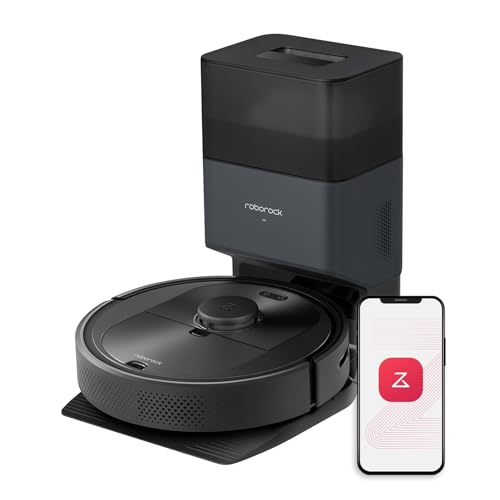
5. roborock Q5+ Robot Vacuum with Self-Empty Dock — Best for Large Mixed-Floor Homes
The Q5+ is the elder statesman of this list, and its listing makes the transition pitch plainly: it is described as perfect for hard floors, carpets and pet hair. Its suction figure of 2700 Pa reads modestly next to the newest models, but its 180-minute maximum runtime is the specification that matters in a big home — the robot can finish a full mixed-floor clean in one outing instead of splitting the house across recharge cycles.
Runtime and transitions are quietly linked. A robot that runs low mid-clean tends to beeline home by the shortest route, skipping the far carpeted rooms. A long-runtime robot finishes the planned map in order, which is why, for larger homes, battery endurance can matter more than a bigger suction number that only runs at full tilt for part of the clean.
Strengths
- 180-minute runtime covers large mixed-floor layouts in a single run
- Self-empty dock stretches hands-free cleaning to up to 7 weeks
- Proven platform with a listing written for hard floors and carpets alike
Trade-offs
- 2700 Pa is the gentlest suction here — deep-pile carpet extraction is not its strength
- An older platform, so obstacle avoidance is simpler than on newer flagships
- No mopping function on this model
| Suction | 2700 Pa Max Suction (per Amazon title) |
| Runtime | 180 minutes max run-time (per Amazon title) |
| Self-empty | Hands-free for up to 7 weeks (per Amazon title) |
| Surfaces | Hard floors, carpets and pet hair (per Amazon title) |
| Control | Compatible with Alexa (per Amazon title) |
Where the Q5+ still earns its place is reliability of routine. The mapping is mature, the dock is proven, and parts and bags are widely stocked — the unglamorous virtues that decide whether a robot is still in daily service in year three. For a large home with mostly low- and medium-pile carpet, that steadiness beats a spec-sheet sprinter.
Be honest about your pile depth before choosing it. On short pile and hard floors its cleaning is thoroughly competitive; on plush carpet, the Q7 M5+ above is the roborock to buy instead. The brand makes both because the homes are genuinely different, and matching the robot to the pile is the whole game in this category.
Best for: large homes needing long runtime and a proven self-empty platform / Not suited for: plush or deep-pile carpet that needs maximum extraction power

6. Shark AV2501S AI Ultra Robot Vacuum — Best Self-Empty Shark Without Mopping
The AV2501S is the vacuum-only expression of Shark’s Matrix idea: the same grid-pattern cleaning and home mapping as its mop-combo sibling, the same bagless HEPA self-empty concept with a listed 30-day capacity, and no water tanks, pads or mopping hardware to wash, store or pay for. For households whose hard floors get a proper mop on a schedule anyway, that subtraction is a feature.
Pet hair is the headline use in its listing, and the transition logic follows from it: hair behaves differently on each surface, clinging deep in carpet and drifting into corners on hardwood. A multi-pass grid on carpet plus systematic rows on hard floors addresses both behaviours with one map, which is the correct way to think about a mixed-floor pet home.
Strengths
- Bagless HEPA base keeps consumable costs to filters only
- Matrix grid cleaning suits hair that hides in carpet pile
- Vacuum-only design means no mop pads or tanks to maintain
Trade-offs
- 30-day base capacity is half its Matrix Plus sibling’s interval
- No mopping at all — hard floors need a separate solution
- Dark grey finish shows dust on the dock more than lighter colours
| Navigation | Matrix Clean with home mapping (per Amazon title) |
| Self-empty | 30-day capacity HEPA bagless self-empty base (per Amazon title) |
| Focus | Built for pet hair (per Amazon title) |
| Control | Wi-Fi connected (per Amazon title) |
Between the two Sharks in this guide, the choice is a lifestyle question. Choose this one if your hard floors are mostly timber or tile that you already wet-mop, and you want the robot purely as a vacuum with a self-empty base. Choose the Matrix Plus if the robot will be your only hard-floor cleaner between deeper sessions and the sonic mop will genuinely be used.
One setup tip applies to both: place the base on the hard-floor side of the home. The robot returns there after every clean, and a dock on carpet can shift slightly on pile over months of docking, which is how mysterious docking failures begin. A firm, level, hard surface keeps the alignment the robot expects.
Best for: pet homes that want Shark’s grid cleaning and bagless base without mopping hardware / Not suited for: buyers who want the robot to handle hard-floor damp cleaning too
Comparison Table
The table compresses the decision: match the key spec column to your harder surface, and the best-for column to your household, and the shortlist usually shrinks to two.
| Pick | Badge | Key spec | Best for | Link |
|---|---|---|---|---|
| iRobot Roomba 105 Vac Robot Vacuum with Charging Base | Best Overall | 7,000 Pa suction, LiDAR navigation, multi-surface cleaning | homes with a genuine mix of hardwood and carpet that want one dependable daily robot | Check price |
| roborock Q7 M5+ Robot Vacuum and Mop | Best Suction for Carpet | 10,000 Pa suction, dual anti-tangle system, 7–9 weeks self-empty | carpet-heavy or pet-owning homes that want maximum extraction and minimal bin duty | Check price |
| Shark Matrix Plus Robot Vacuum & Mop Combo (AV2610WA) | Best for Pet Hair | Matrix Clean navigation, 60-day HEPA self-empty base, sonic mopping | pet owners who want grid cleaning, hair-resistant brushes and no bag costs | Check price |
| iRobot Roomba 105 Vac Robot Vacuum with AutoEmpty Dock | Best Hands-Off Value in the Roomba Line | 7,000 Pa suction, LiDAR, self-empties for up to 75 days | owners who want Roomba simplicity with the longest hands-off emptying interval | Check price |
| roborock Q5+ Robot Vacuum with Self-Empty Dock | Best for Large Mixed-Floor Homes | 2700 Pa suction, 180-minute runtime, 7-week self-empty dock | large homes needing long runtime and a proven self-empty platform | Check price |
| Shark AV2501S AI Ultra Robot Vacuum | Best Self-Empty Shark Without Mopping | Matrix Clean, 30-day HEPA bagless base, home mapping, Wi-Fi | pet homes that want Shark’s grid cleaning and bagless base without mopping hardware | Check price |
How to Choose a Robot Vacuum for Mixed Hardwood and Carpet
Start with your ratio. A home that is 80 percent hardwood with one carpeted bedroom needs a different robot from a home that is 80 percent carpet with a tiled kitchen. The majority surface sets the priority — extraction power for carpet-led homes, gentle thoroughness and maybe mopping for hardwood-led homes — and the minority surface sets the minimum bar the robot must clear at the transition.
Next, measure your transitions honestly. Standard thresholds and rug edges up to roughly the height of a coin stack are routine for modern robots. Tall saddle strips, deep-pile rugs with steep edges, and loose tasselled rug borders are the real obstacles. No software fixes a physical climb the wheels cannot make, so walk your floor plan with a ruler before you fall for a spec sheet.
- Carpet-led home: prioritise suction, anti-tangle brushes and a self-empty dock.
- Hardwood-led home: prioritise mapping quality, gentle brush behaviour and mopping if you want it.
- Pet home on any ratio: hair handling — brush design plus base capacity — outranks everything else.
- Large home: runtime and recharge-and-resume behaviour decide whether cleans actually finish.
Finally, decide the dock question before you shop, not after. Bagged docks are the most hands-off and add a small ongoing bag cost. Bagless docks remove the bags but ask you to empty and occasionally wash filters. No dock is cheapest and lightest on floor space, and it is the right answer for small homes where the bin is a ten-second job you will genuinely do.
Suction, Brushes and the Physics of the Transition
On hardwood, dirt sits on top of the surface. The cleaning job is capture: the brush must sweep grit into the suction path without flicking it sideways, which is why very stiff brushes and maximum suction can paradoxically leave a hard floor looking worse around the edges. On carpet, dirt lives inside the pile. The job is extraction: airflow at depth, agitation from the brush, and enough passes to work particles loose. A transition-capable robot manages both by sensing the surface — most modern models boost suction automatically on carpet — and by keeping the brush engaged rather than riding up over the pile.
Brush design is the unsung half of the equation. Rubber extractors resist hair wrapping and maintain contact on both surfaces. Bristle brushes agitate carpet well but wrap hair and can scatter debris on hard floors. Dual systems try to take both halves. When a listing in this guide calls out an anti-tangle or anti-hair-wrap design, that is a genuine transition feature, not marketing garnish — it is what keeps week-ten performance close to day-one performance.
Navigation: Why Mapping Decides the Carpet Edge
The dirtiest strip in a mixed-floor home is the boundary itself — the metre of carpet just inside the bedroom door, the rug edge in the living room where shoes come off. Random-navigation robots cross boundaries at random angles and may not revisit a given edge for days. Mapped robots clean in rows or grids, which means every boundary is crossed deliberately, usually twice, on every run.
Mapping also unlocks the scheduling pattern that makes mixed floors easy: room-by-room cleaning. Once the robot knows the house, you can deep-clean the carpeted rooms twice a week and whisk the hard floors daily in a fraction of the time, instead of running the entire home at one compromise setting. If you take one buying rule from this guide, take this one: for transition duty, buy the map, not just the motor.
Bagged Dock, Bagless Dock or No Dock on Mixed Floors?
The dock decision deserves its own section because mixed floors stress bins harder than either surface alone. A week of debris from a carpeted home is bulky — fibre, hair and dust fluff that fills volume fast — while hardwood debris is dense and gritty. The same bin that lasts four runs on boards may last one and a half on carpet, which is why owners of carpeted homes so often conclude, correctly, that the dock is not an accessory but half the product.
Bagged docks, like the Roomba AutoEmpty and both roborock docks here, seal debris away most hygienically and run the longest between interventions — up to 75 days on the Roomba listing, 7–9 weeks on the Q7 M5+, up to 7 weeks on the Q5+. The cost is literal: replacement bags, forever. Bagless docks, Shark’s approach in both its picks, trade a little of that sealed cleanliness for zero bag costs, asking instead for a monthly base empty and filter care. No dock at all keeps the purchase simplest and the footprint smallest, and in a small flat it remains the rational choice.
Choose by predicting your own behaviour, not your aspirations. If an overflowing bin has ever quietly ended a cleaning routine in your home, buy the longest-interval dock you can justify. If you are the sort of person who empties a bin the way you take out kitchen rubbish — automatically, without resentment — save the money and the floor space, and put the difference toward the better-mapped robot.
How to Set Up a Robot Vacuum for a Mixed-Floor Home
The first clean in a new home decides how good every later clean feels, so set the robot up as a mapping exercise first and a cleaning exercise second. Do it in daylight, with the house in its normal state — doors where they usually are, rugs where they live — because the map it builds is the map it will trust.
- Place the dock on a hard, level surface against a wall, with clear space on both sides and in front, and a socket nearby.
- Walk the route and fix the physical traps: lift loose cables, move tasselled rug edges, and check the tallest threshold by hand before the robot meets it.
- Run a full mapping clean with every internal door in its usual position, and let the robot finish and dock by itself.
- In the app, label the rooms and mark which are carpeted; set no-go zones for pet bowls, delicate rug fringes and floor-length curtains.
- Schedule asymmetrically: shorter frequent passes for hard floors, longer deeper passes for carpeted rooms.
- After the first week, empty or check the bin and brush once, and look specifically for hair wrap and grit lines along the transition zones — that inspection tells you whether the setup is working.
From there the routine should disappear into the background. The maintenance that keeps transitions clean is small and monthly: wipe the cliff and surface sensors, pull hair from the brush ends, and wash or replace filters on the maker’s schedule. A robot that gets those ten minutes a month will clean the boundary between your floors in year two the way it did in week one.
Common Buying Mistakes
Most mixed-floor disappointment traces back to one of these five decisions, all of them made before the robot ever reached the threshold.
- Buying suction alone. A huge Pascal figure on a random-navigation robot still misses the carpet edge; mapping is what guarantees coverage of the transition zone.
- Ignoring pile depth. Deep-pile and shag carpets defeat standard robots physically — wheels sink and brushes stall. Match the robot to your deepest pile, not your average one.
- Skipping the dock on carpet. Carpet fills bins fast; a robot that needs emptying every run gets run less and less until it is furniture.
- Docking on carpet. Bases shift subtly on pile and docking failures creep in. Give the dock hard, level floor whenever you can.
- Judging by day one. Hair wrap, filter loading and map drift show up over weeks. Use the return window to test your worst threshold and deepest rug, not just the easy rooms.
None of these mistakes require a bigger budget to avoid — they require ten minutes of measuring and honest thinking about your own floors and habits before you order. That is a better investment than any single specification.
Final Recommendation
For most mixed-floor homes the decision lands in one of three places. The Roomba 105 Vac is the balanced default: mapped, multi-surface and sensibly priced in effort if not in dock hardware. The roborock Q7 M5+ is the carpet answer: the strongest extraction here, anti-tangle brushes and a long-interval dock. The Shark Matrix Plus is the pet answer: grid cleaning, a bagless HEPA base and a brush designed to resist the hair that mixed-floor pet homes produce daily.
The remaining three are refinements of those ideas — the 105 with its 75-day dock for the truly hands-off, the Q5+ for large homes that prize runtime and maturity, and the AV2501S for Shark fans who want the grid and the base without mopping hardware. There is no wrong pick among the six for a genuinely mixed floor; there is only the wrong match between a pick and a particular home.
One last piece of advice whichever you choose: spend the first fortnight watching the transitions, not the app statistics. Stand in the doorway once or twice and watch your robot climb from board to carpet. If it climbs cleanly, boosts, and covers the edge in rows, you have bought the right machine and it will quietly keep both of your floors at the same standard for years. If it struggles at one specific threshold, you have learned the single most useful fact about your floor plan while the return window is still open — and that, not any specification, is what a good test looks like.
- Choose the Roomba 105 Vac (charging base version) if you want the safest all-round balance of mapping, suction and multi-surface manners — check price on Amazon.
- Choose the roborock Q7 M5+ if carpet, pet hair and hands-off emptying are your top three priorities — check price on Amazon.
- Choose the Shark Matrix Plus 2-in-1 if pet hair on both surfaces is the daily battle and you dislike buying dock bags — check price on Amazon.
- Choose the Roomba 105 Vac with AutoEmpty Dock if you want the Roomba experience but know bin duty is where routines die — check price on Amazon.
Keep researching with these related guides from our team: Best Bagged Vacuums For Carpet And Hardwood Best Battery Carpet Vacuums Best Area Rug That Vacuums Easily Best Bissell Canister Vacuums Best Affordable Upright Bagless Vacuums
Related guides
Frequently Asked Questions
Do robot vacuums really clean carpet as well as hardwood?
Not identically, and any guide claiming otherwise is selling something. On hardwood a good robot can be close to complete in one pass because dirt sits on the surface. On carpet it removes surface and mid-pile dirt very effectively, especially with mapped repeat passes, but it does not replace an occasional deep clean with a full-size vacuum on deep pile. The honest framing: a transition-capable robot keeps both surfaces at a consistently clean baseline, and dramatically reduces how often the big vacuum comes out.
How does a robot vacuum know it is on carpet?
Most modern models use a combination of brush resistance, wheel and ultrasonic or pressure sensing to detect the surface change, and many automatically raise suction on carpet — a feature often called carpet boost. You can hear it happen: the motor note rises as the robot climbs from board to pile. Models in this guide with explicit multi-surface or carpet positioning in their listings are built around exactly that behaviour.
What threshold height can a robot vacuum climb?
Typical robots handle standard transitions and thresholds in the range of a typical door saddle or rug edge — roughly up to 15–20 mm for many models, though makers state their own figures and you should check the listing for your specific floors. Beyond that, the limit is physical wheel geometry, not software. If one doorway in your home has a tall saddle, a transition ramp strip is a cheap permanent fix.
Is a self-empty dock worth it for mixed floors?
On carpet-heavy layouts, yes, more than on any other floor type. Carpet sheds fibre and traps volume — bins fill several times faster than on hardwood. A dock stretches emptying from every run or two to monthly or beyond, depending on the model, and that convenience is what keeps the robot on schedule. On a small, mostly-hardwood flat, the dock is a nice-to-have you can skip without regret.
Can a robot vacuum damage hardwood floors?
A well-maintained robot should not: its wheels are rubberised and its brushes are designed for hard floors. The realistic risk is neglect — grit trapped in a worn brush or a stone caught in a wheel can drag. Wiping the brush and wheels monthly, and choosing a model whose listing explicitly covers hard floors, keeps the risk where it belongs: theoretical rather than lived.
Should I buy a vacuum-and-mop combo for mixed floors?
Only if the mopping will genuinely be used on the hard-floor share of your home. Combos add tanks, pads and washing-up to your routine, and on carpet the mop must lift or be left behind — the better models handle that automatically. If your hard floors already get a proper mop weekly, a vacuum-only robot like the Shark AV2501S or either Roomba here is the simpler, cheaper-to-run tool.


