Disclosure: airfryerkitchensupply.com is reader-supported. When you buy through links on our site, we may earn an affiliate commission at no extra cost to you.
Where to buy
All six picks below were confirmed in this batch’s own verification pass and carry a direct link. Every one is a true bagged machine — the dirt seals into a disposable bag instead of billowing out of a bagless bin — and every one is chosen specifically for a home split between carpet and hardwood, which is the hardest flooring combination to serve with a single vacuum.
Before choosing, note your carpet pile honestly. Low and medium pile suits every pick here; deep shag defeats most suction-only canister heads and challenges even good uprights. The reviews flag pile limits pick by pick, because a vacuum that is perfect on your hardwood and merely adequate on your carpet is the wrong way round — carpet is where the dirt hides.
Simplicity Vacuums S20EZM Allergy Bagged Upright — Check the current price on Amazon
Kenmore Intuition Bagged Upright (BU4022) — Check the current price on Amazon
Oreck Commercial XL Bagged Upright — Check the current price on Amazon
Kenmore 600 Series Bagged Canister (BC4039) — Check the current price on Amazon
Miele Classic C1 Pure Suction — Check the current price on Amazon
Bissell Zing Bagged Canister (2154A) — Check the current price on Amazon
The best bagged vacuums for carpet and hardwood start from a unfashionable truth: bags are back, and for good reasons. A sealed bag traps fine dust and allergens instead of aerosolising them at emptying time, holds weeks of dirt without losing suction to a clogging filter, and turns maintenance into a thirty-second swap instead of a bin-washing chore. For a mixed-floor home — carpet that needs a rotating brush to dig grit out, hardwood that needs that same brush switched off before it scatters or scratches — a bagged machine with the right floor head is the considered choice.
The category splits into uprights and canisters, and the split maps onto houses. Uprights carry the brush roll in the machine, excel on carpet, and store in a closet corner; they are the natural pick when carpet dominates. Canisters trail a separate floor head, glide over hardwood with soft suction heads that cannot scratch, and reach under furniture uprights cannot; they win when hardwood dominates or the house has stairs. This guide fields three of each, because the right answer depends on your floor ratio, not on brand loyalty.
All six picks were verified in this batch’s session. We print no prices and no fixed ratings — bag costs and filter costs are the honest running-cost conversation, and the buying guide covers them in words rather than invented numbers.
In this guide
Quick Picks
Simplicity Vacuums S20EZM Allergy Bagged Upright — Best Overall. A bagged upright built for exactly this brief: multi-surface cleaning across carpet, rugs, and hardwood, certified HEPA filtration, and allergy-first positioning that suits pet homes too.
Check the current price on Amazon
Kenmore Intuition Bagged Upright (BU4022) — Best for Pet Hair on Both Floors. A two-motor bagged upright with a lift-up canister mode, HEPA filtration, and a powered pet tool — built for homes where hair lands on carpet and hardwood alike.
Check the current price on Amazon
Oreck Commercial XL Bagged Upright — Best Lightweight Upright. The famously light commercial upright: a high-speed brush roll, automatic height adjustment across carpets and hard floors, and a design hotels have abused for decades without killing it.
Check the current price on Amazon
Kenmore 600 Series Bagged Canister (BC4039) — Best Canister for Mixed Floors. A full-power bagged canister with a motorised carpet head, a hair-eliminator brushroll, a Pet PowerMate, HEPA filtration, and design details aimed at stairs.
Check the current price on Amazon
Miele Classic C1 Pure Suction — Best for Hardwood-Dominant Homes. Miele’s entry canister in its purest form: suction only, tuned for hard floors and low-pile carpet, with the build quality the brand’s reputation rests on.
Check the current price on Amazon
Bissell Zing Bagged Canister (2154A) — Best Budget Canister. A featherweight bagged canister at the accessible end of the market: simple suction cleaning for hard floors and light carpet duty, easy to carry, easy to store.
Check the current price on Amazon
How These Picks Were Chosen
The filter for this guide was strict: true bagged machines only, with a credible answer for both floor types — a brush roll that agitates carpet and either switches off, retracts, or swaps for a parquet head on hardwood. Bagless machines with good marketing were excluded even when popular, because the search asks for bagged and the bag is the point: sealed disposal, steadier suction, and allergen control.
We weighted carpet cleaning first among equals, because carpet is where vacuums fail expensively: grit works down to the backing where only agitation plus suction retrieves it. Hardwood performance was judged on scatter (does the head push debris ahead of itself?), scratch safety, and edge behaviour along baseboards. Filtration was the third axis — a bagged machine should be a sealed system, ideally with HEPA-grade exhaust filtration, so what the bag misses does not return to the room.
Running costs are discussed qualitatively — bags are a per-year consumable, and availability of the bag type your machine uses is a genuine buying criterion we flag per pick.
The 6 Best Bagged Vacuums for Carpet and Hardwood

Simplicity Vacuums S20EZM Allergy Bagged Upright — Best Overall
The S20EZM is the pick that reads the keyword back to you: a bagged upright, multi-surface by design, with certified HEPA filtration and an allergy focus that is structural rather than decorative — the bag is the primary filter, and the sealed system keeps what it captures. On carpet it behaves like a proper upright should, digging with its brush and holding suction as the bag fills, which is the bagged advantage in daily form: week three cleans like week one.
On hardwood, the multi-surface design means you are not dragging a carpet-only machine across boards it would rather scatter debris on. Simplicity is a dealer-network brand, which cuts both ways in the best sense: bags and service exist through real vacuum shops as well as online, and a machine like this is built to be repaired rather than replaced. For a mixed-floor home that wants one upright to do everything well, this is the centre of the guide.
Strengths
- Certified HEPA filtration in a sealed bagged system
- Genuinely multi-surface: carpet, rugs, and hardwood by design
- Dealer-supported brand — bags, belts, and repairs are a real ecosystem
Trade-offs
- Upright weight and size make stairs a carry, not a glide
- Bags are a specific type — keep spares so a full bag never stops a clean
- Less nimble under low furniture than a canister with a flat head
Key specs
- Type: bagged upright, multi-surface (per Amazon listing title)
- Filtration: certified HEPA per the listing title
- Positioned for allergy and pet homes
Buy this if carpet and hardwood share your home roughly equally and you want one machine, allergy-grade filtration, and a brand your local vacuum shop will happily service in ten years. Homes that are nearly all hardwood should look at the canisters below, whose parquet heads are gentler still; homes that are nearly all carpet can stay upright but might prefer the pet-specialist Kenmore next door.
Best for: mixed-floor homes wanting one HEPA bagged upright for everything / Not suited for: stair-heavy homes and mostly-hardwood floors better served by a canister
Check the current price on Amazon

Kenmore Intuition Bagged Upright (BU4022) — Best for Pet Hair on Both Floors
Pet hair is two different problems: woven into carpet it needs agitation and suction together; scattered on hardwood it needs a head that captures instead of blowing it into corners. The Intuition’s two-motor design addresses the pair — strong suction with a driven brush for carpet — and its lift-up mode detaches the canister for stairs and above-floor work, where pet hair actually lives: sofas, stairs, and the car.
The HandiMate powered tool is the detail pet owners will use weekly: a small motorised brush that does on upholstery what the main head does on carpet. The bagged system with HEPA filtration suits the pet-allergy overlap household, where emptying a bagless bin of hair and dander is precisely the exposure you bought a bag to avoid. As an upright it stores simply and its bag ecosystem is a mainstream Kenmore type, widely stocked.
Strengths
- Two-motor power with lift-up mode for stairs and furniture
- Powered HandiMate tool for upholstery pet hair
- Bagged HEPA system — no dander cloud at emptying time
Trade-offs
- Feature-rich means more weight than a basic upright
- Lift-up mode helps stairs but a canister still wins a full staircase
- Pet homes fill bags faster — budget bags as a real consumable
Key specs
- Type: bagged upright with lift-up canister mode (per Amazon listing title)
- 2-motor suction; HEPA filter
- Includes 3-in-1 tool and HandiMate pet tool
This is the pet household’s pick: dogs and cats, carpet in the bedrooms, hardwood in the living spaces, hair on everything. The lift-up design also suits split-level homes where a full canister is overkill. Pet-free homes pay for tools they will rarely use and should start with the Simplicity above; multi-storey homes with a staircase as a daily route should weigh the Kenmore canister below.
Best for: pet homes with mixed floors and stairs or upholstery to clean / Not suited for: pet-free homes and full-staircase houses better served by a canister
Check the current price on Amazon

Oreck Commercial XL Bagged Upright — Best Lightweight Upright
The Oreck Commercial XL’s argument is weight — or the absence of it. This is the upright class you can carry in one hand and vacuum with the other on the door handle, and for anyone whose current vacuum loses the will to live at the bottom of the stairs, that changes how often the house gets cleaned. Commercial DNA shows in the priorities: a high-speed brush roll that agitates carpet properly, automatic height adjustment that walks from carpet to hard floor without a settings ritual, and a build intended to be serviced, not binned.
The compromises are the commercial ones. Filtration is bag-based and practical rather than the sealed-HEPA story of the Simplicity and Kenmore picks, so severe-allergy households should rank those first. There are no onboard tools to speak of — this is a floor machine, and above-floor cleaning means a second tool or a handheld. What you get instead is the simplest, lightest, most repairable carpet-and-hard-floor upright pattern in this guide.
Strengths
- Featherweight for an upright — stairs and storage stop being events
- Automatic height adjustment across carpet and hard floor
- Commercial build: serviceable, durable, and simple
Trade-offs
- No onboard tool set for above-floor cleaning
- Filtration is practical rather than sealed-HEPA class
- Basic feature set — no lift-up modes or powered pet tools
Key specs
- Type: bagged upright, commercial class (per Amazon listing title)
- Automatic height adjustment; high-speed brush roll
- Rated for carpets and hard floors
Buy it for a home where the vacuum’s weight is the reason vacuuming does not happen: older users, multi-floor homes, anyone with a bad back and a carpeted upstairs. It is also the second-vacuum pick for large homes — one upstairs, permanently, instead of a heavyweight on the stairs. Allergy-led and tool-led buyers have better picks above and below; nobody else in this guide is this easy to live with.
Best for: weight-sensitive users, multi-floor homes, and second-vacuum duty / Not suited for: severe-allergy homes needing sealed HEPA and tool-rich cleaning
Check the current price on Amazon

Kenmore 600 Series Bagged Canister (BC4039) — Best Canister for Mixed Floors
If your home is half carpet, half hardwood, and connected by stairs, this is the machine shaped like your house. The 600 Series canister trails its weight behind you while the head does the work: a motorised PowerMate-style head with a hair-eliminator brushroll for carpet — the brushroll design sheds wrapped hair instead of collecting it into a maintenance session — and the suction control to calm down for hardwood and rugs.
The stair grip design is not a brochure phrase to skip: canister bodies that sit securely on a step are the difference between stair cleaning being a task and being a hazard. Add HEPA filtration in a bagged system, a retractable cord that ends the wrap-up ritual, and the Pet PowerMate mini head for stairs and upholstery, and you have the most complete mixed-floor canister package in this guide — at the cost of canister storage, which needs a home for body, hose, and wand.
Strengths
- Motorised carpet head plus canister glide for hardwood
- Hair-eliminator brushroll reduces the cut-the-hair chore
- Stair grip design and Pet PowerMate suit real mixed homes
Trade-offs
- Canister storage needs dedicated space for body and hose
- Trailing body takes a week of habit to stop clipping door frames
- Heavier total system than the light canister picks
Key specs
- Type: bagged canister, 2-motor design (per Amazon listing title)
- HEPA filter; retractable cord
- Hair Eliminator brushroll; Pet PowerMate included
Choose this for the classic mixed-floor family home, especially with pets and stairs — it is the guide’s most complete single answer to that brief. Mostly-hardwood homes can step down to the Miele’s gentler suction-only approach and save the motorised head’s cost; mostly-carpet flats will find an upright simpler to store and faster to deploy.
Best for: mixed-floor family homes with pets and stairs / Not suited for: tiny flats with no canister storage and mostly-carpet homes
Check the current price on Amazon

Miele Classic C1 Pure Suction — Best for Hardwood-Dominant Homes
The Classic C1 Pure Suction is honest about its brief in its own name: hard floors and low-pile carpet. With no brush roll to scatter or scratch, its combination floor head glides over hardwood, tile, and stone with the quiet competence Miele built its name on, and the bagged system — Miele’s bags are a byword for clean, sealed disposal — keeps fine floor dust where it belongs.
The limit is in the name too: pure suction does not dig grit out of medium or deep carpet pile. If your home is hardwood-dominant with low-pile rugs and one low-pile carpeted room, that limit never bites, and you get Miele build, Miele bags, and a machine with a genuinely long service horizon. If your carpets are plush, this is the wrong Miele — the Turbo Team variant adds a turbine carpet head — and the wrong pick in this guide, where the Kenmore canister and the uprights exist for your floors.
Strengths
- Superb hard-floor manners: no brush to scatter or scratch
- Miele bag system — sealed, tidy, widely available
- Build quality and service horizon beyond its tier
Trade-offs
- Suction only: not for medium or deep carpet pile
- Smaller bag capacity than the big uprights
- Accessories and bags are premium-ecosystem priced in kind
Key specs
- Type: bagged canister, pure suction (per Amazon listing title)
- Rated by maker for hard floors and low-pile carpet
- Combination floor head
This is the hardwood home’s pick: apartments and houses where boards, tile, and low-pile rugs dominate and carpet is the guest, not the host. It is also the quietest ownership experience here. Deep-pile households should not talk themselves into it on brand aura — read the Turbo Team note above, or take the Kenmore 600, whose motorised head was built for your floors.
Best for: hardwood-dominant homes with low-pile rugs and carpet / Not suited for: medium and deep pile carpet anywhere in the home
Check the current price on Amazon
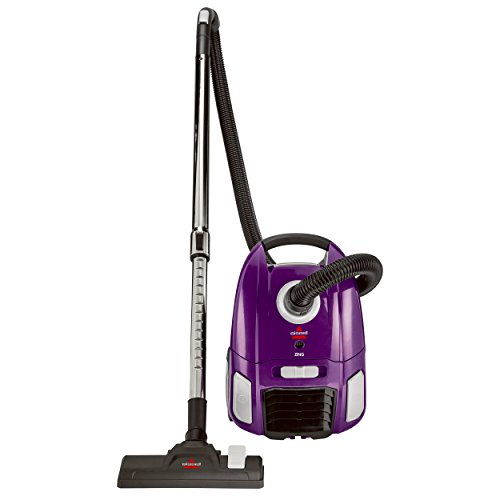
Bissell Zing Bagged Canister (2154A) — Best Budget Canister
The Zing’s proposition is that not every home needs a flagship. For a small flat, a mostly-hardwood rental, a second vacuum for one floor, or a first bagged machine on a tight budget, a light canister that trails easily, stores in a broom cupboard, and takes inexpensive bags is a rational purchase — and its bagged design still delivers the sealed-disposal benefit that is this guide’s whole premise.
Set expectations by its class. Suction cleaning suits hard floors and low, light carpet; it is not the tool for deep carpet grit or a heavy pet household, and its build is honest plastic rather than the Kenmore’s or Miele’s engineering. Within its brief — light mixed floors, small spaces, easy carrying between rooms and floors — it is the pick that respects a budget without abandoning the bag.
Strengths
- Lightweight and compact — ideal for flats and second-vacuum duty
- Bagged disposal at the most accessible tier in this guide
- Simple to use, store, and carry between floors
Trade-offs
- Suction class only: not for deep carpet or heavy pet loads
- Basic build and filtration versus the premium canisters
- Smaller bags fill faster in larger homes
Key specs
- Type: bagged canister, lightweight (per Amazon listing title)
- Model 2154A per the listing title
- Suction floor head for hard floors and light carpet
Buy it for the small, hard-floor-led home, the student flat that wants a real vacuum, or as the upstairs machine in a house whose main vacuum lives below. It is the wrong buy as the sole vacuum for a large carpeted family home — the Kenmore 600 and the uprights exist at the other end of this guide for exactly that household, and stretching a budget canister across that brief helps nobody.
Best for: small homes, rentals, and second-vacuum duty on light floors / Not suited for: large carpeted homes and heavy pet households
Check the current price on Amazon
Comparison Table
| Pick | Badge | Key spec | Best for |
|---|---|---|---|
| Simplicity Vacuums S20EZM Allergy Bagged Upright | Best Overall | Bagged upright, certified HEPA, multi-surface carpet/hardwood | mixed-floor homes wanting one HEPA bagged upright for everything |
| Kenmore Intuition Bagged Upright (BU4022) | Best for Pet Hair on Both Floors | Bagged upright, 2-motor, lift-up, HEPA, powered pet tool | pet homes with mixed floors and stairs or upholstery to clean |
| Oreck Commercial XL Bagged Upright | Best Lightweight Upright | Bagged upright, lightweight commercial build, auto height adjust | weight-sensitive users, multi-floor homes, and second-vacuum duty |
| Kenmore 600 Series Bagged Canister (BC4039) | Best Canister for Mixed Floors | Bagged canister, motorised head, hair-eliminator brushroll, HEPA | mixed-floor family homes with pets and stairs |
| Miele Classic C1 Pure Suction | Best for Hardwood-Dominant Homes | Bagged canister, pure suction, hard floors + low-pile carpet | hardwood-dominant homes with low-pile rugs and carpet |
| Bissell Zing Bagged Canister (2154A) | Best Budget Canister | Bagged canister, lightweight budget class, suction head | small homes, rentals, and second-vacuum duty on light floors |
Why Bags Came Back: The Sealed-System Argument
Bagless won the 2000s on a true claim — no bags to buy — and lost ground on three experiences every owner recognises: the dust cloud at emptying, the filter washing, and the slow fade of suction as fine dust coats every internal surface. A modern bagged machine inverts all three. The bag is the filter’s first and largest stage, so suction stays consistent until the bag is genuinely full; emptying is a sealed swap; and for allergy households, the dirt’s exit from the house happens inside a closed bag rather than in a bin you shake over a bin.
The honest cost is a consumable: bags, bought forever, in the specific type your machine takes. That is why bag availability is a buying criterion in this guide — every pick here uses a bag type that is mainstream, stocked by the brand and by third parties, and unlikely to orphan the machine. A vacuum is a ten-year appliance; its bag supply should be boringly secure.
Upright or Canister for a Mixed-Floor Home?
Count your floors by area and by difficulty. Carpet-majority homes with few stairs: an upright, because the brush roll lives where the work is and storage is a closet corner. Hardwood-majority homes, homes with lots of furniture to go under, and homes with a real staircase: a canister, because the head goes where uprights cannot and the body parks on the stairs. Genuinely split homes should weight the staircase and the furniture honestly — they, not the floor ratio, are what make upright owners borrow a neighbour’s canister.
There is also a body question. Uprights push weight through your arm on every pass; canisters ask you to pull a trailing body and manage a hose. People with shoulder trouble often prefer the canister’s light wand; people with back trouble often prefer not bending to a canister’s controls. Neither is universally kinder — match the machine to the body that will push it for a decade.
Brush Rolls and Hardwood: Agitation Without Scatter or Scratches
On carpet, the brush roll is non-negotiable: suction alone skims the surface while grit migrates to the carpet backing, where it saws fibres from below. On hardwood, that same brush becomes a liability — it can flick grit ahead of the head and, with worn or hard bristles, mark soft finishes. The solutions in this guide are the three legitimate ones: brush-roll shutoff or height adjustment on the uprights, a suction-only combination head on the Miele and Zing, and a motorised head with suction control on the Kenmore canister.
What to avoid is the fourth, illegitimate pattern: a carpet upright with a fixed, always-on aggressive brush marketed as ‘multi-surface’ on the strength of suction alone. If a listing cannot tell you what changes when the machine meets hardwood, nothing changes — and your floors will learn that before you do.
- Carpet: brush roll on, full agitation, slow passes let it dig
- Hardwood: brush off, retracted, or a suction/parquet head
- Rugs: medium setting — enough agitation, not enough to eat fringes
- Edges: slow the head along baseboards where grit collects
- Test any new machine’s hard-floor behaviour in a corner first
Filtration, HEPA, and What ‘Sealed System’ Should Mean
HEPA on a specification sheet can describe the exhaust filter alone or the whole system’s leakage, and the difference is the product. A bagged machine starts ahead: the bag itself is a large, fine filter, and a well-sealed body with a HEPA exhaust stage — the Simplicity and both Kenmores in this guide — keeps the fine fraction from bypassing around gaskets and seams. Allergy households should read for ‘sealed’ language and certified claims, and should treat bag changes as part of the system: a torn or badly seated bag quietly converts a sealed machine into a dust pump.
For non-allergy homes, filtration still matters over years: fine dust that escapes settles on every surface you just cleaned, which is why bagged homes often report the house staying cleaner between cleans. It is a modest, compounding benefit — like the bag itself, unglamorous and real.
Bags, Belts, and Running Costs: Owning a Bagged Machine Well
Budget bags as you would any consumable: a typical home changes a bag every month or two, pet homes faster, and the correct habit is to change on fullness and suction feel, not on a calendar. Buy bags in the multi-packs, keep two spares in the vacuum’s closet, and never run a machine on an overfull bag — suction, filtration, and motor cooling all degrade together, and the motor is the expensive part.
Upright brush rolls wear belts; canister heads wear brushes. Both are cheap, user-level parts on every pick in this guide, and both are why dealer and mainstream brands dominate this list: a ten-year machine with available parts beats a sealed novelty at any headline price. Once a year, check the brush roll for wrapped hair and worn bristles, confirm the bag housing seal is clean, and your vacuum will repay the ten minutes with a decade of consistency.
Pile Height: The Specification That Decides Carpet Success
Low pile — most modern carpet, Berber, and commercial styles — suits every pick here. Medium pile suits the uprights and the motorised Kenmore canister, worked slowly. Deep plush and shag defeat suction-only heads entirely and challenge even good uprights; if shag is your floor, your vacuum is a specialist purchase beyond this guide’s mixed-floor brief, and no honest all-rounder should pretend otherwise.
Height adjustment is the mechanism that mediates pile: too low and the head seals to the carpet and strains; too high and agitation skims. Automatic adjustment, as on the Oreck, handles the common range gracefully; manual settings reward thirty seconds of attention per room. The test is sound and feel — the machine should pull itself gently forward on carpet, not fight you or float.
Stairs, Furniture, and Above-Floor Cleaning: The Forgotten Half
Half the dirt in a mixed-floor home is not on the floor. It is on the stairs, the sofa arms, the car seats, and the tops of the baseboards, and a vacuum chosen purely as a floor machine fails that half silently. This is where the formats diverge in daily life: a canister’s hose and wand are a complete above-floor system by design; a lift-up upright converts for the same work; a basic upright needs its tool set — which is why the Oreck’s absence of onboard tools is scored as a real trade-off rather than a footnote.
Stairs deserve their own sentence in every vacuum decision, because they are the surface where format, weight, and balance all collide. If your home has a full staircase on the weekly route, let it vote: canister first, lift-up second, full upright a reluctant third. A home without stairs can ignore this entire section and choose on floors alone — which is most of what the rest of this guide is for.
How Long Should a Bagged Vacuum Last — and What Kills Them Early
A well-bought bagged vacuum is a ten-to-fifteen-year appliance; the picks in this guide come from brands whose parts ecosystems assume that horizon. What kills them early is rarely the motor. It is the overfull bag run for months, starving cooling and coating everything in fine dust; the brush roll never cleared, straining its belt or bearing; and the small collision damage — a canister body dragged down stairs by its hose, an upright stored falling in a cupboard — that accumulates in machines treated as disposable.
The ownership pattern that reaches fifteen years is dull: bags changed on time, brush roll checked yearly, filters replaced on the maker’s rhythm, and the machine stored dry and upright. None of it requires skill. All of it is why the considered end of this market — dealer brands, mainstream bag types, serviceable designs — keeps outliving the novelty end, and why this guide is deliberately conservative in its picks.
Noise, Weight, and the Will to Vacuum: The Human Specifications
The best vacuum is the one that gets used, and usage is decided by friction: how heavy it feels at the cupboard, how loud it is at the hour you clean, how annoying its cord and hose are in your actual rooms. Canisters generally run quieter at the ear because the motor trails behind you; uprights concentrate the noise at your feet and hands. Neither is silent, and a household with a sleeping baby or a night-shift sleeper should weight this honestly — a slightly less powerful machine used at the right hours beats a flagship avoided for its roar.
Weight distributes differently by format, which the headline number hides. An upright’s weight is in your pushing arm all clean long. A canister’s weight mostly sits on the floor; your hand carries only the wand and head, which is why canister users describe long cleans as less tiring even when the total machine is heavier. Judge by the format’s working weight, not the box weight, and by your own body’s preferences — you are the other half of this machine’s specification.
How to Vacuum a Mixed-Floor Home in the Right Order
Technique is worth more than horsepower in a mixed-floor home. This is the order and method that gets carpet genuinely clean and hardwood genuinely unscratched, with any pick in this guide.
- Start with the rooms furthest from storage and work back; do above-floor dusting first so fallout lands before you vacuum, not after.
- Carpet rooms first, brush roll on: slow, overlapping passes — forward at walking pace is too fast for agitation to work.
- Cross-hatch high-traffic carpet areas with a second pass at ninety degrees; grit releases from both directions.
- Switch for hardwood: brush off or suction head on, and slow down at baseboards where debris collects.
- Use the hose and tools for edges, stairs, and under furniture rather than forcing the floor head where it does not fit.
- Check the bag indicator or feel after large cleans; a bag changed on time keeps the next clean at full power.
- Finish with the entry mats — they hold the grit that would otherwise migrate to every other floor in the house.
Followed weekly, that routine is why bagged homes stay ahead of their dirt: the carpet never accumulates the deep grit load that makes cleaning a project, and the hardwood never accumulates the scratchy film that dulls it. The machine matters; the rhythm matters more.
Common Buying Mistakes
Running the carpet brush across hardwood. An always-on brush roll scatters debris ahead of the head and can mark soft finishes. Use the shutoff, the height, or the suction head your machine provides — every pick in this guide has a legitimate hardwood mode; use it.
Vacuuming carpet at a walking pace. Agitation needs time: the brush must beat grit loose and the suction must lift it. Fast passes skim the surface and leave the backing load to grow. Slow, overlapping passes are the difference between a clean carpet and a vacuumed-looking one.
Letting the bag overfill. An overfull bag strangles suction, leaks filtration, and cooks the motor’s cooling air. Change on fullness — the bag is the cheapest part of the machine and the one everything else depends on.
Buying suction-only for real carpet. Pure-suction canisters are superb on hard floors and low pile, and genuinely inadequate on medium carpet. Match the head to your pile honestly — the Miele in this guide states its limits in its name; believe it.
Ignoring bag-type availability. A machine is only as good as its bag supply. Every pick here uses a mainstream, well-stocked bag type; before buying anything outside this list, confirm the bags exist, in multi-packs, from more than one seller.
Forcing the floor head under furniture. Jamming a tall upright head under a low sofa cleans nothing and scars both objects. Canister heads and lift-up modes exist for this zone; upright owners should use the hose tools and accept the extra minute.
Final Recommendation
Most mixed-floor homes should start with the Simplicity S20EZM: sealed HEPA bagged cleaning, honest multi-surface design, and a serviceable brand behind it. Pet homes step to the Kenmore Intuition upright or, with stairs in play, the Kenmore 600 canister — the guide’s most complete mixed-floor package. Weight-sensitive and multi-floor homes take the Oreck; hardwood-dominant homes take the Miele C1; small homes and second-vacuum shoppers take the Zing without a qualm.
Whichever you choose, keep bags on the shelf and passes slow. A bagged vacuum rewards exactly two habits, and repays them with a decade of suction that feels like the first month.
Keep exploring this cluster: Best Bagged Vacuums For Allergies Best All Around Vacuums Best 12 Amp Self Propelled Vacuums Best Carpet For Under Desk Chairs Best Bags For Blankets Best Bagged Vacuums For Carpet And Hardwood
Frequently Asked Questions
Are bagged vacuums really better for allergies?
For most allergy households, yes — the mechanism is disposal. A sealed bag removes the collected dust, dander, and pollen from the house in a closed container, instead of releasing a fraction back into the air at bin-emptying time. Combined with HEPA exhaust filtration and a sealed body, as on the top picks here, a bagged machine is the lowest-exposure way to vacuum a home.
How often do vacuum bags need changing?
On fullness, not on schedule: typically every one to two months in an average home, faster with pets or after a renovation clean. Signs are a full-bag indicator, a drop in suction, or a musty smell at the exhaust. Keep spares in stock — running on an overfull bag is the fastest way to age an otherwise durable machine.
Can one vacuum really do both carpet and hardwood well?
Yes, if it has the right transitions: a brush roll that agitates carpet and switches off, retracts, or swaps for hardwood, plus suction control. Every pick in this guide was chosen on that criterion. The machines that fail the brief are carpet specialists with no hardwood mode and suction-only cleaners asked to deep-clean pile — both are fine products in the wrong house.
Do bagged vacuums lose suction as the bag fills?
Far less than bagless machines lose to filter loading, which is the bagged system’s core advantage: the bag’s large surface keeps airflow steady until it is genuinely full. You will notice a drop only near the end of a bag’s life — which is the signal to change it, restoring full performance in thirty seconds.
Upright or canister — which is better for stairs?
A canister, and it is not close: the body parks on a step (the Kenmore 600 is designed to grip one) while the light head and hose do the work. Lift-up uprights like the Kenmore Intuition are the respectable compromise. A full-size upright carried step by step is how vacuums, and occasionally people, get dropped.
What does HEPA actually do in a vacuum?
A HEPA stage captures the fine particle fraction — pollen, dander fragments, fine dust — that coarser filtration passes back into the room. Its value depends on the system around it: in a sealed bagged machine it is the final stage of a closed path, which is why this guide pairs HEPA with bags rather than treating the filter as a standalone badge.
Should I keep a second, smaller vacuum as well?
In multi-floor homes, often yes — and this guide contains the two natural candidates: the Oreck upright that lives upstairs, or the Zing canister for one floor’s quick cleans. A second vacuum is not indulgence when the alternative is a heavyweight carried on stairs weekly; it is how the main machine survives a decade and the house stays clean on both floors. Buy the second machine for the floor it will live on, not as a clone of the first.
Are vacuum bags expensive to keep buying?
They are a real but modest consumable — the trade the category makes openly. Multi-packs bring the per-bag cost down, and the counterfactual is not free either: bagless machines consume filters, time, and suction consistency. For most households the bag budget is the price of a coffee or two per change, a few times a year.
How do I know when a bagged vacuum is at the end of its life?
When repairs stop being parts and start being systems: a motor that smells hot and loses power, a body cracked at its stress points, or a bag type discontinued with no third-party supply. Until then, belts, brush rolls, filters, and hoses are all consumables on the picks in this guide, and replacing them is maintenance, not decline. A bagged machine that has been fed bags on time usually announces its old age politely, over years.
Can a bagged vacuum handle pet hair without clogging?
Yes — hair is where bags shine, because the bag’s volume swallows hair without the bin-packing and filter-blinding that plague bagless machines in pet homes. The work is at the brush roll, which is why the pet picks here add hair-shedding brushroll designs and powered hand tools for the hair that lands on furniture and stairs.

